brake SAAB 9-5 2007 Workshop Manual
[x] Cancel search | Manufacturer: SAAB, Model Year: 2007, Model line: 9-5, Model: SAAB 9-5 2007Pages: 288, PDF Size: 18.14 MB
Page 238 of 288
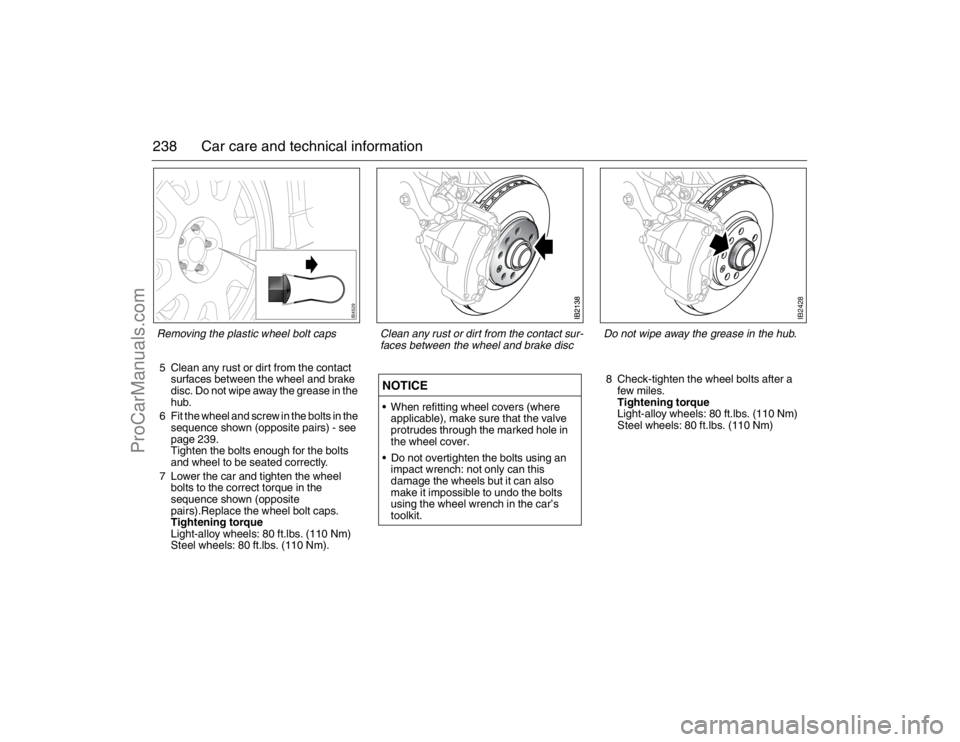
238 Car care and technical information5 Clean any rust or dirt from the contact
surfaces between the wheel and brake
disc. Do not wipe away the grease in the
hub.
6 Fit the wheel and screw in the bolts in the
sequence shown (opposite pairs) - see
page 239.
Tighten the bolts enough for the bolts
and wheel to be seated correctly.
7 Lower the car and tighten the wheel
bolts to the correct torque in the
sequence shown (opposite
pairs).Replace the wheel bolt caps.
Tightening torque
Light-alloy wheels: 80 ft.lbs. (110 Nm)
Steel wheels: 80 ft.lbs. (110 Nm).
8 Check-tighten the wheel bolts after a
few miles.
Tightening torque
Light-alloy wheels: 80 ft.lbs. (110 Nm)
Steel wheels: 80 ft.lbs. (110 Nm)
NOTICE When refitting wheel covers (where
applicable), make sure that the valve
protrudes through the marked hole in
the wheel cover.
Do not overtighten the bolts using an
impact wrench: not only can this
damage the wheels but it can also
make it impossible to undo the bolts
using the wheel wrench in the car’s
toolkit. Clean any rust or dirt from the contact sur-
faces between the wheel and brake disc
IB2428
Do not wipe away the grease in the hub.
IB4529
Removing the plastic wheel bolt caps95_U S _M 07.book Page 238 Friday, June 9, 2006 8:58 AM
ProCarManuals.com
Page 241 of 288

241 Car care and technical information
Washing the carWash your car frequently. To facilitate
cleaning, a suitable detergent can be added
to the water, which should be lukewarm.
Saab offers a full line of car care products,
including car wash, for the care of your vehi-
cle. See your dealer for available products
or visit www.saabcatalog.com (U.S. resi-
dents only).
Do not use a pressure washer at close
range on stone chip damage, scratches or
other damage to the paintwork. The paint
can otherwise start to flake.
Remove any bird droppings without delay,
as these can discolor the paintwork and
prove difficult to polish out.
Use a soft cloth moistened with methyl alco-
hol to remove splashes of tar or asphalt. Do
not use strong cleaners, as these can dry
out the paintwork.
The underside of the car also needs wash-
ing regularly, and this should be done extra
thoroughly at the end of winter. Clean the
underside of the car by hand if the car is usu-
ally washed in an automatic car wash with-
out special facilities for underbody cleaning.
Never wash or leave the car to dry in the
sun, but wipe it dry with a chamois leather
immediately after washing to avoid smears
and streaks.
Clean the window glass inside and out using
a high quality window cleaner. This is partic-
ularly important when the car is new, as
upholstery and trim have a tendency to
sweat a little at first.
Keep the glass well cleaned, as this helps to
prevent misting.
NOTICEAvoid using any alcohol-based cleaners
on the front and rear light clusters, as
these can cause cracking of the lenses.
NOTICE The door mirrors must be fully
retracted before the car enters an
automatic car wash.
Remove fixed antennas, e.g. for
mobile phone, before putting car
through an automatic car wash.
Try your brakes on leaving a car wash.
Wet brake discs may reduce the per-
formance of the brakes.
Cars with Saab Parking Assistance:
Do not spray the sensors or closer
than 8 in. (20 cm) to the sensors with
a pressure washer, as this can
damage them.
95_U S _M 07.book Page 241 Friday, June 9, 2006 8:58 AM
ProCarManuals.com
Page 246 of 288

246 Car care and technical information2Clean the underside of the car during
the winter. Use high pressure water to
clean the car’s underside (floor panels,
wheel wells) at least at mid- winter and
in the spring.
3Inspect the car frequently for leaks or
damage, and arrange for needed
repairs promptly. After washing or after
heavy rain, check for leaks. When wash-
ing the car inspect body surfaces for
paint damage. While checking for leaks,
lift the floor mats and check beneath
them. Water can collect in these areas
and remain for prolonged periods. Dry
any wet areas including the floor mats.
Have leaks repaired as soon as possi-
ble.
Use touch-up paint to repair small
scratches or minor finish damage. Areas
where metal is exposed will rust quickly
and MUST be repaired immediately by
touch-up or professional repainting.
Rust must be removed, the bare metal
primed and painted. Major body
damage should be repaired immediately
and new panels or exposed areas
should be undercoated with anti- corro-
sion material.
Repairs of this type are the owner’s
responsibility and are not covered under
warranty.4Inspect the undercoating and touch
up if necessary. Pay particular atten-
tion to the fenders and wheel housings,
which are exposed to abrasion by flying
gravel, etc. If the composition has worn
or flaked off, the steel must be thor-
oughly cleaned and dried before a fresh
coat is applied. The cleaning is best
done with a scraper and a steel wire
brush, followed by washing with solvent.
Apply the new coating thinly, as other-
wise it may run off or fall off when dry.
For long tripsBefore setting off on a long journey, it is
advisable to have your car checked over by
your Saab dealer.
Obtain a few important items to take along
on your journey such as spare bulbs, wiper
blades, fuses, a Poly-V-belt and the like.
You can check some points yourself before-
hand:
Make sure that the engine is in good con-
dition.
Check that no oil or gasoline leaks out of
the engine or gearbox/transmission.
Check the coolant and power steering
fluid levels. Check also for leaks.
Inspect the Poly-V-belt and replace it if it
shows any signs of hard wear.
Check the battery charge.
Check the tires for tread pattern and air
pressure, including the compact spare
wheel.
Check the brakes.
Check all bulbs.
Check for the presence of the tool kit and
the jack in the car.
95_U S _M 07.book Page 246 Friday, June 9, 2006 8:58 AM
ProCarManuals.com
Page 253 of 288

253 Customer Assistance and Information
Service record retentionIt is the owner´s responsibility to retain ser-
vice records. If possible, you should keep
copies of all shop work orders for all service
and repairs, whenever performed. As indi-
cated in the new car and emission control
system warranties, it is important to docu-
ment that all necessary maintenance has
been done.HOW THE SERVICE RECORD IS
ORGANIZEDThe service record is comprised of a series
of coupons on which to record services as
they are performed. There are additional
coupons for documenting extra engine oil
and filter changes, extra automatic trans-
mission fluid services necessary for severe
service conditions, and brake fluid changes.HOW TO USE THE SERVICE
RECORD COUPONSWhen the car is brought to a Saab dealer for
scheduled maintenance, present the Saab
Warranty and Service Record Booklet to the
service manager. When the technician has
completed the service, the technician will
sign the maintenance record. The person
responsible for quality assurance at the
dealership will also sign and stamp the
record with the dealer identification stamp.
Service costsDealer pricing practices and labor for ser-
vice work vary. Saab’s recommended ser-
vice times for each service point do not
include the labor required to replace wear
items, such as wiper blades, brake pads or
tires. Nor is labor to perform other service or
repairs found to be necessary as a result of
the inspections included in these times.
Additional labor and parts will be charged
for such work when necessary, except as
covered under an applicable Saab warranty
or any optional extended service contract.
Transmission fluid changes or suspension
alignment, when necessary, are also addi-
tional.
Dealer charges for general shop material,
regulated hazardous waste removal, recy-
cling expenses or other operation costs may
also be applied to service and repair
invoices and are apt to vary by dealer and
location.
Owner assistanceWarranties and service problem
assistanceFor complete information about all applica-
ble warranties, including the New Car War-
ranty, Perforation Warranty, Vehicle Emis-
sion Warranty and Emission Perforation
Warranty, consult the Warranties and Ser-
vice Record Booklet which accompanies
this Owner’s Manual. It also contains owner
assistance information including Saab
Roadside Assistance. If the booklet is lost or
misplaced, a new one may be ordered
through a Saab dealer or by contacting
Saab.
In the U.S. there is a national Customer
Assistance Center at Saab Automobile
USA, Inc. The toll-free number to call from
all 50 states is 1-800-955-9007.
In Canada, please call the Saab Customer
Assistance Center at 1-800-263-1999.
A list of authorized Saab sales and service
dealers is available for those planning to
travel in the United States and Canada.
Canadian or U.S. travelers may call the
Customer Assistance Center in the country
in which they are traveling.
95_U S _M 07.book Page 253 Friday, June 9, 2006 8:58 AM
ProCarManuals.com
Page 255 of 288

255 Customer Assistance and Information
Vehicle Data Collection and
Event Data RecordersYour vehicle, like other modern motor vehi-
cles, has a number of sophisticated com-
puter systems that monitor and control sev-
eral aspects of the vehicle’s performance.
Your vehicle uses on-board vehicle comput-
ers to monitor emission control components
to optimize fuel economy, to monitor condi-
tions for air bag deployment and, if so
equipped, to provide anti-lock braking and
to help the driver control the vehicle in diffi-
cult driving situations. Some information
may be stored during regular operations to
facilitate repair of detected malfunctions;
other information is stored only in a crash
event by computer systems commonly
called event data recorders (EDR).
In a crash event, computer systems, such
as the Air Bag Sensing and Diagnostic
Module (SDM) in your vehicle may record
information about the condition of the vehi-
cle and how it was operated, such as data
related to engine speed, brake application,
throttle position, vehicle speed, steering
wheel angle, lateral acceleration, safety belt
usage, air bag readiness, air bag perfor-
mance, and the severity of a collision. This
information has been used to improve vehi-
cle crash performance and may be used to
improve crash performance of future vehi-
cles and driving safety. Unlike the data
recorders on many airplanes, these
on-board systems do not record sounds,
such as conversation of vehicle occupants.To read this information, special equipment
is needed and access to the vehicle or the
SDM is required.
Saab will not access information about a
crash event or share it with others other than
with the consent of the vehicle owner or, if
the vehicle is leased, with the consent of
the lessee,
in response to an official request of police
or similar government office,
as part of Saab’s defense of litigation
through the discovery process, or
as required by law.
In addition, once Saab collects or receives
data, Saab may
use the data for Saab research needs,
make it available for research where
appropriate confidentiality is to be main-
tained and need is shown, or
share summary data which is not tied to a
specific vehicle with non-Saab organiza-
tions for research purposes.
Others, such as law enforcement, may have
access to the special equipment that can
read the information if they have access to
the vehicle or SDM.
If your vehicle is equipped with OnStar®,
please check the OnStar® subscription ser-
vice agreement or manual for information
on its operations and data collection.95_U S _M 07.book Page 255 Friday, June 9, 2006 8:58 AM
ProCarManuals.com
Page 257 of 288
257 Specifications
General______________ 258
Engine ______________ 260
Fuel_________________ 260
Engine oil ____________ 261
Engine variants _______ 262
Electrical system______ 263
Drive belts ___________ 263
Manual gearbox_______ 264
Automatic transmission 264
Suspension __________ 265
Steering _____________ 265
Brake system_________ 265
Wheels and tires ______ 266
Plates and labels ______ 268
IB3918
Specifications
3 Asterisk means: equipment not fitted in all cars
(can depend on model variant, engine variant,
market specification, options or accessories).95_U S _M 07.book Page 257 Friday, June 9, 2006 8:58 AM
ProCarManuals.com
Page 259 of 288

259 Specifications
Trailer:
Luggage compartment
Volume (SAE):
9-5 Sedan _______________________ 15.9 cu.ft.
(450 litres)
9-5 SportCombi, rear seat upright ____ 31.4 cu. ft.
(890 litres)
9-5 SportCombi, rear seat folded _____ 73.0 cu. ft.
(2067 litres)
Luggage compartment, length, 9-5 Sedan:
Rear seat upright _________________ 43.0 in (1092 mm)
Rear seat folded down _____________ 67.5 in (1714 mm)
Luggage compartment, length,
9-5 SportCombi:
Rear seat upright _________________ 42.8 in (1087 mm)
Rear seat folded __________________ 68.2 in (1732 mm)
WARNING
The GVW and maximum axle loads must not be exceeded.
Note that if some accessories (e.g. towbar, CD changer) are
fitted, the available load capacity is reduced by the weight of
these.
When carrying a load in the luggage compartment, make sure
that it is tied down securely, particularly when part or all of the
rear seat is folded down.
Maximum towing speed:
Trailer with brakes _________________ 60 mph (100 km/h)
Trailer without brakes _______________ Local restrictions
apply
Maximum weight:
Trailer with brakes _________________ 3500 lbs (1588 kg)
Trailer without brakes ______________ 1000 lbs (450 kg)
Maximum load on ball hitch __________ 110–165 lbs
(50–75 kg)
The above speed and weight restrictions are those specified by
Saab Automobile AB.
Note that local restrictions may apply to trailer speeds and weights
(see page 174).
95_U S _M 07.book Page 259 Friday, June 9, 2006 8:58 AM
ProCarManuals.com
Page 264 of 288

264 SpecificationsManual gearbox Automatic transmission Type ____________________________ All-synchromesh
5-speed with final
drive and differen-
tial
Oil ______________________________ Saab MTF 0063
Oil capacity _______________________ 1.9 qts (1.8 litres)
Oil volume (on changing) ____________ 1.6 qts (1.5 litres)
Clutch type _______________________ Hydraulic, single
dry-plate clutch of
diaphragm-spring
type
Speed (mph / km/h) at 1000 rpm in 5th gear: 27–29 / 43–47Type _____________________________ Electronically con-
trolled 5-speed,
fully automatic with
hydraulic torque
converter, plane-
tary gear set and
integral final drive
Lock-up function in
selector positions 3,
4 and 5.
Selector-lever positions ______________ P R N D M L
Clutch type ________________________ Hydraulic plate
clutches, brake
bands and one-way
couplings
Speed (mph / km/h) at 1000 rpm in 5th gear: 29–30 / 46–4895_U S _M 07.book Page 264 Friday, June 9, 2006 8:58 AM
ProCarManuals.com
Page 265 of 288

265 Specifications
Suspension
Steering Brake system Spring type, front and rear ___________ Coil springs
Maximum deflection of springs:
Front __________________________ 7.09 in (180 mm)
Rear ___________________________ 7.87 in (200 mm)
Dampers:
Front __________________________ Gas-filled
Rear ___________________________ Oil and gas filled
Steering _________________________ Power-assisted
steering of
rack-and-pinion
type; telescopic
steering-column
shaft with universal
joints
Number of turns, lock to lock __________ 2.9
Power-steering fluid ________________ Power-steering fluid
CHF 11S or
CHF 202Footbrake (ABS) ____________________ Hydraulic, dual-
circuit brake sys-
tem. Diagonally
split circuit with vac-
uum servo unit.
Disc brakes front
and rear. EBD, see
page 160.
Parkingbrake _______________________ Acts on rear wheels
Brake fluid _________________________ DOT 4
Brake-fluid capacity _________________ 0.951 qts (900 ml)
Disc diameter:
Front, ventilated ___________________ 12.05 in (308 mm)
Rear, solid _______________________ 11.26 in (286 mm)
Total friction area of brake pads:
Front ___________________________ 36.3 in
2 (234 cm
2)
Rear ___________________________ 15.5 in
2 (100 cm
2)
95_U S _M 07.book Page 265 Friday, June 9, 2006 8:58 AM
ProCarManuals.com
Page 271 of 288

271 Index
Index
AA/C system, fault diagnosis
_______ 244
A/C system, maintenance
_________ 243
ABS brakes
____________________ 160
ACC
__________________________ 79
ACC functions
___________________ 82
ACC, automatic climate control
_____ 79
ACC, calibration
_________________ 86
ACC, condensation water
__________ 86
ACC, useful tips
_________________ 86
AUX input
_____________________ 104
Adjusting the steering wheel
_______ 114
Adjustment, seats
________________ 18
Air conditioning (A/C), fault diagnosis
and maintenance ______________ 243
Airbag
_________________________ 29
Alarm _________________________ 50
Alarm functions
__________________ 53
Alarm signals
________________ 50
, 53
Album information
_______________ 104
Alternator
_____________________ 201
Alternator drive belt
__________ 201
, 263
Alternator rating
________________ 263
Antennas
______________________ 109
Anticorrosion treatment
___________ 245
Antidazzle rear-view mirror
________ 121
Anti-skid
______________________ 163
Autochecking of lights on starting
____ 64Auto-dimming rear-view mirror with
garage door opener
____________ 118
Automatic climate control (ACC)
_____ 79
Automatic transmission, technical
data
_________________________ 264
Aviod theft, tip
__________________ 166
BBattery
________________________ 199
Battery charging/replacing
________ 200
Battery, boost starting
____________ 186
Before a long journey ____________ 246
Before towing a camper or trailer
___ 177
Belt guide
______________________ 12
Boost starting using jump leads
____ 186
Brake and clutch fluid
____________ 196
Brake-fluid reservoir
_____________ 196
Brakes, technical data ____________ 265
Bulbs, changing
________________ 204
Bulbs, table of
__________________ 215
Buying new tires ________________ 225
CCD changer
____________________ 100
CHECK messages
_______________ 71
CHECKING
_____________________ 71
Car alarm
______________________ 50
Car care
______________________ 189
Cargo net, 9-5 SportCombi
________ 137Carpeting, care of
_______________ 240
Catalytic converter, important
considerations
_________________ 145
Central locking ___________________ 44
Change language in SID
___________ 72
Change of address notification
_____ 254
Changing a wheel
_______________ 236
Changing bulbs
_________________ 204
Changing wiper blades
___________ 202
Charge mobile phone
____________ 126
Charger/Jump starting ____________ 188
Charging the battery/Jump starting
__ 188
Chassis number
________________ 268
Chassis number, key to
___________ 269
Checks before towing a camper or
trailer
________________________ 177
Child safety
_____________________ 22
Child safety locks, rear doors
_______ 47
Cleaning, engine bay
_____________ 242
Clock
_________________________ 105
Color code, body
________________ 268
Color code, trim _________________ 268
Compact spare wheel
____________ 234
Compass
______________________ 122
Condensation water, ACC
__________ 86
Connecting a portable player ______ 104
Coolant
_______________________ 195
Courtesy Headlight Feature
________ 74
Crash memory, see EDR
_________ 255
Cross modulation
_______________ 110
Cruise control
__________________ 159
Cup holder
_____________________ 128
95_U S _M 07.book Page 271 Friday, June 9, 2006 8:58 AM
ProCarManuals.com