warning light SAAB 9-5 2007 Workshop Manual
[x] Cancel search | Manufacturer: SAAB, Model Year: 2007, Model line: 9-5, Model: SAAB 9-5 2007Pages: 288, PDF Size: 18.14 MB
Page 226 of 288

226 Car care and technical informationUniform Tire Quality GradingQuality grades can be found where applica-
ble on the tire sidewall between tread shoul-
der and maximum section width. For exam-
ple:
Treadwear 200 Traction AA
Temperature A
The following information relates to the
system developed by the United States
National Highway Traffic Safety Administra-
tion, which grades tires by treadwear, trac-
tion and temperature performance. (This
applies only to vehicles sold in the United
States.) The grades are molded on the side-
walls of most passenger car tires. The Uni-
form Tire Quality Grading system does not
apply to deep tread, winter-type snow tires,
space-saver or temporary use spare tires,
tires with nominal rim diameters of 10 to 12
inches (25 to 30 cm), or to some limited-pro-
duction tires.
While the tires available on General Motors
passenger cars and light trucks may vary
with respect to these grades, they must also
conform to federal safety requirements and
additional General Motors Tire Perfor-
mance Criteria (TPC) standards.Treadwear
The treadwear grade is a comparative
rating based on the wear rate of the tire
when tested under controlled conditions on
a specified government test course. For
example, a tire graded 150 would wear one
and a half (1.5) times as well on the govern-
ment course as a tire graded 100. The rela-
tive performance of tires depends upon the
actual conditions of their use, however, and
may depart significantly from the norm due
to variations in driving habits, service prac-
tices and differences in road characteristics
and climate.
Traction – AA, A, B, C
The traction grades, from highest to lowest,
are AA, A, B, and C. Those grades repre-
sent the tire’s ability to stop on wet pave-
ment as measured under controlled condi-
tions on specified government test surfaces
of asphalt and concrete. A tire marked C
may have poor traction performance. Warn-
ing: The traction grade assigned to this tire
is based on straight-ahead braking traction
tests, and does not include acceleration,
cornering, hydroplaning, or peak traction
characteristics.Temperature – A, B, C
The temperature grades are A (the highest),
B, and C, representing the tire’s resistance
to the generation of heat and its ability to dis-
sipate heat when tested under controlled
conditions on a specified indoor laboratory
test wheel. Sustained high temperature can
cause the material of the tire to degenerate
and reduce tire life, and excessive temper-
ature can lead to sudden tire failure. The
grade C corresponds to a level of perfor-
mance which all passenger car tires must
meet under the Federal Motor Vehicle
Safety Standard No. 109. Grades B and A
represent higher levels of performance on
the laboratory test wheel than the minimum
required by law.
Warning: The temperature grade for this tire
is established for a tire that is properly
inflated and not overloaded. Excessive
speed, underinflation, or excessive loading,
either separately or in combination, can
cause heat buildup and possible tire failure.95_U S _M 07.book Page 226 Friday, June 9, 2006 8:58 AM
ProCarManuals.com
Page 234 of 288
234 Car care and technical informationTire date codeTires should be regarded as perishable
goods. As the tires age, the rubber becomes
progressively harder, and the roadholding
ability of the tires diminishes. This is partic-
ularly true on winter tires.
Tires now have a date-code marking for the
year of manufacture. The first two digits
denote the week number and the two last
digits the year followed by a filled triangle.
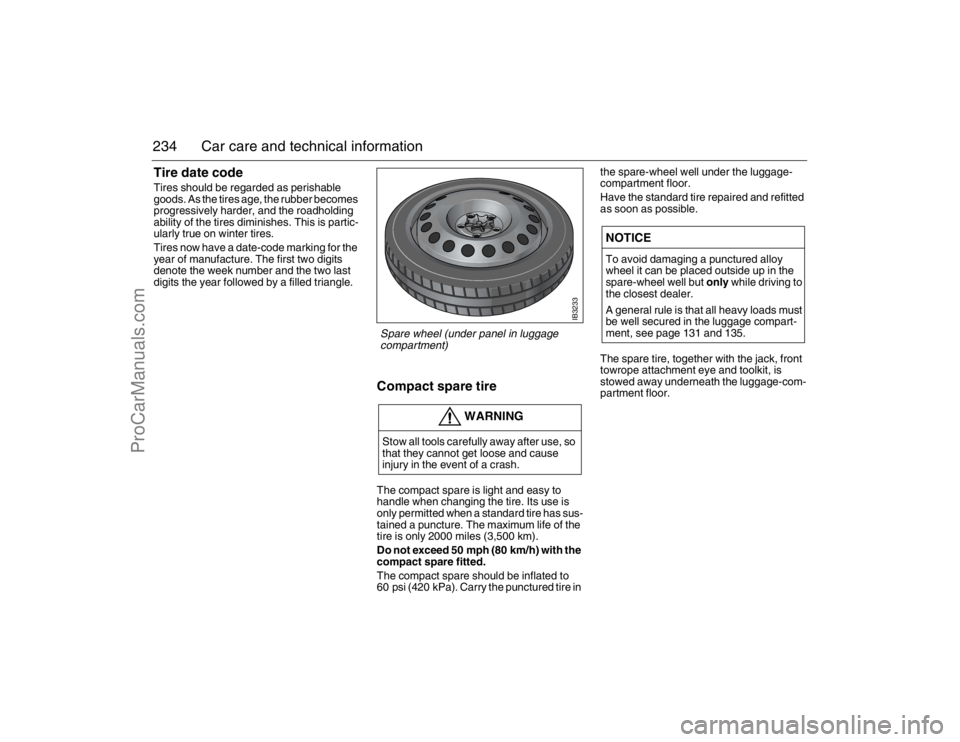
Compact spare tireThe compact spare is light and easy to
handle when changing the tire. Its use is
only permitted when a standard tire has sus-
tained a puncture. The maximum life of the
tire is only 2000 miles (3,500 km).
Do not exceed 50 mph (80 km/h) with the
compact spare fitted.
The compact spare should be inflated to
60 psi (420 kPa). Carry the punctured tire in the spare-wheel well under the luggage-
compartment floor.
Have the standard tire repaired and refitted
as soon as possible.
The spare tire, together with the jack, front
towrope attachment eye and toolkit, is
stowed away underneath the luggage-com-
partment floor.
WARNING
Stow all tools carefully away after use, so
that they cannot get loose and cause
injury in the event of a crash.
NOTICETo avoid damaging a punctured alloy
wheel it can be placed outside up in the
spare-wheel well but only while driving to
the closest dealer.
A general rule is that all heavy loads must
be well secured in the luggage compart-
ment, see page 131 and 135.
IB3233
Spare wheel (under panel in luggage
compartment)
95_U S _M 07.book Page 234 Friday, June 9, 2006 8:58 AM
ProCarManuals.com
Page 235 of 288

235 Car care and technical information
Driving considerations with
compact spare wheel/tire fitted
The following should be observed when the
compact spare wheel (T115/70 R16) is
fitted:
The compact spare is light and easy to
handle when changing the wheel.
Do not drive further than necessary with
the compact spare fitted – the maximum
life of the wheel is only just over
2000 miles (3,500 km).
Refit the standard tire as soon as possi-
ble.
Important considerations when driving with
a compact spare tire:
The car’s ground clearance is reduced.
The car must not be driven with more than
one compact tire at a time.
Avoid driving against a curb.
Do not use snow chains.
Do not fit the wheel cover - this would con-
ceal the warning text.
WARNING
Do not exceed 50 mph (80 km/h) as
the tire can overheat and adversely
affect the handling of the car.
Tire pressure: refer to page 267.
The spare wheel or punctured tire
must be stowed under the trunk floor,
and secured in place with the retaining
nut.
IB3234
Hanging up the cover, 9-5 SportCombi
95_U S _M 07.book Page 235 Friday, June 9, 2006 8:58 AM
ProCarManuals.com
Page 236 of 288

236 Car care and technical informationChanging a wheel
WARNING
Lifting a vehicle and getting under it to do
maintenance or repairs is dangerous
without the appropriate safety equipment
and training. The jack provided with your
vehicle is designed only for changing a
flat tire. If it is used for anything else, you
or others could be badly injured or killed if
the vehicle slips off the jack. Use the jack
provided with your vehicle only for chang-
ing a flat tire.
Changing a tire can be dangerous. The
vehicle can slip off the jack and roll over
or fall on you or other people. You and
they could be badly injured or even killed.
Find a level place to change your tire. To
help prevent the vehicle from moving:
1 Set the parking brake firmly.
2 If you have an automatic transmis-
sion, put the shift lever in PARK (P).
For a manual transmission, leave the
car in gear (1st or REVERSE (R)).
3 Turn off the engine and do not restart
while the vehicle is raised.
4 Do not allow passengers to remain in
the vehicle.
To be even more certain the vehicle won't
move, you should put blocks at the front
and rear of the tire farthest away from the
one being changed. That would be the
tire, on the other side, at the opposite end
of the vehicle.
The car jack is designed solely for use
in changing a wheel or fitting snow
chains. It must not be used to sup-
port the car during repair work or
servicing.
Never crawl under a car that is
supported only by a jack.
Raising your vehicle too high or with
the jack improperly positioned can
damage the vehicle and even make
the vehicle fall. To help avoid personal
injury and vehicle damage, be sure to
fit the jack lift head into the proper
location before raising the vehicle, and
raise the vehicle only far enough off
the ground so there is enough room
for the spare tire to fit (no more than
25 mm or 1 inch clearance between
the ground and the bottom of the tire).
Switch on the hazard warning lights if
the car is on a road.
The jack should be stored correctly
under the carpeting in the trunk. If it
lies loose in the car, it could thrown for-
ward and cause personal injury in the
event of a crash or if the car rolls over.
Grit, salt and rust can clog the inner
threads of the wheel bolts if the car has
been driven for several years exclu-
sively with alloy wheels.
If steel wheels are being installed, the
bolt hole threads in the brake hubs
should be cleaned before the thinner
steel wheels are fitted. It may other-
wise not be possible to achieve the
correct clamping force, despite tight-
ening the wheel bolts to the correct
torque.
95_U S _M 07.book Page 236 Friday, June 9, 2006 8:58 AM
ProCarManuals.com
Page 247 of 288

247 Car care and technical information
Recovery and/or
recycling of automotive
materialsInformation on the scrapping and recycling
of car materials is available on
www.saab.com.
Headlight aimingThe vehicle has a visual optical headlight
aiming system equipped with vertical
aiming device. The aim has been preset at
the factory and should normally not need
further adjustments.
If your headlights are damaged in a crash,
the headlight aim may be affected. If you
believe your headlights need to be
re-aimed, we recommend that you take it to
your Saab dealer for service, however, it is
possible for you to re-aim your headlights as
described in the following procedure.To check the aim, the vehicle should be
properly prepared as follows:
The vehicle shall be placed so that the
headlights are 25 ft (7.6 m) from a light
colored wall or other flat surface. The
aiming area should be darkened, this will
improve your ability to see the beam of the
low beam headlight being aimed.
The vehicle must have all four wheels on
a perfectly level surface which is level all
the way to the wall or other flat surface.
The vehicle should be placed so it is per-
pendicular to the wall or other flat surface.
The vehicle should be unloaded and fuel
tank full, and one person or 160 lbs.
(75 kg) on the drivers seat.
WARNING
Before checking/adjusting the headlight
aiming, switch off the engine to avoid
danger of fingers and hands being injured
by moving parts.
The radiator fan can start up even when
the engine is switched off.NOTICETo make sure that your headlights are
aimed properly read all instructions
before beginning. Failure to follow these
instructions could cause damage to
headlight parts or a not correctly aimed
headlight.
95_U S _M 07.book Page 247 Friday, June 9, 2006 8:58 AM
ProCarManuals.com
Page 272 of 288

272 IndexDDICE/TWICE
___________________ 217
Dampers
______________________ 265
Date
_________________________ 105
Date code, tires
_________________ 234
Date display
___________________ 105
Definitions and terminology, tire
____ 231
Determining correct load, tires
_____ 233
Dim-dipped beam
________________ 73
Direction indicators _______________ 75
Diversity antenna
_______________ 109
Door handles
___________________ 44
Door mirrors
___________________ 116
Doors, locks & luggage compartment
_43
Drive belt
______________________ 263
Drive belt, alternator
_____________ 201
Drive belts, length
_______________ 263
Driver’s seat, programmable
________ 20
Driving at night
_________________ 181
Driving in hot weather
____________ 173
Driving with a load
______________ 181
EEDR (Event Data Recorders)
______ 255
ESP
® _________________________ 163
Electric heating of rear seat
________ 87
Electric windows
________________ 115
Electrical system, technical data
____ 263
Electronic Stability Program
_______ 163
Electronic starting interlock _________ 49Emergency operation of moonroof
__ 124
Emission control systems
_________ 192
Engine bay
____________________ 191
Engine bay, cleaning
_____________ 242
Engine number
_________________ 268
Engine oil, grade ________________ 261
Engine, description ______________ 194
Engine, technical data ____________ 260
Engine, temperature gauge
________ 65
Engine-oil level, checking
_________ 194
Error codes, Audio System ________ 112
Event Data Recorders (EDR) ______ 255
Expansion tank, coolant
__________ 195
FFilling a portable fuel container
_____ 148
Flat spots, tires
_________________ 224
Fluid level, automatic transmission
__ 195
Folding the parcel shelf,
9-5 SportCombi
________________ 133
Folding the rear seat, 9-5 Sedan
___ 129
Folding the rear seat, 9-5 SportCombi
132
Frequency band
_________________ 93
Frequently asked questions on airbag
40
Front fog lights
__________________ 76
Frost warning
___________________ 68
Fuel
__________________________ 146
Fuel consumption
________________ 68
Fuel container
__________________ 148
Fuel gauge
_____________________ 65
Fuel grade _____________________ 260Fuel information
_________________ 148
Fuse box under hood
____________ 220
Fuse panel
_____________________ 216
Fuses
_________________________ 216
GGarage door opener
_____________ 118
Gearbox number
________________ 268
Gearbox oil, checking
____________ 195
Gearbox, technical data, __________ 264
General functions
_______________ 105
Glove compartment ______________ 126
HHandbrake
_____________________ 165
Hazard warning lights
_____________ 76
Head restraint
___________________ 21
Headlight flasher _________________ 73
Headlights
______________________ 73
Heated front seats
________________ 87
Hood
_________________________ 190
Horn __________________________ 114
IIf a tire goes flat
_________________ 228
Ignition switch
__________________ 140
Immobilizer
_____________________ 49
Indicator and warning lights
_________ 58
95_U S _M 07.book Page 272 Friday, June 9, 2006 8:58 AM
ProCarManuals.com
Page 275 of 288

275 Index
Technical data
_________________ 257
Technical data, radio/audio
________ 108
Temperature control, ACC _________ 81
Temperature gauge, engine ________ 65
Temperature zones, ACC
__________ 81
Textile carpeting
________________ 240
Through-load hatch ______________ 131
Tie Downs
_____________________ 131
Tightening torque, wheel studs
_____ 236
Time display
___________________ 105
Tip, driving at night
______________ 181
Tip, to avoid theft
_______________ 166
Tips, ACC
______________________ 86
Tire chains ____________________ 228
Tire date code __________________ 234
Tire inspection and rotation
_______ 223
Tire markings
__________________ 230
Tire pressure ___________________ 182
Tire sidewall labeling
____________ 229
Tire terminology and definitions
____ 231
Tire, compact spare
_____________ 234
Tires
_____________________ 222
, 266
Tires, winter
___________________ 266
Tools
_________________________ 183
Touching-in the paintwork
_________ 242
Towbar attachment
______________ 174
Towbar load
___________________ 178
Towing the car _________________ 183
Towing, automatics
______________ 183
Traffic programme _______________ 99
Trailer weights
_________________ 259
Treadwear indicators
____________ 224Trionic
________________________ 192
Trip computer
___________________ 68
Trip meter
______________________ 64
Trunk
_________________________ 129
Trunk lid, opening
________________ 47
Tuning
_________________________ 93
Turbo gauge
____________________ 66
Turbo, points to note
_____________ 144
UUnder the hood
_________________ 191
Uniform tire quality grading
________ 226
Upholstery and trim
______________ 240
Upholstery and trim, care of
_______ 240
VVanity mirrors
__________________ 125
Vehicle Data Collection
___________ 255
Ventilated front seats
_____________ 87
Viscosity, engine oil
_____________ 260
WWarning labels
___________________ 7
Warning light, AIR BAG
___________ 37
Warning lights
___________________ 58
Washers
______________________ 202
Washers, windshield
_____________ 203
Washing the car
________________ 241Waxing and polishing
____________ 242
Wear indicators, tires _____________ 224
What Will You See After an Airbag
Inflates?
______________________ 38
Wheel replacement
______________ 227
Wheel, change
_________________ 236
Wheels and tires ________________ 266
Wheels and tires, sizes
___________ 266
When it is time for new tires
_______ 224
Windshield washers
______________ 77
Windshield wipers
________________ 77
Winter tires
________________ 233
, 266
Wiper blades, replacing
___________ 202
Wipers and washers
__________ 77
, 202
XXenon headlight
________________ 204
95_U S _M 07.book Page 275 Friday, June 9, 2006 8:58 AM
ProCarManuals.com