DIRECT SAAB 9-5 2008 Owner's Manual
[x] Cancel search | Manufacturer: SAAB, Model Year: 2008, Model line: 9-5, Model: SAAB 9-5 2008Pages: 288, PDF Size: 27.54 MB
Page 161 of 288
161 Starting and driving
ABS brakes
ABS (antilock braking system) modulates
the brake pressure to the respective
wheels. Wheel sensors detect if a wheel is
about to lock, and the control module
reduces the pressure to that wheel and then
increases it once more until the tendency is
detected again.
The brake system is equipped with an Elec-
tronic Brake-force Distribution device
(EBD), which distributes the brake pressure
between the front and rear wheels, in such
a way as to achieve optimum braking perfor-
mance irrespective of the car’s speed and
load.
WARNING
It is prudent to try your brakes from
time to time, especially when driving in
heavy rain, through water collected on
the road, in snow, on a wet road sur-
face or in salty slush. In such condi-
tions, the brakes may take longer than
normal to take effect. To rectify this,
touch the brake pedal periodically to
dry the brakes out.
The same applies after the car has
been washed or when the weather is
very humid.
Avoid parking the car with wet brakes.
Before parking, and if the traffic condi-
tions allow, brake quite heavily so that
the brake discs and pads warm up and
dry.
The brakes are power assisted and it
should be kept in mind that the servo
unit only provides the power assis-
tance when the engine is running.
The brake pressure required when the
engine is off,(e.g. when the car is
being towed) is roughly four times the
normal pedal force required. The
pedal also feels hard and unre-
sponsive.
WARNING
The additional safety afforded by the
ABS system is not designed to allow
drivers to drive faster but to make
normal driving safer.
To stop as quickly as possible, without
loss of directional stability, whether
the road surface is dry, wet or slippery,
press the brake pedal down hard-
without letting up (do not pump the
pedal), declutching simulta-
neously, and steer the car to safety.
95_US_M08.book Page 161 Friday, May 11, 2007 1:06 PM
ProCarManuals.com
Page 163 of 288
163 Starting and driving
Electronic Stability
Program (ESP
®)
The system employs both the antilock brak-
ing system (ABS) and the traction control
system (TCS). It is a system that helps the
driver to stabilize the car in unusual circum-
stances that would otherwise be more diffi-
cult to handle.
How the ESP
® system works
The system can help to prevent the car from
skidding by braking one or several wheels
independently of the driver. The engine
output is then also reduced to prevent the
driving wheels from spinning. The car has
sensors that measure wheel speed, yaw
acceleration, lateral acceleration, steering
wheel position and braking pressure. The
values provided by these sensors are used
to calculate the actual direction of the car. If
this direction does not agree with that
intended by the driver, calculated from the
steering wheel position, the ESP
® is
engaged.
The ESP
® system improves the driver’s
chances of retaining control over the car in
critical situations.
To ensure that the system works as
designed, the dimensions of all four tires
must be the same.
WARNING
When driving normally, the ESP
® system
will help to improve the stability of the car.
This does not mean that car can be driven
faster. The same care and prudence as
normally applied should be displayed on
cornering and when driving on slippery
roads.
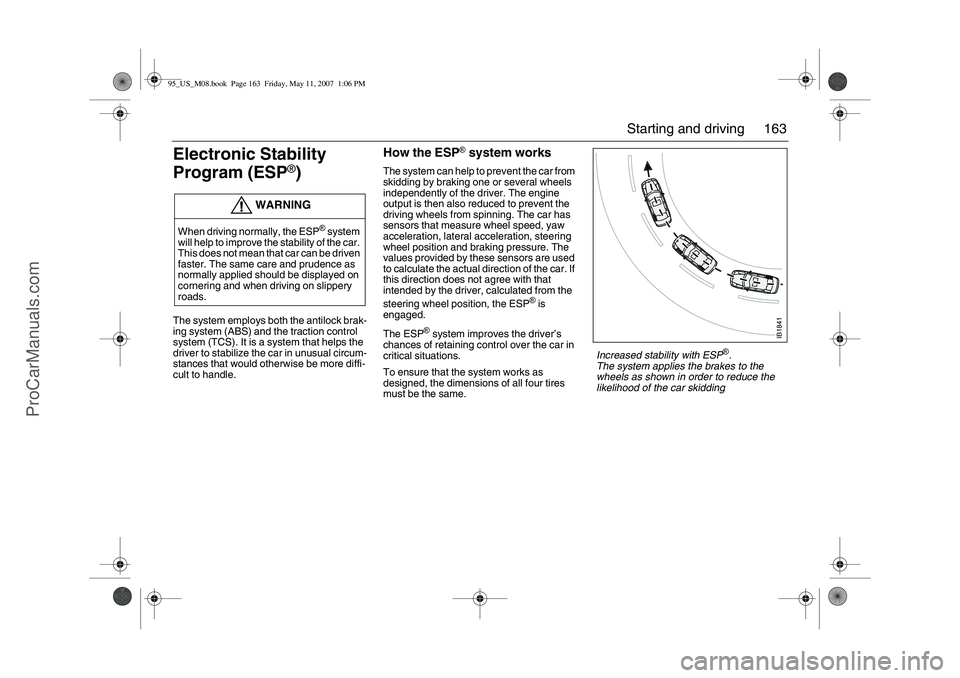
IB1841
Increased stability with ESP
®.
The system applies the brakes to the
wheels as shown in order to reduce the
likelihood of the car skidding
95_US_M08.book Page 163 Friday, May 11, 2007 1:06 PM
ProCarManuals.com
Page 173 of 288
173 Starting and driving
If winter tires are fitted, the same type must
be fitted on all wheels. Your Saab dealer will
be pleased to advise you on the best tires for
your car.
Remember that tires age. It may therefore
be necessary to change them before they
reach the legal wear limit, as they gradually
lose their friction properties.
The best response if the car gets into a
front-wheel skid is to freewheel (manual
gearbox only), i.e. disengage the clutch (so
that the wheels are neither driven or
retarded by the engine.
If the car has automatic transmission, ease
up on the accelerator and steer carefully in
the desired direction.
In a rear-wheel skid, steer in the same direc-
tion that the rear of the car is moving.
Tire chains3
33 3If you want to fit tire chains (where legally
permitted) they should only be fitted to the
tires recommended under ”Specifications”
(see page 268).
Consult your Saab dealer for details of
approved tire chains.
Driving in hot weatherAlways check the coolant level before start-
ing a journey. When the engine is cold, the
coolant shall lie on or just above the
KALT/COLD mark on the expansion tank..
At the end of a journey, if the engine has
worked hard, allow it to idle for two or three
minutes before switching it off.
If the needle on the temperature gauge
enters the red zone:
1 Bring the car to a standstill but leave the
engine running. Do not remove the cap
on the expansion tank even if the tank is
empty. If the needle on the temperature
gauge continues to rise while the engine
is idling, switch off the engine.
WARNING
Do not exceed 30 mph (50 km/h)
when tire chains are fitted.
Tire chains can reduce the directional
stability of the car.
Tire chains must not be used on the
rear wheels. NOTECheck the links frequently for wear.
Check that the chains do not contact
the wheel-arch liner at full lock.
See section ”Specifications”,
page 268, for information on allowable
wheel dimensions for the fitting of tire
chains.
95_US_M08.book Page 173 Friday, May 11, 2007 1:06 PM
ProCarManuals.com
Page 205 of 288
205 Car care and technical informationHeadlight bulb for high beam (Halogen)On cars equipped with Xenon lamps the Halogen lamps are used
only for high beam flasher if the daytime running lights are deacti-
vated and the headlight switch is in the off position (otherwise Xenon
lamp is utilized):
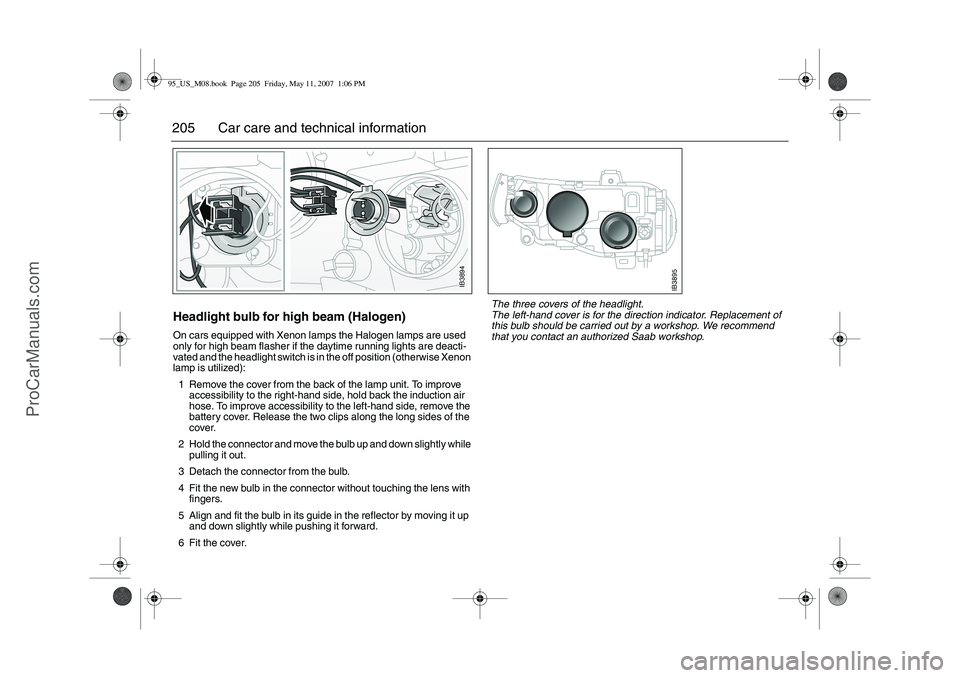
1 Remove the cover from the back of the lamp unit. To improve
accessibility to the right-hand side, hold back the induction air
hose. To improve accessibility to the left-hand side, remove the
battery cover. Release the two clips along the long sides of the
cover.
2 Hold the connector and move the bulb up and down slightly while
pulling it out.
3 Detach the connector from the bulb.
4 Fit the new bulb in the connector without touching the lens with
fingers.
5 Align and fit the bulb in its guide in the reflector by moving it up
and down slightly while pushing it forward.
6Fit the cover.
IB3894
IB3895
The three covers of the headlight.
The left-hand cover is for the direction indicator. Replacement of
this bulb should be carried out by a workshop. We recommend
that you contact an authorized Saab workshop.
95_US_M08.book Page 205 Friday, May 11, 2007 1:06 PM
ProCarManuals.com
Page 207 of 288
207 Car care and technical information
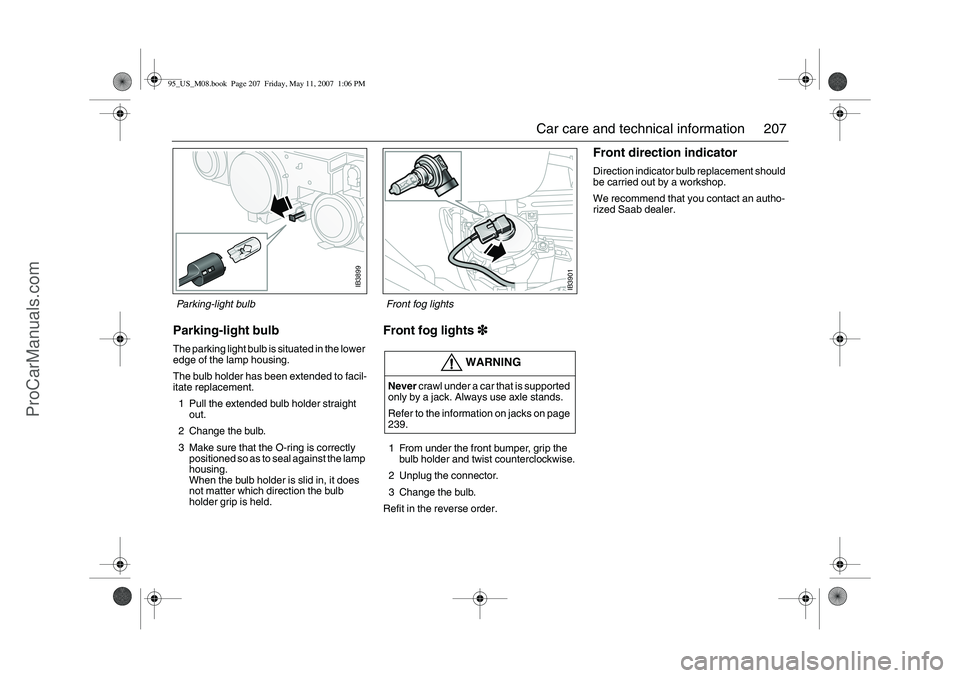
Parking-light bulbThe parking light bulb is situated in the lower
edge of the lamp housing.
The bulb holder has been extended to facil-
itate replacement.
1 Pull the extended bulb holder straight
out.
2 Change the bulb.
3 Make sure that the O-ring is correctly
positioned so as to seal against the lamp
housing.
When the bulb holder is slid in, it does
not matter which direction the bulb
holder grip is held.
Front fog lights3
33 31 From under the front bumper, grip the
bulb holder and twist counterclockwise.
2 Unplug the connector.
3 Change the bulb.
Refit in the reverse order.
Front direction indicatorDirection indicator bulb replacement should
be carried out by a workshop.
We recommend that you contact an autho-
rized Saab dealer.
WARNING
Never crawl under a car that is supported
only by a jack. Always use axle stands.
Refer to the information on jacks on page
239.
IB3899
Parking-light bulb
IB3901
Front fog lights
95_US_M08.book Page 207 Friday, May 11, 2007 1:06 PM
ProCarManuals.com
Page 208 of 288
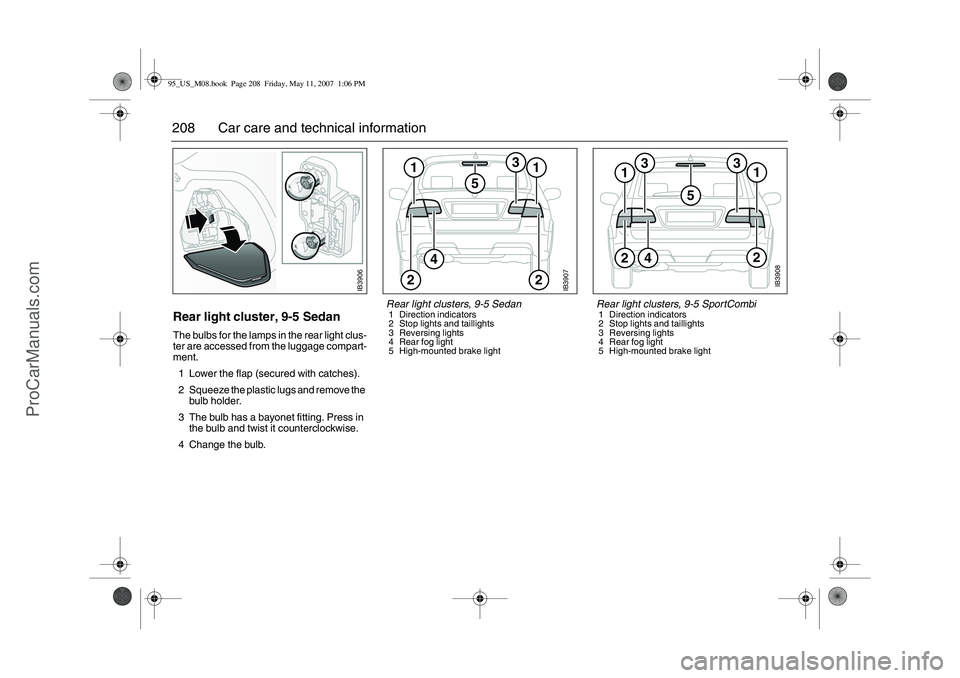
208 Car care and technical informationRear light cluster, 9-5 SedanThe bulbs for the lamps in the rear light clus-
ter are accessed from the luggage compart-
ment.
1 Lower the flap (secured with catches).
2 Squeeze the plastic lugs and remove the
bulb holder.
3 The bulb has a bayonet fitting. Press in
the bulb and twist it counterclockwise.
4 Change the bulb.
IB3906
IB3907
12
4
5
1
3
2
IB3908
1
1
2
4
5
3
3
2
Rear light clusters, 9-5 SportCombi1 Direction indicators
2 Stop lights and taillights
3 Reversing lights
4 Rear fog light
5 High-mounted brake light
Rear light clusters, 9-5 Sedan1 Direction indicators
2 Stop lights and taillights
3 Reversing lights
4 Rear fog light
5 High-mounted brake light
95_US_M08.book Page 208 Friday, May 11, 2007 1:06 PM
ProCarManuals.com
Page 213 of 288
213 Car care and technical information
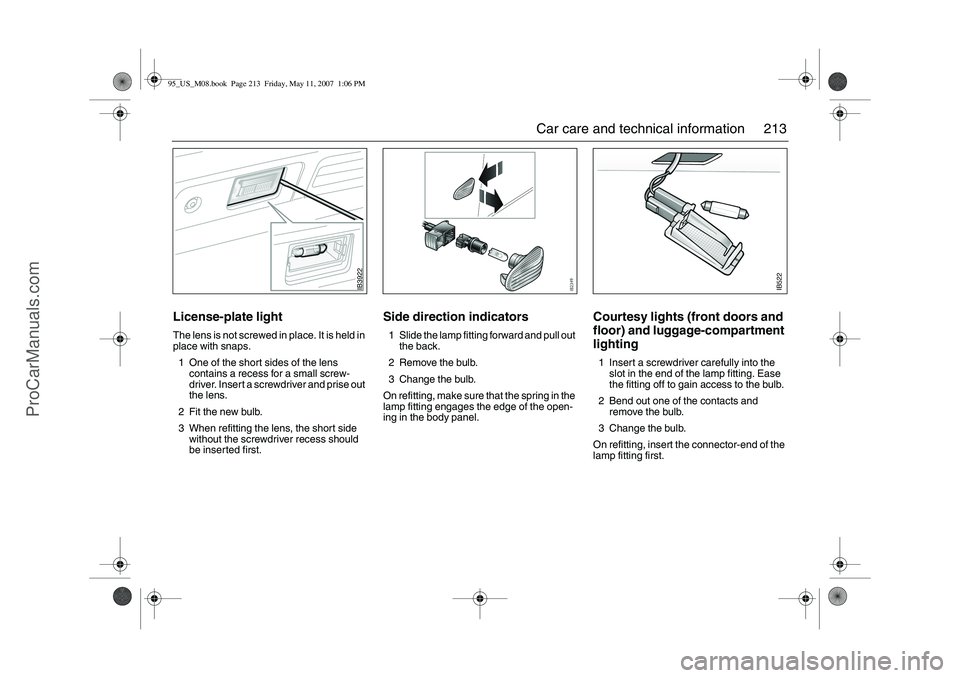
License-plate lightThe lens is not screwed in place. It is held in
place with snaps.
1 One of the short sides of the lens
contains a recess for a small screw-
driver. Insert a screwdriver and prise out
the lens.
2 Fit the new bulb.
3 When refitting the lens, the short side
without the screwdriver recess should
be inserted first.
Side direction indicators 1 Slide the lamp fitting forward and pull out
the back.
2 Remove the bulb.
3 Change the bulb.
On refitting, make sure that the spring in the
lamp fitting engages the edge of the open-
ing in the body panel.
Courtesy lights (front doors and
floor) and luggage-compartment
lighting 1 Insert a screwdriver carefully into the
slot in the end of the lamp fitting. Ease
the fitting off to gain access to the bulb.
2 Bend out one of the contacts and
remove the bulb.
3 Change the bulb.
On refitting, insert the connector-end of the
lamp fitting first.
IB522
IB3922
95_US_M08.book Page 213 Friday, May 11, 2007 1:06 PM
ProCarManuals.com
Page 218 of 288
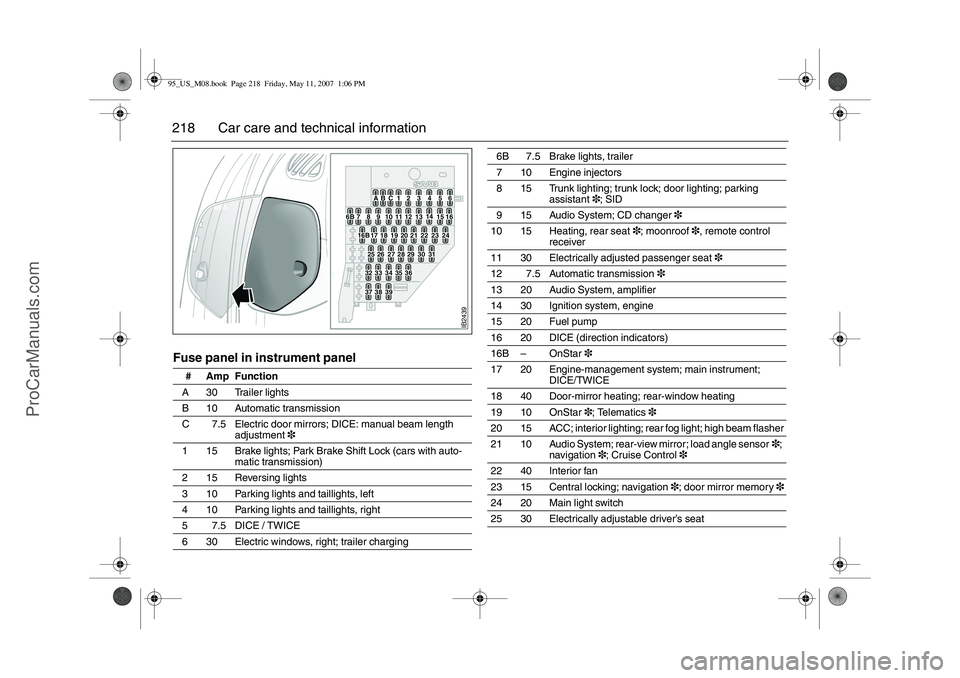
218 Car care and technical informationFuse panel in instrument panel
# Amp Function
A 30 Trailer lights
B 10 Automatic transmission
C 7.5 Electric door mirrors; DICE: manual beam length
adjustment3
1 15 Brake lights; Park Brake Shift Lock (cars with auto-
matic transmission)
2 15 Reversing lights
3 10 Parking lights and taillights, left
4 10 Parking lights and taillights, right
5 7.5 DICE / TWICE
6 30 Electric windows, right; trailer charging
6B 7.5 Brake lights, trailer
7 10 Engine injectors
8 15 Trunk lighting; trunk lock; door lighting; parking
assistant3; SID
9 15 Audio System; CD changer3
10 15 Heating, rear seat3; moonroof3, remote control
receiver
11 30 Electrically adjusted passenger seat3
12 7.5 Automatic transmission3
13 20 Audio System, amplifier
14 30 Ignition system, engine
15 20 Fuel pump
16 20 DICE (direction indicators)
16B –OnStar3
17 20 Engine-management system; main instrument;
DICE/TWICE
18 40 Door-mirror heating; rear-window heating
19 10 OnStar3; Telematics3
20 15 ACC; interior lighting; rear fog light; high beam flasher
21 10 Audio System; rear-view mirror; load angle sensor3;
navigation3; Cruise Control3
22 40 Interior fan
23 15 Central locking; navigation3; door mirror memory3
24 20 Main light switch
25 30 Electrically adjustable driver’s seat
IB2439
BC123456 A
14
121110987
13
6B
1516
2324
222120191817
16B25262728293031
3635343332
393837
95_US_M08.book Page 218 Friday, May 11, 2007 1:06 PM
ProCarManuals.com
Page 219 of 288
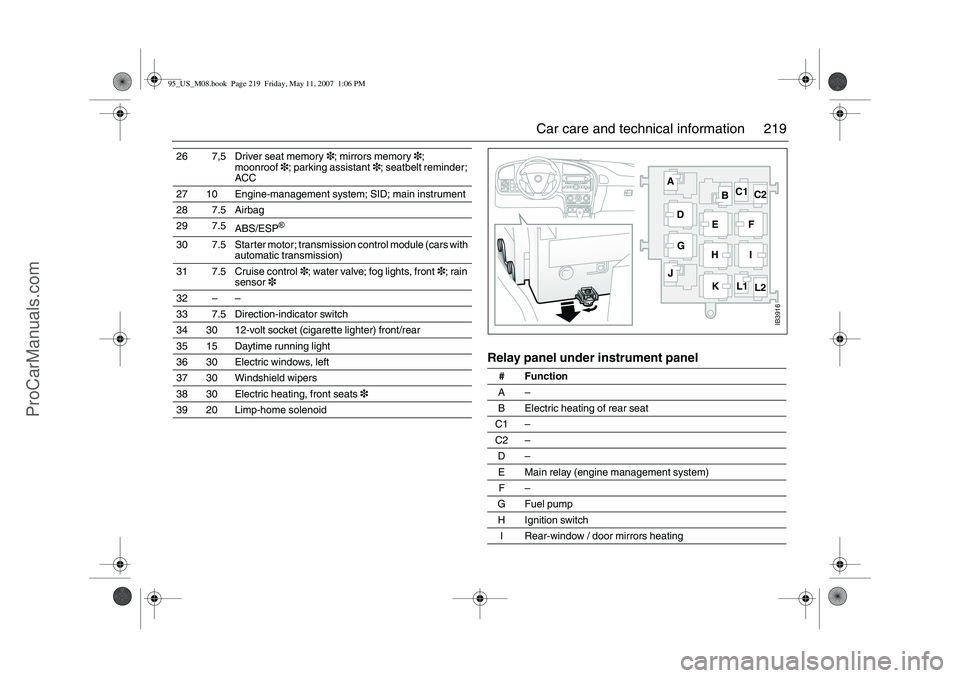
219 Car care and technical information
Relay panel under instrument panel
26 7,5 Driver seat memory3; mirrors memory3;
moonroof3; parking assistant3; seatbelt reminder;
ACC
27 10 Engine-management system; SID; main instrument
28 7.5 Airbag
29 7.5
ABS/ESP
®
30 7.5 Starter motor; transmission control module (cars with
automatic transmission)
31 7.5 Cruise control3; water valve; fog lights, front3; rain
sensor3
32––
33 7.5 Direction-indicator switch
34 30 12-volt socket (cigarette lighter) front/rear
35 15 Daytime running light
36 30 Electric windows, left
37 30 Windshield wipers
38 30 Electric heating, front seats3
39 20 Limp-home solenoid
# Function
A –
B Electric heating of rear seat
C1 –
C2–
D–
E Main relay (engine management system)
F–
GFuel pump
H Ignition switch
I Rear-window / door mirrors heating
IB3916
A
BC1
C2
L2 L1 D
GE
F
H
I
K J
95_US_M08.book Page 219 Friday, May 11, 2007 1:06 PM
ProCarManuals.com
Page 225 of 288

225 Car care and technical information
Buying New TiresTo find out what kind and size of tires you
need, look at the Tire-Loading Information
label.
Before changing to wheels/tires of another
size, we recommend that you contact an
authorized Saab workshop regarding
acceptable options. See also page 268
Wheels/tires combinations that are not
approved by the vehicle manufacturer can
negatively affect the car’s directional stabil-
ity, steering and braking in both wet and dry
conditions.
The wheels and tires have been carefully
matched to the characteristics of the car and
play a key role in its outstanding roadhold-
ing and handling.
Do not take it for granted that a wheel/tire
combination will work in the best possible
way, just because it can be fitted to the car.
To ensure that the speedometer is as accu-
rate as possible it should be reprogrammed
if wheels of a different dimension are fitted.
Contact a Saab dealer.
Because of front wheel drive, the front tires
tend to wear faster than the rear ones. New
tires should always be fitted in pairs, so that
tires on the same axle have the same
amount of tread.
Store wheels lying flat or hanging – never
standing upright.
NOTEWide wheels and tires with sidewalls that
are too low can:
be damaged in potholes etc.
cause springs, shock absorbers and
wheel bearings and body mountings
can be overloaded.
cause the wheels to come into contact
with chassis and body components.
can affect the function of the Elec-
tronic Stability Program (ESP
®).
The speed and load limits for the tires
must not be exceeded; see page 230.
Wheels larger than 17” must not be fitted.
The maximum permissible offset is
49 mm.
WARNING
Mixing tires could cause you to lose con-
trol while driving. If you mix tires of differ-
ent sizes or types (radial and bias-belted
tires), the vehicle may not handle prop-
erly, and you could have a crash. Using
tires of different sizes may also cause
damage to your vehicle. Be sure to use
the same size and type tires on all wheels.
It’s all right to drive with your compact
spare temporarily, it was developed for
use on your vehicle. See “Compact spare
tire” on page 237.
WARNING
If you use bias-ply tires on your vehicle,
the wheel rim flanges could develop
cracks after many miles of driving. A tire
and/or wheel could fail suddenly, causing
a crash. Use only radial-ply tires with the
wheels on your vehicle.
95_US_M08.book Page 225 Friday, May 11, 2007 1:06 PM
ProCarManuals.com