ECO mode SAAB 9-5 2009 Owner's Manual
[x] Cancel search | Manufacturer: SAAB, Model Year: 2009, Model line: 9-5, Model: SAAB 9-5 2009Pages: 272, PDF Size: 21.53 MB
Page 154 of 272
154 Starting and drivingIf ”Automatic transmission3, fault indicator”
light appears on the main instrument panel,
the system has detected a fault in the auto-
matic transmission or its control module
(see page 62).
This also means that the Limp-home mode
has been selected, to guard against further
damage being done to the transmission. In
this mode, the automatic transmission
starts in 5th gear, and gear changes (if nec-
essary) will have to be made manually.
Stop the car in a safe place. Switch off then
restart the engine. If the fault is intermittent,
the transmission will operate as normal
despite the fault indicator being on. Have
the car checked at a workshop. We recom-
mend that you contact an authorized Saab
dealer.
It is not possible to select the SPORT or
Sentronic mode when the Limp-home mode
is active.
Gear changes must be made manually.
The following gears will be engaged in the
respective selector positions when the auto-
matic transmission is in Limp-home mode:
Overheated transmission fluid If the automatic-transmission fluid should
overheat, the following message will appear
on the SID:
”Gearbox too hot.
Make a safe stop.”
In this event, stop the car in a suitable place,
switch off the engine and open the hood.
Wait for several minutes then turn on the
ignition to check that the message has gone
out. When driving subsequent to the trans-
mission fluid overheating, select a gear in
which the engine speed is about 3,000 rpm.
Overheating of the automatic-transmission
fluid can occur when the car is towing a
heavy load, such as a camping trailer in hilly
country. High ambient temperatures can
also increase the temperature of the trans-
mission fluid or the oil cooler may be faulty.
Contact a workshop. We recommend that
you contact an authorized Saab dealer (see
also page 174).
Automatic transmission3,
fault indicator
Position R D M L
Gear Reverse 5th 5th 2nd
NOTICEIf the control module has actuated the
Limp-home function for the automatic
transmission, the car will remain in 5th
gear when D is selected, making it very
sluggish.
Select position L to prevent unnecessary
wear on the transmission. The transmis-
sion then starts in 2nd gear. Once the car
is moving you can select position D.
When the indicator light is on, the car
must not be driven with a caravan or
trailer attached.
95_US_MY09.book Page 154 Tuesday, April 15, 2008 11:03 AM
ProCarManuals.com
Page 158 of 272
158 Starting and drivingIf you move the selector lever from D to L, down shifts will follow a
set pattern to avoid damaging the engine or transmission.
Manual gear-changing is not recommended on slippery roads.
If one of the drive wheels spins excessively, the engine torque will
be reduced to avoid damaging the transmission.Adaptive gear-change patternsAdaptive gear-change patterns are selected automatically depend-
ing on the engine load and the present temperature of the transmis-
sion. The function is available in Normal and Sport modes.
The changes occur at a higher engine speed and the car remains in
the same gear for longer, if the transmission control module senses
that the load has not decreased. These gear-change patterns pre-
vent unnecessary changing up and down, when for example driving
up or down long slopes with a trailer or caravan, and to prevent over-
heating the transmission oil. The adaptive gear-change function is
also selected automatically when the transmission oil becomes too
hot, to protect the transmission itself from damage and to lower the
oil temperature.
The adaptive gear-change pattern function is deselected when:
The engine is switched off.
The load is reduced so much that the function is no longer
required.
”Automatic transmission3, fault indicator” appears on main
instrument panel, see page 154.
SPORT modes
To select Sport mode, press the ”S” button on
the selector lever when the selector lever is in
position N or D.
In this mode, gear changes will take place at
higher engine speeds than in Normal mode, in
other words, the transmission will change up
later and change down earlier for the same throt-
tle (accelerator) position.
The Sport mode will be deselected if:
The SPORT button is pressed.
The selector lever is moved to position P,R, M
or L.
The engine is switched off.
”Automatic transmission3, fault indicator”
appears on main instrument panel, see
page 154.
95_US_MY09.book Page 158 Tuesday, April 15, 2008 11:03 AM
ProCarManuals.com
Page 160 of 272
160 Starting and drivingTo reduce the preset speedThe cruise control system will always disen-
gage automatically the moment that either
the brake pedal or the clutch pedal is
depressed.
It is also possible to reduce the speed by
means of the RESUME/– button.
Sliding the button to RESUME/– once will
reduce the speed by 1 mph (1.6 km/h).
Holding the button in the RESUME/– posi-
tion will effect a gradual reduction in speed
until the button is released.
Disengaging the system The system will be disengaged:
When the brake or clutch pedal is
depressed.
When the switch is moved to CANCEL.
When the switch is moved to OFF.
When the engine is switched off.
When the selector lever is moved to posi-
tion N (cars with automatic transmission).
When the ESP
® system is operative for
more than 1 second.
BrakingTo avoid the brakes becoming overheated,
(e.g. when negotiating long descents with a
drop of several hundred feet), select a low
gear to use the braking effect of the engine.
If the car has automatic transmission, move
the selector lever to position D or L.
When driving fast, you can help to prolong
the life of the brakes by thinking ahead and
braking harder for short periods, rather than
braking more moderately over long
stretches. Brake pad wear indicatorsThe outboard brake pads on the front
wheels incorporate pad-wear indicators.
When the lining is down to 3 mm, the pad
will produce a screeching, squealing or
scraping noise when the brakes are applied.
New pads should be fitted without delay.
Brake pads should only be replaced by a
workshop. We recommend that you con-
tact an authorized Saab dealer.
95_US_MY09.book Page 160 Tuesday, April 15, 2008 11:03 AM
ProCarManuals.com
Page 176 of 272
176 Starting and drivingWhen negotiating long hills, bear the follow-
ing important considerations in mind:
Use Normal mode when driving with a
caravan or trailer on hilly roads. The
adaptive gear change pattern function will
prevent the transmission overheating.
Rises in coolant temperature are indi-
cated by the temperature gauge in the
main instrument panel.Recommendations for cars with
automatic transmission
Rises in coolant temperature are indicated
by the temperature gauge in the main instru-
ment panel.
The following steps are taken in order as the
temperature of the engine increases:
Gear change pattern is altered.
A/C compressor is switched off.
Engine torque is reduced.
The following message will be displayed on
the SID if the transmission fluid becomes
too hot:
“Gearbox too hot.
Make a safe stop.“
If this message appears, stop the car as
soon as it is safe to do so and allow the
engine to idle until the message has gone
out. The selector lever should be in
position P.When continuing your journey, select
manual mode and a gear in which the
engine speed is about 3,000 rpm until the
incline eases (see page 157).
WARNING
Remember to use the braking effect of the
engine (position D or L) when you are
descending long or steep hills to spare
the brakes.
Brake failure can result from overheated
brakes!
95_US_MY09.book Page 176 Tuesday, April 15, 2008 11:03 AM
ProCarManuals.com
Page 187 of 272
187 Car care and technical information
IB3888
Hood ________________ 188
Engine compartment __ 189
Emission control
systems ____________ 190
Engine ______________ 192
Engine oil ____________ 192
Transmission fluid ____ 193
Coolant ______________ 193
Brake and clutch fluid__ 194
Power steering fluid ___ 196
Air filter _____________ 196
Battery ______________ 197
Drive belts ___________ 199
Wipers and washers ___ 200
Changing bulbs _______ 202
Fuses _______________ 214 Tires ________________ 220
Automatic tire pressure
monitoring system ___ 232
Compact spare tire ____ 235
Safety belts __________ 240
Upholstery and trim ___ 241
Textile carpeting ______ 241
Washing the car ______ 242
Waxing and polishing __ 243
Engine compartment __ 243
Touching up the paint _ 243
Air conditioning (ACC) _ 244
Anti-corrosion treatment 246
For long trips _________ 247
Recovery and/or
recycling of automotive
materials ___________ 248
Headlight aiming ______ 248
Car care and technical information
3 Asterisk means: equipment not fitted in all cars
(can depend on model variant, engine variant,
market specification, options or accessories).95_US_MY09.book Page 187 Tuesday, April 15, 2008 11:03 AM
ProCarManuals.com
Page 192 of 272
192 Car care and technical informationEngineThe 2.3-liter model is a transverse, 4-cylin-
der in-line engine with twin overhead cam-
shafts and 4 valves per cylinder.
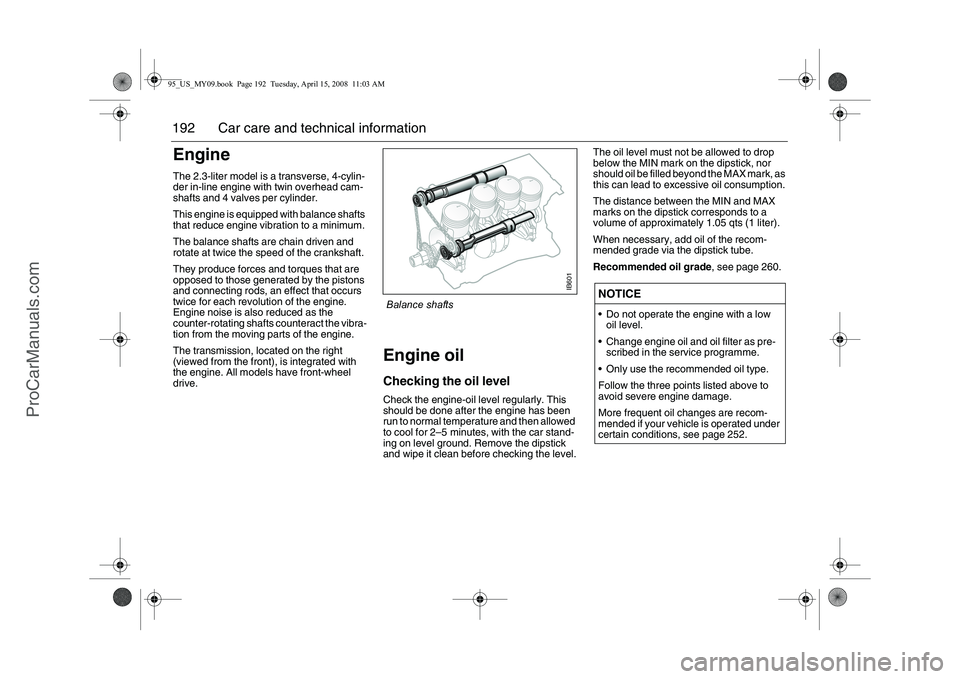
This engine is equipped with balance shafts
that reduce engine vibration to a minimum.
The balance shafts are chain driven and
rotate at twice the speed of the crankshaft.
They produce forces and torques that are
opposed to those generated by the pistons
and connecting rods, an effect that occurs
twice for each revolution of the engine.
Engine noise is also reduced as the
counter-rotating shafts counteract the vibra-
tion from the moving parts of the engine.
The transmission, located on the right
(viewed from the front), is integrated with
the engine. All models have front-wheel
drive.
Engine oilChecking the oil level Check the engine-oil level regularly. This
should be done after the engine has been
run to normal temperature and then allowed
to cool for 2–5 minutes, with the car stand-
ing on level ground. Remove the dipstick
and wipe it clean before checking the level.The oil level must not be allowed to drop
below the MIN mark on the dipstick, nor
should oil be filled beyond the MAX mark, as
this can lead to excessive oil consumption.
The distance between the MIN and MAX
marks on the dipstick corresponds to a
volume of approximately 1.05 qts (1 liter).
When necessary, add oil of the recom-
mended grade via the dipstick tube.
Recommended oil grade, see page 260.
NOTICE Do not operate the engine with a low
oil level.
Change engine oil and oil filter as pre-
scribed in the service programme.
Only use the recommended oil type.
Follow the three points listed above to
avoid severe engine damage.
More frequent oil changes are recom-
mended if your vehicle is operated under
certain conditions, see page 252.
IB601
Balance shafts
95_US_MY09.book Page 192 Tuesday, April 15, 2008 11:03 AM
ProCarManuals.com
Page 195 of 272
195 Car care and technical information
Use only new brake fluid from a sealed
container.
Check that there are no leaks in the brake
system.
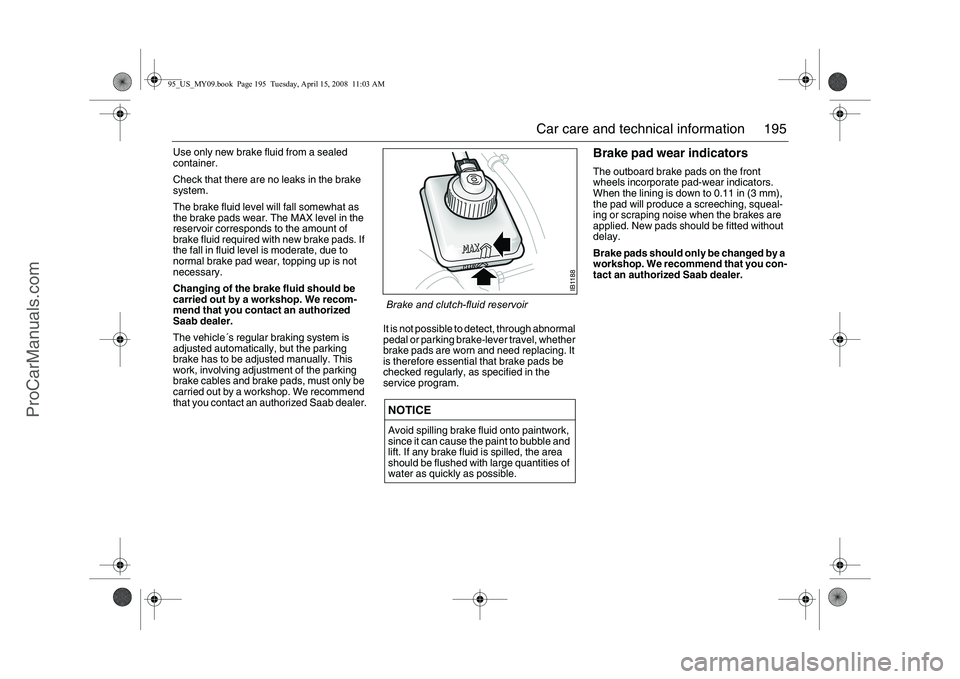
The brake fluid level will fall somewhat as
the brake pads wear. The MAX level in the
reservoir corresponds to the amount of
brake fluid required with new brake pads. If
the fall in fluid level is moderate, due to
normal brake pad wear, topping up is not
necessary.
Changing of the brake fluid should be
carried out by a workshop. We recom-
mend that you contact an authorized
Saab dealer.
The vehicle´s regular braking system is
adjusted automatically, but the parking
brake has to be adjusted manually. This
work, involving adjustment of the parking
brake cables and brake pads, must only be
carried out by a workshop. We recommend
that you contact an authorized Saab dealer.It is not possible to detect, through abnormal
pedal or parking brake-lever travel, whether
brake pads are worn and need replacing. It
is therefore essential that brake pads be
checked regularly, as specified in the
service program.
Brake pad wear indicators The outboard brake pads on the front
wheels incorporate pad-wear indicators.
When the lining is down to 0.11 in (3 mm),
the pad will produce a screeching, squeal-
ing or scraping noise when the brakes are
applied. New pads should be fitted without
delay.
Brake pads should only be changed by a
workshop. We recommend that you con-
tact an authorized Saab dealer.
NOTICEAvoid spilling brake fluid onto paintwork,
since it can cause the paint to bubble and
lift. If any brake fluid is spilled, the area
should be flushed with large quantities of
water as quickly as possible.
IB1188
Brake and clutch-fluid reservoir
95_US_MY09.book Page 195 Tuesday, April 15, 2008 11:03 AM
ProCarManuals.com
Page 230 of 272
230 Car care and technical informationMaximum Load rating: The load rating for
a tire at the maximum permissible inflation
pressure for that tire.
Maximum Loaded Vehicle Weight: The
sum of curb weight; accessory weight; vehi-
cle capacity weight; and production options
weight.
Maximum Permissible Inflation Pres-
sure: The maximum cold inflation pressure
to which a tire may be inflated.
Normal occupant weight: The number of
occupants a vehicle is designed to seat mul-
tipled by 150 pounds (68 kg). See “Loading
Your Vehicle” on page 229.
Occupant Distribution: Designated seat-
ing positions.
Outward Facing Sidewall: The side of a
asymmetrical tire that has a particular side
that faces outward when mounted on a vehi-
cle. The side of the tire that contains a white-
wall bears white lettering or bears manufac-
turer, brand and or model name molding on
the other sidewall of the tire.
Passenger (P-Metric) Tire: A tire used on
passenger cars and some light duty trucks
and multipurpose vehicles.Recommended Inflation Pressure: Vehi-
cle manufacturer´s recommended tire infla-
tion pressure shown on the tire label, see
“Inflation - Tire Pressure” on page 220 and
“Loading Your Vehicle” on page 229.
Radial Ply Tire: A pneumatic tire in which
the ply cords that extend to the beads are
laid at substantially 90 degrees to the cen-
terline of the tread.
Rim: A metal support for a tire or a tire and
tube assembly upon which the tire beads
are seated.
Sidewall: The portion of a tire between the
tread and the bead.
Speed rating: An alphanumeric code
assigned to a tire indicating the maximum
speed at which a tire can operate.
Traction: The friction between the tire and
the road surface. The amount of grip pro-
vided.
Treadwear Indicators: Narrow bands,
sometimes called “wear bars”, that show
across the tread of a tire when only
2/32 inch of tread remains. See “When It Is
Time for New Tires” on page 222.Tread Width: The width of the tire´s tread.
UTQGS: Uniform Tire Quality Grade Stan-
dards, a tire information system that pro-
vides consumers with ratings for a tire´s
traction, temperature and treadwear. Rat-
ings are determined by tire manufacturers
using government testing procedures. The
rating are molded into the sidewall of the
tire. See “Uniform Tire Quality Grading” on
page 224.
Vehicle Capacity Weight: Is the number of
designated seating positions multipled by
150 pounds (68 kg) plus the rated cargo
load. See “Loading Your Vehicle” on
page 229.
Vehicle Maximum Load on the Tire: Load
on an individual tire due to curb weight,
accessory weight, occupant weight and
cargo weight.
Vehicle label: A label permanently
attached to a vehicle showing original
equipment tire size and the recommended
cold inflation pressure. See “Loading Your
Vehicle” on page 229.95_US_MY09.book Page 230 Tuesday, April 15, 2008 11:03 AM
ProCarManuals.com
Page 251 of 272
251 Customer Assistance and Information
Maintenance schedule _ 252
Owner assistance _____ 253
Reporting Safety Defects
(U.S.A.) _____________ 254
Reporting Safety Defects
to the Canadian
government _________ 254
Vehicle Data Collection
and Event Data
Recorders __________ 255
Customer Assistance and Information
3 Asterisk means: equipment not fitted in all cars
(can depend on model variant, engine variant,
market specification, options or accessories).95_US_MY09.book Page 251 Tuesday, April 15, 2008 11:03 AM
ProCarManuals.com
Page 254 of 272
254 Customer Assistance and InformationChange of Address Notification
(U.S. and Canada)Two change of address cards are provided
at the end of the Warranty and Service
Record Booklet. Knowing your current
address allows Saab to contact you in the
event of a recall or service campaign.
Please help us keep our records up to date
for your own peace of mind.Service informationFactory Service Manuals for the Saab 9-5
car line can be ordered through your Saab
dealer or by visiting
www.saabtechinfo.com. These are com-
prehensive manuals on CD rom, geared to
use by professional technicians.
Consult your Saab dealer for prices and for
a listing for your model.
Reporting Safety
Defects (U.S.A.)If you believe that your vehicle has a defect
which could cause a crash or could cause
injury or death, you should immediately
inform the National Highway Traffic Safety
Administration (NHTSA) in addition to noti-
fying Saab Cars USA, Inc.
If NHTSA receives similar complaints, it
may open an investigation, and if it finds that
a safety defect exists in a group of vehicles,
it may order a recall and remedy campaign.
However, NHTSA cannot become involved
in individual problems between you, your
dealer, or Saab Automobile USA, Inc.
To contact NHTSA, you may call the
toll-free Vehicle Safety Hotline at
1-888-327-4236 (TTY: 1-800-424-9153; go
to http://www.safercar.gov; or write to:
Administrator, NHTSA, 400 Seventh Street,
SW., Washington D.C. 20590. You can also
obtain other information about motor vehi-
cle safety from http:// www safercar.gov.
Reporting Safety
Defects to the Canadian
governmentIf you live in Canada, and believe that your
vehicle has a safety defect, you should
immediately notify Transport Canada, in
addition to notifying General Motors of
Canada Limited.
You may write to Transport Canada at
Box 8880, Ottawa, Ontario, K1G 3J2.
In addition to notifying Transport Canada
in a situation like this, we certainly hope
you will notify us. In Canada, please call
our Saab Customer Assistance Center at
1-800-263- 1999.
Or write:
General Motors of Canada Limited
Customer Assistance Center,
1908 Colonel Sam Drive,
Oshawa, Ontario, L1H 8P7.
95_US_MY09.book Page 254 Tuesday, April 15, 2008 11:03 AM
ProCarManuals.com