belt SAAB 9-5 2009 Service Manual
[x] Cancel search | Manufacturer: SAAB, Model Year: 2009, Model line: 9-5, Model: SAAB 9-5 2009Pages: 272, PDF Size: 21.53 MB
Page 223 of 272
223 Car care and technical information
Buying New TiresTo find out what kind and size of tires you
need, look at the Tire-Loading Information
label.
Before changing to wheels/tires of another
size, we recommend that you contact an
authorized Saab workshop regarding
acceptable options. See also page 261
Wheels/tires combinations that are not
approved by the vehicle manufacturer can
negatively affect the car’s directional stabil-
ity, steering and braking in both wet and dry
conditions.
The wheels and tires have been carefully
matched to the characteristics of the car and
play a key role in its outstanding roadhold-
ing and handling.
Do not take it for granted that a wheel/tire
combination will work in the best possible
way, just because it can be fitted to the car.
To ensure that the speedometer is as accu-
rate as possible it should be reprogrammed
if wheels of a different dimension are fitted.
Contact a Saab dealer.
Because of front wheel drive, the front tires
tend to wear faster than the rear ones. New
tires should always be fitted in pairs, so that
tires on the same axle have the same
amount of tread.
Store wheels lying flat or hanging – never
standing upright.
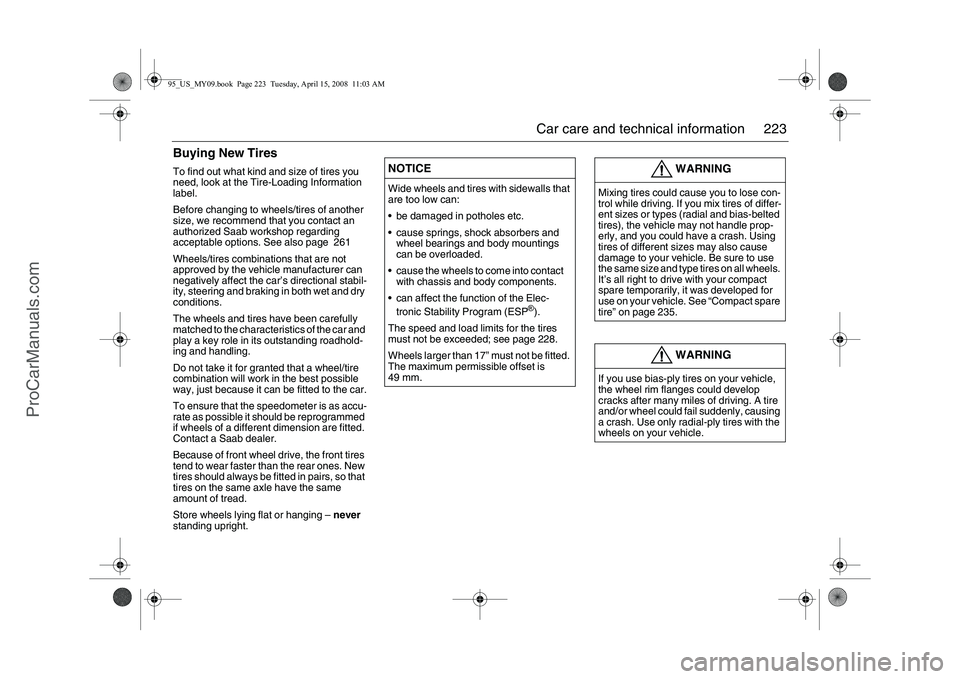
NOTICEWide wheels and tires with sidewalls that
are too low can:
be damaged in potholes etc.
cause springs, shock absorbers and
wheel bearings and body mountings
can be overloaded.
cause the wheels to come into contact
with chassis and body components.
can affect the function of the Elec-
tronic Stability Program (ESP
®).
The speed and load limits for the tires
must not be exceeded; see page 228.
Wheels larger than 17” must not be fitted.
The maximum permissible offset is
49 mm.
WARNING
Mixing tires could cause you to lose con-
trol while driving. If you mix tires of differ-
ent sizes or types (radial and bias-belted
tires), the vehicle may not handle prop-
erly, and you could have a crash. Using
tires of different sizes may also cause
damage to your vehicle. Be sure to use
the same size and type tires on all wheels.
It’s all right to drive with your compact
spare temporarily, it was developed for
use on your vehicle. See “Compact spare
tire” on page 235.
WARNING
If you use bias-ply tires on your vehicle,
the wheel rim flanges could develop
cracks after many miles of driving. A tire
and/or wheel could fail suddenly, causing
a crash. Use only radial-ply tires with the
wheels on your vehicle.
95_US_MY09.book Page 223 Tuesday, April 15, 2008 11:03 AM
ProCarManuals.com
Page 227 of 272
227 Car care and technical information
Tire Sidewall LabelingUseful information about a tire is molded
into it´s sidewall.
Tire size: The tire size ia a combination of
letters and numbers used to define a partic-
ular tire´s width, height, aspect ratio, con-
struction type and service description.
Department of Transportation (DOT):
The Department of Transportation (DOT)
code indicates that the tire is in compliance
with the U.S. Department of Transportation
Motor Vehicle Safety standards.
Tire Identification Number (TIN): The let-
ters and numbers following DOT code are
the Tire Identification Number (TIN). The
TIN shows the manufacturer and plant
code, tire size, and date the tire was manu-
factured. The TIN is molded onto both sides
of the tire.
Tire Ply Material: The type of cord and
number of plies in the sidewall and under
the tread.Uniform Tire Quality Grading (UTQG):
Tire manufacturers are required to grade
tires based on performance factors: tread-
wear, traction and temperature resistance.
For more information see “Uniform Tire
Quality Grading” on page 224.
Maximum Cold Inflation Load Limit: Max-
imum load that can be carried and the max-
imum pressure needed to support that load.
For information on recommended tire pres-
sure see “Lowest recommended tire pres-
sure, cold tires” on page 263and “Loading
Your Vehicle” on page 229.
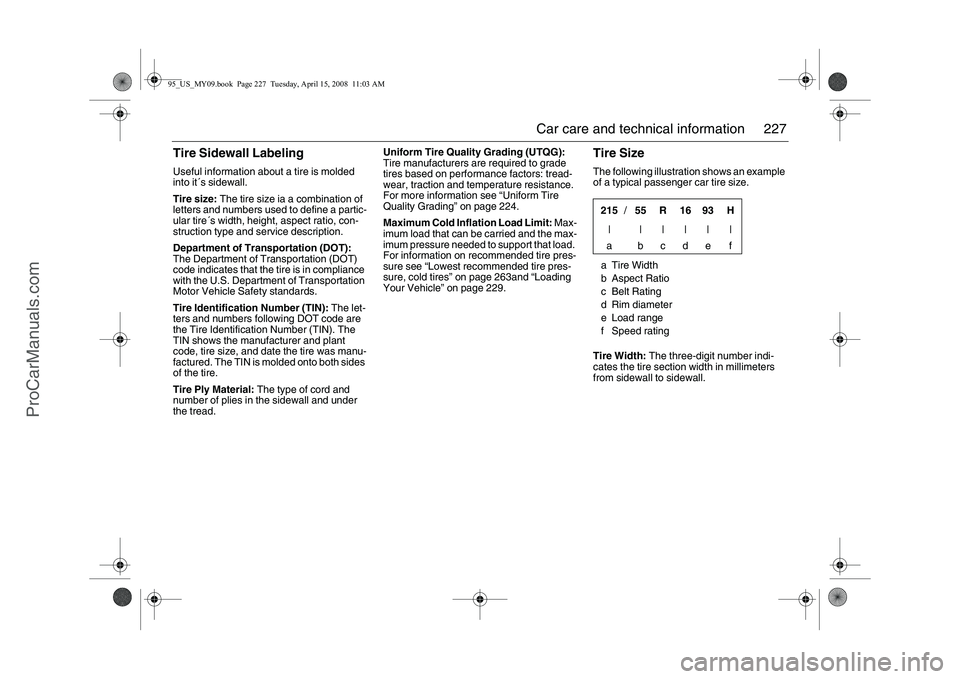
Tire SizeThe following illustration shows an example
of a typical passenger car tire size.
Tire Width: The three-digit number indi-
cates the tire section width in millimeters
from sidewall to sidewall.215/55 R 16 93 H
| |||||
abcdef
aTire Width
b Aspect Ratio
c Belt Rating
d Rim diameter
e Load range
f Speed rating
95_US_MY09.book Page 227 Tuesday, April 15, 2008 11:03 AM
ProCarManuals.com
Page 228 of 272
228 Car care and technical informationAspect ratio: A two-digit number that indi-
cates the tire height-to-width measure-
ments. For example, if the tire size aspect
ratio is “55”, as shown in item “C” of the illus-
tration, it would mean that the tire´s sidewall
is 55% as high as it is wide.
Belt Rating: A letter code is used to indicate
the type of ply construction in the tire. The
letter “R” means radial ply construction; the
letter “D” means diagonal or bias ply con-
struction; and the letter “B” means
belted-bias ply construction.
Rim Diameter: Diameter of the wheel in
inches.
Load range: The load range represents the
load carry capacity a tire is certified to carry.
Speed Rating: The maximum speed that a
tire is certified to carry a load. Speed ratings
range from “A” to “Z”.
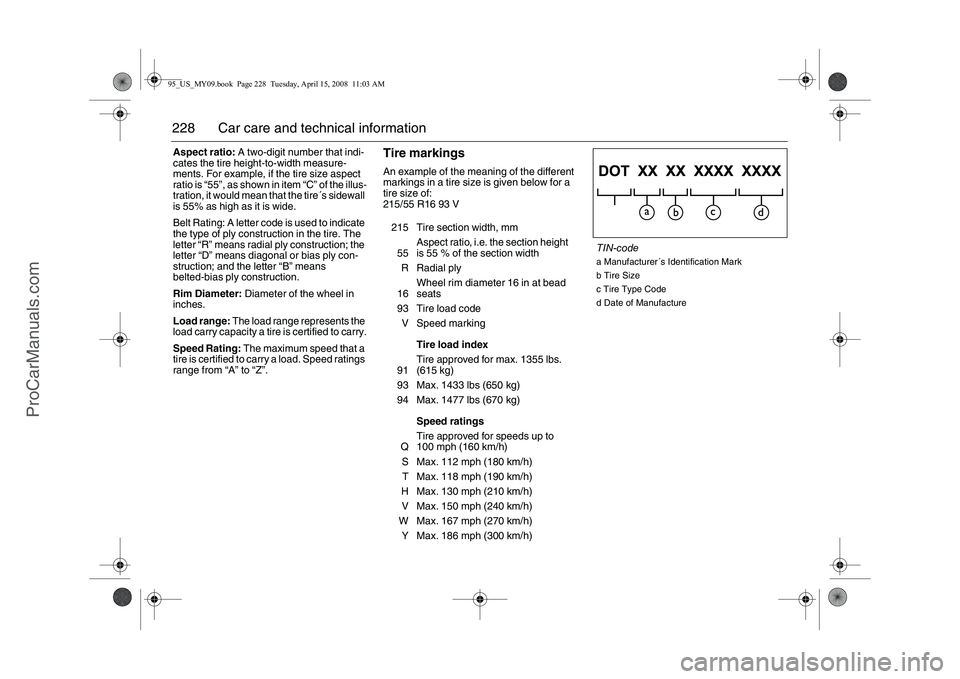
Tire markingsAn example of the meaning of the different
markings in a tire size is given below for a
tire size of:
215/55 R16 93 V 215 Tire section width, mm
55Aspect ratio, i.e. the section height
is 55 % of the section width
R Radial ply
16Wheel rim diameter 16 in at bead
seats
93 Tire load code
V Speed marking
Tire load index
91Tire approved for max. 1355 lbs.
(615 kg)
93 Max. 1433 lbs (650 kg)
94 Max. 1477 lbs (670 kg)
Speed ratings
QTire approved for speeds up to
100 mph (160 km/h)
S Max. 112 mph (180 km/h)
T Max. 118 mph (190 km/h)
H Max. 130 mph (210 km/h)
V Max. 150 mph (240 km/h)
W Max. 167 mph (270 km/h)
Y Max. 186 mph (300 km/h)
TIN-codea Manufacturer´s Identification Mark
b Tire Size
c Tire Type Code
d Date of Manufacture
95_US_MY09.book Page 228 Tuesday, April 15, 2008 11:03 AM
ProCarManuals.com
Page 229 of 272
229 Car care and technical information
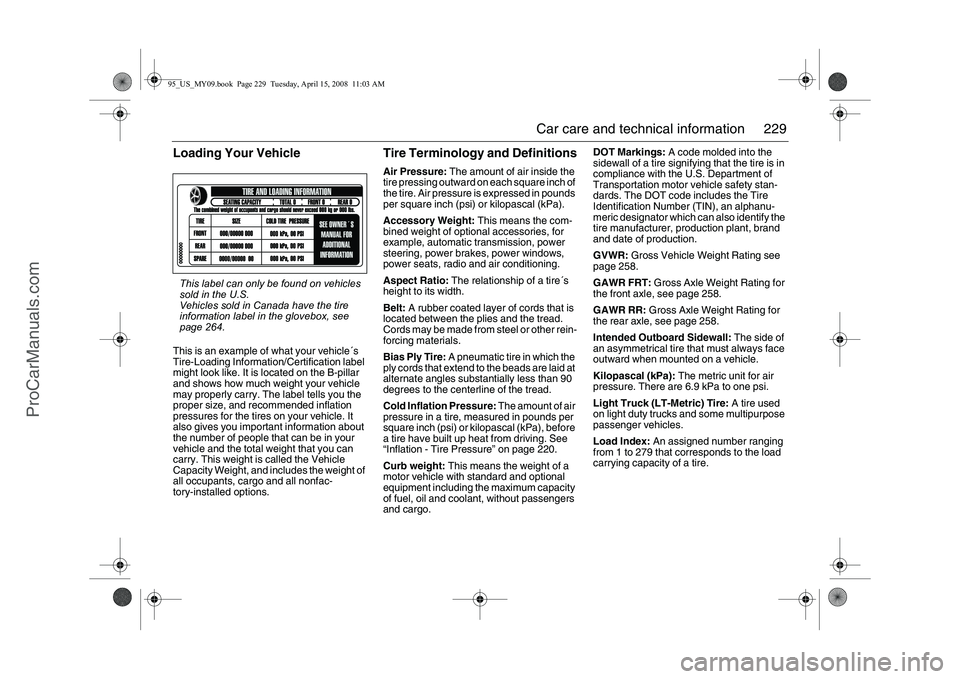
Loading Your VehicleThis is an example of what your vehicle´s
Tire-Loading Information/Certification label
might look like. It is located on the B-pillar
and shows how much weight your vehicle
may properly carry. The label tells you the
proper size, and recommended inflation
pressures for the tires on your vehicle. It
also gives you important information about
the number of people that can be in your
vehicle and the total weight that you can
carry. This weight is called the Vehicle
Capacity Weight, and includes the weight of
all occupants, cargo and all nonfac-
tory-installed options.
Tire Terminology and DefinitionsAir Pressure: The amount of air inside the
tire pressing outward on each square inch of
the tire. Air pressure is expressed in pounds
per square inch (psi) or kilopascal (kPa).
Accessory Weight: This means the com-
bined weight of optional accessories, for
example, automatic transmission, power
steering, power brakes, power windows,
power seats, radio and air conditioning.
Aspect Ratio: The relationship of a tire´s
height to its width.
Belt: A rubber coated layer of cords that is
located between the plies and the tread.
Cords may be made from steel or other rein-
forcing materials.
Bias Ply Tire: A pneumatic tire in which the
ply cords that extend to the beads are laid at
alternate angles substantially less than 90
degrees to the centerline of the tread.
Cold Inflation Pressure: The amount of air
pressure in a tire, measured in pounds per
square inch (psi) or kilopascal (kPa), before
a tire have built up heat from driving. See
“Inflation - Tire Pressure” on page 220.
Curb weight: This means the weight of a
motor vehicle with standard and optional
equipment including the maximum capacity
of fuel, oil and coolant, without passengers
and cargo.DOT Markings: A code molded into the
sidewall of a tire signifying that the tire is in
compliance with the U.S. Department of
Transportation motor vehicle safety stan-
dards. The DOT code includes the Tire
Identification Number (TIN), an alphanu-
meric designator which can also identify the
tire manufacturer, production plant, brand
and date of production.
GVWR: Gross Vehicle Weight Rating see
page 258.
GAWR FRT: Gross Axle Weight Rating for
the front axle, see page 258.
GAWR RR: Gross Axle Weight Rating for
the rear axle, see page 258.
Intended Outboard Sidewall: The side of
an asymmetrical tire that must always face
outward when mounted on a vehicle.
Kilopascal (kPa): The metric unit for air
pressure. There are 6.9 kPa to one psi.
Light Truck (LT-Metric) Tire: A tire used
on light duty trucks and some multipurpose
passenger vehicles.
Load Index: An assigned number ranging
from 1 to 279 that corresponds to the load
carrying capacity of a tire. This label can only be found on vehicles
sold in the U.S.
Vehicles sold in Canada have the tire
information label in the glovebox, see
page 264.
95_US_MY09.book Page 229 Tuesday, April 15, 2008 11:03 AM
ProCarManuals.com
Page 240 of 272

240 Car care and technical information8 Check-tighten the wheel bolts after a few
miles.
Tightening torque
Light-alloy wheels: 80 ft.lbs. (110 Nm)
Steel wheels: 80 ft.lbs. (110 Nm)
Safety beltsRegularly check the function of the safety
belts as follows:
Hold the diagonal strap and pull it sharply.
The safety belt should lock and it should
not be possible to withdraw it further.
Check the anchorage points in the floor.
They must not have suffered rust damage.
There must be no frayed threads in the web-
bing.
Safety belts must not come into contact with
substances such as polishes, oils or other
chemicals. If the straps are dirty, wash them
with warm water and a detergent or have
them replaced.
WARNING
If the car is involved in a crash, the safety
belts, belt pretensioners and other com-
ponents must be inspected by a work-
shop. We recommend that you contact an
authorized Saab dealer.
Never make any alterations or repairs to
the safety belt yourself.
IB1800IB1800
Removing the wheel cover
IB539
Tightening sequence, wheel bolts
95_US_MY09.book Page 240 Tuesday, April 15, 2008 11:03 AM
ProCarManuals.com
Page 245 of 272
245 Car care and technical information
Fault diagnosisIf a fault occurs in the A/C system, there are
a number of checks you can perform your-
self. If the fault persists, however, have the
system checked by a workshop. We recom-
mend that you contact an authorized Saab
dealer.
Important!
When the A/C system is running, the intake
air is dehumidified, and the resultant con-
densation is drained off through two outlets
underneath the floor of the car in the vicinity
of the front doors. It is therefore perfectly
normal for water to be seen dripping from
these outlets when the car is parked. The
warmer the ambient air and the higher the
humidity, the greater will be the amount of
condensation formed.Inadequate cooling:
a Check that the condenser (forward of
the radiator) has not become clogged
with dirt and insects.
b Make sure that the drive belt for the com-
pressor is not slipping.
c Check the fuses for the ventilation fans
and compressor.
Maintenance The drive belt for the compressor should
be inspected under the regular service
program.
Clean dirt and insects away from the
condenser and radiator to prevent clog-
ging. When washing the car, use the hose
to spray the radiator and condenser
(located forward of the radiator) from both
sides (both from the front of the car and
from inside the engine bay). Do not use a
pressure washer.
Caution: Do not use the hose when the
engine is hot.
Other than in extremely cold weather, do not
screen the radiator, e.g. with netting, as this
will greatly diminish its cooling capacity.
Note: The A/C system will only operate
when the outdoor temperature is above the
freezing point (0°C, 32°F).
95_US_MY09.book Page 245 Tuesday, April 15, 2008 11:03 AM
ProCarManuals.com
Page 247 of 272
247 Car care and technical information
2Clean the underside of the car during
the winter. Use high pressure water to
clean the car’s underside (floor panels,
wheel wells) at least at mid- winter and
in the spring.
3Inspect the car frequently for leaks or
damage, and arrange for needed
repairs promptly. After washing or after
heavy rain, check for leaks. When wash-
ing the car inspect body surfaces for
paint damage. While checking for leaks,
lift the floor mats and check beneath
them. Water can collect in these areas
and remain for prolonged periods. Dry
any wet areas including the floor mats.
Have leaks repaired as soon as possi-
ble.
Use touch-up paint to repair small
scratches or minor finish damage. Areas
where metal is exposed will rust quickly
and MUST be repaired immediately by
touch-up or professional repainting.
Rust must be removed, the bare metal
primed and painted. Major body
damage should be repaired immediately
and new panels or exposed areas
should be undercoated with anti- corro-
sion material.
Repairs of this type are the owner’s
responsibility and are not covered under
warranty.4Inspect the undercoating and touch
up if necessary. Pay particular atten-
tion to the fenders and wheel housings,
which are exposed to abrasion by flying
gravel, etc. If the composition has worn
or flaked off, the steel must be thor-
oughly cleaned and dried before a fresh
coat is applied. The cleaning is best
done with a scraper and a steel wire
brush, followed by washing with solvent.
Apply the new coating thinly, as other-
wise it may run off or fall off when dry.
For long tripsBefore setting off on a long journey, it is
advisable to have your car checked over by
your Saab dealer.
Obtain a few important items to take along
on your journey such as spare bulbs, wiper
blades, fuses, a Poly-V-belt and the like.
You can check some points yourself before-
hand:
Make sure that the engine is in good
condition.
Check that no oil or gasoline leaks out of
the engine or gearbox/transmission.
Check the coolant and power steering
fluid levels. Check also for leaks.
Inspect the Poly-V-belt and replace it if it
shows any signs of hard wear.
Check the battery charge.
Check the tires for tread pattern and air
pressure, including the compact spare
wheel.
Check the brakes.
Check all bulbs.
Check for the presence of the tool kit and
the jack in the car.
95_US_MY09.book Page 247 Tuesday, April 15, 2008 11:03 AM
ProCarManuals.com
Page 255 of 272
255 Customer Assistance and Information
Vehicle Data Collection and
Event Data RecordersYour vehicle, like other modern motor vehi-
cles, has a number of sophisticated com-
puter systems that monitor and control sev-
eral aspects of the vehicle’s performance.
Your vehicle uses on-board vehicle comput-
ers to monitor emission control components
to optimize fuel economy, to monitor condi-
tions for air bag deployment and, if so
equipped, to provide anti-lock braking and
to help the driver control the vehicle in diffi-
cult driving situations. Some information
may be stored during regular operations to
facilitate repair of detected malfunctions;
other information is stored only in a crash
event by computer systems commonly
called event data recorders (EDR).
In a crash event, computer systems, such
as the Air Bag Sensing and Diagnostic
Module (SDM) in your vehicle may record
information about the condition of the vehi-
cle and how it was operated, such as data
related to engine speed, brake application,
throttle position, vehicle speed, steering
wheel angle, lateral acceleration, safety belt
usage, air bag readiness, air bag perfor-
mance, and the severity of a collision. This
information has been used to improve vehi-
cle crash performance and may be used to
improve crash performance of future vehi-
cles and driving safety. Unlike the data
recorders on many airplanes, these
on-board systems do not record sounds,
such as conversation of vehicle occupants.To read this information, special equipment
is needed and access to the vehicle or the
SDM is required.
Saab will not access information about a
crash event or share it with others other than
with the consent of the vehicle owner or, if
the vehicle is leased, with the consent of
the lessee,
in response to an official request of police
or similar government office,
as part of Saab’s defense of litigation
through the discovery process, or
as required by law.
In addition, once Saab collects or receives
data, Saab may
use the data for Saab research needs,
make it available for research where
appropriate confidentiality is to be main-
tained and need is shown, or
share summary data which is not tied to a
specific vehicle with non-Saab organiza-
tions for research purposes.
Others, such as law enforcement, may have
access to the special equipment that can
read the information if they have access to
the vehicle or SDM.
If your vehicle is equipped with OnStar®,
please check the OnStar® subscription ser-
vice agreement or manual for information
on its operations and data collection.95_US_MY09.book Page 255 Tuesday, April 15, 2008 11:03 AM
ProCarManuals.com
Page 267 of 272
267 Index
Index
AA/C system, fault diagnosis
________ 245
A/C system, maintenance _________ 244
ABS brakes
____________________ 160
ACC
__________________________ 79
ACC functions
___________________ 82
ACC, automatic climate control
______ 79
ACC, calibration
_________________ 86
ACC, condensation water
__________ 86
ACC, useful tips
_________________ 86
AUX input
_____________________ 104
Adjustable systems
______________ 265
Adjusting the steering wheel
_______ 114
Adjustment, seats
________________ 18
Air conditioning (A/C), fault diagnosis
and maintenance ______________ 244
Airbag
_________________________ 29
Alarm __________________________ 50
Alarm functions
__________________ 53
Alarm signals
________________ 50
, 53
Album information
_______________ 104
Alternator
_____________________ 199
Alternator drive belt
__________ 199
, 260
Alternator rating
________________ 260
Antennas
______________________ 109
Anticorrosion treatment
___________ 246
Antidazzle rear-view mirror
________ 121
Anti-skid
______________________ 163Autochecking of lights on starting
____ 64
Auto-dimming rear-view mirror with
garage door opener
____________ 118
Automatic climate control (ACC)
_____ 79
Aviod theft, tip
__________________ 166
BBattery
________________________ 197
Battery charging/replacing
________ 197
Battery, boost starting
____________ 184
Before a long journey ____________ 247
Before towing a camper or trailer
___ 177
Belt guide
______________________ 12
Boost starting using jump leads
____ 184
Brake and clutch fluid
____________ 194
Brake-fluid reservoir
_____________ 194
Brakes, technical data ____________ 261
Bulbs, changing
_________________ 202
Bulbs, table of
__________________ 213
Buying new tires ________________ 223
CCD changer
____________________ 100
CHECK messages
_______________ 71
CHECKING
_____________________ 71
Car alarm
______________________ 50
Car care
______________________ 187
Cargo net, 9-5 SportCombi
________ 137
Carpeting, care of
_______________ 241Catalytic converter, important
considerations
_________________ 145
Central locking ___________________ 44
Change language in SID
___________ 72
Change of address notification
_____ 254
Changing a wheel
_______________ 237
Changing bulbs
_________________ 202
Changing wiper blades
___________ 200
Charge mobile phone
____________ 126
Charger/Jump starting ____________ 186
Charging the battery/Jump starting
__ 186
Chassis number
________________ 264
Checks before towing a camper or
trailer
________________________ 177
Child safety
_____________________ 22
Child safety locks, rear doors
_______ 47
Cleaning, engine bay
_____________ 243
Clock
_________________________ 105
Color code, body
________________ 264
Color code, trim _________________ 264
Compact spare wheel
____________ 235
Compass
______________________ 122
Condensation water, ACC
__________ 86
Connecting a portable player ______ 105
Coolant
_______________________ 193
Courtesy Headlight Feature
________ 74
Crash memory, see EDR
_________ 255
Cross modulation
_______________ 110
Cruise control
__________________ 159
Cup holder
_____________________ 128
95_US_MY09.book Page 267 Tuesday, April 15, 2008 11:03 AM
ProCarManuals.com
Page 268 of 272
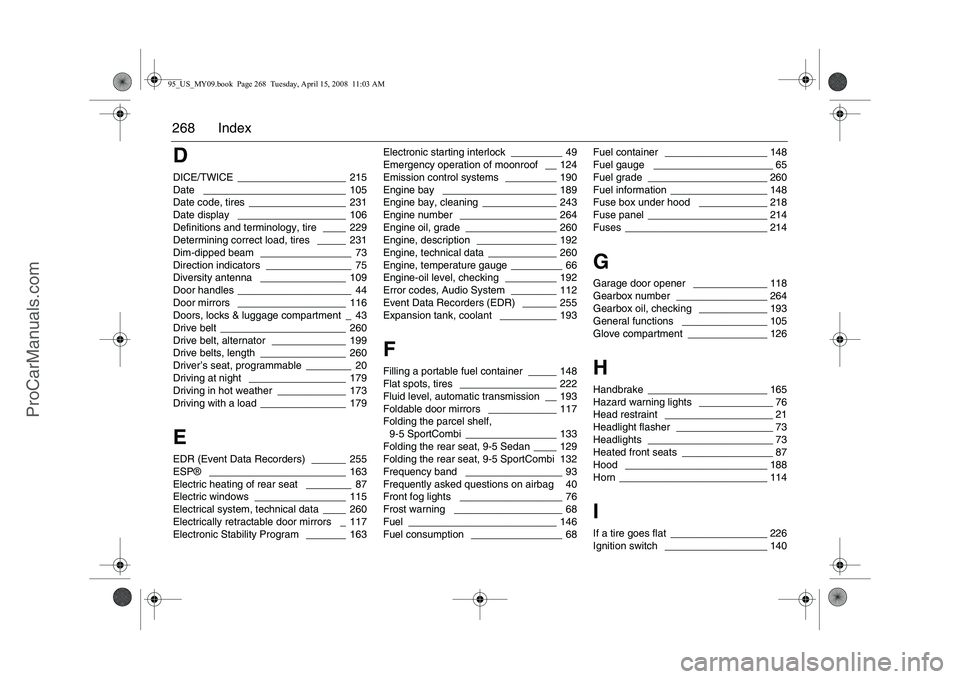
268 IndexDDICE/TWICE
___________________ 215
Date
_________________________ 105
Date code, tires
_________________ 231
Date display
___________________ 106
Definitions and terminology, tire
____ 229
Determining correct load, tires
_____ 231
Dim-dipped beam
________________ 73
Direction indicators _______________ 75
Diversity antenna
_______________ 109
Door handles
____________________ 44
Door mirrors ___________________ 116
Doors, locks & luggage compartment
_43
Drive belt
______________________ 260
Drive belt, alternator
_____________ 199
Drive belts, length
_______________ 260
Driver’s seat, programmable
________ 20
Driving at night
_________________ 179
Driving in hot weather
____________ 173
Driving with a load
_______________ 179
EEDR (Event Data Recorders)
______ 255
ESP®
________________________ 163
Electric heating of rear seat
________ 87
Electric windows
________________ 115
Electrical system, technical data
____ 260
Electrically retractable door mirrors _117
Electronic Stability Program
_______ 163Electronic starting interlock
_________ 49
Emergency operation of moonroof
__ 124
Emission control systems
_________ 190
Engine bay
____________________ 189
Engine bay, cleaning
_____________ 243
Engine number
_________________ 264
Engine oil, grade ________________ 260
Engine, description ______________ 192
Engine, technical data ____________ 260
Engine, temperature gauge
_________ 66
Engine-oil level, checking
_________ 192
Error codes, Audio System ________ 112
Event Data Recorders (EDR) ______ 255
Expansion tank, coolant
__________ 193
FFilling a portable fuel container
_____ 148
Flat spots, tires
_________________ 222
Fluid level, automatic transmission
__ 193
Foldable door mirrors
____________ 117
Folding the parcel shelf,
9-5 SportCombi
________________ 133
Folding the rear seat, 9-5 Sedan
____ 129
Folding the rear seat, 9-5 SportCombi
132
Frequency band
_________________ 93
Frequently asked questions on airbag
40
Front fog lights
__________________ 76
Frost warning
___________________ 68
Fuel
__________________________ 146
Fuel consumption
________________ 68Fuel container
__________________ 148
Fuel gauge
_____________________ 65
Fuel grade _____________________ 260
Fuel information
_________________ 148
Fuse box under hood
____________ 218
Fuse panel
_____________________ 214
Fuses
_________________________ 214
GGarage door opener
_____________ 118
Gearbox number
________________ 264
Gearbox oil, checking
____________ 193
General functions
_______________ 105
Glove compartment ______________ 126
HHandbrake
_____________________ 165
Hazard warning lights
_____________ 76
Head restraint
___________________ 21
Headlight flasher _________________ 73
Headlights
______________________ 73
Heated front seats
________________ 87
Hood
_________________________ 188
Horn __________________________ 114
IIf a tire goes flat
_________________ 226
Ignition switch
__________________ 140
95_US_MY09.book Page 268 Tuesday, April 15, 2008 11:03 AM
ProCarManuals.com