lock SAAB 9-5 2009 Workshop Manual
[x] Cancel search | Manufacturer: SAAB, Model Year: 2009, Model line: 9-5, Model: SAAB 9-5 2009Pages: 272, PDF Size: 21.53 MB
Page 165 of 272
165 Starting and driving
Parking brake
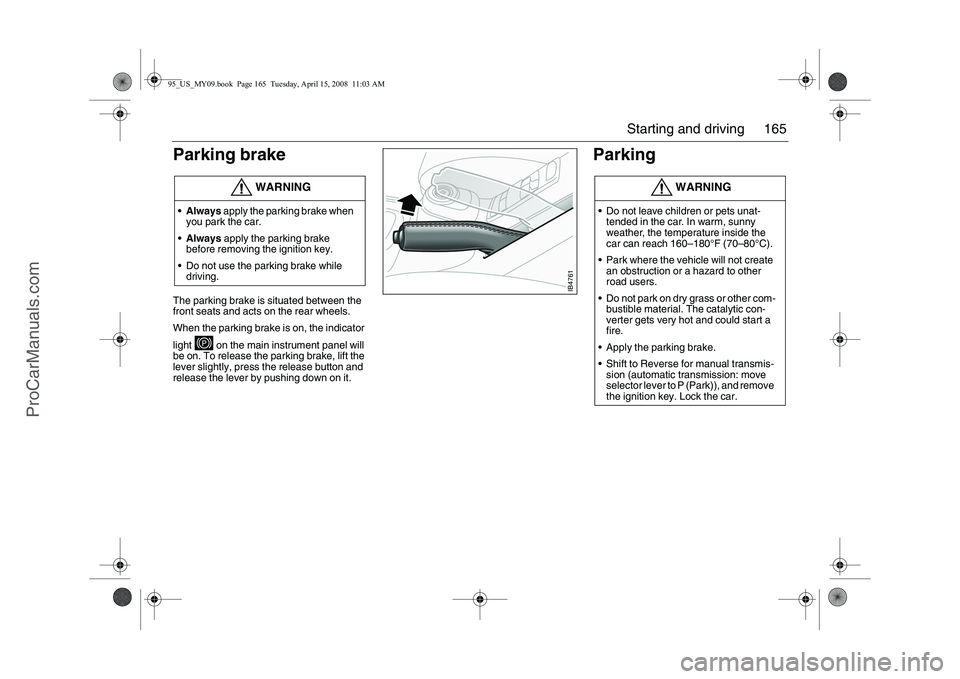
The parking brake is situated between the
front seats and acts on the rear wheels.
When the parking brake is on, the indicator
light on the main instrument panel will
be on. To release the parking brake, lift the
lever slightly, press the release button and
release the lever by pushing down on it.
Parking
WARNING
Always apply the parking brake when
you park the car.
Always apply the parking brake
before removing the ignition key.
Do not use the parking brake while
driving.
WARNING
Do not leave children or pets unat-
tended in the car. In warm, sunny
weather, the temperature inside the
car can reach 160–180°F (70–80°C).
Park where the vehicle will not create
an obstruction or a hazard to other
road users.
Do not park on dry grass or other com-
bustible material. The catalytic con-
verter gets very hot and could start a
fire.
Apply the parking brake.
Shift to Reverse for manual transmis-
sion (automatic transmission: move
selector lever to P (Park)), and remove
the ignition key. Lock the car.
IB4761
95_US_MY09.book Page 165 Tuesday, April 15, 2008 11:03 AM
ProCarManuals.com
Page 166 of 272
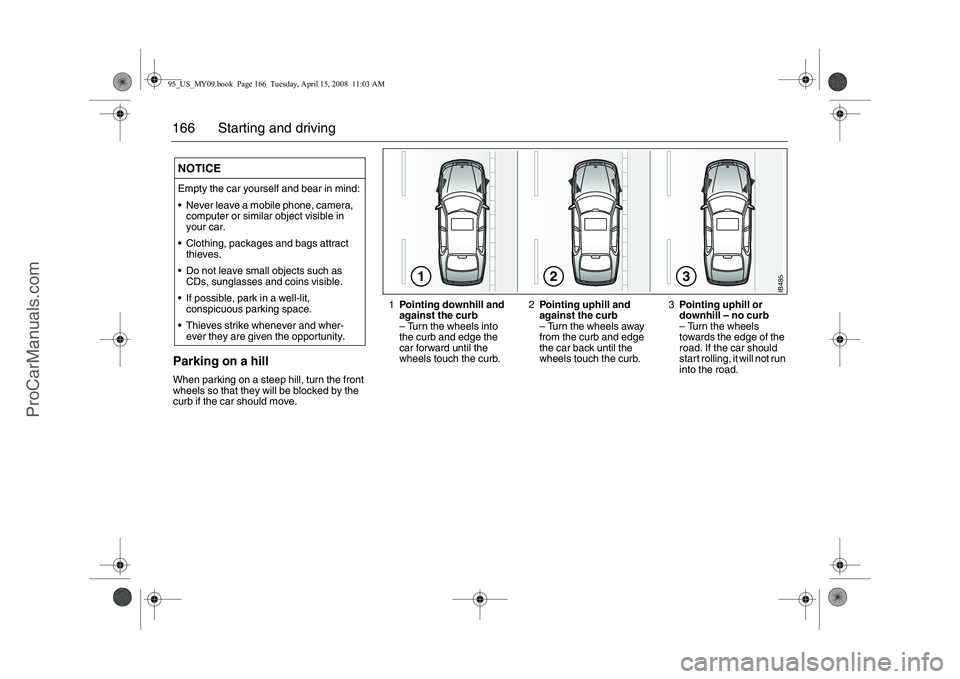
166 Starting and drivingParking on a hillWhen parking on a steep hill, turn the front
wheels so that they will be blocked by the
curb if the car should move. NOTICEEmpty the car yourself and bear in mind:
Never leave a mobile phone, camera,
computer or similar object visible in
your car.
Clothing, packages and bags attract
thieves.
Do not leave small objects such as
CDs, sunglasses and coins visible.
If possible, park in a well-lit,
conspicuous parking space.
Thieves strike whenever and wher-
ever they are given the opportunity.
123
IB485
1Pointing downhill and
against the curb
– Turn the wheels into
the curb and edge the
car forward until the
wheels touch the curb.2Pointing uphill and
against the curb
– Turn the wheels away
from the curb and edge
the car back until the
wheels touch the curb.3Pointing uphill or
downhill – no curb
– Turn the wheels
towards the edge of the
road. If the car should
start rolling, it will not run
into the road.
95_US_MY09.book Page 166 Tuesday, April 15, 2008 11:03 AM
ProCarManuals.com
Page 167 of 272
167 Starting and driving
Long-term parkingIf the car is not going to be used for some
time, e.g. 3–4 months, the following steps
are recommended:
Run the engine to normal temperature
before long-term parking.
Drain the washer-fluid reservoir and
hoses.
Wash and wax the car. Clean the rubber
seals on the hood, luggage compartment
lid and doors, and lubricate them with
glycerol (glycerin).
After washing the car, dry the brake discs
by taking the car out on the road and
applying the brakes a few times. Fill the fuel tank with fuel to prevent
condensation forming in it.
Top up the coolant and check the anti-
freeze before the onset of winter.
Park the car in a dry, covered and
well-ventilated building. Leave the park-
ing brake OFF!
Disconnect the negative (–) battery lead.
If frost is likely to occur during the
long-term parking, remove the battery
and store it away from the frost.
Ideally, the car should be put up on
blocks, with the wheels off the ground. If
this is not possible, inflate the tires to
about 43 psi (300 kPa).
Leave all the windows open a crack and
cover the car with a fabric tarpaulin – not
one made of plastic.95_US_MY09.book Page 167 Tuesday, April 15, 2008 11:03 AM
ProCarManuals.com
Page 172 of 272
172 Starting and drivingEngine block heater3The following are just some of the benefits
to the car and the environment of using an
engine block heater:
Lower fuel consumption.
Exhaust emissions substantially reduced
over short runs.
Reduced wear on the engine.
Inside of car warms up faster.
The engine heater is effective at outside
temperatures up to 58–68°F (+15–20°C).
The warmer it is outside, the shorter the time
the engine heater needs to be connected.
Longer than 1.5 hours is unnecessary.
If the car is equipped with a removable,
electrical cabin heater that is not in use, this
should be stored in the luggage compart-
ment.
Driving in cold weatherBefore starting a journey in cold weather
you should check the following:
That the wiper blades have not become
frozen to the windshield/glass.
Brush any snow away from the air intake
for the heater system (opening between
hood and windshield).
It may be advisable to lubricate the
door-lock cylinder (use molybdenum
disulphide, MoS
2) to prevent its freezing.
If the lock has frozen, take care not to
break the key (or use the remote control)
– heat it first or spray it with de-icer.
Periodically during the winter, add gaso-
line anti-freeze to the fuel to dispel any
condensation in the fuel tank which could
freeze and cause problems in the system.
Keep the tank well filled to reduce the risk
of condensation forming.
If the car is parked outside in freezing
weather, fuel additives (gasoline
anti-freeze) will not do any good as it
cannot remove water that has already
frozen. Park the car in a warm place so
that any ice that may have built up melts,
then add gasoline anti-freeze when filling
up the tank. Condensation is caused by
changes in the outdoor temperature or by
the car being parked alternately in a
garage and outside. It is particularly important when the roads
are slippery that the brakes and tires be in
good condition.
Check the anti-freeze in the engine cool-
ant, see page 193.
The car´s trip computer will warn you when
there is a risk of slippery conditions. For fur-
ther information on this function, see
page 68.
The car is equipped with tires designed to
provide optimum grip on both wet and dry
roads, although this has been achieved at
the expense of somewhat reduced grip on
snow and ice. For regular driving on snow
and ice, we therefore recommend that
winter (snow) tires be fitted.
Winter (snow) tires, particularly studded
tires (where use is legally permitted), gener-
ally make driving safer on snow and ice.
Acquaint yourself with the legal provi-
sions governing the use of different
types of winter tires and snow chains.
Studded tires are not allowed in some
countries.
95_US_MY09.book Page 172 Tuesday, April 15, 2008 11:03 AM
ProCarManuals.com
Page 173 of 272
173 Starting and driving
If winter tires are fitted, the same type must
be fitted on all wheels. Your Saab dealer will
be pleased to advise you on the best tires for
your car.
Remember that tires age. It may therefore
be necessary to change them before they
reach the legal wear limit, as they gradually
lose their friction properties.
The best response if the car gets into a
front-wheel skid is to freewheel (manual
gearbox only), i.e. disengage the clutch (so
that the wheels are neither driven or
retarded by the engine.
If the car has automatic transmission, ease
up on the accelerator and steer carefully in
the desired direction.
In a rear-wheel skid, steer in the same direc-
tion that the rear of the car is moving.
Tire chains3If you want to fit tire chains (where legally
permitted) they should only be fitted to the
tires recommended under ”Specifications”
(see page 261).
Consult your Saab dealer for details of
approved tire chains.
Driving in hot weatherAlways check the coolant level before start-
ing a journey. When the engine is cold, the
coolant shall lie on or just above the
KALT/COLD mark on the expansion tank..
At the end of a journey, if the engine has
worked hard, allow it to idle for two or three
minutes before switching it off.
If the needle on the temperature gauge
enters the red zone:
1 Bring the car to a standstill but leave the
engine running. Do not remove the cap
on the expansion tank even if the tank is
empty. If the needle on the temperature
gauge continues to rise while the engine
is idling, switch off the engine.
WARNING
Do not exceed 30 mph (50 km/h)
when tire chains are fitted.
Tire chains can reduce the directional
stability of the car.
Tire chains must not be used on the
rear wheels. NOTICE Check the links frequently for wear.
Check that the chains do not contact
the wheel-arch liner at full lock.
See section ”Specifications”,
page 261, for information on allowable
wheel dimensions for the fitting of tire
chains.
95_US_MY09.book Page 173 Tuesday, April 15, 2008 11:03 AM
ProCarManuals.com
Page 177 of 272
177 Starting and driving
Recommendations for cars with manual
gearbox
Rises in coolant temperature are indicated
by the temperature gauge in the main instru-
ment panel.
The following steps are taken in order as the
temperature of the engine increases:
A/C compressor is switched off.
engine torque is reduced.
When continuing your journey, select a gear
in which the engine speed is about
3,000 rpm until the incline eases.
Driving considerations Always take extra care when towing a
trailer, as the car’s handling will be different
and its braking effect reduced. The trailer’s
braking system and suspension also have a
considerable effect on these characteris-
tics, see also ”Driving with a load” page 179.
If the car has automatic transmission, select
position D when ascending steep hills. This
ensures that the adaptive gear change pat-
terns are operational, see page 158. Use
position D or L for steep descents.Checks before drivingMake sure that the car and camper or trailer
are in good working order. This is essential
since towing a camper or trailer increases
the strain on the car.
Check and if necessary adjust the tire
pressure of the car and camper or trailer.
Make sure all wheel bolts are properly
tightened.
Make sure that the equipment joining the
car and camper or trailer is properly
secured and adjusted. Make sure the camper or trailer’s electri-
cal cable is properly connected and is not
so long that it drags along the ground.
Also, make sure the cable is not too short
and risks breaking when turning a corner.
Check all bulbs.
Check the car and camper or trailer
brakes.
Make sure that all items on or in the cara-
van or trailer are properly secured.
Make sure that the camper or trailer’s
jockey wheel is raised and locked.
Check the distribution of the load so that
the car and camper or trailer are well
balanced.
Check that the rearview mirrors provide
the best possible rearward vision.
Make sure the camper or trailer’s safety
cable is correctly attached.
WARNING
Utilize the braking effect of the engine
(1st, 2nd or 3rd gear) when you are
descending long or steep hills to spare
the brakes.
Brake failure can result from overheated
brakes!
NOTICEIf the ”Automatic transmission3, fault
indicator” indicator comes on, cease
towing until the problem has been recti-
fied.
95_US_MY09.book Page 177 Tuesday, April 15, 2008 11:03 AM
ProCarManuals.com
Page 200 of 272
200 Car care and technical informationWipers and washersCheck and clean all wiper blades regularly.
If poor wiper performance is experienced,
clean the windshield with a quality glass
cleaner. This is particularly important if the
car has been through an automatic car
wash, as these sometimes leave a wax
coating on the windshield.
If wiper performance is still unsatisfactory,
fit new blades.
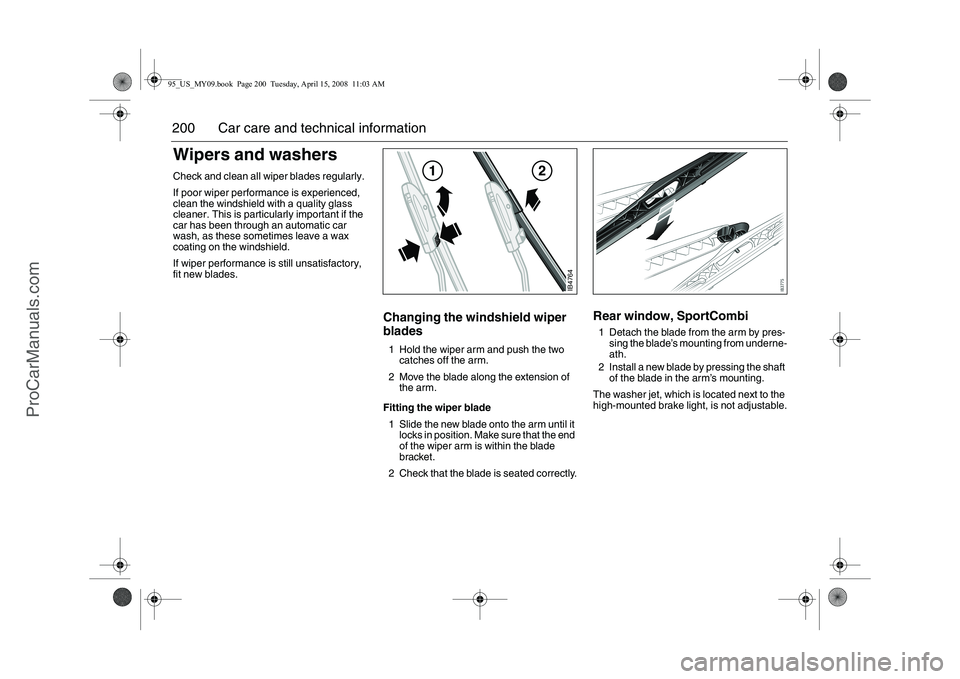
Changing the windshield wiper
blades1 Hold the wiper arm and push the two
catches off the arm.
2 Move the blade along the extension of
the arm.
Fitting the wiper blade
1 Slide the new blade onto the arm until it
locks in position. Make sure that the end
of the wiper arm is within the blade
bracket.
2 Check that the blade is seated correctly.
Rear window, SportCombi1 Detach the blade from the arm by pres-
sing the blade’s mounting from underne-
ath.
2 Install a new blade by pressing the shaft
of the blade in the arm’s mounting.
The washer jet, which is located next to the
high-mounted brake light, is not adjustable.
IB4764
95_US_MY09.book Page 200 Tuesday, April 15, 2008 11:03 AM
ProCarManuals.com
Page 205 of 272
205 Car care and technical information
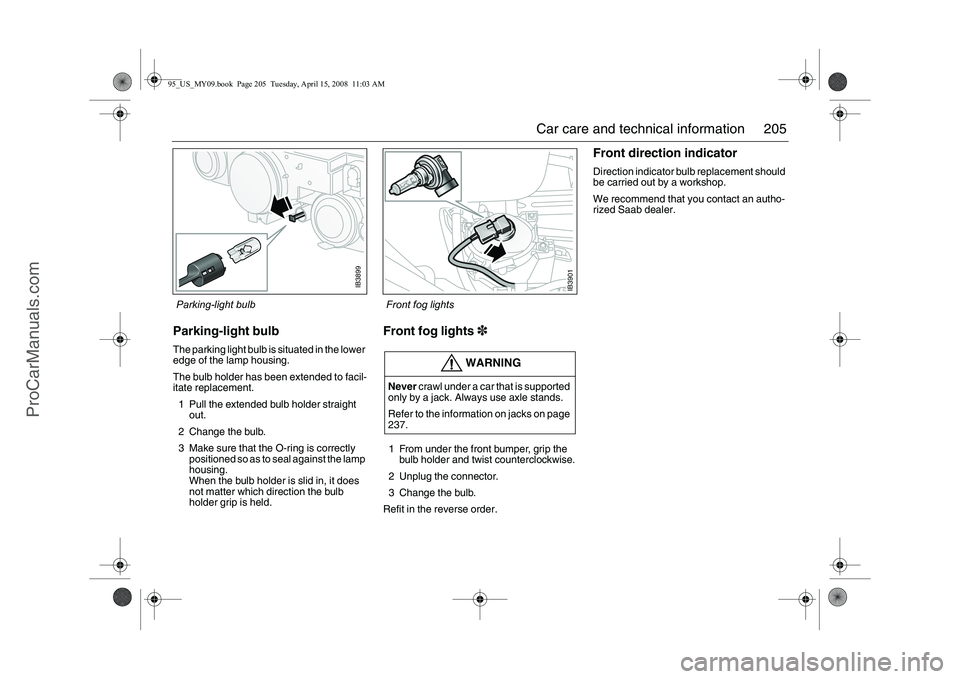
Parking-light bulbThe parking light bulb is situated in the lower
edge of the lamp housing.
The bulb holder has been extended to facil-
itate replacement.
1 Pull the extended bulb holder straight
out.
2 Change the bulb.
3 Make sure that the O-ring is correctly
positioned so as to seal against the lamp
housing.
When the bulb holder is slid in, it does
not matter which direction the bulb
holder grip is held.
Front fog lights31 From under the front bumper, grip the
bulb holder and twist counterclockwise.
2 Unplug the connector.
3 Change the bulb.
Refit in the reverse order.
Front direction indicatorDirection indicator bulb replacement should
be carried out by a workshop.
We recommend that you contact an autho-
rized Saab dealer.
WARNING
Never crawl under a car that is supported
only by a jack. Always use axle stands.
Refer to the information on jacks on page
237.
IB3899
Parking-light bulb
IB3901
Front fog lights
95_US_MY09.book Page 205 Tuesday, April 15, 2008 11:03 AM
ProCarManuals.com
Page 206 of 272
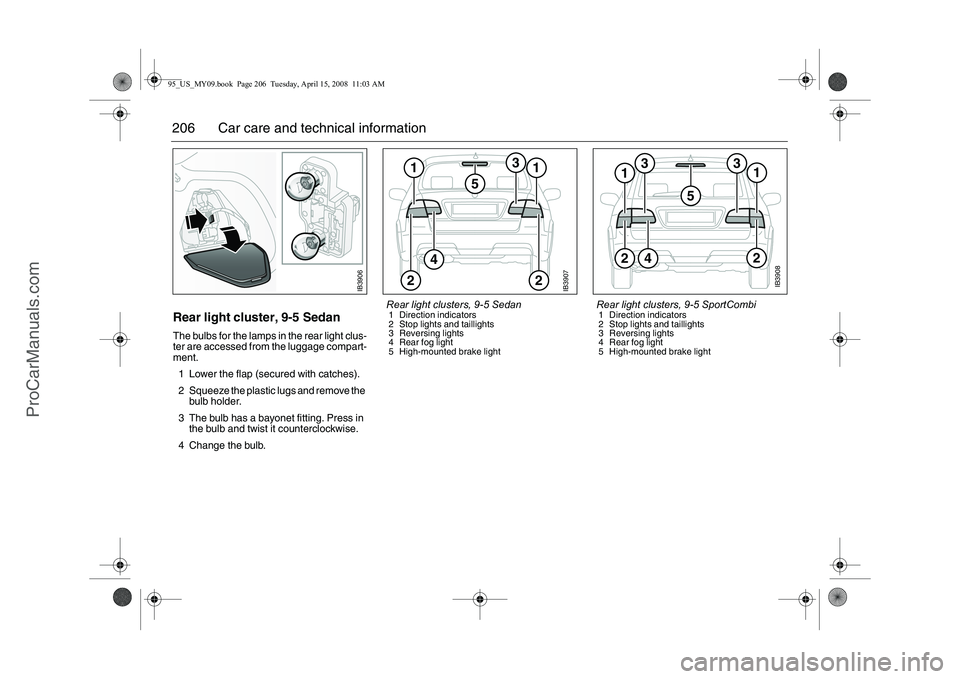
206 Car care and technical informationRear light cluster, 9-5 SedanThe bulbs for the lamps in the rear light clus-
ter are accessed from the luggage compart-
ment.
1 Lower the flap (secured with catches).
2 Squeeze the plastic lugs and remove the
bulb holder.
3 The bulb has a bayonet fitting. Press in
the bulb and twist it counterclockwise.
4 Change the bulb.
IB3906
IB3907
12
4
5
1
3
2
IB3908
1
1
2
4
5
3
3
2
Rear light clusters, 9-5 SportCombi1 Direction indicators
2 Stop lights and taillights
3 Reversing lights
4 Rear fog light
5 High-mounted brake light
Rear light clusters, 9-5 Sedan1 Direction indicators
2 Stop lights and taillights
3 Reversing lights
4 Rear fog light
5 High-mounted brake light
95_US_MY09.book Page 206 Tuesday, April 15, 2008 11:03 AM
ProCarManuals.com
Page 207 of 272
207 Car care and technical information
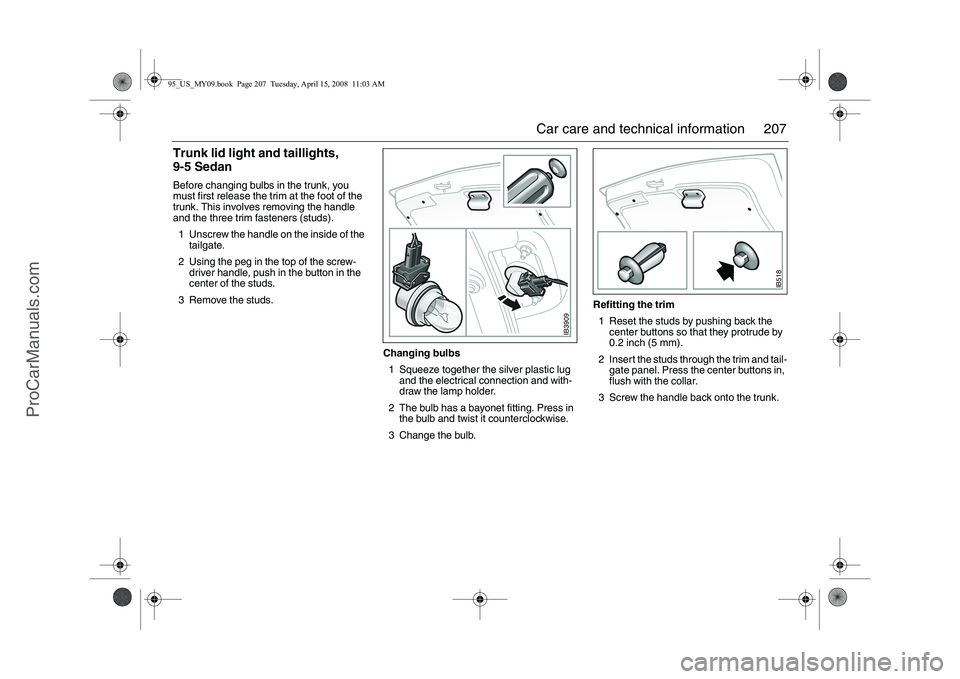
Trunk lid light and taillights,
9-5 SedanBefore changing bulbs in the trunk, you
must first release the trim at the foot of the
trunk. This involves removing the handle
and the three trim fasteners (studs).
1 Unscrew the handle on the inside of the
tailgate.
2 Using the peg in the top of the screw-
driver handle, push in the button in the
center of the studs.
3 Remove the studs.
Changing bulbs
1 Squeeze together the silver plastic lug
and the electrical connection and with-
draw the lamp holder.
2 The bulb has a bayonet fitting. Press in
the bulb and twist it counterclockwise.
3 Change the bulb.Refitting the trim
1 Reset the studs by pushing back the
center buttons so that they protrude by
0.2 inch (5 mm).
2 Insert the studs through the trim and tail-
gate panel. Press the center buttons in,
flush with the collar.
3 Screw the handle back onto the trunk.
IB3909
IB518
95_US_MY09.book Page 207 Tuesday, April 15, 2008 11:03 AM
ProCarManuals.com