service SAAB 9-7X 2007 Workshop Manual
[x] Cancel search | Manufacturer: SAAB, Model Year: 2007, Model line: 9-7X, Model: SAAB 9-7X 2007Pages: 498, PDF Size: 3.13 MB
Page 274 of 498
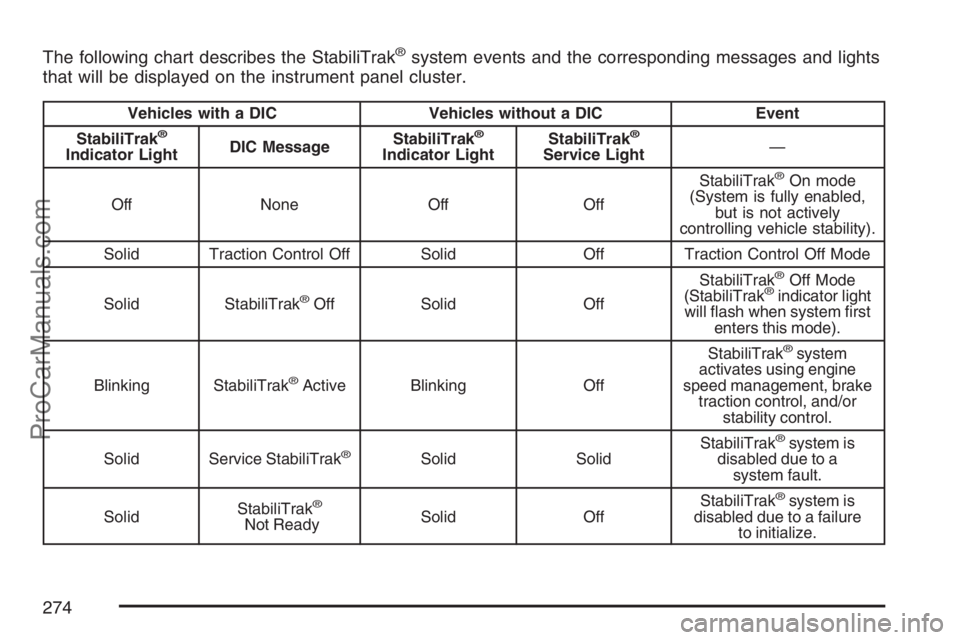
The following chart describes the StabiliTrak®system events and the corresponding messages and lights
that will be displayed on the instrument panel cluster.
Vehicles with a DIC Vehicles without a DIC Event
StabiliTrak
®
Indicator LightDIC MessageStabiliTrak
®
Indicator LightStabiliTrak
®
Service Light—
Off None Off OffStabiliTrak
®On mode
(System is fully enabled,
but is not actively
controlling vehicle stability).
Solid Traction Control Off Solid Off Traction Control Off Mode
Solid StabiliTrak
®Off Solid OffStabiliTrak
®Off Mode
(StabiliTrak®indicator light
will ash when system rst
enters this mode).
Blinking StabiliTrak
®Active Blinking OffStabiliTrak
®system
activates using engine
speed management, brake
traction control, and/or
stability control.
Solid Service StabiliTrak
®Solid SolidStabiliTrak
®system is
disabled due to a
system fault.
SolidStabiliTrak
®
Not ReadySolid OffStabiliTrak
®system is
disabled due to a failure
to initialize.
274
ProCarManuals.com
Page 275 of 498
Notice:If the StabiliTrak®light comes on due
to heavy braking and/or because the traction
control system has been continuously active,
do not allow the wheel(s) of one axle to spin
excessively. If you do, you may be causing
damage to the transfer case. This could lead to
costly repairs not covered by your warranty.
Notice:If you allow the wheel(s) of one axle to
spin excessively while the StabiliTrak
®, ABS
and brake warning lights and the SERVICE
STABILITRAK message are displayed, you
could damage the transfer case. The repairs
would not be covered by your warranty. Reduce
engine power and do not spin the wheel(s)
excessively while these lights and this message
are displayed.
StabiliTrak
®may activate on dry or rough roads or
under conditions such as heavy acceleration
while turning or abrupt upshifts/downshifts of the
transmission. When this happens, you may
notice a reduction in acceleration, or may hear a
noise or vibration. This is normal.
If your vehicle is in cruise control when the system
activates, the StabiliTrak
®light will blink, and
the cruise control will automatically disengage.When road conditions allow, you may re-engage
the cruise control. SeeCruise Control on page 156.
StabiliTrak
®will turn off automatically if a problem
is detected in the system. The StabiliTrak®
light will come on and SERVICE STABILITRAK
will be displayed on the DIC. For vehicles without a
DIC, the StabiliTrak
®light and the StabiliTrak®
service light will both come on. If the SERVICE
STABILITRAK message (or StabiliTrak®service
light) does not clear itself after restarting the
vehicle, you should see your dealer for service.
Adding non-GM accessories can affect your
vehicle’s performance. SeeAccessories and
Modications on page 322for more information.
All-Wheel Drive (AWD) System
Your vehicle has this feature. There is no lever or
switch to engage or disengage the front axle. It
is fully automatic and adjusts as needed for
road conditions. Your vehicle has an active
transfer case allowing two-wheel-drive operation
on dry roads. The transfer case will shift
automatically into all-wheel drive on slippery
surfaces. You may feel an extra shift when the
all-wheel drive engages.
275
ProCarManuals.com
Page 281 of 498
Off-Road Driving
Your vehicle does not have features like added
ground clearance, special underbody shielding, and
a transfer case low gear range, things that are
necessary for extended or severe off-road service.
You should not drive off-road unless you are on a
level, solid surface.
Driving at Night
Night driving is more dangerous than day driving.
One reason is that some drivers are likely to
be impaired — by alcohol or drugs, with night
vision problems, or by fatigue.
Here are some tips on night driving.
Drive defensively.
Do not drink and drive.
Adjust the inside rearview mirror to reduce the
glare from headlamps behind you.
Since you cannot see as well, you may need
to slow down and keep more space between
you and other vehicles.
Slow down, especially on higher speed roads.
Your vehicle’s headlamps can light up only so
much road ahead.
In remote areas, watch for animals.
If you are tired, pull off the road in a safe
place and rest.
No one can see as well at night as in the daytime.
But as we get older these differences increase.
A 50-year-old driver may require at least twice as
much light to see the same thing at night as a
20-year-old.
What you do in the daytime can also affect your
night vision. For example, if you spend the
day in bright sunshine you are wise to wear
sunglasses. Your eyes will have less trouble
adjusting to night. But if you are driving, do not
wear sunglasses at night. They may cut down on
glare from headlamps, but they also make a
lot of things invisible.
281
ProCarManuals.com
Page 287 of 498
Once you are moving on the freeway, make
certain you allow a reasonable following distance.
Expect to move slightly slower at night.
When you want to leave the freeway, move to the
proper lane well in advance. If you miss your
exit, do not, under any circumstances, stop and
back up. Drive on to the next exit.
The exit ramp can be curved, sometimes quite
sharply. The exit speed is usually posted.
Reduce your speed according to your
speedometer, not to your sense of motion.
After driving for any distance at higher speeds,
you may tend to think you are going slower than
you actually are.
Before Leaving on a Long Trip
Make sure you are ready. Try to be well rested.
If you must start when you are not fresh — such as
after a day’s work — do not plan to make too
many miles that rst part of the journey. Wear
comfortable clothing and shoes you can easily
drive in.Is your vehicle ready for a long trip? If you keep it
serviced and maintained, it is ready to go. If it needs
service, have it done before starting out. Of course,
you will nd experienced and able service experts
in dealerships all across North America. They will
be ready and willing to help if you need it.
Here are some things you can check before a trip:
Windshield Washer Fluid:Is the reservoir
full? Are all windows clean inside and outside?
Wiper Blades:Are they in good shape?
Fuel, Engine Oil, Other Fluids:Have you
checked all levels?
Lamps:Are they all working? Are the lenses
clean?
Tires:They are vitally important to a safe,
trouble-free trip. Is the tread good enough
for long-distance driving? Are the tires
all inated to the recommended pressure?
Weather Forecasts:What is the weather
outlook along your route? Should you
delay your trip a short time to avoid a major
storm system?
Maps:Do you have up-to-date maps?
287
ProCarManuals.com
Page 288 of 498
Highway Hypnosis
Is there actually such a condition as highway
hypnosis? Or is it just plain falling asleep at the
wheel? Call it highway hypnosis, lack of
awareness, or whatever.
There is something about an easy stretch of road
with the same scenery, along with the hum of the
tires on the road, the drone of the engine, and the
rush of the wind against the vehicle that can make
you sleepy. Do not let it happen to you! If it does,
your vehicle can leave the road in less than a
second, and you could crash and be injured.
What can you do about highway hypnosis?
First, be aware that it can happen.
Then here are some tips:
Make sure your vehicle is well ventilated,
with a comfortably cool interior.
Keep your eyes moving. Scan the road ahead
and to the sides. Check your mirrors and your
instruments frequently.
If you get sleepy, pull off the road into a
rest, service, or parking area and take a nap,
get some exercise, or both. For safety, treat
drowsiness on the highway as an emergency.
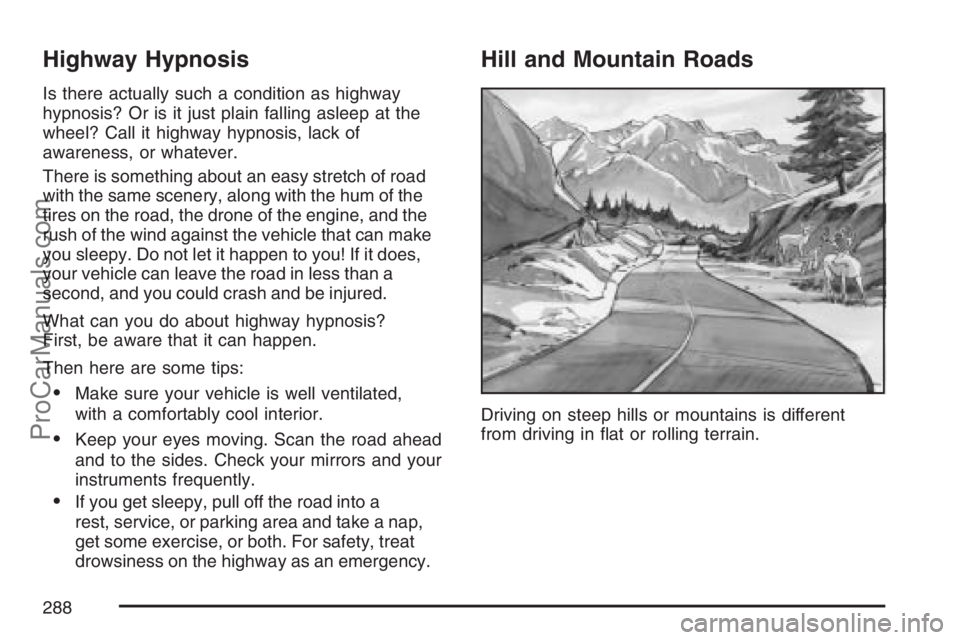
Hill and Mountain Roads
Driving on steep hills or mountains is different
from driving in at or rolling terrain.
288
ProCarManuals.com
Page 302 of 498
If you put things inside your vehicle like suitcases,
tools, packages, or anything else they will go
as fast as the vehicle goes. If you have to stop or
turn quickly, or if there is a crash, they will
keep going.
{CAUTION:
Things you put inside your vehicle can
strike and injure people in a sudden stop
or turn, or in a crash.
Put things in the cargo area of your
vehicle. Try to spread the weight
evenly.
Never stack heavier things, like
suitcases, inside the vehicle so that
some of them are above the tops of
the seats.
Do not leave an unsecured child
restraint in your vehicle.
When you carry something inside the
vehicle, secure it whenever you can.
Do not leave a seat folded down
unless you need to.
Towing
Towing Your Vehicle
Consult your dealer or a professional towing
service if you need to have your disabled vehicle
towed. SeeRoadside Assistance Program on
page 469.
If you want to tow your vehicle behind another
vehicle for recreational purposes (such as behind
a motorhome), see “Recreational Vehicle
Towing” following.
Recreational Vehicle Towing
Recreational vehicle towing means towing your
vehicle behind another vehicle — such as behind
a motorhome. The two most common types of
recreational vehicle towing are known as “dinghy
towing” (towing your vehicle with all four wheels
on the ground) and “dolly towing” (towing
your vehicle with two wheels on the ground and
two wheels up on a device known as a “dolly”).
302
ProCarManuals.com
Page 304 of 498
Overload Protection
The air suspension system is equipped with
overload protection. Overload protection is
designed to protect the air suspension system,
and it is an indicator to the driver that the
vehicle is overloaded. When the overload
protection mode is on, it will not allow damage to
the air compressor. However, do not overload
the vehicle. SeeLoading Your Vehicle on
page 296.
If the suspension remains at a low height,
the rear axle load has exceeded GAWR
(Gross Axle Weight Rating). When the overload
protection mode is activated, the compressor
operates for about 30 seconds to one minute
without raising the vehicle depending on the
amount of overload. This will continue each time
the ignition is turned on until the rear axle load
is reduced below GAWR.
Indicator Light
The indicator light on the inator switch in the
rear passenger compartment also serves as an
indicator for internal system error. If the indicator
light is ashing without the load leveling function
or the inator being active, turn off the ignition.
The next day turn on the ignition and check
the indicator light. The vehicle can be driven with
the light ashing, but if it is you should have
the vehicle serviced as soon as possible.
304
ProCarManuals.com
Page 317 of 498
Maintenance When Trailer Towing
Your vehicle will need service more often when
you’re pulling a trailer. See the Maintenance
Schedule for more on this. Things that are
especially important in trailer operation are
automatic transmission uid (don’t overll), engine
oil, axle lubricant, belt(s), cooling system and
brake system. Each of these is covered in
this manual, and the Index will help you nd them
quickly. If you’re trailering, it’s a good idea to
review these sections before you start your trip.
Check periodically to see that all hitch nuts
and bolts are tight.
Trailer Wiring Harness
Your vehicle is equipped with a seven-wire trailer
towing harness. This harness has a seven-pin
universal heavy-duty trailer connector (if equipped
with the trailering package) that is attached to a
bracket on the hitch platform. If your vehicle is not
equipped with the heavy-duty trailer connector,
you can purchase one from your Saab dealer.The seven-wire harness contains the following
trailer circuits:
Yellow: Left Stop/Turn Signal
Dark Green: Right Stop/Turn Signal
Brown: Running Lamps
White: Ground
Light Green: Back-up Lamps
Dark Blue: Electric Brakes
Red: Battery Feed (The chassis wiring ring
terminal must be fastened to a stud on the
underhood electrical center before the
trailer feed will become active.)
If you need to tow a light-duty trailer with a standard
four-way round pin connector, an adapter connector
is available from your dealer.
If you are charging a remote (non-vehicle) battery,
turn on the headlamps to boost the vehicle
system voltage and properly charge the battery.
Your vehicle is also equipped with wiring for an
electric trailer brake controller. These wires are
located inside the vehicle on the driver’s side under
the instrument panel. These wires should be
connected to an electric trailer brake controller by
your dealer or a qualied service center.
317
ProCarManuals.com
Page 319 of 498
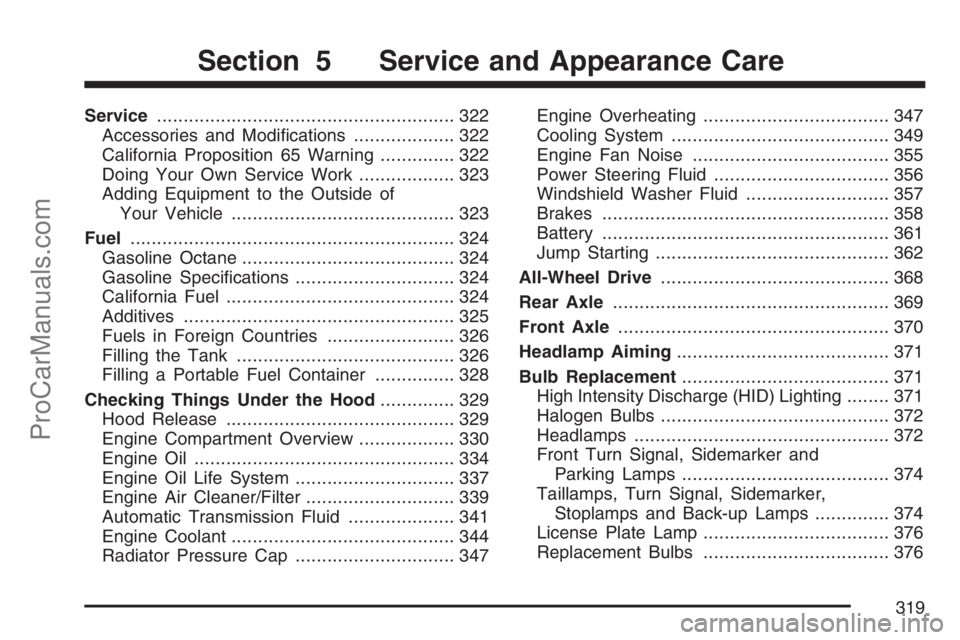
Service........................................................ 322
Accessories and Modications................... 322
California Proposition 65 Warning.............. 322
Doing Your Own Service Work.................. 323
Adding Equipment to the Outside of
Your Vehicle.......................................... 323
Fuel............................................................. 324
Gasoline Octane........................................ 324
Gasoline Specications.............................. 324
California Fuel........................................... 324
Additives................................................... 325
Fuels in Foreign Countries........................ 326
Filling the Tank......................................... 326
Filling a Portable Fuel Container............... 328
Checking Things Under the Hood.............. 329
Hood Release........................................... 329
Engine Compartment Overview.................. 330
Engine Oil................................................. 334
Engine Oil Life System.............................. 337
Engine Air Cleaner/Filter............................ 339
Automatic Transmission Fluid.................... 341
Engine Coolant.......................................... 344
Radiator Pressure Cap.............................. 347Engine Overheating................................... 347
Cooling System......................................... 349
Engine Fan Noise..................................... 355
Power Steering Fluid ................................. 356
Windshield Washer Fluid........................... 357
Brakes...................................................... 358
Battery...................................................... 361
Jump Starting............................................ 362
All-Wheel Drive........................................... 368
Rear Axle.................................................... 369
Front Axle................................................... 370
Headlamp Aiming........................................ 371
Bulb Replacement....................................... 371
High Intensity Discharge (HID) Lighting........ 371
Halogen Bulbs........................................... 372
Headlamps................................................ 372
Front Turn Signal, Sidemarker and
Parking Lamps....................................... 374
Taillamps, Turn Signal, Sidemarker,
Stoplamps and Back-up Lamps.............. 374
License Plate Lamp................................... 376
Replacement Bulbs................................... 376
Section 5 Service and Appearance Care
319
ProCarManuals.com
Page 320 of 498
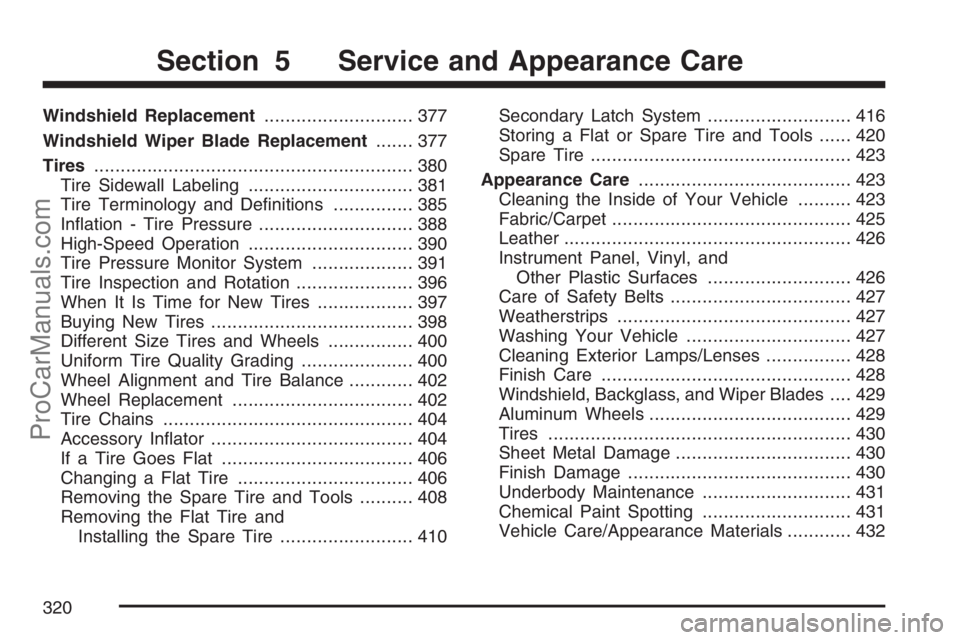
Windshield Replacement............................ 377
Windshield Wiper Blade Replacement....... 377
Tires............................................................ 380
Tire Sidewall Labeling............................... 381
Tire Terminology and Denitions............... 385
Ination - Tire Pressure............................. 388
High-Speed Operation............................... 390
Tire Pressure Monitor System................... 391
Tire Inspection and Rotation...................... 396
When It Is Time for New Tires.................. 397
Buying New Tires...................................... 398
Different Size Tires and Wheels................ 400
Uniform Tire Quality Grading..................... 400
Wheel Alignment and Tire Balance............ 402
Wheel Replacement.................................. 402
Tire Chains............................................... 404
Accessory Inator...................................... 404
If a Tire Goes Flat.................................... 406
Changing a Flat Tire................................. 406
Removing the Spare Tire and Tools.......... 408
Removing the Flat Tire and
Installing the Spare Tire......................... 410Secondary Latch System........................... 416
Storing a Flat or Spare Tire and Tools...... 420
Spare Tire................................................. 423
Appearance Care........................................ 423
Cleaning the Inside of Your Vehicle.......... 423
Fabric/Carpet............................................. 425
Leather...................................................... 426
Instrument Panel, Vinyl, and
Other Plastic Surfaces........................... 426
Care of Safety Belts.................................. 427
Weatherstrips............................................ 427
Washing Your Vehicle............................... 427
Cleaning Exterior Lamps/Lenses................ 428
Finish Care............................................... 428
Windshield, Backglass, and Wiper Blades.... 429
Aluminum Wheels...................................... 429
Tires......................................................... 430
Sheet Metal Damage................................. 430
Finish Damage.......................................... 430
Underbody Maintenance............................ 431
Chemical Paint Spotting............................ 431
Vehicle Care/Appearance Materials............ 432
Section 5 Service and Appearance Care
320
ProCarManuals.com