remote start SAAB 9-7X 2009 User Guide
[x] Cancel search | Manufacturer: SAAB, Model Year: 2009, Model line: 9-7X, Model: SAAB 9-7X 2009Pages: 424, PDF Size: 2.75 MB
Page 213 of 424
Problem Recommended Action
In auxiliary mode, the
picture moves or scrolls.Check the auxiliary input
connections at both
devices. Change the
Video Format to PAL or
NTSC. See “Stereo RCA
Jacks” previously for
how to change the video
format.
The language in the audio
or on the screen is wrong.Check the audio or
language selection in the
main DVD menu.
The remote control
does not work.Check to make sure there
is no obstruction between
the remote control and the
transmitter window.
Check the batteries to
make sure they are not
dead or installed
incorrectly.
The parental control
button might have been
turned on. The power
indicator light will ash.Problem Recommended Action
After stopping the player,
I push Play but
sometimes the DVD
starts where I left off
and sometimes at the
beginning.If the stop button was
pressed one time, the
DVD player will resume
playing where the DVD
was stopped. If the stop
button was pressed two
times the DVD player will
begin to play from the
beginning of the DVD.
The auxiliary source is
running but there is no
picture or sound.Check that the DVD
player is in the auxiliary
source mode.
Check the auxiliary input
connections at both
devices.
My disc is stuck in the
player. The Load/Eject
button does not work.Turn the DVD power off,
then on, then press the
load/eject button on the
DVD player.
Do not attempt to forcibly
remove the disc from the
DVD player. This could
permanently damage the
disc and DVD player.
3-93
ProCarManuals.com
Page 273 of 424
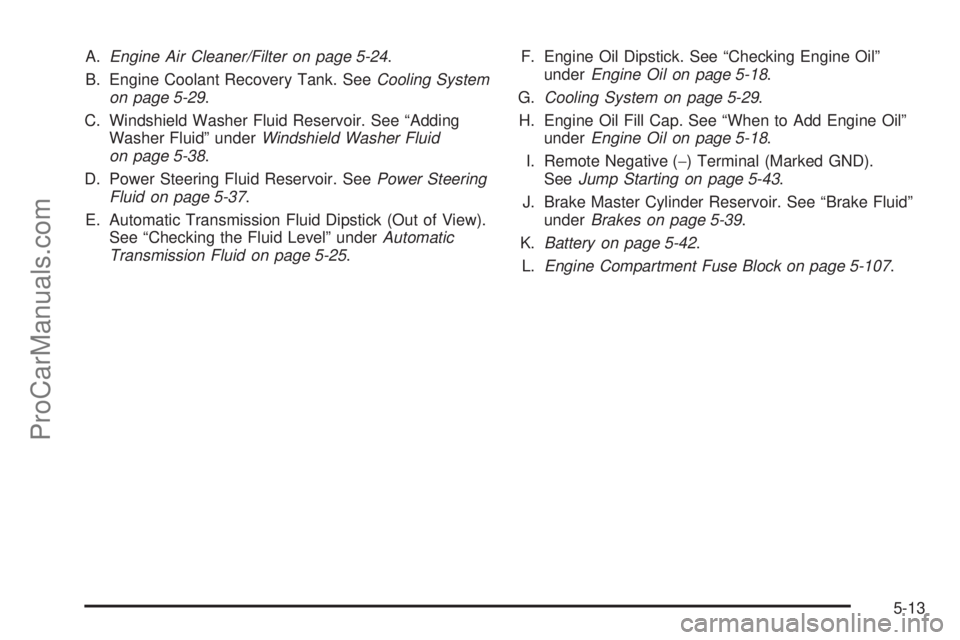
A.Engine Air Cleaner/Filter on page 5-24.
B. Engine Coolant Recovery Tank. SeeCooling System
on page 5-29.
C. Windshield Washer Fluid Reservoir. See “Adding
Washer Fluid” underWindshield Washer Fluid
on page 5-38.
D. Power Steering Fluid Reservoir. SeePower Steering
Fluid on page 5-37.
E. Automatic Transmission Fluid Dipstick (Out of View).
See “Checking the Fluid Level” underAutomatic
Transmission Fluid on page 5-25.F. Engine Oil Dipstick. See “Checking Engine Oil”
underEngine Oil on page 5-18.
G.Cooling System on page 5-29.
H. Engine Oil Fill Cap. See “When to Add Engine Oil”
underEngine Oil on page 5-18.
I. Remote Negative (−) Terminal (Marked GND).
SeeJump Starting on page 5-43.
J. Brake Master Cylinder Reservoir. See “Brake Fluid”
underBrakes on page 5-39.
K.Battery on page 5-42.
L.Engine Compartment Fuse Block on page 5-107.
5-13
ProCarManuals.com
Page 275 of 424
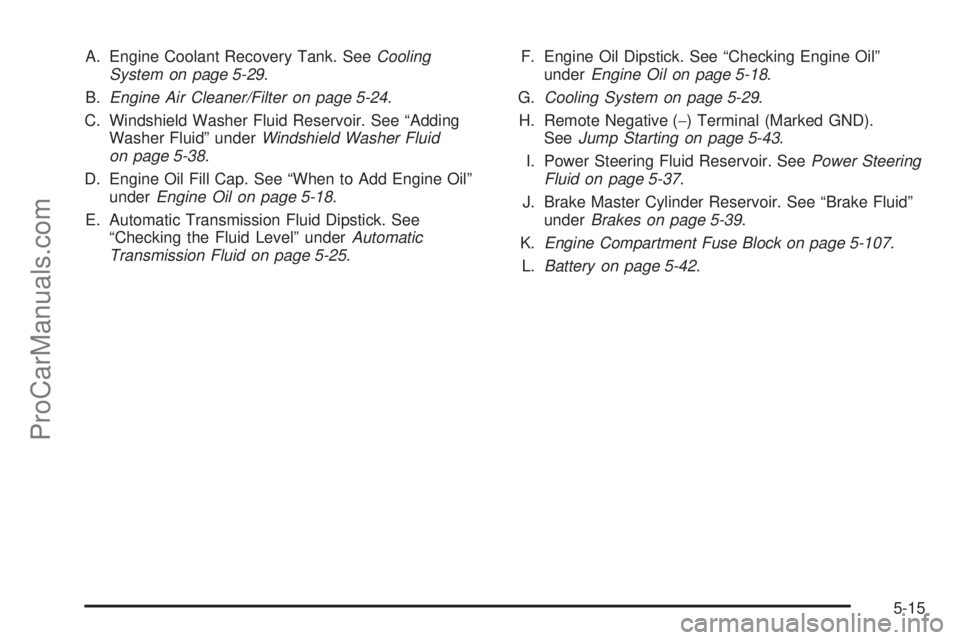
A. Engine Coolant Recovery Tank. SeeCooling
System on page 5-29.
B.Engine Air Cleaner/Filter on page 5-24.
C. Windshield Washer Fluid Reservoir. See “Adding
Washer Fluid” underWindshield Washer Fluid
on page 5-38.
D. Engine Oil Fill Cap. See “When to Add Engine Oil”
underEngine Oil on page 5-18.
E. Automatic Transmission Fluid Dipstick. See
“Checking the Fluid Level” underAutomatic
Transmission Fluid on page 5-25.F. Engine Oil Dipstick. See “Checking Engine Oil”
underEngine Oil on page 5-18.
G.Cooling System on page 5-29.
H. Remote Negative (−) Terminal (Marked GND).
SeeJump Starting on page 5-43.
I. Power Steering Fluid Reservoir. SeePower Steering
Fluid on page 5-37.
J. Brake Master Cylinder Reservoir. See “Brake Fluid”
underBrakes on page 5-39.
K.Engine Compartment Fuse Block on page 5-107.
L.Battery on page 5-42.
5-15
ProCarManuals.com
Page 277 of 424
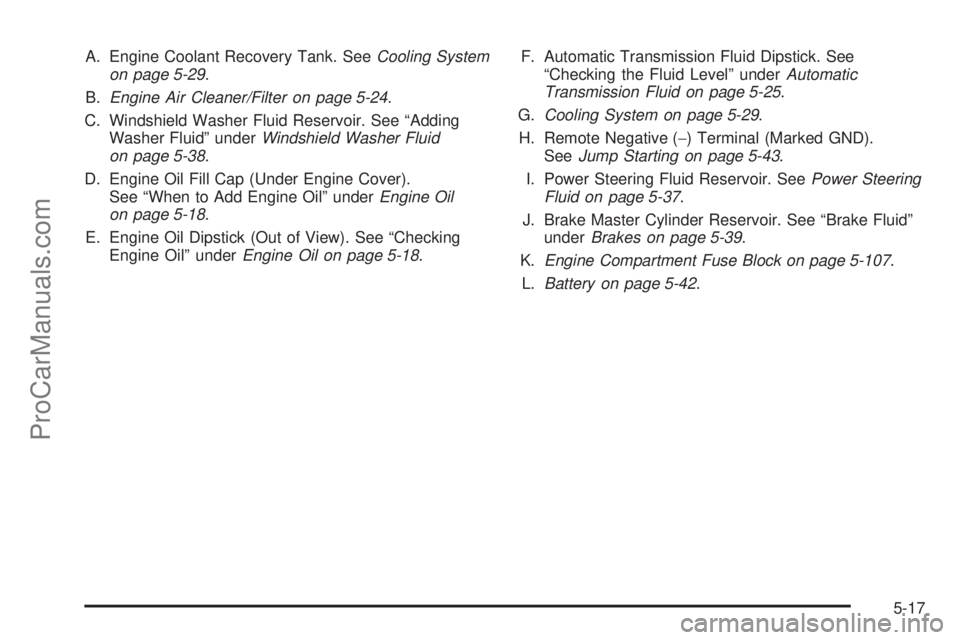
A. Engine Coolant Recovery Tank. SeeCooling System
on page 5-29.
B.Engine Air Cleaner/Filter on page 5-24.
C. Windshield Washer Fluid Reservoir. See “Adding
Washer Fluid” underWindshield Washer Fluid
on page 5-38.
D. Engine Oil Fill Cap (Under Engine Cover).
See “When to Add Engine Oil” underEngine Oil
on page 5-18.
E. Engine Oil Dipstick (Out of View). See “Checking
Engine Oil” underEngine Oil on page 5-18.F. Automatic Transmission Fluid Dipstick. See
“Checking the Fluid Level” underAutomatic
Transmission Fluid on page 5-25.
G.Cooling System on page 5-29.
H. Remote Negative (−) Terminal (Marked GND).
SeeJump Starting on page 5-43.
I. Power Steering Fluid Reservoir. SeePower Steering
Fluid on page 5-37.
J. Brake Master Cylinder Reservoir. See “Brake Fluid”
underBrakes on page 5-39.
K.Engine Compartment Fuse Block on page 5-107.
L.Battery on page 5-42.
5-17
ProCarManuals.com
Page 304 of 424
Notice:If you leave the radio or other accessories
on during the jump starting procedure, they could be
damaged. The repairs would not be covered by the
warranty. Always turn off the radio and other
accessories when jump starting the vehicle.
3. Turn off the ignition on both vehicles. Unplug
unnecessary accessories plugged into the cigarette
lighter or the accessory power outlets, if equipped.
Turn off the radio and all lamps that are not
needed. This will avoid sparks and help to save
both batteries. And it could save the radio!
4. Open both hoods and locate the batteries. Find the
positive (+) and negative (−) terminals on each
battery. Your vehicle has a remote negative (−) jump
starting terminal. You should always use this
remote terminal instead of the terminal on the
battery. The remote negative (−) terminal is located
on the front engine lift bracket on vehicles with
the 4.2L L6 engine or the engine accessory drive
bracket for vehicles with the 5.3L or 6.0L V8
engines, and is marked GND (Ground). SeeEngine
Compartment Overview on page 5-12for more
information on location.
{CAUTION:
Using a match near a battery can cause battery
gas to explode. People have been hurt doing this,
and some have been blinded. Use a ashlight if
you need more light.
Be sure the battery has enough water. You do not
need to add water to the battery installed in your
new vehicle. But if a battery has ller caps, be
sure the right amount of uid is there. If it is low,
add water to take care of that rst. If you do not,
explosive gas could be present.
Battery uid contains acid that can burn you.
Do not get it on you. If you accidentally get it in
your eyes or on your skin, ush the place with
water and get medical help immediately.
5-44
ProCarManuals.com
Page 306 of 424
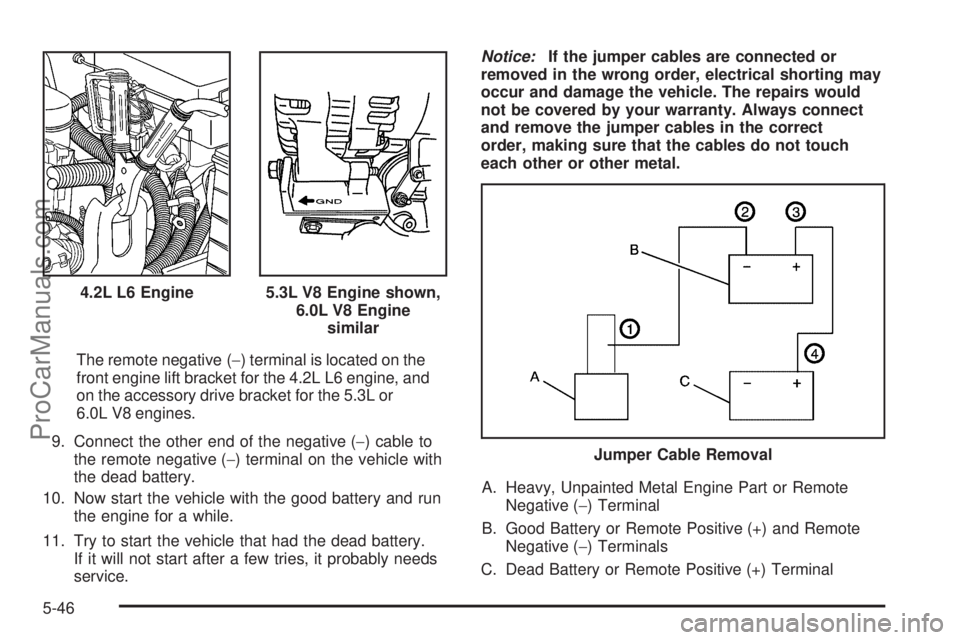
The remote negative (−) terminal is located on the
front engine lift bracket for the 4.2L L6 engine, and
on the accessory drive bracket for the 5.3L or
6.0L V8 engines.
9. Connect the other end of the negative (−) cable to
the remote negative (−) terminal on the vehicle with
the dead battery.
10. Now start the vehicle with the good battery and run
the engine for a while.
11. Try to start the vehicle that had the dead battery.
If it will not start after a few tries, it probably needs
service.Notice:If the jumper cables are connected or
removed in the wrong order, electrical shorting may
occur and damage the vehicle. The repairs would
not be covered by your warranty. Always connect
and remove the jumper cables in the correct
order, making sure that the cables do not touch
each other or other metal.
A. Heavy, Unpainted Metal Engine Part or Remote
Negative (−) Terminal
B. Good Battery or Remote Positive (+) and Remote
Negative (−) Terminals
C. Dead Battery or Remote Positive (+) Terminal 4.2L L6 Engine
5.3L V8 Engine shown,
6.0L V8 Engine
similar
Jumper Cable Removal
5-46
ProCarManuals.com
Page 399 of 424
Coverage
Services are provided up to 4 years/50,000 miles
(80 000 km), whichever comes rst.
In the U.S., anyone driving the vehicle is covered.
In Canada, a person driving the vehicle without
permission from the owner is not covered.
Roadside Assistance is not a part of the New Vehicle
Limited Warranty. Saab and General Motors of Canada
Limited reserve the right to make any changes or
discontinue the Roadside Assistance program at any
time without notication.
Saab and General Motors of Canada Limited reserve the
right to limit services or payment to an owner or driver if
they decide the claims are made too often, or the same
type of claim is made many times.
Services Provided
Emergency Fuel Delivery:Delivery of enough fuel
for the vehicle to get to the nearest service station.
Lock-Out Service:Service is provided to unlock the
vehicle if you are locked out. A remote unlock may be
available if you have OnStar
®. For security reasons,
the driver must present identication before this
service is given.
Emergency Tow From a Public Road or Highway:
Tow to the nearest Saab dealer for warranty service,
or if the vehicle was in a crash and cannot be driven.
Assistance is also given when the vehicle is stuck in
sand, mud, or snow.
Flat Tire Change:Service is provided to change a
at tire with the spare tire. The spare tire, if equipped,
must be in good condition and properly inated.
It is the owner’s responsibility for the repair or
replacement of the tire if it is not covered by the
warranty.
Battery Jump Start:Service is provided to jump
start a dead battery.
Trip Routing Service:Detailed maps of North
America are provided when requested either with
the most direct route or the most scenic route.
Additional travel information is also available.
Allow three weeks for delivery.
Trip Interruption Benets and Assistance:
If your trip is interrupted due to a warranty failure,
incidental expenses may be reimbursed during the
4 years/50,000 miles (80 000 km) New Vehicle
Bumper-to-Bumper Limited Warranty period.
Items considered are hotel, meals, and rental car.
7-7
ProCarManuals.com
Page 409 of 424
OnStar®
If your vehicle has OnStar and you subscribe to the
OnStar services, please refer to the OnStar Terms and
Conditions for information on data collection and
use. See alsoOnStar
®System on page 2-35in this
manual for more information.
Navigation System
If your vehicle has a navigation system, use of the
system may result in the storage of destinations,
addresses, telephone numbers, and other trip
information. Refer to the navigation system operating
manual for information on stored data and for deletion
instructions.
Radio Frequency
Identication (RFID)
RFID technology is used in some vehicles for functions
such as tire pressure monitoring and ignition system
security, as well as in connection with conveniences
such as key fobs for remote door locking/unlocking and
starting, and in-vehicle transmitters for garage door
openers. RFID technology in Saab vehicles does
not use or record personal information or link with any
other Saab system containing personal information.
7-17
ProCarManuals.com