engine light SATURN ASTRA 2009 Owner's Manual
[x] Cancel search | Manufacturer: SATURN, Model Year: 2009, Model line: ASTRA, Model: SATURN ASTRA 2009Pages: 314, PDF Size: 1.94 MB
Page 166 of 314
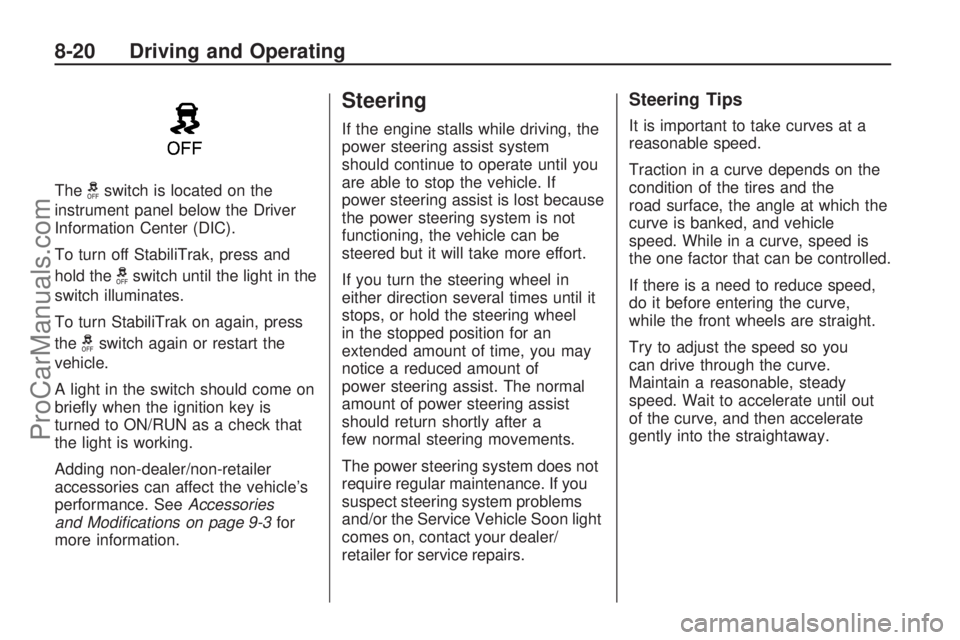
Thegswitch is located on the
instrument panel below the Driver
Information Center (DIC).
To turn off StabiliTrak, press and
hold the
gswitch until the light in the
switch illuminates.
To turn StabiliTrak on again, press
the
gswitch again or restart the
vehicle.
A light in the switch should come on
briey when the ignition key is
turned to ON/RUN as a check that
the light is working.
Adding non-dealer/non-retailer
accessories can affect the vehicle’s
performance. SeeAccessories
and Modifications on page 9-3for
more information.
Steering
If the engine stalls while driving, the
power steering assist system
should continue to operate until you
are able to stop the vehicle. If
power steering assist is lost because
the power steering system is not
functioning, the vehicle can be
steered but it will take more effort.
If you turn the steering wheel in
either direction several times until it
stops, or hold the steering wheel
in the stopped position for an
extended amount of time, you may
notice a reduced amount of
power steering assist. The normal
amount of power steering assist
should return shortly after a
few normal steering movements.
The power steering system does not
require regular maintenance. If you
suspect steering system problems
and/or the Service Vehicle Soon light
comes on, contact your dealer/
retailer for service repairs.
Steering Tips
It is important to take curves at a
reasonable speed.
Traction in a curve depends on the
condition of the tires and the
road surface, the angle at which the
curve is banked, and vehicle
speed. While in a curve, speed is
the one factor that can be controlled.
If there is a need to reduce speed,
do it before entering the curve,
while the front wheels are straight.
Try to adjust the speed so you
can drive through the curve.
Maintain a reasonable, steady
speed. Wait to accelerate until out
of the curve, and then accelerate
gently into the straightaway.
8-20 Driving and Operating
ProCarManuals.com
Page 175 of 314
Repeat this until help arrives but
only when you feel really
uncomfortable from the cold. Moving
about to keep warm also helps.
If it takes some time for help
to arrive, now and then when you
run the engine, push the accelerator
pedal slightly so the engine runs
faster than the idle speed. This
keeps the battery charged to restart
the vehicle and to signal for help
with the headlamps. Do this as little
as possible to save fuel.
If Your Vehicle is Stuck
in Sand, Mud, Ice,
or Snow
Slowly and cautiously spin the
wheels to free the vehicle when
stuck in sand, mud, ice, or snow.
SeeRocking Your Vehicle to Get It
Out on page 8-29.
{CAUTION
If you let your vehicle’s tires spin
at high speed, they can explode,
and you or others could be
injured. The vehicle can overheat,
causing an engine compartment
re or other damage. Spin the
wheels as little as possible and
avoid going above 35 mph
(55 km/h) as shown on the
speedometer.
For information about using tire
chains on the vehicle, seeTire
Chains on page 9-60.
Rocking Your Vehicle to
Get It Out
Turn the steering wheel left and
right to clear the area around
the front wheels. Turn off any
stability system. Shift back and forth
between R (Reverse) and a
forward gear, or with a manual
transmission, between 1 (First) or
2 (Second) and R (Reverse),
spinning the wheels as little as
possible. To prevent transmission
wear, wait until the wheels stop
spinning before shifting gears.
Release the accelerator pedal while
shifting, and press lightly on the
accelerator pedal when the
transmission is in gear. Slowly
spinning the wheels in the forward
and reverse directions causes a
rocking motion that could free
the vehicle. If that does not get the
vehicle out after a few tries, it
might need to be towed out. If the
vehicle does need to be towed
out, seeTowing Your Vehicle on
page 9-73.
Driving and Operating 8-29
ProCarManuals.com
Page 191 of 314

A.Engine Air Cleaner/Filter on
page 9-11.
B. Engine Oil Fill Cap.Engine Oil
on page 9-7.
C. Brake Fluid Reservoir.Brakes
on page 9-22.
D. Coolant Reservoir.Cooling
System on page 9-12.
E. Coolant Reservoir Pressure Cap.
Pressure Cap on page 9-18.
F.Engine Compartment Fuse Block
on page 9-35.
G.Battery on page 9-25.
H.Windshield Washer Fluid on
page 9-20.
I. Engine Oil Dipstick.Engine Oil
on page 9-7.Engine Oil
If the low oil level light appears on
the instrument cluster, check the
engine oil level right away. SeeLow
Oil Level Light on page 4-22.
Check the engine oil level regularly;
this is just a reminder.
Checking Engine Oil
It is a good idea to check the
engine oil level at each fuel ll.
In order to get an accurate reading,
the oil must be warm and the
vehicle must be on level ground.The engine oil dipstick handle
is a yellow loop. SeeEngine
Compartment Overview on page 9-6
for the location of the engine oil
dipstick.
1. Turn off the engine and give the
oil several minutes to drain back
into the oil pan. If this is not
done, the oil dipstick might not
show the actual level.
2. Pull the dipstick and clean it with
a paper towel or cloth, then push
it back in all the way. Remove
it again, keeping the tip down and
check the level.
Vehicle Service and Care 9-7
ProCarManuals.com
Page 195 of 314
Engine Air Cleaner/Filter
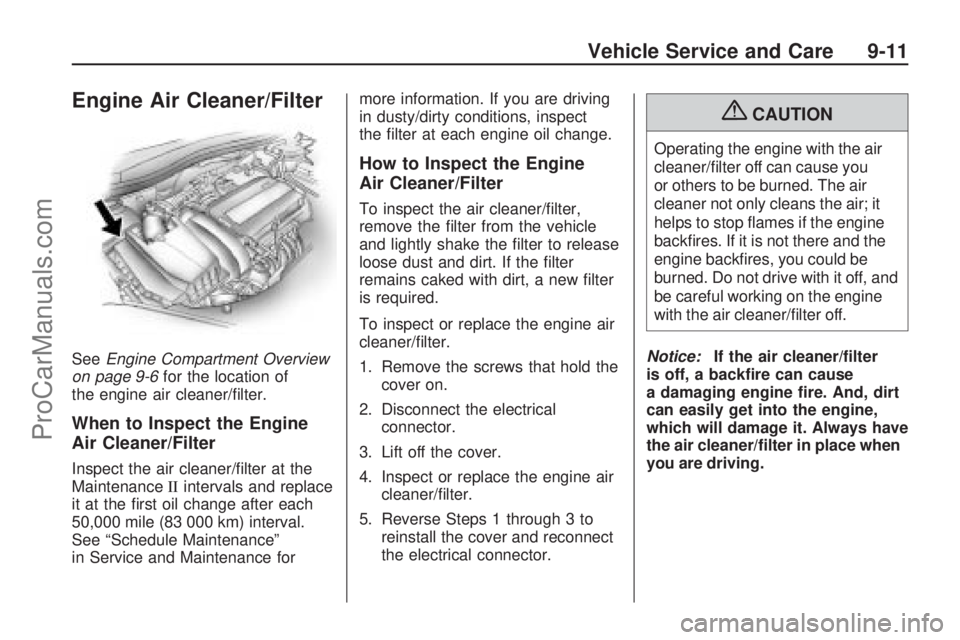
SeeEngine Compartment Overview
on page 9-6for the location of
the engine air cleaner/lter.
When to Inspect the Engine
Air Cleaner/Filter
Inspect the air cleaner/lter at the
MaintenanceIIintervals and replace
it at the rst oil change after each
50,000 mile (83 000 km) interval.
See “Schedule Maintenance”
in Service and Maintenance formore information. If you are driving
in dusty/dirty conditions, inspect
the lter at each engine oil change.
How to Inspect the Engine
Air Cleaner/Filter
To inspect the air cleaner/lter,
remove the lter from the vehicle
and lightly shake the lter to release
loose dust and dirt. If the lter
remains caked with dirt, a new lter
is required.
To inspect or replace the engine air
cleaner/lter.
1. Remove the screws that hold the
cover on.
2. Disconnect the electrical
connector.
3. Lift off the cover.
4. Inspect or replace the engine air
cleaner/lter.
5. Reverse Steps 1 through 3 to
reinstall the cover and reconnect
the electrical connector.
{CAUTION
Operating the engine with the air
cleaner/lter off can cause you
or others to be burned. The air
cleaner not only cleans the air; it
helps to stop ames if the engine
backres. If it is not there and the
engine backres, you could be
burned. Do not drive with it off, and
be careful working on the engine
with the air cleaner/lter off.
Notice:If the air cleaner/lter
is off, a backre can cause
a damaging engine re. And, dirt
can easily get into the engine,
which will damage it. Always have
the air cleaner/lter in place when
you are driving.
Vehicle Service and Care 9-11
ProCarManuals.com
Page 200 of 314
Engine Coolant
The cooling system in your vehicle
is lled with DEX-COOL®engine
coolant. This coolant is designed to
remain in your vehicle for ve years
or 150,000 miles (240 000 km),
whichever occurs rst, if you add
only DEX-COOL
®extended life
coolant.
The following explains your cooling
system and how to add coolant
when it is low. If you have a problem
with engine overheating, see
Engine Overheating on page 9-18.
A 50/50 mixture of clean, drinkable
water and DEX-COOL
®coolant will:
Give freezing protection down to
−34°F (−37°C).
Give boiling protection up to
265°F (129°C).
Protect against rust and
corrosion.
Help keep the proper engine
temperature.
Let the warning lights and gages
work as they should.
Notice:Using coolant other than
DEX-COOL
®can cause premature
engine, heater core, or radiator
corrosion. In addition, the engine
coolant may require changing
sooner, at the rst maintenance
service after each 30,000 miles
(50 000 km) or 24 months,
whichever occurs rst. Any
repairs would not be covered by
the vehicle warranty. Always
use DEX-COOL
®(silicate-free)
coolant in the vehicle.
What to Use
Use a mixture of one-half clean,
drinkable water and one-half
DEX-COOL
®coolant which will not
damage aluminum parts. If you
use this coolant mixture, you do not
need to add anything else.
{CAUTION
Adding only plain water to the
cooling system can be dangerous.
Plain water, or some other liquid
such as alcohol, can boil before
the proper coolant mixture will.
The vehicle’s coolant warning
system is set for the proper
coolant mixture. With plain water
or the wrong mixture, the engine
could get too hot but would not
get the overheat warning. The
engine could catch re and you or
others could be burned. Use a
50/50 mixture of clean, drinkable
water and DEX-COOL
®coolant.
9-16 Vehicle Service and Care
ProCarManuals.com
Page 202 of 314

Adding Coolant
If you need more coolant, add the
proper DEX-COOL®coolant mixture
at the coolant reservoir, but only
when the engine is cool. If the
coolant reservoir is empty, a
special ll procedure is necessary.
SeeCooling System on page 9-12
for instructions on “How to Add
Coolant to the Coolant Reservoir.”
{CAUTION
You can be burned if you spill
coolant on hot engine parts.
Coolant contains ethylene glycol,
and it will burn if the engine parts
are hot enough. Do not spill
coolant on a hot engine.
When replacing the pressure cap,
make sure it is hand-tight and
fully seated.
Pressure Cap
Notice:If the pressure cap is not
tightly installed, coolant loss
and possible engine damage may
occur. Be sure the cap is
properly and tightly secured.
SeeEngine Compartment Overview
on page 9-6for more information
on location.
Engine Overheating
There is an engine coolant
temperature warning light on your
vehicle’s instrument panel. See
Engine Coolant Temperature
Warning Light on page 4-18for
more information.
If Steam Is Coming From
Your Engine
{CAUTION
Steam from an overheated engine
can burn you badly, even if you
just open the hood. Stay away
from the engine if you see or hear
steam coming from it. Just turn it
off and get everyone away from
the vehicle until it cools down.
Wait until there is no sign of
steam or coolant before you open
the hood.
If you keep driving when your
engine is overheated, the liquids in
it can catch re. You or others
could be badly burned. Stop your
engine if it overheats, and get out
of the vehicle until the engine
is cool.
9-18 Vehicle Service and Care
ProCarManuals.com
Page 203 of 314

Notice:If the engine catches re
because of being driven with
no coolant, your vehicle can be
badly damaged. The costly
repairs would not be covered by
the vehicle warranty.
If No Steam Is Coming From
Your Engine
An engine coolant temperature
warning can indicate a serious
problem. SeeEngine Coolant
Temperature Warning Light on
page 4-18.
If you get an engine coolant
temperature warning, but see or hear
no steam, the problem may not be
too serious. Sometimes the engine
can get a little too hot when you:
Climb a long hill on a hot day.
Stop after high-speed driving.
Idle for long periods in traffic.If you get the engine coolant
temperature warning with no sign of
steam, try this for a minute or so:
1. If your air conditioner is on,
turn it off.
2. In heavy traffic, let the engine
idle in N (Neutral) while
stopped. If it is safe to do so,
pull off the road, shift to P (Park)
or N (Neutral) and let the
engine idle.
3. Turn on your heater to full hot at
the highest fan speed and open
the windows as necessary.
If you no longer have the overheat
warning, you can drive. Just to
be safe, drive slower for about
10 minutes. If the warning does not
come back on, you can drive
normally.If the warning continues and you
have not stopped, pull over,
stop, and park your vehicle
right away.
If there is still no sign of steam,
you can idle the engine for
three minutes while you are parked.
If you still have the warning, turn
off the engine and get everyone out
of the vehicle until it cools down.
You may decide not to lift the hood
but to get service help right away.
Vehicle Service and Care 9-19
ProCarManuals.com
Page 254 of 314

Notice:If you leave the radio or
other accessories on during
the jump starting procedure,
they could be damaged. The
repairs would not be covered by
the warranty. Always turn off
the radio and other accessories
when jump starting the vehicle.
3. Turn off the ignition on both
vehicles. Unplug unnecessary
accessories plugged into
the cigarette lighter or the
accessory power outlet. Turn off
the radio and all lamps that
are not needed. This will avoid
sparks and help save both
batteries. And it could save
the radio!4. Open the hoods and locate the
batteries. Find the positive (+)
and negative (−) terminal
locations on each vehicle. Your
vehicle’s positive (+) terminal
is identied by “+” sign on battery
case or terminal. SeeEngine
Compartment Overview on
page 9-6.
{CAUTION
An electric fan can start up even
when the engine is not running
and can injure you. Keep hands,
clothing and tools away from any
underhood electric fan.
{CAUTION
Using a match near a battery can
cause battery gas to explode.
People have been hurt doing this,
and some have been blinded. Use
a ashlight if you need more light.
Be sure the battery has enough
water. You do not need to add
water to the battery installed in
your new vehicle. But if a battery
has ller caps, be sure the right
amount of uid is there. If it is
low, add water to take care of that
rst. If you don’t, explosive gas
could be present.
Battery uid contains acid that
can burn you. Do not get it on
you. If you accidentally get it in
your eyes or on your skin, ush
the place with water and get
medical help immediately.
9-70 Vehicle Service and Care
ProCarManuals.com
Page 276 of 314

Maintenance Footnotes
(a)A fluid loss in any vehicle system
could indicate a problem. Have the
system inspected and repaired
and the fluid level checked. Add fluid
if needed.
(b)If driving regularly under dusty
conditions or in high-polluted
regions, replace the filter at each
engine oil change.
(c)Inspect brake lines and hoses for
proper hook-up, binding, leaks,
cracks, chafing, etc. Inspect disc
brake pads for wear and rotors for
surface condition. Inspect other
brake parts, including calipers,
parking brake, etc.
(d)Inspect front and rear suspension
and steering system for damaged,
loose, or missing parts or signs of
wear. Inspect power steering cables
for proper hook-up, binding, cracks,
chafing, etc. Inspect power steering
hydraulic lines and hoses for proper
hook-up, binding, leaks, cracks,
chafing, etc.(e)Inspect hoses and have them
replaced if they are cracked,
swollen, or deteriorated. Inspect all
pipes, fittings and clamps; replace
with genuine parts as needed.
To help ensure proper operation,
a pressure test of the cooling system
and pressure cap and cleaning
the outside of the radiator and
air conditioning condenser is
recommended at least once a year.
(f)Inspect wiper blades for wear,
cracking, or contamination.
Clean the windshield and wiper
blades, if contaminated. Replace
wiper blades that are worn or
damaged. See Windshield Wiper
Blade Replacement on page 9-21
and “Windshield and Wiper Blades”
in Exterior Cleaning on page 9-76.
(g)Make sure the safety belt
reminder light and safety belt
assemblies are working properly.
Look for any other loose or
damaged safety belt system parts.
If you see anything that might keep
a safety belt system from doingits job, have it repaired. Have any
torn or frayed safety belts replaced.
Also see Airbag System Check
on page 1-37.
(h)Lubricate all key lock cylinders,
door hinges and latches, hood
hinges and latches, and trunk lid
hinges and latches. More frequent
lubrication may be required
when exposed to a corrosive
environment. Applying silicone
grease on weatherstrips with a clean
cloth will make them last longer,
seal better, and not stick or squeak.
(i)Change automatic transmission
fluid if the vehicle is mainly driven
under one or more of these
conditions:
In heavy city traffic where the
outside temperature regularly
reaches 90°F (32°C) or higher.
In hilly or mountainous terrain.
When doing frequent trailer
towing.
Uses such as found in taxi, police,
or delivery service.
11-8 Service and Maintenance
ProCarManuals.com
Page 305 of 314

A
Accessories and
Modications...................... 9-3
Accessory Power Outlets......4-10
Adding Equipment to Your
Airbag-Equipped Vehicle....1-36
Additives, Fuel.....................8-34
Add-On Electrical
Equipment.......................9-34
Air Cleaner/Filter, Engine.......9-11
Air Conditioning..................... 7-1
Airbag
Passenger Status
Indicator.......................4-15
Readiness Light................4-14
System, Replacing Parts
After a Crash................1-37
Airbag System.....................1-24
Adding Equipment to Your
Airbag-Equipped
Vehicle........................1-36
Check.............................1-37
How Does an Airbag
Restrain?.....................1-28
Passenger Sensing
System........................1-30Airbag System (cont.)
Servicing Your
Airbag-Equipped
Vehicle........................1-35
What Makes an Airbag
Inate?........................1-28
What Will You See After
an Airbag Inates?........1-29
When Should an Airbag
Inate?........................1-27
Where Are the Airbags?.....1-26
Antenna, Fixed Mast............6-24
Antilock Brake
System (ABS)..................8-18
Antilock Brake, System
Warning Light...................4-17
Appearance Care
Chemical Paint Spotting.....9-80
Exterior Cleaning..............9-76
Finish Damage.................9-79
Interior Cleaning...............9-73
Sheet Metal Damage........9-79
Underbody Maintenance....
9-80
Appointments, Scheduling
Service...........................12-8Audio System........................ 6-1
Audio Steering Wheel
Controls.......................6-23
Fixed Mast Antenna..........6-24
Radio Reception...............6-24
Theft-Deterrent Feature......6-23
Audio System(s).................... 6-2
Automatic Transmission
Fluid...............................9-12
Operation.......................... 8-6
B
Battery...............................9-25
Run-Down Protection.......... 5-4
Brake Fluid.........................9-22
Brakes...............................9-22
System Warning Light.......4-16
Braking...............................8-17
Break-In, New Vehicle............ 8-2
Bulb Replacement
Daytime Running Lamp....... 5-2
Bulb Replacement
Center High-Mounted
Stoplamp (CHMSL)........9-29
Fog Lamp ......................... 5-2
Front Turn Signal Lamps . . . 9-28
INDEX i-1
ProCarManuals.com