brake light SATURN AURA 2007 User Guide
[x] Cancel search | Manufacturer: SATURN, Model Year: 2007, Model line: AURA, Model: SATURN AURA 2007Pages: 406, PDF Size: 6.49 MB
Page 214 of 406
Control of a Vehicle
You have three systems that make your vehicle
go where you want it to go. They are the brakes,
the steering, and the accelerator. All three
systems have to do their work at the places where
the tires meet the road.
Sometimes, as when you are driving on snow or
ice, it is easy to ask more of those control systems
than the tires and road can provide. That means
you can lose control of your vehicle. SeeTraction
Control System (TCS) on page 217and
Electronic Stability Control on page 219.
Adding non-Saturn accessories can affect your
vehicle’s performance. SeeAccessories and
Modications on page 253.
Braking
SeeBrake System Warning Light on page 168.
Braking action involves perception time and
reaction time.
First, you have to decide to push on the brake
pedal. That is perception time. Then you have to
bring up your foot and do it. That is reaction time.
Average reaction time is about three-fourths of a
second. But that is only an average. It might be less
with one driver and as long as two or three seconds
or more with another. Age, physical condition,
alertness, coordination, and eyesight all play a part.
So do alcohol, drugs, and frustration. But even in
three-fourths of a second, a vehicle moving at
60 mph (100 km/h) travels 66 feet (20 m). That
could be a lot of distance in an emergency, so
keeping enough space between your vehicle and
others is important.
And, of course, actual stopping distances vary
greatly with the surface of the road, whether it is
pavement or gravel; the condition of the road,
whether it is wet, dry, or icy; tire tread; the
condition of the brakes; the weight of the vehicle;
and the amount of brake force applied.
214
ProCarManuals.com
Page 215 of 406

Avoid needless heavy braking. Some people drive
in spurts — heavy acceleration followed by
heavy braking — rather than keeping pace with
traffic. This is a mistake. The brakes may not have
time to cool between hard stops. The brakes
will wear out much faster if you do a lot of heavy
braking. If you keep pace with the traffic and
allow realistic following distances, you will
eliminate a lot of unnecessary braking. That means
better braking and longer brake life.
If your vehicle’s engine ever stops while you are
driving, brake normally but do not pump the
brakes. If you do, the pedal may get harder to
push down. If the engine stops, you will still have
some power brake assist. But you will use it
when you brake. Once the power assist is used
up, it may take longer to stop and the brake pedal
will be harder to push.
Adding non-Saturn accessories can affect your
vehicle’s performance. SeeAccessories and
Modications on page 253.Antilock Brake System (ABS)
Your vehicle has the Antilock Brake System (ABS),
an advanced electronic braking system that will
help prevent a braking skid.
When you start the engine and begin to drive
away, ABS will check itself. You might hear
a momentary motor or clicking noise while this test
is going on, and you might even notice that the
brake pedal moves a little. This is normal.
If there is a problem
with ABS, this warning
light will stay on.
SeeAntilock Brake
System Warning Light
on page 169.
215
ProCarManuals.com
Page 219 of 406
Electronic Stability Control
Your vehicle may have an Electronic Stability
Control (ESC) system which combines antilock
brake, traction and stability control systems
and helps the driver maintain directional control of
the vehicle in most driving conditions.
When you rst start your vehicle and begin to
drive away, the system performs several diagnostic
checks to ensure there are no problems. You
may hear or feel the system working. This
is normal and does not mean there is a problem
with your vehicle. The system should initialize
before the vehicle reaches 20 mph (32 km/h). In
some cases, it may take approximately two
miles of driving before the system initializes.
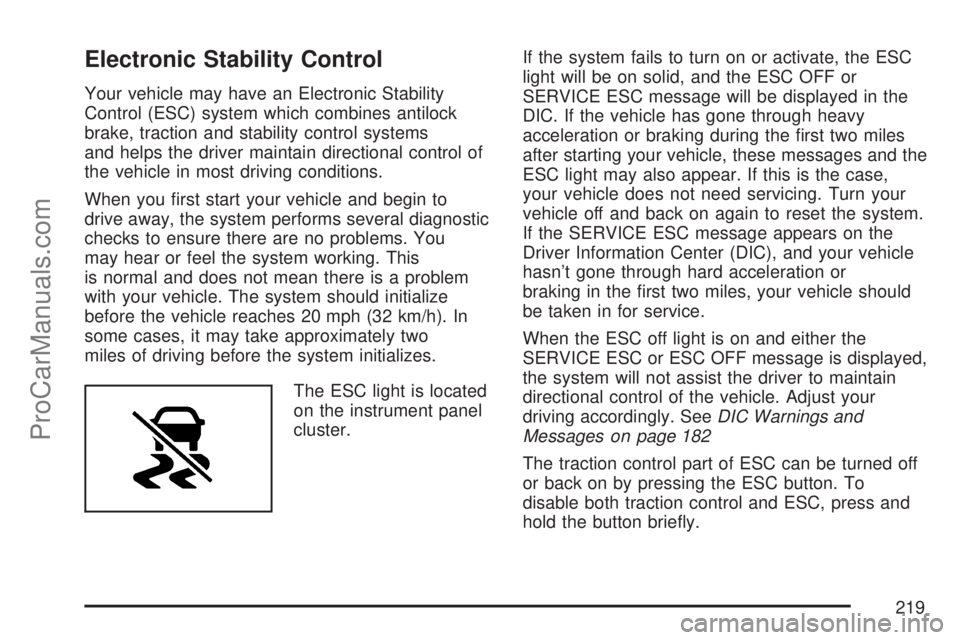
The ESC light is located
on the instrument panel
cluster.If the system fails to turn on or activate, the ESC
light will be on solid, and the ESC OFF or
SERVICE ESC message will be displayed in the
DIC. If the vehicle has gone through heavy
acceleration or braking during the rst two miles
after starting your vehicle, these messages and the
ESC light may also appear. If this is the case,
your vehicle does not need servicing. Turn your
vehicle off and back on again to reset the system.
If the SERVICE ESC message appears on the
Driver Information Center (DIC), and your vehicle
hasn’t gone through hard acceleration or
braking in the rst two miles, your vehicle should
be taken in for service.
When the ESC off light is on and either the
SERVICE ESC or ESC OFF message is displayed,
the system will not assist the driver to maintain
directional control of the vehicle. Adjust your
driving accordingly. SeeDIC Warnings and
Messages on page 182
The traction control part of ESC can be turned off
or back on by pressing the ESC button. To
disable both traction control and ESC, press and
hold the button briey.
219
ProCarManuals.com
Page 220 of 406

When the system is turned off, the TRACTION
OFF message will rst appear followed by the ESC
OFF message. The ESC OFF and TCS OFF
indicator lights will also appear to warn the driver
that both traction control and ESC are disabled.
It is recommended to leave the system on
for normal driving conditions, but it may be
necessary to turn the system off if your vehicle is
stuck in sand, mud, ice or snow, and you want
to “rock” your vehicle to attempt to free it. It may
also be necessary to turn off the system when
driving in extreme off-road conditions where high
wheel spin is required. SeeIf Your Vehicle is
Stuck in Sand, Mud, Ice, or Snow on page 241.
ESC may also turn off automatically if it determines
that a problem exists with the system. The ESC
OFF and SERVICE ESC messages and the
ESC OFF light will be on solid to warn the driver
that ESC is disabled and requires service. If
the problem does not clear itself after restarting
the vehicle, you should see your retailer for
service. SeeDIC Warnings and Messages on
page 182.
Adding non-dealer/non-retailer accessories can
affect your vehicle’s performance. SeeAccessories
and Modications on page 253.Traction Control Operation
The traction control system is part of the ESC
system. Traction control limits wheel spin by
reducing engine power to the wheels (engine
speed management) and by applying brakes to
each individual wheel (brake-traction control)
as necessary.
The traction control system is enabled
automatically when you start your vehicle, and it
will activate and display the LOW TRACTION
message if it senses that any of the wheels are
spinning or beginning to lose traction while driving.
If you turn off traction control, the TCS OFF
warning light will come on and the TRACTION
OFF message will be displayed The ESC system
will remain operational unless it is turned off.
For more information on the traction active
message, seeDriver Information Center (DIC) on
page 179.
220
ProCarManuals.com
Page 221 of 406

Notice:If you allow the wheel(s) of one axle to
spin excessively while the ESC, ABS and brake
warning lights and the SERVICE ESC message
are displayed, you could damage the transfer
case. The repairs would not be covered by your
warranty. Reduce engine power and do not spin
the wheel(s) excessively while these lights and
this message are displayed.
The traction control system may activate on dry or
rough roads or under conditions such as heavy
acceleration while turning or abrupt
upshifts/downshifts of the transmission. When this
happens, you may notice a reduction in
acceleration, or may hear a noise or vibration.
This is normal.
If your vehicle is in cruise control when the system
activates, the ESC ACTIVE message will appear
and the cruise control will automatically disengage.
When road conditions allow you to use cruise
again, you may re-engage the cruise control. See
Cruise Control on page 145.
ESC may also turn off automatically if it determines
that a problem exists with the system. If the
problem does not clear itself after restarting the
vehicle, you should see your retailer for service.Adding non-dealer/non-retailer accessories can
affect your vehicle’s performance. SeeAccessories
and Modications on page 253for more
information.
Steering
If the engine stalls while you are driving, the
power steering assist system will continue
to operate until you are able to stop your vehicle.
If you lose power steering assist because the
electric power steering system is not functioning,
you can steer, but it will take more effort.
If you turn the steering wheel in either direction
several times until it stops, or hold the steering
wheel in the stopped position for an extended
amount of time, you may notice a reduced amount
of power steering assist. The normal amount of
power steering assist should return shortly after a
few normal steering movements.
The electric power steering system does not
require regular maintenance. If you suspect
steering system problems, contact your
dealer/retailer for service repairs. SeeDIC
Warnings and Messages on page 182.
221
ProCarManuals.com
Page 227 of 406

Learn to recognize warning clues — such as
enough water, ice, or packed snow on the road to
make a mirrored surface — and slow down when
you have any doubt.
Remember: Any Anti-Lock Brake System (ABS)
helps avoid only the braking skid.
Driving at Night
Night driving is more dangerous than day driving.
One reason is that some drivers are likely to
be impaired — by alcohol or drugs, with night
vision problems, or by fatigue.
Here are some tips on night driving.
Drive defensively.
Do not drink and drive.
Adjust the inside rearview mirror to reduce the
glare from headlamps behind you.
Since you cannot see as well, slow down and
keep more space between you and other
vehicles.
Slow down, especially on higher speed roads.
Your vehicle’s headlamps can light up only so
much road ahead.
In remote areas, watch for animals.
If you are tired, pull off the road in a safe
place and rest.
No one can see as well at night as in the daytime.
But as we get older these differences increase.
A 50-year-old driver might require at least twice as
much light to see the same thing at night as a
20-year-old.
What you do in the daytime can also affect your
night vision. For example, if you spend the
day in bright sunshine you are wise to wear
sunglasses. Your eyes will have less trouble
adjusting to night. But if you are driving, do not
wear sunglasses at night. They might cut down on
glare from headlamps, but they also make a lot
of things invisible.
227
ProCarManuals.com
Page 229 of 406
The heavier the rain, the harder it is to see. Even
if your windshield wiper blades are in good
shape, a heavy rain can make it harder to see
road signs and traffic signals, pavement markings,
the edge of the road, and even people walking.
It is wise to keep your windshield wiping equipment
in good shape and keep your windshield washer
uid reservoir lled with washer uid. Replace your
windshield wiper inserts when they show signs
of streaking or missing areas on the windshield, or
when strips of rubber start to separate from the
inserts.
{CAUTION:
Wet brakes can cause accidents. They
may not work as well in a quick stop and
may cause pulling to one side. You could
lose control of the vehicle.
After driving through a large puddle of
water or a car wash, apply the brake pedal
lightly until the brakes work normally.Driving too fast through large water puddles or
even going through some car washes can cause
problems, too. The water may affect your
brakes. Try to avoid puddles. But if you cannot, try
to slow down before you hit them.
Hydroplaning
Hydroplaning is dangerous. So much water can
build up under your tires that they can actually ride
on the water. This can happen if the road is wet
enough and you are going fast enough. When your
vehicle is hydroplaning, it has little or no contact
with the road.
Hydroplaning does not happen often. But it can if
your tires do not have much tread or if the
pressure in one or more is low. It can happen if a
lot of water is standing on the road. If you can
see reections from trees, telephone poles,
or other vehicles, and raindrops dimple the water’s
surface, there could be hydroplaning.
Hydroplaning usually happens at higher speeds.
There just is not a hard and fast rule about
hydroplaning. The best advice is to slow down
when it is raining.
229
ProCarManuals.com
Page 286 of 406

Brake Wear
Your vehicle has disc brakes. Disc brake pads
have built-in wear indicators that make a
high-pitched warning sound when the brake pads
are worn and new pads are needed. The sound
can come and go or be heard all the time
your vehicle is moving, except when you are
pushing on the brake pedal rmly.
{CAUTION:
The brake wear warning sound means that
soon the brakes will not work well. That
could lead to an accident. When you hear
the brake wear warning sound, have your
vehicle serviced.
Notice:Continuing to drive with worn-out
brake pads could result in costly brake repair.Some driving conditions or climates can cause a
brake squeal when the brakes are rst applied
or lightly applied. This does not mean something
is wrong with the brakes.
Properly torqued wheel nuts are necessary to help
prevent brake pulsation. When tires are rotated,
inspect brake pads for wear and evenly tighten
wheel nuts in the proper sequence to torque
specications inCapacities and Specications on
page 351.
Brake linings should always be replaced as
complete axle sets.Brake Pedal Travel
See your dealer/retailer if the brake pedal does
not return to normal height, or if there is a
rapid increase in pedal travel. This could be a sign
that brake service might be required.
Brake Adjustment
Every time you apply the brakes, with or without
the vehicle moving, the brakes adjust for wear.
286
ProCarManuals.com
Page 360 of 406
Maintenance Footnotes
(a)Visually inspect brake lines and hoses for
proper hook-up, binding, leaks, cracks, chang,
etc. Inspect disc brake pads for wear and rotors for
surface condition. Inspect other brake parts,
including calipers, parking brake, etc.
(b)Visually inspect front and rear suspension and
steering system for damaged, loose, or missing
parts or signs of wear. Inspect electric power
steering cables for proper hook-up, binding,
cracks, chang, etc.
(c)Visually inspect hoses and have them replaced
if they are cracked, swollen, or deteriorated.
Inspect all pipes, ttings and clamps; replace with
genuine parts as needed. To help ensure
proper operation, a pressure test of the cooling
system and pressure cap and cleaning the outside
of the radiator and air conditioning condenser is
recommended at least once a year.(d)Inspect wiper blades for wear, cracking, or
contamination. Clean the windshield and
wiper blades, if contaminated. Replace wiper
blades that are worn or damaged. See Windshield
Wiper Blade Replacement on page 297 and
Windshield and Wiper Blades on page 337 for
more information.
(e)Make sure the safety belt reminder light and all
your belts, buckles, latch plates, retractors, and
anchorages are working properly. Look for
any other loose or damaged safety belt system
parts. If you see anything that might keep a safety
belt system from doing its job, have it repaired.
Have any torn or frayed safety belts replaced. Also
look for any opened or broken airbag coverings,
and have them repaired or replaced. The
airbag system does not need regular maintenance.
(f)Lubricate all key lock cylinders, door hinges
and latches, hood hinges and latches, and trunk lid
hinges and latches. More frequent lubrication
may be required when exposed to a corrosive
environment. Applying silicone grease on
weatherstrips with a clean cloth will make them
last longer, seal better, and not stick or squeak.
360
ProCarManuals.com
Page 393 of 406

A
Accessories and Modications..................... 253
Adding Equipment to Your
Airbag-Equipped Vehicle............................ 83
Additives, Fuel............................................ 256
Add-On Electrical Equipment....................... 342
Air Cleaner/Filter, Engine............................. 270
Air Conditioning........................................... 154
Airbag
Passenger Status Indicator....................... 165
Readiness Light....................................... 164
Airbag System............................................... 67
What Will You See After an
Airbag Inates?...................................... 76
When Should an Airbag Inate?................. 73
Where Are the Airbags?............................. 70
Airbag Systems
Adding Equipment to Your
Airbag-Equipped Vehicle......................... 83
How Does an Airbag Restrain?.................. 75
Passenger Sensing System....................... 77
Servicing Your Airbag-Equipped Vehicle..... 82
What Makes an Airbag Inate?.................. 75
Antenna, Backglass..................................... 208
Antilock Brake System (ABS)...................... 215
Antilock Brake, System Warning Light......... 169Appearance Care
Aluminum Wheels.................................... 337
Care of Safety Belts................................ 335
Chemical Paint Spotting........................... 339
Cleaning Exterior Lamps/Lenses.............. 336
Fabric/Carpet........................................... 333
Finish Care.............................................. 336
Finish Damage......................................... 339
Instrument Panel, Vinyl, and
Other Plastic Surfaces.......................... 334
Interior Cleaning....................................... 332
Sheet Metal Damage............................... 338
Tires........................................................ 338
Underbody Maintenance........................... 339
Vehicle Care/Appearance Materials.......... 340
Washing Your Vehicle.............................. 335
Weatherstrips........................................... 335
Windshield and Wiper Blades................... 337
Audio System.............................................. 192
Audio Steering Wheel Controls................. 206
Backglass Antenna................................... 208
Care of Your CD Player........................... 207
Care of Your CDs.................................... 207
Radio Reception...................................... 207
Radio with CD......................................... 195
Setting the Time...................................... 194
Theft-Deterrent Feature............................ 206
393
ProCarManuals.com