cruise control SATURN AURA 2007 Owners Manual
[x] Cancel search | Manufacturer: SATURN, Model Year: 2007, Model line: AURA, Model: SATURN AURA 2007Pages: 406, PDF Size: 6.49 MB
Page 135 of 406
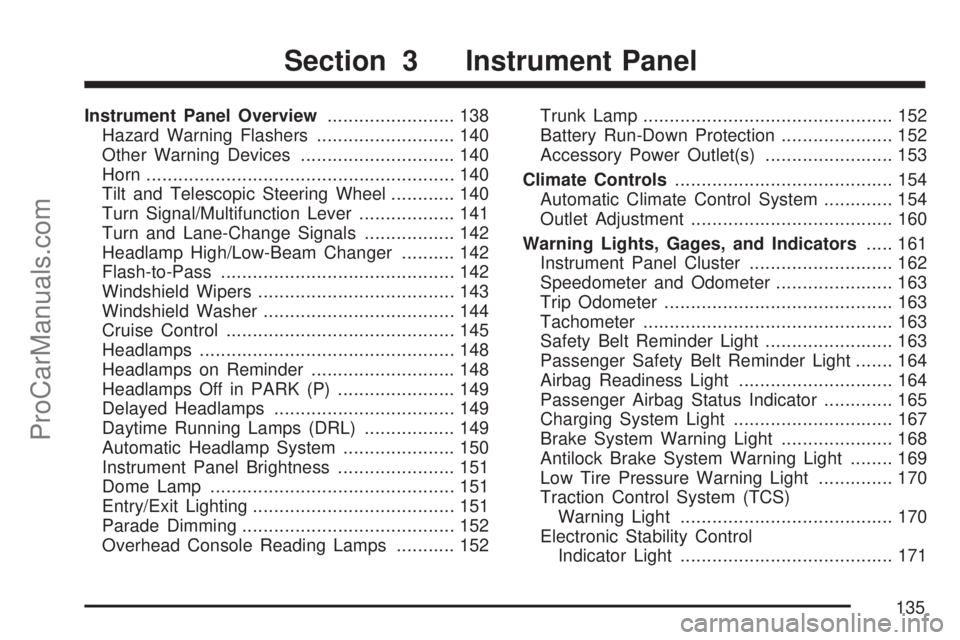
Instrument Panel Overview........................ 138
Hazard Warning Flashers.......................... 140
Other Warning Devices............................. 140
Horn.......................................................... 140
Tilt and Telescopic Steering Wheel............ 140
Turn Signal/Multifunction Lever.................. 141
Turn and Lane-Change Signals................. 142
Headlamp High/Low-Beam Changer.......... 142
Flash-to-Pass............................................ 142
Windshield Wipers..................................... 143
Windshield Washer.................................... 144
Cruise Control........................................... 145
Headlamps................................................ 148
Headlamps on Reminder........................... 148
Headlamps Off in PARK (P)...................... 149
Delayed Headlamps.................................. 149
Daytime Running Lamps (DRL)................. 149
Automatic Headlamp System..................... 150
Instrument Panel Brightness...................... 151
Dome Lamp.............................................. 151
Entry/Exit Lighting...................................... 151
Parade Dimming........................................ 152
Overhead Console Reading Lamps........... 152Trunk Lamp............................................... 152
Battery Run-Down Protection..................... 152
Accessory Power Outlet(s)........................ 153
Climate Controls......................................... 154
Automatic Climate Control System............. 154
Outlet Adjustment...................................... 160
Warning Lights, Gages, and Indicators..... 161
Instrument Panel Cluster........................... 162
Speedometer and Odometer...................... 163
Trip Odometer........................................... 163
Tachometer............................................... 163
Safety Belt Reminder Light........................ 163
Passenger Safety Belt Reminder Light....... 164
Airbag Readiness Light............................. 164
Passenger Airbag Status Indicator............. 165
Charging System Light.............................. 167
Brake System Warning Light..................... 168
Antilock Brake System Warning Light........ 169
Low Tire Pressure Warning Light.............. 170
Traction Control System (TCS)
Warning Light........................................ 170
Electronic Stability Control
Indicator Light........................................ 171
Section 3 Instrument Panel
135
ProCarManuals.com
Page 136 of 406

Engine Coolant Temperature
Warning Light........................................ 171
Malfunction Indicator Lamp........................ 172
Oil Pressure Light..................................... 175
Security Light............................................ 176
Cruise Control Light.................................. 176
Highbeam On Light................................... 176
Fuel Gage................................................. 177
Auto Stop Mode........................................ 178
Charge/Assist Gage................................... 178
Fuel Economy Light.................................. 179
Driver Information Center (DIC).................. 179
DIC Operation and Displays...................... 180
DIC Warnings and Messages.................... 182
DIC Vehicle Personalization....................... 187Audio System(s)......................................... 192
Setting the Time........................................ 194
Radio with CD (MP3)................................ 195
Using an MP3........................................... 200
Theft-Deterrent Feature............................. 206
Audio Steering Wheel Controls.................. 206
Radio Reception........................................ 207
Care of Your CDs..................................... 207
Care of the CD Player.............................. 207
Backglass Antenna.................................... 208
Section 3 Instrument Panel
136
ProCarManuals.com
Page 139 of 406

The main components of your instrument panel are the following:
A. Air Outlets. SeeOutlet Adjustment on
page 160.
B. Turn Signal/Multifunction Lever. SeeTurn
Signal/Multifunction Lever on page 141.
C. Instrument Panel Cluster. SeeInstrument Panel
Cluster on page 162.
D. Windshield Wiper and Washer Lever. See
Windshield Wipers on page 143andWindshield
Washer on page 144.
E. Hazard Warning Flashers Button. SeeHazard
Warning Flashers on page 140.
F. Passenger Airbag Status Indicator. See
Passenger Airbag Status Indicator on page 165.
G. Instrument Panel Brightness Control. See
Instrument Panel Brightness on page 151.
H. Cruise Controls. SeeCruise Control on
page 145. Driver Information Center (DIC)
Buttons. SeeDriver Information Center (DIC)
on page 179.
I. Tilt Lever. SeeTilt and Telescopic Steering
Wheel on page 140.J. Horn. SeeHorn on page 140.
K. Audio Steering Wheel Controls (If Equipped).
SeeAudio Steering Wheel Controls on
page 206.
L. Ignition Switch. SeeIgnition Positions on
page 108.
M. Automatic Climate Control System. See
Automatic Climate Control System on
page 154.
N. Traction Control Button. SeeTraction Control
System (TCS) on page 217. Electronic Stability
Control Button. SeeElectronic Stability
Control on page 219.
O. Shift Lever. SeeAutomatic Transaxle Operation
on page 116.
P. Audio System. SeeAudio System(s) on
page 192.
Q. Glove Box. SeeGlove Box on page 131.
139
ProCarManuals.com
Page 145 of 406
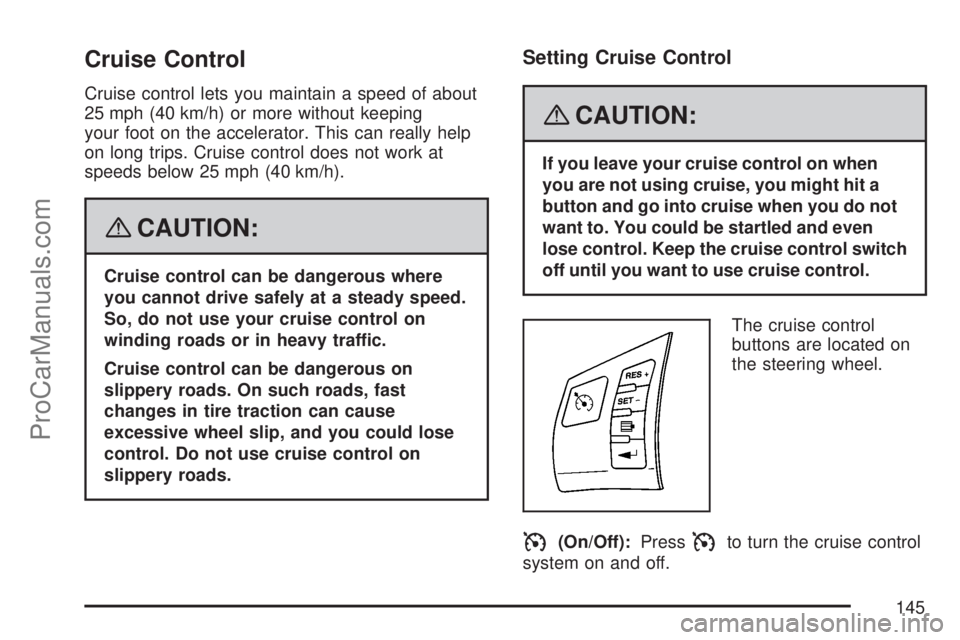
Cruise Control
Cruise control lets you maintain a speed of about
25 mph (40 km/h) or more without keeping
your foot on the accelerator. This can really help
on long trips. Cruise control does not work at
speeds below 25 mph (40 km/h).
{CAUTION:
Cruise control can be dangerous where
you cannot drive safely at a steady speed.
So, do not use your cruise control on
winding roads or in heavy traffic.
Cruise control can be dangerous on
slippery roads. On such roads, fast
changes in tire traction can cause
excessive wheel slip, and you could lose
control. Do not use cruise control on
slippery roads.
Setting Cruise Control
{CAUTION:
If you leave your cruise control on when
you are not using cruise, you might hit a
button and go into cruise when you do not
want to. You could be startled and even
lose control. Keep the cruise control switch
off until you want to use cruise control.
The cruise control
buttons are located on
the steering wheel.
I(On/Off):PressIto turn the cruise control
system on and off.
145
ProCarManuals.com
Page 146 of 406

RES+ (Resume):Press RES+ to resume a set
speed and to accelerate the speed.
SET−(Set):Press SET– to set a speed and to
decrease the speed.
To set a speed do the following:
1. Press
Ito turn cruise control on. The
indicator light on the button comes on.
2. Get up to the desired speed.
3. Press the SET−and release it. The cruise
symbol displays in the instrument panel
cluster to show the system is engaged.
4. Take your foot off the accelerator pedal.
When the brakes are applied, the cruise control
shuts off.
If the vehicle is in cruise control and the Traction
Control System (TCS) begins to limit wheel
spin, the cruise control automatically disengages.
SeeTraction Control System (TCS) on page 217.
When road conditions allow, the cruise control
can be used again.
Resuming a Set Speed
Suppose you set the cruise control at a desired
speed and then apply the brakes. This disengages
the cruise control. The cruise symbol in the
instrument panel cluster also goes out indicating
cruise is no longer engaged. To return to the
previously set speed, you do not need to
go through the set process again. Once the
vehicle is at a speed of about 25 mph (40 km/h) or
more, you can briey press the RES+.
This takes the vehicle back up to the previously
chosen speed and stays there.
Increasing Speed While Using Cruise
Control
There are two ways to go to a higher speed.
If the cruise control system is already
engaged, press the RES+. Hold it there until
you reach the desired speed, and then release
the button.
To increase the vehicle’s speed in very small
amounts, briey press the RES+ and then
release it. Each time this is done, the vehicle
goes about 1 mph (1.6 km/h) faster.
146
ProCarManuals.com
Page 147 of 406

Reducing Speed While Using Cruise
Control
If the cruise control system is already engaged:
Push and hold the SET−until the desired
lower speed is reached, then release it.
To slow down in very small amounts, briey
push the SET−. Each time this is done, the
vehicle goes about 1 mph (1.6 km/h) slower.
Passing Another Vehicle While Using
Cruise Control
Use the accelerator pedal to increase the vehicle’s
speed. When you take your foot off the pedal,
the vehicle slows down to the previous cruise
control speed that was set earlier.
Using Cruise Control on Hills
How well your cruise control works on hills
depends upon the vehicle’s speed, load, and the
steepness of the hills. When going up steep
hills, you might have to step on the accelerator
pedal to maintain the vehicle’s speed. When going
downhill, you might have to brake or shift to a
lower gear to keep the vehicle at a lower speed.When the brakes are applied this turns off the
cruise control. Many drivers nd this to be
too much trouble and do not use cruise control on
steep hills.
Ending Cruise Control
There are two ways to disengage the cruise
control:
Step lightly on the brake pedal; when cruise
control disengages, the cruise symbol in the
instrument panel cluster goes out.
Press the on/off button, to turn off the cruise
control system.
Erasing Speed Memory
The cruise control set speed memory is erased,
when the cruise control or the ignition is turned off.
147
ProCarManuals.com
Page 176 of 406

Security Light
For information
regarding this light, see
Theft-Deterrent
Systems on page 103.
Cruise Control Light
This light comes on
whenever you set the
cruise control.
The light goes out when the cruise control is
turned off. SeeCruise Control on page 145for
more information.
Highbeam On Light
This light comes on
when the high-beam
headlamps are in use.
SeeHeadlamp High/Low-Beam Changer on
page 142for more information.
176
ProCarManuals.com
Page 183 of 406
AUTO (Automatic) LIGHTS ON
This message displays if the automatic headlamp
system is enabled with the headlamp switch.
SeeAutomatic Headlamp System on page 150for
more information.
BRAKE FLUID
This message displays, while the ignition is on,
when the brake uid level is low. The brake system
warning light on the instrument panel cluster
also comes on. SeeBrake System Warning Light
on page 168for more information. Have the
brake system serviced by your retailer as soon as
possible.
CHANGE OIL SOON
This message displays when the life of the engine
oil has expired and it should be changed.
When this message is acknowledged and cleared
from the display, the engine oil life system
must still be reset separately. SeeEngine Oil Life
System on page 268andScheduled Maintenance
on page 356for more information.
CHECK GAS CAP
This message displays if the fuel cap has not
been fully tightened. Recheck the fuel cap to make
sure that it is on properly. A few driving trips
with the cap properly installed should turn
the message off.
CHECK TIRE PRESS (Pressure)
This message displays when the tire pressure in
one or more of the tires needs to be checked. If a
tire pressure message appears on the DIC, stop as
soon as you can. Have the tire pressures checked
and set to those shown on the Tire Loading
Information label. SeeTires on page 298,Loading
Your Vehicle on page 242, andInation - Tire
Pressure on page 304. If the tire pressure is low,
the low tire pressure warning light comes on. See
Low Tire Pressure Warning Light on page 170.
CRUISE ENGAGED
This message displays when the cruise control
system is active. SeeCruise Control on page 145
for more information.
183
ProCarManuals.com
Page 217 of 406

Remember: ABS does not change the time you
need to get your foot up to the brake pedal
or always decrease stopping distance. If you get
too close to the vehicle in front of you, you will not
have time to apply the brakes if that vehicle
suddenly slows or stops. Always leave enough
room up ahead to stop, even though you
have ABS.
Using ABS
Do not pump the brakes. Just hold the brake
pedal down rmly and let antilock work for you.
You might hear the antilock pump or motor
operate, and feel the brake pedal pulsate, but this
is normal.
Braking in Emergencies
With ABS, you can steer and brake at the same
time. In many emergencies, steering can help you
more than even the very best braking.
Traction Control System (TCS)
Your vehicle may have a Traction Control
System (TCS) that limits wheel spin. This is
especially useful in slippery road conditions. The
system operates only if it senses that one or
both of the front wheels are spinning or beginning
to lose traction. When this happens, the system
reduces engine power and may also upshift
the transmission to limit wheel spin. You may feel
or hear the system working, but this is normal.
Also, the traction control system activates
the appropriate corner brakes to gain even quicker
control to limit wheel spin. The LOW TRACTION
message will appear on the Driver Information
Center (DIC) when the traction control system is
limiting wheel spin.
If your vehicle is in cruise control when the
traction control system begins to limit wheel spin,
the cruise control will automatically disengage.
When road conditions allow you to safely
use it again, you may re-engage the cruise control.
SeeCruise Control on page 145.
217
ProCarManuals.com
Page 221 of 406

Notice:If you allow the wheel(s) of one axle to
spin excessively while the ESC, ABS and brake
warning lights and the SERVICE ESC message
are displayed, you could damage the transfer
case. The repairs would not be covered by your
warranty. Reduce engine power and do not spin
the wheel(s) excessively while these lights and
this message are displayed.
The traction control system may activate on dry or
rough roads or under conditions such as heavy
acceleration while turning or abrupt
upshifts/downshifts of the transmission. When this
happens, you may notice a reduction in
acceleration, or may hear a noise or vibration.
This is normal.
If your vehicle is in cruise control when the system
activates, the ESC ACTIVE message will appear
and the cruise control will automatically disengage.
When road conditions allow you to use cruise
again, you may re-engage the cruise control. See
Cruise Control on page 145.
ESC may also turn off automatically if it determines
that a problem exists with the system. If the
problem does not clear itself after restarting the
vehicle, you should see your retailer for service.Adding non-dealer/non-retailer accessories can
affect your vehicle’s performance. SeeAccessories
and Modications on page 253for more
information.
Steering
If the engine stalls while you are driving, the
power steering assist system will continue
to operate until you are able to stop your vehicle.
If you lose power steering assist because the
electric power steering system is not functioning,
you can steer, but it will take more effort.
If you turn the steering wheel in either direction
several times until it stops, or hold the steering
wheel in the stopped position for an extended
amount of time, you may notice a reduced amount
of power steering assist. The normal amount of
power steering assist should return shortly after a
few normal steering movements.
The electric power steering system does not
require regular maintenance. If you suspect
steering system problems, contact your
dealer/retailer for service repairs. SeeDIC
Warnings and Messages on page 182.
221
ProCarManuals.com