wheel SATURN AURA 2008 Workshop Manual
[x] Cancel search | Manufacturer: SATURN, Model Year: 2008, Model line: AURA, Model: SATURN AURA 2008Pages: 362, PDF Size: 2.29 MB
Page 285 of 362
Notice:The wrong wheel can also cause problems
with bearing life, brake cooling, speedometer or
odometer calibration, headlamp aim, bumper height,
vehicle ground clearance, and tire clearance to
the body and chassis.
{CAUTION:
Rust or dirt on a wheel, or on the parts to
which it is fastened, can make wheel nuts
become loose after a time. The wheel
could come off and cause a crash. When
you change a wheel, remove any rust or
dirt from places where the wheel attaches
to the vehicle. In an emergency, you can
use a cloth or a paper towel to do this;
but be sure to use a scraper or wire brush
later, if you need to, to get all the rust or
dirt off.
{CAUTION:
Never use oil or grease on studs or the
threads of the wheel nuts. If you do, the
wheel nuts might come loose and the wheel
could fall off, causing a crash.
{CAUTION:
Incorrect wheel nuts or improperly tightened
wheel nuts can cause the wheel to become
loose and even come off. This could lead to a
crash. Be sure to use the correct wheel nuts.
If you have to replace them, be sure to get
new Saturn original equipment wheel nuts.
Notice:Improperly tightened wheel nuts can lead
to brake pulsation and rotor damage. To avoid
expensive brake repairs, evenly tighten the wheel
nuts in the proper sequence and to the proper
torque specication.
5-65
ProCarManuals.com
Page 286 of 362
Used Replacement Wheels
{CAUTION:
Putting a used wheel on your vehicle is
dangerous. You cannot know how it has been
used or how far it has been driven. It could
fail suddenly and cause a crash. If you have
to replace a wheel, use a new Saturn original
equipment wheel.
Tire Chains
{CAUTION:
Do not use tire chains. There is not enough
clearance. Tire chains used on a vehicle
without the proper amount of clearance can
cause damage to the brakes, suspension or
other vehicle parts. The area damaged by the
tire chains could cause you to lose control
of your vehicle and you or others may be
injured in a crash.
Use another type of traction device only if
its manufacturer recommends it for use on
your vehicle and tire size combination and
road conditions. Follow that manufacturer’s
instructions. To help avoid damage to your
vehicle, drive slowly, readjust or remove the
device if it is contacting your vehicle, and
do not spin your vehicle’s wheels. If you do
nd traction devices that will t, install them
on the front tires.
5-66
ProCarManuals.com
Page 287 of 362
If a Tire Goes Flat
Your vehicle has a tire sealant and compressor kit.
SeeTire Sealant and Compressor Kit on page 5-68.
There is no spare tire, no tire changing equipment,
and no place to store a tire.
It is unusual for a tire to blow out while you are driving,
especially if you maintain your tires properly. See
Tires on page 5-46. If air goes out of a tire, it is much
more likely to leak out slowly. But, if you should
ever have a blow out, here are a few tips about what
to expect and what to do:
If a front tire fails, the at tire will create a drag that
pulls the vehicle toward that side. Take your foot off the
accelerator pedal and grip the steering wheel rmly.
Steer to maintain lane position, and then gently brake
to a stop well out of the traffic lane.
A rear blow out, particularly on a curve, acts much like
a skid and may require the same correction you would
use in a skid. In any rear blow out, remove your foot
from the accelerator pedal. Get the vehicle under control
by steering the way you want the vehicle to go. It may
be very bumpy and noisy, but you can still steer.
Gently brake to a stop, well off the road if possible.If a tire goes at, avoid further tire and wheel damage by
driving slowly to a level place and stopping. Then do this:
1. Turn on the hazard warning ashers. SeeHazard
Warning Flashers on page 3-6.
2. Park your vehicle. Set the parking brake rmly and
put the shift lever in PARK (P). SeeShifting Into
PARK (P) on page 2-29.
3. Turn off the engine.
4. Inspect the at tire.
If the tire has been separated from the wheel, has
damaged sidewalls, or has a puncture larger than a
14inch (6 mm), the tire is too severely damaged for
the tire sealant and compressor kit to be effective.
SeeRoadside Assistance Program on page 7-7.
If the tire has a puncture less than a
14inch (6 mm)
in the tread area of the tire, seeTire Sealant and
Compressor Kit on page 5-68.
5-67
ProCarManuals.com
Page 289 of 362
Accessing the Tire Sealant and
Compressor Kit
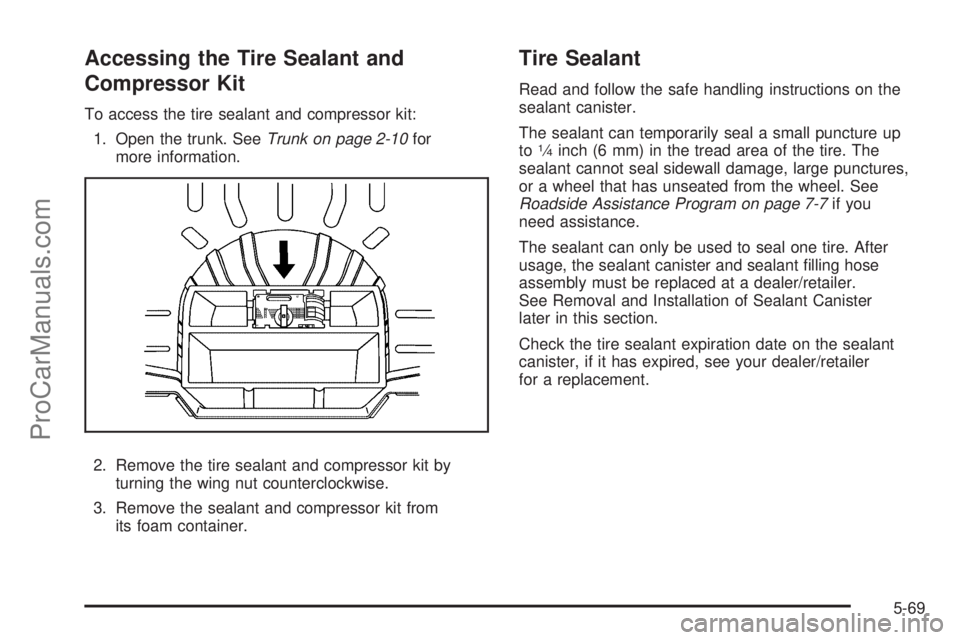
To access the tire sealant and compressor kit:
1. Open the trunk. SeeTrunk on page 2-10for
more information.
2. Remove the tire sealant and compressor kit by
turning the wing nut counterclockwise.
3. Remove the sealant and compressor kit from
its foam container.
Tire Sealant
Read and follow the safe handling instructions on the
sealant canister.
The sealant can temporarily seal a small puncture up
to
14inch (6 mm) in the tread area of the tire. The
sealant cannot seal sidewall damage, large punctures,
or a wheel that has unseated from the wheel. See
Roadside Assistance Program on page 7-7if you
need assistance.
The sealant can only be used to seal one tire. After
usage, the sealant canister and sealant lling hose
assembly must be replaced at a dealer/retailer.
See Removal and Installation of Sealant Canister
later in this section.
Check the tire sealant expiration date on the sealant
canister, if it has expired, see your dealer/retailer
for a replacement.
5-69
ProCarManuals.com
Page 294 of 362
19. Wipe off any sealant from the wheel, tire or
vehicle with a rag.
20. Dispose of the sealant canister at a local
dealer/retailer or in accordance with local
state codes and practices.
After using the sealant canister, replace it with
a new canister from your dealer/retailer.
21. After temporarily sealing a tire with the tire sealant
and compressor kit, take your vehicle to your
dealer/retailer to have the tire inspected and
repaired.
Using the Air Compressor without
Sealant to Inate an Underinated Tire
(Not Punctured)
To use the air compressor to inate a tire with air only
and not sealant:
1. Remove the air compressor inating hose connector
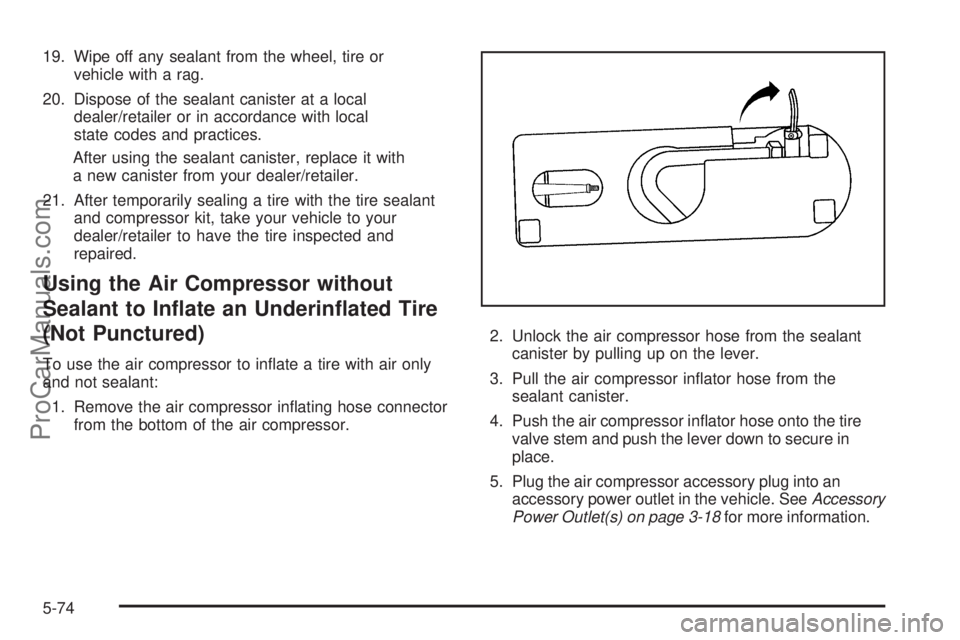
from the bottom of the air compressor.2. Unlock the air compressor hose from the sealant
canister by pulling up on the lever.
3. Pull the air compressor inator hose from the
sealant canister.
4. Push the air compressor inator hose onto the tire
valve stem and push the lever down to secure in
place.
5. Plug the air compressor accessory plug into an
accessory power outlet in the vehicle. SeeAccessory
Power Outlet(s) on page 3-18for more information.
5-74
ProCarManuals.com
Page 302 of 362
Wipers can be damaged by:
Extreme dusty conditions
Sand and salt
Heat and sun
Snow and ice, without proper removal
Aluminum Wheels
Notice:Chrome wheels and other chrome trim may
be damaged if you do not wash your vehicle after
driving on roads that have been sprayed with
magnesium, calcium or sodium chloride. These
chlorides are used on roads for conditions such as
ice and dust. Always wash your vehicle’s chrome
with soap and water after exposure.
Notice:If you use strong soaps, chemicals,
abrasive polishes, cleaners, brushes, or cleaners
that contain acid on aluminum or chrome-plated
wheels, you could damage the surface of the
wheel(s). The repairs would not be covered by your
warranty. Use only approved cleaners on aluminum
or chrome-plated wheels.Keep the wheels clean using a soft clean cloth with mild
soap and water. Rinse with clean water. After rinsing
thoroughly, dry with a soft clean towel. A wax may then
be applied.
Notice:Using chrome polish on aluminum wheels
could damage the wheels. The repairs would not
be covered by your warranty. Use chrome polish
on chrome wheels only.
The surface of these wheels is similar to the painted
surface of the vehicle. Do not use strong soaps,
chemicals, abrasive polishes, abrasive cleaners,
cleaners with acid, or abrasive cleaning brushes on
them because the surface could be damaged. Do not
use chrome polish on aluminum wheels.
Notice:If you drive your vehicle through an
automatic car wash that has silicone carbide tire
cleaning brushes, you could damage the aluminum
or chrome-plated wheels. The repairs would not
be covered by your warranty. Never drive a vehicle
equipped with aluminum or chrome-plated wheels
through an automatic car wash that uses silicone
carbide tire cleaning brushes.
5-82
ProCarManuals.com
Page 304 of 362
Vehicle Care/Appearance Materials
Description Usage
Polishing Cloth
Wax-TreatedInterior and exterior
polishing cloth.
Tar and Road Oil
RemoverRemoves tar, road oil,
and asphalt.
Chrome Cleaner
and PolishUse on chrome or
stainless steel.
White Sidewall
Tire CleanerRemoves soil and black
marks from whitewalls.
Vinyl Cleaner Cleans vinyl.
Glass CleanerRemoves dirt, grime,
smoke, and ngerprints.
Chrome and Wire
Wheel CleanerRemoves dirt and grime
from chrome wheels
and wire wheel covers.
Finish EnhancerRemoves dust,
ngerprints, and
surface contaminants.
Spray on wipe off.
Description Usage
Swirl Remover PolishRemoves swirl marks, ne
scratches, and other light
surface contamination.
Cleaner WaxRemoves light scratches
and protects nish.
Foaming Tire Shine
Low GlossCleans, shines,
and protects tires.
No wiping necessary.
Wash Wax ConcentrateMedium foaming
shampoo. Cleans
and lightly waxes.
Biodegradable and
phosphate free.
Spot LifterRemoves spots and
stains from carpets, vinyl,
and cloth upholstery.
Odor EliminatorOdorless spray odor
eliminator used on fabrics,
vinyl, leather, and carpet.
5-84
ProCarManuals.com
Page 309 of 362
Fuses Usage
CLUSTER/
THEFTInstrument Panel Cluster,
Theft Deterrent System
ONSTAR OnStar
®
NOT
INSTALLEDNot Used
AIRBAG (IGN) Airbag (Ignition)
HVAC
CTRL (BATT)Heating Ventilation Air Conditioning
Control Diagnostic Link Connector
(Battery)
PEDAL Adjustable Pedals
WIPER SW Windshield Wiper/Washer Switch
IGN SENSOR Ignition Switch
STRG WHL
ILLUMSteering Wheel Illumination
NOT
INSTALLEDNot Used
RADIO Audio System
INTERIOR
LIGHTSInterior Lamps
REAR WIPER Not Used
POWER
WINDOWSPower Windows
HVAC
CTRL (IGN)Heating Ventilation Air Conditioning
Control (Ignition)
HVAC
BLOWERHeating Ventilation Air Conditioning
Blower Switch
Fuses Usage
DOOR LOCK Door Locks
ROOF/
HEAT SEATSunroof, Power Windows
NOT
INSTALLEDNot Used
NOT
INSTALLEDNot Used
AIRBAG (BATT) Airbag (Battery)
SPARE FUSE
HOLDERSpare Fuse Holder
SPARE FUSE
HOLDERSpare Fuse Holder
SPARE FUSE
HOLDERSpare Fuse Holder
SPARE FUSE
HOLDERSpare Fuse Holder
FUSE PULLER Fuse Puller
Engine Compartment Fuse Block
The engine compartment fuse block is located on the
driver side of the engine compartment, near the battery.
Your vehicle might not have all the fuses and
features listed.
Notice:Spilling liquid on any electrical components
on your vehicle may damage it. Always keep the
covers on any electrical component.
5-89
ProCarManuals.com
Page 315 of 362
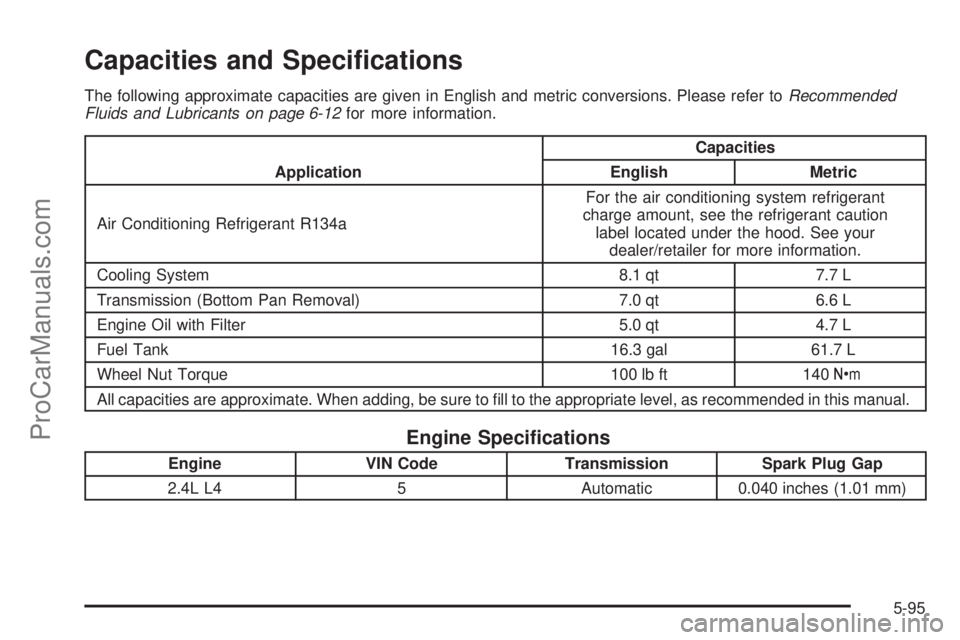
Capacities and Specications
The following approximate capacities are given in English and metric conversions. Please refer toRecommended
Fluids and Lubricants on page 6-12for more information.
ApplicationCapacities
English Metric
Air Conditioning Refrigerant R134aFor the air conditioning system refrigerant
charge amount, see the refrigerant caution
label located under the hood. See your
dealer/retailer for more information.
Cooling System 8.1 qt 7.7 L
Transmission (Bottom Pan Removal) 7.0 qt 6.6 L
Engine Oil with Filter 5.0 qt 4.7 L
Fuel Tank 16.3 gal 61.7 L
Wheel Nut Torque 100 lb ft 140Y
All capacities are approximate. When adding, be sure to ll to the appropriate level, as recommended in this manual.
Engine Specications
Engine VIN Code Transmission Spark Plug Gap
2.4L L4 5 Automatic 0.040 inches (1.01 mm)
5-95
ProCarManuals.com
Page 338 of 362

Customer Assistance Offices
Saturn encourages customers to call the toll-free
number for assistance. If a customer wishes to
write to Saturn, the letter should be addressed to:
Saturn Customer Assistance Center
100 Saturn Parkway
Mail Code 371-999-S24
Spring Hill, TN 37174-1500
1-800-553-6000
1-800-833-6000 (For Text Telephone
devices (TTYs))
Roadside Assistance: 1-800-553-6000
In Canada, write to:
Saturn Customer Communication Centre
General Motors of Canada Ltd.
CA1-163-005
1908 Colonel Sam Drive
Oshawa, Ontario L1H 8P7
www.gmcanada.com
1-800-263-1999
1-800-263-3830 (For Text Telephone
devices (TTYs))
Roadside Assistance: 1-800-268-6800
GM Mobility Reimbursement
Program
This program, available to qualied applicants, can
reimburse you up to $1,000 toward eligible aftermarket
driver or passenger adaptive equipment you may
require for your vehicle such as hand controls,
wheelchair/scooter lifts, etc.
The offer is available for a limited period of time from
the date of vehicle purchase/lease.
For more details, or to determine your vehicle’s
eligibility, visit your Saturn retailer or call the Saturn
Customer Assistance Center at 1-800-553-6000.
Text telephone (TTY) users, call 1-800-833-6000.
In Canada, customers may call the Saturn Customer
Communication Centre at 1-800-263-1999.
TTY users in Canada may call 1-800-263-3830.
7-6
ProCarManuals.com