child seat SATURN AURA 2009 Owner's Manual
[x] Cancel search | Manufacturer: SATURN, Model Year: 2009, Model line: AURA, Model: SATURN AURA 2009Pages: 408, PDF Size: 2.61 MB
Page 56 of 408
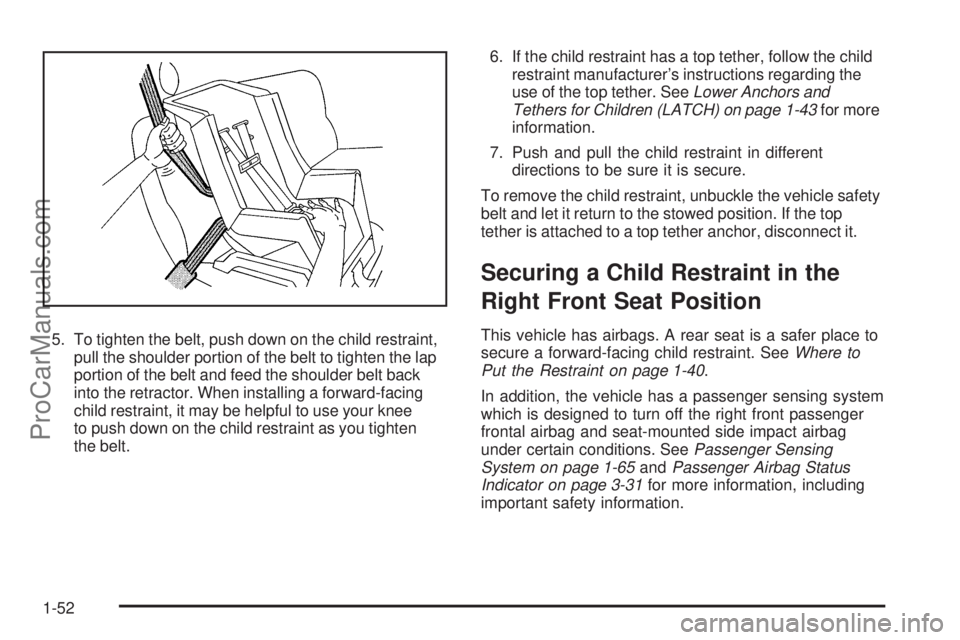
5. To tighten the belt, push down on the child restraint,
pull the shoulder portion of the belt to tighten the lap
portion of the belt and feed the shoulder belt back
into the retractor. When installing a forward-facing
child restraint, it may be helpful to use your knee
to push down on the child restraint as you tighten
the belt.6. If the child restraint has a top tether, follow the child
restraint manufacturer’s instructions regarding the
use of the top tether. SeeLower Anchors and
Tethers for Children (LATCH) on page 1-43for more
information.
7. Push and pull the child restraint in different
directions to be sure it is secure.
To remove the child restraint, unbuckle the vehicle safety
belt and let it return to the stowed position. If the top
tether is attached to a top tether anchor, disconnect it.
Securing a Child Restraint in the
Right Front Seat Position
This vehicle has airbags. A rear seat is a safer place to
secure a forward-facing child restraint. SeeWhere to
Put the Restraint on page 1-40.
In addition, the vehicle has a passenger sensing system
which is designed to turn off the right front passenger
frontal airbag and seat-mounted side impact airbag
under certain conditions. SeePassenger Sensing
System on page 1-65andPassenger Airbag Status
Indicator on page 3-31for more information, including
important safety information.
1-52
ProCarManuals.com
Page 57 of 408

A label on the sun visor says, “Never put a rear-facing
child seat in the front.” This is because the risk to
the rear-facing child is so great, if the airbag deploys.
{CAUTION:
A child in a rear-facing child restraint can be
seriously injured or killed if the right front passenger
airbag inates. This is because the back of the
rear-facing child restraint would be very close to the
inating airbag. A child in a forward-facing child
restraint can be seriously injured or killed if the right
front passenger airbag inates and the passenger
seat is in a forward position.
Even if the passenger sensing system has turned
off the right front passenger frontal airbag, no
system is fail-safe. No one can guarantee that an
airbag will not deploy under some unusual
circumstance, even though it is turned off.
CAUTION: (Continued)
CAUTION: (Continued)
Secure rear-facing child restraints in a rear
seat, even if the airbag is off. If you secure a
forward-facing child restraint in the right front seat,
always move the front passenger seat as far back
as it will go. It is better to secure the child restraint
in a rear seat.
SeePassenger Sensing System on page 1-65for
additional information.
If the child restraint has the LATCH system, seeLower
Anchors and Tethers for Children (LATCH) on page 1-43
for how and where to install the child restraint using
LATCH. If a child restraint is secured using a safety belt
and it uses a top tether, seeLower Anchors and Tethers
for Children (LATCH) on page 1-43for top tether anchor
locations.
Do not secure a child seat in a position without a top
tether anchor if a national or local law requires that the
top tether be anchored, or if the instructions that come
with the child restraint say that the top strap must be
anchored.
1-53
ProCarManuals.com
Page 58 of 408

In Canada, the law requires that forward-facing child
restraints have a top tether, and that the tether be
attached.
You will be using the lap-shoulder belt to secure the
child restraint in this position. Follow the instructions that
came with the child restraint.
1. Move the seat as far back as it will go before
securing the forward-facing child restraint.
When the passenger sensing system has turned
off the right front passenger frontal airbag and
seat-mounted side impact airbag, the off indicator
on the passenger airbag status indicator should
light and stay lit when you start the vehicle. See
Passenger Airbag Status Indicator on page 3-31.
2. Put the child restraint on the seat.
3. Pick up the latch plate, and run the lap and shoulder
portions of the vehicle’s safety belt through or
around the restraint. The child restraint instructions
will show you how.4. Push the latch plate into the buckle until it clicks.
Position the release button on the buckle so that
the safety belt could be quickly unbuckled if
necessary.
1-54
ProCarManuals.com
Page 60 of 408
If a child restraint has been installed and the on
indicator is lit, see “If the On Indicator is Lit for a Child
Restraint ” underPassenger Sensing System on
page 1-65for more information.
To remove the child restraint, unbuckle the vehicle
safety belt and let it return to the stowed position.
Airbag System
The vehicle has the following airbags:
A frontal airbag for the driver.
A frontal airbag for the right front passenger.
A seat-mounted side impact airbag for the driver.
A seat-mounted side impact airbag for the right front
passenger.
A roof-rail airbag for the driver and the passenger
seated directly behind the driver.
A roof-rail airbag for the right front passenger and
the passenger seated directly behind the right
front passenger.All of the airbags in your vehicle will have the word
AIRBAG embossed in the trim or on an attached label
near the deployment opening.
For frontal airbags, the word AIRBAG will appear on
the middle part of the steering wheel for the driver and
on the instrument panel for the right front passenger.
With seat-mounted side impact airbags, the word
AIRBAG will appear on the side of the seatback closest
to the door.
With roof-rail airbags, the word AIRBAG will appear
along the headliner or trim.
Airbags are designed to supplement the protection
provided by safety belts. Even though today’s airbags
are also designed to help reduce the risk of injury
from the force of an inating bag, all airbags must inate
very quickly to do their job.
1-56
ProCarManuals.com
Page 70 of 408
The passenger sensing system works with sensors that
are part of the right front passenger seat. The sensors
are designed to detect the presence of a properly-seated
occupant and determine if the right front passenger
frontal airbag and seat-mounted side impact airbag
should be enabled (may inate) or not.
According to accident statistics, children are safer when
properly secured in a rear seat in the correct child
restraint for their weight and size.
We recommend that children be secured in a rear seat,
including: an infant or a child riding in a rear-facing
child restraint; a child riding in a forward-facing child
seat; an older child riding in a booster seat; and children,
who are large enough, using safety belts.
A label on the sun visor says, “Never put a rear-facing
child seat in the front.” This is because the risk to
the rear-facing child is so great, if the airbag deploys.
{CAUTION:
A child in a rear-facing child restraint can be
seriously injured or killed if the right front passenger
airbag inates. This is because the back of the
rear-facing child restraint would be very close to the
inating airbag. A child in a forward-facing child
restraint can be seriously injured or killed if the right
front passenger airbag inates and the passenger
seat is in a forward position.
Even if the passenger sensing system has turned
off the right front passenger frontal airbag and
seat-mounted side impact airbag (if equipped),
no system is fail-safe. No one can guarantee that
an airbag will not deploy under some unusual
circumstance, even though the airbag(s) are off.
Secure rear-facing child restraints in a rear seat,
even if the airbag(s) are off. If you secure a
forward-facing child restraint in the right front seat,
always move the front passenger seat as far back
as it will go. It is better to secure the child restraint in
a rear seat.
1-66
ProCarManuals.com
Page 71 of 408
The passenger sensing system is designed to turn off
the right front passenger airbag and seat-mounted
side impact airbag if:
The right front passenger seat is unoccupied.
The system determines that an infant is present in
a rear-facing infant seat.
The system determines that a small child is present
in a child restraint.
The system determines that a small child is present
in a booster seat.
A right front passenger takes his/her weight off of
the seat for a period of time.
The right front passenger seat is occupied by a
smaller person, such as a child who has outgrown
child restraints.
Or, if there is a critical problem with the airbag
system or the passenger sensing system.
When the passenger sensing system has turned off the
right front passenger frontal airbag and seat-mounted
side impact airbag, the off indicator will light and stay lit to
remind you that the airbags are off. SeePassenger
Airbag Status Indicator on page 3-31.
The passenger sensing system is designed to turn on
(may inate) the right front passenger frontal airbag and
seat-mounted side impact airbag anytime the system
senses that a person of adult size is sitting properly in
the right front passenger seat.When the passenger sensing system has allowed the
airbags to be enabled, the on indicator will light and stay
lit to remind you that the airbags are active.
For some children who have outgrown child restraints
and for very small adults, the passenger sensing system
may or may not turn off the right front passenger frontal
airbag and seat-mounted side impact airbag, depending
upon the person’s seating posture and body build.
Everyone in the vehicle who has outgrown child restraints
should wear a safety belt properly — whether or not there
is an airbag for that person.
{CAUTION:
If the airbag readiness light ever comes on and
stays on, it means that something may be wrong
with the airbag system. To help avoid injury to
yourself or others, have the vehicle serviced right
away. SeeAirbag Readiness Light on page 3-30
for more information, including important safety
information.
1-67
ProCarManuals.com
Page 72 of 408
If the On Indicator is Lit for a Child
Restraint
If a child restraint has been installed and the on
indicator is lit:
1. Turn the vehicle off.
2. Remove the child restraint from the vehicle.
3. Remove any additional items from the seat such as
blankets, cushions, seat covers, seat heaters, or
seat massagers.
4. Reinstall the child restraint following the directions
provided by the child restraint manufacturer and
refer toSecuring a Child Restraint in the Right Front
Seat Position on page 1-52.5. If, after reinstalling the child restraint and restarting
the vehicle, the on indicator is still lit, turn the vehicle
off. Then slightly recline the vehicle seatback and
adjust the seat cushion, if adjustable, to make sure
that the vehicle seatback is not pushing the child
restraint into the seat cushion.
Also make sure the child restraint is not trapped
under the vehicle head restraint. If this happens,
adjust the head restraint. SeeHead Restraints
on page 1-7.
6. Restart the vehicle.
If the on indicator is still lit with an infant present in
a child restraint, secure the child restraint in a rear
seat position in the vehicle and check with your
dealer/retailer.
1-68
ProCarManuals.com
Page 74 of 408
Additional Factors Affecting System
Operation
Safety belts help keep the passenger in position on the
seat during vehicle maneuvers and braking, which helps
the passenger sensing system maintain the passenger
airbag status. See “Safety Belts” and “Child Restraints” in
the Index for additional information about the importance
of proper restraint use.
A thick layer of additional material, such as a blanket or
cushion, or aftermarket equipment such as seat covers,
seat heaters, and seat massagers can affect how well
the passenger sensing system operates. We recommend
that you not use seat covers or other aftermarket
equipment except when approved by GM for your specic
vehicle. SeeAdding Equipment to Your Airbag-Equipped
Vehicle on page 1-71for more information about
modications that can affect how the system operates.
{CAUTION:
Stowing of articles under the passenger seat or
between the passenger seat cushion and seatback
may interfere with the proper operation of the
passenger sensing system.
Servicing Your Airbag-Equipped
Vehicle
Airbags affect how the vehicle should be serviced. There
are parts of the airbag system in several places around
the vehicle. Your dealer/retailer and the service manual
have information about servicing the vehicle and the
airbag system. To purchase a service manual, see
Service Publications Ordering Information on page 7-15.
{CAUTION:
For up to 10 seconds after the ignition is turned off
and the battery is disconnected, an airbag can still
inate during improper service. You can be injured
if you are close to an airbag when it inates. Avoid
yellow connectors. They are probably part of the
airbag system. Be sure to follow proper service
procedures, and make sure the person performing
work for you is qualied to do so.
1-70
ProCarManuals.com
Page 88 of 408
Doors and Locks
Door Locks
{CAUTION:
Unlocked doors can be dangerous.
Passengers, especially children, can easily
open the doors and fall out of a moving vehicle.
When a door is locked, the handle will not
open it. The chance of being thrown out of the
vehicle in a crash is increased if the doors are
not locked. So, all passengers should wear
safety belts properly and the doors should
be locked whenever the vehicle is driven.
Young children who get into unlocked vehicles
may be unable to get out. A child can be
overcome by extreme heat and can suffer
permanent injuries or even death from heat
stroke. Always lock the vehicle whenever
leaving it.
Outsiders can easily enter through an unlocked
door when you slow down or stop your vehicle.
Locking your doors can help prevent this from
happening.There are several ways to lock and unlock the vehicle.
To lock or unlock the door from the outside, use the
key in the driver or front passenger door or press
the lock or unlock button on the Remote Keyless
Entry (RKE) transmitter, if the vehicle has one.
To lock a door from the inside, push the manual lock
knob down or use the power door lock switches.
Power Door Locks
The power door lock switches are located on the
driver’s and front passenger’s door.
Press the outboard side of the switch to unlock all
doors. Press the inboard side of the switch to lock
all doors.
The rear doors do not have power door lock switches.
Rear seat passengers must use the manual lock
knob on their doors.
Door Ajar Reminder
A chime will sound and the DOOR AJAR message
will display if one of the doors is not fully closed.
This happens when the ignition is on and the shift
lever is moved out of P (Park) or N (Neutral).
SeeDIC Warnings and Messages on page 3-45.
2-10
ProCarManuals.com
Page 246 of 408

If things like suitcases, tools, packages, or
anything else are put inside the vehicle, they will
go as fast as the vehicle goes. If you have to
stop or turn quickly, or if there is a crash, they
will keep going.
{CAUTION:
Things you put inside the vehicle can strike
and injure people in a sudden stop or turn,
or in a crash.
Put things in the trunk of your vehicle.
In a trunk, put them as far forward as you
can. Try to spread the weight evenly.
Never stack heavier things, like
suitcases, inside the vehicle so that some
of them are above the tops of the seats.
Do not leave an unsecured child restraint
in the vehicle.
When you carry something inside the
vehicle, secure it whenever you can.
Do not leave a seat folded down unless
you need to.
Towing
Towing Your Vehicle
To avoid damage, the disabled vehicle should be towed
with all four wheels off the ground. Consult your dealer/
retailer or a professional towing service if the disabled
vehicle must be towed. SeeRoadside Assistance
Program on page 7-7.
To tow the vehicle behind another vehicle for
recreational purposes, such as behind a motorhome,
see “Recreational Vehicle Towing” following.
Recreational Vehicle Towing
Recreational vehicle towing means towing the vehicle
behind another vehicle – such as behind a motorhome.
The two most common types of recreational vehicle
towing are known as dinghy towing and dolly towing.
Dinghy towing is towing the vehicle with all four wheels
on the ground. Dolly towing is towing the vehicle with
two wheels on the ground and two wheels up on a
device known as a dolly.
4-26
ProCarManuals.com