brakes SATURN AURA 2010 Owner's Manual
[x] Cancel search | Manufacturer: SATURN, Model Year: 2010, Model line: AURA, Model: SATURN AURA 2010Pages: 428, PDF Size: 2.78 MB
Page 287 of 428
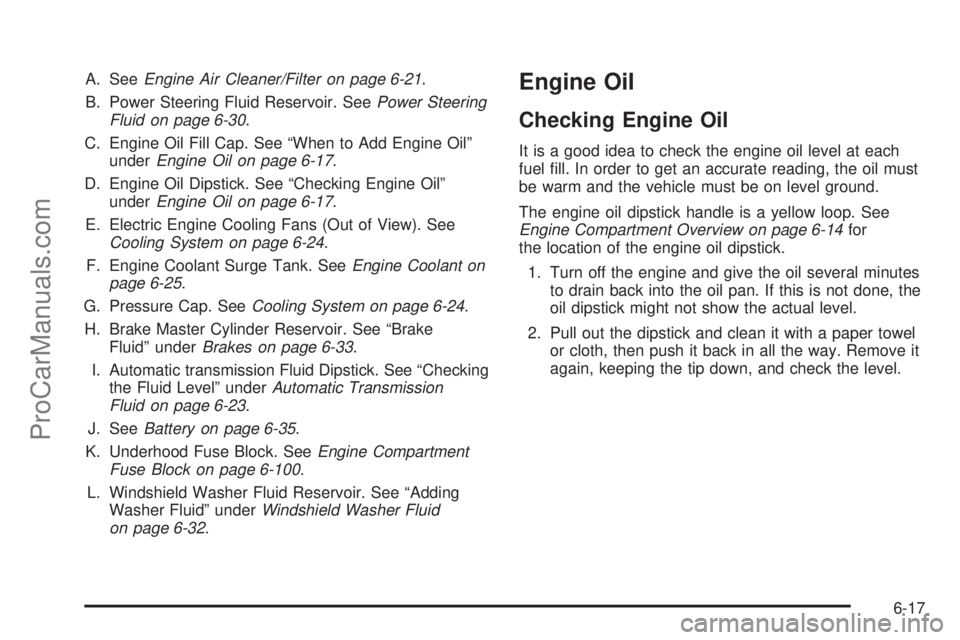
A. SeeEngine Air Cleaner/Filter on page 6-21.
B. Power Steering Fluid Reservoir. SeePower Steering
Fluid on page 6-30.
C. Engine Oil Fill Cap. See “When to Add Engine Oil”
underEngine Oil on page 6-17.
D. Engine Oil Dipstick. See “Checking Engine Oil”
underEngine Oil on page 6-17.
E. Electric Engine Cooling Fans (Out of View). See
Cooling System on page 6-24.
F. Engine Coolant Surge Tank. SeeEngine Coolant on
page 6-25.
G. Pressure Cap. SeeCooling System on page 6-24.
H. Brake Master Cylinder Reservoir. See “Brake
Fluid” underBrakes on page 6-33.
I. Automatic transmission Fluid Dipstick. See “Checking
the Fluid Level” underAutomatic Transmission
Fluid on page 6-23.
J. SeeBattery on page 6-35.
K. Underhood Fuse Block. SeeEngine Compartment
Fuse Block on page 6-100.
L. Windshield Washer Fluid Reservoir. See “Adding
Washer Fluid” underWindshield Washer Fluid
on page 6-32.Engine Oil
Checking Engine Oil
It is a good idea to check the engine oil level at each
fuel fill. In order to get an accurate reading, the oil must
be warm and the vehicle must be on level ground.
The engine oil dipstick handle is a yellow loop. See
Engine Compartment Overview on page 6-14for
the location of the engine oil dipstick.
1. Turn off the engine and give the oil several minutes
to drain back into the oil pan. If this is not done, the
oil dipstick might not show the actual level.
2. Pull out the dipstick and clean it with a paper towel
or cloth, then push it back in all the way. Remove it
again, keeping the tip down, and check the level.
6-17
ProCarManuals.com
Page 303 of 428

Brakes
Brake Fluid
The brake master cylinder
reservoir is filled with
DOT 3 brake fluid. See
Engine Compartment
Overview on page 6-14for
the location of the
reservoir.
There are only two reasons why the brake fluid level in
the reservoir might go down:
•The brake fluid level goes down because of normal
brake lining wear. When new linings are installed,
the fluid level goes back up.
•A fluid leak in the brake hydraulic system can also
cause a low fluid level. Have the brake hydraulic
system fixed, since a leak means that sooner
or later the brakes will not work well.Do not top off the brake fluid. Adding fluid does not
correct a leak. If fluid is added when the linings
are worn, there will be too much fluid when new brake
linings are installed. Add or remove brake fluid, as
necessary, only when work is done on the brake
hydraulic system.
{WARNING:
If too much brake fluid is added, it can spill on the
engine and burn, if the engine is hot enough. You
or others could be burned, and the vehicle could
be damaged. Add brake fluid only when work is
done on the brake hydraulic system.
When the brake fluid falls to a low level, the BRAKE
FLUID message in the Driver Information Center (DIC)
displays. SeeDIC Warnings and Messages on
page 4-42.
6-33
ProCarManuals.com
Page 304 of 428

What to Add
Use only new DOT 3 brake fluid from a sealed container.
SeeRecommended Fluids and Lubricants on page 7-10.
Always clean the brake fluid reservoir cap and the
area around the cap before removing it. This helps keep
dirt from entering the reservoir.
{WARNING:
With the wrong kind of fluid in the brake hydraulic
system, the brakes might not work well. This could
cause a crash. Always use the proper brake fluid.
Notice:
Using the wrong uid can badly damage brake
hydraulic system parts. For example, just a
few drops of mineral-based oil, such as engine
oil, in the brake hydraulic system can damage
brake hydraulic system parts so badly that they
will have to be replaced. Do not let someone
put in the wrong kind of uid.
If brake uid is spilled on the vehicle’s painted
surfaces, the paint nish can be damaged. Be
careful not to spill brake uid on the vehicle.
If you do, wash it off immediately. SeeWashing
Your Vehicle on page 6-92.
Brake Wear
This vehicle has disc brakes. Disc brake pads have
built-in wear indicators that make a high-pitched warning
sound when the brake pads are worn and new pads
are needed. The sound can come and go or be heard all
the time the vehicle is moving, except when applying
the brake pedal firmly.
{WARNING:
The brake wear warning sound means that soon
the brakes will not work well. That could lead to an
accident. When the brake wear warning sound is
heard, have the vehicle serviced.
Notice:Continuing to drive with worn-out brake
pads could result in costly brake repair.
Some driving conditions or climates can cause a brake
squeal when the brakes are first applied or lightly
applied. This does not mean something is wrong with
the brakes.
6-34
ProCarManuals.com
Page 305 of 428

Properly torqued wheel nuts are necessary to help
prevent brake pulsation. When tires are rotated, inspect
brake pads for wear and evenly tighten wheel nuts in
the proper sequence to torque specifications in
Capacities and Specications on page 6-105.
Brake linings should always be replaced as complete
axle sets.
Brake Pedal Travel
See your dealer/retailer if the brake pedal does not
return to normal height, or if there is a rapid increase in
pedal travel. This could be a sign that brake service
might be required.
Brake Adjustment
Every time the brakes are applied, with or without the
vehicle moving, the brakes adjust for wear.
Replacing Brake System Parts
The braking system on a vehicle is complex. Its many
parts have to be of top quality and work well together if
the vehicle is to have really good braking. The vehicle
was designed and tested with top-quality brake parts.
When parts of the braking system are replaced — for
example, when the brake linings wear down and newones are installed — be sure to get new approved
replacement parts. If this is not done, the brakes might
not work properly. For example, if someone puts in brake
linings that are wrong for the vehicle, the balance
between the front and rear brakes can change — for the
worse. The braking performance expected can change in
many other ways if the wrong replacement brake parts
are installed.
Battery
Refer to the replacement number on the original battery
label when a new battery is needed. SeeEngine
Compartment Overview on page 6-14for battery
location.
{DANGER:
Battery posts, terminals, and related accessories
contain lead and lead compounds, chemicals
known to the State of California to cause cancer
and reproductive harm. Wash hands after
handling.
6-35
ProCarManuals.com
Page 318 of 428

(C) Aspect Ratio:A two-digit number that
indicates the tire height-to-width measurements.
For example, if the tire size aspect ratio is 60, as
shown in item C of the illustration, it would mean
that the tire’s sidewall is 60 percent as high as it
is wide.
(D) Construction Code
:A letter code is used to
indicate the type of ply construction in the tire.
The letter R means radial ply construction;
the letter D means diagonal or bias ply
construction; and the letter B means belted-bias
ply construction.
(E) Rim Diameter
:Diameter of the wheel in
inches.
(F) Service Description
:These characters
represent the load index and speed rating of the
tire. The load index represents the load carry
capacity a tire is certified to carry. The speed
rating is the maximum speed a tire is certified to
carry a load.
Tire Terminology and Denitions
Air Pressure:The amount of air inside the
tire pressing outward on each square inch of the
tire. Air pressure is expressed in pounds per
square inch (psi) or kilopascal (kPa).
Accessory Weight
:This means the combined
weight of optional accessories. Some examples of
optional accessories are, automatic transmission,
power steering, power brakes, power windows,
power seats, and air conditioning.
Aspect Ratio
:The relationship of a tire’s height
to its width.
Belt
:A rubber coated layer of cords that is
located between the plies and the tread. Cords
may be made from steel or other reinforcing
materials.
Bead
:The tire bead contains steel wires wrapped
by steel cords that hold the tire onto the rim.
6-48
ProCarManuals.com
Page 331 of 428

{WARNING:
If you use bias-ply tires on the vehicle, the
wheel rim flanges could develop cracks after
many miles of driving. A tire and/or wheel
could fail suddenly, causing a crash. Use only
radial-ply tires with the wheels on the vehicle.
If you must replace your vehicle’s tires with those
that do not have a TPC Spec number, make
sure they are the same size, load range, speed
rating, and construction type (radial and
bias-belted tires) as your vehicle’s original tires.
Vehicles that have a tire pressure monitoring
system could give an inaccurate low-pressure
warning if non-TPC Spec rated tires are installed
on your vehicle. Non-TPC Spec rated tires
may give a low-pressure warning that is higher or
lower than the proper warning level you would
get with TPC Spec rated tires. SeeTire Pressure
Monitor System on page 6-53.
Your vehicle’s original equipment tires are listed
on the Tire and Loading Information Label.
SeeLoading the Vehicle on page 5-19, for more
information about the Tire and Loading Information
Label and its location on your vehicle.
Different Size Tires and Wheels
If you add wheels or tires that are a different size than
your original equipment wheels and tires, this may
affect the way your vehicle performs, including its
braking, ride and handling characteristics, stability, and
resistance to rollover. Additionally, if your vehicle
has electronic systems such as, anti-lock brakes,
traction control, and stability control, the performance of
these systems can be affected.
{WARNING:
If you add different sized wheels, your vehicle may
not provide an acceptable level of performance
and safety if tires not recommended for those
wheels are selected. You may increase the
chance that you will crash and suffer serious
injury. Only use Saturn specific wheel and tire
systems developed for your vehicle, and have
them properly installed by a Saturn certified
technician.
SeeBuying New Tires on page 6-60andAccessories
and Modications on page 6-3for additional information.
6-61
ProCarManuals.com
Page 335 of 428

Used Replacement Wheels
{WARNING:
Putting a used wheel on your vehicle is
dangerous. You cannot know how it has been
used or how far it has been driven. It could fail
suddenly and cause a crash. If you have to
replace a wheel, use a new Saturn original
equipment wheel.
Tire Chains
{WARNING:
Do not use tire chains. There is not enough
clearance. Tire chains used on a vehicle without
the proper amount of clearance can cause
damage to the brakes, suspension or other vehicle
parts. The area damaged by the tire chains could
cause you to lose control of the vehicle and you or
others may be injured in a crash.
Use another type of traction device only if its
manufacturer recommends it for use on the
vehicle and tire size combination and road
conditions. Follow that manufacturer’s instructions.
To help avoid damage to the vehicle, drive slowly,
readjust or remove the device if it is contacting the
vehicle, and do not spin the vehicle’s wheels. If
you do find traction devices that will fit, install
them on the front tires.
6-65
ProCarManuals.com
Page 412 of 428

Arming the System.........................................3-16
Assistance Program, Roadside........................... 8-6
Audio System.........................................4-50, 4-69
Audio Steering Wheel Controls......................4-82
Radio Reception..........................................4-83
Rear Seat (RSA).........................................4-79
Setting the Clock.........................................4-51
Theft-Deterrent Feature................................4-81
XM™ Satellite Radio Antenna System............4-84
Audio System(s).............................................4-52
Automatic Climate Control System.....................4-19
Automatic Dimming Mirror Operation..................3-32
Automatic Headlamp System............................4-11
Automatic Transmission
Fluid..........................................................6-23
Operation...................................................3-23
Automatic Transmission Shift Lock Control
System Check.............................................. 7-8
B
Backglass Antenna..........................................4-84
Backing Up....................................................5-31
Battery..........................................................6-35
Electric Power Management..........................4-14
Run-Down Protection...................................4-14
Battery Replacement......................................... 3-5Belt Routing, Engine.......................................7-12
Blizzard Conditions..........................................5-16
Bluetooth Controls...........................................4-69
Bluetooth
®.....................................................4-68
Brake
Emergencies................................................ 5-5
Brake Adjustment............................................6-35
Brake Fluid....................................................6-33
Brake Pedal Travel.........................................6-35
Brake Wear...................................................6-34
Brakes..........................................................6-33
Antilock....................................................... 5-4
Parking......................................................3-26
System Warning Light..................................4-30
Braking........................................................... 5-3
Braking in Emergencies..................................... 5-5
Break-In, New Vehicle.....................................3-19
Bulb Replacement...........................................6-43
Fog Lamps .................................................4-12
Halogen Bulbs............................................6-41
Headlamp Aiming........................................6-40
Headlamps.................................................6-41
License Plate Lamps....................................6-43
Taillamps, Turn Signal, Sidemarker, Stoplamps,
and Back-Up Lamps.................................6-41
Buying New Tires...........................................6-60
2
ProCarManuals.com
Page 426 of 428

Tires.............................................................6-44
Aluminum Wheels, Cleaning..........................6-94
Buying New Tires........................................6-60
Chains.......................................................6-65
Changing a Flat Tire....................................6-74
Cleaning....................................................6-94
Compact Spare...........................................6-88
Different Size..............................................6-61
High-Speed Operation..................................6-52
If a Tire Goes Flat.......................................6-66
Inflation - Tire Pressure................................6-51
Inspection and Rotation................................6-57
Installing the Spare Tire................................6-78
Pressure Light.............................................4-34
Pressure Monitor Operation...........................6-54
Pressure Monitor System..............................6-53
Removing the Flat Tire.................................6-78
Removing the Spare Tire and Tools...............6-76
Sealant and Compressor Kit.................6-67, 6-74
Sidewall Labeling.........................................6-45
Storing a Flat or Spare Tire and Tools............6-84
Terminology and Definitions...........................6-48
Uniform Tire Quality Grading.........................6-62
Wheel Alignment and Tire Balance.................6-63
Wheel Replacement.....................................6-64
When It Is Time for New Tires......................6-59
To Use the Engine Coolant Heater....................3-22Torque Lock...................................................3-28
Total Weight on the Vehicle’s Tires....................5-30
Towing
Recreational Vehicle.....................................5-24
Towing a Trailer..........................................5-27
Your Vehicle...............................................5-24
TPMS Malfunction Light and Message...............6-55
TPMS Sensor Matching Process
.......................6-56
Traction
Control System (TCS).................................... 5-7
Traction Control Operation................................. 5-8
Traction – AA, A, B, C.....................................6-62
Trailer Brakes.................................................5-30
Transferring a Call..........................................4-76
Transmission
Fluid, Automatic...........................................6-23
Transmission Operation, Automatic....................3-23
Transportation Options...................................... 8-9
Transportation Program, Courtesy....................... 8-9
Treadwear.....................................................6-62
Treadwear 200 Traction AA Temperature A.........6-62
Trip Odometer................................................4-26
Trunk............................................................3-11
Turn and Lane-Change Signals.......................... 4-4
Turn Signal/Multifunction Lever........................... 4-4
Turn Signals When Towing a Trailer..................5-32
16
ProCarManuals.com