lock SATURN AURA HYBRID 2010 User Guide
[x] Cancel search | Manufacturer: SATURN, Model Year: 2010, Model line: AURA HYBRID, Model: SATURN AURA HYBRID 2010Pages: 400, PDF Size: 2.46 MB
Page 27 of 400

Automatic Engine Start/Stop
Feature
Automatic Engine Start/Stop
The vehicle has an automatic engine start/stop feature.
After the engine is started and has reached operating
temperature, the AUTO STOP feature may cause
the engine to turn off when you apply the brakes and
come to a complete stop. When you take your foot
off the brake pedal or press the accelerator pedal, the
engine will start. The engine will continue to run until the
next AUTO STOP.To restart the engine during the AUTO STOP, release
the brake pedal or press the accelerator pedal. The
engine starts immediately. The vehicle continues to run
until the next stop.
The AUTO STOP symbol on the tachometer signifies
that the engine is in AUTO STOP mode. SeeAuto Stop
Mode on page 4-36for more information. A chime
will sound when the driver door is opened while in AUTO
STOP mode. Remember to shift to P (Park) and turn
the ignition to LOCK/OFF before exiting the vehicle.
SeeStarting the Engine (Automatic Engine Start/Stop)
on page 3-22.
Regenerative Braking
Regenerative braking takes some of the energy from
the moving vehicle and turns it back into electrical
energy. This energy is then stored back into the
vehicle’s hybrid battery system, contributing to increased
fuel efficiency.
The system works whenever you take your foot off the
accelerator pedal while the vehicle is moving in a
forward gear. This causes the vehicle to slow down
more quickly. It may feel like the brake pedal is being
pressed, even when it is not. United States
Canada
1-23
ProCarManuals.com
Page 30 of 400
Note:The Tire Pressure Monitor can alert you about
low tire pressure, but it does not replace normal monthly
tire maintenance. It is the driver’s responsibility to
maintain correct tire pressures.
SeeTire Pressure Monitor System on page 6-51and
Tire Pressure Monitor Operation on page 6-52.
Tire Sealant and Compressor Kit
This vehicle has a tire sealant and compressor kit which
can be used to seal small punctures in the tread area
of the tire.
SeeTire Sealant and Compressor Kit on page 6-66for
complete operating information.
Engine Oil Life System
The engine oil life system calculates engine oil life
based on vehicle use and displays a DIC message when
it is necessary to change the engine oil and filter. The
oil life system should be reset to 100% only following an
oil change.
Resetting the Oil Life System
1. Turn the ignition key to ON/RUN with the
engine off.
2. With the CHANGE OIL SOON message displayed,
press either of the DIC buttons to clear the
message. SeeDIC Warnings and Messages on
page 4-41.
3. Display OIL LIFE RESET on the DIC.
4. Press and hold the INFO button for at least one
second. An ACKNOWLEDGED message displays
for three seconds or until the next button is pressed.
This tells you the system has been reset. See
DIC Vehicle Personalization on page 4-45.
5. Turn the key to LOCK/OFF.
SeeEngine Oil Life System on page 6-18.
1-26
ProCarManuals.com
Page 32 of 400

OnStar®
OnStar®uses several innovative technologies and live
advisors to provide a wide range of safety, security,
navigation, diagnostics, and calling services.
Automatic Crash Response
In a crash, built in sensors can automatically alert an
OnStar advisor who is immediately connected to
the vehicle to see if you need help.
How OnStar Service Works
Q
:This blue button connects you to a specially
trained OnStar advisor to verify your account information
and to answer questions.
]:Push this red emergency button to get priority help
from specially trained OnStar emergency advisors.
X:Push this button for hands-free, voice-activated
calling and to give voice commands for turn-by-turn
navigation.
Crisis Assist, Stolen Vehicle Assistance, Vehicle
Diagnostics, Remote Door Unlock, Roadside Assistance,
Turn-by-Turn Navigation and Hands-Free Calling are
available on most vehicles. Not all OnStar services are
available on all vehicles. For more information see
the OnStar Owner’s Guide or visit www.onstar.com
(U.S.) or www.onstar.ca (Canada), contact OnStar at
1-888-4-ONSTAR (1-888-466-7827) or TTY
1-877-248-2080, or press
Qto speak with an OnStar
advisor 24 hours a day, 7 days a week.
For a full description of OnStar services and system
limitations, see the OnStar Owner’s Guide in the
glove box.
OnStar service is subject to the OnStar terms and
conditions included in the OnStar Subscriber
Information.
OnStar service cannot work unless the vehicle is in a
place where OnStar has an agreement with a wireless
service provider for service in that area.
1-28
ProCarManuals.com
Page 37 of 400
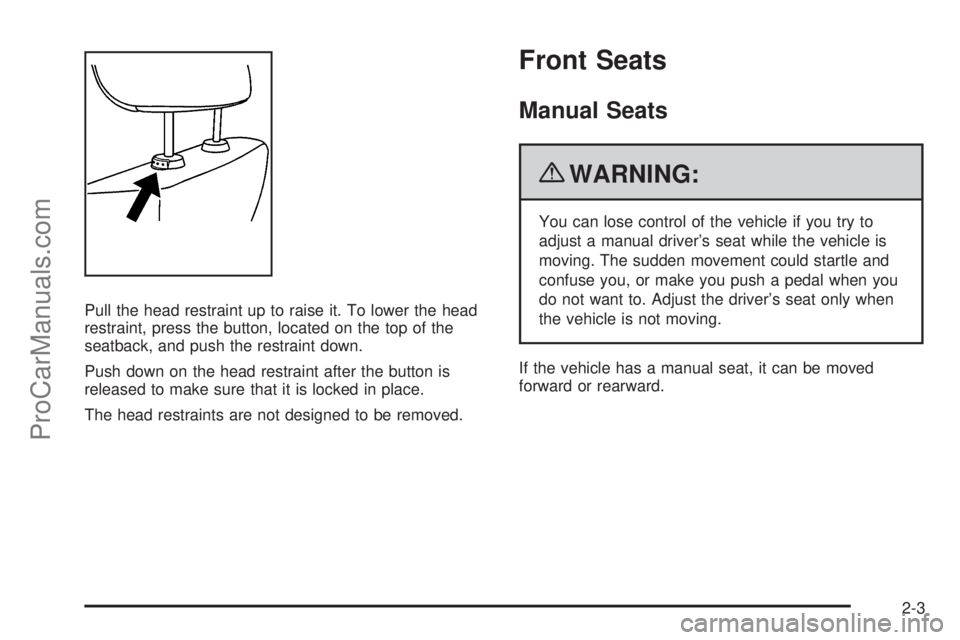
Pull the head restraint up to raise it. To lower the head
restraint, press the button, located on the top of the
seatback, and push the restraint down.
Push down on the head restraint after the button is
released to make sure that it is locked in place.
The head restraints are not designed to be removed.
Front Seats
Manual Seats
{WARNING:
You can lose control of the vehicle if you try to
adjust a manual driver’s seat while the vehicle is
moving. The sudden movement could startle and
confuse you, or make you push a pedal when you
do not want to. Adjust the driver’s seat only when
the vehicle is not moving.
If the vehicle has a manual seat, it can be moved
forward or rearward.
2-3
ProCarManuals.com
Page 38 of 400
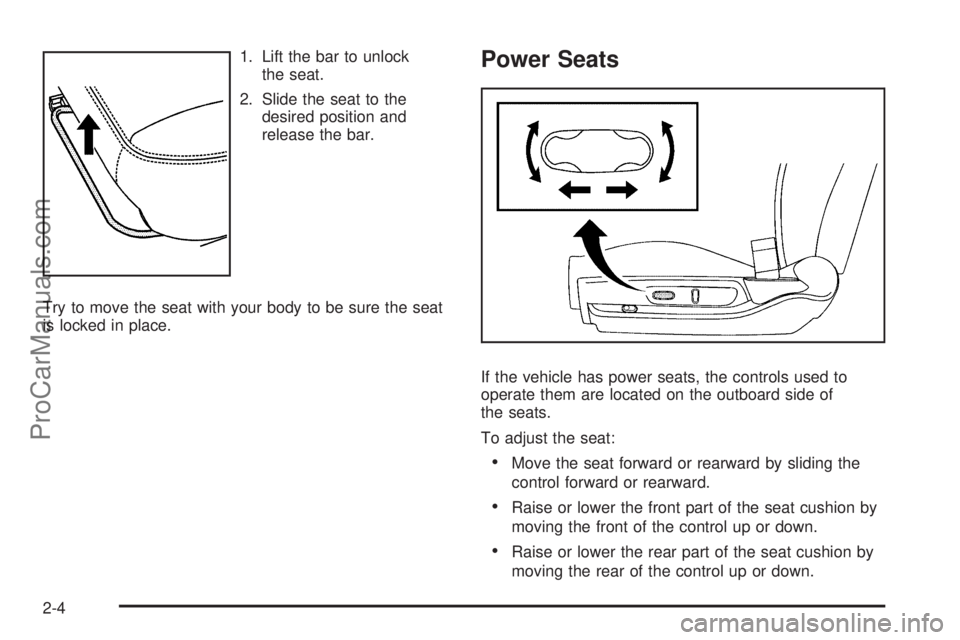
1. Lift the bar to unlock
the seat.
2. Slide the seat to the
desired position and
release the bar.
Try to move the seat with your body to be sure the seat
is locked in place.Power Seats
If the vehicle has power seats, the controls used to
operate them are located on the outboard side of
the seats.
To adjust the seat:
•Move the seat forward or rearward by sliding the
control forward or rearward.
•Raise or lower the front part of the seat cushion by
moving the front of the control up or down.
•Raise or lower the rear part of the seat cushion by
moving the rear of the control up or down.
2-4
ProCarManuals.com
Page 40 of 400
Reclining Seatbacks
Manual Reclining Seatbacks
{WARNING:
You can lose control of the vehicle if you try to
adjust a manual driver’s seat while the vehicle is
moving. The sudden movement could startle and
confuse you, or make you push a pedal when you
do not want to. Adjust the driver’s seat only when
the vehicle is not moving.
{WARNING:
If either seatback is not locked, it could move
forward in a sudden stop or crash. That could
cause injury to the person sitting there. Always
push and pull on the seatbacks to be sure they
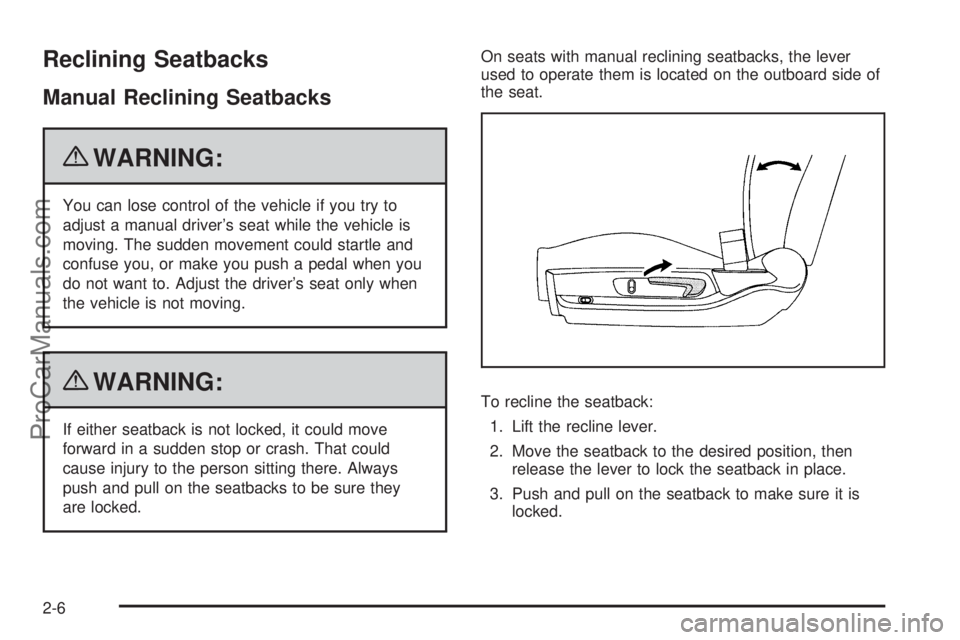
are locked.On seats with manual reclining seatbacks, the lever
used to operate them is located on the outboard side of
the seat.
To recline the seatback:
1. Lift the recline lever.
2. Move the seatback to the desired position, then
release the lever to lock the seatback in place.
3. Push and pull on the seatback to make sure it is
locked.
2-6
ProCarManuals.com
Page 41 of 400
To return the seatback to an upright position:
1. Lift the lever fully without applying pressure to the
seatback and the seatback returns to the upright
position.
2. Release the lever to lock the seatback.
3. Push and pull on the seatback to make sure it is
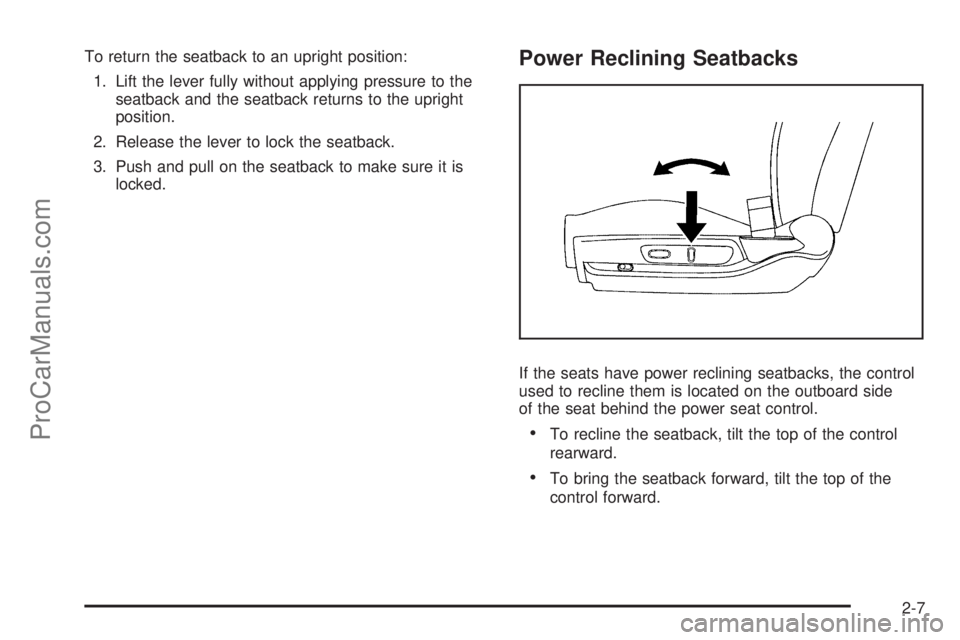
locked.Power Reclining Seatbacks
If the seats have power reclining seatbacks, the control
used to recline them is located on the outboard side
of the seat behind the power seat control.
•To recline the seatback, tilt the top of the control
rearward.
•To bring the seatback forward, tilt the top of the
control forward.
2-7
ProCarManuals.com
Page 44 of 400
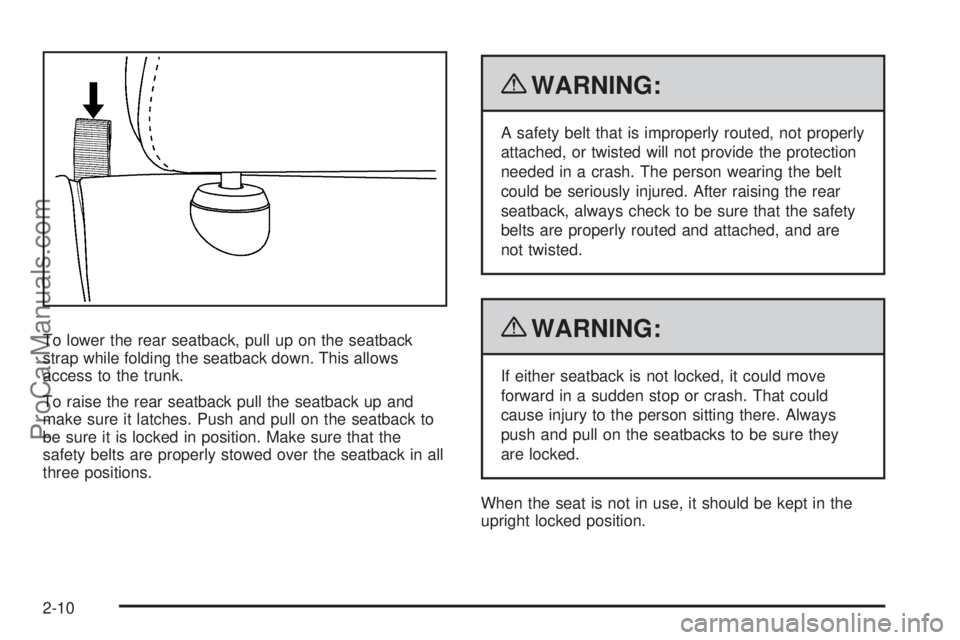
To lower the rear seatback, pull up on the seatback
strap while folding the seatback down. This allows
access to the trunk.
To raise the rear seatback pull the seatback up and
make sure it latches. Push and pull on the seatback to
be sure it is locked in position. Make sure that the
safety belts are properly stowed over the seatback in all
three positions.
{WARNING:
A safety belt that is improperly routed, not properly
attached, or twisted will not provide the protection
needed in a crash. The person wearing the belt
could be seriously injured. After raising the rear
seatback, always check to be sure that the safety
belts are properly routed and attached, and are
not twisted.
{WARNING:
If either seatback is not locked, it could move
forward in a sudden stop or crash. That could
cause injury to the person sitting there. Always
push and pull on the seatbacks to be sure they
are locked.
When the seat is not in use, it should be kept in the
upright locked position.
2-10
ProCarManuals.com
Page 50 of 400
How to Wear Safety Belts Properly
This section is only for people of adult size.
Be aware that there are special things to know about
safety belts and children. And there are different
rules for smaller children and infants. If a child will be
riding in the vehicle, seeOlder Children on page 2-30or
Infants and Young Children on page 2-34. Follow
those rules for everyone’s protection.
It is very important for all occupants to buckle up.
Statistics show that unbelted people are hurt more often
in crashes than those who are wearing safety belts.
Occupants who are not buckled up can be thrown out of
the vehicle in a crash. And they can strike others in
the vehicle who are wearing safety belts.
First, before you or your passenger(s) wear a safety
belt, there is important information you should know.
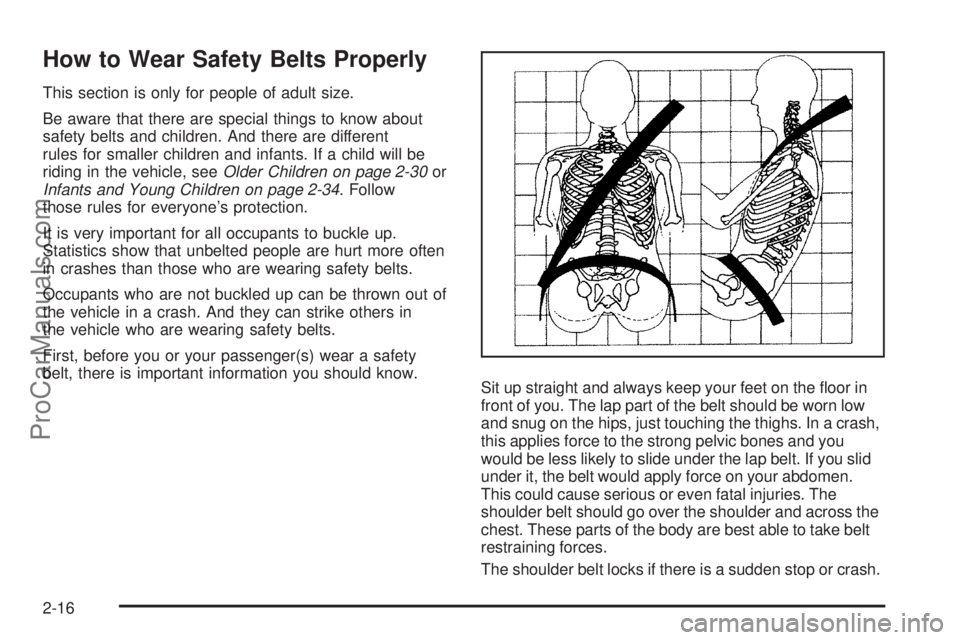
Sit up straight and always keep your feet on the floor in
front of you. The lap part of the belt should be worn low
and snug on the hips, just touching the thighs. In a crash,
this applies force to the strong pelvic bones and you
would be less likely to slide under the lap belt. If you slid
under it, the belt would apply force on your abdomen.
This could cause serious or even fatal injuries. The
shoulder belt should go over the shoulder and across the
chest. These parts of the body are best able to take belt
restraining forces.
The shoulder belt locks if there is a sudden stop or crash.
2-16
ProCarManuals.com
Page 58 of 400

Lap-Shoulder Belt
All seating positions in the vehicle have a
lap-shoulder belt.
The following instructions explain how to wear a
lap-shoulder belt properly.
1. Adjust the seat, if the seat is adjustable, so you
can sit up straight. To see how, see “Seats” in
the Index.
2. Pick up the latch plate and pull the belt across you.
Do not let it get twisted.
The lap-shoulder belt may lock if you pull the belt
across you very quickly. If this happens, let the belt
go back slightly to unlock it. Then pull the belt
across you more slowly.
If the shoulder portion of a passenger belt is pulled
out all the way, the child restraint locking feature
may be engaged. If this happens, just let the belt go
back all the way and start again.
Engaging the child restraint locking feature in the
right front seating position may affect the passenger
sensing system. SeePassenger Sensing System
on page 2-66for more information.3. Push the latch plate into the buckle until it clicks.
Pull up on the latch plate to make sure it is secure.
If the belt is not long enough, seeSafety Belt
Extender on page 2-30.
Position the release button on the buckle so that the
safety belt could be quickly unbuckled if necessary.
4. If equipped with a shoulder belt height adjuster,
move it to the height that is right for you. Improper
shoulder belt height adjustment could reduce
the effectiveness of the safety belt in a crash. See
“Shoulder Belt Height Adjustment” later in this
section for instruction on use and important safety
information.
2-24
ProCarManuals.com