seats SATURN AURA HYBRID 2010 Owner's Manual
[x] Cancel search | Manufacturer: SATURN, Model Year: 2010, Model line: AURA HYBRID, Model: SATURN AURA HYBRID 2010Pages: 400, PDF Size: 2.46 MB
Page 130 of 400

The shift lever must be in P (Park) to turn the ignition
switch to LOCK/OFF.
The steering can bind with the wheels turned off center.
If this happens, move the steering wheel from right to
left while turning the key to ACC/ACCESSORY. If
this doesn’t work, the vehicle needs service.
ACC (ACC/ACCESSORY):This position lets you use
things like the radio and windshield wipers while
the engine is not running.
R(ON/RUN):This position can be used to operate the
electrical accessories and to display some instrument
panel warning lights. The switch will stay in this position
while the engine is running.
If you leave the key in the ACC/ACCESSORY or
ON/RUN position with the engine off, the battery could
be drained. You may not be able to start the vehicle
if the battery is allowed to drain for an extended period
of time.
/(START):This position starts the engine. When the
engine starts, release the key. The ignition switch will
return to the ON/RUN position for driving.
A warning tone will sound when the driver door is
opened, the ignition is in ACC/ACCESSORY or
LOCK/OFF and the key is in the ignition.
Retained Accessory Power (RAP)
These vehicle accessories can be used for up to
10 minutes after the engine is turned off:
•Audio System
•Power Windows
•Sunroof (if equipped)
These features continue to work up to 10 minutes after
the ignition is turned to LOCK/OFF.
The power windows, heated seats, and sunroof will
work until any door is opened.
The radio continues to work until the driver’s door is
opened.
All these features operate when the key is in the
ON/RUN or ACC/ACCESSORY.
Starting the Engine (Automatic
Engine Start/Stop)
The shift lever must be in P (Park) or N (Neutral) for the
vehicle to start. To restart the engine when the vehicle
is already moving, use N (Neutral) only.
3-22
ProCarManuals.com
Page 135 of 400

Automatic Transmission Operation
The shift lever is located on the console between
the seats.
There are several different
positions for the automatic
transmission.
P (Park):This position locks the front wheels. It is the
best position to use when you start the engine
because the vehicle cannot move easily.{WARNING:
It is dangerous to get out of the vehicle if the shift
lever is not fully in P (Park) with the parking brake
firmly set. The vehicle can roll.
Do not leave the vehicle when the engine is
running unless you have to. If you have left the
engine running, the vehicle can move suddenly.
You or others could be injured. To be sure the
vehicle will not move, even when you are on fairly
level ground, always set the parking brake and
move the shift lever to P (Park). SeeShifting Into
Park on page 3-30.
Make sure the shift lever is fully in P (Park) before
starting the engine. The vehicle has an automatic
transmission shift lock control system. Fully apply the
brake pedal, and then press the shift lever button before
shifting from P (Park) when the ignition key is in
ON/RUN. If you cannot shift out of P (Park), ease
pressure on the shift lever and push the shift lever all
the way into P (Park) while maintaining brake
application. Then press the shift lever button and move
the shift lever into another gear. SeeShifting Out of
Park on page 3-32.
3-27
ProCarManuals.com
Page 160 of 400

When the battery’s state of charge is low, the voltage is
raised slightly to quickly bring the charge back up.
When the state of charge is high, the voltage is lowered
slightly to prevent overcharging. If the vehicle has a
voltmeter gage or a voltage display on the Driver
Information Center (DIC), you may see the voltage move
up or down. This is normal. If there is a problem, an
alert will be displayed.
The battery can be discharged at idle if the electrical
loads are very high. This is true for all vehicles. This is
because the generator (alternator) may not be
spinning fast enough at idle to produce all the power
that is needed for very high electrical loads.
A high electrical load occurs when several of the
following are on, such as: headlamps, high beams, fog
lamps, rear window defogger, climate control fan at
high speed, heated seats, engine cooling fans, trailer
loads, and loads plugged into accessory power outlets.
EPM works to prevent excessive discharge of the
battery. It does this by balancing the generator’s output
and the vehicle’s electrical needs. It can increase
engine idle speed to generate more power, whenever
needed. It can temporarily reduce the power demands of
some accessories.
Normally, these actions occur in steps or levels, without
being noticeable. In rare cases at the highest levels
of corrective action, this action may be noticeable to the
driver. If so, a Driver Information Center (DIC)message might be displayed, such as BATTERY
SAVER ACTIVE, BATTERY VOLTAGE LOW, or LOW
BATTERY. If this message is displayed, it is
recommended that the driver reduce the electrical loads
as much as possible. SeeDIC Warnings and Messages
on page 4-41.
Battery Run-Down Protection
The battery run-down feature is designed to protect the
vehicle’s battery.
When any interior lamp (trunk, reading lamps, or dome
lamp) is left on when the ignition is turned off, the
battery run-down protection system automatically shuts
the lamp off after 20 minutes. This prevents draining
of the battery.
To reactivate the interior lamps, do one of the following:
•Open any door.
•Press any Remote Keyless Entry (RKE) transmitter
button.
•Press the power door lock switch.
•Press the remote trunk release.
•Turn the lamp that was left on to off and then to on
again.
4-14
ProCarManuals.com
Page 167 of 400

Outlet Adjustment
There are four main air outlets on the instrument panel.
Move the lever located in the center of each outlet
side-to-side or up and down, to change the direction and
amount of airflow in the vehicle. The center thumbwheel
does not control the main outlets.
Rear Seat Air Outlet
For vehicles with this feature, the rear seat air outlet is
located in the center of the instrument panel above
the two main center outlets.
Use the thumbwheel in the center of the outlet to turn
the airflow on or off.
Operation Tips
•Clear away any ice, snow, or leaves from the air
inlets at the base of the windshield that can
block the flow of air into the vehicle.
•Do not use non-GM approved hood deflectors as
they could adversely affect the performance of
the system.
•Keep the path under the front seats clear of objects
to help circulate the air inside of the vehicle more
effectively.
Warning Lights, Gages, and
Indicators
Warning lights and gages can signal that something is
wrong before it becomes serious enough to cause
an expensive repair or replacement. Paying attention to
the warning lights and gages could prevent injury.
Warning lights come on when there might be or there is
a problem with one of the vehicle’s functions. Some
warning lights come on briefly when the engine is started
to indicate they are working.
Gages can indicate when there might be or there is a
problem with one of the vehicle’s functions. Often gages
and warning lights work together to indicate a problem
with the vehicle.
When one of the warning lights comes on and stays on
while driving, or when one of the gages shows there
could be a problem, check the section that explains what
to do. Follow this manual’s advice. Waiting to do
repairs can be costly and even dangerous.
4-21
ProCarManuals.com
Page 255 of 400

If things like suitcases, tools, packages, or
anything else are put inside the vehicle, they will
go as fast as the vehicle goes. If you have to stop
or turn quickly, or if there is a crash, they will
keep going.
{WARNING:
Things you put inside the vehicle can strike
and injure people in a sudden stop or turn, or
in a crash.
•Put things in the cargo area of the
vehicle. In the cargo area, put them as
far forward as you can. Try to spread the
weight evenly.
•Never stack heavier things, like
suitcases, inside the vehicle so that some
of them are above the tops of the seats.
•Do not leave an unsecured child restraint
in the vehicle.
•When you carry something inside the
vehicle, secure it whenever you can.
•Do not leave a seat folded down unless
you need to.
Towing
Towing Your Vehicle
To avoid damage, the disabled vehicle should be towed
with all four wheels off the ground. Consult your dealer/
retailer or a professional towing service if the disabled
vehicle must be towed. SeeRoadside Assistance
Program on page 8-7.
To tow the vehicle behind another vehicle for
recreational purposes, such as behind a motorhome,
see “Recreational Vehicle Towing” following.
Recreational Vehicle Towing
Recreational vehicle towing means towing the vehicle
behind another vehicle – such as behind a motorhome.
The two most common types of recreational vehicle
towing are known as dinghy towing and dolly towing.
Dinghy towing is towing the vehicle with all four wheels
on the ground. Dolly towing is towing the vehicle with
two wheels on the ground and two wheels up on a
device known as a dolly.
5-25
ProCarManuals.com
Page 304 of 400
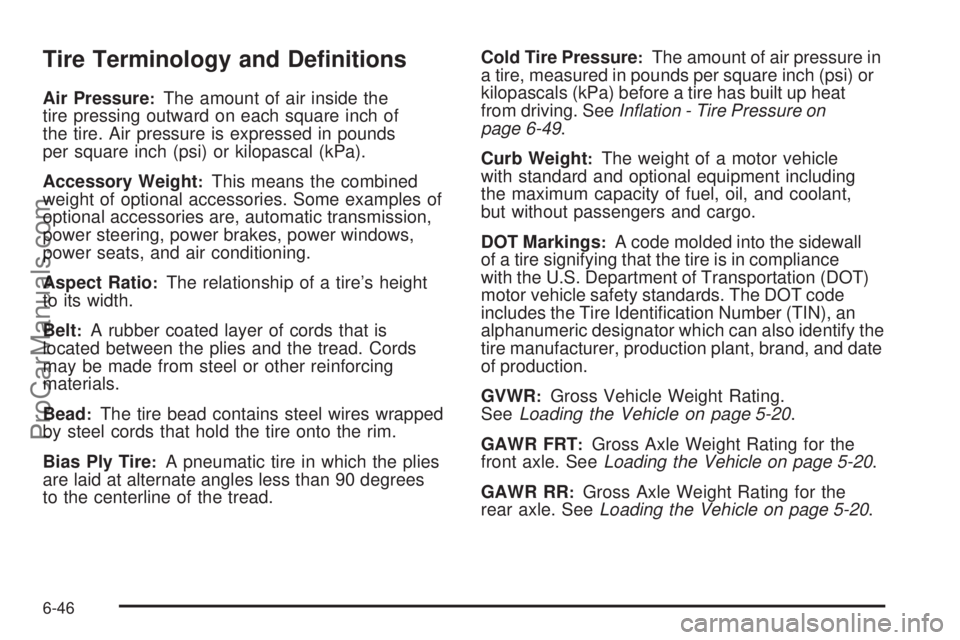
Tire Terminology and Denitions
Air Pressure:The amount of air inside the
tire pressing outward on each square inch of
the tire. Air pressure is expressed in pounds
per square inch (psi) or kilopascal (kPa).
Accessory Weight
:This means the combined
weight of optional accessories. Some examples of
optional accessories are, automatic transmission,
power steering, power brakes, power windows,
power seats, and air conditioning.
Aspect Ratio
:The relationship of a tire’s height
to its width.
Belt
:A rubber coated layer of cords that is
located between the plies and the tread. Cords
may be made from steel or other reinforcing
materials.
Bead
:The tire bead contains steel wires wrapped
by steel cords that hold the tire onto the rim.
Bias Ply Tire
:A pneumatic tire in which the plies
are laid at alternate angles less than 90 degrees
to the centerline of the tread.Cold Tire Pressure
:The amount of air pressure in
a tire, measured in pounds per square inch (psi) or
kilopascals (kPa) before a tire has built up heat
from driving. SeeInation - Tire Pressure on
page 6-49.
Curb Weight
:The weight of a motor vehicle
with standard and optional equipment including
the maximum capacity of fuel, oil, and coolant,
but without passengers and cargo.
DOT Markings
:A code molded into the sidewall
of a tire signifying that the tire is in compliance
with the U.S. Department of Transportation (DOT)
motor vehicle safety standards. The DOT code
includes the Tire Identification Number (TIN), an
alphanumeric designator which can also identify the
tire manufacturer, production plant, brand, and date
of production.
GVWR
:Gross Vehicle Weight Rating.
SeeLoading the Vehicle on page 5-20.
GAWR FRT
:Gross Axle Weight Rating for the
front axle. SeeLoading the Vehicle on page 5-20.
GAWR RR
:Gross Axle Weight Rating for the
rear axle. SeeLoading the Vehicle on page 5-20.
6-46
ProCarManuals.com
Page 344 of 400

Fuses Usage
HVAC
BLOWERHeating Ventilation Air Conditioning
Blower Switch
DOOR LOCK Door Locks
ROOF/HEAT
SEATSunroof, Heated Seat
NOT
INSTALLEDNot Used
NOT
INSTALLEDNot Used
AIRBAG
(BATT)Airbag (Battery)
SPARE FUSE
HOLDERSpare Fuse HolderFuses Usage
SPARE FUSE
HOLDERSpare Fuse Holder
SPARE FUSE
HOLDERSpare Fuse Holder
SPARE FUSE
HOLDERSpare Fuse Holder
FUSE PULLER Fuse Puller
Engine Compartment Fuse Block
The engine compartment fuse block is located on the
driver side of the engine compartment, near the battery.
Notice:Spilling liquid on any electrical components
on the vehicle may damage it. Always keep the
covers on any electrical component.
6-86
ProCarManuals.com
Page 391 of 400

Fuel (cont.)
Filling the Tank............................................. 6-9
Fuels in Foreign Countries.............................. 6-8
Gage .........................................................4-35
Gasoline Octane........................................... 6-6
Gasoline Specifications.................................. 6-7
Fuel Economy
Driving for Better.........................................1-27
Fuses...........................................................6-83
Engine Compartment Fuse Block...................6-86
Instrument Panel Fuse Block.........................6-83
Rear Compartment Fuse Block......................6-89
Windshield Wiper.........................................6-82
G
Gages
Charge/Assist..............................................4-36
Fuel..........................................................4-35
Speedometer..............................................4-23
Tachometer.................................................4-23
Trip Odometer.............................................4-23
Gasoline
Octane........................................................ 6-6
Specifications............................................... 6-7
Glove Box.....................................................3-36
GM Mobility Reimbursement Program.................. 8-6
H
Halogen Bulbs................................................6-39
Hazard Warning Flashers................................... 4-3
Head Restraints............................................... 2-2
Headlamps....................................................4-10
Aiming .......................................................6-39
Bulb Replacement.......................................6-39
Daytime Running Lamps (DRL).....................4-11
Delayed.....................................................4-11
Flash-to-Pass............................................... 4-5
High/Low Beam Changer................................ 4-5
On Reminder..............................................4-10
Headlamps Off in Park....................................4-11
Heated Seats................................................... 2-5
Heated Seats (If Equipped)................................ 1-9
Heater
Engine Coolant...........................................3-26
Highbeam On Light.........................................4-34
High-Speed Operation, Tires.............................6-50
Highway Hypnosis...........................................5-15
Hill and Mountain Roads..................................5-16
Hood
Checking Things Under................................6-12
Release.....................................................6-12
Horn ............................................................... 4-3
How OnStar Service Works..............................1-28
7
ProCarManuals.com
Page 394 of 400

Manual Seats................................................... 2-3
Message
DIC Warnings and Messages........................4-41
Mirrors
Manual Rearview.........................................3-35
Outside Automatic Dimming Mirror.................3-36
Outside Power Mirrors..................................3-35
MP3 .............................................................4-62
Muting a Call.................................................4-77
My GM Canada (Canada) — www.gm.ca............. 8-5
N
Navigation System, Privacy..............................8-17
Net, Convenience...........................................3-37
New Vehicle Break-In......................................3-21
O
Odometer......................................................4-23
Trip ...........................................................4-23
Off-Road
Recovery....................................................5-11
Oil
Engine.......................................................6-15
Engine Oil Life System.................................6-18
Pressure Light.............................................4-33
Older Children, Restraints................................2-30
Online Owner Center........................................ 8-5Online Owner Center (U.S.) —
www.gmownercenter.com/saturn....................... 8-5
OnStar Steering Wheel Controls........................1-29
Operation Tips................................................4-21
Other Information............................................4-80
Other Rainy Weather Tips................................5-14
Outlet Adjustment............................................4-21
Outlets
Accessory Power.........................................4-15
Outside
Automatic Dimming Mirror.............................3-36
Power Mirrors.............................................3-35
Owner Checks and Services.............................. 7-8
Owner Publications.........................................8-15
Owners, Canadian............................................... ii
P
Paint, Damage...............................................6-80
Pairing..........................................................4-70
Parade Dimming.............................................4-13
Park
Headlamps Off in Park.................................4-11
Shifting Into................................................3-30
Shifting Out of............................................3-32
Parking
Brake........................................................3-29
Over Things That Burn.................................3-32
10
ProCarManuals.com
Page 395 of 400

Parking Brake and Automatic Transmission
P (Park) Mechanism Check............................. 7-9
Passenger Airbag Status Indicator.....................4-26
Passenger Safety Belt Reminder Light...............4-24
Passenger Sensing System..............................2-66
Passing.........................................................5-12
PASS-Key
®III+ Electronic Immobilizer...............3-19
PASS-Key®III+ Electronic Immobilizer Operation . 3-19
Perchlorate Materials Requirements, California...... 6-4
Personalization Menu Modes............................4-46
Phone
Bluetooth
®..................................................4-69
Playing a CD.................................................4-58
Playing a CD-R or CD-RW MP3.......................4-63
Playing an MP3 CD-R or CD-RW Disc...............4-59
Playing the Radio...........................................4-53
Power
Door Locks.................................................. 3-9
Electrical System.........................................6-83
Lift Seat....................................................... 2-9
Lumbar Controls........................................... 2-5
Retained Accessory (RAP)............................3-22
Seat ............................................................ 2-4
Windows....................................................3-15
Power Door Locks............................................ 1-6
Power Lumbar ................................................. 1-9
Power Reclining Seatbacks................................ 2-7
Power Reclining Seatbacks (If Equipped)............. 1-8
Power Seats (If Equipped)................................. 1-8
Pregnancy, Using Safety Belts..........................2-29Privacy..........................................................8-16
Navigation System.......................................8-17
Radio Frequency Identification (RFID).............8-18
Program
Courtesy Transportation.................................. 8-9
Programmable Automatic Door Locks.................3-10
Programming the Power Windows.....................3-15
Programming Transmitters to the Vehicle............. 3-5
Proposition 65 Warning, California....................... 6-4
Propriétaires Canadiens........................................ ii
Q
Questions and Answers About Safety Belts.........2-15
R
Radio Data System (RDS)...............................4-53
Radio Frequency
Identification (RFID).....................................8-18
Statement...................................................8-18
Radio Messages.............................................4-57
Radio(s)........................................................4-53
Radios
Reception...................................................4-82
Setting the Clock.........................................4-52
Theft-Deterrent............................................4-80
Reading Lamps..............................................4-13
Rear Door Security Locks................................3-11
11
ProCarManuals.com