seats SATURN ION 2006 User Guide
[x] Cancel search | Manufacturer: SATURN, Model Year: 2006, Model line: ION, Model: SATURN ION 2006Pages: 392, PDF Size: 2.8 MB
Page 38 of 392

Child Restraints
Older Children
Older children who have outgrown booster seats should
wear the vehicle’s safety belts.
Q:What is the proper way to wear safety belts?
A:An older child should wear a lap-shoulder belt and
get the additional restraint a shoulder belt can
provide. The shoulder belt should not cross the
face or neck. The lap belt should t snugly below
the hips, just touching the top of the thighs.
It should never be worn over the abdomen, which
could cause severe or even fatal internal injuries
in a crash.
Accident statistics show that children are safer if they
are restrained in the rear seat.
In a crash, children who are not buckled up can strike
other people who are buckled up, or can be thrown
out of the vehicle. Older children need to use safety
belts properly.
1-32
ProCarManuals.com
Page 45 of 392

A forward-facing child seat (C-E) provides restraint for
the child’s body with the harness and also sometimes
with surfaces such as T-shaped or shelf-like shields.A booster seat (F-G) is a child restraint designed to
improve the t of the vehicle’s safety belt system.
Some booster seats have a shoulder belt positioner,
and some high-back booster seats have a ve-point
harness. A booster seat can also help a child to see
out the window.
1-39
ProCarManuals.com
Page 46 of 392

Q:How Should I Use a Child Restraint?
A:A child restraint system is any device designed
for use in a motor vehicle to restrain, seat, or
position children. A built-in child restraint system is
a permanent part of the motor vehicle. An add-on
child restraint system is a portable one, which
is purchased by the vehicle’s owner. To help
reduce injuries, an add-on child restraint must be
secured in the vehicle. With built-in or add-on
child restraints, the child has to be secured within
the child restraint.
When choosing an add-on child restraint, be sure
the child restraint is designed to be used in a
vehicle. If it is, it will have a label saying that it
meets federal motor vehicle safety standards.
Then follow the instructions for the restraint.
You may nd these instructions on the restraint
itself or in a booklet, or both.
Securing an Add-on Child Restraint
in the Vehicle
{CAUTION:
A child can be seriously injured or killed in a
crash if the child restraint is not properly
secured in the vehicle. Make sure the child
restraint is properly installed in the vehicle
using the vehicle’s safety belt or LATCH
system, following the instructions that came
with that restraint, and also the instructions
in this manual.
To help reduce the chance of injury, the child restraint
must be secured in the vehicle. Child restraint systems
must be secured in vehicle seats by lap belts or the
lap belt portion of a lap-shoulder belt, or by the LATCH
system. SeeLower Anchors and Tethers for Children
(LATCH) on page 1-43for more information. A child can
be endangered in a crash if the child restraint is not
properly secured in the vehicle.
1-40
ProCarManuals.com
Page 57 of 392

To remove the child restraint, if the top tether is attached
to the top tether anchor, disconnect it. Unbuckle the
vehicle’s safety belt and let it go back all the way.
The safety belt will move freely again and be ready to
work for an adult or larger child passenger.
Securing a Child Restraint in the
Right Front Seat Position
Your vehicle has a right front passenger’s airbag. A rear
seat is a safer place to secure a forward-facing child
restraint. SeeWhere to Put the Restraint on page 1-42.
In addition, your vehicle may have the passenger
sensing system. The passenger sensing system is
designed to turn off the right front passenger’s frontal
airbag when an infant in a rear-facing infant seat
or a small child in a forward-facing child restraint or
booster seat is detected. SeePassenger Sensing
System on page 1-62andPassenger Airbag Status
Indicator on page 3-31for more information on
this including important safety information.
A label on your sun visor says, “Never put a rear-facing
child seat in the front.” This is because the risk to the
rear-facing child is so great, if the airbag deploys.
{CAUTION:
A child in a rear-facing child restraint can be
seriously injured or killed if the right front
passenger’s airbag inates. This is because
the back of the rear-facing child restraint
would be very close to the inating airbag.
Even though the passenger sensing system is
designed to turn off the passenger’s frontal
airbag if the system detects a rear-facing child
restraint, no system is fail-safe, and no one
can guarantee that an airbag will not deploy
under some unusual circumstance, even
though it is turned off. We recommend that
rear-facing child restraints be secured in the
rear seat, even if the airbag is off.
If you need to secure a forward-facing child restraint in
the right front seat position, move the seat as far
back as it will go before securing the forward-facing
child restraint. SeeManual Seats on page 1-2.
If your child restraint is equipped with the LATCH
system, seeLower Anchors and Tethers for Children
(LATCH) on page 1-43.
1-51
ProCarManuals.com
Page 58 of 392

There is no top tether anchor at the right front seating
position. Do not secure a child restraint in this position if
a national or local law requires that the top tether be
anchored or if the instructions that come with the child
restraint say that the top tether must be anchored.
SeeLower Anchors and Tethers for Children (LATCH)
on page 1-43if your child restraint has a top tether.
You will be using the lap-shoulder belt to secure
the child restraint in this position. Be sure to follow the
instructions that came with the child restraint. Secure
the child in the child restraint when and as the
instructions say.
1. Your vehicle has a right front passenger’s frontal
airbag. SeePassenger Sensing System on
page 1-62. General Motors recommends that
rear-facing child restraints be secured in a rear
seat, even if the airbag is off. If your child restraint
is forward-facing, move the seat as far back as
it will go before securing the child restraint in this
seat. SeeManual Seats on page 1-2.
When the passenger sensing system has turned off
the right front passenger’s frontal airbag, the off
indicator in the passenger airbag status indicator
should light and stay lit when you turn the ignition
to RUN or START. SeePassenger Airbag
Status Indicator on page 3-31.2. Put the child restraint on the seat.
3. Pick up the latch plate, and run the lap and shoulder
portions of the vehicle’s safety belt through or
around the restraint. The child restraint instructions
will show you how.
4. Buckle the belt. Make sure the release button is
positioned so you would be able to unbuckle the
safety belt quickly if you ever had to.
1-52
ProCarManuals.com
Page 73 of 392

Adding Equipment to Your
Airbag-Equipped Vehicle
Q:Is there anything I might add to the front or
sides of the vehicle that could keep the
airbags from working properly?
A:Yes. If you add things that change your vehicle’s
frame, bumper system, height, front end or side
sheet metal, they may keep the airbag system from
working properly. Also, the airbag system may
not work properly if you relocate any of the airbag
sensors. If you have any questions about this,
you should contact Customer Assistance before
you modify your vehicle. The phone numbers
and addresses for Customer Assistance are in
Step Two of the Customer Satisfaction Procedure
in this manual. SeeCustomer Satisfaction
Procedure on page 7-2.
Q:Because I have a disability, I have to get my
vehicle modied. How can I nd out whether
this will affect my airbag system?
A:Changing or moving any parts of the front seats,
safety belts, the airbag sensing and diagnostic
module, steering wheel, instrument panel,
ceiling headliner, ceiling and pillar garnish trim,
roof-mounted airbag modules, or airbag wiring
can affect the operation of the airbag system.
If you have questions, call Customer Assistance.
The phone numbers and addresses for Customer
Assistance are in Step Two of the Customer
Satisfaction Procedure in this manual. See
Customer Satisfaction Procedure on page 7-2.
1-67
ProCarManuals.com
Page 91 of 392
Sun Visors
To block out glare, swing down the sun visors.
You can also swing them to the side.
Visor Vanity Mirrors
Your sun visors may have vanity mirrors.
If so, the driver’s mirror is covered. Lift the
cover to expose the mirror.
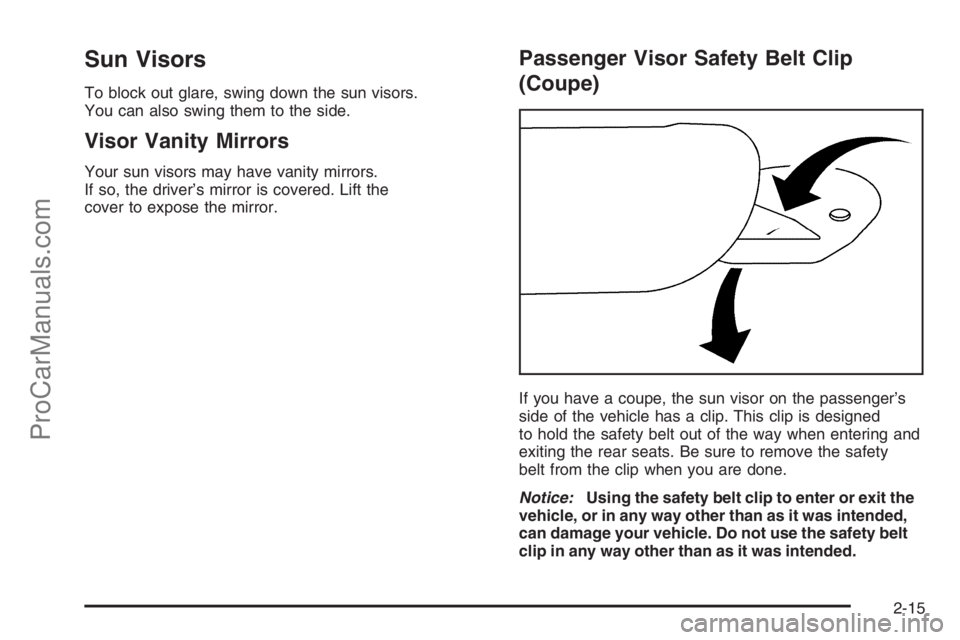
Passenger Visor Safety Belt Clip
(Coupe)
If you have a coupe, the sun visor on the passenger’s
side of the vehicle has a clip. This clip is designed
to hold the safety belt out of the way when entering and
exiting the rear seats. Be sure to remove the safety
belt from the clip when you are done.
Notice:Using the safety belt clip to enter or exit the
vehicle, or in any way other than as it was intended,
can damage your vehicle. Do not use the safety belt
clip in any way other than as it was intended.
2-15
ProCarManuals.com
Page 98 of 392

Automatic Transaxle Operation
If your vehicle is equipped with an automatic
transaxle, the shift lever is located on the console
between the seats.
There are several
different positions for the
automatic transaxle.
PARK (P):This position locks your front wheels.
It is the best position to use when you start your
engine because your vehicle cannot move easily.{CAUTION:
It is dangerous to get out of your vehicle if the
shift lever is not fully in PARK (P) with the
parking brake rmly set. Your vehicle can roll.
Do not leave your vehicle when the engine is
running unless you have to. If you have left the
engine running, the vehicle can move suddenly.
You or others could be injured. To be sure your
vehicle will not move, even when you are on
fairly level ground, always set your parking
brake and move the shift lever to PARK (P).
SeeShifting Into Park (P) (Automatic Transaxle)
on page 2-28. If you are pulling a trailer, see
Towing a Trailer on page 4-39.
Ensure he shift lever is fully in PARK (P) before starting
the engine. Your vehicle has an automatic transaxle shift
lock control system. You have to fully apply your regular
brakes before you can shift from PARK (P) when the
ignition key is in RUN. If you cannot shift out of PARK (P),
ease pressure on the shift lever — push the shift lever
all the way into PARK (P) and also release the shift
lever button as you maintain brake application.
2-22
ProCarManuals.com
Page 103 of 392

Parking Brake
The parking brake lever is located between the
front seats.To set the parking brake, hold the brake pedal down
and pull up on the parking brake lever. If the ignition
is on, the brake system warning light will come on.
SeeBrake System Warning Light on page 3-34.
To release the parking brake, hold the brake pedal
down. Pull the parking brake lever up until you can press
the release button. Hold the release button in as you
move the brake lever all the way down.
Notice:Driving with the parking brake on can
overheat the brake system and cause premature
wear or damage to brake system parts. Verify that
the parking brake is fully released and the brake
warning light is off before driving.
2-27
ProCarManuals.com
Page 116 of 392

Storage Areas
Glove Box
Open the glove box by pulling back on the lever.
Close the glove box with a rm push.
Cupholder(s)
Your vehicle may have cupholders between the
rear seats.
Center Console Storage Area
Your vehicle has a center console storage area
between the front seats. It contains a storage area
for small items.
The center console storage area can be used as an
armrest. Push the lid of the center console forward
for additional arm support.
Roof Rack System
Your vehicle may be equipped with a roof rack system.
{CAUTION:
If you try to carry something on top of your
vehicle that is longer or wider than the luggage
carrier — like paneling, plywood, a mattress
and so forth — the wind can catch it as
you drive along. This can cause you to lose
control. What you are carrying could be
violently torn off, and this could cause you
or other drivers to have a collision, and of
course damage your vehicle. You may be
able to carry something like this inside.
But, never carry something longer or wider
than the luggage carrier on top of your vehicle.
Notice:Loading cargo on the luggage carrier that
weighs more than 100 lbs (45 kg) or hangs over
the rear or sides of the vehicle may damage your
vehicle. Load cargo so that it rests on the slats
as far forward as possible and against the side
rails, making sure to fasten it securely.
Do not exceed the maximum vehicle capacity when
loading your vehicle. For more information on vehicle
capacity and loading, seeLoading Your Vehicle on
page 4-31.
2-40
ProCarManuals.com