brake SATURN ION 2007 User Guide
[x] Cancel search | Manufacturer: SATURN, Model Year: 2007, Model line: ION, Model: SATURN ION 2007Pages: 440, PDF Size: 2.93 MB
Page 117 of 440
Leaving Your Vehicle With the
Engine Running
{CAUTION:
It can be dangerous to leave your vehicle
with the engine running. Your vehicle
could move suddenly if the shift lever is
not fully in PARK (P) with the parking
brake rmly set. And, if you leave the
vehicle with the engine running, it could
overheat and even catch re. You or
others could be injured. Do not leave your
vehicle with the engine running.
If you have to leave your vehicle with the engine
running, be sure your vehicle is in PARK (P)
and your parking brake is rmly set before you
leave it. After you have moved the shift lever into
PARK (P), hold the regular brake pedal down.
Then, see if you can move the shift lever
away from PARK (P) without rst pushing the
button. If you can, it means that the shift lever was
not fully locked into PARK (P).
Torque Lock
If you are parking on a hill and you do not shift
your transaxle into PARK (P) properly, the weight
of the vehicle may put too much force on the
parking pawl in the transaxle. You may nd
it difficult to pull the shift lever out of PARK (P).
This is called “torque lock.” To prevent torque lock,
set the parking brake and then shift into PARK (P)
properly before you leave the driver’s seat.
To nd out how, seeShifting Into Park (P)
(Automatic Transaxle) on page 116.
When you are ready to drive, move the shift
lever out of PARK (P)beforeyou release the
parking brake.
If torque lock does occur, you may need to have
another vehicle push yours a little uphill to
take some of the pressure from the parking pawl
in the transaxle, then you will be able to pull
the shift lever out of PARK (P).
117
ProCarManuals.com
Page 118 of 440
Shifting Out of Park (P)
Your vehicle has an automatic transaxle shift lock
release system. You have to fully apply your
regular brakes before you can shift from PARK (P)
when the ignition is in RUN. SeeAutomatic
Transaxle Operation on page 110.
The shift lock release is designed to do the
following:
Prevent the ignition key from being removed
unless the shift lever is in PARK (P), and
Prevent movement of the shift lever out of
PARK (P) unless the ignition is in a position
other than LOCK. The shift lock release
is always functional except in the case of a
dead battery or low voltage (less than
9 volt) battery.If you cannot shift out of PARK (P), ease pressure
on the shift lever — push the shift lever all the
way into PARK (P), as you maintain brake
application. Then move the shift lever into the
gear you wish. Press the shift lever button before
moving the shift lever.
Parking Your Vehicle
(Manual Transaxle)
Before leaving your vehicle, fully press the clutch
pedal in, move the shift lever into REVERSE (R),
and rmly apply the parking brake. Once the
shift lever has been placed in REVERSE (R) with
the clutch pedal pressed in, you can turn the
ignition key to LOCK, remove the key, and release
the clutch.
SeeManual Transaxle Operation on page 112.
118
ProCarManuals.com
Page 121 of 440

Running the Engine While Parked
It is better not to park with the engine running. But if
you ever have to, here are some things to know.
{CAUTION:
Idling the engine with the climate control
system off could allow dangerous exhaust
into your vehicle. See the earlier caution
underEngine Exhaust on page 120.
Also, idling in a closed-in place can let
deadly carbon monoxide (CO) into your
vehicle even if the climate control fan is at
the highest setting. One place this can
happen is a garage. Exhaust — with
CO — can come in easily. NEVER park in
a garage with the engine running.
Another closed-in place can be a blizzard.
SeeWinter Driving on page 244.
{CAUTION:
It can be dangerous to get out of your
vehicle if the shift lever is not fully in
PARK (P) with the parking brake rmly
set. Your vehicle can roll. Do not leave
your vehicle when the engine is running
unless you have to. If you have left the
engine running, the vehicle can move
suddenly. You or others could be injured.
To be sure your vehicle will not move,
even when you are on fairly level ground,
always set the parking brake and move
the shift lever to PARK (P).
Follow the proper steps to be sure your vehicle
will not move. SeeShifting Into Park (P)
(Automatic Transaxle) on page 116.
If you are parking on a hill and if you are pulling a
trailer, also seeTowing a Trailer on page 259.
121
ProCarManuals.com
Page 137 of 440
Instrument Panel Overview........................ 140
Hazard Warning Flashers.......................... 142
Other Warning Devices............................. 142
Horn.......................................................... 142
Tilt Wheel.................................................. 142
Turn Signal/Multifunction Lever.................. 143
Turn and Lane-Change Signals................. 144
Headlamp High/Low-Beam Changer.......... 145
Flash-to-Pass............................................ 145
Windshield Washer.................................... 145
Windshield Wiper Lever............................. 146
Cruise Control........................................... 147
Headlamps................................................ 150
Daytime Running Lamps (DRL)................. 151
Automatic Headlamp System..................... 151
Fog Lamps................................................ 152
Instrument Panel Brightness...................... 152
Dome Lamp.............................................. 153
Entry Lighting............................................ 153
Map Lamps............................................... 153
Battery Run-Down Protection..................... 153
Accessory Power Outlet(s)........................ 153
Ashtray(s) and Cigarette Lighter................ 154Climate Controls......................................... 155
Climate Control System
(Without Air Conditioning)....................... 155
Climate Control System
(With Air Conditioning)........................... 157
Outlet Adjustment...................................... 160
Passenger Compartment Air Filter............. 161
Warning Lights, Gages, and Indicators..... 163
Instrument Panel Cluster........................... 164
Speedometer and Odometer...................... 165
Trip Odometer........................................... 165
Tachometer............................................... 165
Safety Belt Reminder Light........................ 166
Passenger Safety Belt Reminder Light....... 166
Airbag Readiness Light............................. 167
Passenger Airbag Status Indicator............. 168
Battery Warning Light................................ 170
Up-Shift Light............................................ 170
Brake System Warning Light..................... 170
Anti-Lock Brake System Warning Light...... 172
Engine Coolant Temperature Gage............ 173
Malfunction Indicator Lamp........................ 174
Section 3 Instrument Panel
137
ProCarManuals.com
Page 148 of 440
J(On/Off):Press this button to turn the cruise
control system on and off.
+RES (Resume):Press this part of the button to
resume a set speed and to accelerate the speed.
−SET (Set):Press this part of the button to set a
speed and to decrease the speed.
To set a speed do the following:
1. Press the on/off button to turn cruise control
on. The indicator light on the button will
come on.
2. Get to the speed you want.
3. Press the−SET part of the control button and
release it. The CRUISE message will display
in the instrument panel cluster to show the
system is engaged.
4. Take your foot off the accelerator pedal.
When the brakes are applied, the cruise control
shuts off.If the vehicle is in cruise control and the Enhanced
Traction System (ETS) begins to limit wheel
spin, the cruise control will automatically
disengage. SeeEnhanced Traction System (ETS)
on page 226. When road conditions allow, the
cruise control can be used again.
Resuming a Set Speed
Suppose you set your cruise control at a desired
speed and then you apply the brake. This, of
course, disengages the cruise control. The
CRUISE message in the instrument panel cluster
will also go out indicating cruise is no longer
engaged. To return to your previously set speed,
you do not need to go through the set process
again. Once you are going about 25 mph (40 km/h)
or more, you can press the +RES part of the
button briey.
This will take you back up to your previously
chosen speed and stay there.
148
ProCarManuals.com
Page 149 of 440
Increasing Speed While Using
Cruise Control
There are two ways to go to a higher speed.
Disengage the cruise control but do not turn it
off. Accelerate to a higher speed and reset
the cruise control.
If the cruise control system is already engaged,
press the +RES part of the button. Hold it there
until you get up to the speed you want, and
then release the button. To increase your
speed in very small amounts, press the +RES
part of the button briey and then release it.
Each time you do this, your vehicle will go
about 1 mph (1.6 km/h) faster.
Reducing Speed While Using
Cruise Control
If the cruise control system is already engaged,
Push and hold the−SET part of the button
until you reach the lower speed you want,
then release it.
To slow down in very small amounts, push the
−SET part of the button briey. Each time you
do this, you will go about 1 mph (1.6 km/h)
slower.
Passing Another Vehicle While Using
Cruise Control
Use the accelerator pedal to increase your speed.
When you take your foot off the pedal, your
vehicle will slow down to the cruise control speed
you set earlier.
Using Cruise Control on Hills
How well your cruise control will work on hills
depends upon your speed, load, and the
steepness of the hills. When going up steep hills,
you may have to step on the accelerator pedal
to maintain your speed. When going downhill, you
may have to brake or shift to a lower gear to
keep your speed down. Of course, applying the
brake takes you out of cruise control. Many drivers
nd this to be too much trouble and do not use
cruise control on steep hills.
Ending Cruise Control
To end the cruise control session, step lightly on
the brake pedal or tap the clutch if your vehicle has
a manual transaxle.
Stepping on the brake pedal or clutch will only end
the current cruise control session. Press the
cruise control on/off button to turn the system
completely off.
149
ProCarManuals.com
Page 170 of 440
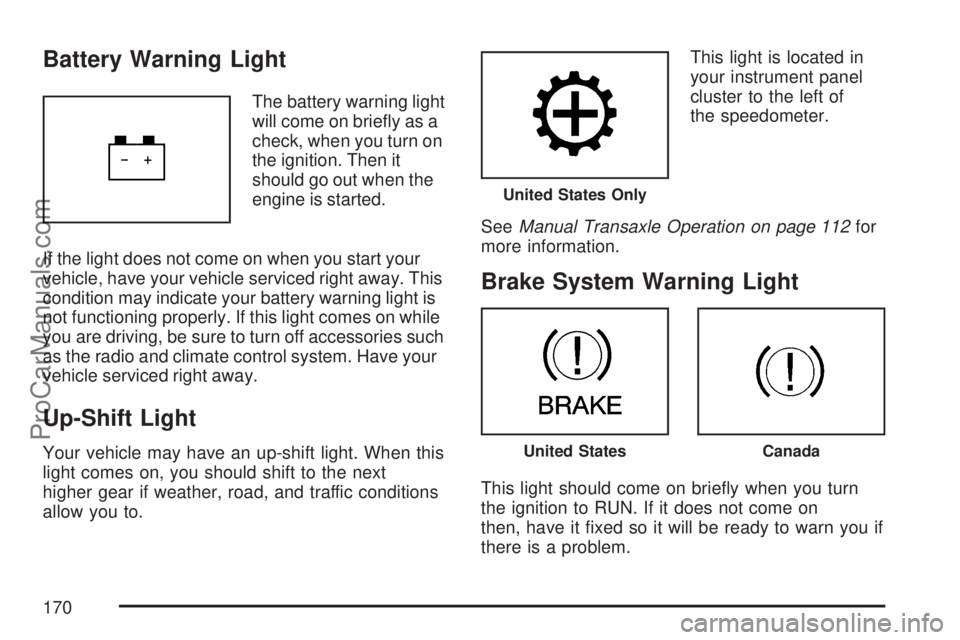
Battery Warning Light
The battery warning light
will come on briey as a
check, when you turn on
the ignition. Then it
should go out when the
engine is started.
If the light does not come on when you start your
vehicle, have your vehicle serviced right away. This
condition may indicate your battery warning light is
not functioning properly. If this light comes on while
you are driving, be sure to turn off accessories such
as the radio and climate control system. Have your
vehicle serviced right away.
Up-Shift Light
Your vehicle may have an up-shift light. When this
light comes on, you should shift to the next
higher gear if weather, road, and traffic conditions
allow you to.This light is located in
your instrument panel
cluster to the left of
the speedometer.
SeeManual Transaxle Operation on page 112for
more information.
Brake System Warning Light
This light should come on briey when you turn
the ignition to RUN. If it does not come on
then, have it xed so it will be ready to warn you if
there is a problem.
United States Only
United StatesCanada
170
ProCarManuals.com
Page 171 of 440

Your vehicle’s hydraulic brake system is divided
into two parts. If one part is not working, the other
part can still work and stop you. For good
braking, though, you need both parts working well.
If the brake system warning light comes on,
there is a brake problem. Have your brake system
inspected right away.
When the ignition is on, the BRAKE light will come
on when you set your parking brake. The light
will stay on if your parking brake does not release
fully. A chime will also sound if the parking
brake is not fully released and the vehicle is
moving. If it stays on after your parking brake is
fully released, it means you have a brake problem.
The BRAKE light will also come on to indicate a
low brake uid level. SeeBrakes on page 308
for more information.If the light comes on while you are driving, pull off
the road and stop carefully. You may notice
that the pedal is harder to push or the pedal may
go closer to the oor. It may take longer to
stop. Make sure the parking brake is fully released.
Turn the ignition off and wait several seconds to
restart vehicle, if the light is still on, have the
vehicle towed for service. SeeTowing Your
Vehicle on page 256.
{CAUTION:
Your brake system may not be working
properly if the brake system warning light
is on. Driving with the brake system
warning light on can lead to an accident.
If the light is still on after you have pulled
off the road and stopped carefully, have
the vehicle towed for service.
171
ProCarManuals.com
Page 172 of 440
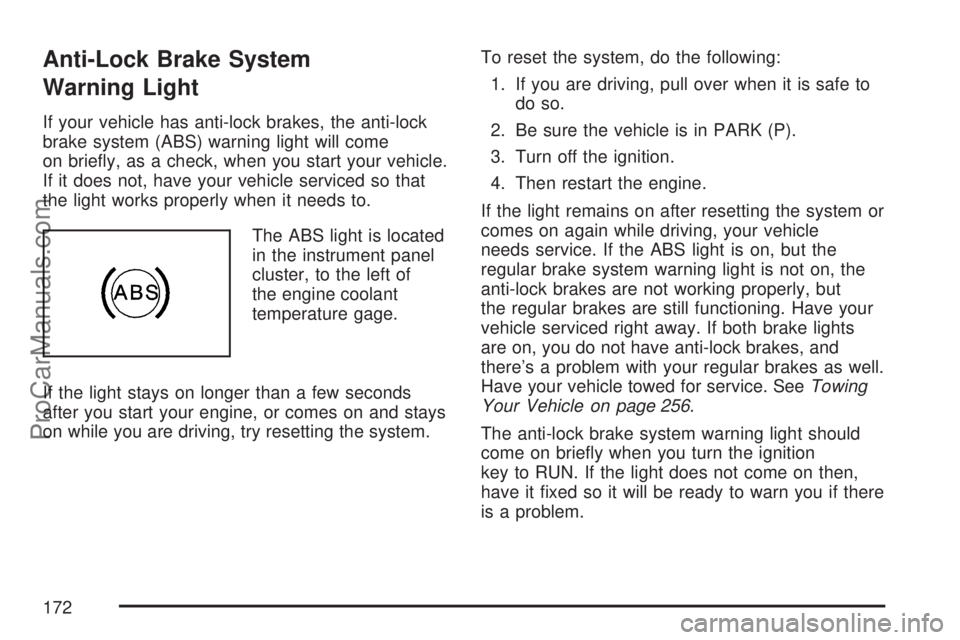
Anti-Lock Brake System
Warning Light
If your vehicle has anti-lock brakes, the anti-lock
brake system (ABS) warning light will come
on briey, as a check, when you start your vehicle.
If it does not, have your vehicle serviced so that
the light works properly when it needs to.
The ABS light is located
in the instrument panel
cluster, to the left of
the engine coolant
temperature gage.
If the light stays on longer than a few seconds
after you start your engine, or comes on and stays
on while you are driving, try resetting the system.To reset the system, do the following:
1. If you are driving, pull over when it is safe to
do so.
2. Be sure the vehicle is in PARK (P).
3. Turn off the ignition.
4. Then restart the engine.
If the light remains on after resetting the system or
comes on again while driving, your vehicle
needs service. If the ABS light is on, but the
regular brake system warning light is not on, the
anti-lock brakes are not working properly, but
the regular brakes are still functioning. Have your
vehicle serviced right away. If both brake lights
are on, you do not have anti-lock brakes, and
there’s a problem with your regular brakes as well.
Have your vehicle towed for service. SeeTowing
Your Vehicle on page 256.
The anti-lock brake system warning light should
come on briey when you turn the ignition
key to RUN. If the light does not come on then,
have it xed so it will be ready to warn you if there
is a problem.
172
ProCarManuals.com
Page 217 of 440
Your Driving, the Road, and Your
Vehicle..................................................... 218
Defensive Driving...................................... 218
Drunken Driving........................................ 219
Control of a Vehicle.................................. 222
Braking...................................................... 222
Anti-Lock Brake System (ABS).................. 223
Braking in Emergencies............................. 225
Enhanced Traction System (ETS).............. 226
Limited-Slip Differential.............................. 227
Steering.................................................... 227
Off-Road Recovery.................................... 230
Passing..................................................... 231
Loss of Control.......................................... 233
Racing or Other Competitive Driving.......... 234
Driving at Night......................................... 234Driving in Rain and on Wet Roads............ 236
City Driving............................................... 239
Freeway Driving........................................ 240
Before Leaving on a Long Trip.................. 241
Highway Hypnosis..................................... 242
Hill and Mountain Roads........................... 242
Winter Driving........................................... 244
If Your Vehicle is Stuck in Sand, Mud,
Ice, or Snow.......................................... 249
Rocking Your Vehicle to Get It Out........... 250
Loading Your Vehicle................................ 250
Towing........................................................ 256
Towing Your Vehicle ................................. 256
Recreational Vehicle Towing...................... 256
Towing a Trailer........................................ 259
Section 4 Driving Your Vehicle
217
ProCarManuals.com