towing SATURN ION 2007 User Guide
[x] Cancel search | Manufacturer: SATURN, Model Year: 2007, Model line: ION, Model: SATURN ION 2007Pages: 440, PDF Size: 2.93 MB
Page 175 of 440
This light should come on, as a check to show
you it is working, when the ignition is on and the
engine is not running. If the light does not
come on, have it repaired. This light will also
come on during a malfunction in one of two ways:
Light Flashing— A misre condition has
been detected. A misre increases vehicle
emissions and may damage the emission
control system on your vehicle. Diagnosis and
service may be required.
Light On Steady— An emission control
system malfunction has been detected on your
vehicle. Diagnosis and service may be
required.
If the Light Is Flashing
The following may prevent more serious damage
to your vehicle:
Reducing vehicle speed
Avoiding hard accelerations
Avoiding steep uphill grades
If you are towing a trailer, reduce the amount
of cargo being hauled as soon as it is
possible
If the light stops ashing and remains on steady,
see “If the Light Is On Steady” following.
If the light continues to ash, when it is safe to do
so, stop the vehicle. Find a safe place to park
your vehicle. Turn the key off, wait at least
10 seconds and restart the engine. If the light
remains on steady, see “If the Light Is On Steady”
following. If the light is still ashing, follow the
previous steps, and see your retailer for service as
soon as possible.
175
ProCarManuals.com
Page 217 of 440
Your Driving, the Road, and Your
Vehicle..................................................... 218
Defensive Driving...................................... 218
Drunken Driving........................................ 219
Control of a Vehicle.................................. 222
Braking...................................................... 222
Anti-Lock Brake System (ABS).................. 223
Braking in Emergencies............................. 225
Enhanced Traction System (ETS).............. 226
Limited-Slip Differential.............................. 227
Steering.................................................... 227
Off-Road Recovery.................................... 230
Passing..................................................... 231
Loss of Control.......................................... 233
Racing or Other Competitive Driving.......... 234
Driving at Night......................................... 234Driving in Rain and on Wet Roads............ 236
City Driving............................................... 239
Freeway Driving........................................ 240
Before Leaving on a Long Trip.................. 241
Highway Hypnosis..................................... 242
Hill and Mountain Roads........................... 242
Winter Driving........................................... 244
If Your Vehicle is Stuck in Sand, Mud,
Ice, or Snow.......................................... 249
Rocking Your Vehicle to Get It Out........... 250
Loading Your Vehicle................................ 250
Towing........................................................ 256
Towing Your Vehicle ................................. 256
Recreational Vehicle Towing...................... 256
Towing a Trailer........................................ 259
Section 4 Driving Your Vehicle
217
ProCarManuals.com
Page 250 of 440
Rocking Your Vehicle to Get It Out
First, turn the steering wheel left and right.
That will clear the area around the front wheels. If
your vehicle has the enhanced traction system
(ETS), you should turn the ETS off. SeeEnhanced
Traction System (ETS) on page 226. Then shift
back and forth between REVERSE (R) and a
forward gear, or with a manual transaxle, between
FIRST (1) or SECOND (2) and REVERSE (R),
spinning the wheels as little as possible. Release
the accelerator pedal while you shift, and press
lightly on the accelerator pedal when the transaxle
is in gear. By slowly spinning the wheels in the
forward and reverse directions, you will cause
a rocking motion that may free your vehicle. If that
does not get your vehicle out after a few tries, it
may need to be towed out. If your vehicle
does need to be towed out, seeTowing Your
Vehicle on page 256.
Loading Your Vehicle
It is very important to know how much weight your
vehicle can carry. This weight is called the
vehicle capacity weight and includes the weight of
all occupants, cargo, and all nonfactory-installed
options. Two labels on your vehicle show how
much weight it may properly carry, the Tire and
Loading Information label and the Certication/Tire
label. Two labels on your vehicle show how
much weight it may properly carry, the Tire and
Loading Information label and the Vehicle
Certication label.
{CAUTION:
Do not load your vehicle any heavier than
the Gross Vehicle Weight Rating (GVWR),
or either the maximum front or rear Gross
Axle Weight Rating (GAWR). If you do,
parts on your vehicle can break, and it
can change the way your vehicle handles.
These could cause you to lose control
and crash. Also, overloading can shorten
the life of your vehicle.
250
ProCarManuals.com
Page 252 of 440
Steps for Determining Correct Load Limit
1. Locate the statement “The combined
weight of occupants and cargo should never
exceed XXX kg or XXX lbs” on your
vehicle’s placard.
2. Determine the combined weight of the driver
and passengers that will be riding in your
vehicle.
3. Subtract the combined weight of the driver
and passengers from XXX kg or XXX lbs.
4. The resulting gure equals the available
amount of cargo and luggage load capacity.
For example, if the “XXX” amount equals
1400 lbs and there will be ve 150 lb
passengers in your vehicle, the amount of
available cargo and luggage load capacity is
650 lbs (1400−750 (5 x 150) = 650 lbs).5. Determine the combined weight of luggage
and cargo being loaded on the vehicle. That
weight may not safely exceed the available
cargo and luggage load capacity calculated in
Step 4.
6. If your vehicle will be towing a trailer, the load
from your trailer will be transferred to your
vehicle. Consult this manual to determine how
this reduces the available cargo and luggage
load capacity for your vehicle.
If your vehicle can tow a trailer, seeTowing a
Trailer on page 259for important information
on towing a trailer, towing safety rules, and
trailering tips.
252
ProCarManuals.com
Page 256 of 440

Towing
Towing Your Vehicle
Consult your retailer or a professional towing
service if you need to have your disabled vehicle
towed. SeeRoadside Assistance Program on
page 415.
If you want to tow your vehicle behind another
vehicle for recreational purposes (such as behind
a motorhome), see “Recreational Vehicle
Towing” following.
Recreational Vehicle Towing
Recreational vehicle towing means towing your
vehicle behind another vehicle – such as behind a
motorhome. The two most common types of
recreational vehicle towing are known as “dinghy
towing” (towing your vehicle with all four wheels
on the ground) and “dolly towing” (towing
your vehicle with two wheels on the ground and
two wheels up on a device known as a “dolly”).With the proper preparation and equipment, many
vehicles can be towed in these ways. See
“Dinghy Towing” and “Dolly Towing” following in
this section.
Here are some important things to consider before
you do recreational vehicle towing:
What is the towing capacity of the towing
vehicle? Be sure you read the tow vehicle
manufacturer’s recommendations.
How far will you tow? Some vehicles have
restrictions on how far and how long they
can tow.
Do you have the proper towing equipment?
See your retailer or trailering professional
for additional advice and equipment
recommendations.
Is your vehicle ready to be towed? Just as
you would prepare your vehicle for a long
trip, you will want to make sure your vehicle is
prepared to be towed. SeeBefore Leaving
on a Long Trip on page 241.
256
ProCarManuals.com
Page 257 of 440
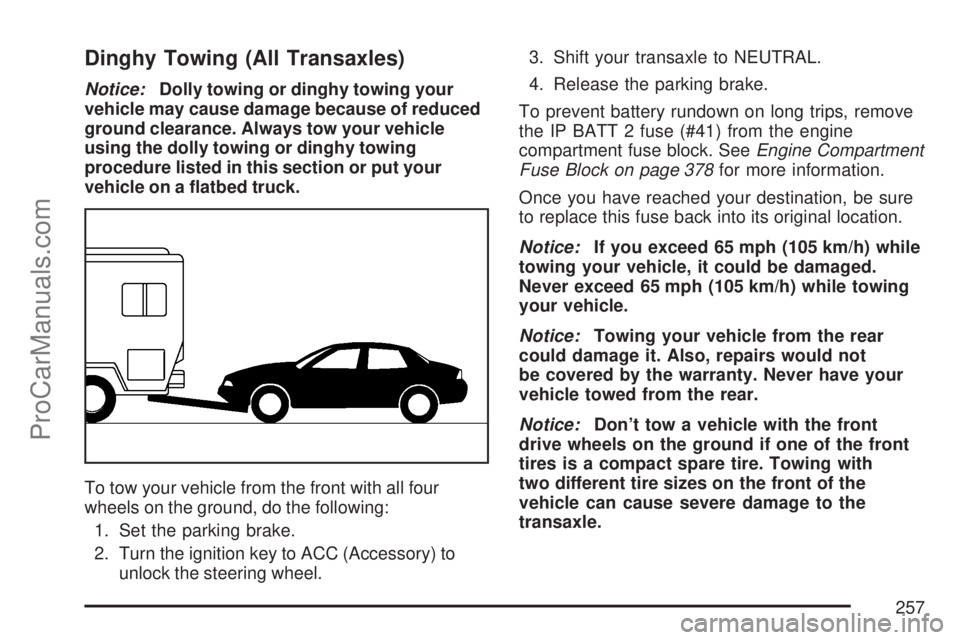
Dinghy Towing (All Transaxles)
Notice:Dolly towing or dinghy towing your
vehicle may cause damage because of reduced
ground clearance. Always tow your vehicle
using the dolly towing or dinghy towing
procedure listed in this section or put your
vehicle on a atbed truck.
To tow your vehicle from the front with all four
wheels on the ground, do the following:
1. Set the parking brake.
2. Turn the ignition key to ACC (Accessory) to
unlock the steering wheel.3. Shift your transaxle to NEUTRAL.
4. Release the parking brake.
To prevent battery rundown on long trips, remove
the IP BATT 2 fuse (#41) from the engine
compartment fuse block. SeeEngine Compartment
Fuse Block on page 378for more information.
Once you have reached your destination, be sure
to replace this fuse back into its original location.
Notice:If you exceed 65 mph (105 km/h) while
towing your vehicle, it could be damaged.
Never exceed 65 mph (105 km/h) while towing
your vehicle.
Notice:Towing your vehicle from the rear
could damage it. Also, repairs would not
be covered by the warranty. Never have your
vehicle towed from the rear.
Notice:Don’t tow a vehicle with the front
drive wheels on the ground if one of the front
tires is a compact spare tire. Towing with
two different tire sizes on the front of the
vehicle can cause severe damage to the
transaxle.
257
ProCarManuals.com
Page 258 of 440

Dolly Towing (All Transaxles)
Notice:Dolly towing or dinghy towing your
vehicle may cause damage because of reduced
ground clearance. Always tow your vehicle
using the dolly towing or dinghy towing
procedure listed in this section or put your
vehicle on a atbed truck.To tow your vehicle from the front with two wheels
on the ground, do the following:
1. Put the front wheels on a dolly.
2. If you have an automatic transaxle, shift the
transaxle to PARK (P). If you have a manual
transaxle, shift the vehicle to SECOND (2).
3. Set the parking brake and then remove
the key.
4. Clamp the steering wheel in a straight-ahead
position with a clamping device designed for
towing.
5. Release the parking brake.
258
ProCarManuals.com
Page 259 of 440
Towing a Trailer
{CAUTION:
If you do not use the correct equipment
and drive properly, you can lose control
when you pull a trailer. For example, if the
trailer is too heavy, the brakes may not
work well — or even at all. You and your
passengers could be seriously injured.
You may also damage your vehicle; the
resulting repairs would not be covered by
your warranty. Pull a trailer only if you have
followed all the steps in this section. Ask
your retailer for advice and information
about towing a trailer with your vehicle.
Notice:Pulling a trailer improperly can
damage your vehicle and result in costly repairs
not covered by your warranty. To pull a trailer
correctly, follow the advice in this part and see
your retailer for important information about
towing a trailer with your vehicle.Your vehicle can tow a trailer if it is equipped with
the proper trailer towing equipment. To identify
the trailering capacity of your vehicle, you should
read the information in “Weight of the Trailer”
that appears later in this section. Trailering
is different than just driving your vehicle by itself.
Trailering means changes in handling, durability
and fuel economy. Successful, safe trailering takes
correct equipment, and it has to be used properly.
That is the reason for this part. In it are many
time-tested, important trailering tips and safety
rules. Many of these are important for your safety
and that of your passengers. So please read
this section carefully before you pull a trailer.
Load-pulling components such as the engine,
transaxle, rear axle, wheel assemblies and tires
are forced to work harder against the drag of
the added weight. The engine is required
to operate at relatively higher speeds and under
greater loads, generating extra heat. What is more,
the trailer adds considerably to wind resistance,
increasing the pulling requirements.
259
ProCarManuals.com
Page 260 of 440

If You Do Decide to Pull a Trailer
If you do, here are some important points:
There are many different laws, including speed
limit restrictions, having to do with trailering.
Make sure your rig will be legal, not only where
you live but also where you’ll be driving. A
good source for this information can be state
or provincial police.
Consider using a sway control. You can ask a
hitch retailer about sway controls.
Do not tow a trailer at all during the rst
1000 miles (1600 km) your new vehicle
is driven. Your engine, axle or other parts
could be damaged. The repairs would not be
covered by your warranty.
Then, during the rst 500 miles (805 km) that
you tow a trailer, do not drive over 50 mph
(80 km/h) and don’t make starts at full throttle.
This helps your engine and other parts of
your vehicle wear in at the heavier loads.
Obey speed limit restrictions when towing a
trailer. Do not drive faster than the maximum
posted speed for trailers, or no more than
55 mph (90 km/h), to save wear on your
vehicle’s parts.
Do not tow a trailer when the outside
temperature is above 100°F (38°C).
Three important considerations have to do with
weight:
the weight of the trailer,
the weight of the trailer tongue
and the total weight on your vehicle’s tires.
Weight of the Trailer
How heavy can a trailer safely be?
It should never weigh more than 1,000 lbs (454 kg).
But even that can be too heavy.
It depends on how you plan to use your rig. For
example, speed, altitude, road grades, outside
temperature and how much your vehicle is used to
pull a trailer are all important. It can also depend on
any special equipment that you have on your
vehicle, and the amount of tongue weight the
vehicle can carry. See “Weight of the Trailer
Tongue” later in this section for more information.
260
ProCarManuals.com
Page 263 of 440

Driving with a Trailer
Towing a trailer requires a certain amount of
experience. Before setting out for the open road,
you’ll want to get to know your rig. Acquaint
yourself with the feel of handling and braking with
the added weight of the trailer. And always
keep in mind that the vehicle you are driving is
now a good deal longer and not nearly as
responsive as your vehicle is by itself.
Before you start, check the trailer hitch and
platform (and attachments), safety chains,
electrical connector, lamps, tires and mirror
adjustment. If the trailer has electric brakes, start
your vehicle and trailer moving and then apply
the trailer brake controller by hand to be sure the
brakes are working. This lets you check your
electrical connection at the same time.
During your trip, check occasionally to be sure
that the load is secure, and that the lamps and any
trailer brakes are still working.
Following Distance
Stay at least twice as far behind the vehicle ahead
as you would when driving your vehicle without
a trailer. This can help you avoid situations
that require heavy braking and sudden turns.
Passing
You will need more passing distance up ahead
when you’re towing a trailer. And, because you’re
a good deal longer when towing a trailer, you
will need to go much farther beyond the passed
vehicle before you can return to your lane.
Backing Up
Hold the bottom of the steering wheel with one
hand. Then, to move the trailer to the left,
just move that hand to the left. To move the trailer
to the right, move your hand to the right. Always
back up slowly and, if possible, have someone
guide you.
263
ProCarManuals.com