battery SATURN ION 2007 Owner's Manual
[x] Cancel search | Manufacturer: SATURN, Model Year: 2007, Model line: ION, Model: SATURN ION 2007Pages: 440, PDF Size: 2.93 MB
Page 313 of 440

Notice:Ignoring these steps could result in
costly damage to your vehicle that would
not be covered by your warranty.
Trying to start your vehicle by pushing or
pulling it will not work, and it could damage
your vehicle.
1. Check the other vehicle. It must have a
12-volt battery with a negative ground system.
Notice:If the other vehicle’s system is not a
12-volt system with a negative ground,
both vehicles can be damaged. Only use
vehicles with 12-volt systems with negative
grounds to jump start your vehicle.
2. Get the vehicles close enough so the jumper
cables can reach, but be sure the vehicles are
not touching each other. If they are, it could
cause a ground connection you do not
want. You would not be able to start your
vehicle, and the bad grounding could damage
the electrical systems.To avoid the possibility of the vehicles rolling,
set the parking brake rmly on both vehicles
involved in the jump start procedure. Put
an automatic transaxle in PARK (P) or
a manual transaxle in NEUTRAL before
setting the parking brake.
Notice:If you leave your radio or other
accessories on during the jump starting
procedure, they could be damaged. The repairs
would not be covered by your warranty.
Always turn off your radio and other
accessories when jump starting your vehicle.
3. Turn off the ignition on both vehicles.
Unplug unnecessary accessories plugged into
the cigarette lighter or the accessory power
outlet. Turn off the radio and all lamps that are
not needed. This will avoid sparks and help
save both batteries. And it could save
the radio!
313
ProCarManuals.com
Page 314 of 440

4. Open the hoods and locate the positive (+)
and negative (−) terminal locations on each
vehicle.
You will not need to access your battery for
jump starting. Your vehicle has a remote
positive (+) and a remote negative (−) jump
starting terminal.
The remote positive (+) terminal is located on
the engine compartment fuse block, under a
red cap. SeeEngine Compartment Overview
on page 280for more information on location.
The remote negative (−) ground terminal is a
bolt located under the metal frame that
supports the radiator. It is at the front of the
engine compartment, on the driver’s side
of the vehicle, and is marked with a label that
says GND (−).
{CAUTION:
An electric fan can start up even when the
engine is not running and can injure you.
Keep hands, clothing and tools away from
any underhood electric fan.
{CAUTION:
Using a match near a battery can cause
battery gas to explode. People have been
hurt doing this, and some have been
blinded. Use a ashlight if you need
more light.
Be sure the battery has enough water.
You do not need to add water to the
battery installed in your new vehicle. But
if a battery has ller caps, be sure the
right amount of uid is there. If it is low,
add water to take care of that rst. If you
do not, explosive gas could be present.
Battery uid contains acid that can burn
you. Do not get it on you. If you
accidentally get it in your eyes or on your
skin, ush the place with water and get
medical help immediately.
314
ProCarManuals.com
Page 315 of 440

{CAUTION:
Fans or other moving engine parts can
injure you badly. Keep your hands away
from moving parts once the engine is
running.
5. Check that the jumper cables do not have
loose or missing insulation. If they do, you
could get a shock. The vehicles could
be damaged too.
Before you connect the cables, here are some
basic things you should know. Positive (+)
will go to positive (+) or to a remote
positive (+) terminal if the vehicle has one.
Negative (−) will go to a heavy, unpainted
metal engine part or to a remote negative (−)
terminal if the vehicle has one.
Do not connect positive (+) to negative (−)or
you will get a short that would damage
the battery and maybe other parts too. And do
not connect the negative (−) cable to the
negative (−) terminal on the dead battery
because this can cause sparks.6. Remove the terminal cover and connect the
red positive (+) cable to the positive (+)
terminal of the dead battery. Use a remote
positive (+) terminal if the vehicle has one.
7. Do not let the other end touch metal. Connect
it to the positive (+) terminal of the good
battery. Use a remote positive (+) terminal if
the vehicle has one.
315
ProCarManuals.com
Page 316 of 440

8. Now connect the black negative (−) cable to
the negative (−) terminal of the good battery.
Use a remote negative (−) terminal if the
vehicle has one.
Do not let the other end touch anything until
the next step. The other end of the
negative (−) cable does not go to the dead
battery. It goes to a heavy, unpainted
metal engine part or to a remote negative (−)
terminal on the vehicle with the dead
battery.
9. Connect the other end of the negative (−)
cable at least 18 inches (45 cm) away from
the dead battery, but not near engine
parts that move. The electrical connection is
just as good there, and the chance of
sparks getting back to the battery is much
less.
Your vehicle has a remote negative (−)
terminal for this purpose.10. Now start the vehicle with the good battery
and run the engine for a while.
11. Press the unlock button on the Remote
Keyless Entry (RKE) transmitter, if the vehicle
has one, to disarm your security system.
12. Try to start the vehicle that had the dead
battery. If it will not start after a few tries, it
probably needs service.
Notice:If the jumper cables are connected or
removed in the wrong order, electrical
shorting may occur and damage the vehicle.
The repairs would not be covered by your
warranty. Always connect and remove
the jumper cables in the correct order, making
sure that the cables do not touch each other
or other metal.
316
ProCarManuals.com
Page 317 of 440

A. Heavy, Unpainted Metal Engine Part
B. Good Battery
C. Dead BatteryTo disconnect the jumper cables from both
vehicles, do the following:
1. Disconnect the black negative (−) cable from
the vehicle that had the dead battery.
2. Disconnect the black negative (−) cable from
the vehicle with the good battery.
3. Disconnect the red positive (+) cable from the
vehicle with the good battery.
4. Disconnect the red positive (+) cable from the
other vehicle.
5. Return the red protector cap to its original
position.
Jumper Cable Removal
317
ProCarManuals.com
Page 416 of 440

Who is Covered?
Roadside Assistance coverage is for the vehicle
operator, regardless of ownership. In Canada,
a person driving this vehicle without the consent of
the owner is not eligible for coverage.
The following services are provided in the U.S.
during the Bumper-to-Bumper warranty period and
in Canada, during the Base Warranty coverage
period of the New Vehicle Limited Warranty, up to
a maximum coverage of $100.
Fuel Delivery:Delivery of enough fuel for the
vehicle to get to the nearest service station
(approximately $5 Canada). Service to provide
diesel may be restricted. For safety reasons,
propane and other alternative fuels are
not provided through this service.
Lock-out Service:To ensure security, the
driver must present personal identication
before lock-out service is provided. In Canada,
the vehicle registration is also required.
Lock-out service is covered at no charge if
you are unable to gain entry into your vehicle.
A remote unlock may be available if you
have an active OnStar
®subscription.
Emergency Tow From a Public Roadway or
Highway:Tow to the nearest Saturn retailer
for warranty service or in the event of a
vehicle-disabling accident. Winch-out
assistance provided when the vehicle is mired
in sand, mud, or snow.
Flat Tire Change:Installation of a spare tire
in good condition, when equipped and
properly inated is covered at no charge.
The customer is responsible for the repair or
replacement of the tire if not covered by a
warrantable failure.
Jump Start:No-start occurrences which
require a battery jump start are covered at no
charge.
Trip Routing Service (Canada only):Upon
request, Roadside Assistance will send you
detailed, computer personalized maps,
highlighting your choice of either the most
direct route or the most scenic route to your
destination, anywhere in North America, along
with helpful travel information pertaining to
your trip.
416
ProCarManuals.com
Page 428 of 440

Audio System (cont.)
Radio with CD................................190, 195
Setting the Time..............................187, 188
Understanding Radio Reception............... 214
XM™ Satellite Radio Antenna System...... 215
Automatic Headlamp System....................... 151
Automatic Transaxle
Fluid........................................................ 292
Operation................................................. 110
B
Battery........................................................ 311
Run-Down Protection............................... 153
Battery Warning Light.................................. 170
Before Leaving on a Long Trip.................... 241
Boost Gage................................................. 180
Brake
Emergencies............................................ 225
Parking.................................................... 115
Brakes........................................................ 308
System Warning Light.............................. 170
Braking....................................................... 222
Braking in Emergencies............................... 225
Break-In, New Vehicle................................. 104Bulb Replacement....................................... 318
Center High-Mounted
Stoplamp (CHMSL)............................... 324
Front Turn Signal, Parking and
Daytime Running Lamps..............322, 323
Halogen Bulbs......................................... 318
Headlamp Aiming..................................... 318
Headlamps......................................319, 320
License Plate Lamps................................ 326
Replacement Bulbs.................................. 326
Taillamps, Turn Signal, Stoplamps and
Back-up Lamps..................................... 324
Buying New Tires........................................ 341
C
Calibration..........................................122, 125
California Fuel............................................. 273
California Proposition 65 Warning................ 271
Canadian Owners........................................... 3
Capacities and Specications...................... 384
Carbon Monoxide............... 98,120, 244, 259
Care of
Safety Belts............................................. 369
Your CD Player........................................ 215
Your CDs ................................................. 215
428
ProCarManuals.com
Page 433 of 440
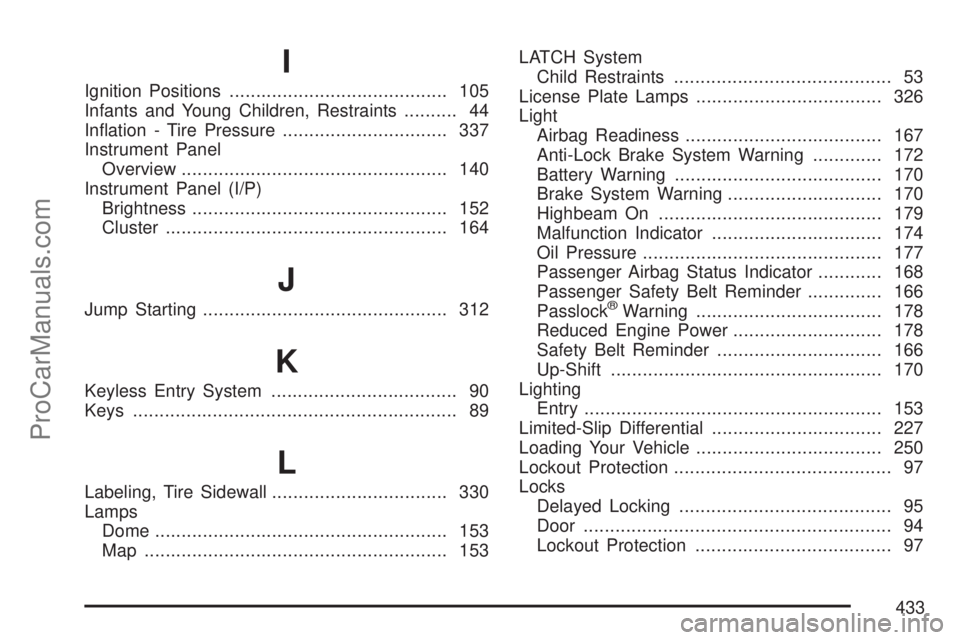
I
Ignition Positions......................................... 105
Infants and Young Children, Restraints.......... 44
Ination - Tire Pressure............................... 337
Instrument Panel
Overview.................................................. 140
Instrument Panel (I/P)
Brightness................................................ 152
Cluster..................................................... 164
J
Jump Starting.............................................. 312
K
Keyless Entry System................................... 90
Keys............................................................. 89
L
Labeling, Tire Sidewall................................. 330
Lamps
Dome....................................................... 153
Map ......................................................... 153LATCH System
Child Restraints......................................... 53
License Plate Lamps................................... 326
Light
Airbag Readiness..................................... 167
Anti-Lock Brake System Warning............. 172
Battery Warning....................................... 170
Brake System Warning............................. 170
Highbeam On.......................................... 179
Malfunction Indicator................................ 174
Oil Pressure............................................. 177
Passenger Airbag Status Indicator............ 168
Passenger Safety Belt Reminder.............. 166
Passlock
®Warning................................... 178
Reduced Engine Power............................ 178
Safety Belt Reminder............................... 166
Up-Shift................................................... 170
Lighting
Entry........................................................ 153
Limited-Slip Differential................................ 227
Loading Your Vehicle................................... 250
Lockout Protection......................................... 97
Locks
Delayed Locking........................................ 95
Door.......................................................... 94
Lockout Protection..................................... 97
433
ProCarManuals.com