spare tire SATURN OUTLOOK 2007 User Guide
[x] Cancel search | Manufacturer: SATURN, Model Year: 2007, Model line: OUTLOOK, Model: SATURN OUTLOOK 2007Pages: 538, PDF Size: 3.2 MB
Page 439 of 538

When rotating your tires, always use the correct
rotation pattern shown here.
Do not include the compact spare tire in your tire
rotation.
After the tires have been rotated, adjust the front
and rear ination pressures as shown on the
Tire and Loading Information label.
Make certain that all wheel nuts are properly
tightened. See “Wheel Nut Torque” under
Capacities and Specifications on page 483.
{CAUTION:
Rust or dirt on a wheel, or on the parts to
which it is fastened, can make wheel nuts
become loose after time. The wheel could
come off and cause an accident. When
you change a wheel, remove any rust or
dirt from places where the wheel attaches
to the vehicle. In an emergency, you can
use a cloth or a paper towel to do this;
but be sure to use a scraper or wire brush
later, if needed, to get all the rust or dirt
off. SeeChanging a Flat Tire on page 447.
439
ProCarManuals.com
Page 441 of 538

the TPC spec number will be followed by an MS
for mud and snow. SeeTire Sidewall Labeling
on page 426for additional information.
{CAUTION:
Mixing tires could cause you to lose
control while driving. If you mix tires of
different sizes, brands, or types (radial
and bias-belted tires), the vehicle may not
handle properly, and you could have a
crash. Using tires of different sizes,
brands, or types may also cause damage
to your vehicle. Be sure to use the correct
size, brand, and type of tires on all
wheels. It is all right to drive with your
compact spare temporarily, as it was
developed for use on your vehicle. See
Compact Spare Tire on page 463.
{CAUTION:
If you use bias-ply tires on your vehicle,
the wheel rim anges could develop
cracks after many miles of driving. A tire
and/or wheel could fail suddenly, causing
a crash. Use only radial-ply tires with the
wheels on your vehicle.
If you must replace your vehicle’s tires with those
that do not have a TPC Spec number, make
sure they are the same size, load range, speed
rating, and construction type (radial and
bias-belted tires) as your vehicle’s original tires.
Your vehicle’s original equipment tires are listed on
the Tire and Loading Information label. This
label is attached to the vehicle’s center pillar
(B-pillar). SeeLoading Your Vehicle on page 353,
for more information about the Tire and Loading
Information label and its location on your vehicle.
441
ProCarManuals.com
Page 442 of 538

Different Size Tires and Wheels
If you add wheels or tires that are a different size
than your original equipment wheels and tires,
this may affect the way your vehicle performs,
including its braking, ride and handling
characteristics, stability, and resistance to rollover.
Additionally, if your vehicle has electronic
systems such as, anti-lock brakes, rollover airbags,
traction control, and stability control, the
performance of these systems can be affected.
{CAUTION:
If you add different sized wheels, your
vehicle may not provide an acceptable
level of performance and safety if tires not
recommended for those wheels are
selected. You may increase the chance
that you will crash and suffer serious
injury. Only use Saturn specic wheel and
tire systems developed for your vehicle,
and have them properly installed by a
Saturn certied technician.SeeBuying New Tires on page 440and
Accessories and Modifications on page 377for
additional information.
Uniform Tire Quality Grading
Quality grades can be found where applicable on
the tire sidewall between tread shoulder and
maximum section width. For example:
Treadwear 200 Traction AA Temperature A
The following information relates to the system
developed by the United States National Highway
Traffic Safety Administration (NHTSA), which
grades tires by treadwear, traction, and
temperature performance. This applies only to
vehicles sold in the United States. The grades are
molded on the sidewalls of most passenger car
tires. The Uniform Tire Quality Grading (UTQG)
system does not apply to deep tread, winter-type
snow tires, space-saver, or temporary use
spare tires, tires with nominal rim diameters of
10 to 12 inches (25 to 30 cm), or to some
limited-production tires.
442
ProCarManuals.com
Page 448 of 538

Removing the Spare Tire and Tools
The tools needed to remove the spare tire are
located in the storage compartment on the driver
side, at the rear of the vehicle.
1. Open the jack storage compartment by
squeezing down on the latch tab and
pulling the cover off.
A. Tool Bag
B. Wing Bolt
C. Jack2. Remove the wing bolt (B) by turning it
counterclockwise
3. Push the jack (C) up out of the holding
bracket.
4. Turn the jack on its side, with the bottom
facing toward you.
5. Pull the jack straight out, bottom rst.
The tools you will be using include the jack (A)
and lug wrench (B).
448
ProCarManuals.com
Page 449 of 538
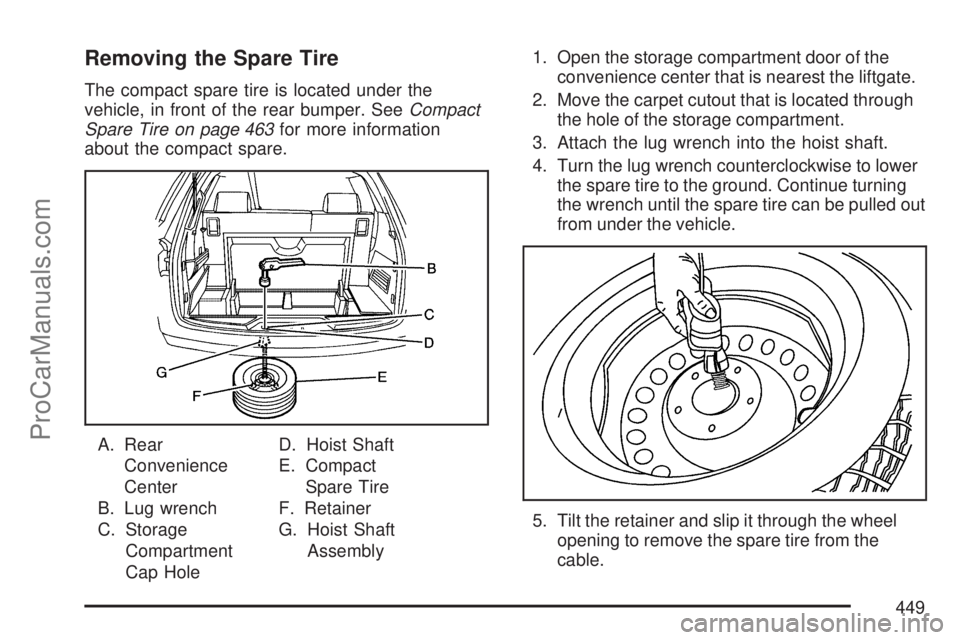
Removing the Spare Tire
The compact spare tire is located under the
vehicle, in front of the rear bumper. SeeCompact
Spare Tire on page 463for more information
about the compact spare.
A. Rear
Convenience
Center
B. Lug wrench
C. Storage
Compartment
Cap HoleD. Hoist Shaft
E. Compact
Spare Tire
F. Retainer
G. Hoist Shaft
Assembly1. Open the storage compartment door of the
convenience center that is nearest the liftgate.
2. Move the carpet cutout that is located through
the hole of the storage compartment.
3. Attach the lug wrench into the hoist shaft.
4. Turn the lug wrench counterclockwise to lower
the spare tire to the ground. Continue turning
the wrench until the spare tire can be pulled out
from under the vehicle.
5. Tilt the retainer and slip it through the wheel
opening to remove the spare tire from the
cable.
449
ProCarManuals.com
Page 450 of 538

6. Turn the wrench clockwise to raise the cable
back up after removing the spare tire.
Do not store a full-size or a at road tire under
the vehicle. SeeStoring a Flat or Spare Tire
and Tools on page 459.
To continue changing the at tire, seeRemoving
the Flat Tire and Installing the Spare Tire on
page 451.
If the spare tire will not lower, the secondary latch
could be engaged.Do the following to check the cable:
1. Check under the vehicle to see if the cable is
visible.
2. If it is not visible, seeSecondary Latch
System on page 456.
If it is visible, rst try to tighten the cable by
turning the lug wrench clockwise until you hear
two clicks or feel it skip twice. You cannot
over-tighten the cable.
3. Loosen the cable by turning the wrench
counterclockwise three or four turns.
4. If the spare tire has not lowered, tighten the
cable all the way and then loosen it at least
two times.
If the spare tire did lower to the ground,
continue with Step 5 under “Removing the
Spare Tire (Vehicles with the Rear
Convenience Center)” listed previously.
5. If you still cannot lower the spare tire to the
ground, seeSecondary Latch System on
page 456.
450
ProCarManuals.com
Page 451 of 538
Removing the Flat Tire and
Installing the Spare Tire
1. Do a safety check before proceeding. See
Changing a Flat Tire on page 447for more
information.
2. If the vehicle has a wheel cover, loosen the
plastic nut caps with the wheel wrench. They
will not come off. Then, using the at end
of the wheel wrench, pry along the edge of the
cover until it comes off. Be careful; the
edges may be sharp. Do not try to remove the
cover with your bare hands.
Store the wheel cover securely in the rear of
the vehicle until you have the at tire
repaired or replaced.
If your vehicle has aluminum wheels, remove
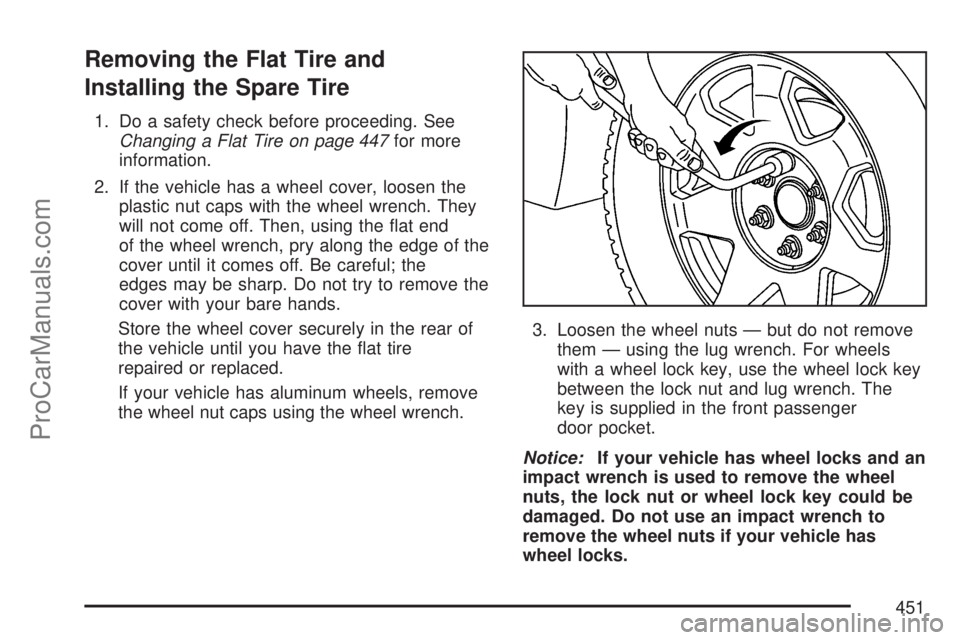
the wheel nut caps using the wheel wrench.3. Loosen the wheel nuts — but do not remove
them — using the lug wrench. For wheels
with a wheel lock key, use the wheel lock key
between the lock nut and lug wrench. The
key is supplied in the front passenger
door pocket.
Notice:If your vehicle has wheel locks and an
impact wrench is used to remove the wheel
nuts, the lock nut or wheel lock key could be
damaged. Do not use an impact wrench to
remove the wheel nuts if your vehicle has
wheel locks.
451
ProCarManuals.com
Page 452 of 538

4. To identify the appropriate jacking location, nd
the triangle (A) about 12 inches (30.5 cm) from
the front tire or (B) about 10.5 inches (27 cm)
from the rear tire.
The triangle is located near each wheel on the
vehicle’s exterior.
Notice:If a jack is used to raise the vehicle
without positioning it correctly, your vehicle
could be damaged. When raising your vehicle
on a jack, avoid contact with the rear axle
control arms.
5. Do not raise the vehicle yet. Put the compact
spare tire near you.
{CAUTION:
Getting under a vehicle when it is jacked
up is dangerous. If the vehicle slips off
the jack you could be badly injured or
killed. Never get under a vehicle when it
is supported only by a jack.
{CAUTION:
Raising your vehicle with the jack
improperly positioned can damage the
vehicle and even make the vehicle fall.
To help avoid personal injury and vehicle
damage, be sure to t the jack lift head
into the proper location before raising
the vehicle.
452
ProCarManuals.com
Page 453 of 538
6. Attach the lug wrench to the jack, and turn the
wrench clockwise to raise the jack head
3 inches (7.6 cm).
7. Place the jack under the vehicle as identied
in Step 3. Raise the vehicle by turning the lug
wrench clockwise in the jack. Raise the
vehicle far enough off the ground so that there
is enough room for the spare tire to t
under the wheel well.
8. Remove all the wheel nuts and the at tire.
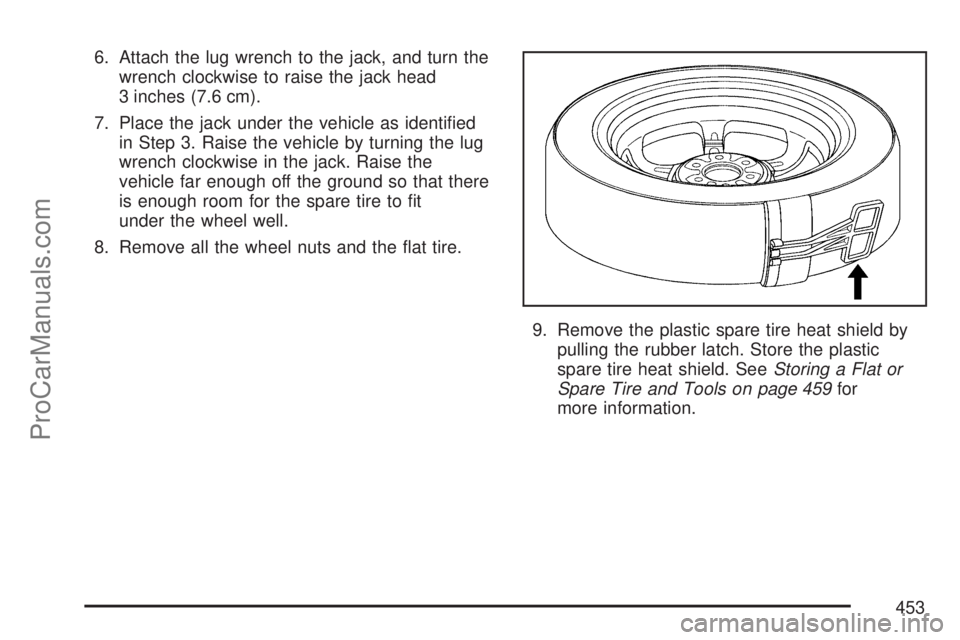
9. Remove the plastic spare tire heat shield by
pulling the rubber latch. Store the plastic
spare tire heat shield. SeeStoring a Flat or
Spare Tire and Tools on page 459for
more information.
453
ProCarManuals.com
Page 454 of 538

{CAUTION:
Rust or dirt on the wheel, or on the parts
to which it is fastened, can make the
wheel nuts become loose after time. The
wheel could come off and cause an
accident. When changing a wheel, remove
any rust or dirt from the places where the
wheel attaches to the vehicle. In an
emergency, a cloth or a paper towel can
be used to do this; but be sure to use a
scraper or wire brush later, if needed, to
get all the rust or dirt off.
{CAUTION:
Never use oil or grease on studs or nuts.
Because the nuts might come loose. The
vehicle’s wheel could fall off, causing a
serious accident.10. Remove any rust or
dirt from the wheel
bolts, mounting
surfaces, and spare
wheel.
11. Install the compact spare tire.
12. Lower the vehicle by attaching the lug wrench
to the jack and turning the wrench
counterclockwise. Lower the jack completely.
454
ProCarManuals.com