brake SATURN OUTLOOK 2009 Owners Manual
[x] Cancel search | Manufacturer: SATURN, Model Year: 2009, Model line: OUTLOOK, Model: SATURN OUTLOOK 2009Pages: 432, PDF Size: 2.48 MB
Page 4 of 432
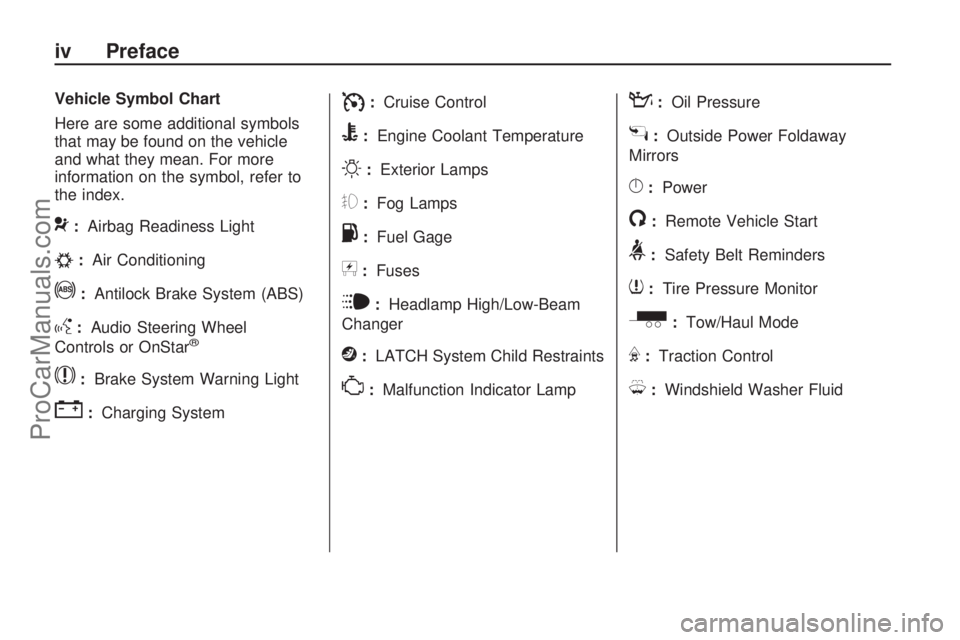
Vehicle Symbol Chart
Here are some additional symbols
that may be found on the vehicle
and what they mean. For more
information on the symbol, refer to
the index.
9:Airbag Readiness Light
#:Air Conditioning
!:Antilock Brake System (ABS)
g:Audio Steering Wheel
Controls or OnStar®
$:Brake System Warning Light
":Charging System
I:Cruise Control
B:Engine Coolant Temperature
O:Exterior Lamps
#:Fog Lamps
.:Fuel Gage
+:Fuses
i:Headlamp High/Low-Beam
Changer
j:LATCH System Child Restraints
*:Malfunction Indicator Lamp
::Oil Pressure
g:Outside Power Foldaway
Mirrors
}:Power
/:Remote Vehicle Start
>:Safety Belt Reminders
7:Tire Pressure Monitor
_:Tow/Haul Mode
F:Traction Control
M:Windshield Washer Fluid
iv Preface
ProCarManuals.com
Page 67 of 432

Features and
Controls
KeysKeys...................................2-2
Remote Keyless Entry (RKE)
System..............................2-3
Remote Keyless Entry (RKE)
System Operation................2-4
Remote Vehicle Start.............2-6
Doors and LocksDoor Locks..........................2-8
Power Door Locks.................2-8
Delayed Locking...................2-8
Programmable Automatic
Door Locks.........................2-9
Rear Door Security Locks.......2-9
Lockout Protection.................2-9
Liftgate...............................2-10
Power Liftgate.....................2-11
WindowsWindows............................2-14
Power Windows..................2-14
Sun Visors.........................2-16
Theft-Deterrent SystemsTheft-Deterrent Systems.......2-16
Content Theft-Deterrent........2-16
PASS-Key
®III+ Electronic
Immobilizer.......................2-18
PASS-Key
®III+ Electronic
Immobilizer Operation.........2-18
Starting and Operating
Your Vehicle
New Vehicle Break-In...........2-20
Ignition Positions.................2-20
Retained Accessory
Power (RAP).....................2-21
Starting the Engine..............2-22
Engine Coolant Heater.........2-23
Automatic Transmission
Operation..........................2-24
Tow/Haul Mode...................2-26
Parking Brake.....................2-27
Shifting Into Park.................2-28
Shifting Out of Park.............2-29
Parking Over Things
That Burn.........................2-29
Engine Exhaust...................2-30
Running the Vehicle While
Parked.............................2-30
MirrorsManual Rearview Mirror........2-31
Automatic Dimming
Rearview Mirror.................2-31
Outside Power Mirrors..........2-32
Outside Power Foldaway
Mirrors.............................2-33
Park Tilt Mirrors..................2-34
Outside Convex Mirror..........2-34
Outside Heated Mirrors.........2-34
Object Detection SystemsUltrasonic Rear Parking
Assist (URPA)...................2-34
Rear Vision Camera (RVC).....2-37
OnStar®SystemOnStar®System..................2-42
Universal Home Remote
System
Universal Home Remote
System.............................2-45
Universal Home Remote
System Operation..............2-46
Features and Controls 2-1
ProCarManuals.com
Page 86 of 432

Starting and
Operating Your
Vehicle
New Vehicle Break-In
Notice:The vehicle does
not need an elaborate break-in.
But it will perform better in
the long run if you follow these
guidelines:
If you have all-wheel drive,
keep your speed at 55 mph
(88 km/h) or less for the
rst 500 miles (805 km).
Do not drive at any one
constant speed, fast or slow,
for the rst 500 miles (805 km).
Do not make full-throttle
starts. Avoid downshifting to
brake or slow the vehicle.
Avoid making hard stops for
the rst 200 miles (322 km)
or so. During this time the
new brake linings are not yet
broken in. Hard stops with new
linings can mean premature
wear and earlier replacement.
Follow this breaking-in
guideline every time you get
new brake linings.
Do not tow a trailer during
break-in. SeeTowing a
Trailer on page 4-26for the
trailer towing capabilities
of your vehicle and more
information.
Following break-in, engine speed
and load can be gradually
increased.
Ignition Positions
The ignition switch has four different
positions.
In order to shift out of P (Park),
the ignition must be in ON/RUN or
ACC/ACCESSORY and the
brake pedal must be applied.
Notice:Using a tool to force the
key to turn in the ignition could
cause damage to the switch or
break the key. Use the correct key,
make sure it is all the way in, and
turn it only with your hand. If the
key cannot be turned by hand,
see your dealer/retailer.
2-20 Features and Controls
ProCarManuals.com
Page 90 of 432

Automatic Transmission
Operation
The automatic transmission has a
shift lever located on the console
between the seats.
P (Park):This position locks the
front wheels. It is the best position
to use when starting the engine
because the vehicle cannot move
easily.
{CAUTION
It is dangerous to get out of the
vehicle if the shift lever is not fully
in P (Park) with the parking brake
rmly set. The vehicle can roll.
Do not leave the vehicle when the
engine is running unless you have
to. If you have left the engine
running, the vehicle can move
suddenly. You or others could be
injured. To be sure the vehicle will
not move, even when you are on
fairly level ground, always set the
parking brake and move the shift
lever to P (Park). SeeShifting Into
Park on page 2-28. If you are
pulling a trailer, seeTowing a
Trailer on page 4-26.
Make sure the shift lever is fully
in P (Park) before starting the
engine. The vehicle has an
automatic transmission shift lockcontrol system. You must fully apply
the regular brake rst and then
press the shift lever button before
shifting from P (Park) when the
ignition key is in ON/RUN. If you
cannot shift out of P (Park),
ease pressure on the shift lever,
then push the shift lever all the way
into P (Park) as you maintain
brake application. Then press the
shift lever button and move the shift
lever into another gear. See
Shifting Out of Park on page 2-29.
R (Reverse):Use this gear to
back up.
Notice:Shifting to R (Reverse)
while the vehicle is moving
forward could damage the
transmission. The repairs would
not be covered by the vehicle
warranty. Shift to R (Reverse)
only after the vehicle is stopped.
2-24 Features and Controls
ProCarManuals.com
Page 91 of 432

To rock the vehicle back and forth
to get out of snow, ice or sand
without damaging the transmission,
seeIf Your Vehicle is Stuck in
Sand, Mud, Ice, or Snow on
page 4-17.
N (Neutral):In this position, the
engine does not connect with
the wheels. To restart the engine
when the vehicle is already moving,
use N (Neutral) only. Also, use
N (Neutral) when the vehicle
is being towed.
{CAUTION
Shifting into a drive gear while the
engine is running at high speed is
dangerous. Unless your foot is
rmly on the brake pedal, the
vehicle could move very rapidly.
You could lose control and hit
people or objects. Do not shift into
a drive gear while the engine is
running at high speed.Notice:Shifting out of P (Park)
or N (Neutral) with the engine
running at high speed may
damage the transmission. The
repairs would not be covered by
the vehicle warranty. Be sure the
engine is not running at high
speed when shifting the vehicle.
D (Drive):This position is for
normal driving. It provides the best
fuel economy. If you need more
power for passing, and you are:
Going less than 35 mph
(56 km/h), push the accelerator
pedal about halfway down.
Going about 35 mph (56 km/h) or
more, push the accelerator all
the way down.Notice:If the vehicle seems to
accelerate slowly or not shift
gears when you go faster, and you
continue to drive the vehicle that
way, you could damage the
transmission. Have the vehicle
serviced right away. You can
drive in L (Low) when you are
driving less than 35 mph (56 km/h)
and D (Drive) for higher speeds
until then.
L (Low):This position gives you
access to gear ranges. This provides
more engine braking but lower fuel
economy than D (Drive). You can
use it on very steep hills, or in deep
snow or mud.
Features and Controls 2-25
ProCarManuals.com
Page 93 of 432
Automatic Engine Grade
Braking
Automatic Engine Grade Braking
assists when driving on a downhill
grade. It maintains vehicle speed by
automatically implementing a shift
schedule that uses the engine and
the transmission to slow the vehicle.
The system will automatically
command downshifts to reduce
vehicle speed, until the brake pedal
is no longer being pressed.
While in the Electronic Range
Select (ERS) mode, grade braking
is deactivated, allowing the driver
to select a range and limiting
the highest gear available. Grade
braking is available for normal
driving and in Tow/Haul mode.
SeeAutomatic Transmission
Operation on page 2-24.
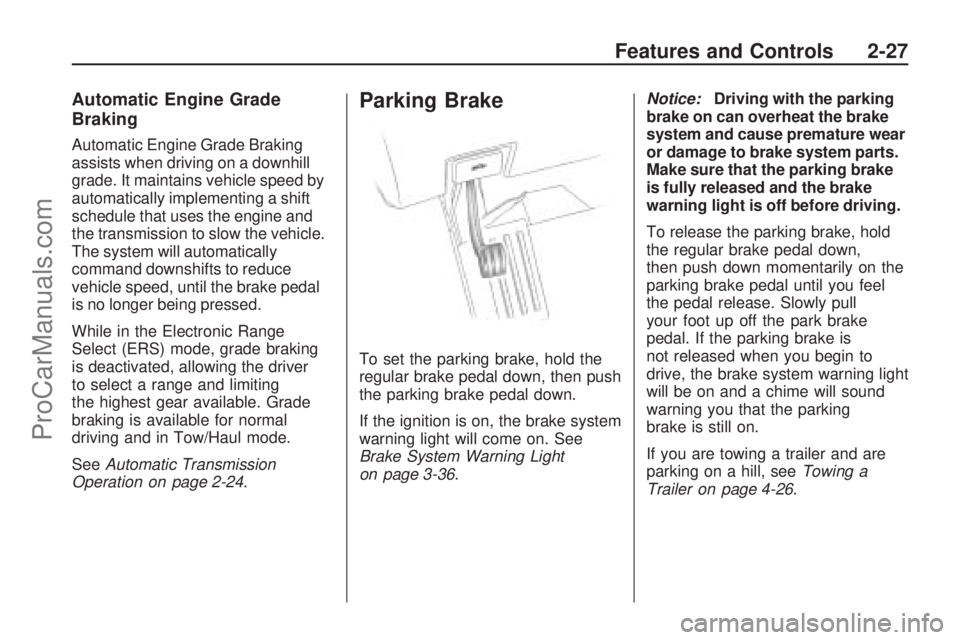
Parking Brake
To set the parking brake, hold the
regular brake pedal down, then push
the parking brake pedal down.
If the ignition is on, the brake system
warning light will come on. See
Brake System Warning Light
on page 3-36.Notice:Driving with the parking
brake on can overheat the brake
system and cause premature wear
or damage to brake system parts.
Make sure that the parking brake
is fully released and the brake
warning light is off before driving.
To release the parking brake, hold
the regular brake pedal down,
then push down momentarily on the
parking brake pedal until you feel
the pedal release. Slowly pull
your foot up off the park brake
pedal. If the parking brake is
not released when you begin to
drive, the brake system warning light
will be on and a chime will sound
warning you that the parking
brake is still on.
If you are towing a trailer and are
parking on a hill, seeTowing a
Trailer on page 4-26.
Features and Controls 2-27
ProCarManuals.com
Page 94 of 432

Shifting Into Park
{CAUTION
It can be dangerous to get out of
the vehicle if the shift lever is not
fully in P (Park) with the parking
brake rmly set. The vehicle can
roll. If you have left the engine
running, the vehicle can move
suddenly. You or others could be
injured. To be sure the vehicle will
not move, even when you are on
fairly level ground, use the steps
that follow. If you are pulling a
trailer, seeTowing a Trailer on
page 4-26.
1. Hold the brake pedal down
and set the parking brake.
SeeParking Brake on page 2-27
for more information.
2. Move the shift lever into P (Park)
by holding in the button on the
shift lever and pushing the
shift lever all the way toward the
front of the vehicle.3. Turn the ignition key to
LOCK/OFF.
4. Remove the key and take it with
you. If you can leave the vehicle
with the ignition key in your
hand, the vehicle is in P (Park).
Leaving the Vehicle with the
Engine Running
{CAUTION
It can be dangerous to leave the
vehicle with the engine running.
The vehicle could move suddenly
if the shift lever is not fully in
P (Park) with the parking brake
rmly set. And, if you leave the
vehicle with the engine running,
it could overheat and even catch
re. You or others could be
injured. Do not leave the vehicle
with the engine running.If you have to leave the vehicle
with the engine running, be sure
the vehicle is in P (Park) and
the parking brake is rmly set
before you leave it. After you have
moved the shift lever into P (Park),
hold the regular brake pedal down.
Then, see if you can move the
shift lever away from P (Park)
without rst pushing the button.
If you can, it means that the shift
lever was not fully locked in P (Park).Torque Lock
Torque lock is when the weight of
the vehicle puts too much force
on the parking pawl in the
transmission. This happens when
parking on a hill and shifting
the transmission into P (Park) is
not done properly and then it
is difficult to shift out of P (Park).
2-28 Features and Controls
ProCarManuals.com
Page 95 of 432
To prevent torque lock, set the
parking brake and then shift
into P (Park). To nd out how,
see “Shifting Into Park” listed
previously.
If torque lock does occur, your
vehicle may need to be pushed
uphill by another vehicle to relieve
the parking pawl pressure, so
you can shift out of P (Park).
Shifting Out of Park
The vehicle is equipped with an
electronic shift lock release system.
The shift lock release is designed to:
Prevent ignition key removal
unless the shift lever is in P (Park)
with the shift lever button fully
released, and
Prevent movement of the shift
lever out of P (Park), unless
the ignition is in ON/RUN or
ACC/ACCESSORY and the
regular brake pedal is applied.The shift lock release is always
functional except in the case of
an uncharged or low voltage
(less than 9 volt) battery.
If the vehicle has an uncharged
battery or a battery with low voltage,
try charging or jump starting the
battery. SeeJump Starting on
page 5-30for more information.
To shift out of P (Park):
1. Apply the brake pedal.
2. Press the shift lever button.
3. Move the shift lever to the
desired position.
If you still are unable to shift out
of P (Park):
1. Fully release the shift lever
button.
2. While holding down the brake
pedal, press the shift lever
button again.
3. Move the shift lever to the
desired position.If you still cannot move the shift
lever from P (Park), see your
dealer/retailer.
Parking Over Things
That Burn
{CAUTION
Things that can burn could touch
hot exhaust parts under the
vehicle and ignite. Do not park
over papers, leaves, dry grass, or
other things that can burn.
Features and Controls 2-29
ProCarManuals.com
Page 97 of 432

{CAUTION
It can be dangerous to get out of
the vehicle if the automatic
transmission shift lever is not fully
in P (Park) with the parking brake
rmly set. The vehicle can roll.
Do not leave the vehicle when the
engine is running unless you have
to. If you have left the engine
running, the vehicle can move
suddenly. You or others could be
injured. To be sure the vehicle will
not move, even when you are on
fairly level ground, always set the
parking brake and move the shift
lever to P (Park).
Follow the proper steps to be
sure the vehicle will not move.
SeeShifting Into Park on page 2-28.
If parking on a hill and pulling a
trailer, seeTowing a Trailer on
page 4-26.
Mirrors
Manual Rearview Mirror
Adjust the inside rearview mirror
to see clearly behind your vehicle.
Hold the mirror in the center to move
it up or down and side to side.
Use the day/night adjustment to help
prevent glare from the headlamps
behind you. Move the lever to the
right for nighttime use and to
the left for daytime use.
Vehicles with OnStar
®have
three additional control buttons
located at the bottom of the mirror.
See your dealer/retailer for more
information about OnStar and
how to subscribe to it. SeeOnStar
®
System on page 2-42for more
information on the services OnStar
provides.
Automatic Dimming
Rearview Mirror
The vehicle may have an automatic
dimming inside rearview mirror.
Vehicles with OnStar
®have
three additional control buttons for
the OnStar
®system. See your
dealer/retailer for more information
about OnStar
®and how to subscribe
to it. SeeOnStar®System on
page 2-42for more information about
the services OnStar
®provides.
O(On/Off):Press to turn the
dimming feature on or off.
The vehicle may also have a Rear
Vision Camera (RVC). SeeRear
Vision Camera (RVC) on page 2-37
for more information.
If the vehicle has RVC, the
Obutton
will not be available.
Features and Controls 2-31
ProCarManuals.com
Page 102 of 432

The following describes how the URPA display lights appear as the vehicle
gets closer to a detected object:
DescriptionEnglishMetric
amber light 8 ft2.5 m
amber/amber lights 40 in1.0 m
amber/amber/red lights 23 in0.6 m
amber/amber/red lights ashing 1 ft 0.3 m
The system can be disabled
through the Driver Information
Center (DIC). See “Park Assist”
under DIC Operation and Displays
(With DIC Buttons) on page 3-45
or DIC Operation and Displays
(Without DIC Buttons) on page 3-50
for more information.
When the System Does Not
Seem to Work Properly
If the URPA system does not
activate due to a temporary
condition, the message PARK ASSIST OFF displays on the DIC
and a red light will be shown on the
rear URPA display when the shift
lever is moved into R (Reverse).
This may occur under the following
conditions:
The driver disables the system.
The ultrasonic sensors are
not clean. Keep the vehicle’s rear
bumper free of mud, dirt, snow,
ice and slush. For cleaning
instructions, see
Washing Your
Vehicle on page 5-87 .
A trailer was attached to the
vehicle, or a bicycle or an
object was hanging out of the
liftgate during the last drive cycle,
the red light may illuminate in
the rear display. Once the
attached object is removed,
URPA will return to normal
operation.
A tow bar is attached to the
vehicle.
The vehicle’s bumper is
damaged. Take the vehicle to
your dealer/retailer to repair
the system.
Other conditions may affect
system performance, such
as vibrations from a jackhammer
or the compression of air
brakes on a very large truck.
If the system is still disabled, after
driving forward at least 15 mph
(25 km/h), take the vehicle to your
dealer/retailer.
2-36 Features and Controls
ProCarManuals.com