towing Seat Alhambra 2005 User Guide
[x] Cancel search | Manufacturer: SEAT, Model Year: 2005, Model line: Alhambra, Model: Seat Alhambra 2005Pages: 272, PDF Size: 6.35 MB
Page 179 of 272
175 Your vehicle and the environment
Safety FirstControls and equipment Tips and Maintenance Technical Data
• As driving stability of vehicle and trailer decreaseswhen the
speed increases do not drive at the maximum permissible top
speed in unfavourable road, weather or wind conditions –
particularly when going downhill.
In any case the speed must be reduced as soon as the trailer
shows the slightest sign of snaking. On no account try to stop the
snaking by accelerating.
• • FFo
or
r ssa
af
fe
et
ty
y rre
ea
as
so
on
ns
s oon
ne
e ssh
ho
ou
ul
ld
d nno
ot
t ddr
ri
iv
ve
e ffa
as
st
te
er
r tth
ha
an
n 880
0 kkm
m/
/h
h
( (5
50
0 mmp
ph
h)
).
. TTh
hi
is
s aal
ls
so
o aap
pp
pl
li
ie
es
s iin
n cco
ou
un
nt
tr
ri
ie
es
s wwh
he
er
re
e hhi
ig
gh
he
er
r ssp
pe
ee
ed
ds
s aar
re
e
p pe
er
rm
mi
it
tt
te
ed
d.
.
• Always brake in good time. If the trailer has an overrun brake,
apply the brakes gently at first then firmly. This will avoid the
jerking caused by the trailer wheels locking.
Change down before going down a steep hill so thatthe engine
can act as a brake.
• When a long climb in a low gear with extremely high engine revs
must be negotiated at exceptionally high ambient temperatures
the coolant temperature gauge must be observed. When the gauge
needle moves to the right end of the scale, the road speed must be
reduced immediately.
• The cooling effect of the radiator fan cannot be increased by
changing down, because the speed of the fan is not dependent on
the engine speed. One should therefore not change down even
when towing a trailer as long as the engine can cope without the
vehicle speed dropping too much.
K
General notes
• • DDu
ur
ri
in
ng
g tth
he
e rru
un
nn
ni
in
ng
g iin
n ppe
er
ri
io
od
d yyo
ou
u ssh
ho
ou
ul
ld
d aav
vo
oi
id
d tto
ow
wi
in
ng
g aa ttr
ra
ai
il
le
er
r iif
f
p po
os
ss
si
ib
bl
le
e.
.
• • IIt
t iis
s aad
dv
vi
is
sa
ab
bl
le
e tto
o hha
av
ve
e tth
he
e vve
eh
hi
ic
cl
le
e sse
er
rv
vi
ic
ce
ed
d bbe
et
tw
we
ee
en
n tth
he
e
I In
ns
sp
pe
ec
ct
ti
io
on
n iin
nt
te
er
rv
va
al
ls
s iif
f iit
t iis
s uus
se
ed
d ffr
re
eq
qu
ue
en
nt
tl
ly
y ffo
or
r tto
ow
wi
in
ng
g aa ttr
ra
ai
il
le
er
r.
.
• The trailer and drawbar load figures on the data plate of the
towing bracket are for test certification only. The correct figuresfor
the vehicle, which may be lower than the above figures, are given
in the vehicle documents and in this manual.
• When using the towing device the car’s empty weight is reduced,
and as a result its effective load is decreased.
• Observe all statutory requirements regarding the use of a
trailer.
K
Page 192 of 272
188Checking and refilling
Checking oil level
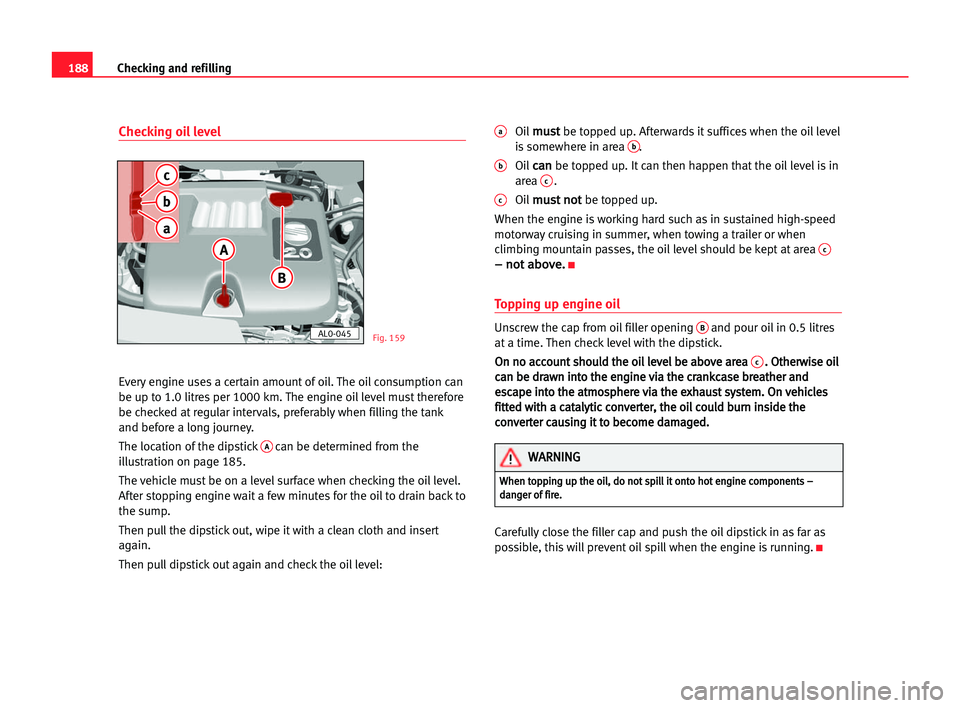
Every engine uses a certain amount of oil. The oil consumption can
be up to 1.0 litres per 1000 km. The engine oil level must therefore
be checked at regular intervals, preferably when filling the tank
and before a long journey.
The location of the dipstick
Acan be determined from the
illustration on page 185.
The vehicle must be on a level surface when checking the oil level.
After stopping engine wait a few minutes for the oil to drain backto
the sump.
Then pull the dipstick out, wipe it with a clean cloth and insert
again.
Then pull dipstick out again and check the oil level:
aOilm mu
us
st
tbe topped up. Afterwards it suffices when the oil level
is somewhere in area b.
bOilc ca
an
nbe topped up. It can then happen that the oil level is in
area c.
cOilm mu
us
st
t nno
ot
tbe topped up.
When the engine is working hard such as in sustained high-speed
motorway cruising in summer, when towing a trailer or when
climbing mountain passes, the oil level should be kept at area
c
– – nno
ot
t aab
bo
ov
ve
e.
.K
Topping up engine oil
Unscrew the cap from oil filler opening Band pour oil in 0.5 litres
at a time. Then check level with the dipstick.
O On
n nno
o aac
cc
co
ou
un
nt
t ssh
ho
ou
ul
ld
d tth
he
e ooi
il
l lle
ev
ve
el
l bbe
e aab
bo
ov
ve
e aar
re
ea
a
c.
. OOt
th
he
er
rw
wi
is
se
e ooi
il
l
c ca
an
n bbe
e ddr
ra
aw
wn
n iin
nt
to
o tth
he
e een
ng
gi
in
ne
e vvi
ia
a tth
he
e ccr
ra
an
nk
kc
ca
as
se
e bbr
re
ea
at
th
he
er
r aan
nd
d
e es
sc
ca
ap
pe
e iin
nt
to
o tth
he
e aat
tm
mo
os
sp
ph
he
er
re
e vvi
ia
a tth
he
e eex
xh
ha
au
us
st
t ssy
ys
st
te
em
m.
. OOn
n vve
eh
hi
ic
cl
le
es
s
f fi
it
tt
te
ed
d wwi
it
th
h aa cca
at
ta
al
ly
yt
ti
ic
c cco
on
nv
ve
er
rt
te
er
r,
, tth
he
e ooi
il
l cco
ou
ul
ld
d bbu
ur
rn
n iin
ns
si
id
de
e tth
he
e
c co
on
nv
ve
er
rt
te
er
r cca
au
us
si
in
ng
g iit
t tto
o bbe
ec
co
om
me
e dda
am
ma
ag
ge
ed
d.
.
Carefully close the filler cap and push the oil dipstick in as far as
possible, this will prevent oil spill when the engine is running.
K
Fig. 159
W Wh
he
en
n tto
op
pp
pi
in
ng
g uup
p tth
he
e ooi
il
l,
, ddo
o nno
ot
t ssp
pi
il
ll
l iit
t oon
nt
to
o hho
ot
t een
ng
gi
in
ne
e cco
om
mp
po
on
ne
en
nt
ts
s ––
d da
an
ng
ge
er
r oof
f ffi
ir
re
e.
.
W
WA
AR
RN
NI
IN
NG
G
a
b
c
A
B
AL0-045
Page 205 of 272
201 If and when
Safety FirstControls and equipment Tips and Maintenance Technical Data
I
If
f aan
nd
d wwh
he
en
n
F
Fi
ir
rs
st
t aai
id
d kki
it
t,
, wwa
ar
rn
ni
in
ng
g ttr
ri
ia
an
ng
gl
le
e
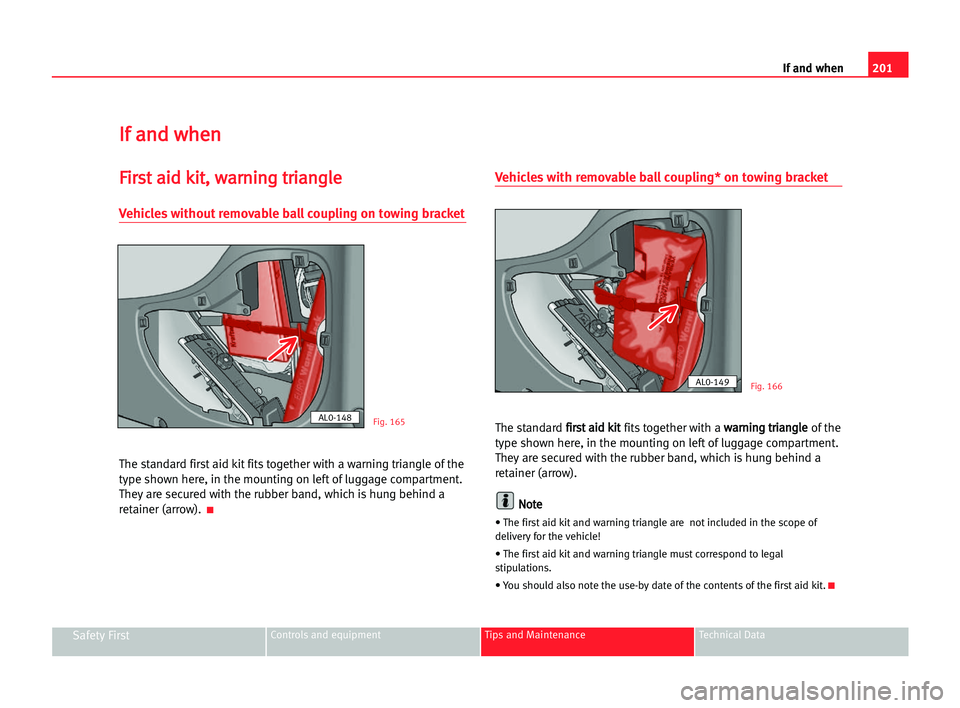
Vehicles without removable ball coupling on towing bracket
The standard first aid kit fits together with a warning triangle of the
type shown here, in the mounting on left of luggage compartment.
They are secured with the rubber band, which is hung behind a
retainer (arrow).
K
Vehicles with removable ball coupling* on towing bracket
The standardf fi
ir
rs
st
t aai
id
d kki
it
t
fits together with a w wa
ar
rn
ni
in
ng
g ttr
ri
ia
an
ng
gl
le
e
of the
type shown here, in the mounting on left of luggage compartment.
They are secured with the rubber band, which is hung behind a
retainer (arrow).
N No
ot
te
e
• The first aid kit and warning triangle are not included in the scope of
delivery for the vehicle!
• The first aid kit and warning triangle must correspond to legal
stipulations.
• You should also note the use-by date of the contents of the firstaid kit.
K
AL0-148
AL0-149
Fig. 165
Fig. 166
Page 230 of 272
226If and when
T
To
ow
w sst
ta
ar
rt
ti
in
ng
g/
/t
to
ow
wi
in
ng
g
A tow-rope or a towing bar must only be applied at the following
points:
F Fr
ro
on
nt
t tto
ow
wi
in
ng
g eey
ye
e
The front towing eye is located on the right below the bumper. It is
protected by a flap. To remove the flap, pull it forward and allow it
to hang.
R Re
ea
ar
r tto
ow
wi
in
ng
g eey
ye
e
The rear towing eye is also located on the right under the bumper.
It is not covered.
K
General notes
• Check whether there are any local traffic regulations concerning
the towing of vehicles.
• The tow-rope should be slightly elastic to reduce the risk of
damage to both vehicles. It is advisable to use synthetic fibre
ropes, or ropes of similar elastic material. I It
t iis
s hho
ow
we
ev
ve
er
r ssa
af
fe
er
r tto
o uus
se
e
a a tto
ow
wi
in
ng
g bba
ar
r!
!
Avoid excessive towing effort and do not jerk. During towing
operations on other than surfaced roadsthere is always the danger
that the attachment points will be overloaded and damaged.
• • BBe
ef
fo
or
re
e ttr
ry
yi
in
ng
g tto
o tto
ow
w sst
ta
ar
rt
t,
, aan
n aat
tt
te
em
mp
pt
t ssh
ho
ou
ul
ld
d bbe
e mma
ad
de
e tto
o sst
ta
ar
rt
t
u us
si
in
ng
g tth
he
e bba
at
tt
te
er
ry
y oof
f aan
no
ot
th
he
er
r vve
eh
hi
ic
cl
le
e
⇒p
pa
ag
ge
e 222
25
5.
.• Both drivers must be familiar with towing procedures.
Inexperienced drivers should not attempt to tow start or tow.
• When using a tow-rope the driver of the towing vehicle must
engage the clutch very gently when moving off and changing gear.
• The driver of the vehicle being towed must ensure that the tow-
rope is always taut.
• The emergency lights must be switched on in both vehicles –
unless local regulations differ.
• Turn ignition on so that the steering wheel is free and the turn
signals, horn, and, if necessary, the windscreen wiper and washer
can be used.
• As the brake servo only works when the engine is running,
considerably more pressure is required on the brake pedal when
the engine is not running.
• More force than usual will be required to turn the steering wheel
as the power assisted steering does not work when engine is not
running.
• When there is no lubricant in the manual or automatic gearbox,
the vehicle may only be towed with driving wheels lifted.
K
Page 231 of 272
227 If and when
Safety FirstControls and equipment Tips and Maintenance Technical Data
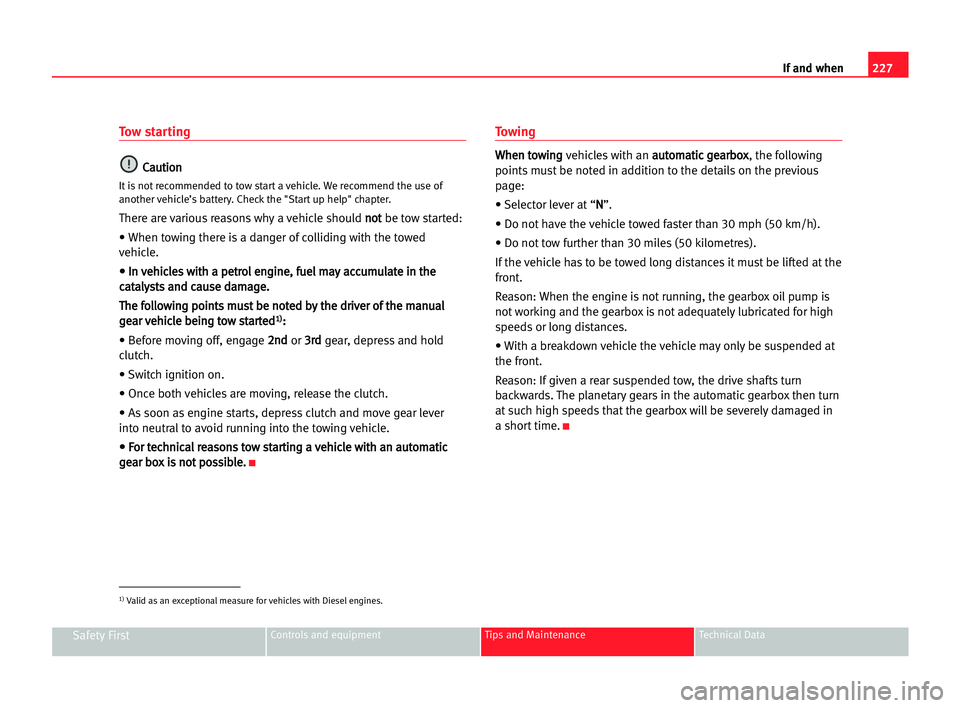
Tow starting
C
Ca
au
ut
ti
io
on
n
It is not recommended to tow start a vehicle. We recommend the use of
another vehicle’s battery. Check the "Start up help" chapter.
There are various reasons why a vehicle should n no
ot
t
be tow started:
• When towing there is a danger of colliding with the towed
vehicle.
• • IIn
n vve
eh
hi
ic
cl
le
es
s wwi
it
th
h aa ppe
et
tr
ro
ol
l een
ng
gi
in
ne
e,
, ffu
ue
el
l mma
ay
y aac
cc
cu
um
mu
ul
la
at
te
e iin
n tth
he
e
c ca
at
ta
al
ly
ys
st
ts
s aan
nd
d cca
au
us
se
e dda
am
ma
ag
ge
e.
.
T Th
he
e ffo
ol
ll
lo
ow
wi
in
ng
g ppo
oi
in
nt
ts
s mmu
us
st
t bbe
e nno
ot
te
ed
d bby
y tth
he
e ddr
ri
iv
ve
er
r oof
f tth
he
e mma
an
nu
ua
al
l
g ge
ea
ar
r vve
eh
hi
ic
cl
le
e bbe
ei
in
ng
g tto
ow
w sst
ta
ar
rt
te
ed
d
1
1)
):
:
• Before moving off, engage 2 2n
nd
d
or 3 3r
rd
d
gear, depress and hold
clutch.
• Switch ignition on.
• Once both vehicles are moving, release the clutch.
• As soon as engine starts, depress clutch and move gear lever
into neutral to avoid running into the towing vehicle.
• • FFo
or
r tte
ec
ch
hn
ni
ic
ca
al
l rre
ea
as
so
on
ns
s tto
ow
w sst
ta
ar
rt
ti
in
ng
g aa vve
eh
hi
ic
cl
le
e wwi
it
th
h aan
n aau
ut
to
om
ma
at
ti
ic
c
g ge
ea
ar
r bbo
ox
x iis
s nno
ot
t ppo
os
ss
si
ib
bl
le
e.
.
K
To w i n g
W
Wh
he
en
n tto
ow
wi
in
ng
g
vehicles with an a au
ut
to
om
ma
at
ti
ic
c gge
ea
ar
rb
bo
ox
x
, the following
points must be noted in addition to the details on the previous
page:
• Selector lever at “N N
”.
• Do not have the vehicle towed faster than 30 mph (50 km/h).
• Do not tow further than 30 miles (50 kilometres).
If the vehicle has to be towed long distances it must be lifted at the
front.
Reason: When the engine is not running, the gearbox oil pump is
not working and the gearbox is not adequately lubricated for high
speeds or long distances.
• With a breakdown vehicle the vehicle may only be suspended at
the front.
Reason: If given a rear suspended tow, the drive shafts turn
backwards. The planetary gears in the automatic gearbox then turn
at such high speeds that the gearbox will be severely damaged in
a short time.
K
1)Valid as an exceptional measure for vehicles with Diesel engines.
Page 236 of 272
232General notes
Weights
N
No
ot
te
e
These weights are valid for European Union vehicles. Vehicles for other
countries may have other weights. At all times it should be taken into
account that the data given with the official vehicle document prevails.
Tyre pressure
The pressure values given here are for cold tyres – do not reduce
the high pressure of warm tyres.
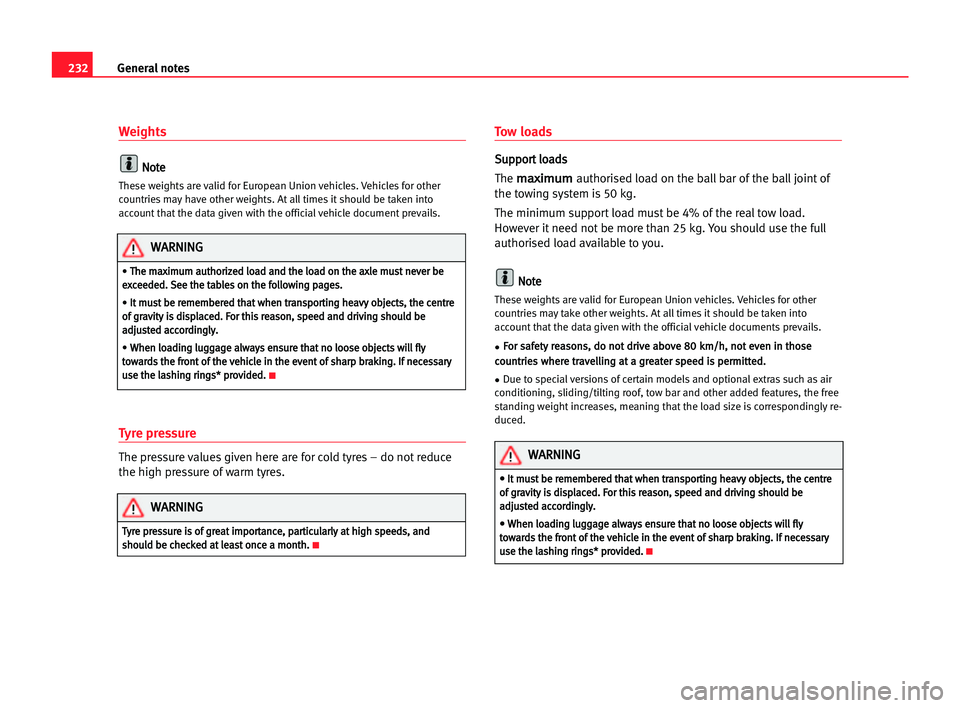
Tow loads
S Su
up
pp
po
or
rt
t llo
oa
ad
ds
s
The
m ma
ax
xi
im
mu
um
m authorised load on the ball bar of the ball joint of
the towing system is 50 kg.
The minimum support load must be 4% of the real tow load.
However it need not be more than 25 kg. You should use the full
authorised load available to you.
N No
ot
te
e
These weights are valid for European Union vehicles. Vehicles for other
countries may take other weights. At all times it should be taken into
account that the data given with the official vehicle documents prevails.
•F Fo
or
r ssa
af
fe
et
ty
y rre
ea
as
so
on
ns
s,
, ddo
o nno
ot
t ddr
ri
iv
ve
e aab
bo
ov
ve
e 880
0k
km
m/
/h
h,
, nno
ot
t eev
ve
en
n iin
n tth
ho
os
se
e
c co
ou
un
nt
tr
ri
ie
es
sw
wh
he
er
re
e ttr
ra
av
ve
el
ll
li
in
ng
g aat
t aa ggr
re
ea
at
te
er
r ssp
pe
ee
ed
d iis
s ppe
er
rm
mi
it
tt
te
ed
d.
.
•Due to special versions of certain models and optional extras such asair
conditioning, sliding/tilting roof, tow bar and other added features, the free
standing weight increases, meaning that the load size is correspondingly re-
duced.
• T Th
he
e mma
ax
xi
im
mu
um
m aau
ut
th
ho
or
ri
iz
ze
ed
d llo
oa
ad
d aan
nd
d tth
he
e llo
oa
ad
d oon
n tth
he
e aax
xl
le
e mmu
us
st
t nne
ev
ve
er
r bbe
e
e ex
xc
ce
ee
ed
de
ed
d.
. SSe
ee
e tth
he
e tta
ab
bl
le
es
s oon
n tth
he
e ffo
ol
ll
lo
ow
wi
in
ng
g ppa
ag
ge
es
s.
.
• I
It
t mmu
us
st
t bbe
e rre
em
me
em
mb
be
er
re
ed
d tth
ha
at
t wwh
he
en
n ttr
ra
an
ns
sp
po
or
rt
ti
in
ng
g hhe
ea
av
vy
y oob
bj
je
ec
ct
ts
s,
, tth
he
e cce
en
nt
tr
re
e
o of
f ggr
ra
av
vi
it
ty
y iis
s ddi
is
sp
pl
la
ac
ce
ed
d.
. FFo
or
r tth
hi
is
s rre
ea
as
so
on
n,
, ssp
pe
ee
ed
d aan
nd
d ddr
ri
iv
vi
in
ng
g ssh
ho
ou
ul
ld
d bbe
e
a ad
dj
ju
us
st
te
ed
d aac
cc
co
or
rd
di
in
ng
gl
ly
y.
.
• W
Wh
he
en
n llo
oa
ad
di
in
ng
g llu
ug
gg
ga
ag
ge
e aal
lw
wa
ay
ys
s een
ns
su
ur
re
e tth
ha
at
t nno
o llo
oo
os
se
e oob
bj
je
ec
ct
ts
s wwi
il
ll
l ffl
ly
y
t to
ow
wa
ar
rd
ds
s tth
he
e ffr
ro
on
nt
t oof
f tth
he
e vve
eh
hi
ic
cl
le
e iin
n tth
he
e eev
ve
en
nt
t oof
f ssh
ha
ar
rp
p bbr
ra
ak
ki
in
ng
g.
. IIf
f nne
ec
ce
es
ss
sa
ar
ry
y
u us
se
e tth
he
e lla
as
sh
hi
in
ng
g rri
in
ng
gs
s*
* ppr
ro
ov
vi
id
de
ed
d.
.
K
W WA
AR
RN
NI
IN
NG
G
T Ty
yr
re
e ppr
re
es
ss
su
ur
re
e iis
s oof
f ggr
re
ea
at
t iim
mp
po
or
rt
ta
an
nc
ce
e,
, ppa
ar
rt
ti
ic
cu
ul
la
ar
rl
ly
y aat
t hhi
ig
gh
h ssp
pe
ee
ed
ds
s,
, aan
nd
d
s sh
ho
ou
ul
ld
d bbe
e cch
he
ec
ck
ke
ed
d aat
t lle
ea
as
st
t oon
nc
ce
e aa mmo
on
nt
th
h.
.
K
W WA
AR
RN
NI
IN
NG
G
• • IIt
t mmu
us
st
t bbe
e rre
em
me
em
mb
be
er
re
ed
d tth
ha
at
t wwh
he
en
n ttr
ra
an
ns
sp
po
or
rt
ti
in
ng
g hhe
ea
av
vy
y oob
bj
je
ec
ct
ts
s,
, tth
he
e cce
en
nt
tr
re
e
o of
f ggr
ra
av
vi
it
ty
y iis
s ddi
is
sp
pl
la
ac
ce
ed
d.
. FFo
or
r tth
hi
is
s rre
ea
as
so
on
n,
, ssp
pe
ee
ed
d aan
nd
d ddr
ri
iv
vi
in
ng
g ssh
ho
ou
ul
ld
d bbe
e
a ad
dj
ju
us
st
te
ed
d aac
cc
co
or
rd
di
in
ng
gl
ly
y.
.
• • WWh
he
en
n llo
oa
ad
di
in
ng
g llu
ug
gg
ga
ag
ge
e aal
lw
wa
ay
ys
s een
ns
su
ur
re
e tth
ha
at
t nno
o llo
oo
os
se
e oob
bj
je
ec
ct
ts
s wwi
il
ll
l ffl
ly
y
t to
ow
wa
ar
rd
ds
s tth
he
e ffr
ro
on
nt
t oof
f tth
he
e vve
eh
hi
ic
cl
le
e iin
n tth
he
e eev
ve
en
nt
t oof
f ssh
ha
ar
rp
p bbr
ra
ak
ki
in
ng
g.
. IIf
f nne
ec
ce
es
ss
sa
ar
ry
y
u us
se
e tth
he
e lla
as
sh
hi
in
ng
g rri
in
ng
gs
s*
* ppr
ro
ov
vi
id
de
ed
d.
.
K
W WA
AR
RN
NI
IN
NG
G
Page 237 of 272

233 Weights and measurements
Safety FirstControls and equipment Tips and Maintenance Technical Data
W
We
ei
ig
gh
ht
ts
s aan
nd
d mme
ea
as
su
ur
re
em
me
en
nt
ts
s
F
Fi
ix
xi
in
ng
g ppo
oi
in
nt
ts
s ffo
or
r tto
ow
w bba
ar
r*
*
A6 mounting points
Bat least 65 mm
All dimensions in mm.
N No
ot
te
e
Technical Service Centres are equipped with the accurate information for the
retrofitting of towing devices and the requirements for reinforcing the
cooling system. For these reasons, it is best to have the fitting done by a
Technical Service Centre.
K
D Da
an
ng
ge
er
r oof
f aac
cc
ci
id
de
en
nt
t!
!
W We
e rre
ec
co
om
mm
me
en
nd
d tth
ha
at
t yyo
ou
u vvi
is
si
it
t aa TTe
ec
ch
hn
ni
ic
ca
al
l SSe
er
rv
vi
ic
ce
e CCe
en
nt
tr
re
e ffo
or
r tth
he
e rre
et
tr
ro
of
fi
it
tt
ti
in
ng
g
o of
f aa tto
ow
w hho
oo
ok
k.
.
W
WA
AR
RN
NI
IN
NG
G
A
A
B 980
A
AL0-125Fig. 195
Page 241 of 272
237 Engine data
Safety FirstControls and equipment Tips and Maintenance Technical Data
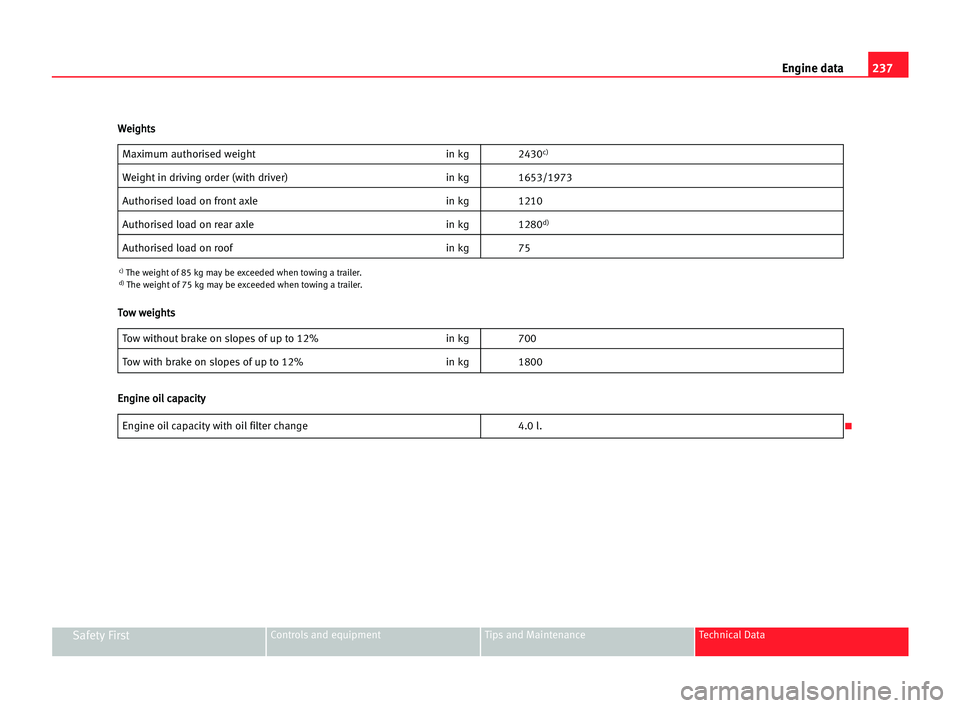
Maximum authorised weight in kg 2430c)
Weight in driving order (with driver) in kg 1653/1973
Authorised load on front axle in kg1210
Authorised load on rear axle in kg1280d)
Authorised load on roof in kg75
W
We
ei
ig
gh
ht
ts
s
Tow without brake on slopes of up to 12% in kg700
Tow with brake on slopes of up to 12% in kg1800
T To
ow
w wwe
ei
ig
gh
ht
ts
s
Engine oil capacity with oil filter change 4.0 l.
E En
ng
gi
in
ne
e ooi
il
l cca
ap
pa
ac
ci
it
ty
y
c)The weight of 85 kg may be exceeded when towing a trailer.d)The weight of 75 kg may be exceeded when towing a trailer.
K
Page 243 of 272
239 Engine data
Safety FirstControls and equipment Tips and Maintenance Technical Data
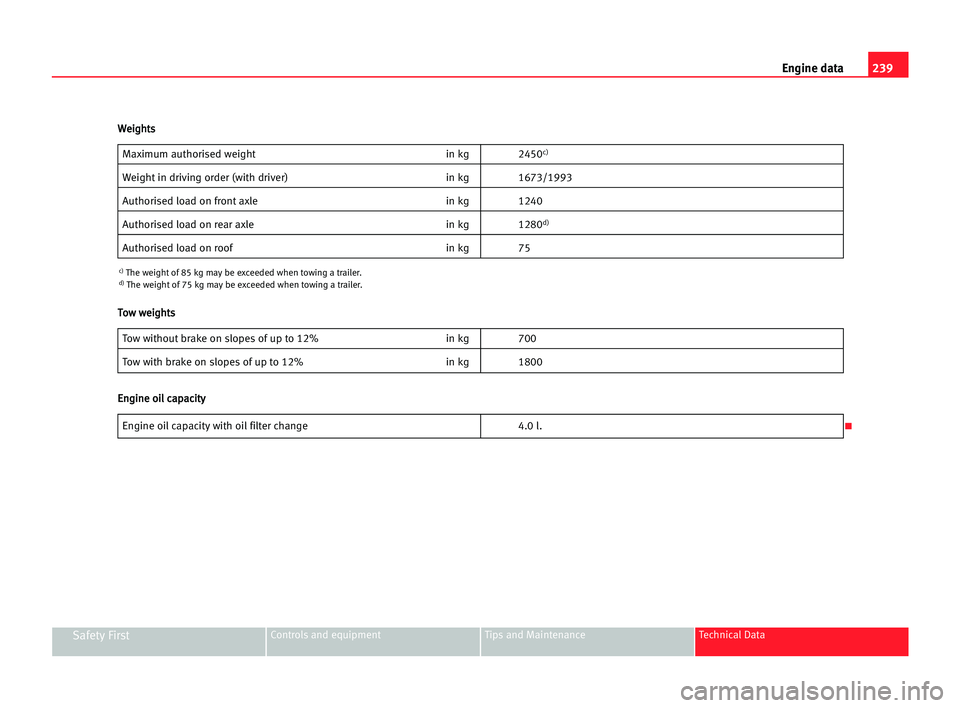
Maximum authorised weight in kg 2450c)
Weight in driving order (with driver) in kg 1673/1993
Authorised load on front axle in kg1240
Authorised load on rear axle in kg1280d)
Authorised load on roof in kg75
W
We
ei
ig
gh
ht
ts
s
Tow without brake on slopes of up to 12% in kg700
Tow with brake on slopes of up to 12% in kg1800
T To
ow
w wwe
ei
ig
gh
ht
ts
s
Engine oil capacity with oil filter change 4.0 l.
E En
ng
gi
in
ne
e ooi
il
l cca
ap
pa
ac
ci
it
ty
y
c)The weight of 85 kg may be exceeded when towing a trailer.d)The weight of 75 kg may be exceeded when towing a trailer.
K
Page 245 of 272
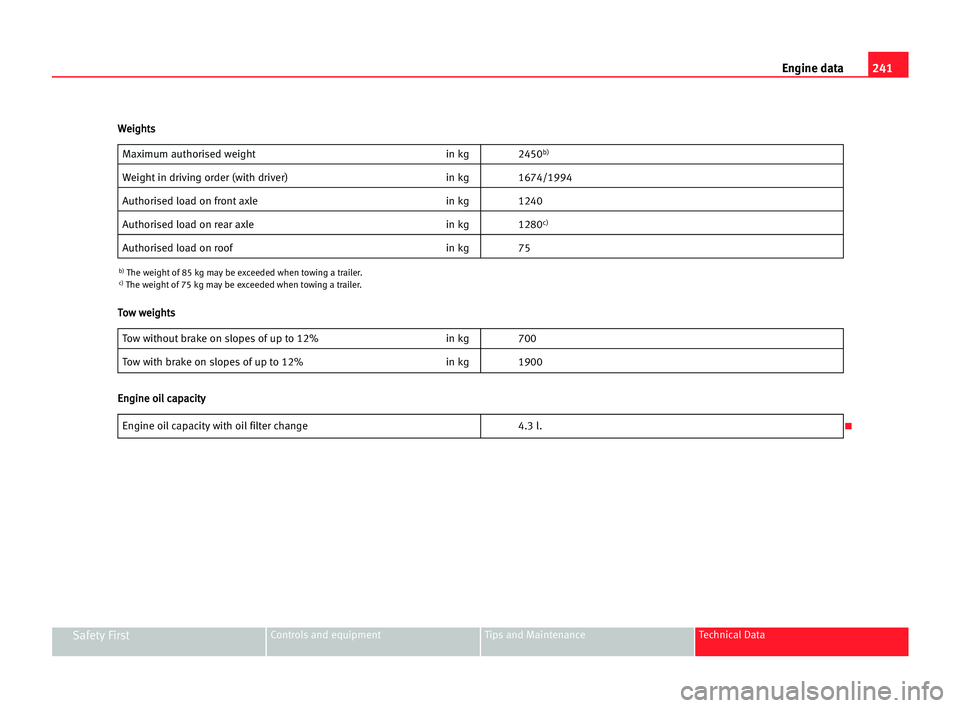
241 Engine data
Safety FirstControls and equipment Tips and Maintenance Technical Data
Maximum authorised weight in kg 2450b)
Weight in driving order (with driver) in kg 1674/1994
Authorised load on front axle in kg1240
Authorised load on rear axle in kg1280c)
Authorised load on roof in kg75
W
We
ei
ig
gh
ht
ts
s
Tow without brake on slopes of up to 12% in kg700
Tow with brake on slopes of up to 12% in kg1900
T To
ow
w wwe
ei
ig
gh
ht
ts
s
Engine oil capacity with oil filter change 4.3 l.
E En
ng
gi
in
ne
e ooi
il
l cca
ap
pa
ac
ci
it
ty
y
b)The weight of 85 kg may be exceeded when towing a trailer.c)The weight of 75 kg may be exceeded when towing a trailer.
K