coolant temperature Seat Alhambra 2006 User Guide
[x] Cancel search | Manufacturer: SEAT, Model Year: 2006, Model line: Alhambra, Model: Seat Alhambra 2006Pages: 299, PDF Size: 6.33 MB
Page 212 of 299
Checking and refilling levels 210
WARNING
All work on the engine or in the engine compartment, e.g. checking and
refilling fluids, involves the danger of injury and scalding as well as the risk
of accident or fire.
•Never open the bonnet if you see steam, smoke or coolant escaping
from the engine compartment. Otherwise, there is a risk of sustaining
burns. Wait until no more steam or coolant is emitted, then allow the
engine to cool before carefully opening the bonnet.
•Switch off the engine and remove the key from the ignition.
•Apply the handbrake and move the gear stick to neutral or selector
lever to position P.
•Keep children away from the vehicle.
•Never touch hot engine parts. There is a risk of burns.
•Never spill liquids on a hot engine or on a hot exhaust gas system. This
is a fire hazard.
•Avoid causing short-circuits in the electrical system, particularly at the
points where the jump leads are attached Ÿpage 250. The battery could
explode.
•Never touch the radiator fan. It is temperature controlled and could
start automatically, even when the engine has been switched off and the
key removed from the ignition!
•Do not unscrew the cap on the expansion tank when the engine is hot.
If the coolant is hot, the cooling system will be pressurised!
•Protect face, hands and arms by covering the cap with a large, thick
cloth to protect against escaping coolant and steam.
•Always make sure you have not left any objects, such as cleaning cloths
and tools, in the engine compartment.
•If you have to work underneath the vehicle, you must use suitable
stands additionally to support the vehicle, there is a risk of accident!. A
hydraulic jack is insufficient for securing the vehicle and there is a risk of
injury.
•If any work has to be performed when the engine is started or with the
engine running, there is an additional, potentially fatal, safety risk from the
rotating parts, such as the drive belts, alternator, radiator fan, etc., and
from the high-voltage ignition system. You should also observe the
following points:
−Never touch the electrical wiring of the ignition system.
−Ensure that jewellery, loose clothing and long hair do not get
trapped in rotating engine parts. Danger of death. Before starting any
work remove jewellery, tie back and cover hair, and wear tight-fitting
clothes.
−Always think carefully about pressing the accelerator if a gear is
engaged in either an automatic or manual gearbox. The vehicle could
move, even if the handbrake is applied. Danger of death.
•If work has to be carried out on the fuel system or on electrical compo-
nents, you must observe the following safety notes in addition to the above
warnings:
−Always disconnect the battery. The vehicle must be unlocked when
this is done, otherwise the alarm will be triggered.
−Do not smoke.
−Never work near naked flames.
−Always have a fire extinguisher on hand.
Caution
When changing or topping up service fluids, make absolutely certain that you
fill the fluids into the correct reservoirs. Failure to observe this point will result
in serious malfunctions and engine damage!
WARNING (continued)
Page 214 of 299
Checking and refilling levels 212
•Never open the bonnet if you see steam, smoke or coolant escaping
from the engine compartment.
•Wait until no more steam, smoke or coolant is emitted from the bonnet,
then carefully open the bonnet.
•Make sure that the support rod is inserted securely and properly in the
holder in the open bonnet.
•When working in the engine compartment, always observe the safety
warnings Ÿpage 209
Closing the bonnet
Closing the bonnet
1. To close the bonnet, pull it down to overcome the gas strut pres-
sure.
2. Make sure that the bonnet catches onto its clasp. Do not press
down Ÿ
If the bonnet does not close properly, open it again and close it properly.
WARNING
If the bonnet is not closed properly, it could open while you are driving and
completely obscure your view of the road. Risk of accident.
•After closing the bonnet, always check that it is properly secured. The
bonnet must be flush with the surrounding body panels.
•If you notice that the bonnet latch is not secured when the vehicle is
moving, stop the vehicle immediately and close the bonnet properly. Risk
of accident.
Engine oil
Engine oil specifications
The engine oil used must conform with exact specifications.
Specifications
The engine comes with a special, high quality, multi grade oil that can be
used in all seasons of the year except for those regions affected by extreme
cold.
As the use of good quality oil is necessary for the correct operation and long
service life of the engine, when it becomes necessary to replenish or change
the oil, always use an oil that complies to the VW standards.
If it is not possible to find oil conforming to the VW standards then oil
conforming to the ACEA or API standards with an appropriate viscosity at
atmospheric temperature should be used instead. The use of this type of oil
may have some repercussions on the performance of the engine for example,
long starting time, increased consumption and a higher emission level.
If a top up is required then different oils may be mixed as long as they all
conform to the VW standards.
The specifications (VW standards) set out in the following page should
appear on the container of the service oil; the container will display together
the different standards for petrol and diesel engines, the oil can be used for
both types of engines.
WARNING (continued)
Page 218 of 299
Checking and refilling levels 216
•Before opening the bonnet, read and observe the warnings
Ÿpage 209, “Safety instructions on working in the engine compartment”
.
•Wait for the engine to cool down. Hot oil may cause burn injuries.
•Wear eye protection to avoid injuries caused by splashes of oil.
•When removing the oil drain plug with your fingers, keep your arm hori-
zontal to help prevent oil from running down your arm.
•Wash your skin thoroughly if it comes into contact with engine oil.
•Engine oil is poisonous! Used oil must be stored in a safe place out of
the reach of children until it is disposed of.
Caution
No additives should be used with engine oil. This could result in engine
damage. Any damage caused by the use of such additives would not be
covered by the factory warranty.
For the sake of the environment
•Because of the disposal problems, the necessary special tools and
specialist knowledge required, we recommend that you have the engine oil
and filter changed by an Authorised Service Centre.
•Never pour oil down drains or into the ground.
•Use a suitable container when draining the used oil. It has to be large
enough to hold all the engine oil
Coolant
Coolant specifications
Coolant is a mixture of water and at least 40% coolant addi-
tive.
The cooling system must be filled with a mixture of water and at least 40 % of
our coolant additive G 12+ or an additive with the specification TT-VW 774 F
(it is dyed purple). This mixture gives the necessary frost protection down to
-25°C and protects the alloy parts of the cooling system against corrosion. It
also prevents scaling and raises the boiling point of the coolant.
The concentration of coolant must always be at least 40% - even if frost
protection is not required.
If greater frost protection is required in very cold climates, the proportion of
the antifreeze additive G 12+ can be increased. However, the percentage of
coolant additives should not exceed 60%, as this would reduce the frost
protection. It would also reduce the cooling effect. A mixture with 60%
coolant additive will give frost protection to approx. -40°C.
WARNING
•The coolant additive is toxic. There is a toxic risk. Always keep the
coolant additive in the original container that should be stored out of the
reach of children. The same applies to coolant that you have drained off.
•The coolant additive G 12+ must be added in sufficient quantities to
provide anti-freeze protection at the coldest ambient temperatures that
can be expected. At extremely cold ambient temperatures, the coolant
could freeze, causing the vehicle to breakdown. As the heater would also
not work in this situation, there is a risk of suffering exposure!
WARNING (continued)
Page 264 of 299
Technical Data 262
Te c h n i c a l D a t a
Checking fluid levels
From time to time, the levels of the different fluids in the
vehicle must be checked. Never fill with incorrect fluids, to do
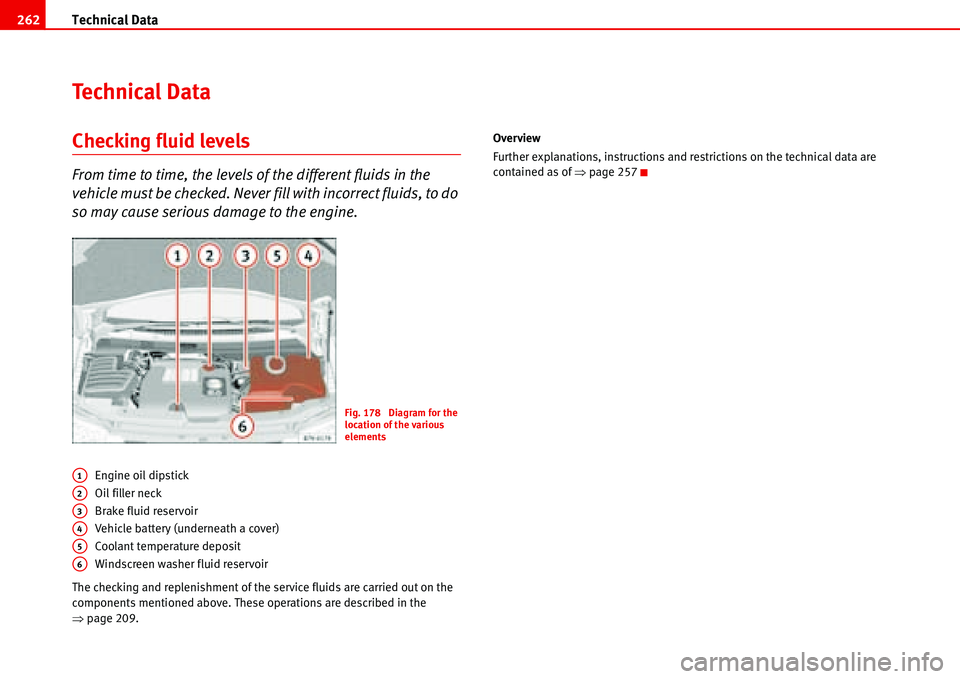
so may cause serious damage to the engine.
Engine oil dipstick
Oil filler neck
Brake fluid reservoir
Vehicle battery (underneath a cover)
Coolant temperature deposit
Windscreen washer fluid reservoir
The checking and replenishment of the service fluids are carried out on the
components mentioned above. These operations are described in the
Ÿpage 209.Overview
Further explanations, instructions and restrictions on the technical data are
contained as of Ÿpage 257
Fig. 178 Diagram for the
location of the various
elements
A1
A2
A3
A4
A5
A6
Page 291 of 299
Index289
Clock . . . . . . . . . . . . . . . . . . . . . . . . . . . . . . . . . . . 62
setting . . . . . . . . . . . . . . . . . . . . . . . . . . . . . . 65
Coat hooks . . . . . . . . . . . . . . . . . . . . . . . . . . . . . 136
Cockpit . . . . . . . . . . . . . . . . . . . . . . . . . . . . . . . . . 61
Code number . . . . . . . . . . . . . . . . . . . . . . . . . . . 232
Coming Home function . . . . . . . . . . . . . . . . . . . 109
Control lamps . . . . . . . . . . . . . . . . . . . . . . . . . . . . 70
Controls
Electric windows . . . . . . . . . . . . . . . . . . . . . 100
Convenience closing
Sliding/tilting roof . . . . . . . . . . . . . . . . . . . . 105
Windows . . . . . . . . . . . . . . . . . . . . . . . . . . . . 102
Convenience opening
Windows . . . . . . . . . . . . . . . . . . . . . . . . . . . . 102
Cool box
cleaning . . . . . . . . . . . . . . . . . . . . . . . . . . . . 201
Coolant . . . . . . . . . . . . . . . . . . . . . . . . . . . 216, 217
Coolant Level . . . . . . . . . . . . . . . . . . . . . . . . . . . 217
Coolant level
warning light . . . . . . . . . . . . . . . . . . . . . . . . . 78
Coolant Loss . . . . . . . . . . . . . . . . . . . . . . . . . . . 217
Coolant temperature
Display . . . . . . . . . . . . . . . . . . . . . . . . . . . . . . 63
Safety instructions . . . . . . . . . . . . . . . . . . . . . 78
Cooling and heating box
Cooling . . . . . . . . . . . . . . . . . . . . . . . . . . . . . 149
Faults . . . . . . . . . . . . . . . . . . . . . . . . . . . . . . 150
Heating . . . . . . . . . . . . . . . . . . . . . . . . . . . . . 149
Notes on usage . . . . . . . . . . . . . . . . . . . . . . 148
Safety notes . . . . . . . . . . . . . . . . . . . . . . . . . 150
Switching off . . . . . . . . . . . . . . . . . . . . . . . . 149Correct adjustment of front head restraints . . . . 12
Cruise control system . . . . . . . . . . . . . . . . . . . . 175
Warning lamp . . . . . . . . . . . . . . . . . . . . . . . . . 73
Cup holders . . . . . . . . . . . . . . . . . . . . . . . . . . . . 136
Curtain airbags . . . . . . . . . . . . . . . . . . . . . . . . . . 41
Description . . . . . . . . . . . . . . . . . . . . . . . . . . . 41
Function . . . . . . . . . . . . . . . . . . . . . . . . . . . . . 42
Safety notes . . . . . . . . . . . . . . . . . . . . . . . . . . 42
D
Daylight driving lights . . . . . . . . . . . . . . . . . . . . 108
Deadlock . . . . . . . . . . . . . . . . . . . . . . . . . . . . . . . 90
Diagram of gears . . . . . . . . . . . . . . . . . . . . . . . . 165
Diesel . . . . . . . . . . . . . . . . . . . . . . . . . . . . . . . . . 207
Diesel engine
Winter driving . . . . . . . . . . . . . . . . . . . . . . . 208
Diesel particle filter . . . . . . . . . . . . . . . . . . . . . . 187
warning lamp . . . . . . . . . . . . . . . . . . . . . . . . . 74
Differential lock fault (EDL)
warning lamp . . . . . . . . . . . . . . . . . . . . . . . . . 75
Dipped headlights . . . . . . . . . . . . . . . . . . . . . . . 108
Disabling airbag
front passenger airbag . . . . . . . . . . . . . . . . . 43
Disabling front and side passenger airbag
Safety notes . . . . . . . . . . . . . . . . . . . . . . . . . . 44
Disabling frontal airbag . . . . . . . . . . . . . . . . . . . 43
Display
Instrument panel . . . . . . . . . . . . . . . . . . . . . . 67
Door lock cylinders . . . . . . . . . . . . . . . . . . . . . . 197Door open display
warning light . . . . . . . . . . . . . . . . . . . . . . . . . 77
Door release lever . . . . . . . . . . . . . . . . . . . . . 61, 91
Drink holders . . . . . . . . . . . . . . . . . . . . . . . . . . . 136
Driving
Driving abroad . . . . . . . . . . . . . . . . . . . . . . . 188
With a trailer . . . . . . . . . . . . . . . . . . . 188, 190
With four-wheel drive . . . . . . . . . . . . . . . . . 184
Driving abroad . . . . . . . . . . . . . . . . . . . . . . . . . . 188
Headlights . . . . . . . . . . . . . . . . . . . . . . . . . . 188
Driving economically . . . . . . . . . . . . . . . . . . . . . 191
Driving safety . . . . . . . . . . . . . . . . . . . . . . . . . . . . . 8
Driving with respect for the environment . . . . 191
Duplicate keys . . . . . . . . . . . . . . . . . . . . . . . . . . . 86
Dust filter . . . . . . . . . . . . . . . . . . . . . . . . . . . . . . 157
Dynamic headlight range control . . . . . . 109, 110
E
EDL . . . . . . . . . . . . . . . . . . . . . . . . . . . . . . . . . . . 182
warning lamp . . . . . . . . . . . . . . . . . . . . . . . . 181
EDS
Warning lamp . . . . . . . . . . . . . . . . . . . . . . . . 75
Electric consumers . . . . . . . . . . . . . . . . . 114, 148
Electric windows
controls . . . . . . . . . . . . . . . . . . . . . . . . . . . . 100
one-touch closing and opening . . . . . . . . . 101
roll-back function . . . . . . . . . . . . . . . . . . . . 102
Electrical accessories . . . . . . . . . . . . . . . . . . . . 141
Electrical windows . . . . . . . . . . . . . . . . . . . . . . . 100
Page 292 of 299
Index 290
Electronic differential lock . . . . . . . . . . . . . . . . 182
Warning lamp . . . . . . . . . . . . . . . . . . . . . . . . 75
warning lamp . . . . . . . . . . . . . . . . . . . . . . . . 181
Electronic immobiliser . . . . . . . . . . . . . . . . 75, 162
Electronic stabilisation program . . . . . . . . . . . 182
Electronic stabilisation programme . . . . . . . . . . 74
Description . . . . . . . . . . . . . . . . . . . . . . . . . 160
warning lamp . . . . . . . . . . . . . . . . . . . . 161, 183
Electronic stabilisation programme (ESP)
warning lamp . . . . . . . . . . . . . . . . . . . . . . . . . 74
Emergency opening
Doors . . . . . . . . . . . . . . . . . . . . . . . . . . . . . . . 95
Engine
Running in . . . . . . . . . . . . . . . . . . . . . . . . . . 185
Engine compartment
Working in the engine compartment . . . . . 209
Engine coolant . . . . . . . . . . . . . . . . . . . . . . . . . 216
Engine fault
monitor indicator . . . . . . . . . . . . . . . . . . . . . . 73
Engine hood
SeeBonnet . . . . . . . . . . . . . . . . . . . . . . . . . 211
Engine management
Warning lamp . . . . . . . . . . . . . . . . . . . . . . . . 73
Engine oil . . . . . . . . . . . . . . . . . . . . . . . . . . . . . . 212
Changing . . . . . . . . . . . . . . . . . . . . . . . . . . . 215
Checking level . . . . . . . . . . . . . . . . . . . . . . . 214
Oil properties . . . . . . . . . . . . . . . . . . . . . . . . 213
Specifications . . . . . . . . . . . . . . . . . . . . . . . 212
Topping up . . . . . . . . . . . . . . . . . . . . . . . . . . 215
Engine oil dipstick . . . . . . . . . . . . . . . . . . . . . . . 214Engine oil pressure
Warning lamp . . . . . . . . . . . . . . . . . . . . . . . . 77
Engine oil temperature display . . . . . . . . . . . . . 65
Engine oil temperature gauge . . . . . . . . . . . . . . 62
ESP . . . . . . . . . . . . . . . . . . . . . . . . . . . . . . . . 74, 182
warning lamp . . . . . . . . . . . . . . . . . . . . . . . . 183
Exhaust gas indicator . . . . . . . . . . . . . . . . . . . . . 74
Exhaust gas purification system
diesel particle filter . . . . . . . . . . . . . . . . . . . 187
Exhaust system fault* . . . . . . . . . . . . . . . . . . . . . 74
Exterior mirrors . . . . . . . . . . . . . . . . . . . . . 119, 196
External aerial . . . . . . . . . . . . . . . . . . . . . . . . . . 203
F
Fastening rings . . . . . . . . . . . . . . . . . . . . . . 15, 143
Fastening seat belt . . . . . . . . . . . . . . . . . . . . . . . 22
Fault messages . . . . . . . . . . . . . . . . . . . . . . . . . . 67
Overview . . . . . . . . . . . . . . . . . . . . . . . . . . . . 67
Faults in operation of air conditioning . . . . . . 157
First-aid kit . . . . . . . . . . . . . . . . . . . . . . . . . . . . . 142
Floor mats . . . . . . . . . . . . . . . . . . . . . . . . . . . . . . 14
Fog lights . . . . . . . . . . . . . . . . . . . . . . . . . . . . . . 108
Foot brake
Warning lamp . . . . . . . . . . . . . . . . . . . . . . . . 73
Four-wheel drive . . . . . . . . . . . . . . . . . . . . . . . . 184
Replacing tyres . . . . . . . . . . . . . . . . . . . . . . 184
Snow chains . . . . . . . . . . . . . . . . . . . . . . . . 184
Winter tyres . . . . . . . . . . . . . . . . . . . . . . . . . 184Front airbags . . . . . . . . . . . . . . . . . . . . . . . . . . . . 36
Description . . . . . . . . . . . . . . . . . . . . . . . . . . 36
Function . . . . . . . . . . . . . . . . . . . . . . . . . . . . . 37
Safety notes . . . . . . . . . . . . . . . . . . . . . . . . . . 38
Front passenger airbags . . . . . . . . . . . . . . . . . . . 43
Front seats
adjusting . . . . . . . . . . . . . . . . . . . . . . . . . . . 124
heating . . . . . . . . . . . . . . . . . . . . . . . . . . . . 125
safety instructions . . . . . . . . . . . . . . . . . . . 131
Fuel
Diesel . . . . . . . . . . . . . . . . . . . . . . . . . . . . . . 207
Petrol . . . . . . . . . . . . . . . . . . . . . . . . . . . . . . 207
Fuel level
Display . . . . . . . . . . . . . . . . . . . . . . . . . . . . . . 64
Fuel reserve . . . . . . . . . . . . . . . . . . . . . . . . . . . . . 76
Fuel tank . . . . . . . . . . . . . . . . . . . . . . . . . . . . . . 206
See alsoFuel reserve . . . . . . . . . . . . . . . . . . 76
Fuel tank cap . . . . . . . . . . . . . . . . . . . . . . . . . . . 206
Fuse box . . . . . . . . . . . . . . . . . . . . . . . . . . . . . . . 242
Fuses . . . . . . . . . . . . . . . . . . . . . . . . . . . . . . . . . 241
G
G 12 . . . . . . . . . . . . . . . . . . . . . . . . . . . . . . . . . . 216
Gear selector lever
SeeAutomatic gearbox . . . . . . . . . . . . . . . . 169
SeeAutomatic gearbox with Tiptronic . . . . 171
General overview of the engine compartment 262
Glove compartment . . . . . . . . . . . . . . . . . . . . . 133
Glove compartment light . . . . . . . . . . . . . . . . . 113
Glow plug system . . . . . . . . . . . . . . . . . . . . . . . 164
Page 295 of 299
Index293
Reverse gear
Automatic gearbox . . . . . . . . . . . . . . . . . . . 169
Manual gearbox . . . . . . . . . . . . . . . . . . . . . . 165
Risk of front passenger seat airbag for a rear facing
child seat . . . . . . . . . . . . . . . . . . . . . . . . . . . 33
RME fuel (biodiesel) . . . . . . . . . . . . . . . . . . . . . 207
Roll-back function
Sliding/tilting roof . . . . . . . . . . . . . . . . . . . . 106
windows . . . . . . . . . . . . . . . . . . . . . . . . . . . . 102
Roof aerial* . . . . . . . . . . . . . . . . . . . . . . . . . . . . 203
Roof carrier . . . . . . . . . . . . . . . . . . . . . . . . 147, 148
saving fuel . . . . . . . . . . . . . . . . . . . . . . . . . . 148
Roof load . . . . . . . . . . . . . . . . . . . . . . . . . . . . . . 148
Rubber seals . . . . . . . . . . . . . . . . . . . . . . . . . . . 197
Running in
Brake pads . . . . . . . . . . . . . . . . . . . . . . . . . . 185
Engine . . . . . . . . . . . . . . . . . . . . . . . . . . . . . 185
Tyres . . . . . . . . . . . . . . . . . . . . . . . . . . . . . . . 185
Running in tyres . . . . . . . . . . . . . . . . . . . . . . . . . 185
S
Safe driving . . . . . . . . . . . . . . . . . . . . . . . . . . . . . . 7
Safety . . . . . . . . . . . . . . . . . . . . . . . . . . . . . . . . . . . 8
Safety equipment . . . . . . . . . . . . . . . . . . . . . . . . . 7
Safety instructions
Coolant temperature . . . . . . . . . . . . . . . . . . . 78
Safety notes
Belt tension devices . . . . . . . . . . . . . . . . . . . 30
Curtain airbags . . . . . . . . . . . . . . . . . . . . . . . 42
Disabling front and side passenger airbag . 44Front airbags . . . . . . . . . . . . . . . . . . . . . . . . . 38
Side airbags . . . . . . . . . . . . . . . . . . . . . . . . . . 40
Using child seats . . . . . . . . . . . . . . . . . . . . . . 45
Using seat belts . . . . . . . . . . . . . . . . . . . . . . . 21
Saving fuel
roof carrier . . . . . . . . . . . . . . . . . . . . . . . . . . 148
Sealant . . . . . . . . . . . . . . . . . . . . . . . . . . . . . . . . 234
Seals . . . . . . . . . . . . . . . . . . . . . . . . . . . . . . . . . . 197
Seat adjustment . . . . . . . . . . . . . . . . . . . . . . . . 121
Front seats . . . . . . . . . . . . . . . . . . . . . . . . . . 124
Seat belt position
Pregnant women . . . . . . . . . . . . . . . . . . . . . . 25
Seat belts . . . . . . . . . . . . . . . . . . . . . . . . . . . . 24
Seat belt warning lamp . . . . . . . . . . . . . . . . . . . . 17
Seat belts . . . . . . . . . . . . . . . . . . . . . . . . . . . . . . . 17
Detachable . . . . . . . . . . . . . . . . . . . . . . . . . . . 28
Incorrectly fastened . . . . . . . . . . . . . . . . . . . . 30
Not worn . . . . . . . . . . . . . . . . . . . . . . . . . . . . . 20
one buckle . . . . . . . . . . . . . . . . . . . . . . . . . . . 22
Safety notes . . . . . . . . . . . . . . . . . . . . . . . . . . 21
Warning lamp . . . . . . . . . . . . . . . . . . . . . . . . . 17
With two buckles . . . . . . . . . . . . . . . . . . . . . . 23
Seat belts protect . . . . . . . . . . . . . . . . . . . . . . . . 21
Seat heating . . . . . . . . . . . . . . . . . . . . . . . . . . . . 125
Seat layout . . . . . . . . . . . . . . . . . . . . . . . . . . . . . 126
Seats . . . . . . . . . . . . . . . . . . . . . . . . . . . . . . . . . . . 17
Folding backrest forwards . . . . . . . . . . . . . . 128
Lifting seat . . . . . . . . . . . . . . . . . . . . . . . . . . 128
Removing and fitting . . . . . . . . . . . . . . . . . . 129
Securing load . . . . . . . . . . . . . . . . . . . . . . . . . . . 148
Selector lever lock . . . . . . . . . . . . . . . . . . . . . . . 167Service interval display . . . . . . . . . . . . . . . . . . . . 66
Shoes . . . . . . . . . . . . . . . . . . . . . . . . . . . . . . . . . . 14
Side airbags . . . . . . . . . . . . . . . . . . . . . . . . . . . . . 39
Description . . . . . . . . . . . . . . . . . . . . . . . . . . . 39
Function . . . . . . . . . . . . . . . . . . . . . . . . . . . . . 40
Safety notes . . . . . . . . . . . . . . . . . . . . . . . . . . 40
Side lights . . . . . . . . . . . . . . . . . . . . . . . . . . . . . 108
Sitting position
Driver . . . . . . . . . . . . . . . . . . . . . . . . . . . . . . . . 9
Front passenger . . . . . . . . . . . . . . . . . . . . . . . 10
Incorrect sitting position . . . . . . . . . . . . . . . . 13
Passengers . . . . . . . . . . . . . . . . . . . . . . . . . . 11
Sitting position, occupants . . . . . . . . . . . . . . . . . . 9
Sliding/tilting sun roof . . . . . . . . . . . . . . . . . . . 104
Snow chains . . . . . . . . . . . . . . . . . . . . . . . 230, 261
Four-wheel drive . . . . . . . . . . . . . . . . . . . . . 184
Sockets . . . . . . . . . . . . . . . . . . . . . . . . . . . . . . . . 141
Spare wheel
Storage . . . . . . . . . . . . . . . . . . . . . . . . . . . . . 231
storage . . . . . . . . . . . . . . . . . . . . . . . . . . . . . 231
Speedometer . . . . . . . . . . . . . . . . . . . . . . . . . . . . 62
Starting
a petrol engine . . . . . . . . . . . . . . . . . . . . . . . 163
Starting the engine
after the fuel tank has been run dry . . . . . . 164
With the ignition key . . . . . . . . . . . . . . . . . . 163
Steam cleaners . . . . . . . . . . . . . . . . . . . . . . . . . 195
Steering . . . . . . . . . . . . . . . . . . . . . . . . . . . . . . . 159
Steering lock . . . . . . . . . . . . . . . . . . . . . . . . 161