battery Seat Alhambra 2006 Owner's Guide
[x] Cancel search | Manufacturer: SEAT, Model Year: 2006, Model line: Alhambra, Model: Seat Alhambra 2006Pages: 299, PDF Size: 6.33 MB
Page 225 of 299
Checking and refilling levels223
Safety FirstOperating instructionsTips and MaintenanceTe c h n i c a l D a t a
Battery
Warnings on handling the battery
WARNING
Always be aware of the danger of injury and chemical burns as well as the
risk of accident or fire when working on the battery and the electrical
system:
•Wear eye protection. Protect your eyes, skin and clothing from acid and
particles containing lead.
•Battery acid is very corrosive and caustic. Wear protective gloves and
eye protection. Do not tilt the batteries. This could spill acid through the
vents. Rinse battery acid from eyes immediately for several minutes with
clear water. Then seek medical care immediately. Neutralize any acid
splashes on the skin or clothing with a soapy solution, and rinse off with
plenty of water. If acid is swallowed by mistake, consult a doctor immedi-
ately.
•Fires, sparks, naked lights and smoking are prohibited. When handling
cables and electrical equipment, avoid causing sparks and electrostatic charge. Never short the battery terminals. High-energy sparks can cause
injury.
•A highly explosive mixture of gases is released when the battery is
under charge. The batteries should be charged in a well-ventilated room
only.
•Keep children away from acid and batteries.
•Before working on the electrical system, you must switch off the
engine, the ignition and all consumers. The negative cable on the battery
must be disconnected. When a light bulb is changed, you need only switch
off the light.
•Deactivate the anti-theft alarm by unlocking the vehicle before you
disconnect the battery! The alarm will otherwise be triggered.
•When disconnecting the battery from the vehicle electrical system,
disconnect first the negative cable and then the positive cable.
•Switch off all electrical consumers before reconnecting the battery.
Reconnect first the positive cable and then the negative cable. Never
reverse the polarity of the connections. This could cause an electrical fire.
•Never charge a frozen battery, or one which has thawed. This could
result in explosions and chemical burns. Always replace a battery which
has frozen. A flat battery can freeze at temperatures around 0
°C.
•Ensure that the vent hose is always connected to the battery.
•Never use a defective battery. This may be fatally explosive. Replace a
damaged battery immediately.
Caution
•Never disconnect the battery if the ignition is switched on or if the engine
is running. This could damage the electrical system or electronic compo-
nents.
•Do not expose the battery to direct sunlight over a long period of time, as
the intense ultraviolet radiation can damage the battery housing.
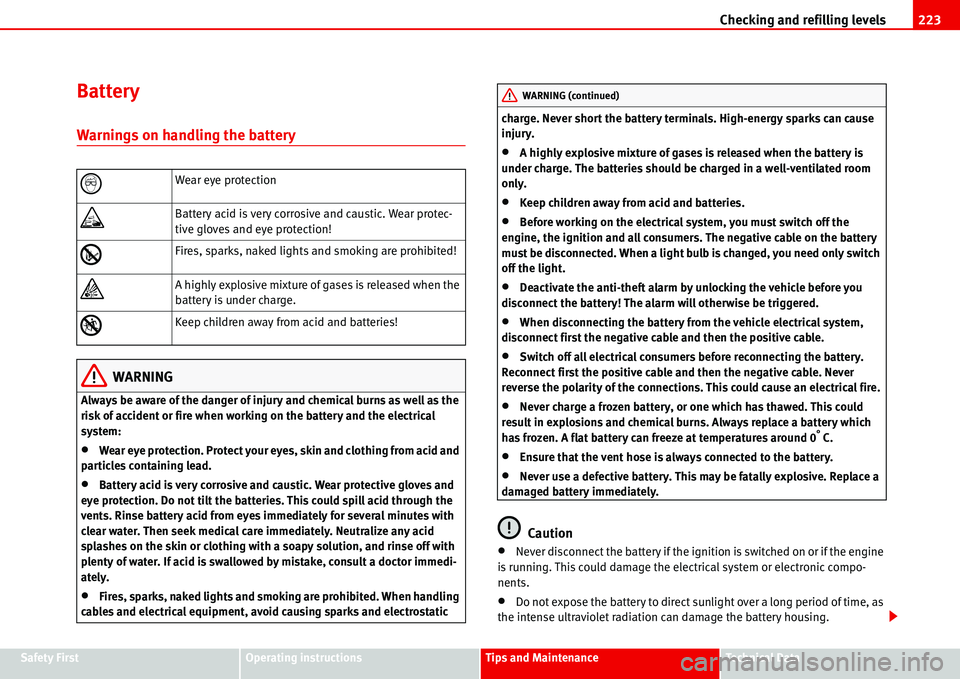
Wear eye protection
Battery acid is very corrosive and caustic. Wear protec-
tive gloves and eye protection!
ŽFires, sparks, naked lights and smoking are prohibited!
ŸA highly explosive mixture of gases is released when the
battery is under charge.
Keep children away from acid and batteries!
WARNING (continued)
Page 226 of 299
Checking and refilling levels 224
•If the vehicle is left standing in cold conditions for a long period, protect
the battery from frost. If it “freezes” it will be damaged.
Checking the electrolyte level
The electrolyte level should be checked regularly in high-
mileage vehicles, in hot countries and in older batteries.
– Open the bonnet and open the battery cover at the front Ÿ in
“Safety instructions on working in the engine compartment” on
page 209 Ÿ in “Warnings on handling the battery” on
page 223.
– Check the colour display in the "magic eye" on the top of the
battery.
– If there are air bubbles in the window, tap the window gently until
they disperse.
The position of the battery is shown in the corresponding engine compart-
ment diagram Ÿpage 262.
The round window (“magic eye”) on the top of the battery changes colour,
depending on the charge level and electrolyte level of the battery.
If the colour in the window is colourless or bright yellow, the electrolyte level
of the battery is too low. Have the battery checked by a qualified workshop.
The colours green and black are used by the workshops for diagnostic
purposes.
Charging and changing the vehicle battery
The battery is maintenance-free and is checked during the
inspection service. All work on the vehicle battery requires
specialist knowledge.
If you often drive short distances or if the vehicle is not driven for long
periods, the battery should be checked by a qualified workshop between the
scheduled services.
If the battery has discharged and you have problems starting the vehicle, the
battery might be damaged. If this happens, we recommend you have the
vehicle battery checked by an Authorised Service Centre where it will be re-
charged or replaced.
Charging the battery
The vehicle battery should be charged by a qualified workshop only, as
batteries using special technology have been installed and they must be
charged in a controlled environment.
Replacing a vehicle battery
The battery has been developed to suit the conditions of its location and has
special safety features.
Genuine SEAT batteries fulfil the maintenance, performance and safety spec-
ifications of your vehicle.
WARNING
•We recommend you use only maintenance-free or cycle free leak-proof
batteries which comply with the standards T 825 06 and VW 7 50 73. This
standard applies as of 2001.
•Before starting any work on the batteries, you must read and observe
the warnings Ÿ in “Warnings on handling the battery” on page 223.
Page 251 of 299
If and when249
Safety FirstOperating instructionsTips and MaintenanceTe c h n i c a l D a t a
Reading light
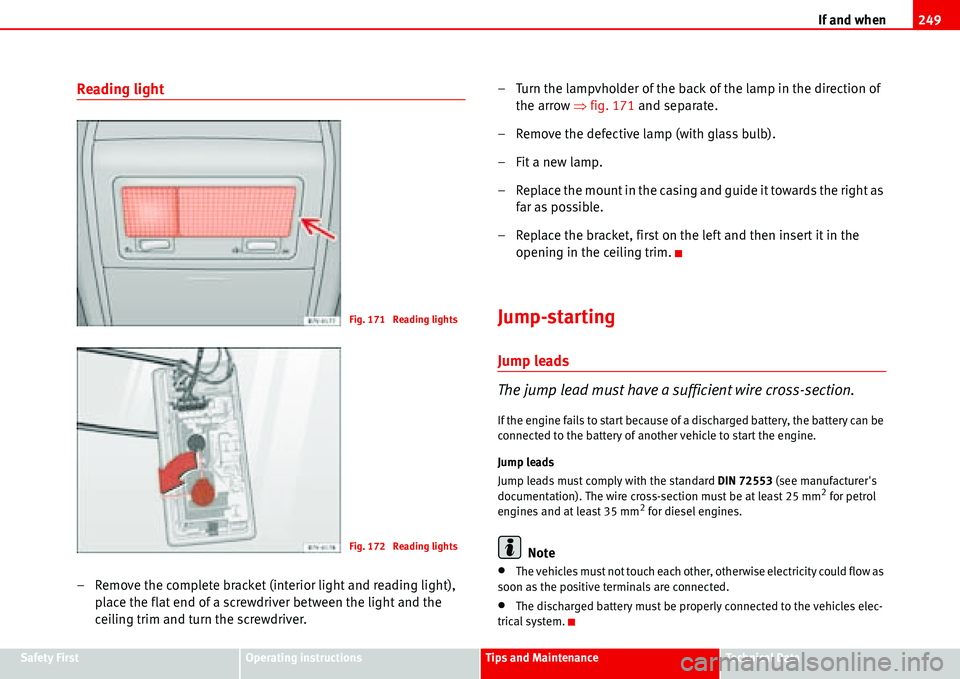
– Remove the complete bracket (interior light and reading light),
place the flat end of a screwdriver between the light and the
ceiling trim and turn the screwdriver.– Turn the lampvholder of the back of the lamp in the direction of
the arrow Ÿfig. 171 and separate.
– Remove the defective lamp (with glass bulb).
– Fit a new lamp.
– Replace the mount in the casing and guide it towards the right as
far as possible.
– Replace the bracket, first on the left and then insert it in the
opening in the ceiling trim.
Jump-starting
Jump leads
The jump lead must have a sufficient wire cross-section.
If the engine fails to start because of a discharged battery, the battery can be
connected to the battery of another vehicle to start the engine.
Jump leads
Jump leads must comply with the standard DIN 72553 (see manufacturer's
documentation). The wire cross-section must be at least 25 mm
2 for petrol
engines and at least 35 mm2 for diesel engines.
Note
•The vehicles must not touch each other, otherwise electricity could flow as
soon as the positive terminals are connected.
•The discharged battery must be properly connected to the vehicles elec-
trical system.
Fig. 171 Reading lights
Fig. 172 Reading lights
Page 252 of 299
If and when 250
How to jump start
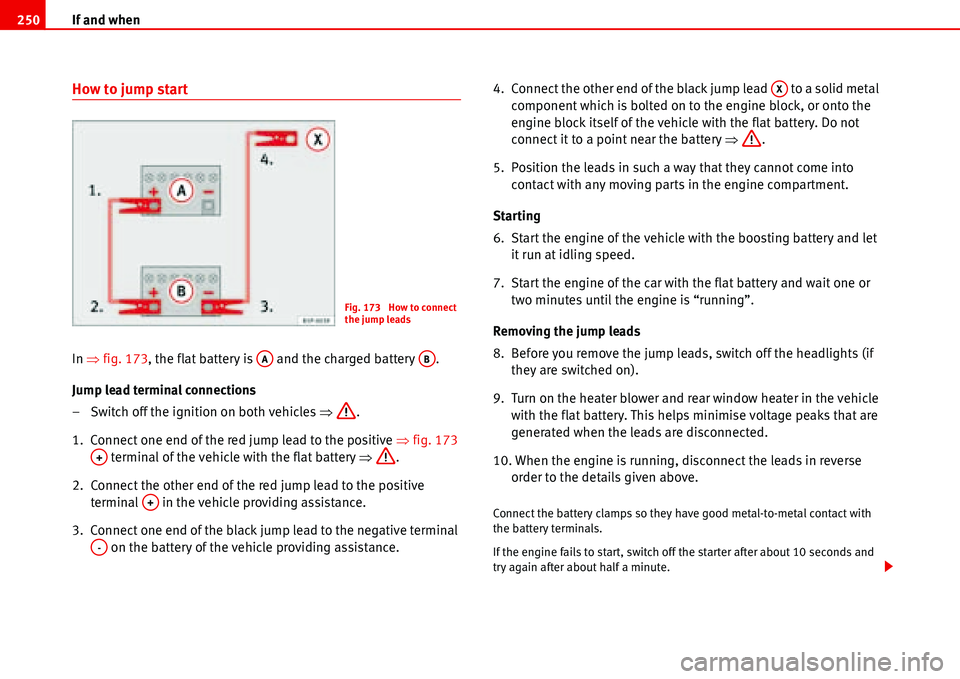
In Ÿfig. 173, the flat battery is and the charged battery .
Jump lead terminal connections
– Switch off the ignition on both vehicles Ÿ.
1. Connect one end of the red jump lead to the positive Ÿfig. 173
terminal of the vehicle with the flat battery Ÿ.
2. Connect the other end of the red jump lead to the positive
terminal in the vehicle providing assistance.
3. Connect one end of the black jump lead to the negative terminal
on the battery of the vehicle providing assistance.4. Connect the other end of the black jump lead to a solid metal
component which is bolted on to the engine block, or onto the
engine block itself of the vehicle with the flat battery. Do not
connect it to a point near the battery Ÿ.
5. Position the leads in such a way that they cannot come into
contact with any moving parts in the engine compartment.
Starting
6. Start the engine of the vehicle with the boosting battery and let
it run at idling speed.
7. Start the engine of the car with the flat battery and wait one or
two minutes until the engine is “running”.
Removing the jump leads
8. Before you remove the jump leads, switch off the headlights (if
they are switched on).
9. Turn on the heater blower and rear window heater in the vehicle
with the flat battery. This helps minimise voltage peaks that are
generated when the leads are disconnected.
10. When the engine is running, disconnect the leads in reverse
order to the details given above.
Connect the battery clamps so they have good metal-to-metal contact with
the battery terminals.
If the engine fails to start, switch off the starter after about 10 seconds and
try again after about half a minute.
Fig. 173 How to connect
the jump leads
AAAB
A+
A+
A-
AX
Page 253 of 299
If and when251
Safety FirstOperating instructionsTips and MaintenanceTe c h n i c a l D a t a
WARNING
•Please note the safety warnings referring to working in the engine
compartment Ÿpage 209, “Working in the engine compartment”.
•The battery providing assistance must have the same voltage as the flat
battery (12V) and approximately the same capacity (see imprint on
battery). Failure to comply could result in an explosion.
•Never use jump leads when one of the batteries is frozen. Danger of
explosion! Even after the battery has thawed, battery acid could leak and
cause chemical burns. If a battery freezes, it should be replaced.
•Keep sparks, flames and lighted cigarettes away from batteries, danger
of explosion. Failure to comply could result in an explosion.
•Observe the instructions provided by the manufacturer of the jump
leads.
•Do not connect the negative cable from the other vehicle directly to the
negative terminal of the flat battery. The gas emitted from the battery could
be ignited by sparks. Danger of explosion.
•Do not attach the negative cable from the other vehicle to parts of the
fuel system or to the brake line.
•The non-insulated parts of the battery clamps must not be allowed to
touch. The jump lead attached to the positive battery terminal must not
touch metal parts of the vehicle, this can cause a short circuit.
•Position the leads in such a way that they cannot come into contact
with any moving parts in the engine compartment.
•Do not bend over the batteries. This could result in chemical burns.
Note
The vehicles must not touch each other, otherwise electricity could flow as
soon as the positive terminals are connected.
Towing and tow-starting
Tow-starting*
The use of jump leads is preferable to tow-starting.
We recommend that you do not tow-start your vehicle. Jump-starting
is preferable Ÿpage 249.
However, if your vehicle has to be tow-started:
– Engage the 2
nd or the 3rd gear.
– Keep the clutch pressed down.
– Switch on the ignition.
– Once both vehicles are moving, release the clutch.
– As soon as the engine starts, press the clutch and move the gear
lever into neutral. This helps to prevent driving into the towing
vehicle.
WARNING
The risk of accidents is high when tow-starting. The vehicle being towed
can easily collide with the towing vehicle.
Caution
When tow-starting, fuel could enter the catalytic converter and damage it.
Page 264 of 299
Technical Data 262
Te c h n i c a l D a t a
Checking fluid levels
From time to time, the levels of the different fluids in the
vehicle must be checked. Never fill with incorrect fluids, to do
so may cause serious damage to the engine.
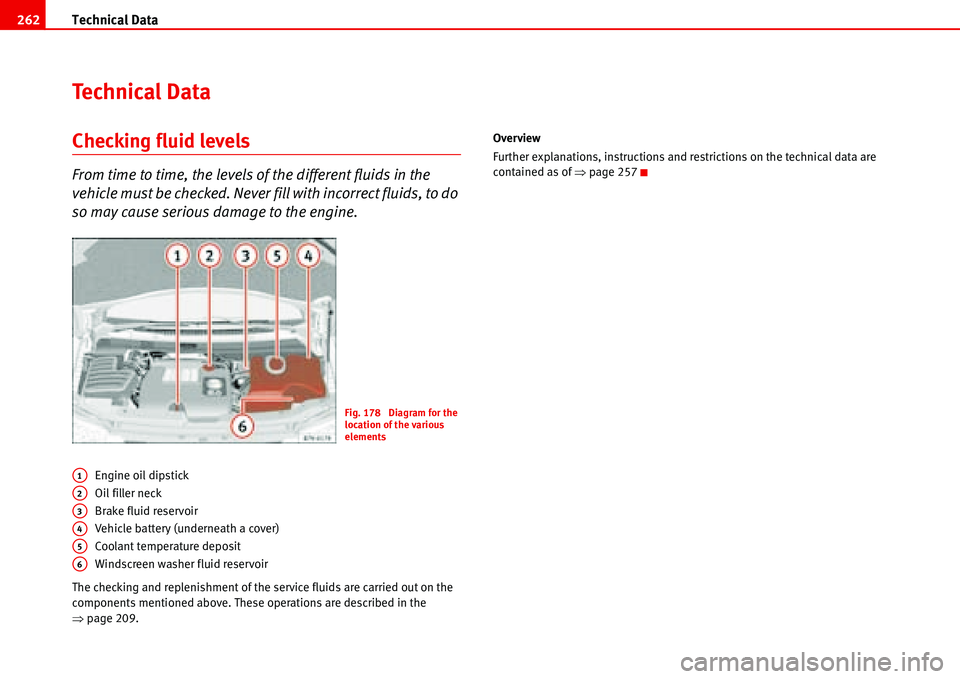
Engine oil dipstick
Oil filler neck
Brake fluid reservoir
Vehicle battery (underneath a cover)
Coolant temperature deposit
Windscreen washer fluid reservoir
The checking and replenishment of the service fluids are carried out on the
components mentioned above. These operations are described in the
Ÿpage 209.Overview
Further explanations, instructions and restrictions on the technical data are
contained as of Ÿpage 257
Fig. 178 Diagram for the
location of the various
elements
A1
A2
A3
A4
A5
A6
Page 289 of 299
Index287
Index
4MOTION . . . . . . . . . . . . . . . . . . . . . . . . . . . . . . 184
A
ABS . . . . . . . . . . . . . . . . . . . . . . . . . . . . . . . . . . . 180
Warning lamp . . . . . . . . . . . . . . . . . . . . . . . . . 75
warning lamp . . . . . . . . . . . . . . . . . . . . . . . . 181
Accessories . . . . . . . . . . . . . . . . . . . . . . . . . . . . 202
Acoustic signal . . . . . . . . . . . . . . . . . . . . . . . . . . 18
Acoustic warning . . . . . . . . . . . . . . . . . . . . . . . . 161
Additional instruction manual
Roof carrier . . . . . . . . . . . . . . . . . . . . . . . . . . 147
Adjust seats
rear seats . . . . . . . . . . . . . . . . . . . . . . . . . . . 127
Adjusting lumbar support . . . . . . . . . . . . . . . . . 124
Air conditioning manual
faults in operation . . . . . . . . . . . . . . . . . . . . 157
Air conditioning system
Climatronic . . . . . . . . . . . . . . . . . . . . . . . . . . 151
General notes . . . . . . . . . . . . . . . . . . . . . . . . 157
Air recirculation mode
Climatronic . . . . . . . . . . . . . . . . . . . . . . . . . . 154
Airbag cover . . . . . . . . . . . . . . . . . . . . . . . . . . . . . 38
Airbag covers . . . . . . . . . . . . . . . . . . . . . . . . . . . . 38Airbag system . . . . . . . . . . . . . . . . . . . . . . . . . . . 32
Curtain airbags . . . . . . . . . . . . . . . . . . . . . . . 41
Front airbags . . . . . . . . . . . . . . . . . . . . . . . . . 36
Side airbags . . . . . . . . . . . . . . . . . . . . . . . . . . 39
Warning lamp . . . . . . . . . . . . . . . . . . . . . . . . . 33
Airbags
Care . . . . . . . . . . . . . . . . . . . . . . . . . . . . . . . . 34
Disposal . . . . . . . . . . . . . . . . . . . . . . . . . . . . . 34
Safety notes . . . . . . . . . . . . . . . . . . . . . . . . . . 34
Alarm system . . . . . . . . . . . . . . . . . . . . . . . . . . . . 95
Switching off . . . . . . . . . . . . . . . . . . . . . . . . . 95
Alterations to the vehicle . . . . . . . . . . . . . . . . . 202
Alternator
Warning lamp . . . . . . . . . . . . . . . . . . . . . . . . . 76
Anti-freeze . . . . . . . . . . . . . . . . . . . . . . . . . . . . . 216
Anti-lock brake system
Warning lamp . . . . . . . . . . . . . . . . . . . . . . . . . 75
Anti-locking brake system . . . . . . . . . . . . . . . . 180
warning lamp . . . . . . . . . . . . . . . . . . . . . . . . 181
Anti-puncture kit . . . . . . . . . . . . . . . . . . . . . . . . 234
Sealing and inflating tyres . . . . . . . . . . . . . 235
Anti-theft alarm system . . . . . . . . . . . . . . . . . . . . 95
Switching off . . . . . . . . . . . . . . . . . . . . . . . . . 95
Anti-theft wheel bolts . . . . . . . . . . . . . . . . . . . . 238
Aquaplaning . . . . . . . . . . . . . . . . . . . . . . . . . . . 227
Armrest . . . . . . . . . . . . . . . . . . . . . . . . . . . . . . . . 130Ashtrays
Front . . . . . . . . . . . . . . . . . . . . . . . . . . . . . . . 139
rear . . . . . . . . . . . . . . . . . . . . . . . . . . . . . . . . 140
Automatic belt retractor . . . . . . . . . . . . . . . . . . . 22
Automatic car washes . . . . . . . . . . . . . . . . . . . . 194
Automatic gearbox . . . . . . . . . . . . . . . . . . . . . . 166
Safety interlock for ignition key . . . . . . . . . 162
Automatic gearbox with Tiptronic . . . . . . . . . . 171
Automatic mode
Climatronic . . . . . . . . . . . . . . . . . . . . . . . . . . 152
Automatic wipe
Windscreen wiper and washer . . . . . . . . . . 116
automatic wipe
Rear window wiper and wash . . . . . . . . . . . 117
B
Ball coupling . . . . . . . . . . . . . . . . . . . . . . . . . . . 189
BAS . . . . . . . . . . . . . . . . . . . . . . . . . . . . . . . . . . . 180
Battery
Changing . . . . . . . . . . . . . . . . . . . . . . . . . . . 224
Charging . . . . . . . . . . . . . . . . . . . . . . . . . . . . 224
Winter conditions . . . . . . . . . . . . . . . . . . . . 223
Belt height adjustment . . . . . . . . . . . . . . . . . 26, 29
Belt retainer . . . . . . . . . . . . . . . . . . . . . . . . . . . . . 29
Belt tension device
Disposal . . . . . . . . . . . . . . . . . . . . . . . . . . . . . 30
Warning lamp . . . . . . . . . . . . . . . . . . . . . . . . 33
Page 290 of 299
Index 288
Belt tension devices . . . . . . . . . . . . . . . . . . . . . . 30
Biodiesel . . . . . . . . . . . . . . . . . . . . . . . . . . . . . . 207
Bonnet . . . . . . . . . . . . . . . . . . . . . . . . . . . . . . . . 211
Brake assist system . . . . . . . . . . . . . . . . . . . . . 180
Brake fluid . . . . . . . . . . . . . . . . . . . . . . . . . . . . . 221
Changing . . . . . . . . . . . . . . . . . . . . . . . . . . . 222
Brake pad wear
Warning lamp . . . . . . . . . . . . . . . . . . . . . . . 179
Brake pad wear indicator*
Indicator . . . . . . . . . . . . . . . . . . . . . . . . . . . . . 77
Brake pads . . . . . . . . . . . . . . . . . . . . . . . . . . . . . 185
Brake servo . . . . . . . . . . . . . . . . . . . . . . . . 179, 185
Brake system . . . . . . . . . . . . . . . . . . . . . . . . . . . 221
brake servo . . . . . . . . . . . . . . . . . . . . . . . . . 179
Warning lamp . . . . . . . . . . . . . . . . . . . . . . . . 76
warning lamp . . . . . . . . . . . . . . . . . . . . . . . . 179
Brakes . . . . . . . . . . . . . . . . . . . . . . . . . . . . 179, 185
Braking distance . . . . . . . . . . . . . . . . . . . . . . . . 185
Bulb change . . . . . . . . . . . . . . . . . . . . . . . . . . . 245
Bulb defect
warning lamp . . . . . . . . . . . . . . . . . . . . . . . . . 76
Buzzer . . . . . . . . . . . . . . . . . . . . . . . . . . . . . . . . 161
C
Car care
Exterior . . . . . . . . . . . . . . . . . . . . . . . . . . . . . 194
Car care products . . . . . . . . . . . . . . . . . . . . . . . 193
Car phone . . . . . . . . . . . . . . . . . . . . . . . . . . . . . 203
Car washes . . . . . . . . . . . . . . . . . . . . . . . . . . . . 194Catalytic converter . . . . . . . . . . . . . . . . . . . . . . 186
CCS . . . . . . . . . . . . . . . . . . . . . . . . . . . . . . . . . . . 175
CD changer
Location . . . . . . . . . . . . . . . . . . . . . . . . . . . . 136
Central locking . . . . . . . . . . . . . . . . . . . . . . . . . . 87
individual opening of doors . . . . . . . . . . . . . 88
Central locking button . . . . . . . . . . . . . . . . . . . . 90
Central stowage on instrument panel . . . . . . . 133
Cetane number . . . . . . . . . . . . . . . . . . . . . . . . . 207
Changing a bulb . . . . . . . . . . . . . . . . . . . . . . . . 245
Changing a wheel . . . . . . . . . . . . . . . . . . . 236, 240
Changing brake pads . . . . . . . . . . . . . . . . . . . . 185
Changing bulbs
lights on tailgate/rear door . . . . . . . . . . . . 247
Lights on vehicle body . . . . . . . . . . . . . . . . 246
Reading light . . . . . . . . . . . . . . . . . . . . . . . . 249
Registration plate light . . . . . . . . . . . . . . . . 247
Changing gear
SeeManual gearbox . . . . . . . . . . . . . . . . . . 165
Changing the bulbs
interior light . . . . . . . . . . . . . . . . . . . . . . . . . 248
rear lights . . . . . . . . . . . . . . . . . . . . . . . . . . 246
Changing the lamps
Side indicator lights . . . . . . . . . . . . . . . . . . 245
Chassis number . . . . . . . . . . . . . . . . . . . . . . . . 258
Checking . . . . . . . . . . . . . . . . . . . . . . . . . . . . . . 224
Checking battery electrolyte level . . . . . . . . . . 224
Checking engine oil level . . . . . . . . . . . . . . . . . 214
Child safety . . . . . . . . . . . . . . . . . . . . . . . . . . . . . 45Child seat . . . . . . . . . . . . . . . . . . . . . . . . . . . . . . . 47
Categorisation in groups . . . . . . . . . . . . . . . 47
Group 1 . . . . . . . . . . . . . . . . . . . . . . . . . . . . . 48
Group 2 . . . . . . . . . . . . . . . . . . . . . . . . . . . . . 48
Group 3 . . . . . . . . . . . . . . . . . . . . . . . . . . . . . 48
Groups 0 and 0+ . . . . . . . . . . . . . . . . . . . . . . 47
in front passenger seat . . . . . . . . . . . . . . . . . 33
Safety notes . . . . . . . . . . . . . . . . . . . . . . . . . . 45
securing . . . . . . . . . . . . . . . . . . . . . . . . . . . . . 49
Childproof locks . . . . . . . . . . . . . . . . . . . . . . . . . 92
Cigarette lighter . . . . . . . . . . . . . . . . . . . . . . . . 140
Cleaning alloy wheels . . . . . . . . . . . . . . . . . . . . 198
Cleaning and caring for your vehicle . . . . . . . . 193
Cleaning chrome . . . . . . . . . . . . . . . . . . . . . . . . 197
Cleaning cloth seat covers . . . . . . . . . . . . . . . . 200
Cleaning dash panel . . . . . . . . . . . . . . . . . . . . . 199
Cleaning engine compartment . . . . . . . . . . . . . 199
Cleaning fabric trim . . . . . . . . . . . . . . . . . . . . . 200
Cleaning leather . . . . . . . . . . . . . . . . . . . . . . . . 200
Cleaning plastic parts . . . . . . . . . . . . . . . . . . . . 199
Cleaning seat belts . . . . . . . . . . . . . . . . . . . . . . 201
Cleaning steel wheels . . . . . . . . . . . . . . . . . . . . 197
Cleaning windows . . . . . . . . . . . . . . . . . . . . . . . 196
Cleaning wooden trim . . . . . . . . . . . . . . . . . . . . 200
Climatronic . . . . . . . . . . . . . . . . . . . . . . . . . . . . 151
Air outlet . . . . . . . . . . . . . . . . . . . . . . . . . . . 156
Controls . . . . . . . . . . . . . . . . . . . . . . . . . . . . 151
faults . . . . . . . . . . . . . . . . . . . . . . . . . . . . . . 157
General notes . . . . . . . . . . . . . . . . . . . . . . . 157
Second cooling system . . . . . . . . . . . . . . . 155
Page 294 of 299
Index 292
Mobile phone . . . . . . . . . . . . . . . . . . . . . . . . . . 203
Modifications . . . . . . . . . . . . . . . . . . . . . . . . . . 202
Multifunction steering wheel . . . . . . . . . . . . . . . 84
N
Navigation system* . . . . . . . . . . . . . . . . . . . . . . . 83
Net bag . . . . . . . . . . . . . . . . . . . . . . . . . . . . . . . 146
Number of seats . . . . . . . . . . . . . . . . . . . . . . . . . 17
O
Observations . . . . . . . . . . . . . . . . . . . . . . . . . . . 188
Octane number . . . . . . . . . . . . . . . . . . . . . . . . . 207
Oil . . . . . . . . . . . . . . . . . . . . . . . . . . . . . . . . . . . . 212
Oil change . . . . . . . . . . . . . . . . . . . . . . . . . . . . . 215
Oil properties . . . . . . . . . . . . . . . . . . . . . . . . . . . 213
On board computer with multifunction display*
Check working . . . . . . . . . . . . . . . . . . . . . . . . 79
Message on display . . . . . . . . . . . . . . . . . . . 79
One-touch closing and opening
electric windows . . . . . . . . . . . . . . . . . . . . . 101
Overview
Control lamps . . . . . . . . . . . . . . . . . . . . . . . . 70
Instrument panel . . . . . . . . . . . . . . . . . . . . . . 61
Instruments . . . . . . . . . . . . . . . . . . . . . . . . . . 62
Multifunction steering wheel . . . . . . . . . . . . 84
Warning lamps . . . . . . . . . . . . . . . . . . . . . . . 70
P
Paintwork
Polishing . . . . . . . . . . . . . . . . . . . . . . . . . . . 196
Waxing . . . . . . . . . . . . . . . . . . . . . . . . . . . . . 195
Parking . . . . . . . . . . . . . . . . . . . . . . . . . . . . . . . . 172
Parking aid . . . . . . . . . . . . . . . . . . . . . . . . . . . . 173
Parking distance warning system . . . . . . . . . . 173
Parking lights . . . . . . . . . . . . . . . . . . . . . . . . . . 112
Parts . . . . . . . . . . . . . . . . . . . . . . . . . . . . . . . . . . 202
Parts replacement . . . . . . . . . . . . . . . . . . . . . . . 202
Passenger compartment
Climatronic . . . . . . . . . . . . . . . . . . . . . . . . . 155
Pedals . . . . . . . . . . . . . . . . . . . . . . . . . . . . . . . . . 14
Petrol . . . . . . . . . . . . . . . . . . . . . . . . . . . . . . . . . 207
Trips to foreign countries . . . . . . . . . . . . . . 188
Petrol additives . . . . . . . . . . . . . . . . . . . . . . . . . 207
Physical principles of a frontal collision . . . . . . 19
Plastic key tab . . . . . . . . . . . . . . . . . . . . . . . . . . . 86
Plastic parts . . . . . . . . . . . . . . . . . . . . . . . . . . . . 196
Pollen filter . . . . . . . . . . . . . . . . . . . . . . . . . . . . 157
Power steering . . . . . . . . . . . . . . . . . . . . . . . . . . 184
Preheating system
indicator . . . . . . . . . . . . . . . . . . . . . . . . . . . . . 73
Puncture repair kit
storage . . . . . . . . . . . . . . . . . . . . . . . . . . . . . 231
R
Raising the vehicle with the vehicle tool kit jack . .
239Reading lights . . . . . . . . . . . . . . . . . . . . . . . . . . 113
Rear door
driving with the tailgate open . . . . . . . . . . . 98
Rear fog light . . . . . . . . . . . . . . . . . . . . . . . . . . . 108
Warning lamp . . . . . . . . . . . . . . . . . . . . . . . . 73
warning light . . . . . . . . . . . . . . . . . . . . . . . . 108
Rear seats
characteristics of seat equipment . . . . . . . 126
moving . . . . . . . . . . . . . . . . . . . . . . . . . . . . . 127
safety instructions . . . . . . . . . . . . . . . . . . . 131
Rear window heating . . . . . . . . . . . . . . . . . . . . 115
Heating element wires . . . . . . . . . . . . . . . . 197
Rear window wiper . . . . . . . . . . . . . . . . . . . . . . 117
Rear-view mirror . . . . . . . . . . . . . . . . . . . . . . . . 118
Refilling . . . . . . . . . . . . . . . . . . . . . . . . . . . . . . . 206
Remote control key
Replacing the battery . . . . . . . . . . . . . . . . . . 95
Synchronising . . . . . . . . . . . . . . . . . . . . . . . . 94
Repairs
Airbags . . . . . . . . . . . . . . . . . . . . . . . . . . . . . . 34
Replacement keys . . . . . . . . . . . . . . . . . . . . . . . . 86
Replacing the battery
Remote control key . . . . . . . . . . . . . . . . . . . . 95
Replacing tyres
Four-wheel drive . . . . . . . . . . . . . . . . . . . . . 184
Retractor
SeeAutomatic belt retractor . . . . . . . . . . . . . 22
Retrofitting a towing bracket . . . . . . . . . . . . . . 204
Rev counter . . . . . . . . . . . . . . . . . . . . . . . . . . . . . 63
Page 296 of 299
Index 294
Steering wheel audio controls
audio + telephone version . . . . . . . . . . . . . . 84
audio version . . . . . . . . . . . . . . . . . . . . . . . . . 84
Steering wheel height adjustment . . . . . . . . . . 159
Stowage
Other stowage areas . . . . . . . . . . . . . . . . . . 135
Stowage compartment
Front passenger side . . . . . . . . . . . . . . . . . 133
Sun visor
front . . . . . . . . . . . . . . . . . . . . . . . . . . . . . . . 114
Sunroof blind
Sliding/tilting roof . . . . . . . . . . . . . . . . . . . 105
Switches
Exterior mirrors . . . . . . . . . . . . . . . . . . . . . . 119
Hazard warning lights . . . . . . . . . . . . . . . . . 110
lights . . . . . . . . . . . . . . . . . . . . . . . . . . . . . . 108
Sliding/tilting roof . . . . . . . . . . . . . . . . . . . 104
Switching off the engine
With the ignition key . . . . . . . . . . . . . . . . . . 164
T
Tailgate . . . . . . . . . . . . . . . . . . . . . . . . . . . . . . . . 97
Closing . . . . . . . . . . . . . . . . . . . . . . . . . . . . . . 98
Convenience opening . . . . . . . . . . . . . . . . . . 97
Opening . . . . . . . . . . . . . . . . . . . . . . . . . . . . . 97
safety instructions . . . . . . . . . . . . . . . . . . . . . 99
Tailgate open display*
warning light . . . . . . . . . . . . . . . . . . . . . . . . . 77Tank
Fuel level . . . . . . . . . . . . . . . . . . . . . . . . . . . . 64
Tank capacity . . . . . . . . . . . . . . . . . . . . . . . . . 64
Tank capacity . . . . . . . . . . . . . . . . . . . . . . . . . . . 206
TCS . . . . . . . . . . . . . . . . . . . . . . . . . . . . . . . . . . . 183
TCS (Traction control system)
Warning lamp . . . . . . . . . . . . . . . . . . . . . . . . 74
The danger of not using the seat belt . . . . . . . . 20
Thermos box
cleaning . . . . . . . . . . . . . . . . . . . . . . . . . . . . 201
Tightening torque of wheel bolts . . . . . . . . . . . 261
Tools . . . . . . . . . . . . . . . . . . . . . . . . . . . . . . . . . . 231
Towing . . . . . . . . . . . . . . . . . . . . . . . . . . . . . . . . 251
Towing a trailer . . . . . . . . . . . . . . . . . . . . . 188, 260
Towing bracket . . . . . . . . . . . . . . . . . . . . . . . . . 189
storage . . . . . . . . . . . . . . . . . . . . . . . . . . . . . 231
Towing eye . . . . . . . . . . . . . . . . . . . . . . . . . . . . . 251
Towline anchorage
Front . . . . . . . . . . . . . . . . . . . . . . . . . . . . . . . 252
Rear . . . . . . . . . . . . . . . . . . . . . . . . . . . . . . . 252
Tow-starting . . . . . . . . . . . . . . . . . . . . . . . . 251, 253
Traction control system . . . . . . . . . . . . . . . . . . 183
warning lamp . . . . . . . . . . . . . . . . . . . . . . . . . 74
Trailer turn signals
Indicator lamps . . . . . . . . . . . . . . . . . . . . . . . 72
Warning lamp . . . . . . . . . . . . . . . . . . . . . . . 112
Trailer weights . . . . . . . . . . . . . . . . . . . . . . . . . . 260
Trips, checklist . . . . . . . . . . . . . . . . . . . . . . . . . . . 8
Turn signals . . . . . . . . . . . . . . . . . . . . . . . . . . . . 112
Warning lamp . . . . . . . . . . . . . . . . . . . . 73, 112Two-way radio . . . . . . . . . . . . . . . . . . . . . . . . . . 203
Type plate . . . . . . . . . . . . . . . . . . . . . . . . . . . . . 258
Tyre pressure . . . . . . . . . . . . . . . . . . . . . . . . . . . 226
Tyre pressures . . . . . . . . . . . . . . . . . . . . . . . . . . 260
Tyres and wheels
Dimensions . . . . . . . . . . . . . . . . . . . . . . . . . 227
Tyres service life . . . . . . . . . . . . . . . . . . . . . . . . 226
Tyres tread depth . . . . . . . . . . . . . . . . . . . . . . . 227
Tyres with directional tread pattern . . . . . . . . . 225
U
Underbody sealant . . . . . . . . . . . . . . . . . . . . . . 198
Unfastening seat belt
(with one buckle) . . . . . . . . . . . . . . . . . . . . . 26
Unfastening seat belts
(with two buckles) . . . . . . . . . . . . . . . . . . . . . 27
Upper right stowage on instrument panel . . . 134
V
Vehicle
Lifting . . . . . . . . . . . . . . . . . . . . . . . . . . . . . . 255
Vehicle battery . . . . . . . . . . . . . . . . . . . . . . . . . 223
Vehicle data . . . . . . . . . . . . . . . . . . . . . . . . . . . . 258
Vehicle identification data . . . . . . . . . . . . . . . . 258
Vehicle identification number . . . . . . . . . . . . . 258
Vehicle onboard tools . . . . . . . . . . . . . . . . . . . . 231
Vehicle paint
Car care products . . . . . . . . . . . . . . . . . . . . 193
Vehicle tool kit jack . . . . . . . . . . . . . . . . . . . . . . 239