fuel Seat Alhambra 2006 Owner's Guide
[x] Cancel search | Manufacturer: SEAT, Model Year: 2006, Model line: Alhambra, Model: Seat Alhambra 2006Pages: 299, PDF Size: 6.33 MB
Page 189 of 299
Driving and the environment187
Safety FirstOperating instructionsTips and MaintenanceTe c h n i c a l D a t a
•Never park where the catalytic converter could come into contact with
dry grass or inflammable materials under the vehicle.
•Do not apply additional undercarriage protection or anti-corrosion coat-
ings to the exhaust pipes, catalytic converter or the heat shields on the
exhaust system, because the heat from the engine could ignite these.
Caution
Never fully drain the fuel tank, in this case, the irregularity of the fuel supply
may cause ignition problems. This allows unburnt fuel to enter the exhaust
system, which could cause overheating and damage the catalytic converter.
For the sake of the environment
Even when the emission control system is working perfectly, there may be a
smell of sulphur from the exhaust under some conditions. This depends on
the sulphur content of the fuel used. Quite often the problem can be reme-
died by changing to another brand of fuel.
Diesel particle filter
The diesel particle filter retains and burns the soot derived
from the combustion process.
The diesel particle filter system is made up of the following elements:
•Additive deposit with integrated pump
•Additive
•Diesel particle filter
•Lambda probeThe diesel particle filter removes practically all the particles of soot from the
exhaust gas. The filter retains these particles and burns them.
By adding additive automatically, the ignition temperature of the soot is
lowered. The additive is in a separate deposit and, after settling, is pumped
to the interior of the fuel tank The additive is also burned in the filter with the
soot, and so is not released into the atmosphere.
WARNING
The particle filter attains very high temperatures. Fire hazard!
•Never park where the catalytic converter could come into contact with
dry grass or inflammable materials under the vehicle.
•Do not apply additional underseal or anti-corrosion coatings to the
exhaust pipes, catalytic converter or the heat shields on the exhaust
system, because the heat from the engine could ignite them.
WARNING
The additive is toxic.
•If any work is required on the additive deposit, go to a specialized work-
shop because of the danger of toxicity.
•The additive should be stored in the closed original container in a safe
place out of reach of children. There is a toxic risk.
Caution
•Vehicles with the diesel particle filter should not use RME fuel (biodiesel)
as it may damage the fuel system.
•Using diesel fuel with a high sulphur count can reduce the working life of
the filter. Your SEAT dealership will be able to tell you which countries have
diesel with a high sulphur content.
WARNING (continued)
Page 190 of 299
Driving and the environment 188
Driving abroad
Notes
For driving abroad, the following must be taken into consideration:
•For vehicles fitted with a catalytic converter ensure that unleaded petrol is
available for the journey. See the chapter “Refuelling”. Automobile organisa-
tions will have information about service station networks selling unleaded
fuel.
•In some countries it is possible that a vehicle model is sold under condi-
tions where some spare parts are not available or that the Authorised Service
Centre may only carry out limited repairs.
SEAT importers and distributors will gladly provide information about the
technical preparation of your vehicle in addition to necessary maintenance
and repair possibilities.
Adhesive strips for headlights
If you have to drive a right-hand drive vehicle in a left-hand drive country, or
vice versa, the asymmetric dipped beam headlights will dazzle oncoming
traffic.
To prevent dazzling, you must apply stickers to certain parts of the headlight
lenses. Further information is available from your Authorised Service
Centre.
Trailer towing
What do you need to bear in mind when towing a trailer?
The vehicle can, if suitably equipped, be used to tow a trailer or caravan.
If the car is supplied with a factory-fitted towing bracket it will already have
the necessary technical modifications and meet the statutory requirements
for towing a trailer. If you wish to retrofit a towing bracket Ÿpage 204.
Connectors
Your vehicle is fitted with a 12-pin connector for the electrical connection
between the trailer and the vehicle.
If the trailer has a 7-pin plug you will need to use an adapter cable. This is
available from SEAT Service
Trailer weight / draw bar loading
Never exceed the maximum permitted trailer weights. If you do not load the
trailer up to the maximum permitted trailer weight, you can then climb corre-
spondingly steeper gradients.
The maximum trailer weights listed are only applicable for altitudes up to
1,000 m above sea level. With increasing altitude the engine power and
therefore the vehicle's climbing ability are impaired because of the reduced
air density. The maximum trailer weight has to be reduced accordingly. The
weight of the vehicle and trailer combination must be reduced by 10% for
every further 1,000 m (or part thereof). Where possible, operate the trailer
with the maximum permitted draw bar weight on the ball joint of the towing
bracket, but do not exceed the specified limit.
The figures for trailer weights and draw bar weights given on the data plate
of the towing bracket are for certification purposes only. The correct figures
for your specific model, which may be lower than these figures for the towing
bracket, are given in the registration documents and “Technical data”.
Page 193 of 299
Driving and the environment191
Safety FirstOperating instructionsTips and MaintenanceTe c h n i c a l D a t a Overheating
At very high temperatures and during prolonged ascents, driving in a low gear
and high engine speed always monitor the temperature indicator for the
coolant.
Electronic Stabilisation Program
Do not switch off the ESP when towing a trailer. The ESP makes it easier to
stabilise if the trailer starts to snake.
Driving economically and with respect for the
environment
General notes
Fuel consumption depends largely on your personal driving
style.
Fuel economy, environmental impact and wear on the engine, brakes and
tyres depend largely on three factors:
•Personal driving style
•Conditions of use (weather, road surface)
•Technical requirements
By adopting an economical driving style and anticipating the traffic situation
ahead, you can easily reduce fuel consumption by 10-15%. This section
suggests methods of lessening the impact on the environment and reducing
your operating costs at the same time.
Think ahead when driving
A vehicle uses most fuel when accelerating. If you think ahead when driving,
you will need to brake less and thus accelerate less. Wherever possible, let
the vehicle roll slowly to a stop, for instance when you can see that the next
traffic lights are red.
Regular servicing
By taking your car to an Authorised Service Centre for regular servicing you
can establish a basis for good fuel economy before you start driving. A well-
serviced engine gives you the benefit of improved fuel efficiency as well as
maximum reliability and an enhanced resale value.
A badly serviced engine can consume up to 10% more fuel than necessary.
Check the oil level every time you fill the tank. Oil consumption depends to a
great extent on the engine load and engine speed. Depending on your
personal driving style, oil consumption can be up to 1 litre per 1,000 km.
Page 194 of 299
Driving and the environment 192
Avoid short journeys
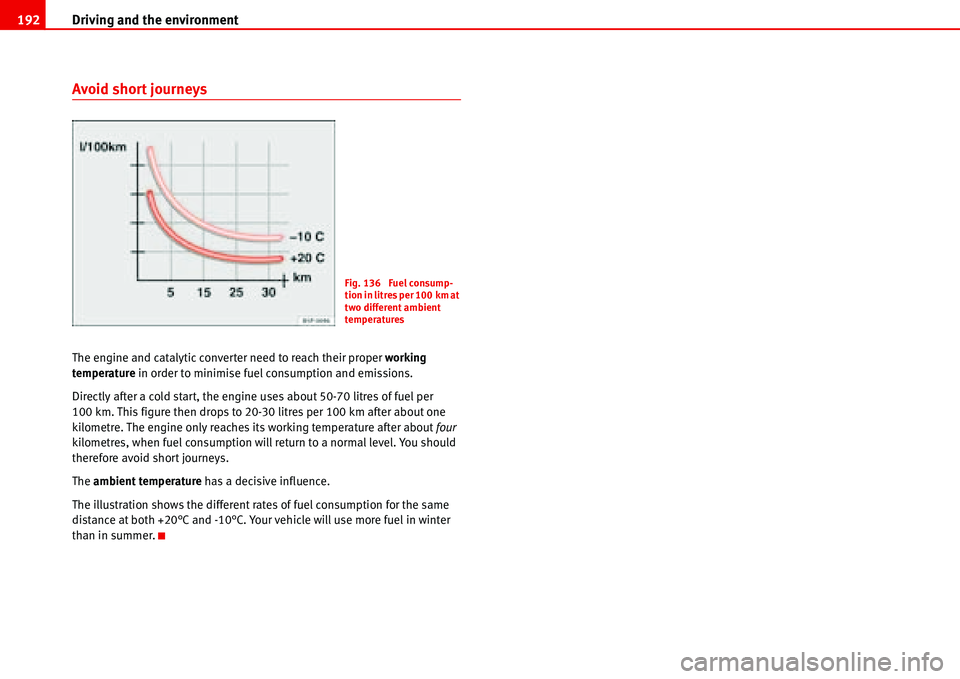
The engine and catalytic converter need to reach their proper working
temperature in order to minimise fuel consumption and emissions.
Directly after a cold start, the engine uses about 50-70 litres of fuel per
100 km. This figure then drops to 20-30 litres per 100 km after about one
kilometre. The engine only reaches its working temperature after about four
kilometres, when fuel consumption will return to a normal level. You should
therefore avoid short journeys.
The ambient temperature has a decisive influence.
The illustration shows the different rates of fuel consumption for the same
distance at both +20°C and -10°C. Your vehicle will use more fuel in winter
than in summer.
Fig. 136 Fuel consump-
tion in litres per 100 km at
two different ambient
temperatures
Page 195 of 299
Cleaning and caring for your vehicle193
Safety FirstOperating instructionsTips and MaintenanceTe c h n i c a l D a t a
Cleaning and caring for your vehicle
General notes
Regular washing and care help maintain the value of your
vehicle.
Regular care
Regular and expert care helps to maintain the value of the vehicle. This may
also be one of the requirements for acknowledging warranty claims in the
event of corrosion or paint defects.
The best way to protect the car against environmental contaminants is to
wash and wax it frequently. The longer substances such as insects, bird drop-
pings, resinous tree sap, road dirt, industrial deposits, tar, soot or road salt
and other aggressive materials remain on the vehicle, the more damage they
do to the paintwork. High temperatures (for instance in strong sunlight)
further intensify the corrosive effect.
After the period when salt is put on the roads it is important to have the
underside of the vehicle washed thoroughly.
Car care products
Car care products are available from your Authorised Service Centre. Keep the
product instructions until you have used up the product.
WARNING
•Car care products can be toxic. For this, they must always be kept
closed in their original container. Keep out of children's reach. Failure to
comply could result in poisoning.
•Always read and observe the instructions and warnings on the package
before using car care products. Improper use could damage your health or your vehicle. The use of certain products may produce noxious vapours;
these should be used in well-ventilated areas.
•Never use fuel, turpentine, engine oil, nail varnish remover or other
volatile fluids. These are toxic and highly flammable. There is a fire / explo-
sion risk.
•Before you wash your vehicle, or carry out any maintenance, switch off
the engine, apply the handbrake firmly and remove the key from the igni-
tion.
Caution
Never attempt to remove dirt, mud or dust if the surface of the vehicle is dry.
Never use a dry cloth or sponge for cleaning purposes. This could damage the
paintwork or glass on your vehicle. Soak dirt, mud or dust with plenty of
water.
For the sake of the environment
•When purchasing car care products, try to select ones which are not
harmful to the environment.
•Left over car care products should not be disposed of with ordinary house-
hold waste. Observe the disposal information on the package.
WARNING (continued)
Page 201 of 299
Cleaning and caring for your vehicle199
Safety FirstOperating instructionsTips and MaintenanceTe c h n i c a l D a t a
Cleaning the engine compartment
Take special care when cleaning the engine compartment.
Anti-corrosion treatment
The engine compartment and the surface of the power unit are given anti-
corrosion treatment at the factory.
Good corrosion protection is particularly important in winter when the car is
frequently driven on salted roads. To prevent the salt corroding the vehicle,
the entire engine compartment should be thoroughly cleaned before and
after the salting period.
Your Authorised Service Centre is able to provide the correct cleaning and
preserving products and has the necessary equipment. For this reason, we
recommend having this work performed by them.
The anti-corrosion protection is usually removed if the engine compartment
is cleaned with grease removing solutions, or if you have the engine cleaned.
If this job is carried out, you should ensure that all surfaces, seams, joints and
components in the engine compartment are given anti-corrosion treatment
afterwards.
WARNING
•When working in the engine compartment, always observe the safety
warnings Ÿpage 209
•Switch off the engine, apply the parking brake firmly and always
remove the key from the ignition before you open the bonnet.
•Allow the engine to cool before you clean the engine compartment.
•Do not clean the underside of vehicle, wheel arches without protecting
your hands and arms. You may cut yourself on sharp-edged metal parts.
Failure to comply could result in injury.
•Moisture, ice and salt on the brakes may affect braking efficiency. Risk
of accident. If possible, avoid sudden braking immediately after washing
the vehicle.
•Never touch the radiator fan. It is temperature-controlled and could
start automatically, even when the key is removed from the ignition!
For the sake of the environment
Fuel, grease and oil deposits could be removed when the engine is washed.
The polluted water must be cleaned in an oil separator. For this reason,
engine washing should be carried out only by a qualified workshop or a suit-
able filling station.
Care of the vehicle interior
Cleaning plastic parts and the dash panel
– Use a clean, damp cloth to clean plastic parts and the dash
panel.
– If this does not provide satisfactory results, use a special
solvent-free plastic cleaning product.
WARNING
Never clean the dash panel and surface of the airbag module with cleansers
containing solvents. Solvents cause the surface to become porous. If the
airbag inflates, disintegrating plastic parts can cause substantial injuries.
WARNING (continued)
Page 208 of 299
Checking and refilling levels 206
Checking and refilling levels
Refilling
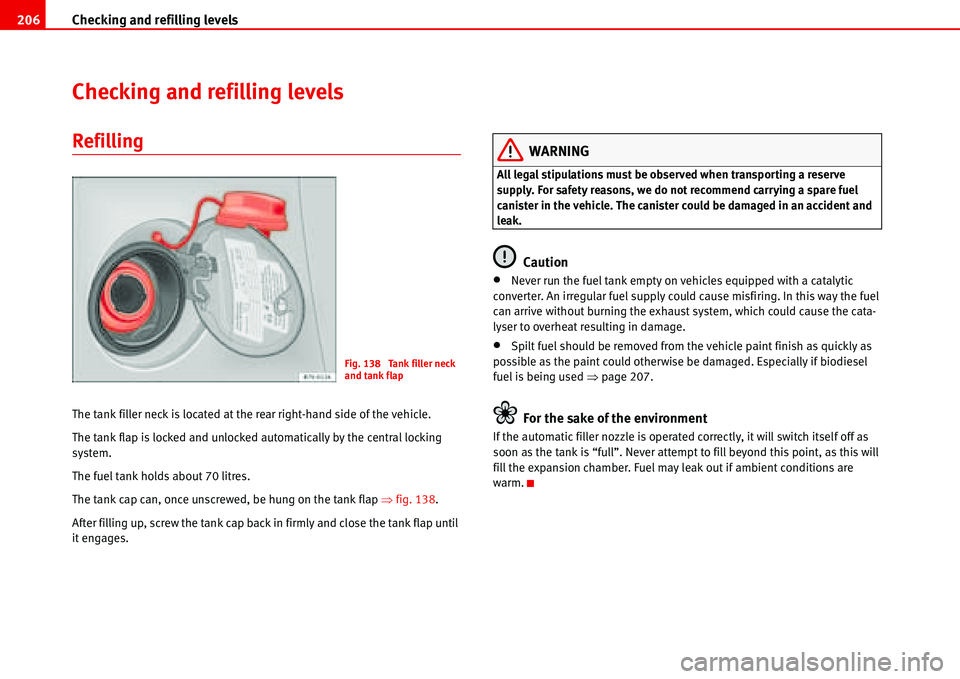
The tank filler neck is located at the rear right-hand side of the vehicle.
The tank flap is locked and unlocked automatically by the central locking
system.
The fuel tank holds about 70 litres.
The tank cap can, once unscrewed, be hung on the tank flap Ÿfig. 138.
After filling up, screw the tank cap back in firmly and close the tank flap until
it engages.
WARNING
All legal stipulations must be observed when transporting a reserve
supply. For safety reasons, we do not recommend carrying a spare fuel
canister in the vehicle. The canister could be damaged in an accident and
leak.
Caution
•Never run the fuel tank empty on vehicles equipped with a catalytic
converter. An irregular fuel supply could cause misfiring. In this way the fuel
can arrive without burning the exhaust system, which could cause the cata-
lyser to overheat resulting in damage.
•Spilt fuel should be removed from the vehicle paint finish as quickly as
possible as the paint could otherwise be damaged. Especially if biodiesel
fuel is being used Ÿpage 207.
For the sake of the environment
If the automatic filler nozzle is operated correctly, it will switch itself off as
soon as the tank is “full”. Never attempt to fill beyond this point, as this will
fill the expansion chamber. Fuel may leak out if ambient conditions are
warm.
Fig. 138 Tank filler neck
and tank flap
Page 209 of 299
Checking and refilling levels207
Safety FirstOperating instructionsTips and MaintenanceTe c h n i c a l D a t a
Petrol
Petrol types
The correct petrol types are listed on a sticker inside the fuel
tank flap.
Only unleaded petrol, corresponding to the standard DIN EN 228, may be
used for vehicles with catalytic converters (EN = “European Norm”).
Petrol types are categorised according to their octane number, e. g. 91, 95,
98 or 99. You may use petrol with a higher octane number than the one
recommended for your engine. However this has no advantage in terms of
fuel consumption and engine power.
Caution
If you must drive with fuel of a lower octane rating than recommended then
avoid driving at high engine speeds or putting demand on your engine.
Otherwise engine damage may occur. Fill up with petrol with the correct
octane number as soon as possible.
For the sake of the environment
Just one full tank of leaded fuel would seriously impair the efficiency of the
catalytic converter.
Petrol additives
The quality of the petrol influences running behaviour, performance and
service life of the engine. For this reason you should use good quality petrol
containing additives. These additives will help to prevent corrosion, keep the
fuel system clean and prevent deposits from building up in the engine.If good quality petrol with additives is not available, this may cause engine
problems (e.g. engine does not run smoothly or problems occur when
starting).
Not all petrol additives are effective. We recommend you use only “genuine
SEAT fuel additives for petrol engines”. They are available from SEAT Service
Centres
®. Your dealer will also be able to provide information on how to use
them.
Do not mix other fuel additives with the fuel.
Diesel
Diesel*
Diesel fuel must correspond to DIN EN 590 (EN = “European standard”). It
must have a cetane number (CN) of at least 51. The cetane number indicates
the ignition quality of the diesel fuel.
Notes on filling with fuel Ÿpage 206.
RME fuel*
Only vehicles fitted with special equipment may drive with
biodiesel fuel in accordance with standard DIN EN 14214.
The biodiesel fuel must comply with the DIN EN 14.214 (FAME) Standard.
•Biodiesel is a methylester obtained from rapeseed oil.
•DIN is a German abbreviation for “ Deutsches Institut für Normug e.V.”, the
German standards institute.
•EN means European Norm.
Page 210 of 299
Checking and refilling levels 208
•FAME is the English abbreviation “ Fatty Acid Methyl Ester”
If the date sticker of the vehicle includes the number PR 2G0 optional equip-
ment) this means that that vehicle has been prepared for biodiesel use.
Your Authorised Service Centre or automobile association will be able to
advise on where you can obtain RME biodiesel fuel.
Your Authorised Service Centre can also be consulted to know if the vehicle
has been prepared for biodiesel use.
Things to note about RME fuel (biodiesel)
•The performance of a vehicle using biodiesel maybe somewhat reduced.
•Fuel consumption of a vehicle using biodiesel may be slightly higher.
•RME fuel can be used in winter at temperatures down to approx. -10°C.
•At outside temperatures below -10°C, we recommend using winter diesel
fuel.
For technical reasons, vehicle fitted with diesel particulate filters cannot use
biodiesel under any circumstances.
Your authorized SEAT dealer will confirm whether your vehicle is prepared to
use biodiesel.
Caution
•RME fuel can damage the fuel system in vehicles that are not suitably
adjusted.
•If you decide to use biodiesel in your vehicle, please use only RME fuel
which is DIN E 14,214 compliant.
•If you use biodiesel that does not meet the required standard, the fuel
filter could become clogged.
•Your authorized SEAT dealer will be able to tell you if your vehicle is suit-
able for use with biodiesel, or whether it requires modifications in order to
use it.
•Vehicles fitted with a diesel particle filter should not use biodiesel under
any circumstance, or even start the engine, at the risk of damaging the fuel
system.
Note
•In case of low exterior temperatures and a fuel biodiesel percentage of
higher than 50%, an increase in gas emission may occur during operation of
the independent heating.
•The fuel filter may become clogged when fuel is changed to biodiesel. For
this reason, we recommend that, about every 300 or 400 km, following a fuel
change, also change the fuel filter. Also. note the instructions in the inspec-
tion and maintenance plan.
•If the vehicle is to remain parked for more than about two weeks, we
recommend filling the fuel tank with biodiesel and driving about 50 km in
order to avoid damage to the injection system.
Winter driving
Diesel can thicken in winter.
Winter-grade diesel
When using “summer-grade diesel fuel”, difficulties may be experienced at
sub-zero temperatures because the fuel thickens due to paraffin separation.
For this reason, “winter-grade diesel fuel” is available in some countries
during the cold months. It can be used at temperatures as low as -22°C.
In countries with different climatic conditions the diesel fuel sold generally
has different temperature characteristics. Check with an Authorised Service
Centre or filling stations in the country concerned regarding the type of diesel
fuels available.
Page 211 of 299
Checking and refilling levels209
Safety FirstOperating instructionsTips and MaintenanceTe c h n i c a l D a t a Filter pre-heater
Your vehicle is fitted with a fuel filter pre-heater, making it well equipped for
operation in winter. This ensures that the fuel system remains operational to
approx. -24°C, provided you use winter-grade diesel which is safe to -15°C .
However, if the fuel has waxed to such an extent that the engine will not start
at temperatures of under -24°C, simply place the vehicle in a warm place for
a while.
Caution
Do not mix fuel additives (“thinners”, or similar additives) with diesel fuel.
Supplementary heating system
The supplementary heating system raises the calorific capacity of the heating
while the engine is running and outside temperatures are very low. The
supplementary heating system connects and disconnects automatically.
The exhaust fumes produced are eliminated through an exhaust pipe below
the vehicle.
Note
•For short journeys, very low outside temperatures and a percentage of
biodiesel fuel of over 50 % too much smoke may be produced.
•Every time the engine is switched off, the fan continues to operate for a
short time in order to more quickly cool the heater. When refuelling it is not
necessary to wait until the fan stops operating.
Working in the engine compartment
Safety instructions on working in the engine compartment
Any work carried out in the engine compartment or on the
engine must be carried out cautiously.
Before starting any work on the engine or in the engine compart-
ment:
1. Switch off the engine and remove the key from the ignition.
2. Apply the handbrake.
3. Move the gear stick to neutral or the selector lever to position P.
4. Wait for the engine to cool down.
5. Keep children away from the vehicle.
6. Raise the bonnet Ÿpage 97.
You should not do any work in the engine compartment unless you know
exactly how to carry out the jobs and have the correct tools! Have the work
carried out by a qualified workshop if you are uncertain.
All service fluids and consumables, e.g. coolant, engine oil, spark plugs and
batteries, are being constantly developed. SEAT provides a constant flow of
information to the Authorised Service Centres concerning modifications. For
this reason we recommend that you have service fluids and consumables
replaced by an Authorised Service Centre. Please observe the relevant
instructions Ÿpage 202. The engine compartment of any motor vehicle is a
hazardous area. Ÿ.