belt Seat Alhambra 2006 Workshop Manual
[x] Cancel search | Manufacturer: SEAT, Model Year: 2006, Model line: Alhambra, Model: Seat Alhambra 2006Pages: 299, PDF Size: 6.33 MB
Page 83 of 299
Cockpit81
Safety FirstOperating instructionsTips and MaintenanceTe c h n i c a l D a t a An audible signal is also given if the car is driven faster than 6 km/h (approx.
4 mph) with the handbrake applied.
Coolant temperature/level gauge
v
The corresponding warning is:
STOP CHECK LEVEL COOLANT
SERVICE MANUAL.
If the symbol flashes while driving, this means that either the coolant temper-
ature is too high or the coolant level is too low. Stop immediately, switch off
the engine and check the level. Top up coolant if necessary.
If the coolant level is correct, the overheating may be caused by a malfunction
of the radiator fan. In this case, check the radiator fan fuse, and replace if
necessary.
If the warning light does not go out, although the coolant level is correct and
the fan fuse is correct, do not continue driving. Obtain technical assistance.
If the fault is only in the radiator fan, it is possible to continue driving as far
as the nearest Technical Service Centre, as long as the coolant level is correct
and the display light is off.
Alternator
F
The corresponding warning is:
ALTERNATOR WORKSHOP!
The warning lamp lights up when the ignition is switched on. It should go out
when the engine is started.
The alternator is operated by a long-lasting drive belt.
If the warning light lights up while driving, stop, switch off the engine and
check the drive belt. If the belt is loose or broken, do not continue driving, as
the coolant pump will not be driven. The belt should be checked or replaced.If the warning light comes on even though the belt is neither loose nor
broken, it is usually possible to continue driving to the nearest Technical
Service Centre.
As the vehicle battery will discharge, it is advisable to switch off all non-vital
electrical consumers.
Seat belt warning lamp
h
The corresponding warning is:
FASTEN SEAT BELT
This warning light (only in some countries) lights up for approximately 6
seconds when the ignition is switched on to remind occupants to fasten seat-
belts. If the seat belts are not fastened, a sound signal is emitted when the
ignition is switched on which will stop when the seat belts are fastened or
after approximately 6 seconds.
WARNING
•If the brake fluid level is below the “MIN” mark, you should wait for
assistance from specialised personnel before continuing to drive.
•If the fluid level is correct, the fault may lie in the ABS. If the ABS control
system fails, the rear wheels may block rapidly on braking. This, in certain
circumstances, could cause the vehicle to skid.
•Never open the bonnet if you see steam or coolant escaping from the
engine compartment. Risk of burns. Wait until you can no longer see or
hear escaping steam or coolant.
•Do not touch the fan, as it could suddenly start to operate, even if the
ignition is switched off.
•To prevent burns from boiling coolant, the following should be
observed:
•Take care when opening the coolant expansion tank!. When the engine
is warm or hot, the system is pressurised! Therefore wait until the engine
cools before opening the cap.
Page 123 of 299
Seats and stowage121
Safety FirstOperating instructionsTips and MaintenanceTe c h n i c a l D a t a
Seats and stowage
The importance of correct seat adjustment
Proper seat adjustment optimises the level of protection
offered by seat belts and airbags.
The driver seat, front passenger seat, and seats in the passenger compart-
ment, can be adjusted in many ways to suit the physical requirements of the
vehicle occupants. The correct seat position is very important for:
•fast and easy operation of all controls on the instrument panel,
•relaxed posture that does not cause drowsiness,
•safe driving,
•optimum protection from the seat belts and airbag system Ÿpage 7.
Vehicle seats
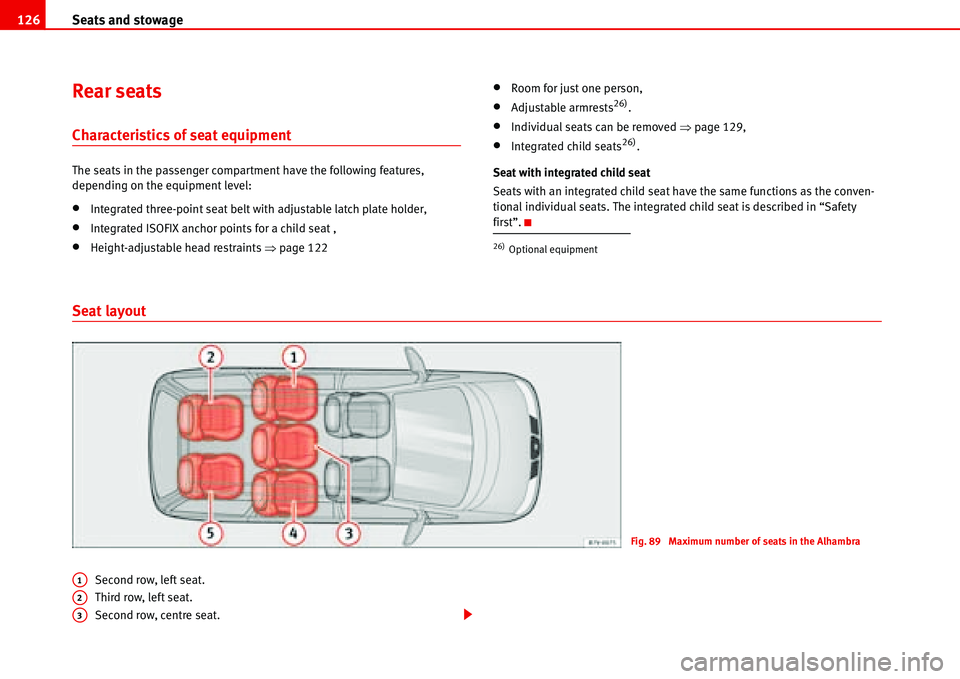
Your vehicle has a total of five or seven
24) seats.
•First row of seats: two seats
•Second row of seats: three seats
•Third row of seats24): two seats
Each seat is equipped with a three-point seat belt.
WARNING
If the driver and passengers assume improper sitting positions, they may
sustain critical injuries.
•Never transport more people than there are seats available in the
vehicle.
•Every occupant in the vehicle must properly fasten and wear the seat
belt belonging to his or her seat. Children must be protected with an appro-
priate child restraint system. Section “Child Safety”
•The seats and all head restraints must always be adjusted to body size
and the seat belt must always be properly adjusted to provide you and your
passengers with optimum protection.
•Always keep your feet in the foot well when the vehicle is moving; never
rest them on the dash panel, out of the window or on the seat. This also
applies to passengers. An incorrect sitting position exposes you to an
increased risk of injury in the event of a braking manoeuvre or an accident.
If the airbag is triggered, you could sustain fatal injuries due to an improper
sitting position.
•It is important for the driver and front passenger to maintain a distance
of at least 25 cm from the steering wheel or dash panel. Failure to respect
the minimum distance means that the airbag will not protect you. Risk of
fatal injury. The distance between the driver and the steering wheel or
between the front passenger and the dash panel should always be as great
as possible.
•Adjust the driver or front passenger seat only when the vehicle is
stationary. Otherwise your seat could move unexpectedly while the vehicle
is moving. This could increase the risk of an accident and therefore injury.
In addition, while adjusting your seat, you will assume an incorrect sitting
position. Risk of fatal accidents.
•Special guidelines apply to installing a child seat on the front
passenger seat. When installing a child seat, observe the warning note in
“Child safety”.
•The seats in the third row of seats may, for safety reasons, only be used
if the luggage compartment cover has been removed.
24)Optional equipment
WARNING (continued)
Page 124 of 299
Seats and stowage 122
Head restraints
Correct adjustment of head restraints
Properly adjusted head restraints are an important part of
occupant protection and can reduce the risk of injuries in
most accident situations.
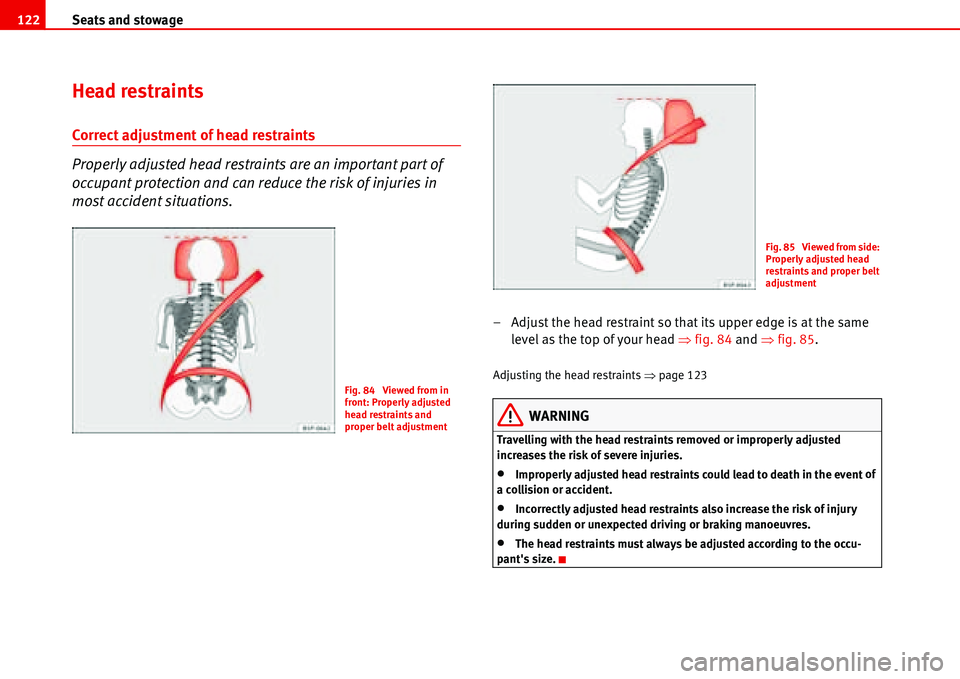
– Adjust the head restraint so that its upper edge is at the same
level as the top of your head Ÿfig. 84 and Ÿfig. 85.
Adjusting the head restraints Ÿpage 123
WARNING
Travelling with the head restraints removed or improperly adjusted
increases the risk of severe injuries.
•Improperly adjusted head restraints could lead to death in the event of
a collision or accident.
•Incorrectly adjusted head restraints also increase the risk of injury
during sudden or unexpected driving or braking manoeuvres.
•The head restraints must always be adjusted according to the occu-
pant's size.
Fig. 84 Viewed from in
front: Properly adjusted
head restraints and
proper belt adjustment
Fig. 85 Viewed from side:
Properly adjusted head
restraints and proper belt
adjustment
Page 127 of 299
Seats and stowage125
Safety FirstOperating instructionsTips and MaintenanceTe c h n i c a l D a t a
•To reduce the risk of injury to the driver and front passenger during
sudden braking manoeuvres or an accident, never drive with the backrest
tilted far back. Risk of injury. The maximum protection of the seat belt can
be achieved only when the backrests are in an upright position and the
driver and front passenger have properly adjusted their seat belts. The
further the backrests are tilted to the rear, the greater the risk of injury due
to improper positioning of the belt web!
•Exercise caution when adjusting the seat height or forwards/back-
wards position. Injuries can be caused if the backrest is tilted without due
care and attention.
•Never turn the driver or front passenger seat while the vehicle is in
motion. While adjusting your seat, you will assume an incorrect sitting
position. Risk of injury. Only turn the driver or passenger seats when the
vehicle is stationary.
•When the vehicle is in motion, the rotating front seats must be securely
engaged and facing the direction of travel. These front seats may be used
only when the vehicle is stationary.
Caution
The driver seat and front passenger seat must not be occupied while they are
being turned. If the seat is occupied when it is turned, it could be damaged.
Seat heating A
The seat cushions and backrests of the front seats can be
heated electrically.
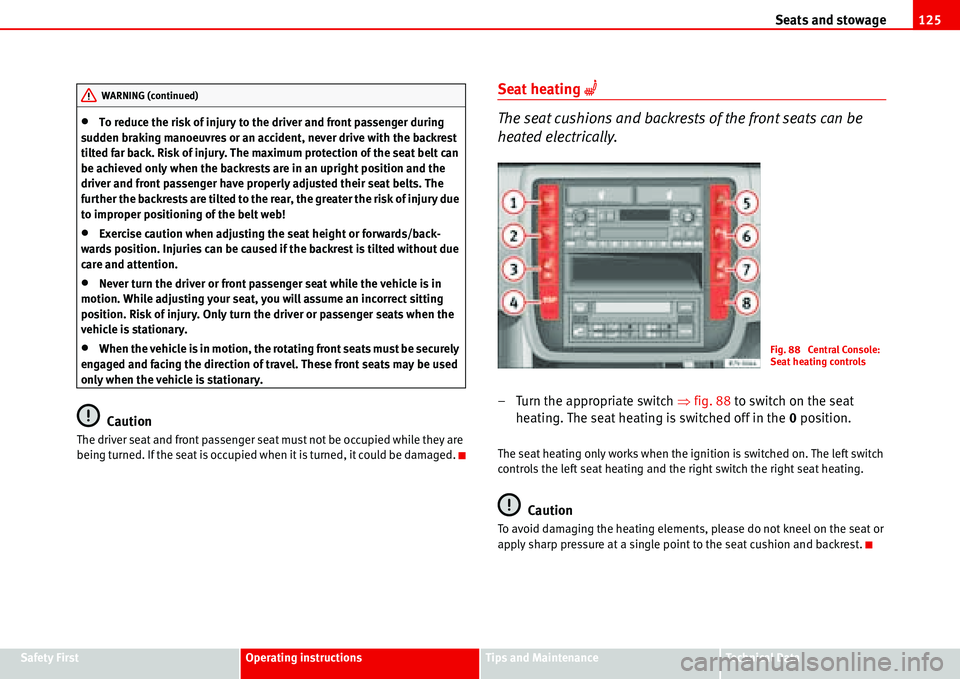
– Turn the appropriate switch Ÿfig. 88 to switch on the seat
heating. The seat heating is switched off in the 0 position.
The seat heating only works when the ignition is switched on. The left switch
controls the left seat heating and the right switch the right seat heating.
Caution
To avoid damaging the heating elements, please do not kneel on the seat or
apply sharp pressure at a single point to the seat cushion and backrest.
WARNING (continued)
Fig. 88 Central Console:
Seat heating controls
Page 128 of 299
Seats and stowage 126
Rear seats
Characteristics of seat equipment
The seats in the passenger compartment have the following features,
depending on the equipment level:
•Integrated three-point seat belt with adjustable latch plate holder,
•Integrated ISOFIX anchor points for a child seat ,
•Height-adjustable head restraints Ÿpage 122
•Room for just one person,
•Adjustable armrests26).
•Individual seats can be removed Ÿpage 129,
•Integrated child seats26).
Seat with integrated child seat
Seats with an integrated child seat have the same functions as the conven-
tional individual seats. The integrated child seat is described in “Safety
first”.
Seat layout
Second row, left seat.
Third row, left seat.
Second row, centre seat.
26)Optional equipment
Fig. 89 Maximum number of seats in the Alhambra
A1
A2
A3
Page 133 of 299
Seats and stowage131
Safety FirstOperating instructionsTips and MaintenanceTe c h n i c a l D a t a
Adjusting the armrest
– Turn the thumb wheel underneath the armrests to adjust the
angle of the armrests to your requirement.
Removable armrest
29)
– Take hold of the armrest at the rear and press the button
Ÿpage 130, fig. 95 in the direction of the arrow.
– With the button pressed, pull the armrest off to the side out of the
holder.
– When installing, please ensure that the armrest engages
securely in the holder.
The removable armrests for the second row of seats can be found in a trans-
port bag Ÿpage 130, fig. 96.
The bag hangs from a head restraint of a seat in the last row of seats or, in
vehicles with 4 integrated child seats
29), on the centre seat of the second row
of seats.
WARNING
•The transport bag should always be secured properly when travelling in
the vehicle as it could otherwise be a safety risk in an accident or braking
manoeuvre. We recommend that you keep the bag at home.
•The bag, if you do decide to keep it in the vehicle, may not be secured
to the head restraint of an integrated child seat. The backrest could be
forced forward in an accident or braking manoeuvre due to the weight of the
bag.
Safety instructions for seats
WARNING
•Occupants may travel on the seats in the passenger compartment only
if the following conditions are fulfilled at the same time:
−The seats must always be fitted in the appropriate floor anchors and
must be securely engaged.
−The backrest of all seats must be in the upright position and securely
engaged in this position.
−The seat occupants must have access to the seat belts. The seat
belts must be fitted correctly.
−All the occupants of the vehicle must be correctly seated while
driving.
•A seat which has been removed can cause injury if it is transported in
the vehicle. Each seat must always be fitted in the floor anchors and must
be securely engaged. The backrest must be in an upright position. If a
bench seat is not properly secured, it could become a life-threatening
hazard for all vehicle occupants.
•Make sure that the bases of seats are not soiled or damaged when
removed from the vehicle.
•All adjustment to the seats, including fitting and removal, may be
carried out only when the vehicle is stationary.
29)Optional equipment
Page 145 of 299
Seats and stowage143
Safety FirstOperating instructionsTips and MaintenanceTe c h n i c a l D a t a
WARNING
Loose luggage and other objects in the luggage compartment can cause
serious injuries.
•Always stow objects in the luggage compartment and secure them on
the fastening rings.
•Use suitable specialist straps to secure heavy objects.
•During sudden manoeuvres or accidents, loose objects can be thrown
forward, injuring vehicle occupants. This increased risk of injury will be
further increased if a loose object is struck by an inflating airbag. If this
happens, objects can be transformed into “missiles”. Risk of fatal injury.
•Remember that transporting heavy objects modifies the driving condi-
tions as the centre of gravity has been altered. There is a risk of accident.
Therefore, it is essential to adjust your speed and driving style accordingly,
to avoid accidents.
•Never exceed the allowed axle loads or allowed maximum weight. If the
allowed axle load or the allowed total weight is exceeded, the driving char-
acteristics of the vehicle may change, leading to accidents, injuries and
damage to the vehicle.
•Never leave the vehicle unattended, especially when the tailgate is
open. Children could climb into the luggage compartment closing the door
behind them; they will remain trapped without help and there is a mortal
risk.
•Never allow children to play in or around the vehicle. Close and lock
both the tailgate and all the doors when you leave the vehicle. Before you
lock the vehicle, make sure that there are no adults or children in the
vehicle.
•Never transport passengers in the luggage compartment. Every
passenger must be properly belted in .
Caution
•Avoid overloading small areas by placing heavy objects on the vehicle
floor.
•The wires of the heating element in the rear window and the window aerial
in the rear side windows could be damaged if objects on the luggage
compartment cover rub against them.
•If you have removed the seats from the passenger compartment, you
should place a large, robust covering over the floor anchors to prevent
damage.
Note
•Air circulation in the vehicle helps reduce fogging of the windows. Used
air escapes through ventilation slits in the side trim of the luggage compart-
ment. Ensure that the ventilation slits are never covered.
•Straps for securing the load to the fastening rings are commercially
available.
Fastening rings
There are fastening rings in the luggage compartment which
can be used to secure luggage and other objects.
– Always use suitable undamaged belts for fastening the luggage
or any other object tot he anchorage rings Ÿ in “Loading the
luggage compartment” on page 142.
The retainers for the detachable seat belts for the third row of seats and the
floor anchors for the seats can be used as fastening rings for items of
luggage.
Page 147 of 299
Seats and stowage145
Safety FirstOperating instructionsTips and MaintenanceTe c h n i c a l D a t a
•Always stow objects safely in the vehicle and secure them on the
fastening rings if necessary.
•Use suitable specialist straps to secure heavy objects.
•Loose objects in the vehicle can move suddenly. As the centre of gravity
moves, safety is impaired and the vehicle becomes difficult to handle.
•During sudden manoeuvres or accidents, loose objects can be thrown
forward, injuring vehicle occupants. This increased risk of injury will be
further increased if a loose object is struck by an inflating airbag. If this
happens, objects can be transformed into “missiles”. Risk of fatal injury.
•Remember that transporting heavy objects modifies the driving condi-
tions as the centre of gravity has been altered. There is a risk of accident.
Therefore, it is essential to adjust your speed and driving style accordingly,
to avoid accidents.
•Never exceed the allowed axle loads or allowed maximum weight. If the
allowed axle load or the allowed total weight is exceeded, the driving char-
acteristics of the vehicle may change, leading to accidents, injuries and
damage to the vehicle.
•Never leave the vehicle unattended, especially when the tailgate is
open. Children could climb into the interior of the vehicle closing the door
behind them; they will remain trapped without help and there is a mortal
risk.
•Never allow children to play in or around the vehicle. Close and lock all
windows, the tailgate and all doors when you leave the vehicle.
•Never transport passengers in the luggage compartment. Every
passenger must be properly belted in.
Luggage compartment cover
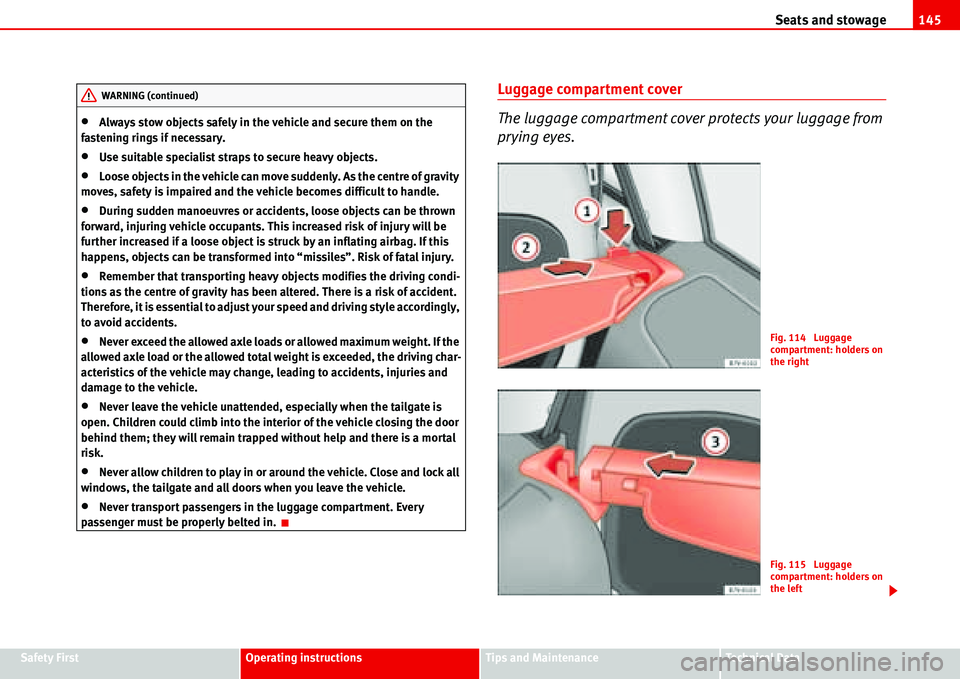
The luggage compartment cover protects your luggage from
prying eyes.WARNING (continued)
Fig. 114 Luggage
compartment: holders on
the right
Fig. 115 Luggage
compartment: holders on
the left
Page 203 of 299
Cleaning and caring for your vehicle201
Safety FirstOperating instructionsTips and MaintenanceTe c h n i c a l D a t a
•To avoid damage, stubborn stains should be removed by a qualified
workshop.
Cleaning seat belts
A dirty belt may stop the seat belt working properly.
Keep the seat belts clean and check all seat belts regularly.
Cleaning seat belts
– Carefully pull the dirty seat belt right out and leave it out.
– Clean the dirty seat belts with a gentle soap solution.
– Allow the seat belt fabric to dry.
– Do not roll up the seat belt until it is dry.
If large stains form on the belts the belt will not retract correctly into the auto-
matic belt retractor.
WARNING
•Do not use chemical cleaning agents on the seat belts, as this can
impair the strength of the webbing. Ensure that the belts do not come into
contact with corrosive fluids.
•Check the condition of all seat belts at regular intervals. If you notice
that the belt webbing, fittings, retractor mechanism or buckle of any of the
belts is damaged, the belt must be replaced by a specialist workshop.
•Do not attempt to repair a damaged seat belt yourself. The seat belts
must not be removed or modified in any way.
Caution
After cleaning, allow seat belts to dry completely before rolling them up.
Otherwise the belt retractors could become damaged.
Cleaning the cool/thermos box
–Before using the insulated box for the first time, you should clean
it, using a household detergent.
– Always clean the inside of the insulated box when it is soiled.
If you do not plan to use the insulated box for a long period, disconnect the
power supply and clean the inside and outside of the box. Place a folded
towel between the box and its lid. This prevents mould and damp stains
forming in the cooling and heating box.
Page 212 of 299
Checking and refilling levels 210
WARNING
All work on the engine or in the engine compartment, e.g. checking and
refilling fluids, involves the danger of injury and scalding as well as the risk
of accident or fire.
•Never open the bonnet if you see steam, smoke or coolant escaping
from the engine compartment. Otherwise, there is a risk of sustaining
burns. Wait until no more steam or coolant is emitted, then allow the
engine to cool before carefully opening the bonnet.
•Switch off the engine and remove the key from the ignition.
•Apply the handbrake and move the gear stick to neutral or selector
lever to position P.
•Keep children away from the vehicle.
•Never touch hot engine parts. There is a risk of burns.
•Never spill liquids on a hot engine or on a hot exhaust gas system. This
is a fire hazard.
•Avoid causing short-circuits in the electrical system, particularly at the
points where the jump leads are attached Ÿpage 250. The battery could
explode.
•Never touch the radiator fan. It is temperature controlled and could
start automatically, even when the engine has been switched off and the
key removed from the ignition!
•Do not unscrew the cap on the expansion tank when the engine is hot.
If the coolant is hot, the cooling system will be pressurised!
•Protect face, hands and arms by covering the cap with a large, thick
cloth to protect against escaping coolant and steam.
•Always make sure you have not left any objects, such as cleaning cloths
and tools, in the engine compartment.
•If you have to work underneath the vehicle, you must use suitable
stands additionally to support the vehicle, there is a risk of accident!. A
hydraulic jack is insufficient for securing the vehicle and there is a risk of
injury.
•If any work has to be performed when the engine is started or with the
engine running, there is an additional, potentially fatal, safety risk from the
rotating parts, such as the drive belts, alternator, radiator fan, etc., and
from the high-voltage ignition system. You should also observe the
following points:
−Never touch the electrical wiring of the ignition system.
−Ensure that jewellery, loose clothing and long hair do not get
trapped in rotating engine parts. Danger of death. Before starting any
work remove jewellery, tie back and cover hair, and wear tight-fitting
clothes.
−Always think carefully about pressing the accelerator if a gear is
engaged in either an automatic or manual gearbox. The vehicle could
move, even if the handbrake is applied. Danger of death.
•If work has to be carried out on the fuel system or on electrical compo-
nents, you must observe the following safety notes in addition to the above
warnings:
−Always disconnect the battery. The vehicle must be unlocked when
this is done, otherwise the alarm will be triggered.
−Do not smoke.
−Never work near naked flames.
−Always have a fire extinguisher on hand.
Caution
When changing or topping up service fluids, make absolutely certain that you
fill the fluids into the correct reservoirs. Failure to observe this point will result
in serious malfunctions and engine damage!
WARNING (continued)