ignition Seat Alhambra 2006 Manual PDF
[x] Cancel search | Manufacturer: SEAT, Model Year: 2006, Model line: Alhambra, Model: Seat Alhambra 2006Pages: 299, PDF Size: 6.33 MB
Page 225 of 299
Checking and refilling levels223
Safety FirstOperating instructionsTips and MaintenanceTe c h n i c a l D a t a
Battery
Warnings on handling the battery
WARNING
Always be aware of the danger of injury and chemical burns as well as the
risk of accident or fire when working on the battery and the electrical
system:
•Wear eye protection. Protect your eyes, skin and clothing from acid and
particles containing lead.
•Battery acid is very corrosive and caustic. Wear protective gloves and
eye protection. Do not tilt the batteries. This could spill acid through the
vents. Rinse battery acid from eyes immediately for several minutes with
clear water. Then seek medical care immediately. Neutralize any acid
splashes on the skin or clothing with a soapy solution, and rinse off with
plenty of water. If acid is swallowed by mistake, consult a doctor immedi-
ately.
•Fires, sparks, naked lights and smoking are prohibited. When handling
cables and electrical equipment, avoid causing sparks and electrostatic charge. Never short the battery terminals. High-energy sparks can cause
injury.
•A highly explosive mixture of gases is released when the battery is
under charge. The batteries should be charged in a well-ventilated room
only.
•Keep children away from acid and batteries.
•Before working on the electrical system, you must switch off the
engine, the ignition and all consumers. The negative cable on the battery
must be disconnected. When a light bulb is changed, you need only switch
off the light.
•Deactivate the anti-theft alarm by unlocking the vehicle before you
disconnect the battery! The alarm will otherwise be triggered.
•When disconnecting the battery from the vehicle electrical system,
disconnect first the negative cable and then the positive cable.
•Switch off all electrical consumers before reconnecting the battery.
Reconnect first the positive cable and then the negative cable. Never
reverse the polarity of the connections. This could cause an electrical fire.
•Never charge a frozen battery, or one which has thawed. This could
result in explosions and chemical burns. Always replace a battery which
has frozen. A flat battery can freeze at temperatures around 0
°C.
•Ensure that the vent hose is always connected to the battery.
•Never use a defective battery. This may be fatally explosive. Replace a
damaged battery immediately.
Caution
•Never disconnect the battery if the ignition is switched on or if the engine
is running. This could damage the electrical system or electronic compo-
nents.
•Do not expose the battery to direct sunlight over a long period of time, as
the intense ultraviolet radiation can damage the battery housing.
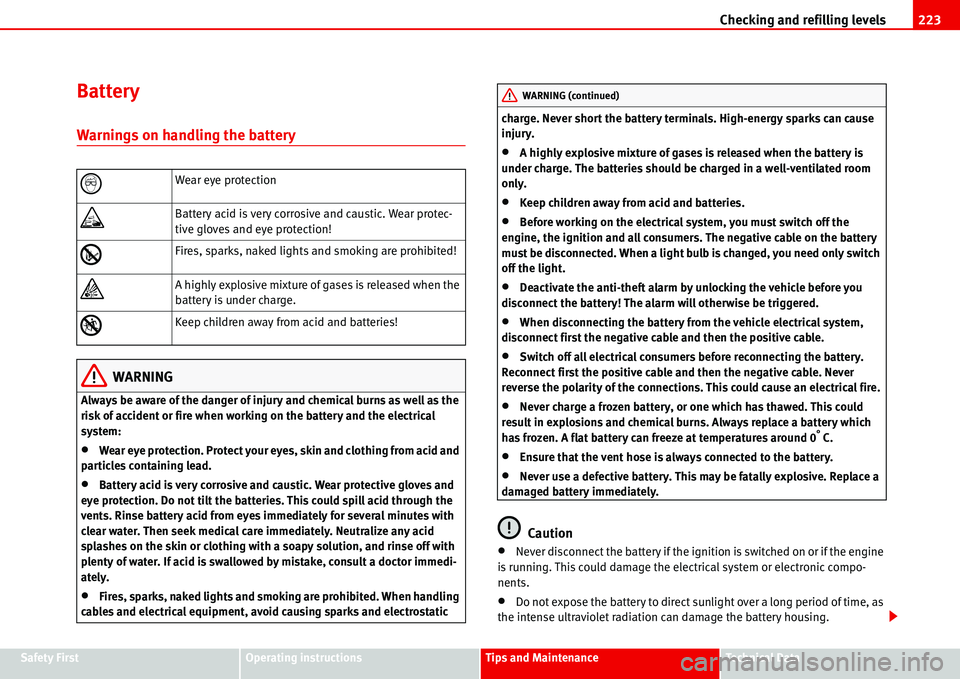
Wear eye protection
Battery acid is very corrosive and caustic. Wear protec-
tive gloves and eye protection!
ŽFires, sparks, naked lights and smoking are prohibited!
ŸA highly explosive mixture of gases is released when the
battery is under charge.
Keep children away from acid and batteries!
WARNING (continued)
Page 243 of 299
If and when241
Safety FirstOperating instructionsTips and MaintenanceTe c h n i c a l D a t a
WARNING
•If the prescribed torque of the wheel bolts is too low, they could loosen
whilst the vehicle is in motion. Risk of accident! If the tightening torque is
too high, the wheel bolts and threads could be damaged.
Caution
The stipulated torque for the wheel bolts on steel wheels and alloy wheels is
170 Nm with a tolerance of ±10 Nm. You should visit a specialised workshop
as soon as possible to check the torque with a torque wrench.
Note
•The wheel bolts should be clean and turn easily. Do not grease or oil them.
•The hexagonal socket in the screwdriver handle should be used only for
turning wheel bolts which have been slackened off. Do not use it to loosen or
tighten the wheel bolts.
•If you notice that the wheel bolts are corroded and difficult to turn when
changing a wheel, they must be replaced before you have the tightening
torque checked.
•If the spare tyre is not the same as the tyres that are mounted on the car -
for example with winter tyres - you should only use the spare tyre for a short
period of time and drive with extra care. Refit the normal road wheel as soon
as possible.
•Have the flat tyre replaced as quickly as possible.
Fuses
Changing a fuse
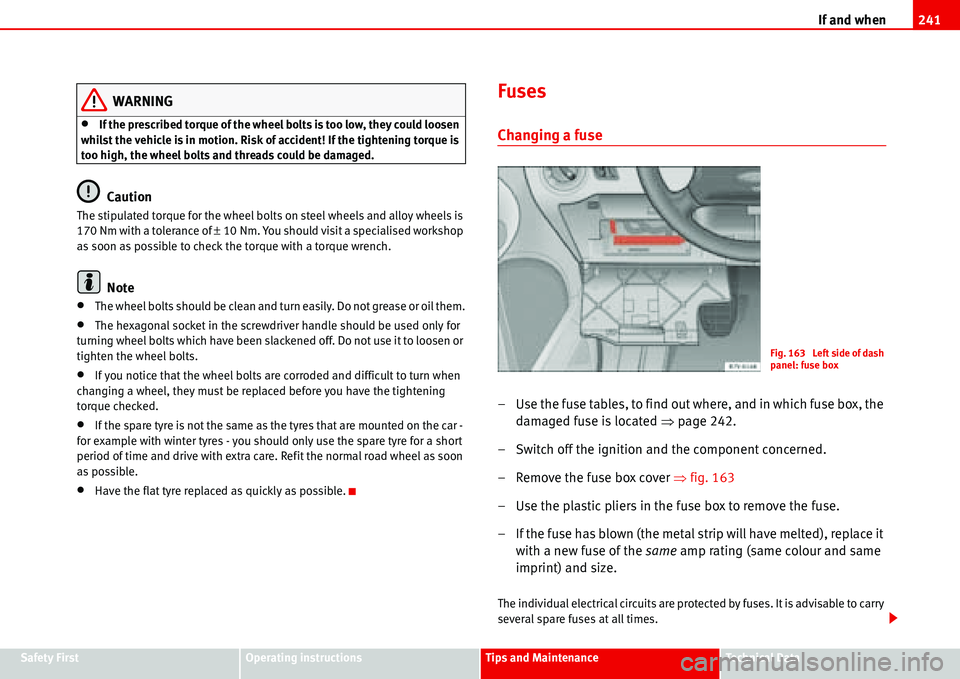
– Use the fuse tables, to find out where, and in which fuse box, the
damaged fuse is located Ÿpage 242.
– Switch off the ignition and the component concerned.
– Remove the fuse box cover Ÿfig. 163
– Use the plastic pliers in the fuse box to remove the fuse.
– If the fuse has blown (the metal strip will have melted), replace it
with a new fuse of the same amp rating (same colour and same
imprint) and size.
The individual electrical circuits are protected by fuses. It is advisable to carry
several spare fuses at all times.
Fig. 163 Left side of dash
panel: fuse box
Page 252 of 299
If and when 250
How to jump start
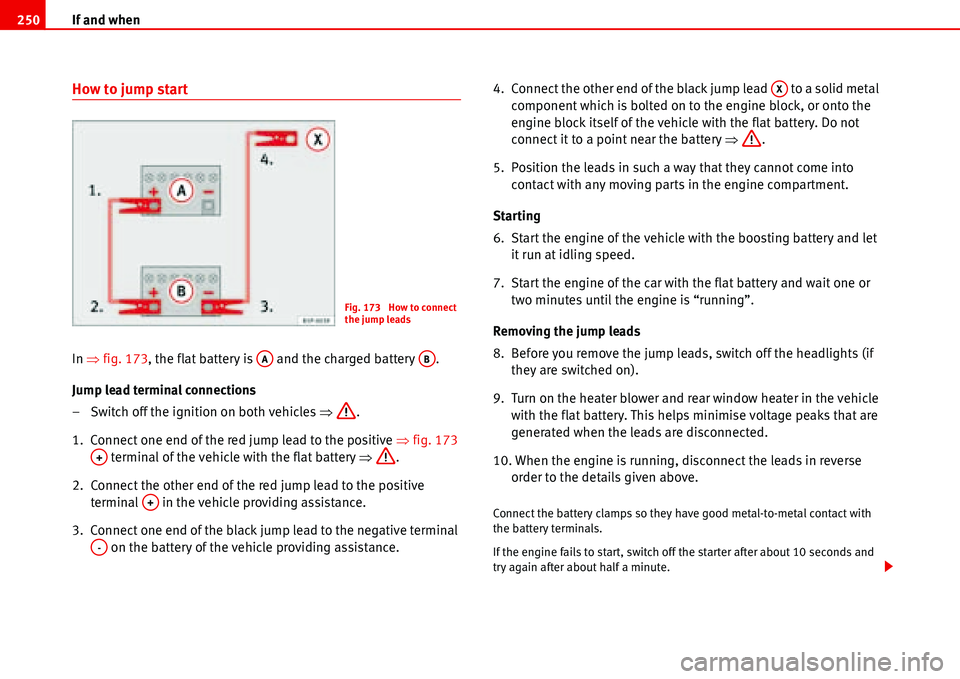
In Ÿfig. 173, the flat battery is and the charged battery .
Jump lead terminal connections
– Switch off the ignition on both vehicles Ÿ.
1. Connect one end of the red jump lead to the positive Ÿfig. 173
terminal of the vehicle with the flat battery Ÿ.
2. Connect the other end of the red jump lead to the positive
terminal in the vehicle providing assistance.
3. Connect one end of the black jump lead to the negative terminal
on the battery of the vehicle providing assistance.4. Connect the other end of the black jump lead to a solid metal
component which is bolted on to the engine block, or onto the
engine block itself of the vehicle with the flat battery. Do not
connect it to a point near the battery Ÿ.
5. Position the leads in such a way that they cannot come into
contact with any moving parts in the engine compartment.
Starting
6. Start the engine of the vehicle with the boosting battery and let
it run at idling speed.
7. Start the engine of the car with the flat battery and wait one or
two minutes until the engine is “running”.
Removing the jump leads
8. Before you remove the jump leads, switch off the headlights (if
they are switched on).
9. Turn on the heater blower and rear window heater in the vehicle
with the flat battery. This helps minimise voltage peaks that are
generated when the leads are disconnected.
10. When the engine is running, disconnect the leads in reverse
order to the details given above.
Connect the battery clamps so they have good metal-to-metal contact with
the battery terminals.
If the engine fails to start, switch off the starter after about 10 seconds and
try again after about half a minute.
Fig. 173 How to connect
the jump leads
AAAB
A+
A+
A-
AX
Page 253 of 299
If and when251
Safety FirstOperating instructionsTips and MaintenanceTe c h n i c a l D a t a
WARNING
•Please note the safety warnings referring to working in the engine
compartment Ÿpage 209, “Working in the engine compartment”.
•The battery providing assistance must have the same voltage as the flat
battery (12V) and approximately the same capacity (see imprint on
battery). Failure to comply could result in an explosion.
•Never use jump leads when one of the batteries is frozen. Danger of
explosion! Even after the battery has thawed, battery acid could leak and
cause chemical burns. If a battery freezes, it should be replaced.
•Keep sparks, flames and lighted cigarettes away from batteries, danger
of explosion. Failure to comply could result in an explosion.
•Observe the instructions provided by the manufacturer of the jump
leads.
•Do not connect the negative cable from the other vehicle directly to the
negative terminal of the flat battery. The gas emitted from the battery could
be ignited by sparks. Danger of explosion.
•Do not attach the negative cable from the other vehicle to parts of the
fuel system or to the brake line.
•The non-insulated parts of the battery clamps must not be allowed to
touch. The jump lead attached to the positive battery terminal must not
touch metal parts of the vehicle, this can cause a short circuit.
•Position the leads in such a way that they cannot come into contact
with any moving parts in the engine compartment.
•Do not bend over the batteries. This could result in chemical burns.
Note
The vehicles must not touch each other, otherwise electricity could flow as
soon as the positive terminals are connected.
Towing and tow-starting
Tow-starting*
The use of jump leads is preferable to tow-starting.
We recommend that you do not tow-start your vehicle. Jump-starting
is preferable Ÿpage 249.
However, if your vehicle has to be tow-started:
– Engage the 2
nd or the 3rd gear.
– Keep the clutch pressed down.
– Switch on the ignition.
– Once both vehicles are moving, release the clutch.
– As soon as the engine starts, press the clutch and move the gear
lever into neutral. This helps to prevent driving into the towing
vehicle.
WARNING
The risk of accidents is high when tow-starting. The vehicle being towed
can easily collide with the towing vehicle.
Caution
When tow-starting, fuel could enter the catalytic converter and damage it.
Page 255 of 299
If and when253
Safety FirstOperating instructionsTips and MaintenanceTe c h n i c a l D a t a
Tow-starting
The use of jump leads is preferable to tow-starting.
We recommend that you do not tow-start your vehicle. Jump-starting
is preferable Ÿpage 250.
However, if your vehicle has to be tow-started:
– Engage 2nd or 3rd gear.
– Keep the clutch pressed down.
– Switch on the ignition and switch on the hazard warning lights.
– Once both vehicles are moving, release the clutch.
– As soon as the engine starts, press the clutch and move the gear
lever into neutral. This helps to prevent driving into the towing
vehicle.
WARNING
The risk of accidents is high when tow-starting. The vehicle being towed
can easily collide with the towing vehicle.
Caution
When tow-starting, fuel could enter the catalytic converter and damage it.
Note
•The legal requirements concerning towing should be observed.
•Switch on the hazard warning lights of both vehicles. However, observe
any regulations to the contrary.
•For technical reasons, vehicles with an automatic gearbox must not be
tow-started.
Notes for tow-starting or towing
If a cable is used for towing the vehicle, please observe the
following:
As the driver of the towing vehicle
– Switch on the hazard warning lights. However, observe any regu-
lations to the contrary.
– Drive slowly at first until the tow-rope is taut. Then accelerate
gradually.
– Begin and change gears cautiously. If you are driving an auto-
matic vehicle, accelerate gently.
– Remember that the brake servo and power steering are not
working in the vehicle you are towing. Brake earlier than you
would normally, but with a more gentle pressure on the brake.
As the driver of the vehicle being towed
– Switch on the hazard warning lights. However, observe any regu-
lations to the contrary.
– Place the gear stick in neutral or position N.
– Ensure that the tow-rope remains taut at all times.
Page 256 of 299
If and when 254
Tow-rope or tow-bar
It is easier and safer to tow a vehicle with a tow-bar. You should only use a
tow-rope if you do not have a tow-bar.
A tow-rope should be slightly elastic to reduce the loading on both vehicles.
It is advisable to use a tow-rope made of synthetic fibre or similarly elastic
material.
Attach the tow-rope or the tow-bar only to the towing eyes provided or a
towing bracket.
Driving tips
Towing requires some experience, especially when using a tow-rope. Both
drivers should be familiar with the technique required for towing. Inexperi-
enced drivers should not attempt to tow-start or tow away another vehicle.
Do not pull too hard with the towing vehicle and take care to avoid jerking the
tow-rope. When towing on an unpaved road, there is always a risk of over-
loading and damaging the anchorage points.
The ignition of the vehicle being towed must be switched on to prevent the
steering wheel from locking and also to allow the use of the turn signals,
horn, windscreen wipers and washers.
If the vehicle is towed, with the hazard warning lights on and the ignition
switched on, the turn signal may be used to indicate that you are going to
change direction. Move the turn signal lever accordingly. Meanwhile, the
hazard warning lights will go off. When the turn signal lever is returned to the
rest position, the hazard warning lights will automatically reconnect.
The brake servo works only when the engine is running. In this case the pedal
has to be pressed harder.
As the power assisted steering does not work if the engine is not running, you
will need more strength to steer than you normally would.
Towing vehicles with an automatic gearbox
•Move the selector lever to N.
•Do not drive faster than 50 km/h when towing a vehicle.
•Do not tow further than 50 km.
•If a breakdown truck is used, the vehicle must be towed with the front
wheels raised.
WARNING
The braking behaviour and capacity of a vehicle changes when being towed
or when you are trying to start the vehicle by pulling. Please observe the
following notes in order to prevent injury and accident:
•Inexperienced drivers should refrain from trying in order to avoid acci-
dent.
•Notes for the driver of the towed vehicle
−The brake must be depressed must harder as the brake servo does
not operate. Take care not to bump into the towing vehicle.
−More strength is required at the steering wheel as the power
steering does not operate when the engine is switched off.
•Notes for the driver of the towing vehicle
−Accelerate smoothly and avoid any sudden movement.
−Brake more in advance than usual and brake gently.
Caution
When tow-starting, fuel could enter the catalytic converter and damage it
Ÿpage 251
Note
•Observe legal requirements when towing or tow-starting.
•For technical reasons, vehicles with an automatic gearbox must not be
tow-started.
Page 259 of 299
General notes on the technical data257
Safety FirstOperating instructionsTips and MaintenanceTe c h n i c a l D a t a
Te c h n i c a l D a t a
General notes on the technical data
What you should be aware of
General notes
All data in the official vehicle documents take precedence over this data.
All data in these documents are valid for the basic model as offered in Spain.
The vehicle data card included in the inspection and maintenance schedule
in the vehicles registration documents show which engine is installed in the
vehicle.The figures may be different if additional equipment is fitted, for different
models, for special vehicles and for other countries.
Abbreviations used in this paragraph of the Technical Data
Abbreviation Meaning
kW Kilowatt, engine power measurement.
bhp Brake horse power, formerly used to denote engine power
at rpm Revolutions per minute - engine speed.
Nm Newton metres, unit of engine torque.
l/100 km Fuel consumption in litres per 100 kilometres
g/km Carbon dioxide emissions in grams per kilometre.
CO
2Carbon dioxide
CN Cetane number, indication of the ignition quality of the diesel.
RON Research octane number, indication of the knock resistance of petrol.
Page 289 of 299
Index287
Index
4MOTION . . . . . . . . . . . . . . . . . . . . . . . . . . . . . . 184
A
ABS . . . . . . . . . . . . . . . . . . . . . . . . . . . . . . . . . . . 180
Warning lamp . . . . . . . . . . . . . . . . . . . . . . . . . 75
warning lamp . . . . . . . . . . . . . . . . . . . . . . . . 181
Accessories . . . . . . . . . . . . . . . . . . . . . . . . . . . . 202
Acoustic signal . . . . . . . . . . . . . . . . . . . . . . . . . . 18
Acoustic warning . . . . . . . . . . . . . . . . . . . . . . . . 161
Additional instruction manual
Roof carrier . . . . . . . . . . . . . . . . . . . . . . . . . . 147
Adjust seats
rear seats . . . . . . . . . . . . . . . . . . . . . . . . . . . 127
Adjusting lumbar support . . . . . . . . . . . . . . . . . 124
Air conditioning manual
faults in operation . . . . . . . . . . . . . . . . . . . . 157
Air conditioning system
Climatronic . . . . . . . . . . . . . . . . . . . . . . . . . . 151
General notes . . . . . . . . . . . . . . . . . . . . . . . . 157
Air recirculation mode
Climatronic . . . . . . . . . . . . . . . . . . . . . . . . . . 154
Airbag cover . . . . . . . . . . . . . . . . . . . . . . . . . . . . . 38
Airbag covers . . . . . . . . . . . . . . . . . . . . . . . . . . . . 38Airbag system . . . . . . . . . . . . . . . . . . . . . . . . . . . 32
Curtain airbags . . . . . . . . . . . . . . . . . . . . . . . 41
Front airbags . . . . . . . . . . . . . . . . . . . . . . . . . 36
Side airbags . . . . . . . . . . . . . . . . . . . . . . . . . . 39
Warning lamp . . . . . . . . . . . . . . . . . . . . . . . . . 33
Airbags
Care . . . . . . . . . . . . . . . . . . . . . . . . . . . . . . . . 34
Disposal . . . . . . . . . . . . . . . . . . . . . . . . . . . . . 34
Safety notes . . . . . . . . . . . . . . . . . . . . . . . . . . 34
Alarm system . . . . . . . . . . . . . . . . . . . . . . . . . . . . 95
Switching off . . . . . . . . . . . . . . . . . . . . . . . . . 95
Alterations to the vehicle . . . . . . . . . . . . . . . . . 202
Alternator
Warning lamp . . . . . . . . . . . . . . . . . . . . . . . . . 76
Anti-freeze . . . . . . . . . . . . . . . . . . . . . . . . . . . . . 216
Anti-lock brake system
Warning lamp . . . . . . . . . . . . . . . . . . . . . . . . . 75
Anti-locking brake system . . . . . . . . . . . . . . . . 180
warning lamp . . . . . . . . . . . . . . . . . . . . . . . . 181
Anti-puncture kit . . . . . . . . . . . . . . . . . . . . . . . . 234
Sealing and inflating tyres . . . . . . . . . . . . . 235
Anti-theft alarm system . . . . . . . . . . . . . . . . . . . . 95
Switching off . . . . . . . . . . . . . . . . . . . . . . . . . 95
Anti-theft wheel bolts . . . . . . . . . . . . . . . . . . . . 238
Aquaplaning . . . . . . . . . . . . . . . . . . . . . . . . . . . 227
Armrest . . . . . . . . . . . . . . . . . . . . . . . . . . . . . . . . 130Ashtrays
Front . . . . . . . . . . . . . . . . . . . . . . . . . . . . . . . 139
rear . . . . . . . . . . . . . . . . . . . . . . . . . . . . . . . . 140
Automatic belt retractor . . . . . . . . . . . . . . . . . . . 22
Automatic car washes . . . . . . . . . . . . . . . . . . . . 194
Automatic gearbox . . . . . . . . . . . . . . . . . . . . . . 166
Safety interlock for ignition key . . . . . . . . . 162
Automatic gearbox with Tiptronic . . . . . . . . . . 171
Automatic mode
Climatronic . . . . . . . . . . . . . . . . . . . . . . . . . . 152
Automatic wipe
Windscreen wiper and washer . . . . . . . . . . 116
automatic wipe
Rear window wiper and wash . . . . . . . . . . . 117
B
Ball coupling . . . . . . . . . . . . . . . . . . . . . . . . . . . 189
BAS . . . . . . . . . . . . . . . . . . . . . . . . . . . . . . . . . . . 180
Battery
Changing . . . . . . . . . . . . . . . . . . . . . . . . . . . 224
Charging . . . . . . . . . . . . . . . . . . . . . . . . . . . . 224
Winter conditions . . . . . . . . . . . . . . . . . . . . 223
Belt height adjustment . . . . . . . . . . . . . . . . . 26, 29
Belt retainer . . . . . . . . . . . . . . . . . . . . . . . . . . . . . 29
Belt tension device
Disposal . . . . . . . . . . . . . . . . . . . . . . . . . . . . . 30
Warning lamp . . . . . . . . . . . . . . . . . . . . . . . . 33
Page 293 of 299
Index291
Guide lights . . . . . . . . . . . . . . . . . . . . . . . . . . . . 109
H
Hand brake
warning lamp . . . . . . . . . . . . . . . . . . . . . . . . 179
Handbrake . . . . . . . . . . . . . . . . . . . . . . . . . . . . . 172
Warning lamp . . . . . . . . . . . . . . . . . . . . 76, 172
Hazard warning lights . . . . . . . . . . . . . . . . . . . . 110
head restraints
Adjusting . . . . . . . . . . . . . . . . . . . . . . 122, 123
fitting . . . . . . . . . . . . . . . . . . . . . . . . . . . . . . 123
Removing . . . . . . . . . . . . . . . . . . . . . . . . . . . 123
Headlamp washer . . . . . . . . . . . . . . . . . . . . . . . 118
Headlight flasher . . . . . . . . . . . . . . . . . . . . . . . . 112
Headlight range control . . . . . . . . . . . . . . . . . . 109
Headlights
Driving abroad . . . . . . . . . . . . . . . . . . . . . . . 188
Heated rear window
Heating elements . . . . . . . . . . . . . . . . . . . . 143
High pressure cleaners . . . . . . . . . . . . . . . . . . . 195
Hubcaps . . . . . . . . . . . . . . . . . . . . . . . . . . . . . . . 237
I
Identification number . . . . . . . . . . . . . . . . . . . . 258
Ignition key . . . . . . . . . . . . . . . . . . . . . . . . . . . . 161
Ignition lock . . . . . . . . . . . . . . . . . . . . . . . . . . . . 161
Illumination of instruments and switches . . . . 109
Indicator lights
indication lamp . . . . . . . . . . . . . . . . . . . . . . . 73Individual opening of doors . . . . . . . . . . . . . . . . 88
Information messages . . . . . . . . . . . . . . . . . . . . 67
Instrument lighting control . . . . . . . . . . . . . . . . . 61
Instrument panel . . . . . . . . . . . . . . . . . . . . . . . . . 61
Instruments . . . . . . . . . . . . . . . . . . . . . . . . . . . . . 62
Integrated child seat . . . . . . . . . . . . . . . . . . . . . . 52
Adjusting belt routing . . . . . . . . . . . . . . . . . . 53
Cleaning the child seat . . . . . . . . . . . . . . . . . 57
Fastening harness belt . . . . . . . . . . . . . . . . . 54
Group 1 . . . . . . . . . . . . . . . . . . . . . . . . . . . . . . 52
Group 2 . . . . . . . . . . . . . . . . . . . . . . . . . . . . . . 55
Group 3 . . . . . . . . . . . . . . . . . . . . . . . . . . . . . . 56
Releasing harness belt . . . . . . . . . . . . . . . . . 55
Interior light . . . . . . . . . . . . . . . . . . . . . . . . . . . . 114
Interior lights . . . . . . . . . . . . . . . . . . . . . . . . . . . 113
Interior monitoring system . . . . . . . . . . . . . . . . . 96
Intermittent wipe
rear window wiper . . . . . . . . . . . . . . . . . . . . 117
windscreen wiper . . . . . . . . . . . . . . . . . . . . . 116
J
Jack . . . . . . . . . . . . . . . . . . . . . . . . . . . . . . . . . . . 239
Jump leads . . . . . . . . . . . . . . . . . . . . . . . . . . . . . 249
Jump-starting . . . . . . . . . . . . . . . . . . . . . . . . . . . 249
K
Key tab . . . . . . . . . . . . . . . . . . . . . . . . . . . . . . . . . 86
Key with remote control . . . . . . . . . . . . . . . . . . . 93
buttons . . . . . . . . . . . . . . . . . . . . . . . . . . . . . . 93Keys . . . . . . . . . . . . . . . . . . . . . . . . . . . . . . . . . . . 86
Kick-down function . . . . . . . . . . . . . . . . . . . . . . 171
L
Lifting platform . . . . . . . . . . . . . . . . . . . . . . . . . 255
Lifting the vehicle . . . . . . . . . . . . . . . . . . . . . . . 255
Lighting of controls . . . . . . . . . . . . . . . . . . . . . . . 61
Lights . . . . . . . . . . . . . . . . . . . . . . . . . . . . . . . . . 108
Load compartment
SeeLuggage compartment . . . . . . . . . . . . . . 14
Loading area
SeeLuggage compartment . . . . . . . . . . . . . 142
Locks . . . . . . . . . . . . . . . . . . . . . . . . . . . . . . . . . 197
Luggage compartment . . . . . . . . . . . . . . . . 14, 142
See alsoLuggage compartment . . . . . . 14, 142
Luggage compartment cover . . . . . . . . . . . . . . 145
M
Main beam . . . . . . . . . . . . . . . . . . . . . . . . . . . . . 112
Main beam headlights
Indicator lamp . . . . . . . . . . . . . . . . . . . . . . . . 73
Manual gearbox . . . . . . . . . . . . . . . . . . . . . . . . . 165
Manual mode
Climatronic . . . . . . . . . . . . . . . . . . . . . . . . . . 153
Mileage display . . . . . . . . . . . . . . . . . . . . . . . 65, 66
Mirrors
Exterior mirrors . . . . . . . . . . . . . . . . . . . . . . 119
Interior mirror . . . . . . . . . . . . . . . . . . . . . . . . 118
Make-up mirrors . . . . . . . . . . . . . . . . . . . . . 114
Page 295 of 299
Index293
Reverse gear
Automatic gearbox . . . . . . . . . . . . . . . . . . . 169
Manual gearbox . . . . . . . . . . . . . . . . . . . . . . 165
Risk of front passenger seat airbag for a rear facing
child seat . . . . . . . . . . . . . . . . . . . . . . . . . . . 33
RME fuel (biodiesel) . . . . . . . . . . . . . . . . . . . . . 207
Roll-back function
Sliding/tilting roof . . . . . . . . . . . . . . . . . . . . 106
windows . . . . . . . . . . . . . . . . . . . . . . . . . . . . 102
Roof aerial* . . . . . . . . . . . . . . . . . . . . . . . . . . . . 203
Roof carrier . . . . . . . . . . . . . . . . . . . . . . . . 147, 148
saving fuel . . . . . . . . . . . . . . . . . . . . . . . . . . 148
Roof load . . . . . . . . . . . . . . . . . . . . . . . . . . . . . . 148
Rubber seals . . . . . . . . . . . . . . . . . . . . . . . . . . . 197
Running in
Brake pads . . . . . . . . . . . . . . . . . . . . . . . . . . 185
Engine . . . . . . . . . . . . . . . . . . . . . . . . . . . . . 185
Tyres . . . . . . . . . . . . . . . . . . . . . . . . . . . . . . . 185
Running in tyres . . . . . . . . . . . . . . . . . . . . . . . . . 185
S
Safe driving . . . . . . . . . . . . . . . . . . . . . . . . . . . . . . 7
Safety . . . . . . . . . . . . . . . . . . . . . . . . . . . . . . . . . . . 8
Safety equipment . . . . . . . . . . . . . . . . . . . . . . . . . 7
Safety instructions
Coolant temperature . . . . . . . . . . . . . . . . . . . 78
Safety notes
Belt tension devices . . . . . . . . . . . . . . . . . . . 30
Curtain airbags . . . . . . . . . . . . . . . . . . . . . . . 42
Disabling front and side passenger airbag . 44Front airbags . . . . . . . . . . . . . . . . . . . . . . . . . 38
Side airbags . . . . . . . . . . . . . . . . . . . . . . . . . . 40
Using child seats . . . . . . . . . . . . . . . . . . . . . . 45
Using seat belts . . . . . . . . . . . . . . . . . . . . . . . 21
Saving fuel
roof carrier . . . . . . . . . . . . . . . . . . . . . . . . . . 148
Sealant . . . . . . . . . . . . . . . . . . . . . . . . . . . . . . . . 234
Seals . . . . . . . . . . . . . . . . . . . . . . . . . . . . . . . . . . 197
Seat adjustment . . . . . . . . . . . . . . . . . . . . . . . . 121
Front seats . . . . . . . . . . . . . . . . . . . . . . . . . . 124
Seat belt position
Pregnant women . . . . . . . . . . . . . . . . . . . . . . 25
Seat belts . . . . . . . . . . . . . . . . . . . . . . . . . . . . 24
Seat belt warning lamp . . . . . . . . . . . . . . . . . . . . 17
Seat belts . . . . . . . . . . . . . . . . . . . . . . . . . . . . . . . 17
Detachable . . . . . . . . . . . . . . . . . . . . . . . . . . . 28
Incorrectly fastened . . . . . . . . . . . . . . . . . . . . 30
Not worn . . . . . . . . . . . . . . . . . . . . . . . . . . . . . 20
one buckle . . . . . . . . . . . . . . . . . . . . . . . . . . . 22
Safety notes . . . . . . . . . . . . . . . . . . . . . . . . . . 21
Warning lamp . . . . . . . . . . . . . . . . . . . . . . . . . 17
With two buckles . . . . . . . . . . . . . . . . . . . . . . 23
Seat belts protect . . . . . . . . . . . . . . . . . . . . . . . . 21
Seat heating . . . . . . . . . . . . . . . . . . . . . . . . . . . . 125
Seat layout . . . . . . . . . . . . . . . . . . . . . . . . . . . . . 126
Seats . . . . . . . . . . . . . . . . . . . . . . . . . . . . . . . . . . . 17
Folding backrest forwards . . . . . . . . . . . . . . 128
Lifting seat . . . . . . . . . . . . . . . . . . . . . . . . . . 128
Removing and fitting . . . . . . . . . . . . . . . . . . 129
Securing load . . . . . . . . . . . . . . . . . . . . . . . . . . . 148
Selector lever lock . . . . . . . . . . . . . . . . . . . . . . . 167Service interval display . . . . . . . . . . . . . . . . . . . . 66
Shoes . . . . . . . . . . . . . . . . . . . . . . . . . . . . . . . . . . 14
Side airbags . . . . . . . . . . . . . . . . . . . . . . . . . . . . . 39
Description . . . . . . . . . . . . . . . . . . . . . . . . . . . 39
Function . . . . . . . . . . . . . . . . . . . . . . . . . . . . . 40
Safety notes . . . . . . . . . . . . . . . . . . . . . . . . . . 40
Side lights . . . . . . . . . . . . . . . . . . . . . . . . . . . . . 108
Sitting position
Driver . . . . . . . . . . . . . . . . . . . . . . . . . . . . . . . . 9
Front passenger . . . . . . . . . . . . . . . . . . . . . . . 10
Incorrect sitting position . . . . . . . . . . . . . . . . 13
Passengers . . . . . . . . . . . . . . . . . . . . . . . . . . 11
Sitting position, occupants . . . . . . . . . . . . . . . . . . 9
Sliding/tilting sun roof . . . . . . . . . . . . . . . . . . . 104
Snow chains . . . . . . . . . . . . . . . . . . . . . . . 230, 261
Four-wheel drive . . . . . . . . . . . . . . . . . . . . . 184
Sockets . . . . . . . . . . . . . . . . . . . . . . . . . . . . . . . . 141
Spare wheel
Storage . . . . . . . . . . . . . . . . . . . . . . . . . . . . . 231
storage . . . . . . . . . . . . . . . . . . . . . . . . . . . . . 231
Speedometer . . . . . . . . . . . . . . . . . . . . . . . . . . . . 62
Starting
a petrol engine . . . . . . . . . . . . . . . . . . . . . . . 163
Starting the engine
after the fuel tank has been run dry . . . . . . 164
With the ignition key . . . . . . . . . . . . . . . . . . 163
Steam cleaners . . . . . . . . . . . . . . . . . . . . . . . . . 195
Steering . . . . . . . . . . . . . . . . . . . . . . . . . . . . . . . 159
Steering lock . . . . . . . . . . . . . . . . . . . . . . . . 161