light Seat Alhambra 2007 Owners Manual
[x] Cancel search | Manufacturer: SEAT, Model Year: 2007, Model line: Alhambra, Model: Seat Alhambra 2007Pages: 291, PDF Size: 9.13 MB
Page 225 of 291
Checking and refilling levels223
Safety First
Operating instructions
Tips and Maintenance
Te c h n i c a l D a t a
BatteryWarnings on handling the battery
WARNING
Always be aware of the danger of injury and chemical burns as well as the
risk of accident or fire when working on the battery and the electrical
system:•
Wear eye protection. Protect your eyes , skin and clothing from acid and
particles containing lead.
•
Battery acid is very corrosive and caustic. Wear protective gloves and
eye protection. Do not tilt the batteries. This could spill acid through the
vents. Rinse battery acid from eyes immediately for several minutes with
clear water. Then seek medical care immediately. Neutralize any acid
splashes on the skin or clothing with a soapy solution, and rinse off with
plenty of water. If acid is swallowed by mistake, consult a doctor immedi-
ately.
•
Fires, sparks, naked lights and smoking are prohibited. When handling
cables and electrical equipment, avoid causing sparks and electrostatic charge. Never short the battery terminals. High-energy sparks can cause
injury.
•
A highly explosive mixture of gases is released when the battery is
under charge. The batteries should be charged in a well-ventilated room
only.
•
Keep children away from acid and batteries.
•
Before working on the electrical system, you must switch off the
engine, the ignition and all consumers. The negative cable on the battery
must be disconnected. When a light bulb is changed, you need only switch
off the light.
•
Deactivate the anti-theft alarm by unlocking the vehicle before you
disconnect the battery! The alar m will otherwise be triggered.
•
When disconnecting the battery from the vehicle electrical system,
disconnect first the negative ca ble and then the positive cable.
•
Switch off all electrical consumers before reconnecting the battery.
Reconnect first the positive cable and then the negative cable. Never
reverse the polarity of the connections. This could cause an electrical fire.
•
Never charge a frozen battery, or one which has thawed. This could
result in explosions and chemical burns. Always replace a battery that has
frozen. A flat battery can freeze at temperatures around 0
°C.
•
Ensure that the vent hose is always connected to the battery.
•
Never use a defective battery. This may be fatally explosive. Replace a
damaged battery immediately.Caution
•
Never disconnect the battery if the ignition is switched on or if the engine
is running. This could damage the electrical system or electronic compo-
nents.
•
Do not expose the battery to direct sunlight over a long period of time, as
the intense ultraviolet radiation can damage the battery housing.
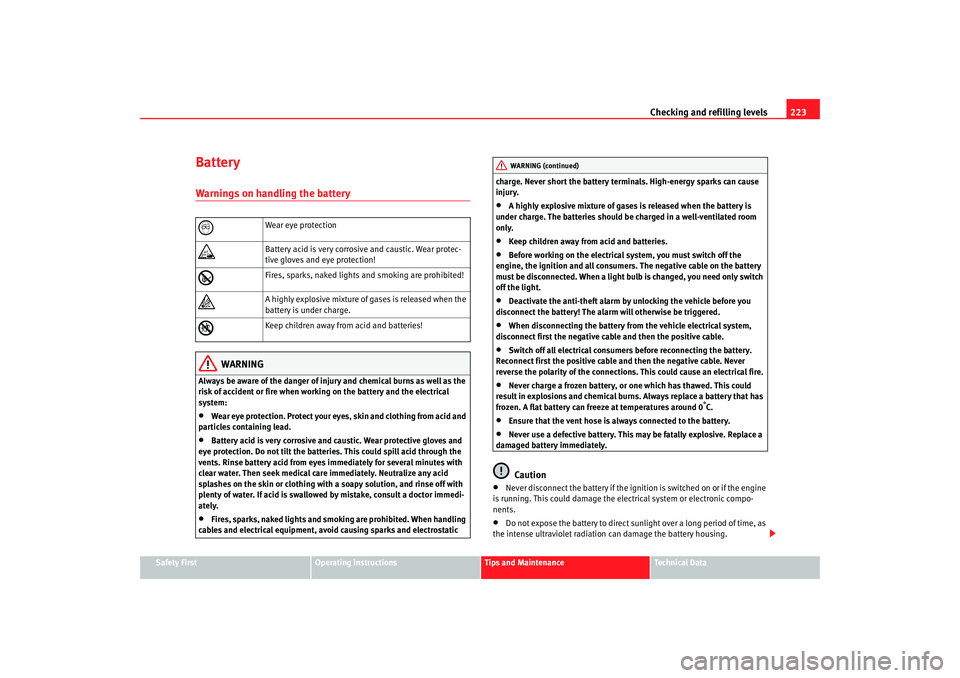
Wear eye protection
Battery acid is very corrosive and caustic. Wear protec-
tive gloves and eye protection!
Fires, sparks, naked lights and smoking are prohibited!
A highly explosive mixture of gases is released when the
battery is under charge.
Keep children away from acid and batteries!
WARNING (continued)
alhambra ingles.book Seite 223 Donnerstag, 19. April 2007 4:04 16
Page 228 of 291
Checking and refilling levels
226Checking tyre pressure
The correct tyre pressure can be seen on the sticker on the
inside of the tank flap.1. Read the required tyre inflation pressure from the sticker. The
values refer to Summer tyres. For Winter tyres, you must add 0.2
bar to the values given on the sticker.
2. The tyre pressures should only be checked when the tyres are cold. The slightly raised pressures of warm tyres must not be
reduced.
3. Adjust the tyre pressure to the load you are carrying.Tyre pressure
The correct tyre pressure is especially important at high speeds. The pressure
should therefore be checked at least once a month and before starting a
journey.
WARNING
A tyre can easily burst if the pressure is too low, causing an accident!•
At continuously high speeds, a tyre with insufficient pressure flexes
more. In this way it becomes too hot, and this can cause tread separation
and tyre blow-out. Always observ e the recommended tyre pressures.
•
If the tyre pressure is too low or too high, the tyres will wear prema-
turely and the vehicle will not h andle well. Risk of accident!For the sake of the environment
Under-inflated tyres will increase fuel consumption.
Tyre service life
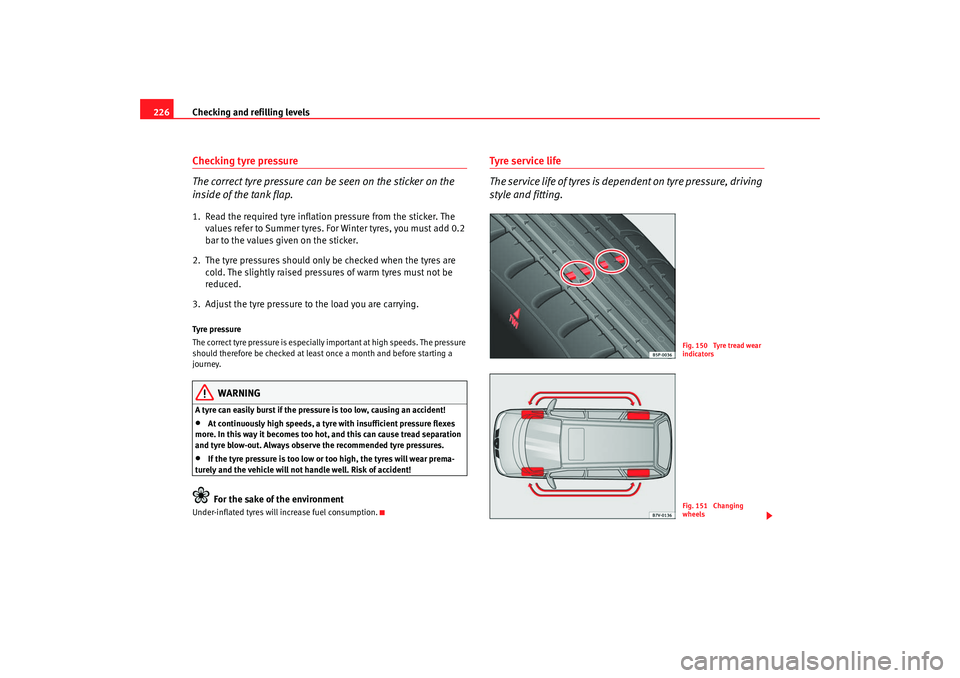
The service life of tyres is dependent on tyre pressure, driving
style and fitting.
Fig. 150 Tyre tread wear
indicatorsFig. 151 Changing
wheels
alhambra ingles.book Seite 226 Donnerstag, 19. April 2007 4:04 16
Page 236 of 291
If and when
234Breakdown set*ComponentsComponents
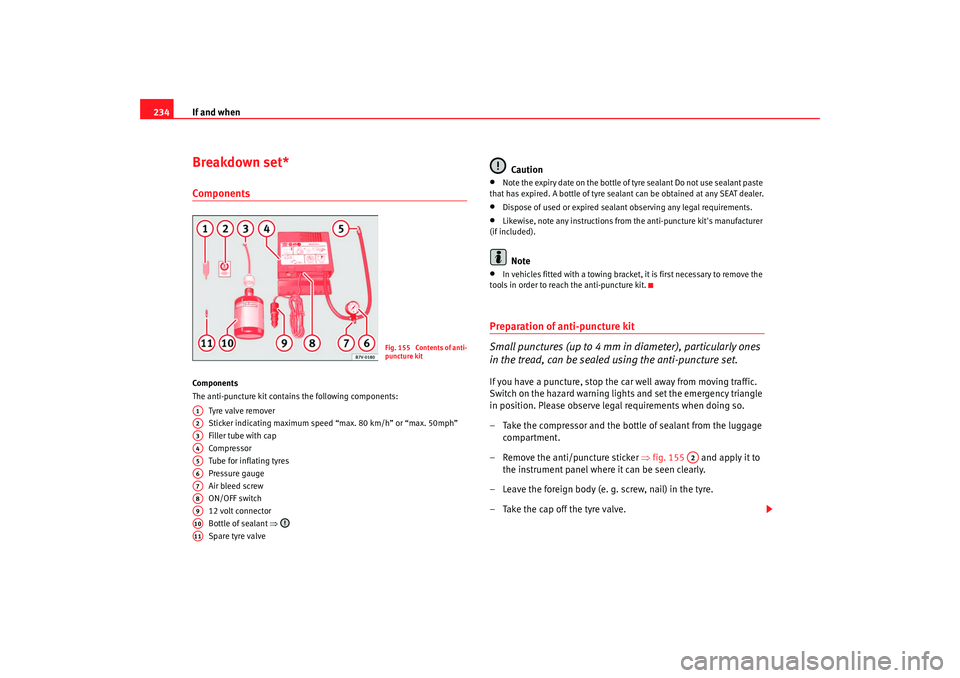
The anti-puncture kit contains the following components:
Tyre valve remover
Sticker indicating maximum speed “max. 80 km/h” or “max. 50mph”
Filler tube with cap
Compressor
Tube for inflating tyres
Pressure gauge
Air bleed screw
ON/OFF switch
12 volt connector
Bottle of sealant ⇒
Spare tyre valve
Caution
•
Note the expiry date on the bottle of tyre sealant Do not use sealant paste
that has expired. A bottle of tyre sealant can be obtained at any SEAT dealer.
•
Dispose of used or expired sealant observing any legal requirements.
•
Likewise, note any instructions from the anti-puncture kit's manufacturer
(if included).Note
•
In vehicles fitted with a towing bracket, it is first necessary to remove the
tools in order to reach the anti-puncture kit.
Preparation of anti-puncture kit
Small punctures (up to 4 mm in diameter), particularly ones
in the tread, can be sealed using the anti-puncture set.If you have a puncture, stop the car well away from moving traffic.
Switch on the hazard warning lights and set the emergency triangle
in position. Please observe legal requirements when doing so.
– Take the compressor and the bottle of sealant from the luggage compartment.
– Remove the anti/puncture sticker ⇒fig. 155 and apply it to
the instrument panel where it can be seen clearly.
– Leave the foreign body (e. g. screw, nail) in the tyre.
– Take the cap off the tyre valve.
Fig. 155 Contents of anti-
puncture kit
A1A2A3A4A5A6A7A8A9A10A11
A2
alhambra ingles.book Seite 234 Donnerstag, 19. April 2007 4:04 16
Page 238 of 291
If and when
236
WARNING
•
Do not allow the sealant to get onto your skin or into your eyes. Risk of
injury.
•
Keep children away from the sealant.
Changing a wheel Preparatory work
You must park the vehicle correctly before changing a tyre.– If you have a flat tyre or puncture, park the car as far away from the flow of traffic as possible on a flat surface.
– Switch off the engine. Switch on the hazard warning lights.
– Apply the handbrake firmly and engage a gear or put the selector in the P position.
– Chock the wheel opposite the wheel being changed with a stone or similar object.
– If you are towing a trailer, unhitch it from your vehicle.
– Remove the spare wheel and the vehicle tools from the luggage compartment.
– All passengers should leave the car. They should wait in a safe place (for instance behind the safety barrier).
WARNING
•
If you have a puncture, stop the car well away from moving traffic.
Switch on the hazard warning lights and set the emergency triangle in
position. Please observe legal requirements when doing so.
•
All passengers should leave the car.
•
Apply the handbrake firmly and engage a gear or put the gear selector
in the P position. Chock the wheel op posite the wheel being changed with
a stone or similar object.
•
If you are towing a trailer, unhitch it from your vehicle.
•
Only use jacks which have been approved for your vehicle by SEAT.
•
Never use other jacks, even if they have been approved for use on other
SEAT models. The jack could slip. Risk of injury.
•
Never start the engine whenthe vehicle is raised. This may cause an
accident.
•
Never place your body (e.g. arm or leg) underneath the vehicle if it is
only supported by the jack Risk of injury.
•
If you have to work underneath th e vehicle, you must use suitable
stands additionally to support the vehicle - Risk of accident!.
alhambra ingles.book Seite 236 Donnerstag, 19. April 2007 4:04 16
Page 242 of 291
If and when
240
NoteThe hexagonal socket in the screwdri ver handle should be used for turning
wheel bolts only. Do not use it to loosen or tighten the wheel bolts.Changing a wheel Removing the wheel
– Using the hexagonal socket in the screwdriver handle, unscrew the slackened wheel bolts and place them on a clean surface.
– Take off the wheel.
– Store the defective wheel as described on ⇒page 233.
Fitting the spare wheel
– Put the spare wheel in place.
– Screw in the wheel bolts and tighten them lightly using the
hexagonal socket.
– Lower the vehicle on the jack.
– Tighten the wheel bolts firmly using the box spanner. Do not tighten the bolts in clockwise or anti-clockwise sequence.
Tighten them in diagonal sequence.Tyres with directional tread pattern
Tyres with directional tread pattern must be mounted so that they rotate in the
correct direction.
A directional tread pattern can be identified by arrows on the sidewall that
point in the direction of rotation. Alwa ys observe the direction of rotation indicated when mounting the wheel. This is important so that these tyres can
give maximum grip and avoid excessive noise, tread wear and aquaplaning.
If, in an emergency, you have to moun
t a wheel so it rotates in the wrong
direction, you must drive extremely care fully. The tyre will not give optimum
performance. This is particularly impo rtant when driving on wet roads. To
benefit from the advantages of tyres with directional tread pattern, the tyre
should be replaced as soon as possible so that it rotates in the correct direc-
tion.
Caution
•
The wheel bolts should be clean and turn easily. Do not grease or oil them.
•
The hexagonal socket in the screwdriver handle should be used for
turning wheel bolts only. Do not use it to loosen or tighten the wheel bolts.
After changing a wheel– Place the wheel with the defective tyre in the spare wheel bracket
⇒page 233.
– Have the flat tyre replaced as quickly as possible.
– Have the tightening torque of the wheel bolts checked as soon as possible with a torque wrench ⇒page 240.
– Check tyre pressure at the next opportunity.
– Avoid fast driving manoeuvres.
alhambra ingles.book Seite 240 Donnerstag, 19. April 2007 4:04 16
Page 244 of 291
If and when
242Colour coding of fuses
WARNING
Never “repair” damaged fuses and neve r replace them with higher rating
fuses. This could cause fires.
Note
•
If a newly inserted fuse blows after a short time, you must have the elec-
trical system checked by a qualifie d dealership as soon as possible.
•
If you replace a fuse with a stronger fuse, you could cause damage to
another location in th e electrical system.
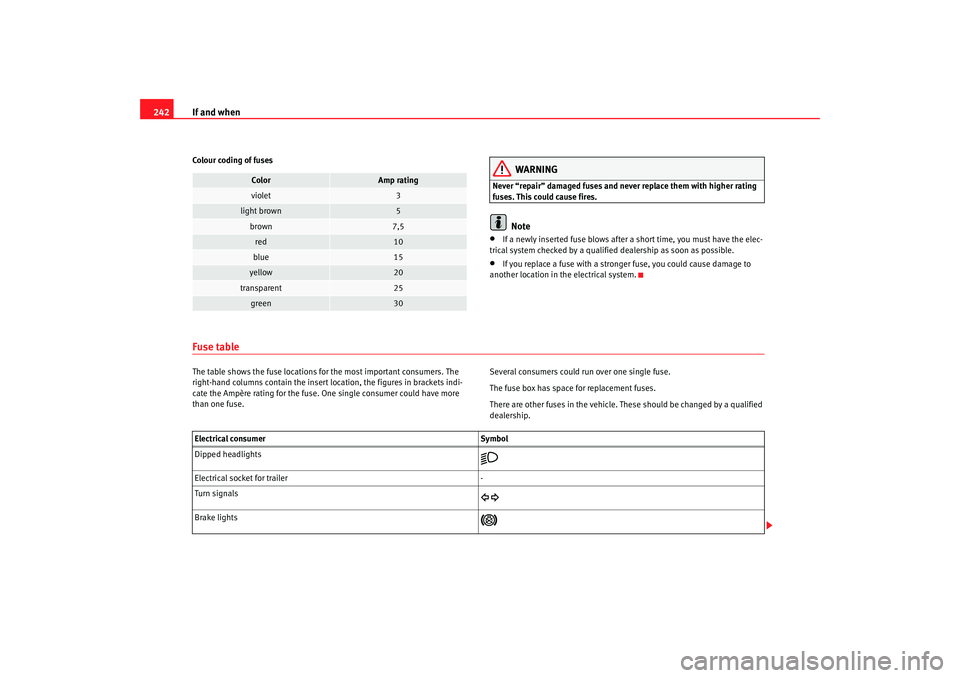
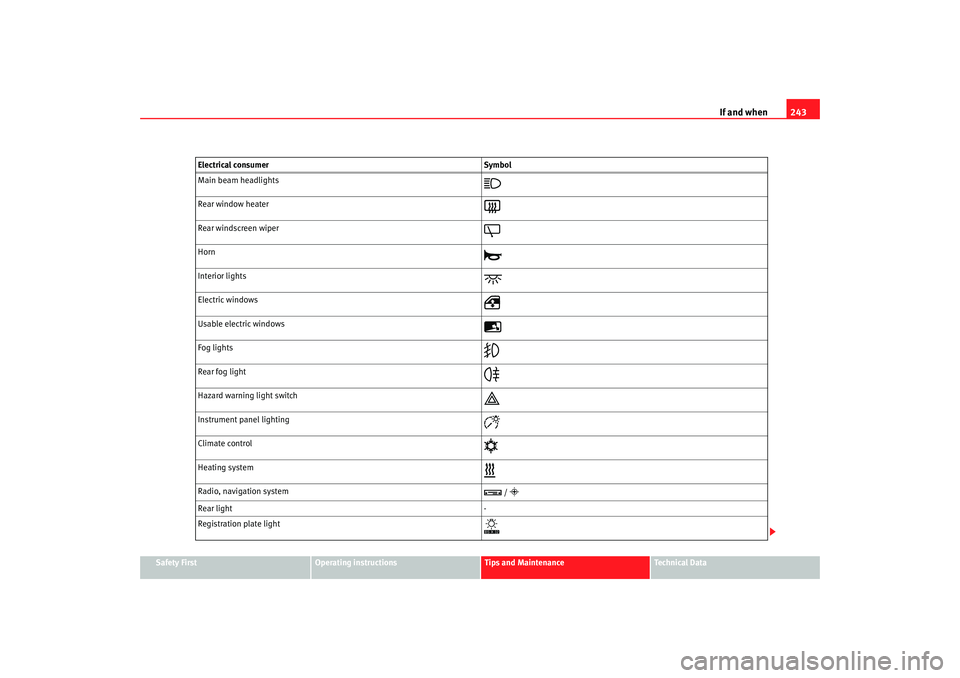
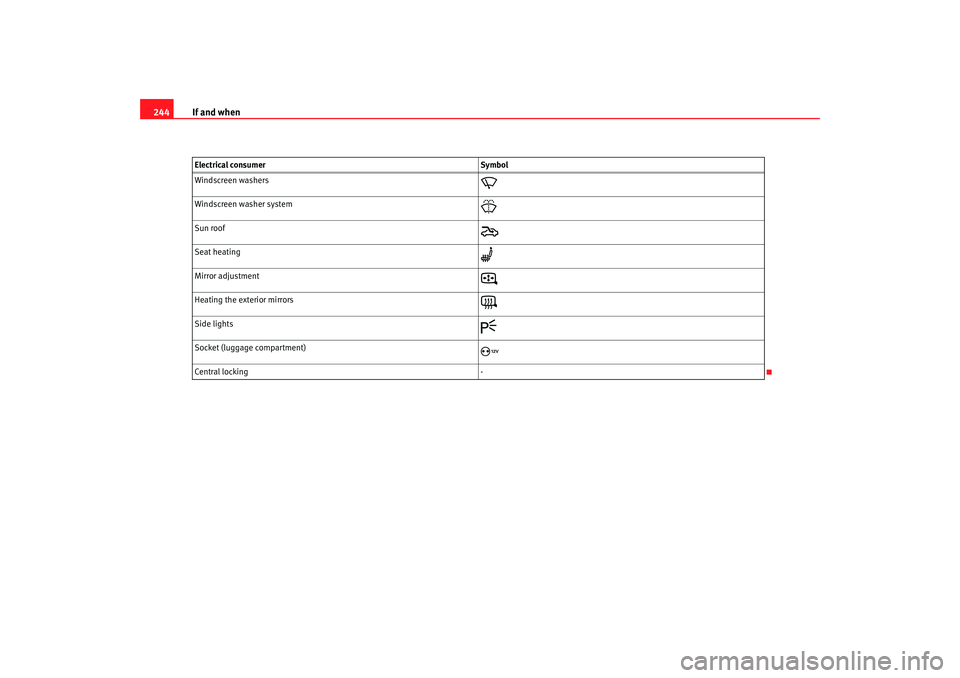
Fuse tableThe table shows the fuse locations fo r the most important consumers. The
right-hand columns contain the insert loc ation, the figures in brackets indi-
cate the Ampère rating for the fuse. One single consumer could have more
than one fuse. Several consumers could run over one single fuse.
The fuse box has space for replacement fuses.
There are other fuses in the vehicle. These should be changed by a qualified
dealership.
Color
Amp rating
violet
3
light brown
5
brown
7,5
red
10
blue
15
yellow
20
transparent
25
green
30
Electrical consumer
Symbol
Dipped headlights
Electrical socket for trailer -
Turn signals
Brake lights
alhambra ingles.book Seite 242 Donnerstag, 19. April 2007 4:04 16
Page 245 of 291
If and when243
Safety First
Operating instructions
Tips and Maintenance
Te c h n i c a l D a t a
Main beam headlights
Rear window heater
Rear windscreen wiper
Horn
Interior lights
Electric windows
Usable electric windows
Fog lights
Rear fog light
Hazard warning light switch
Instrument pa
nel lighting
Climate control
Heating system
Radio, navigation system
/
Rear light -
Registration plate light
Electrical consumer Symbol
alhambra ingles.book Seite 243 Donnerstag, 19. April 2007 4:04 16
Page 246 of 291
If and when
244Windscreen washers
Windscreen washer system
Sun roof
Seat heating
Mirror adjustment
Heating the exterior mirrors
Side lights
Socket (luggage compartment)
Central locking -
Electrical consumer
Symbol
alhambra ingles.book Seite 244 Donnerstag, 19. April 2007 4:04 16
Page 247 of 291
If and when245
Safety First
Operating instructions
Tips and Maintenance
Te c h n i c a l D a t a
Changing a lightBulbs, changing
Bulbs should be changed by a professional mechanic only.Technical knowledge is required to change bulbs. This is because, in certain
cases, access can be gained only by removing other vehicle components.
This applies in particular to bulbs which can be accessed only from the
engine compartment.
We recommend bulbs are changed by a qualified dealership or, if this is not
possible, by a qualified person.
However, if you wish to change the bulb, please observe the following:
Before changing a bulb, you must switch off the light (light switch in O posi-
tion), and the turn signal lever mu st be in the neutral position.
Always replace damaged bulbs with identical bulbs with the same designa-
tion. The type is inscribed on the bulb, either on the glass or on the base.
You should store spare light bulbs in the vehicle for safety-relevant lights.
Bulbs can be obtained from SEAT Service Centres.
WARNING
•
The high voltage element of gas discharge lamps must be handled
correctly. Failure to comply could result in fatal injuries.
•
H7* bulbs are pressurised and could explode when they are being
changed. Risk of injury.
•
In vehicles fitted with gas discharge lamps *, there is a mortal danger if
the high voltage section of th e lamp is incorrectly handled.
•
When working in the engine compartment, always observe the safety
warnings ⇒ page 209.
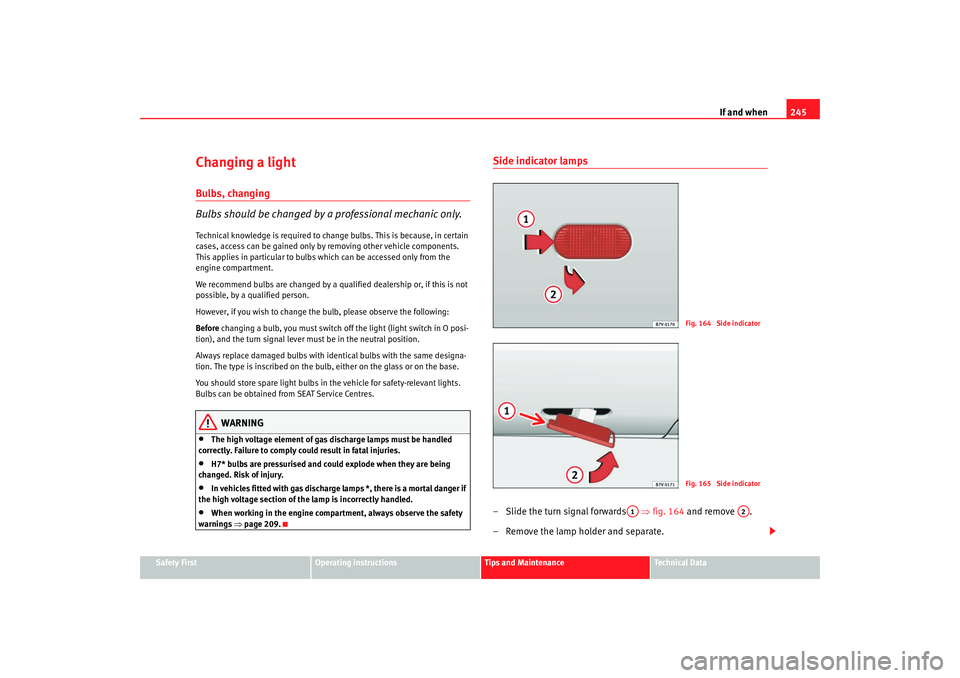
Side indicator lamps– Slide the turn signal forwards ⇒fig. 164 and remove .
– Remove the lamp holder and separate.
Fig. 164 Side indicatorFig. 165 Side indicator
A1
A2
alhambra ingles.book Seite 245 Donnerstag, 19. April 2007 4:04 16
Page 248 of 291
If and when
246
– Remove the failed glass bulb and replace with a new bulb.
– Insert the lamp holder in the turn signal guide rail.
– First fit the turn signal in the opening of the chassis, securing with the tabs ⇒ page 245, fig. 165 and then, fit the bulb as
shown by the arrow .Rear lightsBefore changing a bulb, the tailgate should always be opened.
The lights have the following layout:
On the body
Turn signals, pilot light and brake/rear light
On the tailgate / rear door
Reversing light and rear antifog light.
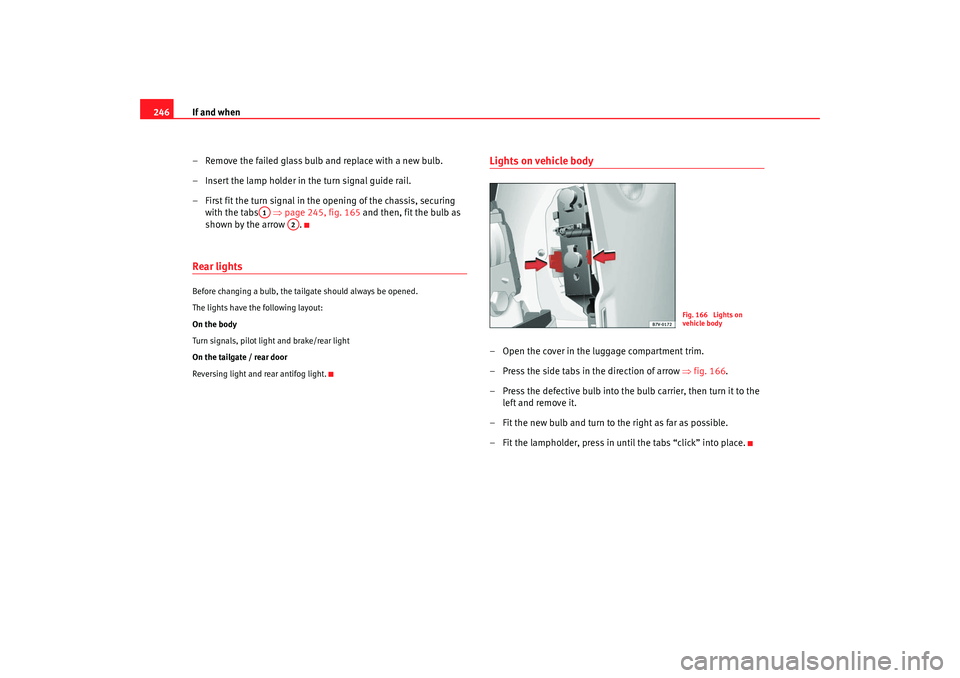
Lights on vehicle body – Open the cover in the luggage compartment trim.
– Press the side tabs in the direction of arrow ⇒fig. 166.
– Press the defective bulb into the bulb carrier, then turn it to the left and remove it.
– Fit the new bulb and turn to the right as far as possible.
– Fit the lampholder, press in until the tabs “click” into place.
A1
A2
Fig. 166 Lights on
vehicle body
alhambra ingles.book Seite 246 Donnerstag, 19. April 2007 4:04 16