seats Seat Alhambra 2007 Owner's Guide
[x] Cancel search | Manufacturer: SEAT, Model Year: 2007, Model line: Alhambra, Model: Seat Alhambra 2007Pages: 291, PDF Size: 9.13 MB
Page 112 of 291
Lights and visibility
110Illumination of instruments and switches
When the headlights are switched on, the brightness of the instruments and
switch lighting can be regulated to suit your requirements by turning the
switch ⇒page 109, fig. 72 .
Headlight range control
Using the headlight range control, you can adjust the headlight range to the
l o ad l ev el that is b e i ng ca r r i e d in t he ve h ic l e . In t h is way i t is p o ssi ble to a vo i d
dazzling oncoming traffic more than necessary. At the same time, the driver
has the best possible lighting for the road ahead using the correct headlight
settings.
The headlights can only be adjusted when the dipped beam is switched on.
To lower the beam, turn the switch down from the basic setting 0.
If the vehicle load does not correspond to those shown in the table, it is
possible to select intermediary positions.
Dynamic headlight range control
Vehicles with gas discharge lamps
19) (“xenon lamps”) are equipped with
dynamic headlight range control. When the dipped light is switched on, the
range of the headlights adjusts to the vehicle load condition. In these vehi-
cles, the control is not available.
WARNING
In order not to dazzle other drivers, the dipped light should be adjusted
according to the vehicle load using the headlight range control. If not, an
accident may occur.•
Use the switch to lower the light cone, depending on the vehicle load.
Hazard warning lights
The hazard warning lights are used to draw the attention of
other road users to your vehicle in emergencies.If you have a breakdown:
1. Park your vehicle at a safe distance from moving traffic.
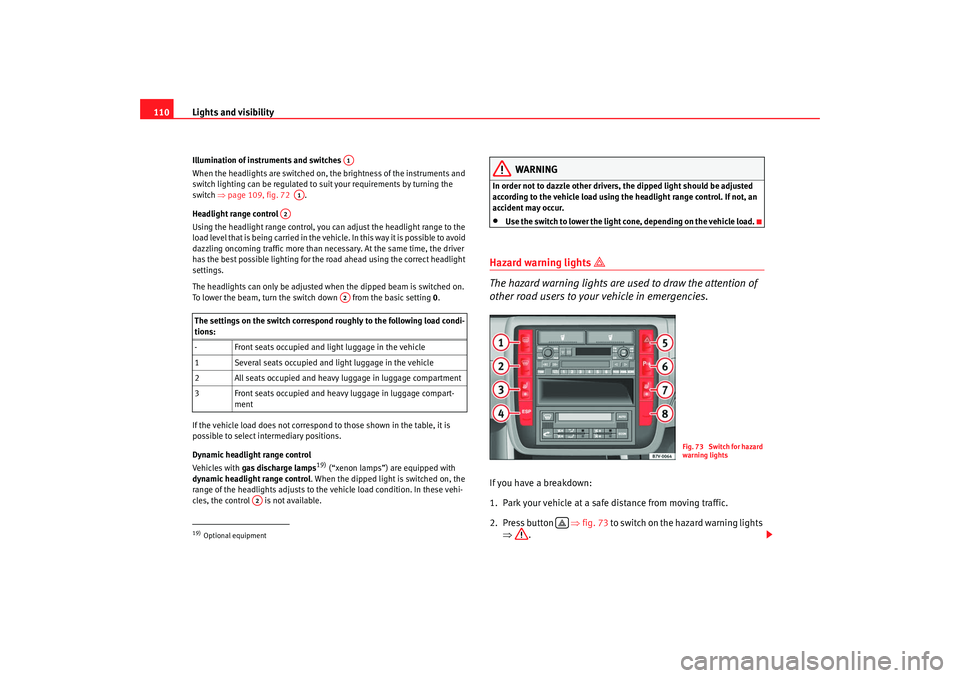
2. Press button ⇒fig. 73 to switch on the hazard warning lights
⇒ .
The settings on the switch correspond roughly to the following load condi-
tions:
- Front seats occupied and light luggage in the vehicle
1 Several seats occupied and light luggage in the vehicle
2 All seats occupied and heavy luggage in luggage compartment
3 Front seats occupied and heavy luggage in luggage compart- ment19)Optional equipment
A1
A1
A2
A2
A2
Fig. 73 Switch for hazard
warning lights
alhambra ingles.book Seite 110 Donnerstag, 19. April 2007 4:04 16
Page 123 of 291
Seats and stowage121
Safety First
Operating instructions
Tips and Maintenance
Te c h n i c a l D a t a
Seats and stowageThe importance of correct seat adjustmentProper seat adjustment optimi ses the level of protection
offered by seat belts and airbags.The driver seat, front passenger seat, and seats in the passenger compart-
ment, can be adjusted in many ways to suit the physical requirements of the
vehicle occupants. The correct seat position is very important for:•
fast and easy operation of all controls on the instrument panel,
•
relaxed posture that does not cause drowsiness,
•
safe driving,
•
optimum protection from the seat belts and airbag system ⇒page 7.
Vehicle seats
Your vehicle has a total of five or seven
24) seats.
•
First row of seats: two seats
•
Second row of seats: three seats
•
Third row of seats
24): two seats
Each seat is equipped with a three-point seat belt.
WARNING
If the driver and passengers assume improper sitting positions, they may
sustain critical injuries.•
Never transport more people than there are seats available in the
vehicle.
•
Every occupant in the vehicle must properly fasten and wear the seat
belt belonging to his or her seat. Chil dren must be protected with an appro-
priate child restraint system. Section “Child Safety”
•
The seats and all head restraints must always be adjusted to body size
and the seat belt must always be prop erly adjusted to provide you and your
passengers with optimum protection.
•
Always keep your feet in the footwell when the vehicle is moving; never
rest them on the dash panel, out of the window or on the seat. This also
applies to passengers. An incorrect sitting position exposes you to an
increased risk of injury in the event of a braking manoeuvre or an accident.
If the airbag is triggered, you could sustain fatal injuries due to an improper
sitting position.
•
It is important for the driver and front passenger to maintain a distance
of at least 25 cm from the steering wheel or dash panel. Failure to respect
the minimum distance means that the airbag will not protect you. Risk of
fatal injury. The distance between the driver and the steering wheel or
between the front passenger and the dash panel should always be as great
as possible.
•
Adjust the driver or front passenger seat only when the vehicle is
stationary. Otherwise your seat coul d move unexpectedly while the vehicle
is moving. This could increase the risk of an accident and therefore injury.
In addition, while adjusting your seat, you will assume an incorrect sitting
position. Risk of fatal accidents.
•
Special guidelines apply to installing a child seat on the front
passenger seat. When installing a child seat, observe the warning note in
“Child safety”.
•
The seats in the third row of seats may, for safety reasons, only be used
if the luggage compartment cover has been removed.
24)Optional equipment
WARNING (continued)
alhambra ingles.book Seite 121 Donnerstag, 19. April 2007 4:04 16
Page 124 of 291
Seats and stowage
122Head restraintsCorrect adjustment of head restraints
Properly adjusted head restraints are an important part of
occupant protection and can redu ce the risk of injuries in
most accident situations.
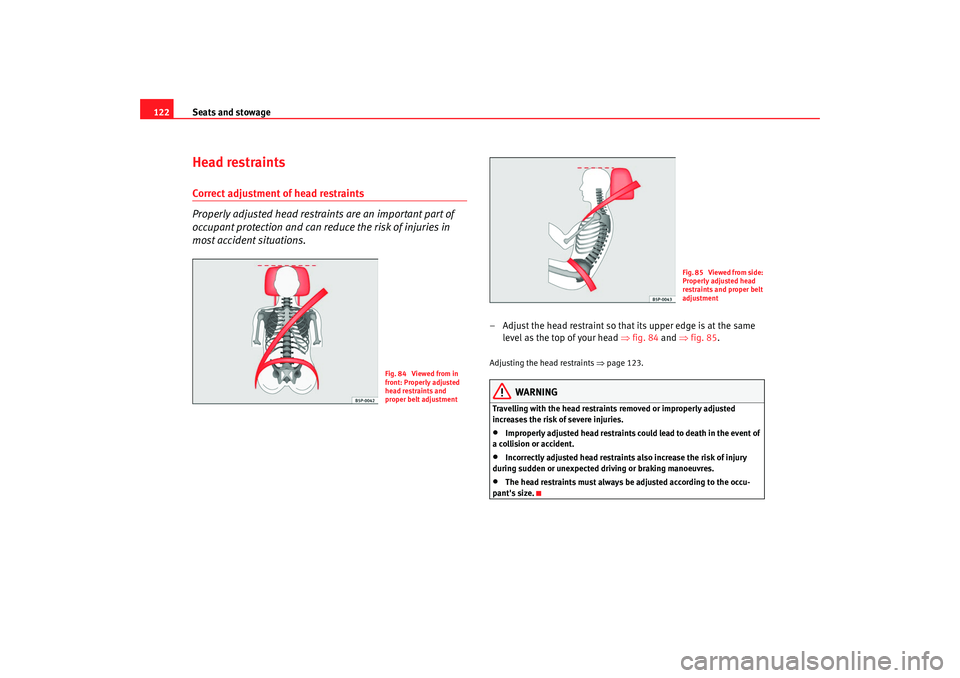
– Adjust the head restraint so that its upper edge is at the same
level as the top of your head ⇒fig. 84 and ⇒ fig. 85.Adjusting the head restraints ⇒page 123.
WARNING
Travelling with the head restraints removed or improperly adjusted
increases the risk of severe injuries.•
Improperly adjusted head restraints could lead to death in the event of
a collision or accident.
•
Incorrectly adjusted head restraints also increase the risk of injury
during sudden or unexpected driving or braking manoeuvres.
•
The head restraints must always be adjusted according to the occu-
pant's size.
Fig. 84 Viewed from in
front: Properly adjusted
head restraints and
proper belt adjustment
Fig. 85 Viewed from side:
Properly adjusted head
restraints and proper belt
adjustment
alhambra ingles.book Seite 122 Donnerstag, 19. April 2007 4:04 16
Page 125 of 291
Seats and stowage123
Safety First
Operating instructions
Tips and Maintenance
Te c h n i c a l D a t a
Removing or adjusting head restraints
The head restraints can be adju sted by moving them up and
down.Adjusting height
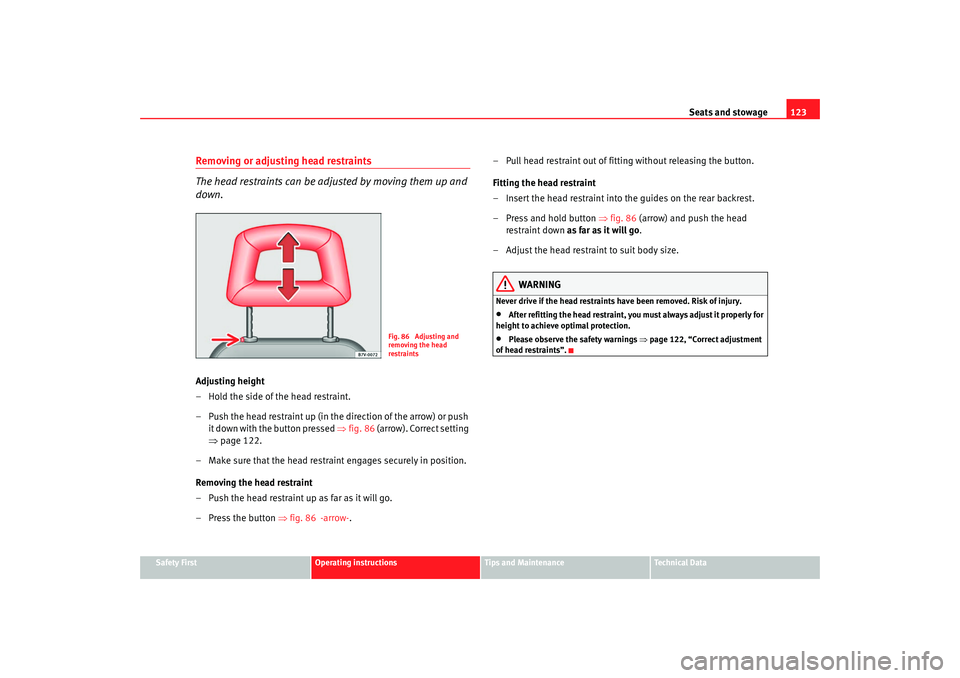
– Hold the side of the head restraint.
– Push the head restraint up (in the direction of the arrow) or push
it down with the button pressed ⇒ fig. 86 (arrow). Correct setting
⇒ page 122.
– Make sure that the head restraint engages securely in position.
Removing the head restraint
– Push the head restraint up as far as it will go.
– Press the button ⇒fig. 86 -arrow-. – Pull head restraint out of fitting without releasing the button.
Fitting the head restraint
– Insert the head restraint into the guides on the rear backrest.
– Press and hold button ⇒
fig. 86 (arrow) and push the head
restraint down as far as it will go .
– Adjust the head restraint to suit body size.
WARNING
Never drive if the head restraints have been removed. Risk of injury.•
After refitting the head restraint, you must always adjust it properly for
height to achieve optimal protection.
•
Please observe the safety warnings ⇒page 122, “Correct adjustment
of head restraints”.
Fig. 86 Adjusting and
removing the head
restraints
alhambra ingles.book Seite 123 Donnerstag, 19. April 2007 4:04 16
Page 126 of 291
Seats and stowage
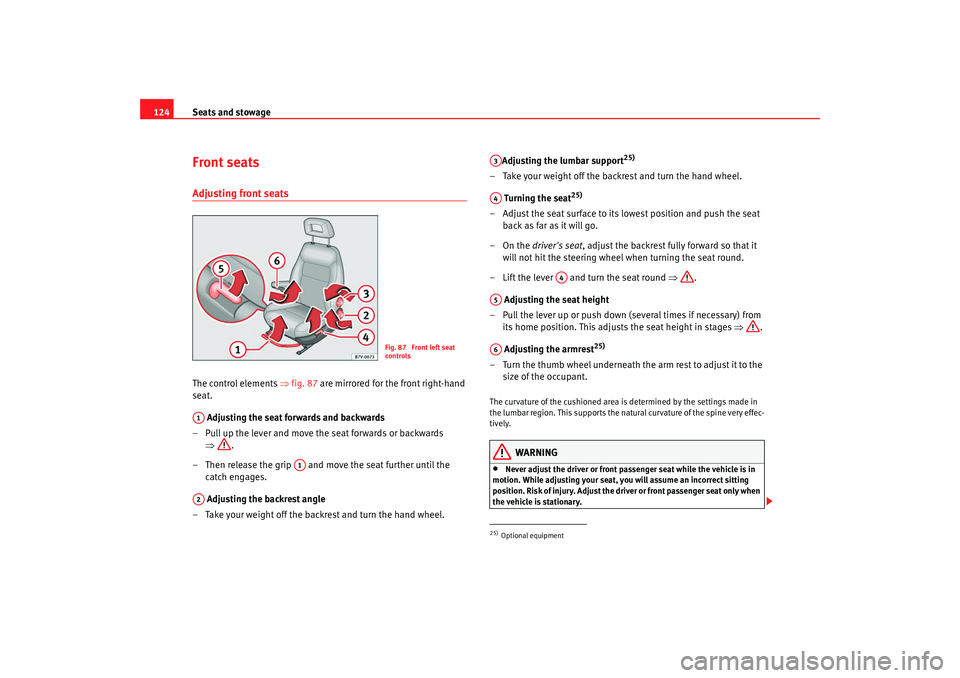
124Front seatsAdjusting front seats The control elements ⇒fig. 87 are mirrored for the front right-hand
seat.
Adjusting the seat forwards and backwards
– Pull up the lever and move the seat forwards or backwards ⇒ .
– Then release the grip and move the seat further until the catch engages.
Adjusting the backrest angle
– Take your weight off the backrest and turn the hand wheel. Adjusting the lumbar support
25)
– Take your weight off the backrest and turn the hand wheel.
Turning t he seat
25)
– Adjust the seat surface to its lowest position and push the seat back as far as it will go.
–On the driver's seat , adjust the backrest fully forward so that it
will not hit the steering wheel when turning the seat round.
– Lift the lever and turn the seat round ⇒.
Adjusting the seat height
– Pull the lever up or push down (several times if necessary) from its home position. This adjusts the seat height in stages ⇒ .
Adjusting the armrest
25)
– Turn the thumb wheel underneath th e arm rest to adjust it to the
size of the occupant.The curvature of the cushioned area is determined by the settings made in
the lumbar region. This supp orts the natural curvature of the spine very effec-
tively.
WARNING
•
Never adjust the driver or front passenger seat while the vehicle is in
motion. While adjusting your seat, you will assume an incorrect sitting
position. Risk of injury. Adjust the dr iver or front passenger seat only when
the vehicle is stationary.
Fig. 87 Front left seat
controls
A1
A1
A2
25)Optional equipmentA3A4
A4
A5A6
alhambra ingles.book Seite 124 Donnerstag, 19. April 2007 4:04 16
Page 127 of 291
Seats and stowage125
Safety First
Operating instructions
Tips and Maintenance
Te c h n i c a l D a t a
•
To reduce the risk of injury to the driver and front passenger during
sudden braking manoeuvres or an accident, never drive with the backrest
tilted far back. Risk of injury. The maximum protection of the seat belt can
be achieved only when the backrests are in an upright position and the
driver and front passenger have properly adjusted their seat belts. The
further the backrests are tilted to the rear, the greater the risk of injury due
to improper positioning of the belt web!
•
Exercise caution when adjusting the seat height or forwards/back-
wards position. Injuries can be caused if the backrest is tilted without due
care and attention.
•
Never turn the driver or front passenger seat while the vehicle is in
motion. While adjusting your seat, you will assume an incorrect sitting
position. Risk of injury. Only turn the driver or passenger seats when the
vehicle is stationary.
•
When the vehicle is in motion, the rotating front seats must be securely
engaged and facing the direction of travel. These front seats may be used
only when the vehicle is stationary.Caution
The driver seat and front passenger seat must not be occupied while they are
being turned. If the seat is occupied when it is turned, it could be damaged.
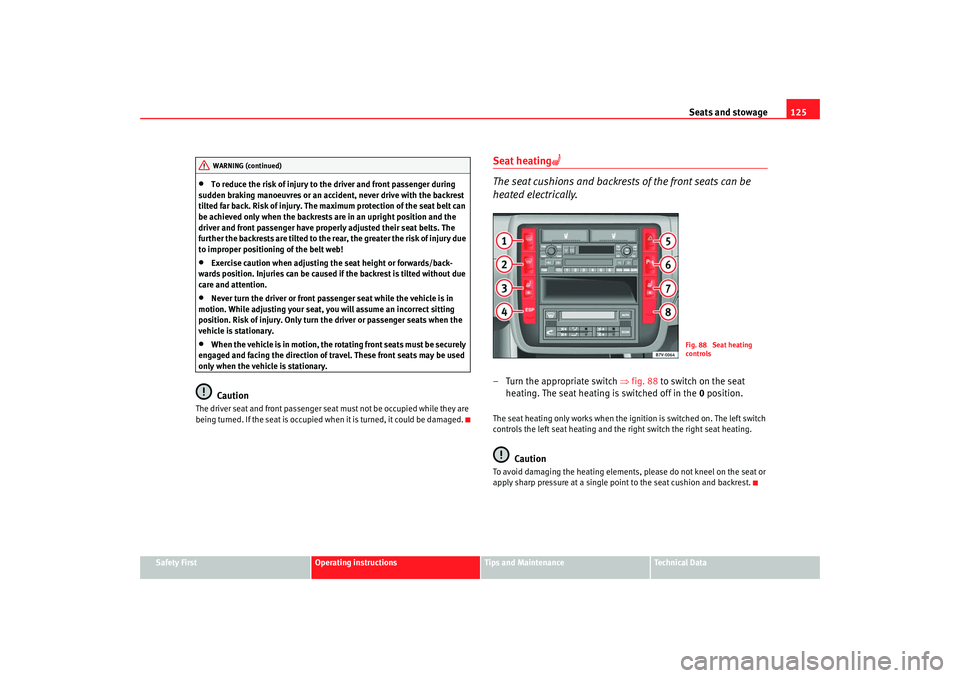
Seat heating
The seat cushions and backrests of the front seats can be
heated electrically.– Turn the appropriate switch ⇒fig. 88 to switch on the seat
heating. The seat heating is switched off in the 0 position.The seat heating only works when the ignition is switched on. The left switch
controls the left seat heating and the right switch the right seat heating.
Caution
To avoid damaging the heating elements, please do not kneel on the seat or
apply sharp pressure at a single point to the seat cushion and backrest.
WARNING (continued)
Fig. 88 Seat heating
controls
alhambra ingles.book Seite 125 Donnerstag, 19. April 2007 4:04 16
Page 128 of 291
Seats and stowage
126Rear seatsCharacteristics of seat equipmentThe seats in the passenger compartment have the following features,
depending on the equipment level:•
Integrated three-point seat belt with adjustable latch plate holder,
•
Integrated ISOFIX anchor points for a child seat,
•
Height-adjustable head restraints ⇒page 122
•
Room for just one person,
•
Adjustable armrests
26).
•
Individual seats can be removed ⇒ page 129,
•
Integrated child seats
26).
Seat with integrated child seat
Seats with an integrated child seat have the same functions as the conven-
tional individual seats. The integrated child seat is described in “Safety
first”.
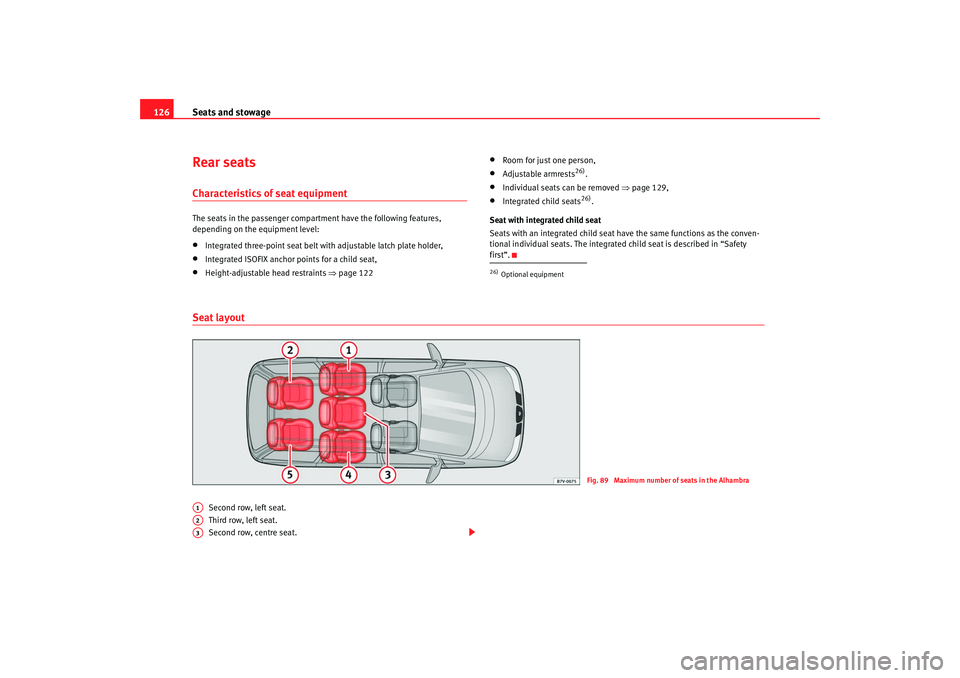
Seat layout
Second row, left seat.
Third row, left seat.
Second row, centre seat.
26)Optional equipment
Fig. 89 Maximum number of seats in the Alhambra
A1A2A3
alhambra ingles.book Seite 126 Donnerstag, 19. April 2007 4:04 16
Page 129 of 291
Seats and stowage127
Safety First
Operating instructions
Tips and Maintenance
Te c h n i c a l D a t a
Second row, right seat.
27)
Third row, right seat.
27)
Notes on the installation of the seats•
Seats and are of the same construction and thus interchangeable.
•
Seats and are of the same construction and thus interchangeable.
•
Seat can be installed in positions .
•
Seat can be installed in place of seats , , and .
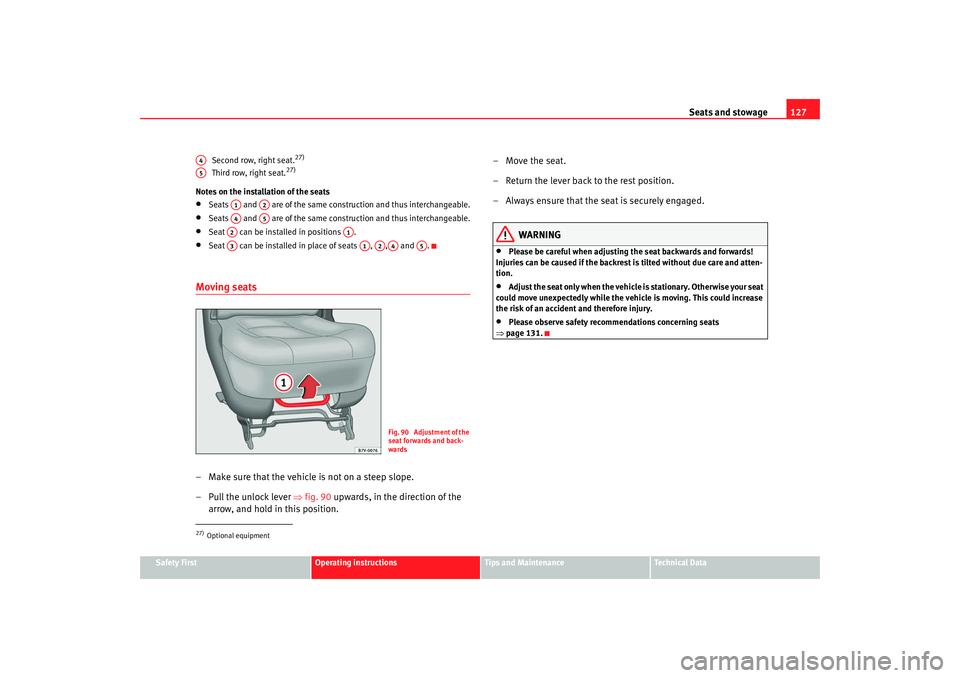
Moving seats – Make sure that the vehicle is not on a steep slope.
– Pull the unlock lever
⇒fig. 90 upwards, in the direction of the
arrow, and hold in this position. –Move the seat.
– Return the lever back to the rest position.
– Always ensure that the seat is securely engaged.
WARNING
•
Please be careful when adjusting the seat backwards and forwards!
Injuries can be caused if the backrest is tilted without due care and atten-
tion.
•
Adjust the seat only when the vehicl e is stationary. Otherwise your seat
could move unexpectedly while the vehicle is moving. This could increase
the risk of an accident and therefore injury.
•
Please observe safety recommendations concerning seats
⇒ page 131.
27)Optional equipmentA4A5
A1
A2
A4
A5
A2
A1
A3
A1
A2A4
A5
Fig. 90 Adjustment of the
seat forwards and back-
wards
alhambra ingles.book Seite 127 Donnerstag, 19. April 2007 4:04 16
Page 130 of 291
Seats and stowage
128Folding the backrest and the seat forwards
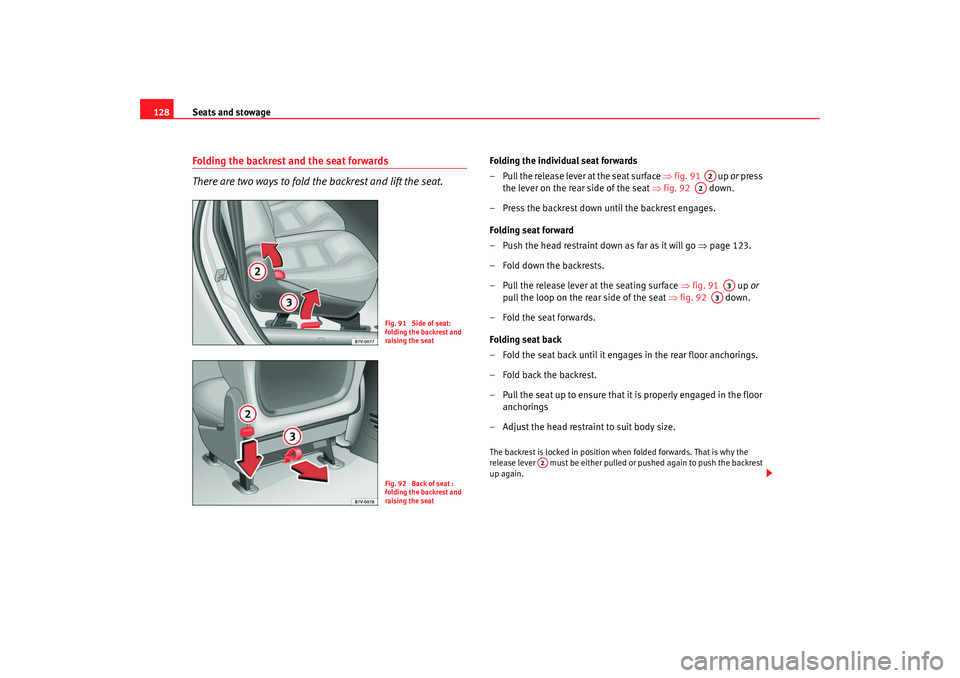
There are two ways to fold the backrest and lift the seat.
Folding the individual seat forwards
– Pull the release lever at the seat surface ⇒fig. 91 up or press
the lever on the rear side of the seat ⇒fig. 92 down.
– Press the backrest down until the backrest engages.
Folding seat forward
– Push the head restraint down as far as it will go ⇒page 123.
– Fold down the backrests.
– Pull the release lever at the seating surface ⇒fig. 91 up or
pull the loop on the rear side of the seat ⇒fig. 92 down.
– Fold the seat forwards.
Folding seat back
– Fold the seat back until it engages in the rear floor anchorings.
– Fold back the backrest.
– Pull the seat up to ensure that it is properly engaged in the floor anchorings
– Adjust the head restraint to suit body size.The backrest is locked in position when folded forwards. That is why the
release lever must be either pulled or pushed again to push the backrest
up again.
Fig. 91 Side of seat:
folding the backrest and
raising the seatFig. 92 Back of seat :
folding the backrest and
raising the seat
A2
A2
A3
A3
A2
alhambra ingles.book Seite 128 Donnerstag, 19. April 2007 4:04 16
Page 131 of 291
Seats and stowage129
Safety First
Operating instructions
Tips and Maintenance
Te c h n i c a l D a t a
WARNING
If you do not hold the backrest firmly when you operate the lever for
adjusting the backrest angle, the backrest will be pushed forward by
springs. Risk of injury.•
Always hold the backrest firmly when you adjust the backrest angle.
•
Please observe safety recommendations concerning seats
⇒ page 131.
Removing and fitting individual seats
The seats can be fitted and removed more easily by two
people than by one person.
Removing an individual seat
– Push the head restraint down as far as it will go ⇒page 123.
– Fold down the backrests ⇒page 128.
– Fold the seat forwards ⇒page 128.
– When removing a seat in the third row
28)
, push the seat back as
far as it will go and forwards as far as it will go when removing a
seat in the second row.
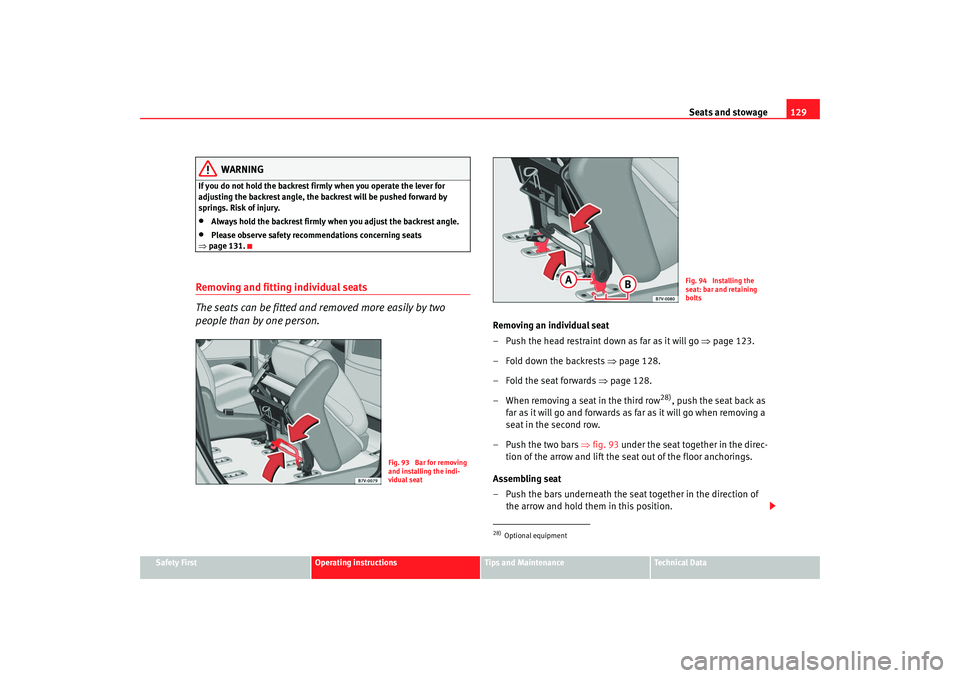
– Push the two bars ⇒fig. 93 under the seat together in the direc-
tion of the arrow and lift the se at out of the floor anchorings.
Assembling seat
– Push the bars underneath the seat together in the direction of
the arrow and hold them in this position.
Fig. 93 Bar for removing
and installing the indi-
vidual seat
28)Optional equipment
Fig. 94 Installing the
seat: bar and retaining
bolts
alhambra ingles.book Seite 129 Donnerstag, 19. April 2007 4:04 16