clutch Seat Alhambra 2007 Owner's Manual
[x] Cancel search | Manufacturer: SEAT, Model Year: 2007, Model line: Alhambra, Model: Seat Alhambra 2007Pages: 291, PDF Size: 9.13 MB
Page 11 of 291
Safe driving9
Safety First
Operating instructions
Tips and Maintenance
Te c h n i c a l D a t a
– If possible, avoid driving when you are tired or are under pres-
sure of time.
WARNING
When driving safety is impaired during a trip, the risk of injury and acci-
dents increases.Proper sitting position for occupantsProper sitting position for driver
The proper sitting position for the driver is important for safe
and relaxed driving.
For your own safety and to reduce the risk of injury in the event of an
accident, we recommend the following adjustments for the driver:
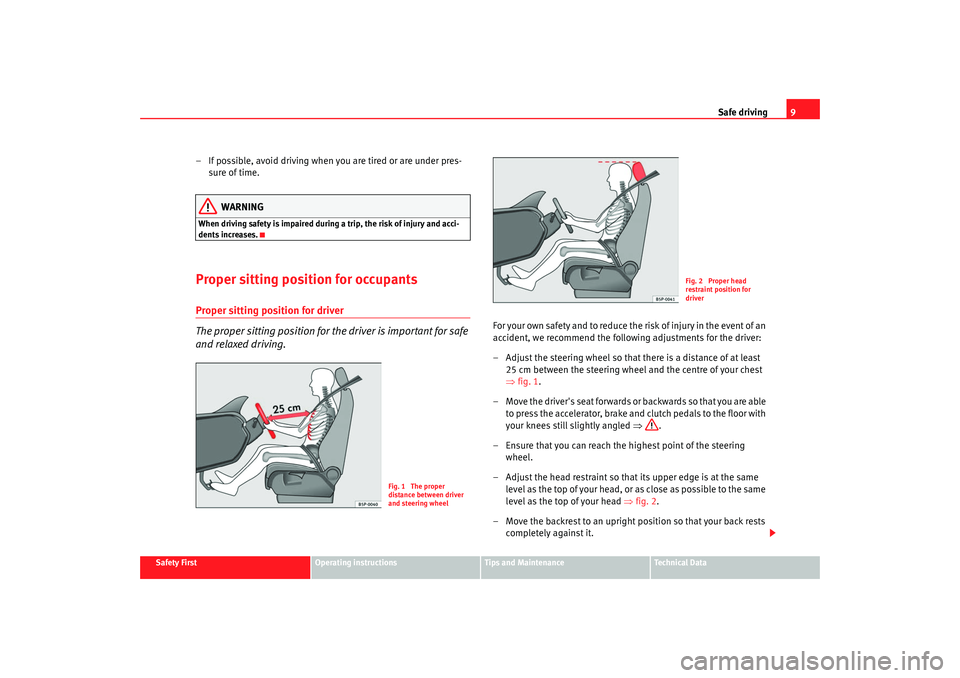
– Adjust the steering wheel so that there is a distance of at least
25 cm between the steering wheel and the centre of your chest
⇒ fig. 1.
– Move the driver's seat forwards or backwards so that you are able to press the accelerator, brake and clutch pedals to the floor with
your knees still slightly angled ⇒.
– Ensure that you can reach the highest point of the steering wheel.
– Adjust the head restraint so that its upper edge is at the same level as the top of your head, or as close as possible to the same
level as the top of your head ⇒fig. 2.
– Move the backrest to an upright position so that your back rests completely against it.
Fig. 1 The proper
distance between driver
and steering wheel
Fig. 2 Proper head
restraint position for
driver
alhambra ingles.book Seite 9 Donnerstag, 19. April 2007 4:04 16
Page 16 of 291
Safe driving
14Pedal areaPedals
The operation and freedom of movement of all pedals must
never be impaired by objects or floor mats.– Ensure that you can always press the accelerator, brake and
clutch pedals unimpaired to the floor.
– Ensure that the pedals can return unimpaired to their initial posi- tions.Use only floor mats which leave the pedal area free and can be securely
fastened in the foot well.
If a brake circuit fails, the brake pedal must be free to move further than
normal in order to bring the vehicle to a stop.
Wear suitable shoes
Always wear shoes which support your feet properly and give you a good feel
for the pedals.
WARNING
•
Restricting pedal operation can lead to critical situations while driving.
•
Never place objects in the driver foot well. An object could move into the
pedal area and impair pedal operation. In the event of a sudden driving or
braking manoeuvre, you will not be ab le to operate the brake, clutch or
accelerator pedal. Risk of accident!
Floor mats on the driver side
Only floor mats may be used which can be securely fastened
in the foot well and do not impair operation of the pedals.– Ensure that the floor mats are securely fastened during the trip and do not obstruct the pedals ⇒.Only use floor mats which leave the pedals clear and which are secured to
prevent them from slipping. You can obta in suitable floor mats from a quali-
fied dealership.
WARNING
•
If the pedals are obstructed, you could cause an accident. Risk of
serious injuries.
•
Ensure that the floor mats are always securely attached.
•
Never lay or fit floor mats or other floor coverings over the original floor
mats. This would reduce the pedal area and could obstruct the pedals. Risk
of accident.
Stowing luggageLoading the luggage compartment
All luggage and other loose objects must be safely secured in
the luggage compartment.Unsecured objects which shift back and forth could impair the
driving safety or driving characteristics of the vehicle by shifting the
centre of gravity.
alhambra ingles.book Seite 14 Donnerstag, 19. April 2007 4:04 16
Page 138 of 291
Seats and stowage
136Coat hooks are located in the roof. They are integrated in the grab handles in
the passenger compartment.
Location of CD changer
31)
The CD changer, which can be factory fitted, is located either in the dash
panel or in the right-hand stowage compartment in the luggage compart-
ment.
WARNING
•
Ensure that no objects can fall fr om the dash panel or other stowage
areas into the driver footwell while the vehicle is moving. In the event of a
sudden braking manoeuvre, you will not be able to use the brake, clutch or
accelerator. Risk of accident.
•
Clothing hung on the coat hooks must not restrict the driver's view.
Risk of accident. The coat hooks are intended only for use with light arti-
cles of clothing. Do not leave any ha rd, sharp or heavy objects in hanging
articles of clothing. During sudden braking manoeuvres or accidents, espe-
cially those involving airbag deployment, these objects could injure the
vehicle occupants.
Cup holders
In the centre console: there are two cup holdersOpening cup holder
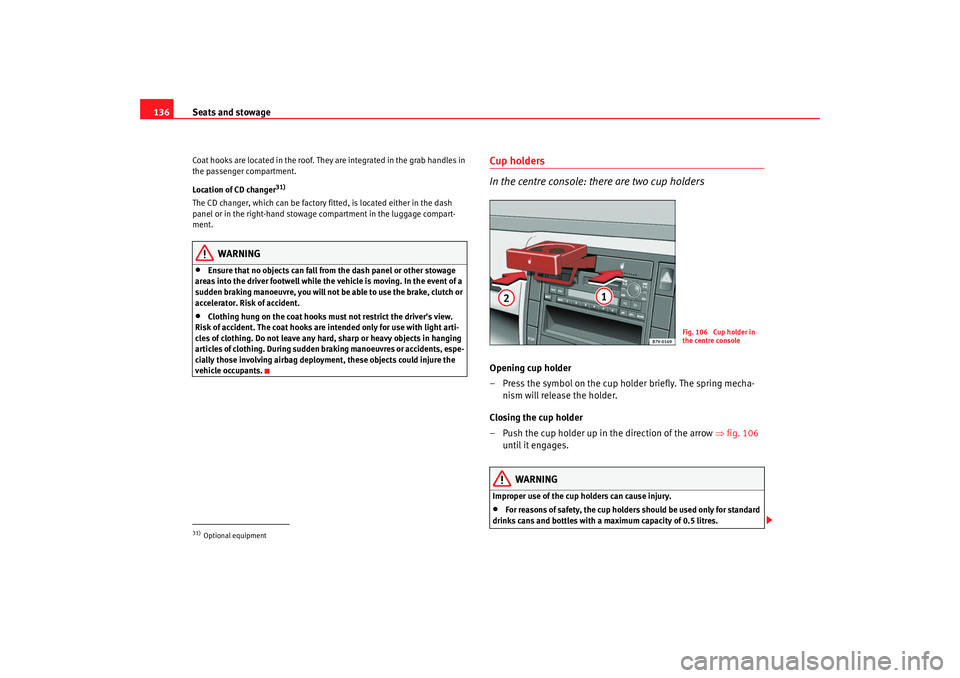
– Press the symbol on the cup holder briefly. The spring mecha- nism will release the holder.
Closing the cup holder
– Push the cup holder up in the direction of the arrow ⇒ fig. 106
until it engages.
WARNING
Improper use of the cup holders can cause injury.•
For reasons of safety, the cup holders should be used only for standard
drinks cans and bottles with a maximum capacity of 0.5 litres.
31)Optional equipment
Fig. 106 Cup holder in
the centre console
alhambra ingles.book Seite 136 Donnerstag, 19. April 2007 4:04 16
Page 139 of 291
Seats and stowage137
Safety First
Operating instructions
Tips and Maintenance
Te c h n i c a l D a t a
•
Never place hot drinks in the drink holders. During normal or sudden
driving manoeuvres, sudden braking or an accident, the hot drink could be
spilled. Danger of scalding.
•
Ensure, when driving, that no can or other object is dropped in the
driver footwell, as it could get under the pedals and obstruct their working.
In the event of a sudden driving or braking manoeuvre, you will not be able
to operate the brake, clutch or accelerator pedal. Risk of accident!
•
Never leave closed drinks cans in direct sunlight for any length of time.
If the inside temperature is high they could explode.Caution
When driving, do not leave open cans in the cup holders. The drink might be
spilt on braking, for example, and could damage the vehicle.
Note
There is no left-hand cup holder on vehicles fitted with a hands-free tele-
phone system
32)
Folding table
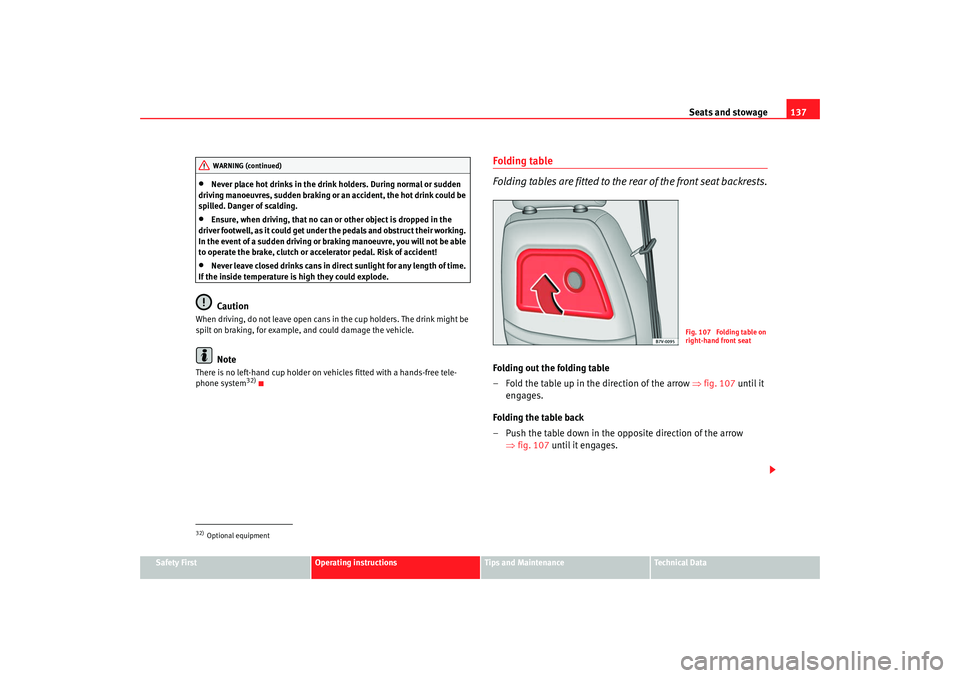
Folding tables are fitted to the rear of the front seat backrests.Folding out the folding table
– Fold the table up in the direction of the arrow ⇒fig. 107 until it
engages.
Folding the table back
– Push the table down in the opposite direction of the arrow ⇒fig. 107 until it engages.
32)Optional equipmentWARNING (continued)
Fig. 107 Folding table on
right-hand front seat
alhambra ingles.book Seite 137 Donnerstag, 19. April 2007 4:04 16
Page 141 of 291
Seats and stowage139
Safety First
Operating instructions
Tips and Maintenance
Te c h n i c a l D a t a
The seats in the second row are fitted with a net bag ⇒
page 138, fig. 109 for
the stowage of small objects.
The bag will hold a newspaper, can or standard bottle of up to a maximum of
0.5 litres ⇒ .
WARNING
•
Ensure, when driving, that no can or other object is dropped in the
driver footwell, as it could get under the pedals and obstruct their working.
In the event of a sudden driving or braking manoeuvre, you will not be able
to operate the brake, clutch or accelerator pedal. Risk of accident!
Ashtrays, cigarette lighter and electrical
socketsFront ashtray
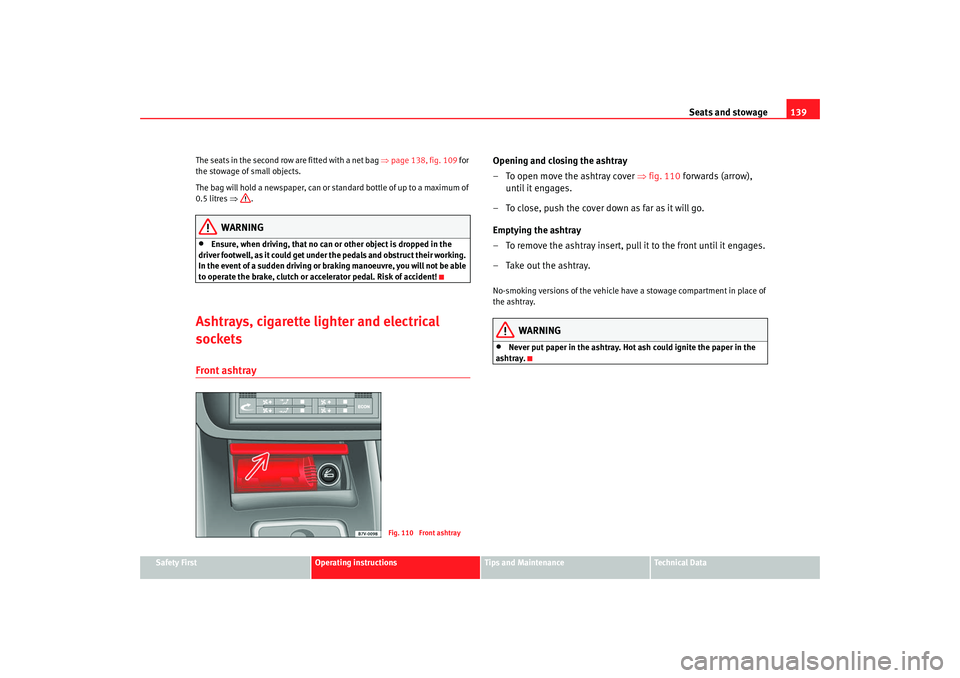
Opening and closing the ashtray
– To open move the ashtray cover ⇒fig. 110 forwards (arrow),
until it engages.
– To close, push the cover down as far as it will go.
Emptying the ashtray
– To remove the ashtray insert, pull it to the front until it engages.
– Take out the ashtray.No-smoking versions of the vehicle have a stowage compartment in place of
the ashtray.
WARNING
•
Never put paper in the ashtray. Hot ash could ignite the paper in the
ashtray.
Fig. 110 Front ashtray
alhambra ingles.book Seite 139 Donnerstag, 19. April 2007 4:04 16
Page 165 of 291
Driving163
Safety First
Operating instructions
Tips and Maintenance
Te c h n i c a l D a t a
Starting and stopping the engineStarting a petrol engine
The engine can only be started using a genuine SEAT key with
the correct code.– Place the gear in neutral (if it is an automatic gearbox, place the
gear lever in P or in N ).
– In vehicles with a manual gearbox, depress the clutch pedal fully and hold it in this position, the starter will then only have to turn
the engine.
– Turn the ignition key to position ⇒page 161, fig. 126 to start
the engine.
– Let go of the ignition key as soon as the engine starts; the starter motor must not be allowed to run on with the engine.You may need to press the accelerator briefly after starting a very hot engine.
When starting from cold, the engine ma y be a little noisy for the first few
seconds until oil pressure has built up in the hydraulic valve lifters. This is
quite normal, and no cause for concern.
If the engine does not start immediatel y, switch off the starter after about
10 seconds and try again after about half a minute. If the engine still does not
start, the fuel pump fuse should be checked.
WARNING
•
Never start or run the engine in unventilated or closed rooms. The
exhaust fumes contain carbon monoxide, an odourless and colourless poisonous gas. Risk of fatal accidents. Carbon monoxide can cause people
to lose consciousness. It can also cause death.
•
Never leave the vehicle unattended if the engine is running.
•
Never use “cold start sprays”, they could explode or cause the engine
to run at high revs. Risk of injury.Caution
•
When the engine is cold, you should avoid high engine speeds, driving at
full throttle and over-loading the engine. Risk of engine damage.
•
The vehicle should not be pushed or towed for more than approximately
50 metres to start the engine. Fuel could enter the catalytic converter and
damage it.
•
Before attempting to push-start or tow a vehicle to start it, you should first
try to start it using the battery of another vehicle. Observe the warnings in the
chapter Help with Ignition.For the sake of the environment
Do not warm up the engine by running it with the car stationary. You should
drive off as soon as you start the engine. This helps the engine reach oper-
ating temperature faster and reduces emissions.Starting a diesel engine
The engine can only be started using a genuine SEAT key with
the correct code.– Place the gear in neutral (if it is an automatic gearbox, place the gear lever in P or in N).
A3
WARNING (continued)
alhambra ingles.book Seite 163 Donnerstag, 19. April 2007 4:04 16
Page 167 of 291
Driving165
Safety First
Operating instructions
Tips and Maintenance
Te c h n i c a l D a t a
After the engine is switched off the radiator fan may run on for up to 10
minutes, even if the ignition is switched off. The radiator fan can start auto-
matically if the hot engine causes the coolant temperature to rise, or if the sun
heats the engine compartment.
WARNING
•
Never switch off the engine until the vehicle is stationary.
•
The brake servo and the power assisted steering work only when the
engine is running. You need more strength to steer and brake the vehicle
when the engine is switched off. As you cannot steer and brake in the
normal manner, there is a greater risk of accidents and serious injury.
•
The steering lock can engage immediately when the key is removed
from the ignition lock. The vehicle cannot be steered. Risk of accident.Caution
If the engine has been driven hard for a long period, the engine could over-
heat when it is switched off. Risk of engine damage. For this reason, you
should idle the engine for approx. 2 minutes before you switch it off.
Manual gearboxManual gearboxSelecting the reverse gear
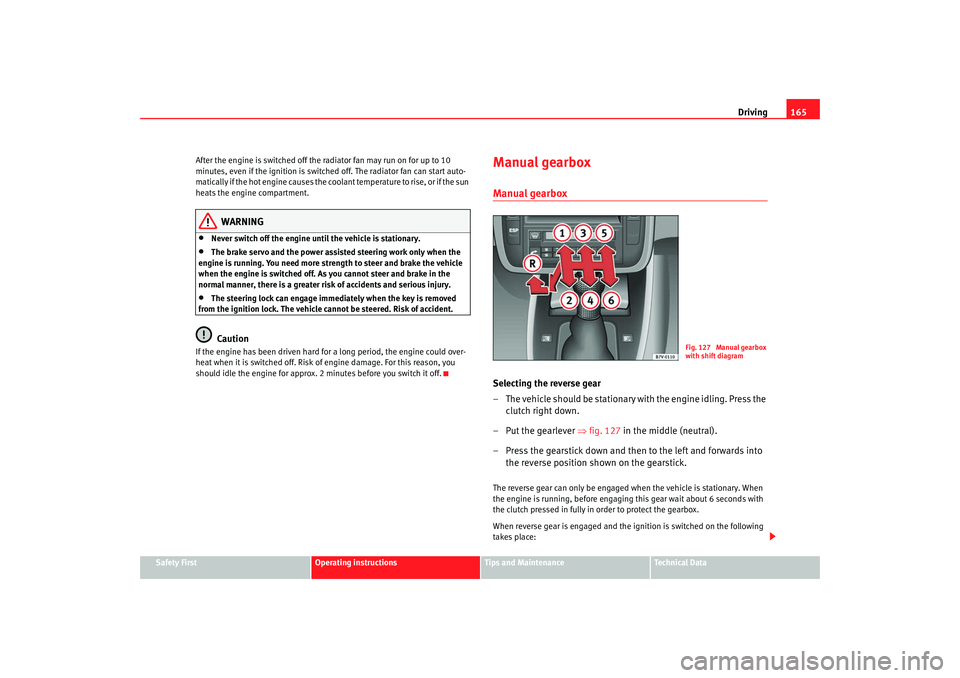
– T h e v e h i c l e s h o u l d b e s t a t i o n a r y with the engine idling. Press the
clutch right down.
–Put the gearlever ⇒fig. 127 in the middle (neutral).
– Press the gearstick down and then to the left and forwards into the reverse position shown on the gearstick.The reverse gear can only be engaged when the vehicle is stationary. When
the engine is running, before engaging this gear wait about 6 seconds with
the clutch pressed in fully in order to protect the gearbox.
When reverse gear is engaged and the ignition is switched on the following
takes place:
Fig. 127 Manual gearbox
with shift diagram
alhambra ingles.book Seite 165 Donnerstag, 19. April 2007 4:04 16
Page 168 of 291
Driving
166•
The reversing lights come on
•
The heating or air condit ioning automatically change to air recirculation
mode.
•
The rear window heater switches on when the windscreen wiper is acti-
vated.
WARNING
•
When the engine is running, the vehicle will start to move as soon as a
gear is engaged and the clutch released.
•
Never select the reverse gear when the vehicle is in motion. Risk of acci-
dent.Caution
•
Do not rest your hand on the gear lever when driving. The pressure of your
hand could cause premature wear on the selector forks in the gearbox.
•
When changing gear, you should always depress the clutch fully to avoid
unnecessary wear and damage.
•
Do not hold the car “on the clutch” on hills. This causes premature wear
and damages the clutch. It can also prevent power being transferred from the
engine to the gearbox.
Automatic gearboxGearbox programs
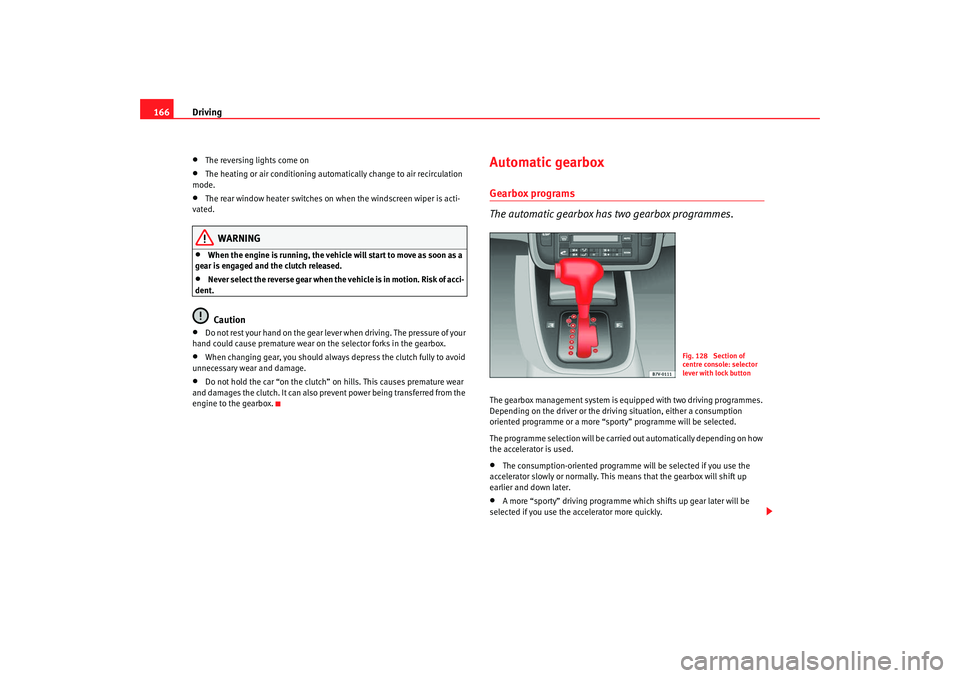
The automatic gearbox has two gearbox programmes.The gearbox management system is equipped with two driving programmes.
Depending on the driver or the driv ing situation, either a consumption
oriented programme or a more “sporty” programme will be selected.
The programme selection will be carried out automatically depending on how
the accelerator is used.•
The consumption-oriented programme will be selected if you use the
accelerator slowly or normally. This means that the gearbox will shift up
earlier and down later.
•
A more “sporty” driving programme wh ich shifts up gear later will be
selected if you use the accelerator more quickly.
Fig. 128 Section of
centre console: selector
lever with lock button
alhambra ingles.book Seite 166 Donnerstag, 19. April 2007 4:04 16
Page 171 of 291
Driving169
Safety First
Operating instructions
Tips and Maintenance
Te c h n i c a l D a t a
Note
The two clutch system of the direct shift gearbox* has a system to protect
against excess strain, which may occur, for example, when the vehicle is held
on a hill with the clutch and the gearbox oil overheats. When the clutch is
overloaded, the vehicle begins to jerk and the position indicator of the
selector lever begins to flash. To avoid breakdowns, the clutch breaks the
power transmission between the engine and the gearbox, as a result of which
the vehicle loses impetus. If the clutch opens automatically due to over-
loading, depress the brake pedal and wait a few seconds before
continuing.Selector lever positions
The selector lever positions and gears are shown on the
display in the combi-instrument.
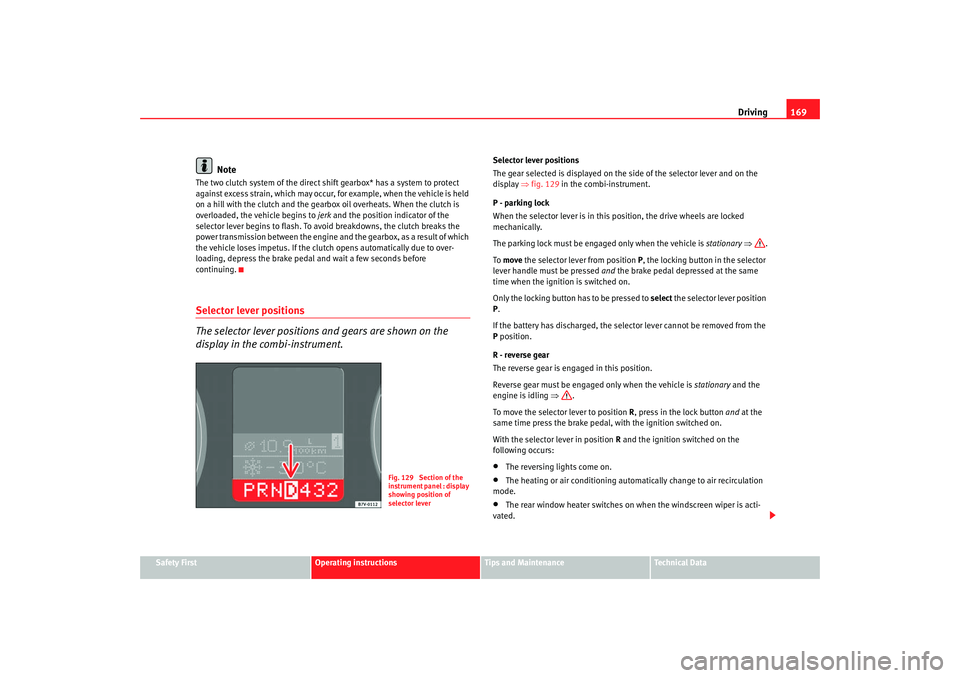
Selector lever positions
The gear selected is displayed on the side of the selector lever and on the
display ⇒fig. 129 in the combi-instrument.
P - parking lock
When the selector lever is in this position, the drive wheels are locked
mechanically.
The parking lock must be engaged only when the vehicle is stationary ⇒ .
To move the selector lever from position P, the locking button in the selector
lever handle must be pressed and the brake pedal depressed at the same
time when the ignition is switched on.
Only the locking button has to be pressed to select the selector lever position
P .
If the battery has discharged, the selector lever cannot be removed from the
P position.
R - reverse gear
The reverse gear is engaged in this position.
Reverse gear must be engaged only when the vehicle is stationary and the
engine is idling ⇒.
To move the selector lever to position R, press in the lock button and at the
same time press the brake pedal, with the ignition switched on.
With the selector lever in position R and the ignition switched on the
following occurs:•
The reversing li ghts come on.
•
The heating or air conditioning automatically change to air recirculation
mode.
•
The rear window heater switches on when the windscreen wiper is acti-
vated.
Fig. 129 Section of the
instrument panel : display
showing position of
selector lever
alhambra ingles.book Seite 169 Donnerstag, 19. April 2007 4:04 16
Page 177 of 291
Driving175
Safety First
Operating instructions
Tips and Maintenance
Te c h n i c a l D a t a
Cruise control system (CCS)Cruise control operation
The cruise control system(CCS) is able to maintain the set
speed in the range from approx. 30 km/h to 180 km/h.Once the desired speed has been reached and the setting stored, you may
take your foot off the accelerator.
In vehicles fitted with a manual gearbox and in vehicles with an automatic
gearbox with the lever in positions P, N or R the cruise control does not
operate in first gear.
WARNING
It could be dangerous to use the cruise control system (CCS) if it is not
possible to drive at constant speed.•
Do not use the cruise control in heavy traffic or on steep roads, with
several bends or in slippery circumstances (snow, ice, rain or loose gravel),
as there is a risk of accident.
•
Always adapt your speed and the dist ance to the vehicles ahead to take
the traffic situation into consideration. This is the duty of the driver. The
cruise control system is merely an aid to the driver.
•
Never use the cruise control system when driving off-road or on
unpaved roads. This feature is designed for use on paved roads only. Risk
of accident.
•
Always switch off the CCS when you have finished using it. This will
prevent you using it by mistake.
•
It is dangerous to use a set speed wh ich is too high for the prevailing
road, traffic or weather conditions. This may cause an accident.
Caution
if the cruise control is activated the gearbox should not be set in neutral
without first releasing the clutch, as the the engine speed will increase and
this may cause damage.
Note
When travelling down hills, the CCS cannot maintain a constant speed. The
vehicle will accelerate under its own weight. Reduce gears (with an automatic
gearbox, reduce gears using the “Tiptronic”) or brake using the footbrake.
alhambra ingles.book Seite 175 Donnerstag, 19. April 2007 4:04 16