trailer Seat Alhambra 2007 Owner's Manual
[x] Cancel search | Manufacturer: SEAT, Model Year: 2007, Model line: Alhambra, Model: Seat Alhambra 2007Pages: 291, PDF Size: 9.13 MB
Page 5 of 291
Contents3
ContentsThe structure of this manual
. . . . .
Content
. . . . . . . . . . . . . . . . . . . . . . . . . . . . . . . .
Safety First
. . . . . . . . . . . . . . . . . . . . . . . . . . .
Safe driving
. . . . . . . . . . . . . . . . . . . . . . . . . . . . . .
Brief introduction . . . . . . . . . . . . . . . . . . . . . . . .
Proper sitting position for occupants . . . . . . . . .
Pedal area . . . . . . . . . . . . . . . . . . . . . . . . . . . . . .
Stowing luggage . . . . . . . . . . . . . . . . . . . . . . . . .
Seat belts
. . . . . . . . . . . . . . . . . . . . . . . . . . . . . . . .
Introduction . . . . . . . . . . . . . . . . . . . . . . . . . . . . .
Why wear seat belts? . . . . . . . . . . . . . . . . . . . . . .
Seat belts . . . . . . . . . . . . . . . . . . . . . . . . . . . . . . .
Belt tension devices . . . . . . . . . . . . . . . . . . . . . .
Airbag system
. . . . . . . . . . . . . . . . . . . . . . . . . . . .
Brief introduction . . . . . . . . . . . . . . . . . . . . . . . .
Front airbags . . . . . . . . . . . . . . . . . . . . . . . . . . . .
Side airbags . . . . . . . . . . . . . . . . . . . . . . . . . . . . .
Curtain airbags . . . . . . . . . . . . . . . . . . . . . . . . . .
Deactivating airbags* . . . . . . . . . . . . . . . . . . . . .
Child safety
. . . . . . . . . . . . . . . . . . . . . . . . . . . . . .
Brief introduction . . . . . . . . . . . . . . . . . . . . . . . .
Child seats . . . . . . . . . . . . . . . . . . . . . . . . . . . . . .
Installation of child seats in vehicle seats . . . . .
Integrated child seat . . . . . . . . . . . . . . . . . . . . . .
Operating instructions
. . . . . . . . . . . .
Cockpit
. . . . . . . . . . . . . . . . . . . . . . . . . . . . . . . . . . .
Overview . . . . . . . . . . . . . . . . . . . . . . . . . . . . . . .
Instruments . . . . . . . . . . . . . . . . . . . . . . . . . . . . .
Display in the instrument panel . . . . . . . . . . . . .
Warning lamps . . . . . . . . . . . . . . . . . . . . . . . . . . .
On board computer with multifunction display*
Navigation system * . . . . . . . . . . . . . . . . . . . . . .
Steering wheel controls
. . . . . . . . . . . . . . . . . . .
Steering wheel . . . . . . . . . . . . . . . . . . . . . . . . . . .
Unlocking and locking
. . . . . . . . . . . . . . . . . . . .
Keys . . . . . . . . . . . . . . . . . . . . . . . . . . . . . . . . . . .
Central locking . . . . . . . . . . . . . . . . . . . . . . . . . . .
Key with remote control . . . . . . . . . . . . . . . . . . .
Anti-theft alarm system . . . . . . . . . . . . . . . . . . . .
Tailgate . . . . . . . . . . . . . . . . . . . . . . . . . . . . . . . . .
Windows . . . . . . . . . . . . . . . . . . . . . . . . . . . . . . .
Sliding/tilting sun roof . . . . . . . . . . . . . . . . . . . .
Lights and visibility
. . . . . . . . . . . . . . . . . . . . . . .
Lights . . . . . . . . . . . . . . . . . . . . . . . . . . . . . . . . . .
Visibility . . . . . . . . . . . . . . . . . . . . . . . . . . . . . . . .
Windscreen washers . . . . . . . . . . . . . . . . . . . . . .
Mirrors . . . . . . . . . . . . . . . . . . . . . . . . . . . . . . . . .
Seats and stowage
. . . . . . . . . . . . . . . . . . . . . . .
The importance of correct seat adjustment . . . .
Head restraints . . . . . . . . . . . . . . . . . . . . . . . . . .
Front seats . . . . . . . . . . . . . . . . . . . . . . . . . . . . . .
Rear seats . . . . . . . . . . . . . . . . . . . . . . . . . . . . . .
Stowage compartments . . . . . . . . . . . . . . . . . . .
Ashtrays, cigarette lighter and electrical sockets
Hazard warning triangles and first aid kit . . . . .
Luggage compartment . . . . . . . . . . . . . . . . . . . . Roof carrier . . . . . . . . . . . . . . . . . . . . . . . . . . . . . .
Cooling and heating box* . . . . . . . . . . . . . . . . . .
Heating, Ventilation and Air conditioning
. .
Climatronic . . . . . . . . . . . . . . . . . . . . . . . . . . . . . .
Driving
. . . . . . . . . . . . . . . . . . . . . . . . . . . . . . . . . . .
Steering . . . . . . . . . . . . . . . . . . . . . . . . . . . . . . . .
Safety . . . . . . . . . . . . . . . . . . . . . . . . . . . . . . . . . .
Ignition lock . . . . . . . . . . . . . . . . . . . . . . . . . . . . .
Starting and stopping the engine . . . . . . . . . . .
Manual gearbox . . . . . . . . . . . . . . . . . . . . . . . . . .
Automatic gearbox . . . . . . . . . . . . . . . . . . . . . . .
Handbrake . . . . . . . . . . . . . . . . . . . . . . . . . . . . . .
Parking distance warning system . . . . . . . . . . . .
Cruise control system (CCS) . . . . . . . . . . . . . . . .
Tips and Maintenance
. . . . . . . . . . . . .
Intelligent technology
. . . . . . . . . . . . . . . . . . . . .
Brakes . . . . . . . . . . . . . . . . . . . . . . . . . . . . . . . . .
Driving and the environment
. . . . . . . . . . . . . .
Running-in . . . . . . . . . . . . . . . . . . . . . . . . . . . . . .
Exhaust gas emission control system . . . . . . . .
Driving abroad . . . . . . . . . . . . . . . . . . . . . . . . . . .
Trailer towing . . . . . . . . . . . . . . . . . . . . . . . . . . . .
Driving economically and with respect for the
environment . . . . . . . . . . . . . . . . . . . . . . . . . . . . .
Cleaning and caring for your vehicle
. . . . . . .
General notes . . . . . . . . . . . . . . . . . . . . . . . . . . .
Care of the vehicle exterior . . . . . . . . . . . . . . . . .
Care of the vehicle interior . . . . . . . . . . . . . . . . .
5
6
7
7
7
9
14
14
17
17
19
22
30
32
32
36
39
41
43
45
45
47
49
52 61
61
61
62
67
70
79
83
84
84
86
86
87
93
95
97
100
104
108
108
114
116
118
121
121
122
124
126
133
139
142
142 147
148
151
151
159
159
160
161
163
165
166
172
173
175
179
179
179
185
185
186
187
188
191
193
193
194
199
alhambra ingles.book Seite 3 Donnerstag, 19. April 2007 4:04 16
Page 6 of 291
Contents
4Accessories, parts replacement and
modifications
. . . . . . . . . . . . . . . . . . . . . . . . . . . .
Accessories and parts . . . . . . . . . . . . . . . . . . . . .
Modifications . . . . . . . . . . . . . . . . . . . . . . . . . . . .
Roof aerial* . . . . . . . . . . . . . . . . . . . . . . . . . . . . .
Mobile telephones and two-way radios . . . . . . .
Retrofitting a towing bracket . . . . . . . . . . . . . . .
Checking and refilling levels
. . . . . . . . . . . . . .
Refilling . . . . . . . . . . . . . . . . . . . . . . . . . . . . . . . .
Petrol . . . . . . . . . . . . . . . . . . . . . . . . . . . . . . . . . .
Diesel . . . . . . . . . . . . . . . . . . . . . . . . . . . . . . . . . .
Working in the engine compartment . . . . . . . . .
Engine oil . . . . . . . . . . . . . . . . . . . . . . . . . . . . . . .
Coolant . . . . . . . . . . . . . . . . . . . . . . . . . . . . . . . . .
Washer fluid and windscreen wiper blades . . . .
Brake fluid . . . . . . . . . . . . . . . . . . . . . . . . . . . . . .
Battery . . . . . . . . . . . . . . . . . . . . . . . . . . . . . . . . .
Wheels . . . . . . . . . . . . . . . . . . . . . . . . . . . . . . . . .
If and when
. . . . . . . . . . . . . . . . . . . . . . . . . . . . . .
Vehicle tools*, spare wheel*, breakdown set* and
towing bracket . . . . . . . . . . . . . . . . . . . . . . . . . . .
Breakdown set* . . . . . . . . . . . . . . . . . . . . . . . . . .
Changing a wheel . . . . . . . . . . . . . . . . . . . . . . . .
Fuses . . . . . . . . . . . . . . . . . . . . . . . . . . . . . . . . . .
Changing a light . . . . . . . . . . . . . . . . . . . . . . . . .
Jump-starting . . . . . . . . . . . . . . . . . . . . . . . . . . . .
Towing and tow-starting . . . . . . . . . . . . . . . . . . .
Lifting the vehicle . . . . . . . . . . . . . . . . . . . . . . . .
Te c h n i c a l D a t a
. . . . . . . . . . . . . . . . . . . . . . .
General notes on the technical data
. . . . . . .
What you should be aware of . . . . . . . . . . . . . . .
How are the figures measured? . . . . . . . . . . . . .
Towing a trailer . . . . . . . . . . . . . . . . . . . . . . . . . .
Wheels . . . . . . . . . . . . . . . . . . . . . . . . . . . . . . . . .
Techn ical Data
. . . . . . . . . . . . . . . . . . . . . . . . . . . .
Checking fluid levels . . . . . . . . . . . . . . . . . . . . . .
Petrol engine 2.0l 85 kW (115 bhp) 6 gear . . . .
Petrol engine 2.0 litre 85 kW (115 hp). Automatic
Petrol engine 1.8l 110 kW (150 bhp) 6 gear . . .
Petrol engine 1.8l 110 kW (150 bhp). Automatic
Petrol engine 2.8l VR6150 kW (204 bhp) 6 gear
Petrol engine 2.8l VR6 150 kW (204 bhp)
Automatic . . . . . . . . . . . . . . . . . . . . . . . . . . . . . .
Petrol engine 2.8l VR6150 kW (204 bhp) 6 gear
four-wheel drive . . . . . . . . . . . . . . . . . . . . . . . . .
Diesel engine 1.9l TDI 85 kW (115 bhp) 6 gears
four-wheel drive . . . . . . . . . . . . . . . . . . . . . . . . .
Diesel engine 1.9l TDI 85 kW (115 bhp) 6 gears
Diesel engine 1.9 TDI 85 kW (115 bhp).
Automatic . . . . . . . . . . . . . . . . . . . . . . . . . . . . . .
Diesel engine 2.0l TDI 103 kW (140 bhp) 6 gears
Dimensions and capacities . . . . . . . . . . . . . . . .
Index
. . . . . . . . . . . . . . . . . . . . . . . . . . . . . . . . . .
202
202
202
203
203
204
206
206
207
207
209
212
216
218
221
223
225
231
231
234
236
241
245
249
252
255
257
257
257
259
260
260 262
262
263
264
265
267
268
269
271
272
273
275
276
278
279
alhambra ingles.book Seite 4 Donnerstag, 19. April 2007 4:04 16
Page 72 of 291
Cockpit
70Warning lampsOverview of the warning lamps
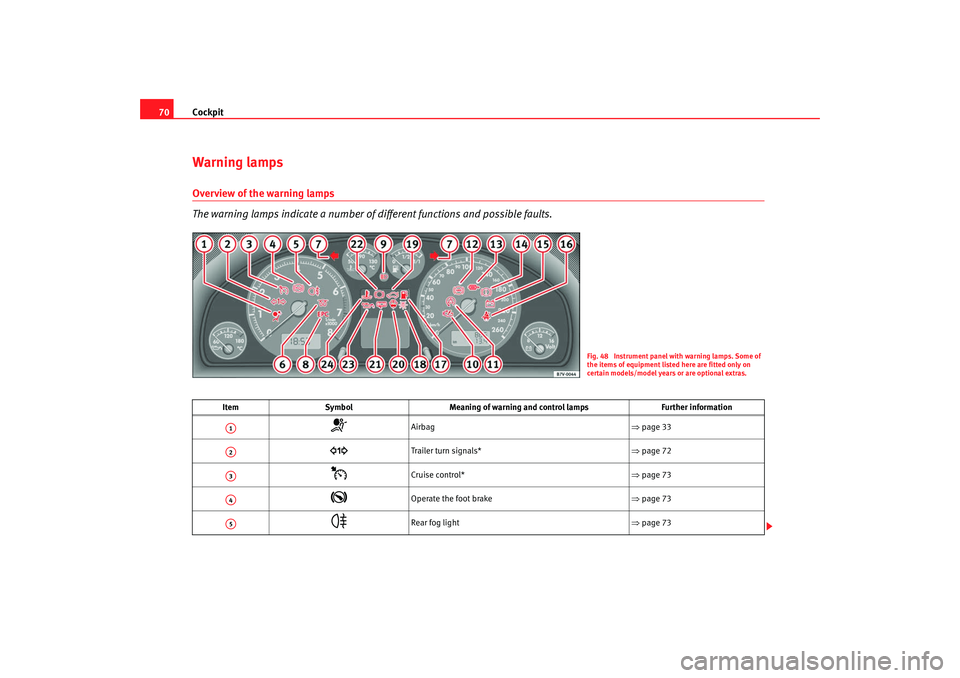
The warning lamps indicate a number of different functions and possible faults.
Item Symbol Meaning of warning and control lamps Further information
Airbag ⇒page 33
Trailer turn signals* ⇒page 72
Cruise control* ⇒page 73
Operate the foot brake ⇒page 73
Rear fog light ⇒page 73
Fig. 48 Instrument panel with warning lamps. Some of
the items of equipment listed here are fitted only on
certain models/model years or are optional extras.
A1A2A3A4A5
alhambra ingles.book Seite 70 Donnerstag, 19. April 2007 4:04 16
Page 74 of 291
Cockpit
72
WARNING
•
Failure to observe warning lamps and warning messages can result in
serious personal injury or damage to your vehicle.
•
The risk of an accident increases if your vehicle breaks down. Use a
warning triangle to draw the attention of other road users to your
stationary vehicle so that it does not represent a danger.
•
The engine compartment of any motor vehicle is a dangerous area!
Before you open the bonnet to work on the engine or in the engine compart-
ment, you must switch off the engine and allow it to cool to reduce the risk
of scalding or other injuries. Read and observe the relevant warnings
⇒ page 209.Note
•
The appropriate warning lamp for a fa ult will light up in vehicles without
warning or information texts in the display.
•
In vehicles with warning or information texts in the display, the appro-
priate warning lamp for a fault will ligh t up and a warning or information text
will also appear in the display.
Trailer turn signals
This warning lamp also flashes when the turn signals are
operated while towing a caravan or trailer.The warning lamp
flashes when the turn signals are operated, provided a
trailer is correctly attached and connected to the vehicle.
The warning lamp will not flash if one of the turn signals on the trailer fails.
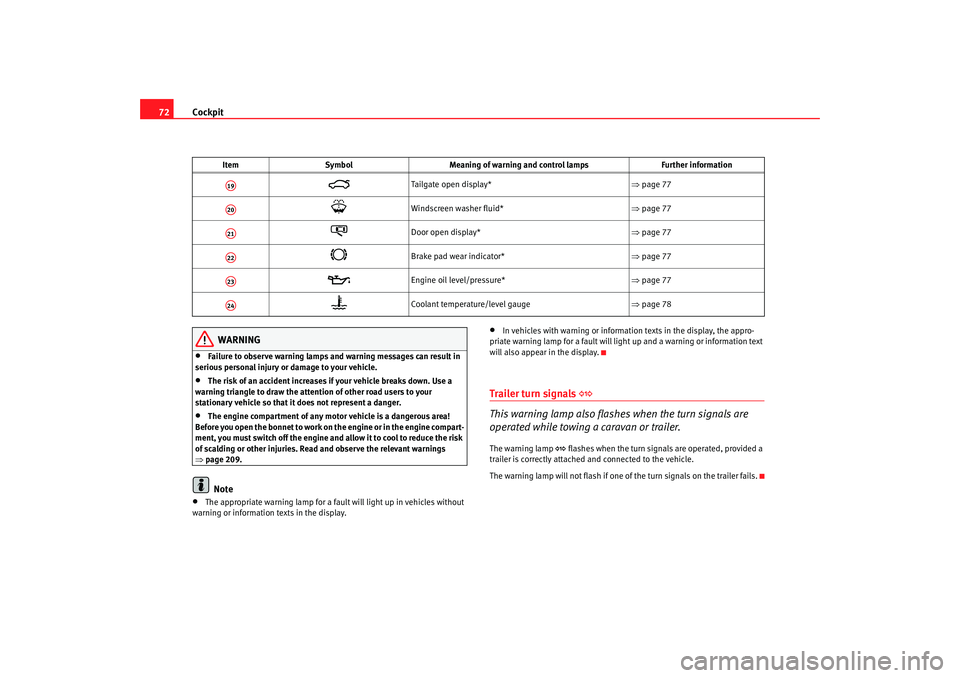
Tailgate open display* ⇒page 77
Windscreen washer fluid* ⇒page 77
Door open display* ⇒page 77
Brake pad wear indicator* ⇒page 77
Engine oil level/pressure* ⇒page 77
Coolant temperature/level gauge ⇒page 78
Item
Symbol Meaning of warning and control lamps Further information
A19A20A21A22A23A24
alhambra ingles.book Seite 72 Donnerstag, 19. April 2007 4:04 16
Page 111 of 291
Lights and visibility109
Safety First
Operating instructions
Tips and Maintenance
Te c h n i c a l D a t a
If you are towing a trailer equipped with a rear fog light on a vehicle with a
factory-fitted
towing bracket
17), the rear fog light on the car will automatically
be switched off.
WARNING
•
Never drive with just the side lights on. Risk of accident. The side lights
are not bright enough to illuminate the road ahead and to ensure that other
road users are able to see you. Always use your dipped headlights if it is
dark or if visibility is poor.Note
•
If the lights are left on after the key has been taken out of the ignition lock,
a buzzer sounds when the driver door is opened. This is a reminder to switch
off the lights.
•
The rear fog light is so bright that it can dazzle drivers behind you. You
should use the rear fog light only when visibility is very poor.
•
If you are towing a trailer equipped with a rear fog light on a vehicle with
a factory-fitted towing bracket, the rear fog light on the car will automatically
be switched off.
•
The use of the lighting described here is subject to the relevant statutory
requirements.
Coming Home function (guide lights)*
The Coming Home function (guide lights) allows the vehicle
lights to stay on for approximately 3 minutes after the ignition
is switched off.To activate the Coming Home function the vehicle lights should have
already been switched on. – Switch off vehicle lights.
– Switch off ignition.
– Keep all doors closed.
– Briefly pull the turn signal lever towards the steering wheel
within a maximum of 2 minutes after switching off the lights.
– Open the driver door.
When the driver's door is opened, the ve hicle lights automatically light up for
approx. 3 minutes If the door is closed within 3 minutes, the guide lights will
stay on for approximately. 30 seconds. If the door is closed after 3 minutes,
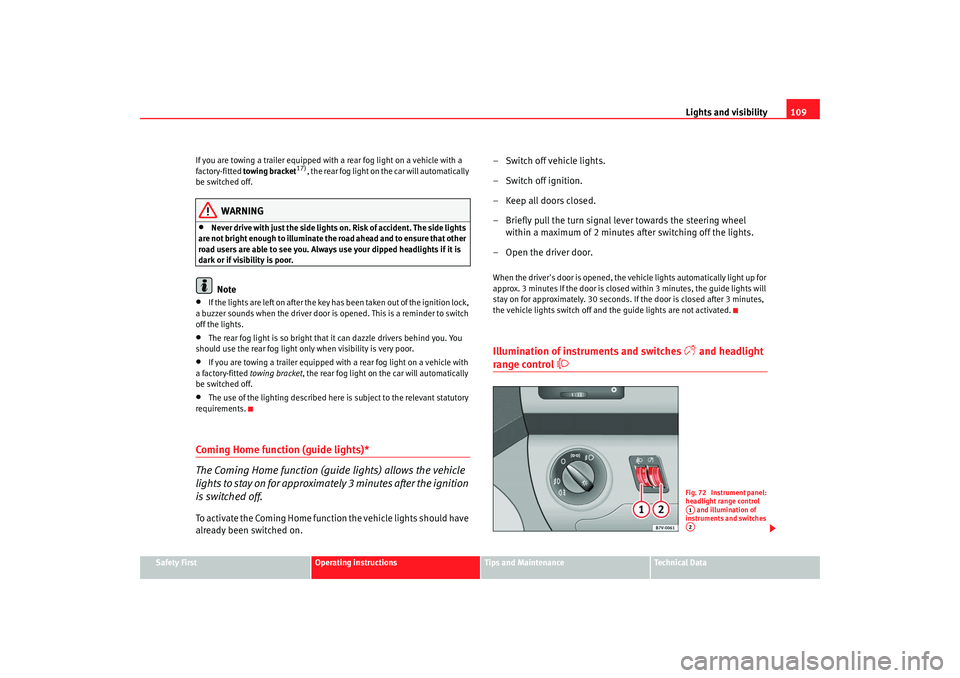
the vehicle lights switch off and the guide lights are not activated.Illumination of instruments and switches
and headlight
range control
Fig. 72 Instrument panel:
headlight range control and illumination of
instruments and switches A1A2
alhambra ingles.book Seite 109 Donnerstag, 19. April 2007 4:04 16
Page 114 of 291
Lights and visibility
112
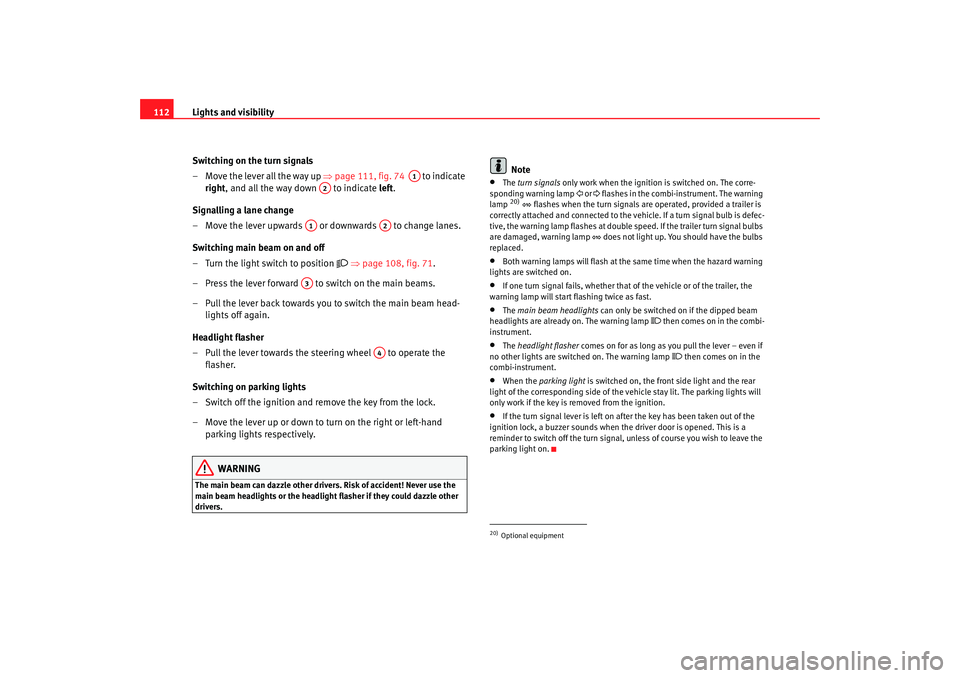
Switching on the turn signals
– Move the lever all the way up ⇒page 111, fig. 74 to indicate
right , and all the way down to indicate left.
Signalling a lane change
– Move the lever upwards or downwards to change lanes.
Switching main beam on and off
– Turn the light switch to position
⇒ page 108, fig. 71 .
– Press the lever forward to switch on the main beams.
– Pull the lever back towards you to switch the main beam head- lights off again.
Headlight flasher
– Pull the lever towards the steering wheel to operate the flasher.
Switching on parking lights
– Switch off the ignition and remove the key from the lock.
– Move the lever up or down to turn on the right or left-hand parking lights respectively.
WARNING
The main beam can dazzle other drivers. Risk of accident! Never use the
main beam headlights or the headlight flasher if they could dazzle other
drivers.
Note
•
The turn signals only work when the ignition is switched on. The corre-
sponding warning lamp or flashes in the combi-instrument. The warning
lamp 20) flashes when the turn signals are operated, provided a trailer is
correctly attached and connected to the vehicle. If a turn signal bulb is defec-
tive, the warning lamp flashes at double speed. If the trailer turn signal bulbs
are damaged, warning lamp does not light up. You should have the bulbs
replaced.
•
Both warning lamps will flash at the same time when the hazard warning
lights are switched on.
•
If one turn signal fails, whether that of the vehicle or of the trailer, the
warning lamp will start flashing twice as fast.
•
The main beam headlights can only be switched on if the dipped beam
headlights are already on. The warning lamp
then comes on in the combi-
instrument.
•
The headlight flasher comes on for as long as you pull the lever – even if
no other lights are switch ed on. The warning lamp
then comes on in the
combi-instrument.
•
When the parking light is switched on, the front side light and the rear
light of the corresponding side of the ve hicle stay lit. The parking lights will
only work if the key is removed from the ignition.
•
If the turn signal lever is left on after the key has been taken out of the
ignition lock, a buzzer sounds when th e driver door is opened. This is a
reminder to switch off the turn signal, unless of course you wish to leave the
parking light on.
A1
A2
A1
A2
A3
A4
20)Optional equipment
alhambra ingles.book Seite 112 Donnerstag, 19. April 2007 4:04 16
Page 163 of 291
Driving161
Safety First
Operating instructions
Tips and Maintenance
Te c h n i c a l D a t a
•
when rocking the vehicle backwards and forwards to free it from mud, for
example.
You should press the button to switch the ESP back on when you no longer
need wheel spin.
The TCS and EDL are also switched off if the ESP is switched off. This means
that this technology is not available for as long as the ESP remains switched
off.
When does the inscriptio nOFF light up on the button?
•
It will light up continuously if there is a malfunction in the ESP.
•
It will light up continuously if the ESP is switched off.
WARNING
•
The electronic stabilisation program (ESP) cannot defy the laws of
physics. This should be kept in mind, particularly on slippery and wet
roads and when towing a trailer.
•
Always adapt your driving style to suit the condition of the roads and
the traffic situation. Do not let the extra safety afforded by ESP tempt you
into taking any risks when driving, this can cause accidents.
•
Please refer to the corresponding warning notes on ESP.
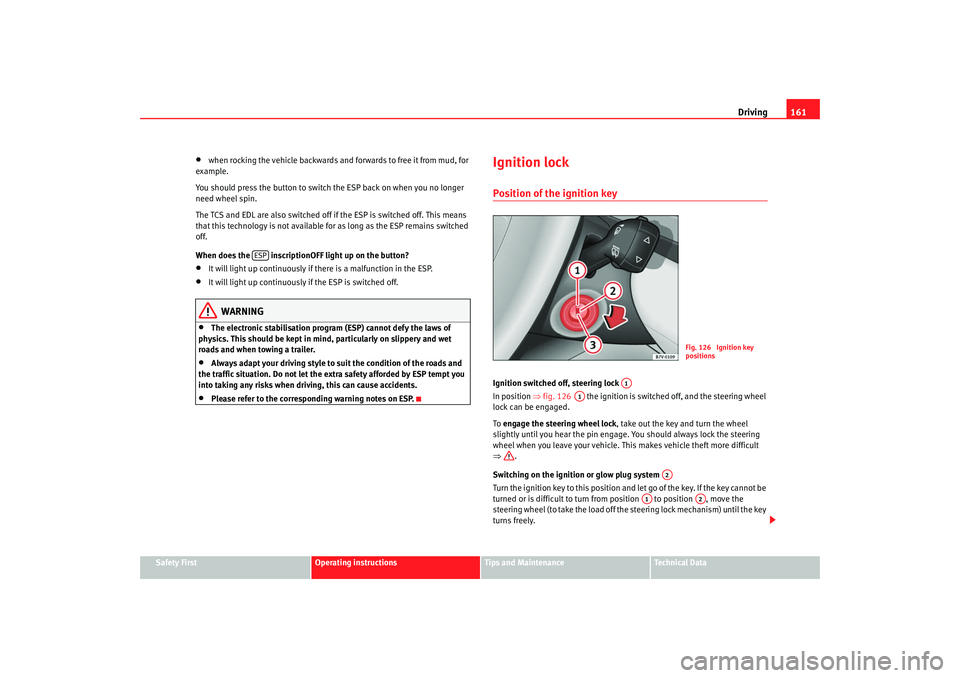
Ignition lockPosition of the ignition keyIgnition switched off, steering lock
In position ⇒fig. 126 the ignition is switched off, and the steering wheel
lock can be engaged.
To engage the steering wheel lock, take out the key and turn the wheel
slightly until you hear the pin engage. You should always lock the steering
wheel when you leave your vehicle. This makes vehicle theft more difficult
⇒ .
Switching on the ignition or glow plug system
Tu rn the ignition key to this position and let go of the key. If the key canno t b e
turned or is difficult to turn from position to position , move the
steering wheel (to take the load off the steering lock mechanism) until the key
turns freely.
ESP
Fig. 126 Ignition key
positions
A1
A1
A2
A1
A2
alhambra ingles.book Seite 161 Donnerstag, 19. April 2007 4:04 16
Page 176 of 291
Driving
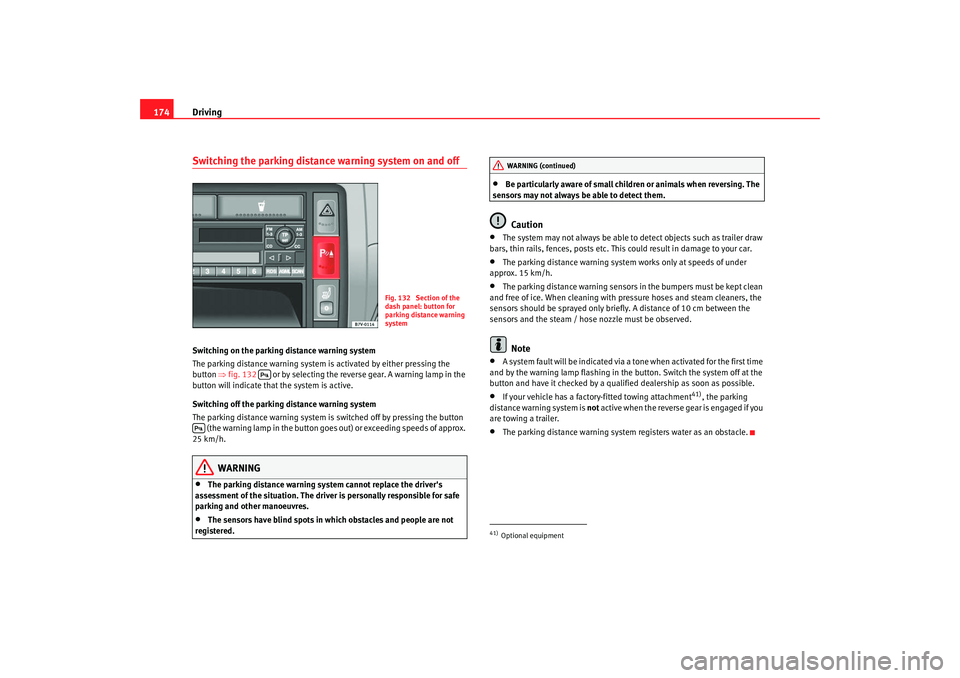
174Switching the parking distance warning system on and offSwitching on the parking distance warning system
The parking distance warning system is activated by either pressing the
button ⇒fig. 132 or by selecting the reverse gear. A warning lamp in the
button will indicate that the system is active.
Switching off the parking distance warning system
The parking distance warning system is switched off by pressing the button (the warning lamp in the button goes out) or exceeding speeds of approx.
25 km/h.
WARNING
•
The parking distance warning system cannot replace the driver's
assessment of the situation. The driver is personally responsible for safe
parking and other manoeuvres.
•
The sensors have blind spots in which obstacles and people are not
registered.
•
Be particularly aware of small children or animals when reversing. The
sensors may not always be able to detect them.Caution
•
The system may not always be able to detect objects such as trailer draw
bars, thin rails, fences, posts etc. This could result in damage to your car.
•
The parking distance warning system works only at speeds of under
approx. 15 km/h.
•
The parking distance warning sensors in the bumpers must be kept clean
and free of ice. When cleaning with pressure hoses and steam cleaners, the
sensors should be sprayed only briefly. A distance of 10 cm between the
sensors and the steam / hose nozzle must be observed.Note
•
A system fault will be indicated via a tone when activated for the first time
and by the warning lamp flashing in the button. Switch the system off at the
button and have it checked by a qualified dealership as soon as possible.
•
If your vehicle has a factory-fitted towing attachment
41), the parking
distance warning system is not active when the reverse gear is engaged if you
are towing a trailer.
•
The parking distance warning system registers water as an obstacle.
Fig. 132 Section of the
dash panel: button for
parking distance warning
system
41)Optional equipmentWARNING (continued)
alhambra ingles.book Seite 174 Donnerstag, 19. April 2007 4:04 16
Page 185 of 291

Intelligent technology183
Safety First
Operating instructions
Tips and Maintenance
Te c h n i c a l D a t a
You should press the button to switch the ESP back on when you no longer
need wheel spin.
When the ESP is deactivated, the TCS is switched off at the same time. This
means that this technology is not available for as long as the ESP remains
switched off.
How ESP works
ESP reduces the danger of skidding by
braking the wheels individually. The
system uses the steering wheel angle and road speed to calculate the
changes of direction desired by the driver, and constantly compares them
with the actual behaviour of the car. If the desired course is not being main-
tained accurately (for instance if the ca r is beginning to skid) the ESP compen-
sates automatically by applying the brake at the appropriate wheel.
The forces acting on the braked wheel bring the car back to a stable condi-
tion. If the car is tending to oversteer (break away at the rear) the brake appli-
cation is concentrated on the outside front wheel; if the car is understeering
(tending to follow a wider radius in a bend), the brake is mainly applied to the
inside rear wheel.
How the Traction Control System (TCS) works
TCS reduces engine power to help prev ent the driven wheels of front-wheel
drive vehicles losing traction during acceleration. The system works in the
entire speed range in conjunction with ABS. If a malfunction should occur in
the ABS, the TCS will also be out of action. TCS helps the car to start moving,
accelerate and climb a gradient in slippery conditions where this may other-
wise be difficult or even impossible.
When does the warning lamp light up or flash
?
•
The warning lamp
lights up when the ignition is switched on and
should go out again after a few seconds.
•
The warning lamp
will start flashing to indicate that the ESP and TCS
are counteracting an unstable driving condition.
•
It will light up continuously if there is a malfunction in the ESP.
•
It will light up continuously if the ESP is switched off.
•
It will also come on if a fault should occur in the ABS because the ESP
operates in conjunction with the ABS.
If the warning lamp
lights up and stays on after the engine is started, this
may mean that the control system has temporarily switched off the function.
In this case the ESP can be reactivated by switching the ignition off and then
on again. If the warning lamp goes out, this means the system is fully func-
tional
If the battery is disconnected, the warning lamp
lights after turning the
ignition on. This should turn off after a brief trip.
WARNING
Try to always adapt the speed of the vehicle to weather, road and traffic
conditions. Do not let the extra safety afforded by the system tempt you
into taking any risks when driving. Risk of accident.•
The ESP and TCS cannot defy the laws of motion. This should be kept in
mind, particularly on slippery and wet roads and when towing a trailer.
•
Always adapt your driving style to suit the condition of the roads and
the traffic situation.
•
The ESP cannot reduce the risk of accident if, for example, you are
driving with an unsuitable load or too close to the preceding vehicle.
•
Modifications to the vehicle or work carried out incorrectly (e. g. to the
engine, the brake system, running gear or any components affecting the
wheels and tyres) could affect the efficiency of the ABS, EDL, ESP and TCS
and lessen their efficiency.
•
The effectiveness of the ESP is also determined by the tyres fitted
⇒ page 225.Caution
In order to ensure that ESP and TCS func tion correctly, all four wheels must be
fitted with the same tyres. Any differences in the rolling radius of the tyres can
cause the system to reduce engine power when this is not desired.
alhambra ingles.book Seite 183 Donnerstag, 19. April 2007 4:04 16
Page 187 of 291
Driving and the environment185
Safety First
Operating instructions
Tips and Maintenance
Te c h n i c a l D a t a
Driving and the environmentRunning-inRunning in a new engine
The engine needs to be run-in over the first 1,500 km.Up to 1,000 kilometres
– Do not drive faster than three quarters of top speed.
– Do not use full throttle.
– Avoid high engine revolutions.
– Do not tow a trailer.
From 1000 to 1500 km
–Speeds can be gradually increased to the maximum road speed
or maximum permissible engine speed (rpm).During its first few hours of running, the internal fric tion in the engine is
greater than later on when all the moving parts have bedded down.
For the sake of the environment
If the engine is run in gently, the life of the engine will be increased and its oil
consumption reduced.
Running in tyres and brake pads
New tyres should be run-in carefully for the first 500 km. New
brake pads should be run-in carefully for the first 200 km.During the first 200 km, you can compensate for the reduced braking effect
by applying more pressure to the brake pedal. If you need to make an emer-
gency stop, the braking distance will be longer with new brake pads than with
brake pads that have been run-in.
WARNING
•
New tyres do not give maximum grip to start with, and need running in.
This may cause an accident. Drive particularly carefully in the first 500 km.
•
New brake pads must be “run in” and do not have the correct friction
properties during the first 200 km. However, you can compensate for the
slightly reduced braking effect by applying more pressure on the brake
pedal.
Braking effect and braking distance
The braking effect and braking distance are influenced by
driving situations and road conditions.The efficiency of the brakes depends directly on the brake pad wear. The rate
of wear of the brake pads depends to a great extent on the conditions under
which the vehicle is operated and the way the vehicle is driven. If you often
drive in town traffic, drive short distances or have a sporty driving style, we
recommend that you have the thickness of your brake pads checked by SEAT
Service more frequently than reco mmended in the service schedule.
alhambra ingles.book Seite 185 Donnerstag, 19. April 2007 4:04 16