trailer Seat Alhambra 2007 User Guide
[x] Cancel search | Manufacturer: SEAT, Model Year: 2007, Model line: Alhambra, Model: Seat Alhambra 2007Pages: 291, PDF Size: 9.13 MB
Page 190 of 291
Driving and the environment
188•
For vehicles fitted with a catalytic converter ensure that unleaded petrol is
available for the journey. See the chap ter “Refuelling”. Automobile organisa-
tions will have information about service station networks selling unleaded
fuel.
•
In some countries it is possible that a vehicle model is sold under condi-
tions where some spare parts are not available or that the Authorised Service
Centre may only carr y out limited repairs.
SEAT importers and distributors will gladly provide information about the
technical preparation of your vehicle in addition to necessary maintenance
and repair possibilities.
Adhesive strips for headlightsIf you have to drive a right-hand drive vehicle in a left-hand drive country, or
vice versa, the asymmetric dipped beam headlights will dazzle oncoming
traffic.
To prevent dazzling, you must apply stickers to certain parts of the headlight
lenses. Further information is available from your Authorised Service
Centre.Trailer towingWhat do you need to bear in mind when towing a trailer?The vehicle can, if suitably equipped, be used to tow a trailer or caravan.
If the car is supplied with a factory-fitted towing bracket it will already have
the necessary technical modifications and meet the statutory requirements
for towing a trailer. If you wish to retrofit a towing bracket ⇒page 204. Connectors
Your vehicle is fitted with a 12-pin connector for the electrical connection
between the trailer and the vehicle.
If the trailer has a
7-pin plug, you will need to use an adapter cable. This is
available from SEAT Service.
Trailer weight / draw bar loading
Never exceed the maximum permitted trailer weights. If you do not load the
trailer up to the maximum permitted tr ailer weight, you can then climb corre-
spondingly steeper gradients.
The maximum trailer weights listed are only applicable for altitudes up to
1,000 m above sea level. With increasing altitude the engine power and
therefore the vehicle's climbing ability are impaired because of the reduced
air density. The maximum trailer weight has to be reduced accordingly. The
weight of the vehicle and trailer co mbination must be reduced by 10% for
every further 1,000 m (or part thereof). Where possible, operate the trailer
with the maximum permitted draw bar weight on the ball joint of the towing
bracket, but do not exceed the specified limit.
The figures for trailer weights and draw bar weights given on the data plate
of the towing bracket are for certificat ion purposes only. The correct figures
for your specific model, which may be lower than these figures for the towing
bracket, are given in the registrati on documents and “Technical data”.
Gross combination weight
The gross combination weight is the actual weight of the laden vehicle plus
the actual weight of the laden trailer. If the maximum permissible trailer
weight is to be utilized, the weight of the vehicle may have to be reduced.
Distributing the load
Distribute loads in the trailer so that heavy objects are as near to the axle as
possible. Loads carried in the trailer must be secured to prevent them
moving.
alhambra ingles.book Seite 188 Donnerstag, 19. April 2007 4:04 16
Page 191 of 291
Driving and the environment189
Safety First
Operating instructions
Tips and Maintenance
Te c h n i c a l D a t a
Tyre pressure
Set tyre pressure to the maximum permitted pressure shown on the sticker on
the inside of the tank flap. Set the tyre pressure of the trailer tyres in accord-
ance with the trailer manufacturer's recommendations.
Exterior mirrors
Check whether you can see enough of the road behind the trailer with the
standard mirrors. If this is not the case you should have additional mirrors
fitted. Both exterior mirrors should
be mounted on hinged extension
brackets. Adjust the mirrors to give sufficient vision to the rear.
Headlight adjustment
If towing a trailer the dipped light may dazzle other drivers. Use the headlight
range control to lower the cone of light. If you do not have headlight range
control, have the headlights adjusted by a qualified dealership.
WARNING
•
Never transport people in a trailer. This could result in fatal accidents.
•
To avoid dazzling other drivers, adjust the dipped beam according to
the load. If not, an accident may occur.Note
•
Towing a trailer places additional demands on the vehicle. We recom-
mend additional services between the normal inspection intervals if the
vehicle is used frequently for towing a trailer.
•
Find out whether special regulations apply to towing a trailer in your
country.
Ball coupling of towing bracket
The removable ball coupling of the towing bracket is stored
with the tools on board behind the right-hand side trim of the
luggage compartment.It is necessary to first tense the towing bracket removing the ball
coupling.
Remove the towing bracket from the luggage compartment
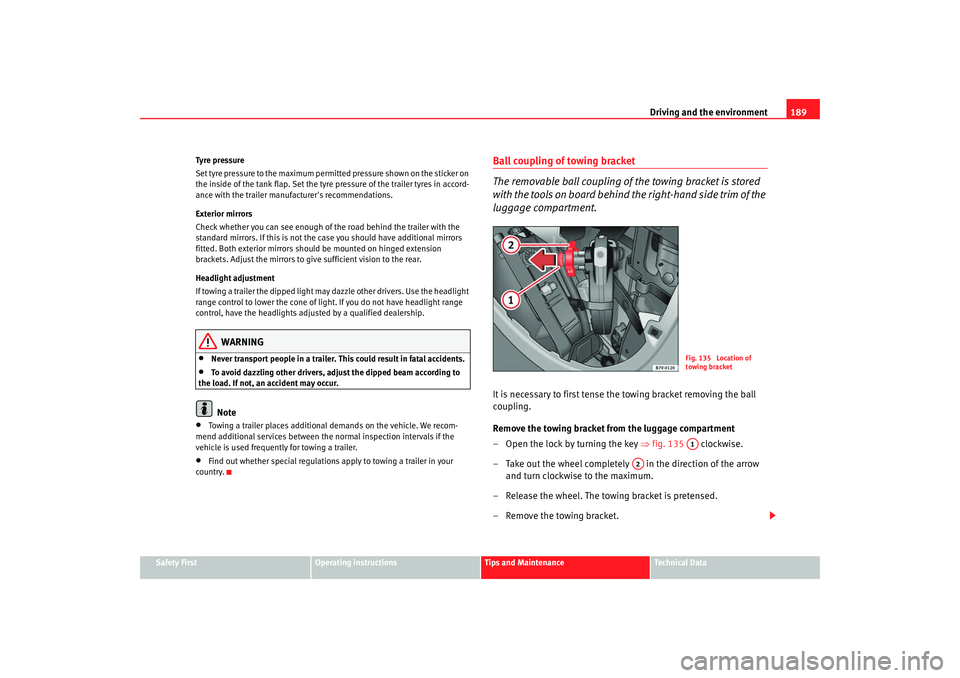
– Open the lock by turning the key ⇒fig. 135 clockwise.
– Take out the wheel completely in the direction of the arrow and turn clockwise to the maximum.
– Release the wheel. The towing bracket is pretensed.
– Remove the towing bracket.
Fig. 135 Location of
towing bracketA1
A2
alhambra ingles.book Seite 189 Donnerstag, 19. April 2007 4:04 16
Page 192 of 291
Driving and the environment
190
Storing towing bracket in the luggage compartment
– First tension the towing bracket.
– Place the towing bracket in its casing on the right-hand side of the luggage compartment. The bracket engages and the tension
is released ⇒ .
– Check that it is correctly fitted.The ball coupling is provided with in structions on fitting and removing the
ball coupling of the towing bracket.
If the ball coupling is fitted it s possible to store the cover of the tow-bar in a
plastic bag next to the tools.
WARNING
The towing bracket ball coupling must be stored securely to prevent it
being flung through the vehicle and causing injury.•
When the pretensed towing bracket is being fitted, there is a risk of
injury in the event that the wheel goes back on itself.Note
By law, the ball coupling must be remo ved if a trailer is not being towed and
it obscures the number plate.•
When placing the towing bracket in the casing check that it is no longer
tensed and securely fastened.
Driving tips
Driving with a trailer always requires extra care.Weight distribution
The weight distribution of a loaded trailer with an unladen vehicle is very
unfavourable. However, if this cannot be avoided, drive extra slowly to allow
for the unbalanced weight distribution.
Speed
The stability of the car and trailer is reduced with increasing speed. For this
reason it is advisable not to drive at the maximum permissible top speed in
unfavourable road, weather or wind conditions. This applies especially when
driving downhill.
You should always reduce speed immediately if the trailer shows the slightest
sign of snaking . Never try to stop the “snaking” by increasing speed.
Always brake in good time. If the trailer has an overrun brake, apply the
brakes gently at first and then firmly. This will prevent the jerking that can be
caused by the trailer wheels locking. Select a low gear (in both manual and
automatic gearboxes) in good time before going down a steep hill. This
enables you to use the engine braking effect to slow down the vehicle.
Overheating
At very high temperatures and during prolonged ascents, driving in a low gear
and high engine speed, always moni tor the temperature indicator for the
coolant.
Electronic Stabilisation Program
Do not switch off the ESP when towing a trailer. The ESP makes it easier to
stabilise if the trailer starts to snake.
alhambra ingles.book Seite 190 Donnerstag, 19. April 2007 4:04 16
Page 207 of 291
Accessories, parts replacement and modifications205
Safety First
Operating instructions
Tips and Maintenance
Te c h n i c a l D a t a
If a towing bracket is to be retro-fitted to
the car, it must be done according to
the instructions of the towing bracket manufacturer.
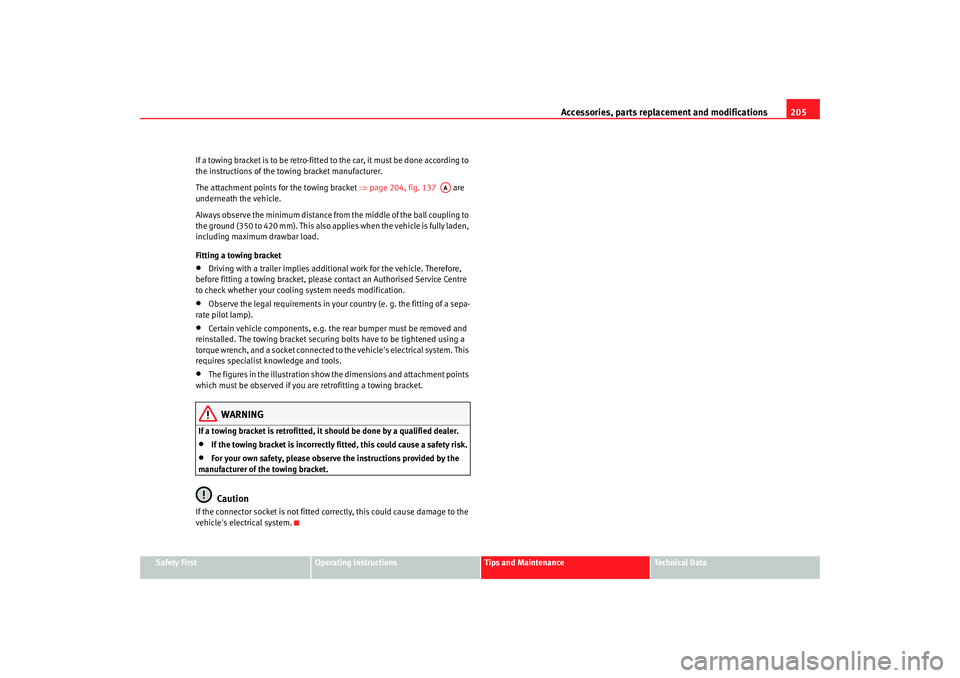
The attachment points for the towing bracket ⇒page 204, fig. 137 are
underneath the vehicle.
Always observe the minimum distance from the middle of the ball coupling to
the ground (350 to 420 mm). This also appl ies when the vehicle is fully laden,
including maximum drawbar load.
Fitting a towing bracket
•
Driving with a trailer implies additional work for the vehicle. Therefore,
before fitting a towing bracket, please contact an Authorised Service Centre
to check whether your cooling system needs modification.
•
Observe the legal requirements in your country (e. g. the fitting of a sepa-
rate pilot lamp).
•
Certain vehicle componen ts, e.g. the rear bumper must be removed and
reinstalled. The towing bracket securing bolts have to be tightened using a
torque wrench, and a socket connected to the vehicle's electrical system. This
requires specialist knowledge and tools.
•
The figures in the illustration show the dimensions and attachment points
which must be observed if you are retrofitting a towing bracket.
WARNING
If a towing bracket is retrofitted, it should be done by a qualified dealer.•
If the towing bracket is incorrectly fi tted, this could cause a safety risk.
•
For your own safety, please observe the instructions provided by the
manufacturer of the towing bracket.Caution
If the connector socket is not fitted correctly, this could cause damage to the
vehicle's electrical system.
AA
alhambra ingles.book Seite 205 Donnerstag, 19. April 2007 4:04 16
Page 216 of 291
Checking and refilling levels
214
NoteBefore a long trip, we recommend findin g an engine oil that conforms to the
corresponding VW specifications and keeping it in the vehicle. This way, the
correct engine oil will always be available for a top-up if needed.Checking the engine oil level
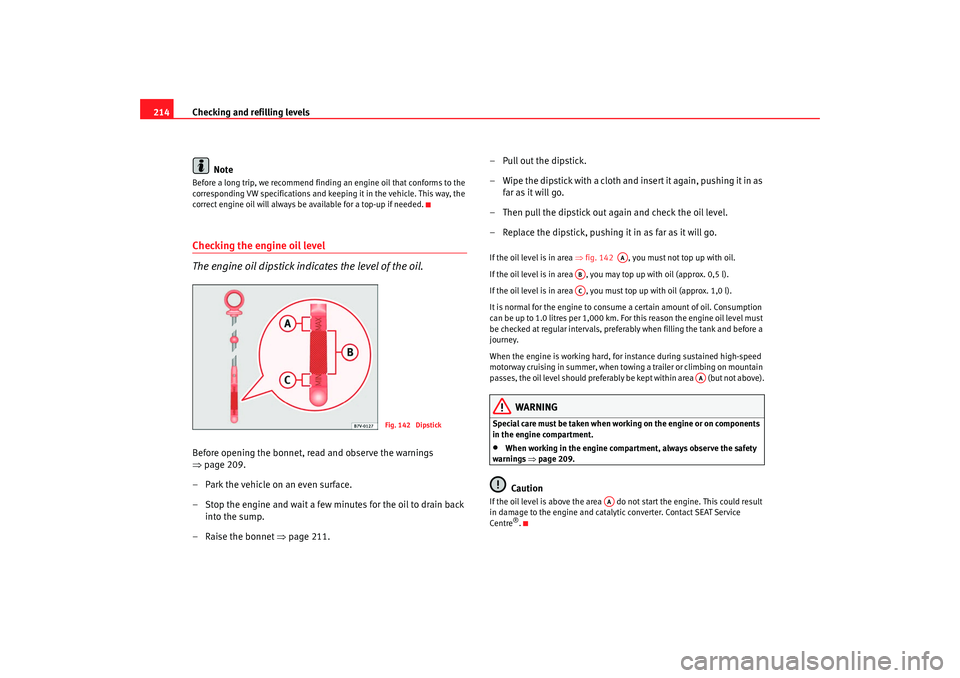
The engine oil dipstick indicates the level of the oil.Before opening the bonnet, read and observe the warnings
⇒ page 209.
– Park the vehicle on an even surface.
– Stop the engine and wait a few minutes for the oil to drain back into the sump.
– Raise the bonnet ⇒page 211. – Pull out the dipstick.
– Wipe the dipstick with a cloth and insert it again, pushing it in as
far as it will go.
– Then pull the dipstick out again and check the oil level.
– Replace the dipstick, pushing it in as far as it will go.
If the oil level is in area ⇒fig. 142 , you must not top up with oil.
If the oil level is in area , you may top up with oil (approx. 0,5 l).
If the oil level is in area , you mu st top up with oil (approx. 1,0 l).
It is normal for the engine to consum e a certain amount of oil. Consumption
can be up to 1.0 litres per 1,000 km. For this reason the engine oil level must
be checked at regular intervals, preferably when filling the tank and before a
journey.
When the engine is working hard, for instance during sustained high-speed
motorway cruising in summer, when towing a trailer or climbing on mountain
passes, the oil level should preferably be kept within area (but not above).
WARNING
Special care must be taken when working on the engine or on components
in the engine compartment.•
When working in the engine compartment, always observe the safety
warnings ⇒page 209.Caution
If the oil level is above the area do not start the engine. This could result
in damage to the engine and catalytic converter. Contact SEAT Service
Centre
®.
Fig. 142 Dipstick
AA
ABAC
AA
AA
alhambra ingles.book Seite 214 Donnerstag, 19. April 2007 4:04 16
Page 238 of 291
If and when
236
WARNING
•
Do not allow the sealant to get onto your skin or into your eyes. Risk of
injury.
•
Keep children away from the sealant.
Changing a wheel Preparatory work
You must park the vehicle correctly before changing a tyre.– If you have a flat tyre or puncture, park the car as far away from the flow of traffic as possible on a flat surface.
– Switch off the engine. Switch on the hazard warning lights.
– Apply the handbrake firmly and engage a gear or put the selector in the P position.
– Chock the wheel opposite the wheel being changed with a stone or similar object.
– If you are towing a trailer, unhitch it from your vehicle.
– Remove the spare wheel and the vehicle tools from the luggage compartment.
– All passengers should leave the car. They should wait in a safe place (for instance behind the safety barrier).
WARNING
•
If you have a puncture, stop the car well away from moving traffic.
Switch on the hazard warning lights and set the emergency triangle in
position. Please observe legal requirements when doing so.
•
All passengers should leave the car.
•
Apply the handbrake firmly and engage a gear or put the gear selector
in the P position. Chock the wheel op posite the wheel being changed with
a stone or similar object.
•
If you are towing a trailer, unhitch it from your vehicle.
•
Only use jacks which have been approved for your vehicle by SEAT.
•
Never use other jacks, even if they have been approved for use on other
SEAT models. The jack could slip. Risk of injury.
•
Never start the engine whenthe vehicle is raised. This may cause an
accident.
•
Never place your body (e.g. arm or leg) underneath the vehicle if it is
only supported by the jack Risk of injury.
•
If you have to work underneath th e vehicle, you must use suitable
stands additionally to support the vehicle - Risk of accident!.
alhambra ingles.book Seite 236 Donnerstag, 19. April 2007 4:04 16
Page 244 of 291
If and when
242Colour coding of fuses
WARNING
Never “repair” damaged fuses and neve r replace them with higher rating
fuses. This could cause fires.
Note
•
If a newly inserted fuse blows after a short time, you must have the elec-
trical system checked by a qualifie d dealership as soon as possible.
•
If you replace a fuse with a stronger fuse, you could cause damage to
another location in th e electrical system.
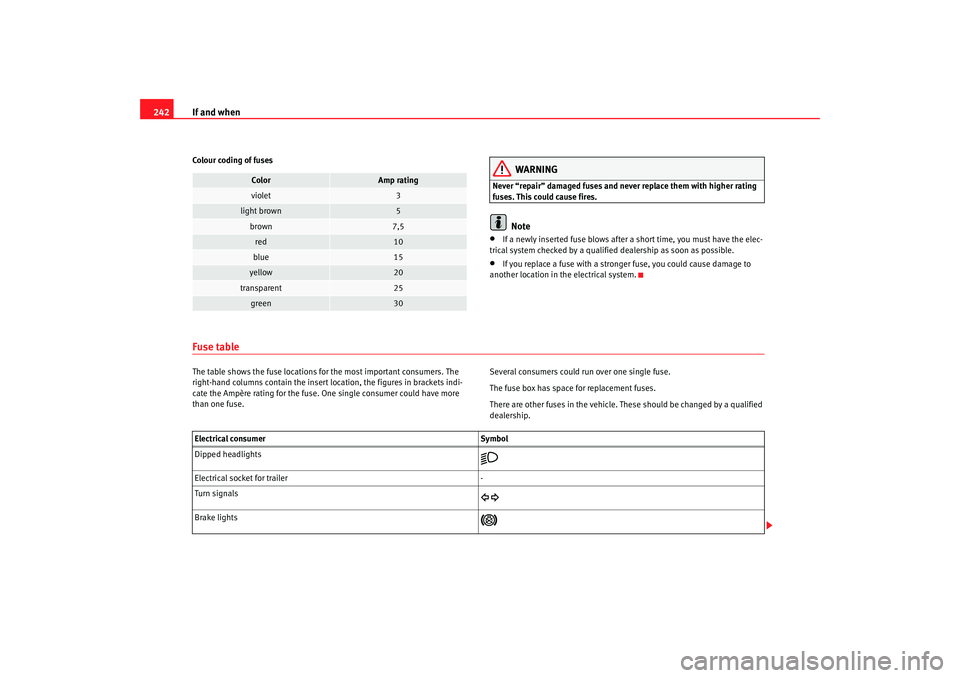
Fuse tableThe table shows the fuse locations fo r the most important consumers. The
right-hand columns contain the insert loc ation, the figures in brackets indi-
cate the Ampère rating for the fuse. One single consumer could have more
than one fuse. Several consumers could run over one single fuse.
The fuse box has space for replacement fuses.
There are other fuses in the vehicle. These should be changed by a qualified
dealership.
Color
Amp rating
violet
3
light brown
5
brown
7,5
red
10
blue
15
yellow
20
transparent
25
green
30
Electrical consumer
Symbol
Dipped headlights
Electrical socket for trailer -
Turn signals
Brake lights
alhambra ingles.book Seite 242 Donnerstag, 19. April 2007 4:04 16
Page 262 of 291
General notes on the technical data
260WeightsKerb weight refers to the basic model with a fuel tank filled to 90% capacity
and without optional extras. The figure quoted includes 75 kg to allow for the
weight of the driver.
For special versions and optional equipment fittings or for the addition of
accessories, the weight of the vehicle will increase ⇒.
WARNING
•
Please note that the centre of gravity may shift when transporting
heavy objects; this may affect the vehi cle's handling and lead to an acci-
dent. Always adjust your speed and dr iving style to suit road conditions
and requirements.
•
Never exceed the gross axle weight rating or the gross vehicle weight
rating. If the allowed axle load or the allowed total weight is exceeded, the
driving characteristics of the vehicle may change, leading to accidents,
injuries and damage to the vehicle.
To w i n g a t r a i l e rTrailer weightsTrailer weights
The trailer weights and drawbar loads approved are selected in intensive
trials according to precisely defined criteria. The approved trailer weights are
valid for vehicles in EU for maximum speeds of 80 km/h (in certain circum-
stances up to 100 km/h). The figures may be different in other countries. All
data in the official vehicle documents take precedence over these data ⇒. Drawbar load
The
maximum permitted weight exerted by the trailer drawbar on the ball joint
of the towing bracket must not exceed 85 kg.
In the interest of road safety, we recommend that you always tow
approaching the maximum drawbar load. The response of the trailer on the
road will be poor if th e drawbar load is too small.
If the maximum permissible drawbar load cannot be met (e.g. with small,
empty and light-weight single axle trailers or tandem axle trailers with an axle
base of less than 1 metre), at least 4% of the actual trailer weight is a legal
stipulation for a drawbar load.
WARNING
•
For safety reasons, you should not drive at speeds above 80 km/h when
towing a trailer. This also applies to countries where higher speeds are
permitted.
•
Never exceed the maximum trailer weights or the draw bar loading. If
the permissible axle load or the perm issible total weight is exceeded, the
driving characteristics of the vehicle may change, leading to accidents,
injuries and damage to the vehicle.
WheelsTyre pressure, snow chains, wheel boltsTyre pressures
The sticker with the tyre pressure values can be found on the inside of the
tank flap. The tyre pressure values given there are for cold tyres. The slightly
raised pressures of warm tyres must not be reduced ⇒.
alhambra ingles.book Seite 260 Donnerstag, 19. April 2007 4:04 16
Page 265 of 291
Technical Data263
Safety First
Operating instructions
Tips and Maintenance
Te c h n i c a l D a t a
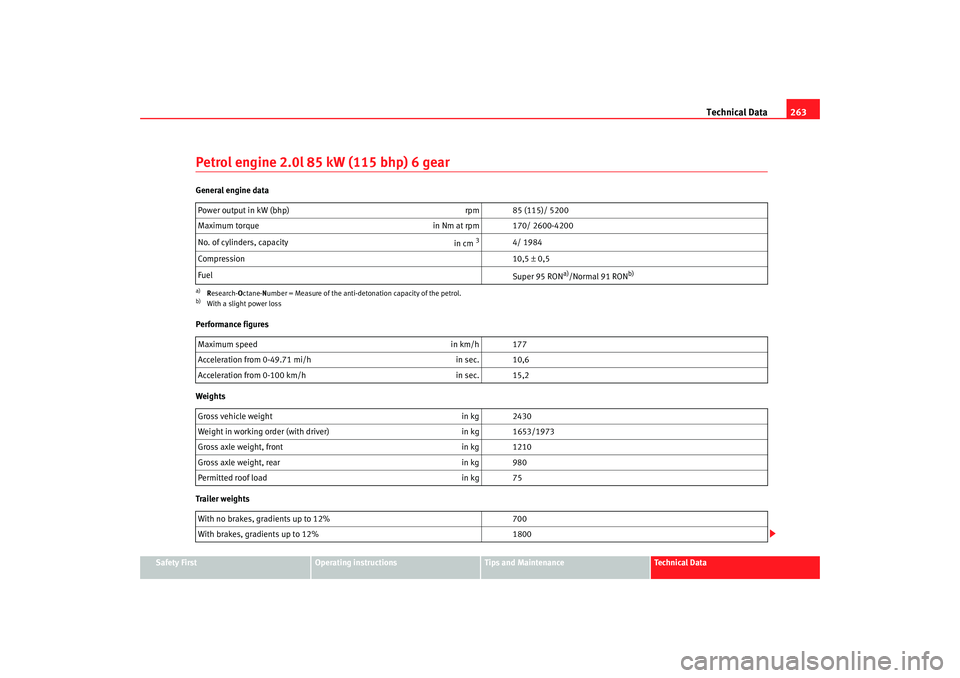
Petrol engine 2.0l 85 kW (115 bhp) 6 gearGeneral engine data
Performance figures
Weights
Trailer weightsPower output in kW (bhp)
rpm 85 (115)/ 5200
Maximum torque in Nm at rpm 170/ 2600-4200
No. of cylinders, capacity in cm
3
4/ 1984
Compression 10,5 ± 0,5
Fuel Super 95 RON
a)/Normal 91 RON
b)
a)Research- Octane- Number = Measure of the anti-detonation capacity of the petrol.b)With a slight power lossMaximum speed in km/h 177
Acceleration from 0- 49.71 mi/h in sec. 10,6
Acceleration from 0-100 km/h in sec. 15,2
Gross vehicle weight in kg 2430
Weight in working order (with driver) in kg 1653/1973
Gross axle weight, front in kg 1210
Gross axle weight, rear in kg 980
Permitted roof load in kg 75
With no brakes, gradients up to 12% 700
With brakes, gradients up to 12% 1800
alhambra ingles.book Seite 263 Donnerstag, 19. April 2007 4:04 16
Page 267 of 291
Technical Data265
Safety First
Operating instructions
Tips and Maintenance
Te c h n i c a l D a t a
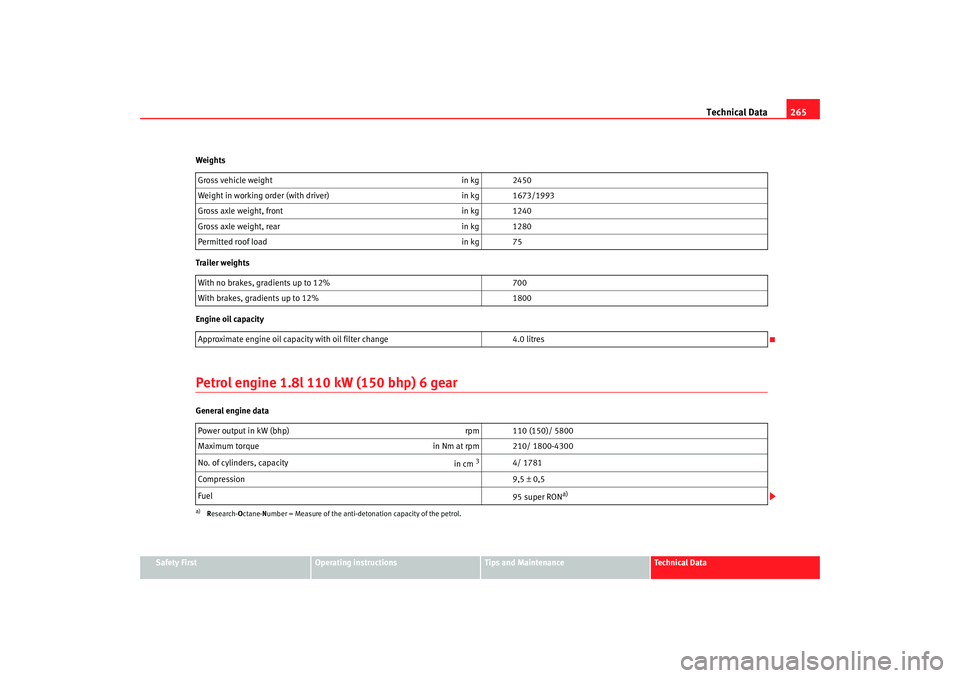
Weights
Trailer weights
Engine oil capacity
Petrol engine 1.8l 110 kW (150 bhp) 6 gearGeneral engine data
Gross vehicle weight
in kg 2450
Weight in working order (with driver) in kg 1673/1993
Gross axle weight, front in kg 1240
Gross axle weight, rear in kg 1280
Permitted roof load in kg 75
With no brakes, gradients up to 12% 700
With brakes, gradients up to 12% 1800
Approximate engine oil capacity with oil filter change 4.0 litres
Power output in kW (bhp) rpm 110 (150)/ 5800
Maximum torque in Nm at rpm 210/ 1800-4300
No. of cylinders, capacity in cm
3
4/ 1781
Compression 9,5 ± 0,5
Fuel 95 super RON
a)
a)Research- Octane- Number = Measure of the anti-detonation capacity of the petrol.
alhambra ingles.book Seite 265 Donnerstag, 19. April 2007 4:04 16