light Seat Alhambra 2008 Owner's Manual
[x] Cancel search | Manufacturer: SEAT, Model Year: 2008, Model line: Alhambra, Model: Seat Alhambra 2008Pages: 295, PDF Size: 7.83 MB
Page 246 of 295
If and when
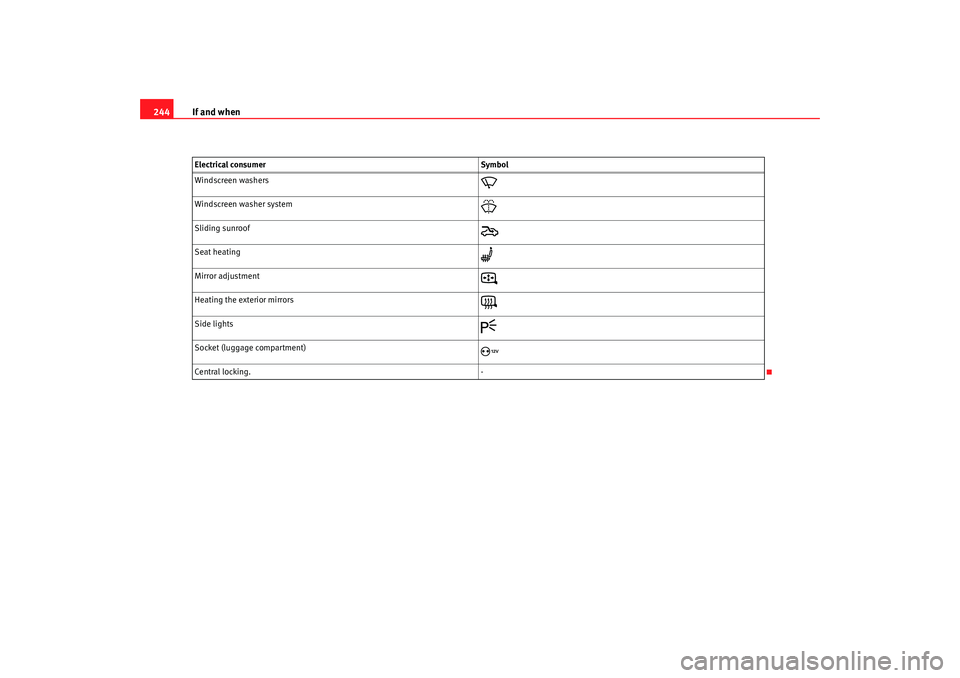
244Windscreen washers
Windscreen washer system
Sliding sunroof
Seat heating
Mirror adjustment
Heating the exterior mirrors
Side lights
Socket (luggage compartment)
Central locking. -
Electrical consumer
Symbol
alhambra_ingles_0708 Seite 244 Mittwoch, 10. September 2008 10:55 10
Page 247 of 295
If and when245
Safety First
Operating instructions
Tips and Maintenance
Te c h n i c a l D a t a
Changing a lightBulbs, changing
Bulbs should be changed by a professional mechanic only.Technical knowledge is required to change bulbs. This is because, in certain
cases, access can be gained only by removing other vehicle components.
This applies in particular to bulbs which can be accessed only from the
engine compartment.
We recommend bulbs are changed by a qualified dealership or, if this is not
possible, by a qualified person.
However, if you wish to change the bulb, please observe the following:
Before changing a bulb, you must switch off the light (light switch in O posi-
tion), and the turn signal lever must be in the neutral position.
Always replace damaged bulbs with identical bulbs with the same designa-
tion. The type is inscribed on the bulb, either on the glass or on the base.
You should store spare light bulbs in the vehicle for safety-relevant lights.
Bulbs can be obtained from SEAT Service Centres.
WARNING
•
The high voltage element of gas discharge lamps must be handled
correctly. Failure to comply could result in fatal injuries.
•
H7* bulbs are pressurised and could explode when they are being
changed. Risk of injury.
•
In vehicles fitted with gas discharge lamps *, there is a mortal danger if
the high voltage section of the lamp is incorrectly handled.
•
When working in the engine compartment, always observe the safety
warnings ⇒page 209.
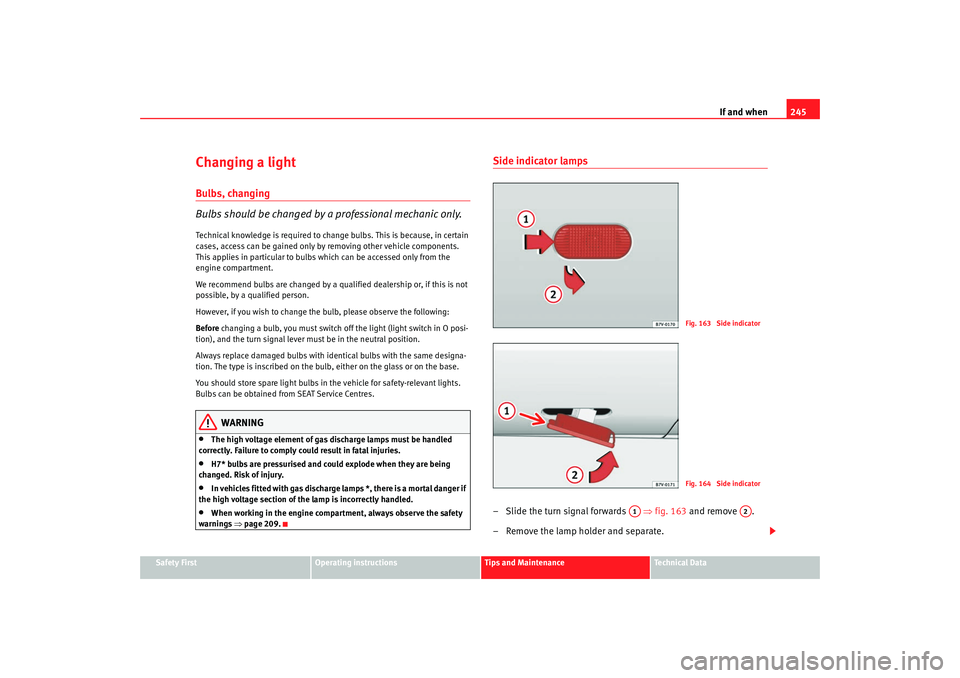
Side indicator lamps– Slide the turn signal forwards ⇒fig. 163 and remove .
– Remove the lamp holder and separate.
Fig. 163 Side indicatorFig. 164 Side indicator
A1
A2
alhambra_ingles_0708 Seite 245 Mittwoch, 10. September 2008 10:55 10
Page 248 of 295
If and when
246
– Remove the failed glass bulb and replace with a new bulb.
– Insert the lamp holder in the turn signal guide rail.
– First fit the turn signal in the opening of the chassis, securing with the tabs ⇒ fig. 164 and then, fit the bulb as shown by
the arrow .Rear lightsBefore changing a bulb, the tailgate should always be opened.
The lights have the following layout:
On the body
Turn signals, pilot light and brake/rear light
On the tailgate / rear door
Reversing light and rear antifog light.
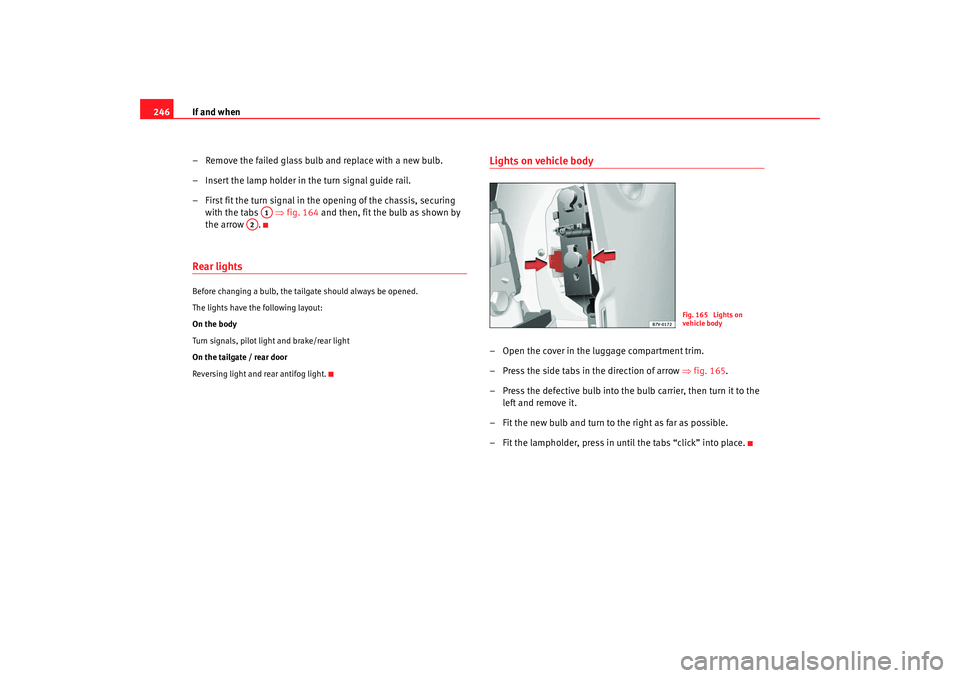
Lights on vehicle body – Open the cover in the luggage compartment trim.
– Press the side tabs in the direction of arrow ⇒ fig. 165.
– Press the defective bulb into the bulb carrier, then turn it to the left and remove it.
– Fit the new bulb and turn to the right as far as possible.
– Fit the lampholder, press in until the tabs “click” into place.
A1
A2
Fig. 165 Lights on
vehicle body
alhambra_ingles_0708 Seite 246 Mittwoch, 10. September 2008 10:55 10
Page 249 of 295
If and when247
Safety First
Operating instructions
Tips and Maintenance
Te c h n i c a l D a t a
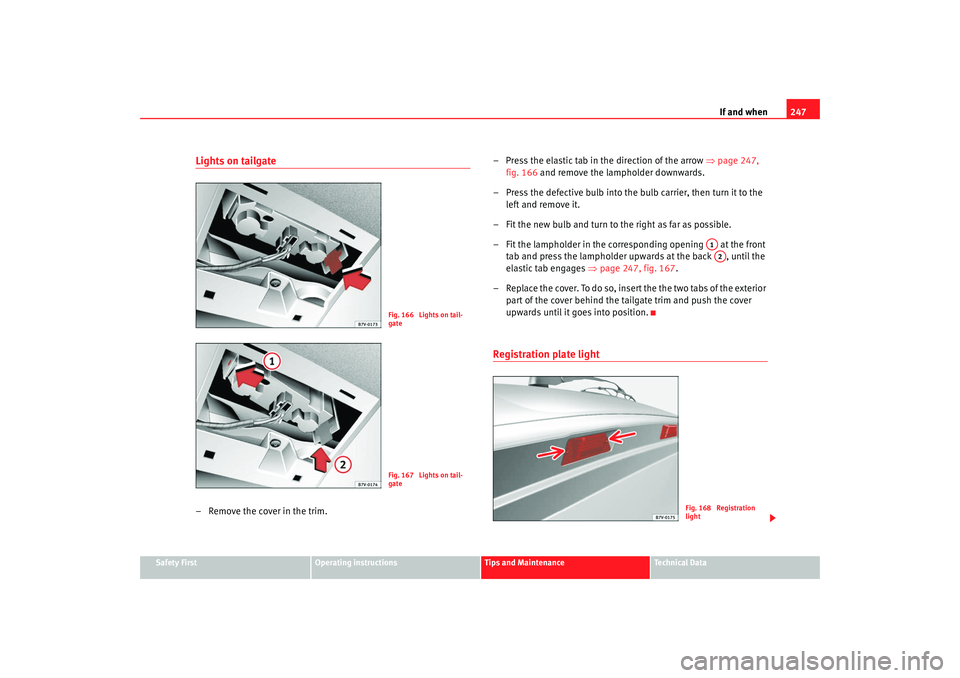
Lights on tailgate– Remove the cover in the trim. – Press the elastic tab in the direction of the arrow
⇒page 247,
fig. 166 and remove the lampholder downwards.
– Press the defective bulb into the bulb carrier, then turn it to the left and remove it.
– Fit the new bulb and turn to the right as far as possible.
– Fit the lampholder in the corresponding opening at the front tab and press the lampholder upwards at the back , until the
elastic tab engages ⇒ page 247, fig. 167.
– Replace the cover. To do so, insert the the two tabs of the exterior part of the cover behind the tailgate trim and push the cover
upwards until it goes into position.
Registration plate light
Fig. 166 Lights on tail-
gateFig. 167 Lights on tail-
gate
A1A2
Fig. 168 Registration
light
alhambra_ingles_0708 Seite 247 Mittwoch, 10. September 2008 10:55 10
Page 250 of 295
If and when
248
– Remove the glass
– Remove the failed glass bulb and replace with a new bulb.
– Bolt down the glass without overtightening, ensuring that the seal is perfectly fitted.
– Fit the reflector in the corresponding space in the tailgate ensuring that the rubber seal and the light are assembled
correctly.
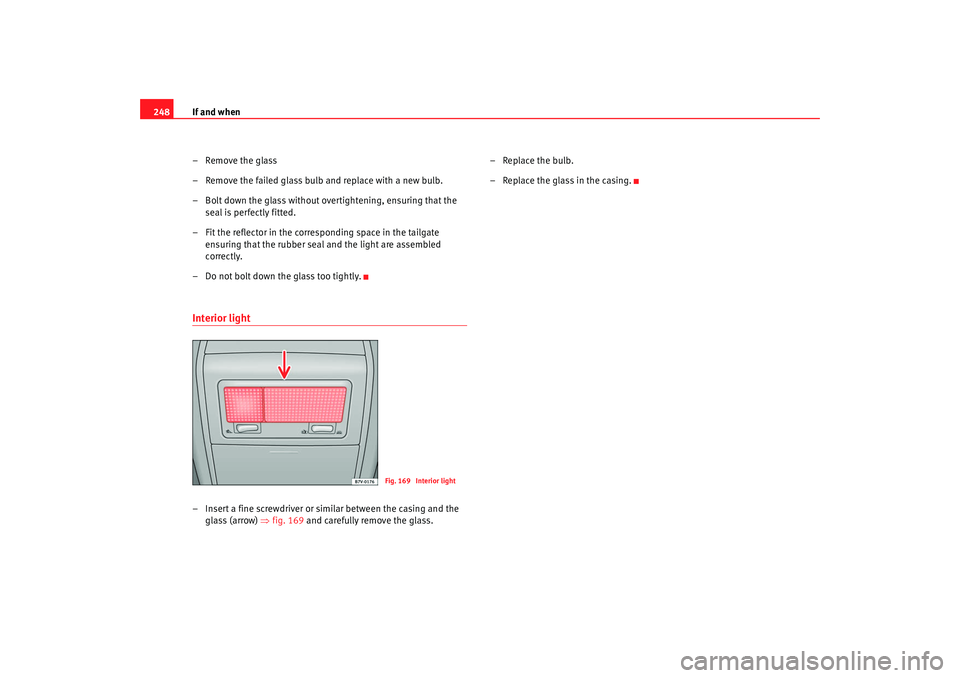
– Do not bolt down the glass too tightly.Interior light– Insert a fine screwdriver or similar between the casing and the glass (arrow) ⇒fig. 169 and carefully remove the glass. – Replace the bulb.
– Replace the glass in the casing.
Fig. 169 Interior light
alhambra_ingles_0708 Seite 248 Mittwoch, 10. September 2008 10:55 10
Page 251 of 295
If and when249
Safety First
Operating instructions
Tips and Maintenance
Te c h n i c a l D a t a
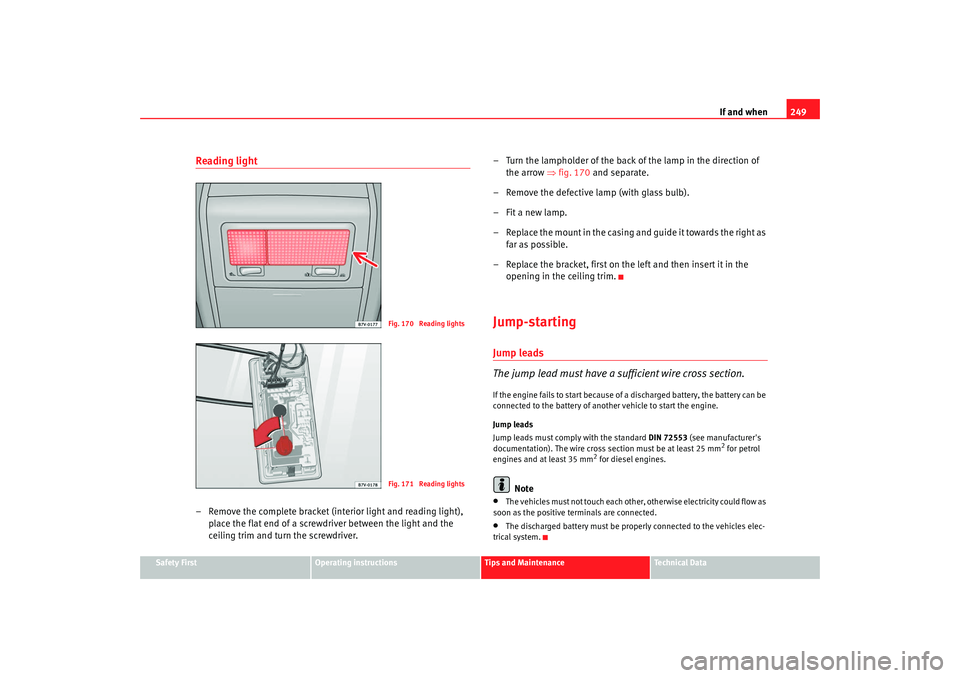
Reading light – Remove the complete bracket (interior light and reading light),
place the flat end of a screwdriver between the light and the
ceiling trim and turn the screwdriver. – Turn the lampholder of the back of the lamp in the direction of
the arrow ⇒fig. 170 and separate.
– Remove the defective lamp (with glass bulb).
–Fit a new lamp.
– Replace the mount in the casing and guide it towards the right as far as possible.
– Replace the bracket, first on the left and then insert it in the opening in the ceiling trim.
Jump-startingJump leads
The jump lead must have a sufficient wire cross section.If the engine fails to start because of a discharged battery, the battery can be
connected to the battery of another vehicle to start the engine.
Jump leads
Jump leads must comply with the standard DIN 72553 (see manufacturer's
documentation). The wire cross section must be at least 25 mm
2 for petrol
engines and at least 35 mm
2 for diesel engines.
Note
•
The vehicles must not touch each other, otherwise electricity could flow as
soon as the positive terminals are connected.
•
The discharged battery must be properly connected to the vehicles elec-
trical system.
Fig. 170 Reading lightsFig. 171 Reading lights
alhambra_ingles_0708 Seite 249 Mittwoch, 10. September 2008 10:55 10
Page 252 of 295
If and when
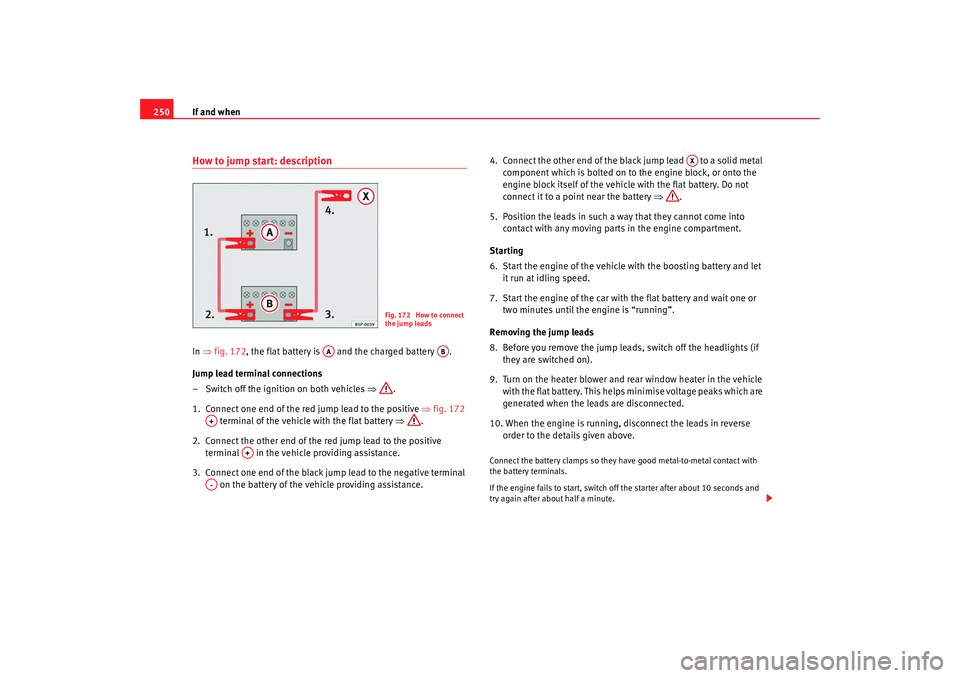
250How to jump start: descriptionIn ⇒ fig. 172 , the flat battery is and the charged battery .
Jump lead terminal connections
– Switch off the ignition on both vehicles ⇒.
1. Connect one end of the red jump lead to the positive ⇒fig. 172
terminal of the vehicle with the flat battery ⇒.
2. Connect the other end of the red jump lead to the positive terminal in the vehicle providing assistance.
3. Connect one end of the black jump lead to the negative terminal on the battery of the vehicle providing assistance. 4. Connect the other end of the black jump lead to a solid metal
component which is bolted on to the engine block, or onto the
engine block itself of the vehicle with the flat battery. Do not
connect it to a point near the battery ⇒.
5. Position the leads in such a way that they cannot come into contact with any moving parts in the engine compartment.
Starting
6. Start the engine of the vehicle with the boosting battery and let it run at idling speed.
7. Start the engine of the car with the flat battery and wait one or two minutes until the engine is “running”.
Removing the jump leads
8. Before you remove the jump leads, switch off the headlights (if they are switched on).
9. Turn on the heater blower and rear window heater in the vehicle with the flat battery. This helps minimise voltage peaks which are
generated when the leads are disconnected.
10. When the engine is running, disconnect the leads in reverse order to the details given above.
Connect the battery clamps so they have good metal-to-metal contact with
the battery terminals.
If the engine fails to start, switch off the starter after about 10 seconds and
try again after about half a minute.
Fig. 172 How to connect
the jump leads
AA
AB
A+
A+
A-
AX
alhambra_ingles_0708 Seite 250 Mittwoch, 10. September 2008 10:55 10
Page 253 of 295
If and when251
Safety First
Operating instructions
Tips and Maintenance
Te c h n i c a l D a t a
WARNING
•
Please note the safety warnings referring to working in the engine
compartment ⇒page 209, “Working in the engine compartment”.
•
The battery providing assistance must have the same voltage as the flat
battery (12V) and approximately the same capacity (see imprint on
battery). Failure to comply could result in an explosion.
•
Never use jump leads when one of the batteries is frozen. Danger of
explosion! Even after the battery has thawed, battery acid could leak and
cause chemical burns. If a battery freezes, it should be replaced.
•
Keep sparks, flames and lighted cigarettes away from batteries, danger
of explosion. Failure to comply could result in an explosion.
•
Observe the instructions provided by the manufacturer of the jump
leads.
•
Do not connect the negative cable from the other vehicle directly to the
negative terminal of the flat battery. The gas emitted from the battery could
be ignited by sparks. Danger of explosion.
•
Do not attach the negative cable from the other vehicle to parts of the
fuel system or to the brake line.
•
The non-insulated parts of the battery clamps must not be allowed to
touch. The jump lead attached to the positive battery terminal must not
touch metal parts of the vehicle, this can cause a short circuit.
•
Position the leads in such a way that they cannot come into contact
with any moving parts in the engine compartment.
•
Do not bend over the batteries. This could result in chemical burns.Note
The vehicles must not touch each other, otherwise electricity could flow as
soon as the positive terminals are connected.
alhambra_ingles_0708 Seite 251 Mittwoch, 10. September 2008 10:55 10
Page 255 of 295
If and when253
Safety First
Operating instructions
Tips and Maintenance
Te c h n i c a l D a t a
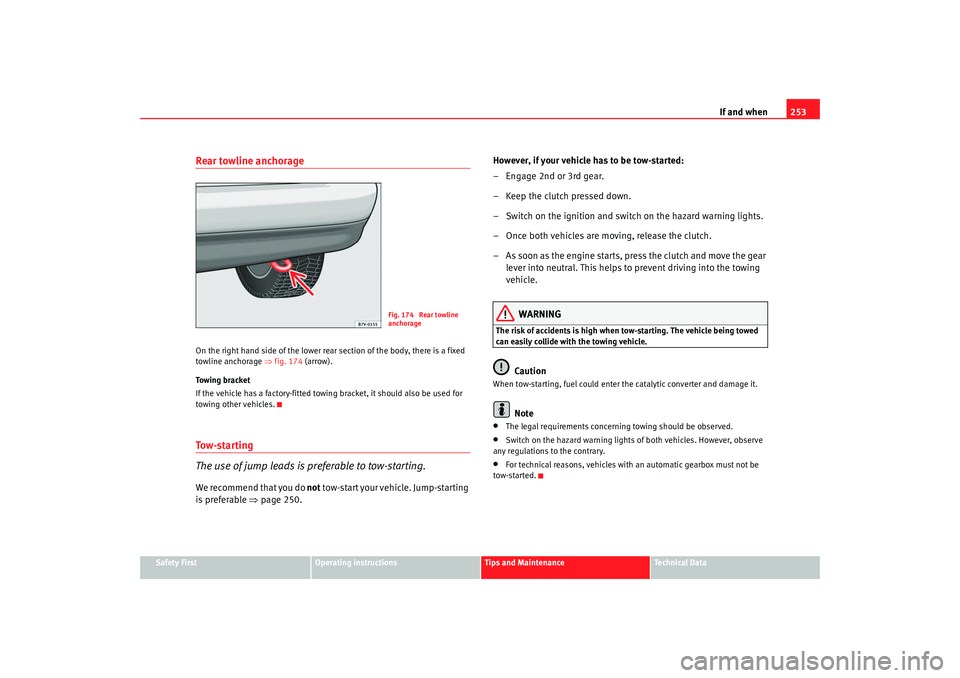
Rear towline anchorageOn the right hand side of the lower rear section of the body, there is a fixed
towline anchorage ⇒ fig. 174 (arrow).
To w i n g b r a c k e t
If the vehicle has a factory-fitted towing bracket, it should also be used for
towing other vehicles.To w - s t a r t i n g
The use of jump leads is preferable to tow-starting.We recommend that you do not tow-start your vehicle. Jump-starting
is preferable ⇒page 250. However, if your vehicle has to be tow-started:
– Engage 2nd or 3rd gear.
– Keep the clutch pressed down.
– Switch on the ignition and switch on the hazard warning lights.
– Once both vehicles are moving, release the clutch.
– As soon as the engine starts, press the clutch and move the gear
lever into neutral. This helps to prevent driving into the towing
vehicle.
WARNING
The risk of accidents is high when tow-starting. The vehicle being towed
can easily collide with the towing vehicle.
Caution
When tow-starting, fuel could enter the catalytic converter and damage it.
Note
•
The legal requirements concerning towing should be observed.
•
Switch on the hazard warning lights of both vehicles. However, observe
any regulations to the contrary.
•
For technical reasons, vehicles with an automatic gearbox must not be
tow-started.
Fig. 174 Rear towline
anchorage
alhambra_ingles_0708 Seite 253 Mittwoch, 10. September 2008 10:55 10
Page 256 of 295
If and when
254Notes for tow-starting or towingIf a cable is used for towing the vehicle, please observe the
following:
As the driver of the towing vehicle
– Switch on the hazard warning lights. However, observe any regu-
lations to the contrary.
– Drive slowly at first until the tow-rope is taut. Then accelerate gradually.
– Begin and change gears cautiously. If you are driving an auto- matic vehicle, accelerate gently.
– Remember that the brake servo and power steering are not working in the vehicle you are towing. Brake earlier than you
would normally, but with a more gentle pressure on the brake.
As the driver of the vehicle being towed
– Switch on the hazard warning lights. However, observe any regu- lations to the contrary.
– Place the gearstick in neutral or position N .
– Ensure that the tow-rope remains taut at all times.Tow-rope or tow-bar
It is easier and safer to tow a vehicle with a tow-bar. You should only use a
tow-rope if you do not have a tow-bar.
A tow-rope should be slightly elastic to reduce the loading on both vehicles.
It is advisable to use a tow-rope made of synthetic fibre or similarly elastic
material. Attach the tow-rope or the tow-bar only to the towing eyes provided or a
towing bracket.
Driving tips
Towing requires some experience, especially when using a tow-rope. Both
drivers should be familiar with the technique required for towing. Inexperi-
enced drivers should not attempt to tow-start or tow away another vehicle.
Do not pull too hard with the towing vehicle and take care to avoid jerking the
tow-rope. When towing on an unpaved road, there is always a risk of over-
loading and damaging the anchorage points.
The ignition of the vehicle being towed must be switched on to prevent the
steering wheel from locking and also to allow the use of the turn signals,
horn, windscreen wipers and washers.
If the vehicle is towed, with the hazard warning lights on and the ignition
switched on, the turn signal may be used to indicate that you are going to
change direction. Move the turn signal lever accordingly. Meanwhile, the
hazard warning lights will go off. When the turn signal lever is returned to the
rest position, the hazard warning lights will automatically reconnect.
The brake servo works only when the engine is running. In this case the pedal
has to be pressed harder.
As the power assisted steering does not work if the engine is not running, you
will need more strength to steer than you normally would.
Towing vehicles with an automatic gearbox
•
Move the selector lever to N.
•
Do not drive faster than 50 km/h when towing a vehicle.
•
Do not tow further than 50 km.
•
If a breakdown truck is used, the vehicle must be towed with the front
wheels raised.
alhambra_ingles_0708 Seite 254 Mittwoch, 10. September 2008 10:55 10