instrument panel Seat Alhambra 2008 User Guide
[x] Cancel search | Manufacturer: SEAT, Model Year: 2008, Model line: Alhambra, Model: Seat Alhambra 2008Pages: 295, PDF Size: 7.83 MB
Page 68 of 295
Cockpit
66between 12 and 15 volts. If the voltage drops below 12 volts when the engine
is running, you should have the power supply (battery and alternator)
checked by a qualified dealership.
Note
The voltage may drop below 8 volts while the engine is being started.Service Interval Display The service display is shown either on the mileage display ⇒page 62, fig. 44
or in the display
7) in the combi-instrument ⇒ page 62, fig. 44 .
Service warning
A service pre-warning will appear in the odometer if a service is due soon. A
spanner symbol
appears in the display along with the miles and the
number of kilometres until the next service. The service message will disap-
pear approximately 20 seconds after the ignition is switched on or if the
engine is running.
The distance quoted to the next scheduled service is reduced in increments
of 100 miles.
The following information text displayed in the instrument panel display:
SERVICE IN... KM OR SERVICE IN... DAYS . The service message will disappear
approximately 20 seconds after the ignition is switched on or the engine is
running. The normal display can be resumed by pressing the reset button on
the trip counter or by pressing the rocker switch of the windscreen wiper lever .
If a service is due , a gong signal will sound and the flashing “spanner”
symbol will appear for approximately 20 seconds. The following information
text displayed in the instrument panel display: SERVICE NOW. With the ignition switched on, you can call up the current service message
by
pressing the trip counter reset knob for 2 seconds.
An overdue service is indicated by a minus sign in front of the mileage or day
information.
Resetting the service display
The display is reset by the SEAT dealer after the service has been carried out.
You will receive a print-out from the SEAT dealership as confirmation that this
work has been carried out.
If the service is not carried out by a SEAT Service centre, the service interval
display will have to be reset manually as follows:
•
Switch off ignition.
•
Press and hold the reset knob for the trip meter.
•
Turn the ignition on and turn the reset button to the right. The display will
return to the normal mode.Note
•
The next service will be displayed after 15,000 km (10,000 miles) if you
reset the service display yourself. The service interval will not be determined
individually.
•
Do not reset the display between service intervals as the display will
otherwise be incorrect.
7)Optional equipmentA10
A3
AB
alhambra_ingles_0708 Seite 66 Mittwoch, 10. September 2008 10:55 10
Page 69 of 295
Cockpit67
Safety First
Operating instructions
Tips and Maintenance
Te c h n i c a l D a t a
Display in the instrument panel Fault messages
Faults are shown by warning lamps and / or as symbols with
warning and information reports on the display.The system runs a check on certain components and functions when the igni-
tion is switched on and while the vehicle is moving. Functional problems are
shown by warning lamps and / or red or yellow symbols with fault texts on the combi-instrument. Depending on the exact nature of the functional problem,
audible warnings may also be given.
Note
•
Th e size o f t h e d isp l ay d e p en ds on th e ty p e o f com b i - ins tr u m e n t y ou h av e
fitted. In some models, the combi-instrument does not have an integrated
display.
•
In addition to warning messages given on a fault, you will receive informa-
tion in the display on procedures or will be asked to carry out certain tasks.
Overview of selected fault messages
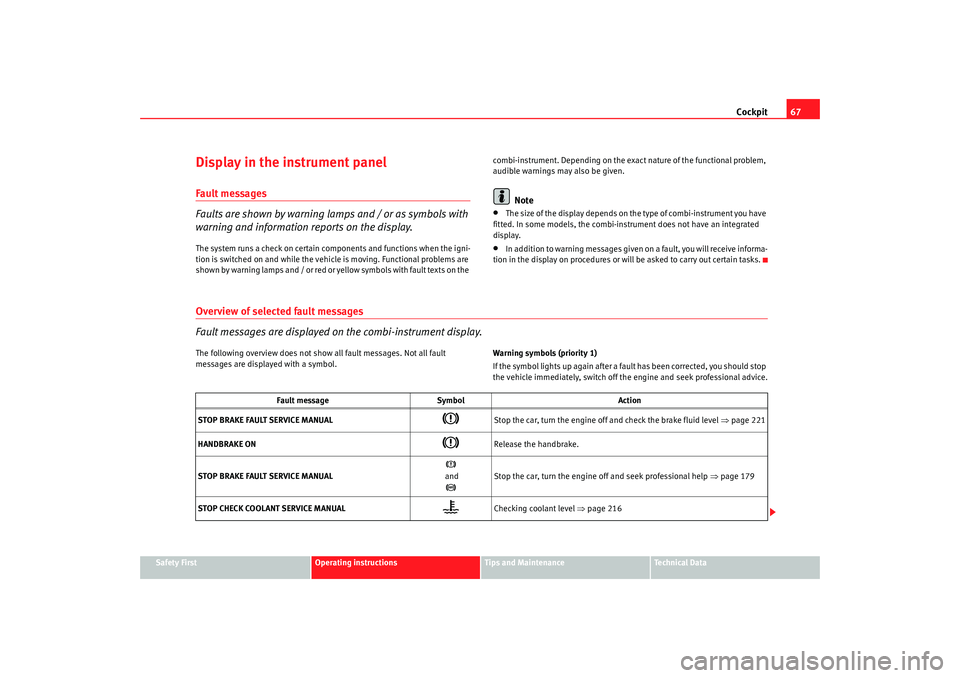
Fault messages are displayed on the combi-instrument display.The following overview does not show all fault messages. Not all fault
messages are displayed with a symbol. Warning symbols (priority 1)
If the symbol lights up again after a fault has been corrected, you should stop
the vehicle immediately, switch off the engine and seek professional advice.
Fault message
Symbol Action
STOP BRAKE FAULT SERVICE MANUAL
Stop the car, turn the engine off and check the brake fluid level ⇒page 221
HANDBRAKE ON
Release the handbrake.
STOP BRAKE FAULT SERVICE MANUAL
and
Stop the car, turn the engine off and seek professional help ⇒page 179
STOP CHECK COOLANT SERVICE MANUAL
Checking coolant level ⇒ page 216
alhambra_ingles_0708 Seite 67 Mittwoch, 10. September 2008 10:55 10
Page 72 of 295
Cockpit
70Warning lampsOverview of the warning lamps
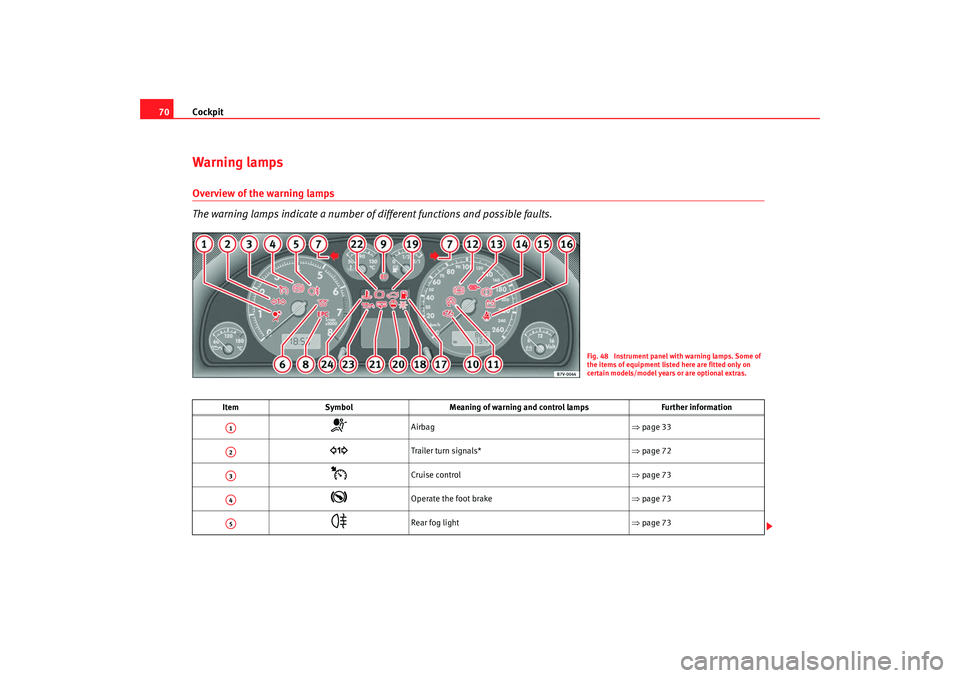
The warning lamps indicate a number of different functions and possible faults.
ItemSymbol Meaning of warning and control lamps Further information
Airbag ⇒page 33
Trailer turn signals* ⇒page 72
Cruise control ⇒page 73
Operate the foot brake ⇒page 73
Rear fog light ⇒page 73
Fig. 48 Instrument panel with warning lamps. Some of
the items of equipment listed here are fitted only on
certain models/model years or are optional extras.
A1A2A3A4A5
alhambra_ingles_0708 Seite 70 Mittwoch, 10. September 2008 10:55 10
Page 75 of 295
Cockpit73
Safety First
Operating instructions
Tips and Maintenance
Te c h n i c a l D a t a
Cruise control system*
The warning lamp comes on when the cruise control system
is switched on.The warning lamp
lights up when the cruise control system is switched
on. Further information see page 176.
Operating the foot brake
The footbrake must be depressed when this warning lamp lights up. This is
necessary when the automatic gearbox* selector lever is moved out of the
positions P or N.Rear fog light
This wa rning lamp ligh ts up when the r ear fo
g light is switched on
. Fu rther
in fo rmation ⇒ page 108.
Faults in diesel engines
This indicator monitors the engine management system for
diesel engines.
If a malfunction occurs in the engine management system while you are
driving, the control lamp will flash
. Take the vehicle to an Authorised
Service Centre as soon as possible and have the engine checked.
At the same time, a text message or the necessary operations may appear on
the instrument panel.
Turn si gnals
The warning lamp flashes when the turn signals are in oper-
ation.Depending on which turn signal is operated, either the left
or right
indi-
cator lamp flashes. Both warning lamps will flash at the same time when the
hazard warning lights are switched on.
If one turn signal fails, the warning lamp will start flashing twice as fast.
Further information on the turn signals ⇒page 111.
Engine management
This warning lamp monitors the engine management system
for petrol engines.
The warning lamp
(Electronic Power Control) lights up when the ignition
is switched on to show that the lamp is working properly. It should go out
when the engine has started running.
If a fault develops in the electronic engine management system while you are
driving, this warning lamp will light up. Take the vehicle to an Authorised
Service Centre as soon as possible and have the engine checked.
Main beam headlights
This warning lamp lights up when the main beams are on.The warning lamp
lights up when the main beams are on or when the
headlight flasher is operated.
Further information ⇒page 111.
alhambra_ingles_0708 Seite 73 Mittwoch, 10. September 2008 10:55 10
Page 76 of 295
Cockpit
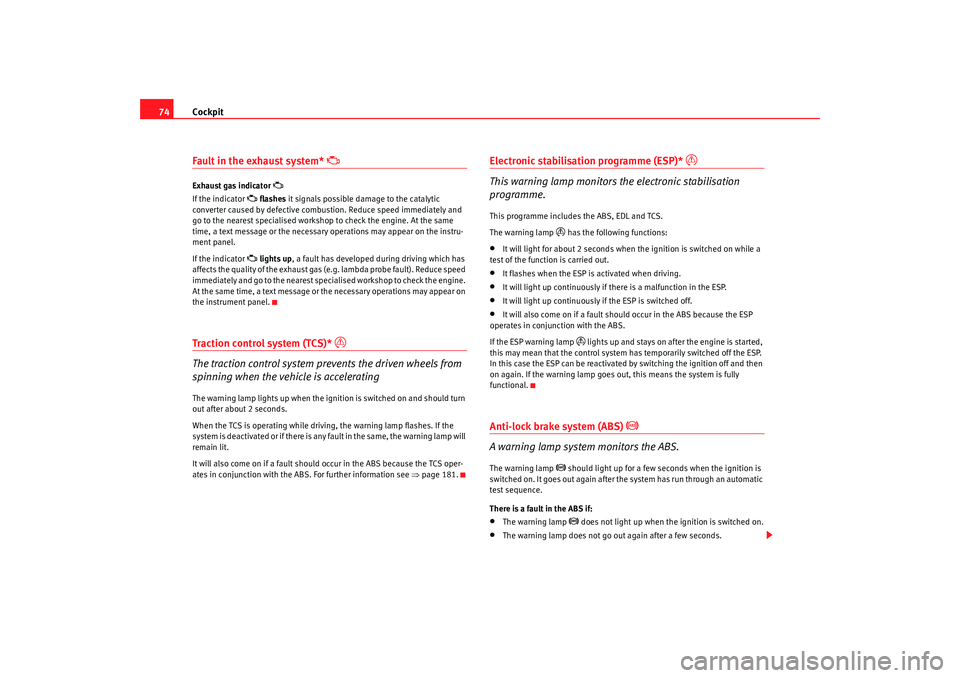
74Fault in the exhaust system*
Exhaust gas indicator
If the indicator
flashes it signals possible damage to the catalytic
converter caused by defective combustion. Reduce speed immediately and
go to the nearest specialised workshop to check the engine. At the same
time, a text message or the necessary operations may appear on the instru-
ment panel.
If the indicator lights up , a fault has developed during driving which has
affects the quality of the exhaust gas (e.g. lambda probe fault). Reduce speed
immediately and go to the nearest specialised workshop to check the engine.
At the same time, a text message or the necessary operations may appear on
the instrument panel.
Traction control system (TCS)*
The traction control system prevents the driven wheels from
spinning when the vehicle is acceleratingThe warning lamp lights up when the ignition is switched on and should turn
out after about 2 seconds.
When the TCS is operating while driving, the warning lamp flashes. If the
system is deactivated or if there is any fault in the same, the warning lamp will
remain lit.
It will also come on if a fault should occur in the ABS because the TCS oper-
ates in conjunction with the ABS. For further information see ⇒ page 181.
Electronic stabilisation programme (ESP)*
This warning lamp monitors the electronic stabilisation
programme.
This programme includes the ABS, EDL and TCS.
The warning lamp
has the following functions:
•
It will light for about 2 seconds when the ignition is switched on while a
test of the function is carried out.
•
It flashes when the ESP is activated when driving.
•
It will light up continuously if there is a malfunction in the ESP.
•
It will light up continuously if the ESP is switched off.
•
It will also come on if a fault should occur in the ABS because the ESP
operates in conjunction with the ABS.
If the ESP warning lamp
lights up and stays on after the engine is started,
this may mean that the control system has temporarily switched off the ESP.
In this case the ESP can be reactivated by switching the ignition off and then
on again. If the warning lamp goes out, this means the system is fully
functional.
Anti-lock brake system (ABS)
A warning lamp system monitors the ABS.
The warning lamp
should light up for a few seconds when the ignition is
switched on. It goes out again after the system has run through an automatic
test sequence.
There is a fault in the ABS if:
•
The warning lamp
does not light up when the ignition is switched on.
•
The warning lamp does not go out again after a few seconds.
alhambra_ingles_0708 Seite 74 Mittwoch, 10. September 2008 10:55 10
Page 77 of 295
Cockpit75
Safety First
Operating instructions
Tips and Maintenance
Te c h n i c a l D a t a
•
The warning lamp lights up when the vehicle is moving.
The vehicle can still be braked in the normal way (except that the ABS control
function will not function). Please take the vehicle to a qualified workshop as
soon as possible. For further information on the ABS see the ⇒page 180.
If a fault occurs in the ABS, the ESP* warning lamp will also light up.
Brake system fault
If the ABS warning lamp
lights up together with the brake warning lamp
, this indicates not only a fault in the ABS function, but also a possible fault
in the brake system ⇒ .
WARNING
•
Before opening the bonnet, read and observe the warnings on
⇒ page 209, “Working in the engine compartment”.
•
If the brake warning lamp
should light up together with the ABS
warning lamp
, stop the vehicle immediately and check the brake fluid
level in the reservoir ⇒page 221, “Brake fluid”. If the fluid level has
dropped below the “MIN” mark you must not drive on. Risk of accident.
Obtain technical assistance.
•
If the brake fluid level is correct, the fault in the brake system may have
been caused by a failure of the ABS system. This could cause the rear
wheels to lock quickly when you brake. This could cause the rear to break
away. Risk of skidding. Drive carefully to the nearest qualified workshop
and have the fault corrected.
Differential lock fault (EDL)*
EDL operates along with the ABS in vehicles equipped with an
Electronic Stabilisation Program (ESP)*A malfunction in the EDL is indicated by the ABS warning lamp
. Please
take the vehicle to a qualified workshop as soon as possible. For further infor-
mation on the EDL ⇒page 182.
Diesel particulate filter indicator lamp*
When the indicator
lights on the instrument panel it signals that the filter
is blocked by soot because of frequent short journeys. To clean the filter of
these particulates, drive at a constant speed of 60 km/h for 15 minutes.
Always respect the speed limit. The most efficient way to clean the diesel
particulate filter is to drive in 4th or 5th gear, at approximately 2,000 rpm
⇒ . This causes a temperature increase sufficient to burn the soot in the
filter.
If the lamp
remains lit afterwards, go to a specialised workshop to
examine the problem.
While the lamp is lit (filter blockage signal) fuel consumption increases
and the engine may lose power in some cases.
At the same time, a text message or the necessary operations may appear on
the instrument panel.
WARNING
•
Try to always adapt the speed of the vehicle to weather, road and traffic
conditions. The indications suggested by the warning lights should not
lead you to disobey the highway code.
alhambra_ingles_0708 Seite 75 Mittwoch, 10. September 2008 10:55 10
Page 80 of 295
Cockpit
78Coolant Level* / temperature
The warning lamp lights up if the coolant temperature is too
high or if the coolant level is too low.There is a fault if:•
The warning symbol does not go out again after a few seconds.
•
The warning lamp lights up or flashes while the vehicle is moving, while
three acoustic warning signals ⇒ are emitted.
This means that either the coolant level is too low or the coolant temperature
is too high.
Coolant temperature too high
First look at the coolant temperature gauge. The coolant temperature is too
high if the needle is over the warning area on the dial. Stop the vehicle,
switch off the engine and wait for it to cool down. Check the coolant level.
If the coolant level is correct, the overheating may be caused by a malfunction
of the radiator fan. Check the radiator fan fuse and have it replaced if neces-
sary ⇒page 241.
If the warning lamp lights up again after driving on for a short distance, stop
the vehicle and switch off the engine . Contact an Authorised Service Centre
or a qualified workshop.
Coolant level too low
The following information text is displayed in the instrument panel display.
First look at the coolant temperature gauge. If the needle is in the normal
range, top up with coolant at the earliest opportunity ⇒.
WARNING
•
If your vehicle is immobilised for any technical reasons, move it to a
sa fe dista n ce from tra ffic. Tu rn o ff the en gin e , tu rn o n the ha za rd ligh ts a nd
place the warning triangle.
•
Never open the bonnet if you can see or hear steam or coolant escaping
from the engine compartment. Risk of scalding. Wait until you can no
longer see or hear escaping steam or coolant.
•
The engine compartment of any motor vehicle is a dangerous area!
Before carrying out any work in the engine compartment, switch off the
engine and allow it to cool down. Always note the corresponding warnings
⇒ page 209.WARNING (continued)
alhambra_ingles_0708 Seite 78 Mittwoch, 10. September 2008 10:55 10
Page 81 of 295

Cockpit79
Safety First
Operating instructions
Tips and Maintenance
Te c h n i c a l D a t a
On board computer with multifunction displayDescription
The information from the multi-function indicator and on board computer is
shown on these displays. The functions and indications of the multi-function
indicator are described in the chapter “Intruments”.
When the ignition is switched on, the on-board computer continually controls
the working of certain systems and vehicle components while the vehicle is
in motion.
Faults in the operation or urgent repairs or services are indicated by sound
signals and light warnings in red or yellow,depending on priority, on the
instrument panel.
In addition to the red and yellow symbols, text messages appear on the
driver's display.
Note
•
Depending on the model version or the country, it is possible that the
equipment installed in your vehicle does not display certain messages, or
they do not correspond with those in this manual. For this reason, we advise
you to consult the chapter “Luminous Indicators” for complementary informa-
tion on the different symbols and a description of their function.
Check operationVehicles with a manual gearbox
If faults exist, these will be indicated after the ignition is switched on. The
corresponding sound signal is emitted at the same time.
Vehicles with an automatic gearbox
Once the ignition is switched on with the lever in position P or N, the driver
warning appears on the display:
WITH CAR STOPPED, DEPRESS BRAKE TO SELECT GEAR
After selecting a gear ( R, D , etc) the warning is erased.
Fig. 49 Vehicle instru-
ment panel display with
telematic or navigation
system.Fig. 50 Display in vehicle
with on-board computer.
alhambra_ingles_0708 Seite 79 Mittwoch, 10. September 2008 10:55 10
Page 100 of 295
Unlocking and locking
98Ta i l g a t eOpening the tailgateUnlocking the tailgate
– Make sure that the key slot is vertical.
– Operate the handle and pull up the tailgate ⇒.
Closing the tailgate
– Take hold of one of the recessed handles in the interior trim of the tailgate.
– Close the tailgate hard ⇒ in “Safety instructions for the tail-
gate” on page 100.A warning appears on the instrument panel
14) if the tailgate is open or not
properly closed. Depending on the level of equipment fitted, an audible warning
14) will be given either while the vehicle is stationary or when you
drive.
Locking and unlocking the tailgate
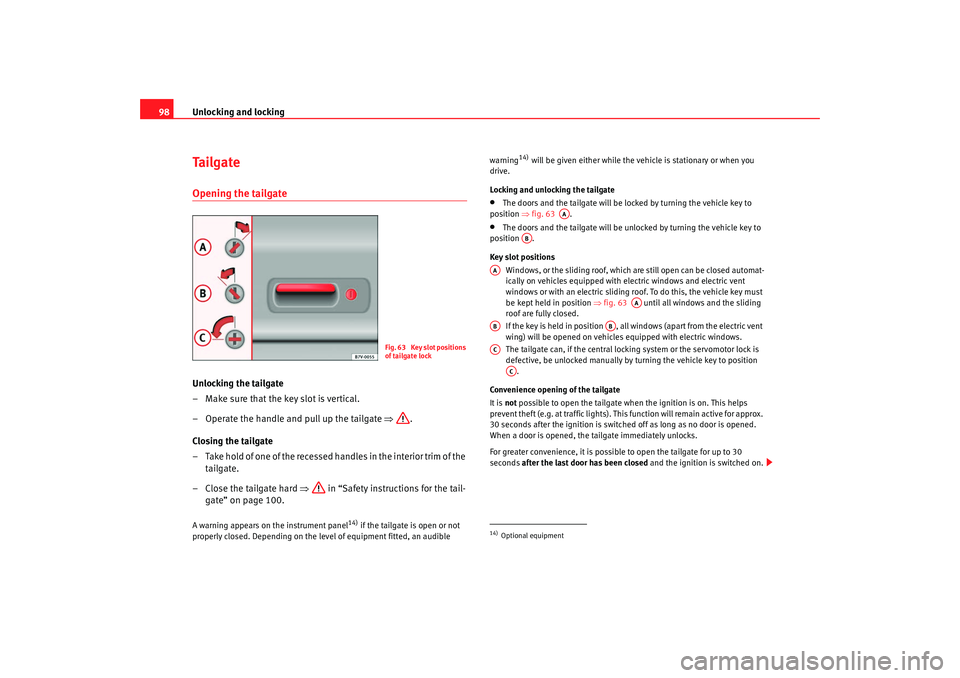
•
The doors and the tailgate will be locked by turning the vehicle key to
position ⇒fig. 63 .
•
The doors and the tailgate will be unlocked by turning the vehicle key to
position .
Key slot positions
Windows, or the sliding roof, which are still open can be closed automat-
ically on vehicles equipped with electric windows and electric vent
windows or with an electric sliding roof. To do this, the vehicle key must
be kept held in position ⇒ fig. 63 until all windows and the sliding
roof are fully closed.
If the key is held in position , all windows (apart from the electric vent
wing) will be opened on vehicles equipped with electric windows.
The tailgate can, if the central locking system or the servomotor lock is
defective, be unlocked manually by turning the vehicle key to position
.
Convenience opening of the tailgate
It is not possible to open the tailgate when the ignition is on. This helps
prevent theft (e.g. at traffic lights). This function will remain active for approx.
30 seconds after the ignition is switched off as long as no door is opened.
When a door is opened, the tailgate immediately unlocks.
For greater convenience, it is possible to open the tailgate for up to 30
seconds after the last door has been closed and the ignition is switched on.
Fig. 63 Key slot positions
of tailgate lock
14)Optional equipment
AA
AB
AA
AA
AB
AB
AC
AC
alhambra_ingles_0708 Seite 98 Mittwoch, 10. September 2008 10:55 10
Page 101 of 295
Unlocking and locking99
Safety First
Operating instructions
Tips and Maintenance
Te c h n i c a l D a t a
Driving with the tailgate open
If the tailgate is open or incorrectly closed, the following warning may be
appear on the display
14). Please note that theft of your cargo is more likely if
the tailgate is open.
WARNING
If you have to drive with the tailgate open, please observe the following
warnings:•
Observe the following points to reduce the danger of poisoning from
exhaust fumes entering the vehicle interior:
−Close all windows.
− Close the sliding/tilting roof,
− Switch off air recirculation.
− Open the air outlets in the dash panel,
− Set the fresh air blower to the highest speed.
•
Drive particularly carefully and think ahead. If possible, avoid sudden
braking and driving manoeuvres as this could cause the open tailgate to
move unpredictably. Risk of injury.
•
When carrying objects that protrude from the boot, the correct signals
should be used; otherwise there is a risk of accident. Observe legal require-
ments when doing so.
•
Always secure objects in the boot. Loose items could fall out of the
vehicle and injure other road users.
•
If a baggage rack is fitted on the tailgate, it should be removed before
travelling with the tailgate open.
•
Read and always observe the safety information concerning the use of
the tailgate ⇒page 100.
Closing the tailgateBefore closing the tailgate, make sure that the key has not been left
inside the boot.
Closing the tailgate
– Take hold of the grip in the inside trim of the tailgate ⇒ and
pull the tailgate down.
– Pull hard.A display appears in the combi-instrument if the tailgate is not properly
closed
15).WARNING
Always close the tailgate properly. Risk of accident or injury.•
Do not close the tailgate by pushing it down with your hand on the
window. The glass could shatter. Risk of injury!
•
Ensure the tailgate is locked after closing. If not, it may open unexpect-
edly while driving.
•
Never allow children to play in or around the vehicle. A locked vehicle
can be subjected to extremely high and low temperatures, depending on
the time of year. This could cause serious injuries/illness. It could even
have fatal consequences. Close and lock both the tailgate and all the other
doors when you are not using the vehicle.
•
Never close the tailgate without observing and ensuring it is clear, to do
otherwise could cause serious injury to you and others. Make sure that no
one is in the path of the tailgate.
15)Optional equipment
alhambra_ingles_0708 Seite 99 Mittwoch, 10. September 2008 10:55 10