weight Seat Alhambra 2008 User Guide
[x] Cancel search | Manufacturer: SEAT, Model Year: 2008, Model line: Alhambra, Model: Seat Alhambra 2008Pages: 295, PDF Size: 7.83 MB
Page 102 of 295
Unlocking and locking
100Safety instructions for the tailgate
WARNING
For safety reasons, you should always keep the tailgate fully closed when
driving. Always close the tailgate properly. Risk of accident or injury.•
Ensure the tailgate is locked after closing. If not, it may open unexpect-
edly while driving.
•
Never close the tailgate without observing and ensuring it is clear, to do
otherwise could cause serious injury to you and others. Make sure that no
one is in the path of the tailgate.
•
Loose objects which could fall out of the vehicle when the tailgate is
opened could cause injury.
•
If you have objects (for example bicycles) on a rack fitted to the tailgate,
you may not be able to open the tailgate fully, or the additional weight
could close the tailgate. For this reason, you should support the tailgate or
remove the objects from the rack. Risk of injury.
•
Never allow children to play in or around the vehicle. A locked vehicle
can be subjected to extremely high and low temperatures, depending on
the time of year. This could cause serious injuries/illness. It could even
have fatal consequences. Close and lock both the tailgate and all the other
doors when you are not using the vehicle. Make sure first that there is no
one in the vehicle.
•
If you have to drive with the tailgate open, observe the all notes
⇒ page 99 to reduce the risk, for example, of poisoning caused by exhaust
fumes entering the passenger compartment.
alhambra_ingles_0708 Seite 100 Mittwoch, 10. September 2008 10:55 10
Page 126 of 295
Seats and stowage
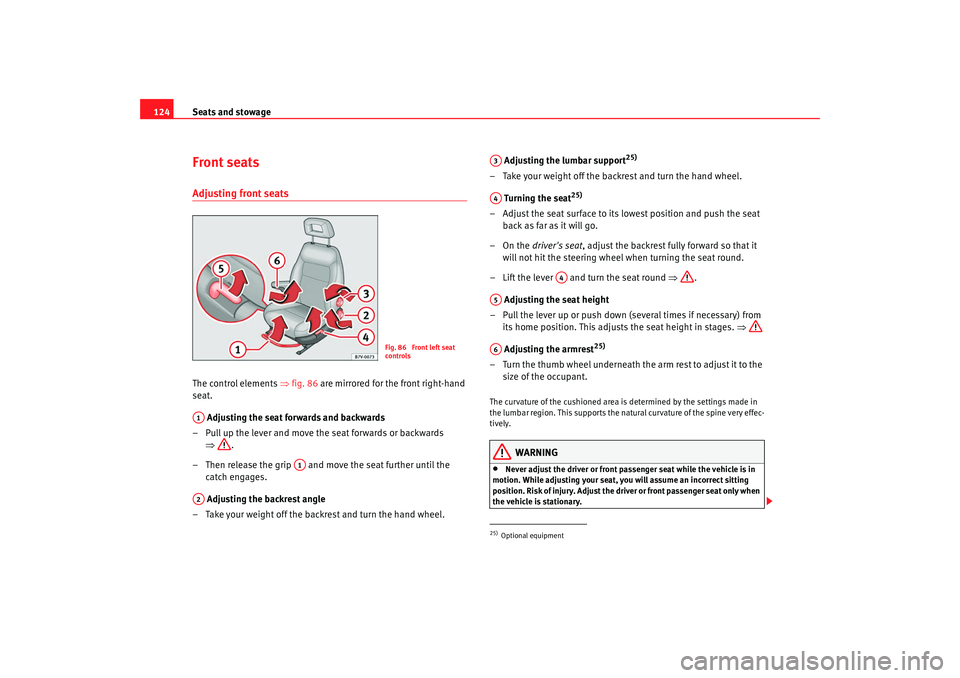
124Front seatsAdjusting front seats The control elements ⇒fig. 86 are mirrored for the front right-hand
seat.
Adjusting the seat forwards and backwards
– Pull up the lever and move the seat forwards or backwards ⇒ .
– Then release the grip and move the seat further until the catch engages.
Adjusting the backrest angle
– Take your weight off the backrest and turn the hand wheel. Adjusting the lumbar support
25)
– Take your weight off the backrest and turn the hand wheel.
Turning the seat
25)
– Adjust the seat surface to its lowest position and push the seat back as far as it will go.
–On the driver's seat , adjust the backrest fully forward so that it
will not hit the steering wheel when turning the seat round.
– Lift the lever and turn the seat round ⇒.
Adjusting the seat height
– Pull the lever up or push down (several times if necessary) from its home position. This adjusts the seat height in stages. ⇒
Adjusting the armrest
25)
– Turn the thumb wheel underneath the arm rest to adjust it to the size of the occupant.The curvature of the cushioned area is determined by the settings made in
the lumbar region. This supports the natural curvature of the spine very effec-
tively.
WARNING
•
Never adjust the driver or front passenger seat while the vehicle is in
motion. While adjusting your seat, you will assume an incorrect sitting
position. Risk of injury. Adjust the driver or front passenger seat only when
the vehicle is stationary.
Fig. 86 Front left seat
controls
A1
A1
A2
25)Optional equipmentA3A4
A4
A5A6
alhambra_ingles_0708 Seite 124 Mittwoch, 10. September 2008 10:55 10
Page 133 of 295
Seats and stowage131
Safety First
Operating instructions
Tips and Maintenance
Te c h n i c a l D a t a
Adjusting the armrest
– Turn the thumb wheel underneath the armrests to adjust the
angle of the armrests to your requirement.
Removable armrest*
29)
– Take hold of the armrest at the rear and press the button ⇒page 130, fig. 94 in the direction of the arrow.
– With the button pressed, pull the armrest off to the side out of the holder.
–When installing , please ensure that the armrest engages
securely in the holder.The removable armrests for the second row of seats can be found in a trans-
port bag ⇒page 130, fig. 95 .
The bag hangs from a head restraint of a seat in the last row of seats or, in
vehicles with 4 integrated child seats
29), on t he ce n t re sea t o f th e se con d ro w
of seats.
WARNING
•
The transport bag should always be secured properly when travelling in
the vehicle as it could otherwise be a safety risk in an accident or braking
manoeuvre. We recommend that you keep the bag at home.
•
The bag, if you do decide to keep it in the vehicle, may not be secured
to the head restraint of an integrated child seat. The backrest could be
forced forward in an accident or braking manoeuvre due to the weight of the
bag.
Safety instructions for seats
WARNING
•
Occupants may travel on the seats in the passenger compartment only
if the following conditions are fulfilled at the same time:
−The seats must always be fitted in the appropriate floor anchorings
and must be securely engaged.
− The backrest of all seats must be in the upright position and securely
engaged in this position.
− The seat occupants must have access to the seat belts. The seat
belts must be fitted correctly.
− All the occupants of the vehicle must be correctly seated while
driving.
•
A seat which has been removed can cause injury if it is transported in
the vehicle. Each seat must always be fitted in the floor anchorings and
must be securely engaged. The backrest must be in an upright position. If
a bench seat is not properly secured, it could become a life-threatening
hazard for all vehicle occupants.
•
Make sure that the seat feet of seats are not soiled or damaged when
removed from the vehicle.
•
All adjustment to the seats, including fitting and removal, may be
carried out only when the vehicle is stationary.
29)Optional equipment
alhambra_ingles_0708 Seite 131 Mittwoch, 10. September 2008 10:55 10
Page 146 of 295
Seats and stowage
144
WARNING
Loose luggage and other objects in the luggage compartment can cause
serious injuries.•
Always stow objects in the luggage compartment and secure them on
the fastening rings.
•
Use suitable specialist straps to secure heavy objects.
•
During sudden manoeuvres or accidents, loose objects can be thrown
forward, injuring vehicle occupants or passers-by. This increased risk of
injury will be further increased if a l oose object is struck by an inflating
airbag. If this happens, objects can be transformed into “missiles”. Risk of
fatal injury.
•
Remember that transporting heavy objects modifies the driving condi-
tions as the centre of gravity has been altered. There is a risk of accident.
Therefore, it is essential to adjust your speed and driving style accordingly,
to avoid accidents.
•
Never exceed the allowed axle loads or allowed maximum weight. If the
allowed axle load or the allowed total weight is exceeded, the driving char-
acteristics of the vehicle may change, leading to accidents, injuries and
damage to the vehicle.
•
Never leave the vehicle unattended, especially when the tailgate is
open. Children could climb into the luggage compartment closing the door
behind them; they will remain trapped without help and there is a mortal
risk.
•
Never allow children to play in or around the vehicle. Close and lock
both the tailgate and all the doors when you leave the vehicle. Before you
lock the vehicle, make sure that there are no adults or children in the
vehicle.
•
Never transport passengers in the luggage compartment. Every
passenger must be properly belted in.
Caution
•
Avoid overloading small areas by placing heavy objects on the vehicle
floor.
•
The wires of the heating element in the rear window and the window aerial
in the rear side windows could be damaged if objects on the luggage
compartment cover rub against them.
•
If you have removed the seats from the passenger compartment, you
should place a large, robust covering over the floor anchorings to prevent
damage.Note
•
Air circulation in the vehicle helps reduce fogging of the windows. Used
air escapes through ventilation slits in the side trim of the luggage compart-
ment. Ensure that the ventilation slits are never covered.
•
Straps for securing the load to the fastening rings are commercially
available.
Fastening rings
There are fastening rings in the luggage compartment which
can be used to secure luggage and other objects.– Always use suitable undamaged belts for fastening the luggage or any other object tot he anchorage rings ⇒ in “Loading the
luggage compartment” on page 143.The retainers for the detachable seat belts for the third row of seats and the
floor anchorings for the seats can be used as fastening rings for items of
luggage.
alhambra_ingles_0708 Seite 144 Mittwoch, 10. September 2008 10:55 10
Page 147 of 295
Seats and stowage145
Safety First
Operating instructions
Tips and Maintenance
Te c h n i c a l D a t a
During a collision or an accident, even small and light objects can build up so
much energy that they can cause very severe injuries. The amount of “kinetic
energy” depends on the speed of the vehicle and the weight of the object.
The most significant factor, however, is the speed of the vehicle.
Example: An object weighing 4.5 kg is lying unsecured in the vehicle. During
a frontal collision at a speed of 50 km/h, this object generates a force corre-
sponding to 20 times its weight. That means that the effective weight of the
object increases to about 90 kg. You can imagine the severity of the injuries
which might be sustained if this “projectile” strikes an occupant as it flies
through the passenger compartment. This increased risk of injury will be
further increased if a loose object is struck by an inflating airbag.
WARNING
If pieces of baggage or other objects are secured to the fastening rings with
inappropriate or damaged re
taining cords, injuries could result in the event
of braking manoeuvres or accidents.•
To prevent pieces of luggage or other objects from flying forward,
always use appropriate retaining cords which are secured to the fastening
rings.
•
Never secure a child seat on the fastening rings.
Loading heavy objects
Special care is required when loading heavy objects and
when driving a vehicle which contains heavy objects.Observe the following points to prevent damage and accidents:
– If necessary, remove the seats to increase the load area. –
Before loading the vehicle place a sturdy mat or similar cover
flush on floor of the vehicle.
– Where necessary, do not cover protruding parts of the vehicle floor.
– Protect the seat anchor points from damage.
– Avoid overloading small areas - spread the load.
– Use suitable straps to secure the objects to retaining rings.
– Drive particularly carefully and think ahead.
– If possible, avoid sudden braking and driving manoeuvres.
WARNING
For safety reasons, you should read and observe all information on loading
the vehicle ⇒ page 145.
Caution
•
If you have removed the seats from the passenger compartment, you
should place a large, robust covering over the seat rails to prevent damage.
•
Avoid overloading small areas - spread the load.
Safety notes on loading the vehicle
WARNING
Loose luggage and other objects in the luggage compartment can cause
serious injuries.
alhambra_ingles_0708 Seite 145 Mittwoch, 10. September 2008 10:55 10
Page 148 of 295
Seats and stowage
146•
Always stow objects safely in the vehicle and secure them on the
fastening rings if necessary.
•
Use suitable specialist straps to secure heavy objects.
•
Loose objects in the vehicle can move suddenly. As the centre of gravity
moves, safety is impaired and the vehicle becomes difficult to handle.
•
During sudden manoeuvres or accidents, loose objects can be thrown
forward, injuring vehicle occupants or passers-by. This increased risk of
injury will be further increased if a l oose object is struck by an inflating
airbag. If this happens, objects can be transformed into “missiles”. Risk of
fatal injury.
•
Remember that transporting heavy objects modifies the driving condi-
tions as the centre of gravity has been altered. There is a risk of accident.
Therefore, it is essential to adjust your speed and driving style accordingly,
to avoid accidents.
•
Never exceed the allowed axle loads or allowed maximum weight. If the
allowed axle load or the allowed total weight is exceeded, the driving char-
acteristics of the vehicle may change, leading to accidents, injuries and
damage to the vehicle.
•
Never leave the vehicle unattended, especially when the tailgate is
open. Children could climb into the interior of the vehicle closing the door
behind them; they will remain trapped without help and there is a mortal
risk.
•
Never allow children to play in or around the vehicle. Close and lock all
windows, the tailgate and all doors when you leave the vehicle.
•
Never transport passengers in the luggage compartment. Every
passenger must be properly belted in.
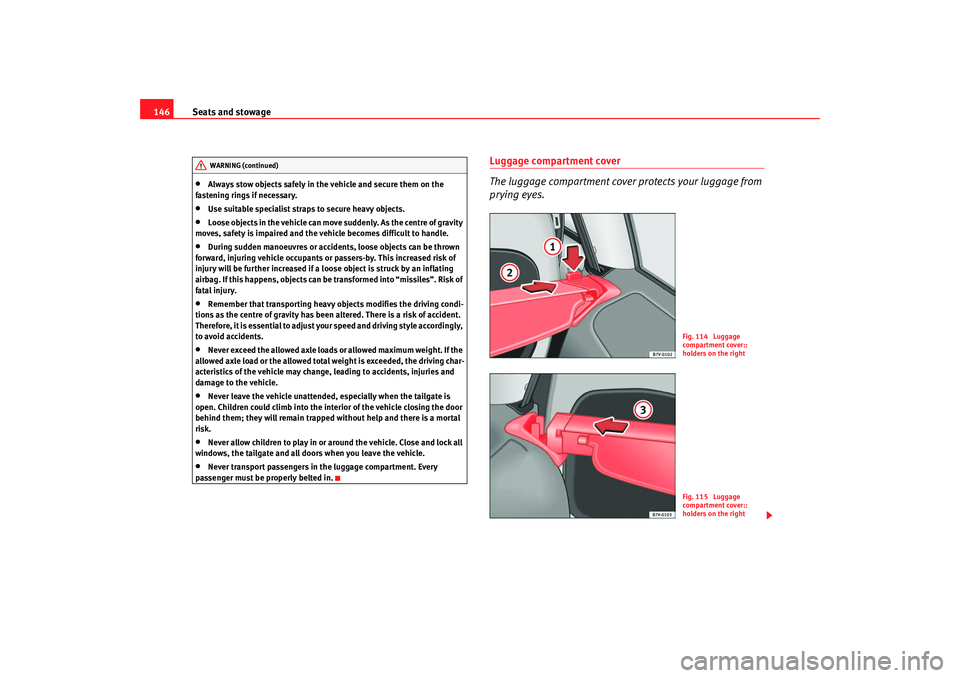
Luggage compartment cover
The luggage compartment cover protects your luggage from
prying eyes.
WARNING (continued)
Fig. 114 Luggage
compartment cover::
holders on the rightFig. 115 Luggage
compartment cover::
holders on the right
alhambra_ingles_0708 Seite 146 Mittwoch, 10. September 2008 10:55 10
Page 151 of 295
Seats and stowage149
Safety First
Operating instructions
Tips and Maintenance
Te c h n i c a l D a t a
•
Damage to the vehicle caused by incorrect installation of mounts or roof
carrier systems not approved by the factory are excluded from the vehicle
warranty.
Securing the load
Loads transported on the roof carrier must be securely
attached. The car's handling is affected when transporting
loads.The maximum permissible roof load for your vehicle is 75 kg. The load limit
applies to the combined weight of the carrier system and the load itself.
Distribute the load evenly. However, if you are using a roof carrier with a lower
weight rating, you will not be able to carry the maximum roof load. Do not
exceed the maximum weight limit for the roof carrier which is listed in the
fitting instructions.
WARNING
•
If damaged, fine or inadequate securing straps are used to fasten
objects carried on the roof, they could break in the event of sharp braking.
This could cause an accident and serious injury.
•
Always use appropriate securing straps to secure objects on the roof
carrier against sliding or flying off.,This could cause an accident. The load
must be correctly secured.
•
Always respect the maximum authorised weight for the roof, the
maximum authorised weight on the axles and the total maximum author-
ised weight of the vehicle. Otherwise there is danger of causing an acci-
dent.
•
The risk of an accident is increased by transporting heavy or bulky
loads on the roof, which affects the car's handling by shifting the centre of
gravity and increasing susceptibility to cross winds. Both circumstances increase the risk of accident. Therefore you must adapt your driving style
and speed to the prevailing conditions - avoid sudden braking or driving
manoeuvres when there is a load on the roof carrier.
Caution
Please take extra care not to let the tailgate or rear window strike the roof load
when open – there is a risk of damage to the vehicle.
For the sake of the environment
The roof carrier is often left on the roof for convenience even if it is not being
used. However, increased air resistance means that the vehicle uses more
fuel. For this reason you should always take off the roof carrier when it is not
in use.Cooling and heating box*Notes on usage
The cooling and heating box may only be installed in the posi-
tion of rear left seat in the third row.Power can be supplied by any of the 12 Volt sockets in the vehicle. It
consumes approximately 33 watts and has a capacity of approximately 32
litres.
The battery will discharge if the cooling and heating box is used for a long
period while the engine is switched off.
WARNING (continued)
alhambra_ingles_0708 Seite 149 Mittwoch, 10. September 2008 10:55 10
Page 178 of 295
Driving
176Cruise control system (CCS)Cruise control operation
The cruise control system(CCS) is able to maintain the set
speed in the range from approx. 30 km/h to 180 km/h.Once the desired speed has been reached and the setting stored, you may
take your foot off the accelerator.
In vehicles fitted with a manual gearbox and in vehicles with an automatic
gearbox with the lever in positions P, N or R the cruise control does not
operate in first gear.
WARNING
It could be dangerous to use the cruise control system (CCS) if it is not
possible to drive at constant speed.•
Do not use the cruise control in heavy traffic or on steep roads, with
several bends or in slippery circumstances (snow, ice, rain or loose gravel),
as there is a risk of accident.
•
Always adapt your speed and the distance to the vehicles ahead to take
the traffic situation into consideration. This is the duty of the driver. The
cruise control system is merely an aid to the driver.
•
Never use the cruise control system when driving off-road or on
unpaved roads. This feature is designed for use on paved roads only. Risk
of accident.
•
Always switch off the CCS when you have finished using it. This will
prevent you using it by mistake.
•
It is dangerous to use a set speed which is too high for the prevailing
road, traffic or weather conditions. This may cause an accident.
Caution
Vehicles with a manual gearbox: if the cruise control is activated the gearbox
should not be set in neutral without first releasing the clutch, as the the
engine speed will increase and this may cause damage.
Note
When travelling down hills, the CCS cannot maintain a constant speed. The
vehicle will accelerate under its own weight. Reduce gears (with an automatic
gearbox, reduce gears using the “Tiptronic”) or brake using the footbrake.
alhambra_ingles_0708 Seite 176 Mittwoch, 10. September 2008 10:55 10
Page 190 of 295
Driving and the environment
188Manual gearbox: Change from first to second gear as quickly as possible. We
recommend that, whenever possible, you change to a higher gear upon
reaching 2,000 rpms.
Automatic gearbox: Accelerate in moderation and avoid the “kick-down” (full
throttle) position.
Avoid driving at high speed
We advise you not to drive at the top speed permitted by the vehicle. Fuel
consumption, exhaust emissions and noise levels all increase very rapidly at
higher speeds. Driving at moderate speeds will help to save fuel.
Avoid idling
It is worthwhile switching off the engine when waiting in a traffic jam, at level
crossings or at traffic lights with a long red phase. The fuel saved after only
30 - 40 seconds is greater than the amount of fuel needed to restart the
engine.
The engine takes a very long time to warm up when it is running at idling
speed. Mechanical wear and pollutant emissions are also especially high
during this initial warm-up phase. It is therefore best to drive off immediately
after starting the engine. Avoid running the engine at high speed.
Periodic maintenance
Periodic maintenance work guarantees that, before beginning a journey, you
will not consume more than the required amount of fuel. A well-serviced
engine gives you the benefit of improved fuel efficiency as well as maximum
reliability and an enhanced resale value.
A badly serviced engine can consume up to 10% more fuel than necessary.
Avoid short journeys
To reduce the consumption and emission of polluting gases, the engine and
the exhaust filtration systems should reach the optimum service tempera-
ture . With the engine cold, fuel consumption is proportionally higher. The engine
does not warm up and fuel consumption does not regularise until having
driven some
four kilometres. This is the reason why we recommend avoiding
short trips wherever possible.
Maintain the correct tyre pressures
Bear in mind that keeping the tyres at the correct pressure saves fuel. If the
tyre pressures are just 1 bar too low, this can put the fuel consumption up by
as much as 5 %. Due to the greater rolling resistance, under-inflation also
increases tyre wear and impairs handling.
The tyre pressures should always be checked when the tyres are cold.
Do not use winter tyres all through the year: they will increase fuel consump-
tion by up to 10 %.
Avoid unnecessary weight
Every kilo of extra weight will put up the fuel consumption, so it is worth
checking the luggage compartment occasionally to make sure that no unnec-
essary loads are being transported.
A roof carrier is often left in place for the sake of convenience, even when it is
no longer needed. At a speed of 100-120 km/h your car will use about 12%
more fuel as a result of the extra wind resistance caused by the roof carrier
even when it is not in use.
Save electrical energy
The engine activates the alternator, which produces electricity. With the need
for electricity, fuel consumption is also increased. Because of this, always
turn off electrical equipment when you do not need them. Examples of equip-
ment that use a lot of electricity are: the fan at high speeds, the rear window
heating or the seat heaters*.
alhambra_ingles_0708 Seite 188 Mittwoch, 10. September 2008 10:55 10
Page 192 of 295

Driving and the environment
190Trailer towingWhat do you need to bear in mind when towing a trailer?The vehicle can, if suitably equipped, be used to tow a trailer or caravan.
If the car is supplied with a factory-fitted towing bracket it will already have
the necessary technical modifications and meet the statutory requirements
for towing a trailer. If you wish to retrofit a towing bracket ⇒page 204.
Connectors
Your vehicle is fitted with a 12-pin connector for the electrical connection
between the trailer and the vehicle.
If the trailer has a 7-pin plug, you will need to use an adapter cable. This is
available from SEAT Service.
Trailer weight / draw bar loading
Never exceed the maximum permitted trailer weights. If you do not load the
trailer up to the maximum permitted trailer weight, you can then climb corre-
spondingly steeper gradients.
The maximum trailer weights listed are only applicable for altitudes up to
1,000 m above sea level. With increasing altitude the engine power and
therefore the vehicle's climbing ability are impaired because of the reduced
air density. The maximum trailer weight has to be reduced accordingly. The
weight of the vehicle and trailer combination must be reduced by 10% for
every further 1,000 m (or part thereof). Where possible, operate the trailer
with the maximum permitted draw bar weight on the ball joint of the towing
bracket, but do not exceed the specified limit.
The figures for trailer weights and draw bar weights given on the data plate
of the towing bracket are for certification purposes only. The correct figures
for your specific model, which may be lower than these figures for the towing
bracket, are given in the registration documents and “Technical data”. Gross combination weight
The gross combination weight is the actual weight of the laden vehicle plus
the actual weight of the laden trailer. If the maximum permissible trailer
weight is to be utilized, the weight of the vehicle may have to be reduced.
Distributing the load
Distribute loads in the trailer so that heavy objects are as near to the axle as
possible. Loads carried in the trailer must be secured to prevent them
moving.
Tyre pressu re
Set tyre pressure to the maximum permitted pressure shown on the sticker on
the inside of the tank flap. Set the tyre pressure of the trailer tyres in accord-
ance with the trailer manufacturer's recommendations.
Exterior mirrors
Check whether you can see enough of the road behind the trailer with the
standard mirrors. If this is not the case you should have additional mirrors
fitted. Both exterior mirrors should be mounted on hinged extension
brackets. Adjust the mirrors to give sufficient vision to the rear.
Headlight adjustment
If towing a trailer the dipped light may dazzle other drivers. Use the headlight
range control to lower the cone of light. If you do not have headlight range
control, have the headlights adjusted by a qualified dealership.
WARNING
•
Never transport people in a trailer. This could result in fatal accidents.
•
To avoid dazzling other drivers, adjust the dipped beam according to
the load. If not, an accident may occur.
alhambra_ingles_0708 Seite 190 Mittwoch, 10. September 2008 10:55 10