weight Seat Alhambra 2008 Owner's Guide
[x] Cancel search | Manufacturer: SEAT, Model Year: 2008, Model line: Alhambra, Model: Seat Alhambra 2008Pages: 295, PDF Size: 7.83 MB
Page 194 of 295
Driving and the environment
192
NoteBy law, the ball coupling must be removed if a trailer is not being towed and
it obscures the number plate.•
When placing the towing bracket in the casing check that it is no longer
tensed and securely fastened.
Driving tips
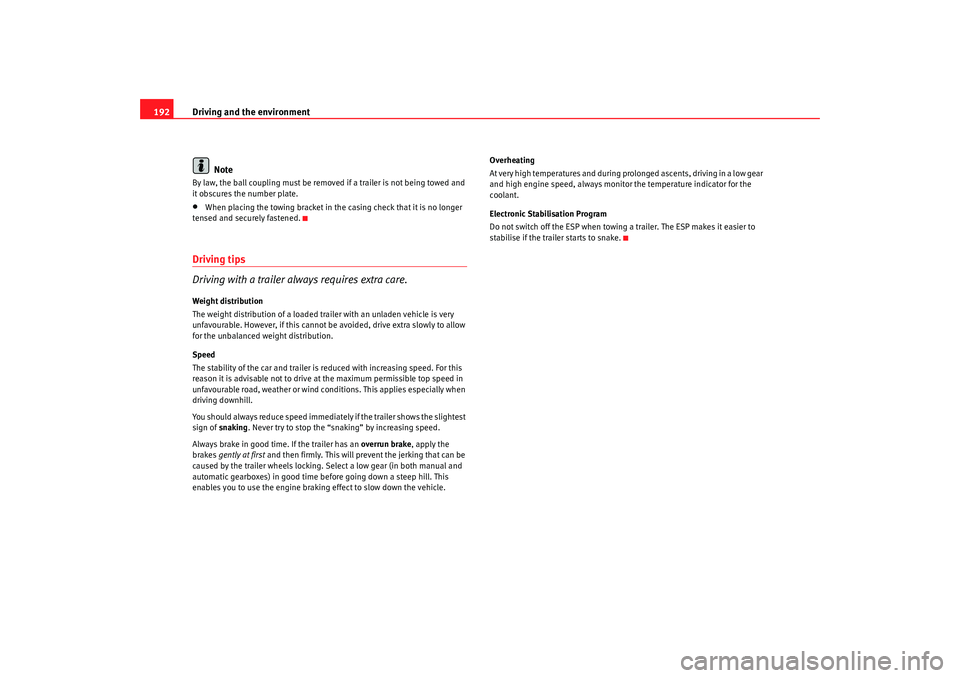
Driving with a trailer always requires extra care.Weight distribution
The weight distribution of a loaded trailer with an unladen vehicle is very
unfavourable. However, if this cannot be avoided, drive extra slowly to allow
for the unbalanced weight distribution.
Speed
The stability of the car and trailer is reduced with increasing speed. For this
reason it is advisable not to drive at the maximum permissible top speed in
unfavourable road, weather or wind conditions. This applies especially when
driving downhill.
You should always reduce speed immediately if the trailer shows the slightest
sign of snaking . Never try to stop the “snaking” by increasing speed.
Always brake in good time. If the trailer has an overrun brake, apply the
brakes gently at first and then firmly. This will prevent the jerking that can be
caused by the trailer wheels locking. Select a low gear (in both manual and
automatic gearboxes) in good time before going down a steep hill. This
enables you to use the engine braking effect to slow down the vehicle. Overheating
At very high temperatures and during prolonged ascents, driving in a low gear
and high engine speed, always monitor the temperature indicator for the
coolant.
Electronic Stabilisation Program
Do not switch off the ESP when towing a trailer. The ESP makes it easier to
stabilise if the trailer starts to snake.
alhambra_ingles_0708 Seite 192 Mittwoch, 10. September 2008 10:55 10
Page 261 of 295

General notes on the technical data259
Safety First
Operating instructions
Tips and Maintenance
Te c h n i c a l D a t a
How are the figures measured?Fuel consumption
The consumption and emission details shown on the vehicle data sticker differ from one vehicle to another.The fuel consumption, CO
2 emissions and actual kerb weight of the vehicle
are noted on the vehicle data sticker.
The fuel consumption and emissions figures given are based on the weight
category of the car, which is determined according to the engine/gearbox
combination and the equipment fitted. The consumption and emission figures are calculated in accordance with the
EC test requirements 1999/100/EC. These test requirements specify a real-
istic test method based on normal everyday driving.
The following test conditions are applied:
Note
•
Actual consumption may vary from quoted test values, depending on
personal driving style, road and traffic conditions, the weather and the condi-
tion of the vehicle. Urban cycle
The urban cycle starts with an engine cold start. City driving is then simulated.
Extra urban cycle In the extra urban cycle the vehicle undergoes frequent acceleration and braking in all gears, as in normal everyday driving. T
he
road speed ranges from 0 to 120 km/h.
Combined The average overall consumption is calculated with a weighting of around 37% for the urban cycle and 63% for the extra urban
cycle.
CO2 emissions The exhaust gases are collected during both driving cycles to calculate carbon dioxide emissions. The gas composition is then
analysed to evaluate the CO
2 content and other emissions.
alhambra_ingles_0708 Seite 259 Mittwoch, 10. September 2008 10:55 10
Page 262 of 295

General notes on the technical data
260WeightsKerb weight refers to the basic model with a fuel tank filled to 90% capacity
and without optional extras. The figure quoted includes 75 kg to allow for the
weight of the driver.
For special versions and optional equipment fittings or for the addition of
accessories, the weight of the vehicle will increase ⇒.
WARNING
•
Please note that the centre of gravity may shift when transporting
heavy objects; this may affect the vehicle's handling and lead to an acci-
dent. Always adjust your speed and driving style to suit road conditions
and requirements.
•
Never exceed the gross axle weight rating or the gross vehicle weight
rating. If the allowed axle load or the allowed total weight is exceeded, the
driving characteristics of the vehicle may change, leading to accidents,
injuries and damage to the vehicle.
To w i n g a t r a i l e rTra iler weig htsTrailer weigh ts
The trailer weights and drawbar loads approved are selected in intensive
trials according to precisely defined criteria. The approved trailer weights are
valid for vehicles in the EU for maximum speeds of 80 km/h (in certain
circumstances up to 100 km/h). The figures may be different in other coun-
tries. All data in the official vehicle documents take precedence over these
data ⇒ . Drawbar load
The
maximum permitted weight exerted by the trailer drawbar on the ball joint
of the towing bracket must not exceed 85 kg.
In the interest of road safety, we recommend that you always tow
approaching the maximum drawbar load. The response of the trailer on the
road will be poor if the drawbar load is too small.
If the maximum permissible drawbar load cannot be met (e.g. with small,
empty and light-weight single axle trailers or tandem axle trailers with an axle
base of less than 1 metre), at least 4% of the actual trailer weight is a legal
stipulation for a drawbar load.
WARNING
•
For safety reasons, you should not drive at speeds above 80 km/h when
towing a trailer. This also applies to countries where higher speeds are
permitted.
•
Never exceed the maximum trailer weights or the draw bar loading. If
the permissible axle load or the permissible total weight is exceeded, the
driving characteristics of the vehicle may change, leading to accidents,
injuries and damage to the vehicle.
WheelsTyre pressure, snow chains, wheel boltsTyre pressu res
The sticker with the tyre pressure values can be found on the inside of the
tank flap. The tyre pressure values given there are for cold tyres. The slightly
raised pressures of warm tyres must not be reduced. ⇒
alhambra_ingles_0708 Seite 260 Mittwoch, 10. September 2008 10:55 10
Page 266 of 295
Technical Data
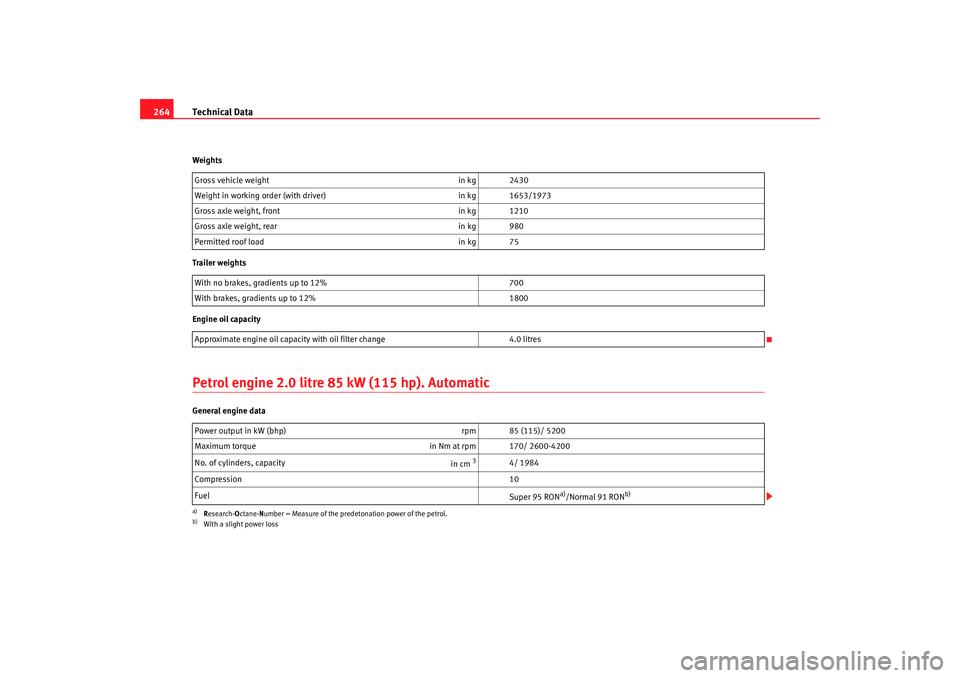
264Weights
Trailer weigh ts
Engine oil capacityPetrol engine 2.0 litre 85 kW (115 hp). AutomaticGeneral engine data Gross vehicle weight
in kg 2430
Weight in working order (with driver) in kg 1653/1973
Gross axle weight, front in kg 1210
Gross axle weight, rear in kg 980
Permitted roof load in kg 75
With no brakes, gradients up to 12% 700
With brakes, gradients up to 12% 1800
Approximate engine oil capacity with oil filter change 4.0 litres
Power output in kW (bhp) rpm 85 (115)/ 5200
Maximum torque in Nm at rpm 170/ 2600-4200
No. of cylinders, capacity in cm
3
4/ 1984
Compression 10
Fuel Super 95 RON
a)/Normal 91 RON
b)
a)Research- Octane- Number = Measure of the predetonation power of the petrol.b)With a slight power loss
alhambra_ingles_0708 Seite 264 Mittwoch, 10. September 2008 10:55 10
Page 267 of 295
Technical Data265
Safety First
Operating instructions
Tips and Maintenance
Te c h n i c a l D a t a
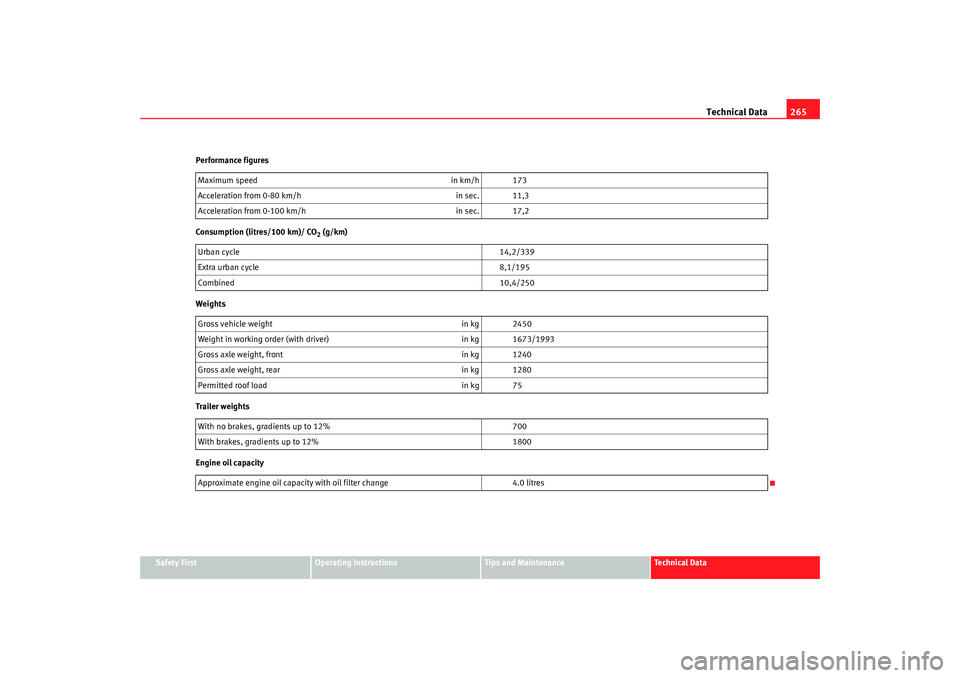
Performance figures
Consumption (litres/100 km)/ CO
2 (g/km)
Weights
Trailer weights
Engine oil capacity Maximum speed
in km/h 173
Acceleration from 0-80 km/h in sec. 11,3
Acceleration from 0-100 km/h in sec. 17,2
Urban cycle 14,2/339
Extra urban cycle 8,1/195
Combined 10,4/250
Gross vehicle weight in kg 2450
Weight in working order (with driver) in kg 1673/1993
Gross axle weight, front in kg 1240
Gross axle weight, rear in kg 1280
Permitted roof load in kg 75
With no brakes, gradients up to 12% 700
With brakes, gradients up to 12% 1800
Approximate engine oil capacity with oil filter change 4.0 litres
alhambra_ingles_0708 Seite 265 Mittwoch, 10. September 2008 10:55 10
Page 269 of 295
Technical Data267
Safety First
Operating instructions
Tips and Maintenance
Te c h n i c a l D a t a
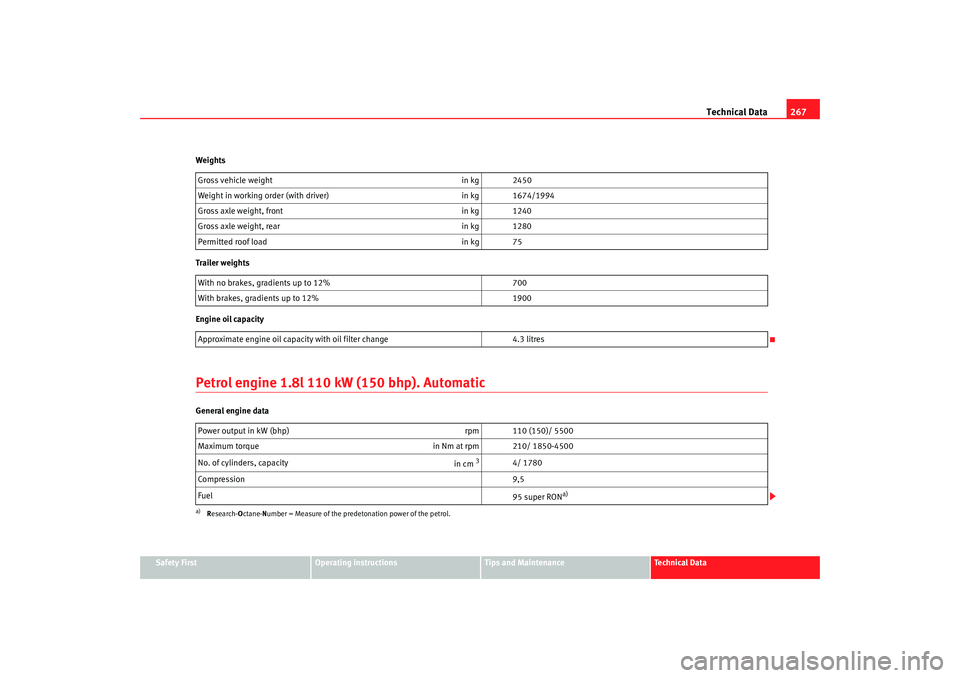
Weights
Trailer weights
Engine oil capacity
Petrol engine 1.8l 110 kW (150 bhp). AutomaticGeneral engine data
Gross vehicle weight
in kg 2450
Weight in working order (with driver) in kg 1674/1994
Gross axle weight, front in kg 1240
Gross axle weight, rear in kg 1280
Permitted roof load in kg 75
With no brakes, gradients up to 12% 700
With brakes, gradients up to 12% 1900
Approximate engine oil capacity with oil filter change 4.3 litres
Power output in kW (bhp) rpm 110 (150)/ 5500
Maximum torque in Nm at rpm 210/ 1850-4500
No. of cylinders, capacity in cm
3
4/ 1780
Compression 9,5
Fuel 95 super RON
a)
a)Research- Octane- Number = Measure of the predetonation power of the petrol.
alhambra_ingles_0708 Seite 267 Mittwoch, 10. September 2008 10:55 10
Page 270 of 295
Technical Data
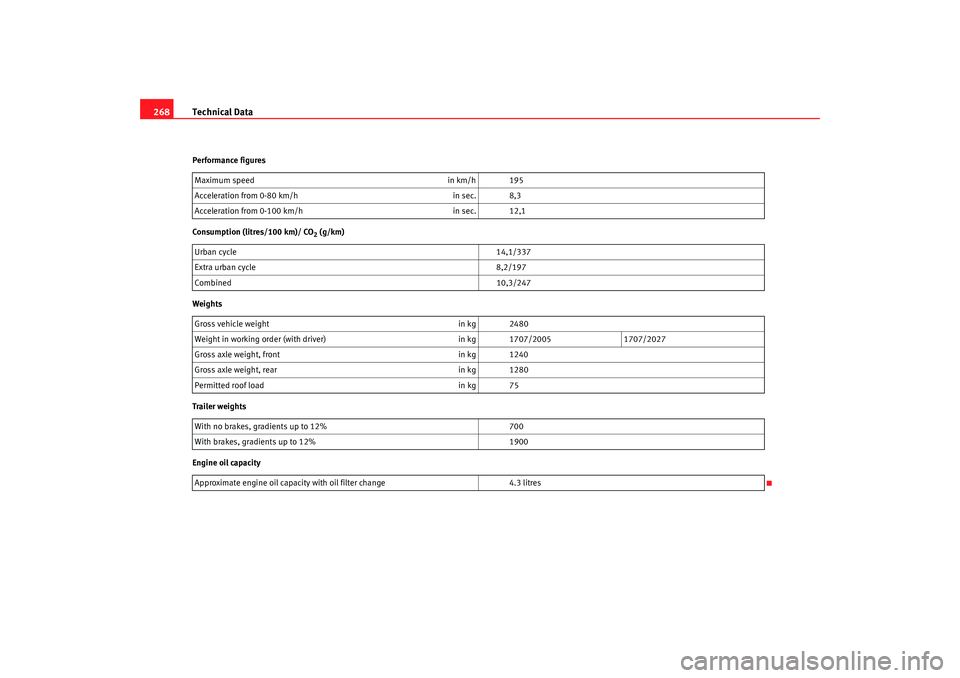
268Performance figures
Consumption (litres/100 km)/ CO
2 (g/km)
Weights
Trailer weigh ts
Engine oil capacity Maximum speed
in km/h 195
Acceleration from 0-80 km/h in sec. 8,3
Acceleration from 0-100 km/h in sec. 12,1
Urban cycle 14,1/337
Extra urban cycle 8,2/197
Combined 10,3/247
Gross vehicle weight in kg 2480
Weight in working order (with driver) in kg 1707/20051707/2027
Gross axle weight, front in kg 1240
Gross axle weight, rear in kg 1280
Permitted roof load in kg 75
With no brakes, gradients up to 12% 700
With brakes, gradients up to 12% 1900
Approximate engine oil capacity with oil filter change 4.3 litres
alhambra_ingles_0708 Seite 268 Mittwoch, 10. September 2008 10:55 10
Page 272 of 295
Technical Data
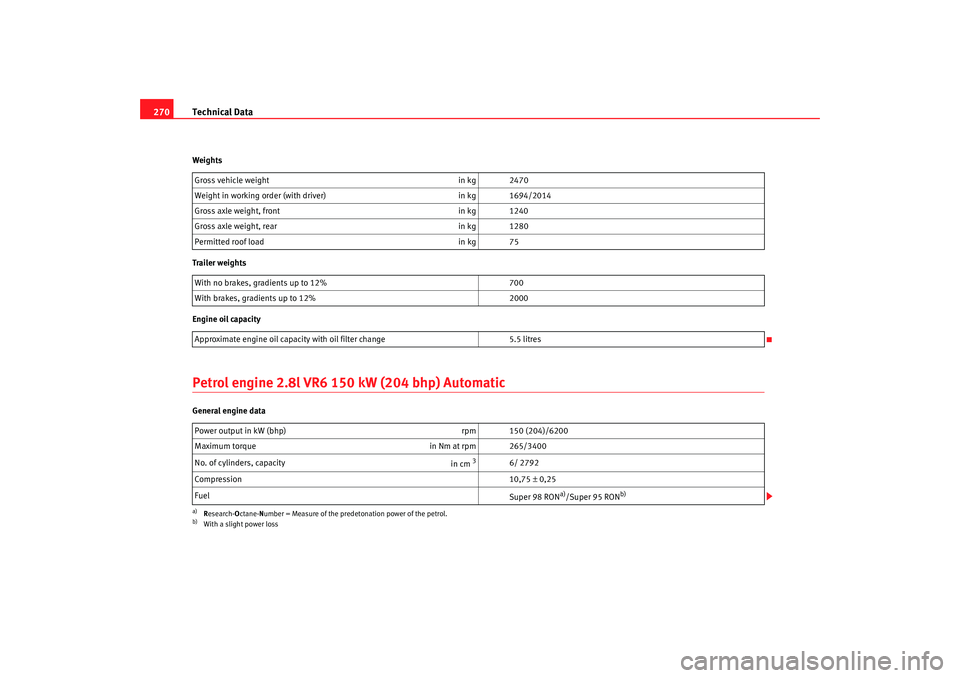
270Weights
Trailer weigh ts
Engine oil capacityPetrol engine 2.8l VR6 150 kW (204 bhp) AutomaticGeneral engine data Gross vehicle weight
in kg 2470
Weight in working order (with driver) in kg 1694/2014
Gross axle weight, front in kg 1240
Gross axle weight, rear in kg 1280
Permitted roof load in kg 75
With no brakes, gradients up to 12% 700
With brakes, gradients up to 12% 2000
Approximate engine oil capacity with oil filter change 5.5 litres
Power output in kW (bhp) rpm 150 (204)/6200
Maximum torque in Nm at rpm 265/3400
No. of cylinders, capacity in cm
3
6/ 2792
Compression 10,75 ± 0,25
Fuel Super 98 RON
a)/Super 95 RON
b)
a)Research- Octane- Number = Measure of the predetonation power of the petrol.b)With a slight power loss
alhambra_ingles_0708 Seite 270 Mittwoch, 10. September 2008 10:55 10
Page 273 of 295
Technical Data271
Safety First
Operating instructions
Tips and Maintenance
Te c h n i c a l D a t a
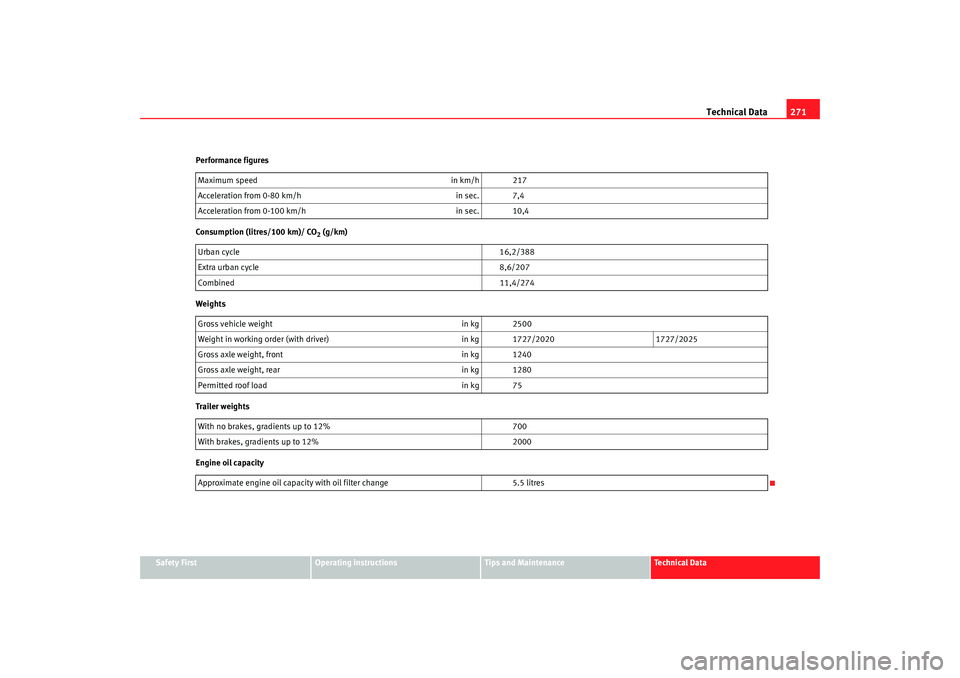
Performance figures
Consumption (litres/100 km)/ CO
2 (g/km)
Weights
Trailer weights
Engine oil capacity Maximum speed
in km/h 217
Acceleration from 0-80 km/h in sec. 7,4
Acceleration from 0-100 km/h in sec. 10,4
Urban cycle 16,2/388
Extra urban cycle 8,6/207
Combined 11,4/274
Gross vehicle weight in kg 2500
Weight in working order (with driver) in kg 1727/20201727/2025
Gross axle weight, front in kg 1240
Gross axle weight, rear in kg 1280
Permitted roof load in kg 75
With no brakes, gradients up to 12% 700
With brakes, gradients up to 12% 2000
Approximate engine oil capacity with oil filter change 5.5 litres
alhambra_ingles_0708 Seite 271 Mittwoch, 10. September 2008 10:55 10
Page 275 of 295
Technical Data273
Safety First
Operating instructions
Tips and Maintenance
Te c h n i c a l D a t a
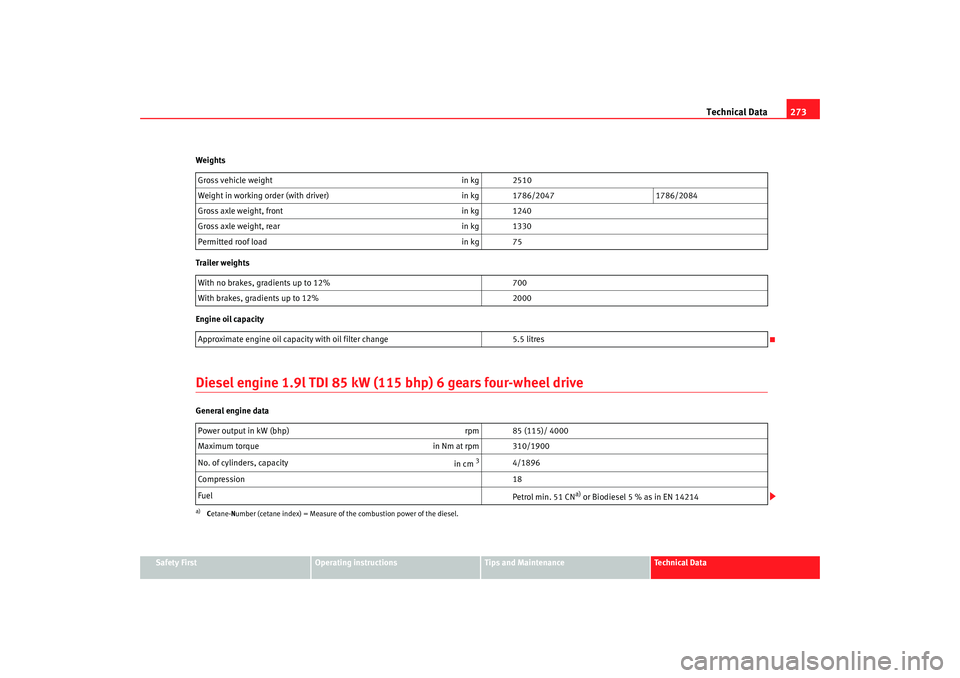
Weights
Trailer weights
Engine oil capacity
Diesel engine 1.9l TDI 85 kW (115 bhp) 6 gears four-wheel driveGeneral engine data
Gross vehicle weight
in kg 2510
Weight in working order (with driver) in kg 1786/20471786/2084
Gross axle weight, front in kg 1240
Gross axle weight, rear in kg 1330
Permitted roof load in kg 75
With no brakes, gradients up to 12% 700
With brakes, gradients up to 12% 2000
Approximate engine oil capacity with oil filter change 5.5 litres
Power output in kW (bhp) rpm 85 (115)/ 4000
Maximum torque in Nm at rpm 310/1900
No. of cylinders, capacity in cm
3
4/1896
Compression 18
Fuel Petrol min. 51 CN
a) or Biodiesel 5 % as in EN 14214
a)Cetane- Number (cetane index) = Measure of the combustion power of the diesel.
alhambra_ingles_0708 Seite 273 Mittwoch, 10. September 2008 10:55 10