maintenance Seat Alhambra 2008 Manual Online
[x] Cancel search | Manufacturer: SEAT, Model Year: 2008, Model line: Alhambra, Model: Seat Alhambra 2008Pages: 295, PDF Size: 7.83 MB
Page 163 of 295
Driving161
Safety First
Operating instructions
Tips and Maintenance
Te c h n i c a l D a t a
•
Adjust the driver seat or steering wheel so that there is a distance of at
least 25 cm between the steering wheel and your breast bone ⇒page 160,
fig. 124 . If you fail to observe the minimum distance, the airbag will not
protect you. Risk of fatal injury.
•
If your physical constitution prevents you from maintaining the
minimum distance of 25 cm, contact an Authorised Service Centre. The
Authorised Service Centre will help you decide if special specific modifica-
tions are necessary.
•
If you adjust the steering wheel so that it points towards your face, the
driver airbag will not protect you properly in the event of an accident. Make
sure that the steering wheel points towards your chest.
•
When driving, always hold the steering wheel with both hands on the
outside of the ring at the 9 o'clock and 3 o'clock positions. Never hold the
steering wheel at the 12 o'clock position, or in any other manner (e.g. in
the centre of the steering wheel, or on the inside of the rim). In such cases,
you could receive severe injuries to the arms, hands and head.
SafetyElectronic stabilisation programme (ESP)
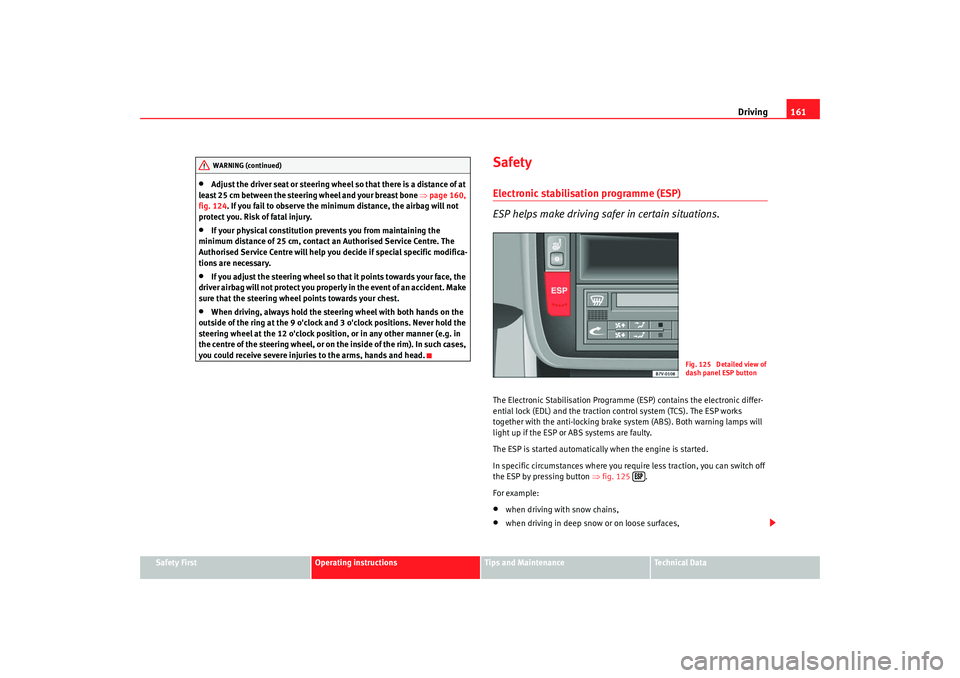
ESP helps make driving safer in certain situations.The Electronic Stabilisation Programme (ESP) contains the electronic differ-
ential lock (EDL) and the traction control system (TCS). The ESP works
together with the anti-locking brake system (ABS). Both warning lamps will
light up if the ESP or ABS systems are faulty.
The ESP is started automatically when the engine is started.
In specific circumstances where you require less traction, you can switch off
the ESP by pressing button ⇒fig. 125 .
For example:•
when driving with snow chains,
•
when driving in deep snow or on loose surfaces,
WARNING (continued)
Fig. 125 Detailed view of
dash panel ESP button
alhambra_ingles_0708 Seite 161 Mittwoch, 10. September 2008 10:55 10
Page 165 of 295
Driving163
Safety First
Operating instructions
Tips and Maintenance
Te c h n i c a l D a t a
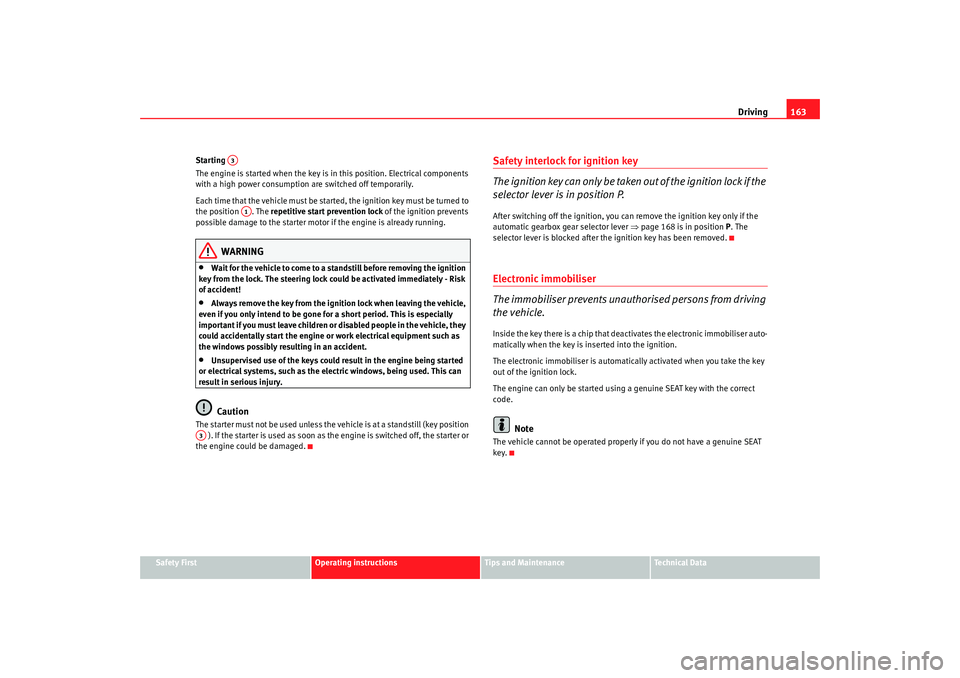
Starting
The engine is started when the key is in this position. Electrical components
with a high power consumption are switched off temporarily.
Each time that the vehicle must be started, the ignition key must be turned to
the position . The repetitive start prevention lock
of the ignition prevents
possible damage to the starter motor if the engine is already running.
WARNING
•
Wait for the vehicle to come to a standstill before removing the ignition
key from the lock. The steering lock could be activated immediately - Risk
of accident!
•
Always remove the key from the ignition lock when leaving the vehicle,
even if you only intend to be gone for a short period. This is especially
important if you must leave children or disabled people in the vehicle, they
could accidentally start the engine or work electrical equipment such as
the windows possibly resulting in an accident.
•
Unsupervised use of the keys could result in the engine being started
or electrical systems, such as the electric windows, being used. This can
result in serious injury.Caution
The starter must not be used unless the vehicle is at a standstill (key position ). If the starter is used as soon as the engine is switched off, the starter or
the engine could be damaged.
Safety interlock for ignition key
The ignition key can only be taken out of the ignition lock if the
selector lever is in position P.After switching off the ignition, you can remove the ignition key only if the
automatic gearbox gear selector lever ⇒ page 168 is in position P. The
selector lever is blocked after the ignition key has been removed.Electronic immobiliser
The immobiliser prevents unauthorised persons from driving
the vehicle.Inside the key there is a chip that deactivates the electronic immobiliser auto-
matically when the key is inserted into the ignition.
The electronic immobiliser is automatically activated when you take the key
out of the ignition lock.
The engine can only be started using a genuine SEAT key with the correct
code.
Note
The vehicle cannot be operated properly if you do not have a genuine SEAT
key.
A3A1
A3
alhambra_ingles_0708 Seite 163 Mittwoch, 10. September 2008 10:55 10
Page 167 of 295
Driving165
Safety First
Operating instructions
Tips and Maintenance
Te c h n i c a l D a t a
– In vehicles with a manual gearbox, depress the clutch pedal fully
and hold it in this position, the starter will then only have to turn
the engine.
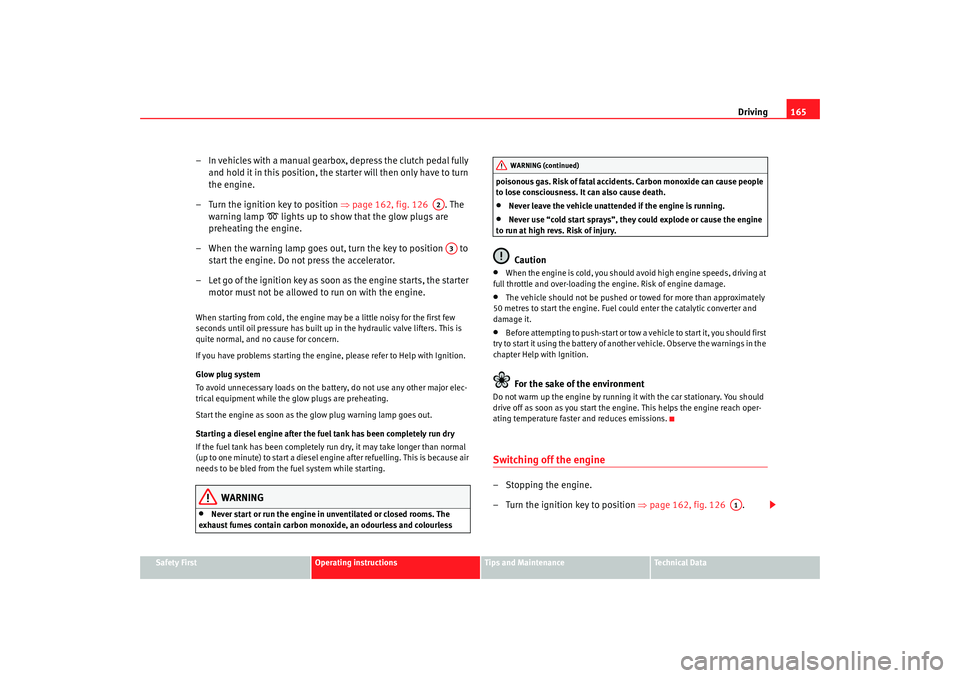
– Turn the ignition key to position ⇒page 162, fig. 126 . The
warning lamp
lights up to show that the glow plugs are
preheating the engine.
– When the warning lamp goes out, turn the key to position to start the engine. Do not press the accelerator.
– Let go of the ignition key as soon as the engine starts, the starter motor must not be allowed to run on with the engine.
When starting from cold, the engine may be a little noisy for the first few
seconds until oil pressure has built up in the hydraulic valve lifters. This is
quite normal, and no cause for concern.
If you have problems starting the engine, please refer to Help with Ignition.
Glow plug system
To avoid unnecessary loads on the battery, do not use any other major elec-
trical equipment while the glow plugs are preheating.
Start the engine as soon as the glow plug warning lamp goes out.
Starting a diesel engine after the fuel tank has been completely run dry
If the fuel tank has been completely run dry, it may take longer than normal
(up to one minute) to start a diesel engine after refuelling. This is because air
needs to be bled from the fuel system while starting.
WARNING
•
Never start or run the engine in unventilated or closed rooms. The
exhaust fumes contain carbon monoxide, an odourless and colourless poisonous gas. Risk of fatal accidents. Carbon monoxide can cause people
to lose consciousness. It can also cause death.
•
Never leave the vehicle unattended if the engine is running.
•
Never use “cold start sprays”, they could explode or cause the engine
to run at high revs. Risk of injury.Caution
•
When the engine is cold, you should avoid high engine speeds, driving at
full throttle and over-loading the engine. Risk of engine damage.
•
The vehicle should not be pushed or towed for more than approximately
50 metres to start the engine. Fuel could enter the catalytic converter and
damage it.
•
Before attempting to push-start or tow a vehicle to start it, you should first
try to start it using the battery of another vehicle. Observe the warnings in the
chapter Help with Ignition.For the sake of the environment
Do not warm up the engine by running it with the car stationary. You should
drive off as soon as you start the engine. This helps the engine reach oper-
ating temperature faster and reduces emissions.Switching off the engine– Stopping the engine.
– Turn the ignition key to position ⇒ page 162, fig. 126 .
A2A3
WARNING (continued)
A1
alhambra_ingles_0708 Seite 165 Mittwoch, 10. September 2008 10:55 10
Page 169 of 295
Driving167
Safety First
Operating instructions
Tips and Maintenance
Te c h n i c a l D a t a
•
The reversing lights come on.
•
The heating or air conditioning automatically change to air recirculation
mode.
•
The rear window heater switches on when the windscreen wiper is acti-
vated.
WARNING
•
When the engine is running, the vehicle will start to move as soon as a
gear is engaged and the clutch released.
•
Never select the reverse gear when the vehicle is in motion. Risk of acci-
dent.Caution
•
D o n o t r est yo u r ha n d o n t he ge ar l e ve r w h e n d r ivi ng . Th e p r essu re of y ou r
hand could cause premature wear on the selector forks in the gearbox.
•
When changing gear, you should always depress the clutch fully to avoid
unnecessary wear and damage.
•
Do not hold the car “on the clutch” on hills. This causes premature wear
and damages the clutch. It can also prevent power being transferred from the
engine to the gearbox.
Automatic gearboxGearbox programmes
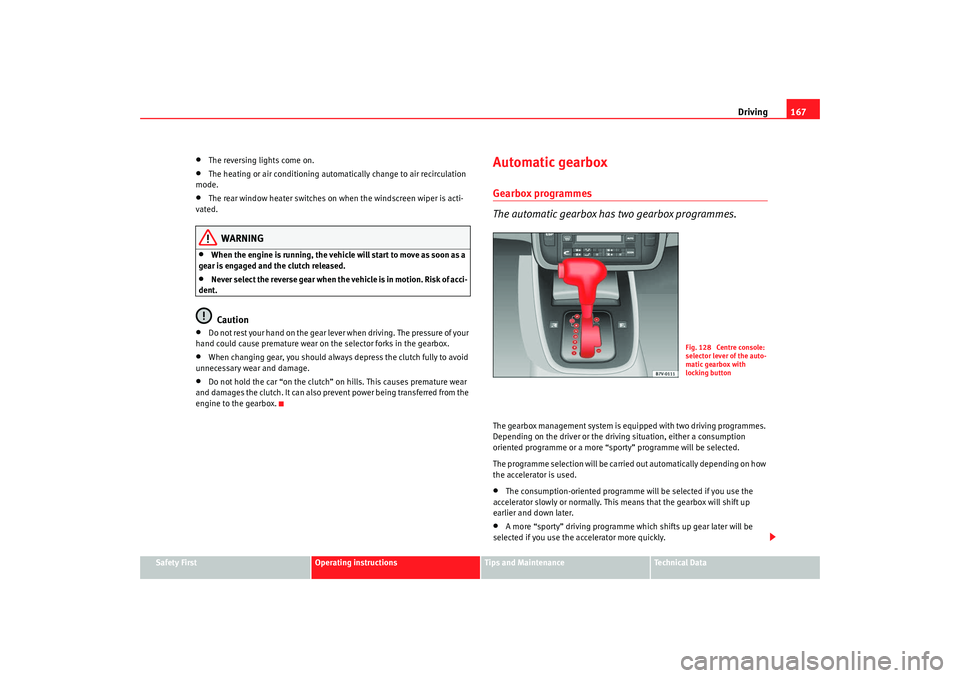
The automatic gearbox has two gearbox programmes.The gearbox management system is equipped with two driving programmes.
Depending on the driver or the driving situation, either a consumption
oriented programme or a more “sporty” programme will be selected.
The programme selection will be carried out automatically depending on how
the accelerator is used.•
The consumption-oriented programme will be selected if you use the
accelerator slowly or normally. This means that the gearbox will shift up
earlier and down later.
•
A more “sporty” driving programme which shifts up gear later will be
selected if you use the accelerator more quickly.
Fig. 128 Centre console:
selector lever of the auto-
matic gearbox with
locking button
alhambra_ingles_0708 Seite 167 Mittwoch, 10. September 2008 10:55 10
Page 171 of 295
Driving169
Safety First
Operating instructions
Tips and Maintenance
Te c h n i c a l D a t a
– Press and hold the lock button, move the selector lever to P and
release the lock button.
Driving up and down hills
– Press the selector lever from position D to the right into the
“Tiptronic” selector gate.
– Lightly press the selector lever back to change down.
Holding the car on a hill
– You should always hold the vehicle in position with the footbrake
to stop it from “rolling backwards” ⇒. Do not try to prevent
the vehicle from “rolling backwards” by increasing the engine
speed while a range of gears is selected.
Moving away on an incline
– With a gear engaged, take your foot from the brake and depress the accelerator.The steeper the gradient, the lower the gear you will need. This increases the
braking effect of the engine. For example, you should drive down a very steep
slope in 3rd gear. If the engine brake effect is not sufficient, the vehicle will
gain speed. The automatic gearbox / direct shift gearbox automatically
changes up to prevent the engine over revving. Use the foot brake to reduce
speed and change into 3rd gear using “Tiptronic” ⇒.
Your vehicle has an automatic interlock which prevents the selector lever
being put into a position for driving forwards or in reverse from positions P or
N if the brake pedal is not depressed.
The ignition key cannot be removed unless the selector lever is in position P.
WARNING
•
As a driver you should never leave your vehicle if the engine is running
and a gear is engaged. If you have to leave your vehicle while the engine is
running, you must apply the parking brake and engage parking lock P.
•
I f th e e n gin e is r un n ing a n d if D, S or R is e n ga ged , yo u will n ee d to hold
the car on the foot brake. The car will creep forward as the power transmis-
sion is not fully interrupted even when the engine is idling.
•
Never press the accelerator when you move the selector lever. Risk of
accident.
•
Never move the selector lever to R or P when driving. Risk of accident!
•
Before you drive down a steep gradient, reduce your speed and use
“Tiptronic” to select a low gear.
•
If you have to stop the vehicle on a gradient, always hold the vehicle in
position using the foot brake to stop it from rolling back.
•
Never allow the brake to rub and do not use the brake pedal too often
or for long periods. Constant braking will cause the brakes to overheat and
will considerably reduce the brake effect. This increases the braking
distance and could cause the brake system to fail.
•
Never allow the car to roll down a gradient with the gear in neutral N, or
in selector lever position D, even if the engine is not running.Caution
•
If you stop the vehicle on a gradient, do not attempt to stop it from rolling
by depressing the accelerator when a gear has been selected. Otherwise, the
automatic gearbox /direct shift gearbox* may overheat causing damage. Pull
the handbrake on fully or depress the brake pedal to prevent the vehicle from
rolling away.
•
If you allow the car to roll with the selector lever in position N with the
engine switched off, the automatic gearbox / direct shift gearbox* will be
damaged as it will not be lubricated.
alhambra_ingles_0708 Seite 169 Mittwoch, 10. September 2008 10:55 10
Page 173 of 295
Driving171
Safety First
Operating instructions
Tips and Maintenance
Te c h n i c a l D a t a
N - neutral (idling)
If this position is selected, the gearbox is in neutral. Power is not transmitted
to the wheels and the engine does not have a braking function.
Never use the
N position to drive down a hill. The engine does not function as
a brake and the brakes are subjected to excessive stain.
You could damage the automatic gearbox if you drive down hills with the
selector lever in position N and the engine switched off.
D - Drive (forwards)
In this position the gearbox automatically changes automatically to a longer
or shorter gear, according to the driving style and speed. The braking effect
of the engine when driving downhill is very limited when the selector is in this
position. The display also shows which gear has been selected in addition to
position D.
If position N has been selected and you wish to select D, you must press the
foot brake if the vehicle is stationary, or travelling at under 5 km/h (approx.
3mph) ⇒.
WARNING
•
Never move the selector lever to R or P when driving. Risk of accident!
•
Never drive the vehicle with the engine and the ignition switched off.
You could loose control of the vehicle. The brake servo only functions when
the engine is running as does the elector-mechanical steering system. You
need more strength to steer and brake the vehicle when the engine and the
ignition are switched off. As you cannot steer and brake in the normal
manner, there is a greater risk of accidents and serious injury.Caution
If you allow the car to roll with the selector lever in position N with the engine
switched off, the automatic gearbox will be damaged as it will not be lubri-
cated.
Note
If the lever is moved accidentally to N when driving, take your foot off the
accelerator and let the engine speed drop to idling before selecting D
again.
alhambra_ingles_0708 Seite 171 Mittwoch, 10. September 2008 10:55 10
Page 175 of 295
Driving173
Safety First
Operating instructions
Tips and Maintenance
Te c h n i c a l D a t a
•
Be particularly careful, therefore, when using the kick-down function on
slippery road surfaces.
•
You should use the kick-down function only when traffic and weather
conditions allow it to be used safely.
HandbrakeUsing the handbrake
The handbrake should be applied firmly to prevent the
vehicle from accidentally rolling away.Always apply the handbrake when you leave your vehicle and when
you park.
Using the handbrake
– Firmly pull the handbrake lever up all the way.
Releasing the handbrake
– Firmly pull the handbrake lever up all the way.
– Push in the lock button on the handbrake lever.
– Keep the locking knob pressed and push the lever all the way down ⇒ .The handbrake is located at the side of the driver seat. Always apply the
handbrake firmly. This prevents you driving with the handbrake applied
⇒ . The handbrake warning lamp
lights up when the handbrake is applied
and the ignition switched on. The warning lamp goes out when the hand-
brake is released.
WARNING
•
Never use the handbrake to slow down the vehicle when it is in motion.
The braking distance is considerably longer, as braking is only applied to
the rear wheels. Risk of accident!
•
Never drive with the handbrake slightly applied. This could cause the
rear brakes to overheat and lose their braking efficiency. Risk of accident.
This also causes premature wear on the rear brake pads/linings.Caution
Always apply the handbrake before you leave the vehicle. On cars with a
manual gearbox engage 1st gear, or on an automatic move the selector lever
to P.Parking
The handbrake should always be firmly applied when the
vehicle is parked.Always note the following points when parking the vehicle:
– Use the foot brake to stop the vehicle.
– Apply the handbrake firmly.
– On a manual gearbox engage 1st gear. On an automatic move
the selector lever to P .
WARNING (continued)
alhambra_ingles_0708 Seite 173 Mittwoch, 10. September 2008 10:55 10
Page 177 of 295
Driving175
Safety First
Operating instructions
Tips and Maintenance
Te c h n i c a l D a t a
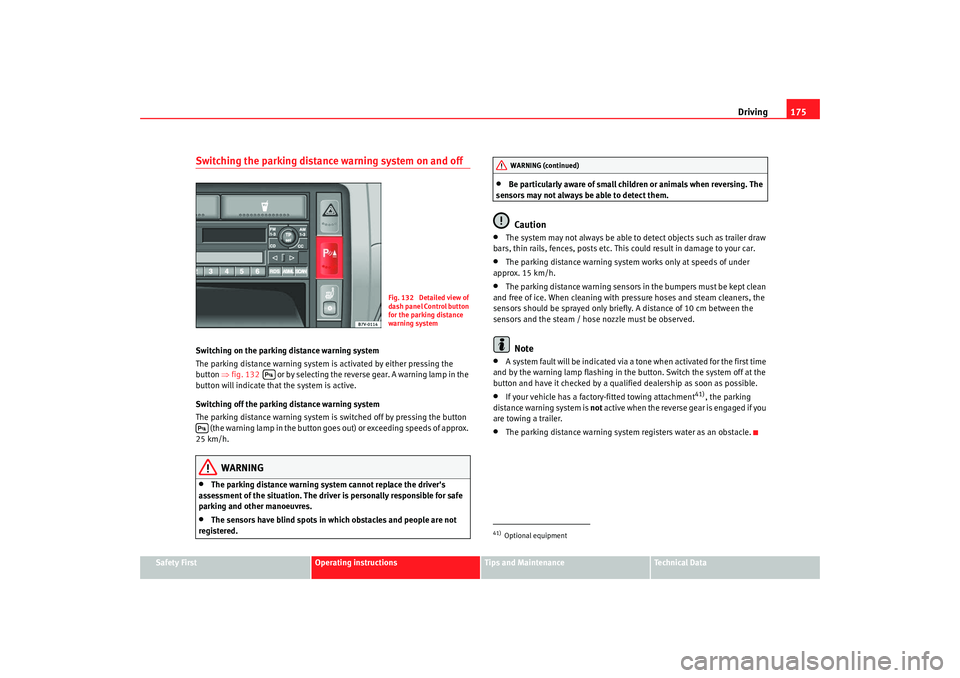
Switching the parking distance warning system on and offSwitching on the parking distance warning system
The parking distance warning system is activated by either pressing the
button ⇒fig. 132 or by selecting the reverse gear. A warning lamp in the
button will indicate that the system is active.
Switching off the parking distance warning system
The parking distance warning system is switched off by pressing the button
(the warning lamp in the button goes out) or exceeding speeds of approx.
25 km/h.
WARNING
•
The parking distance warning system cannot replace the driver's
assessment of the situation. The driver is personally responsible for safe
parking and other manoeuvres.
•
The sensors have blind spots in which obstacles and people are not
registered.
•
Be particularly aware of small children or animals when reversing. The
sensors may not always be able to detect them.Caution
•
The system may not always be able to detect objects such as trailer draw
bars, thin rails, fences, posts etc. This could result in damage to your car.
•
The parking distance warning system works only at speeds of under
approx. 15 km/h.
•
The parking distance warning sensors in the bumpers must be kept clean
and free of ice. When cleaning with pressure hoses and steam cleaners, the
sensors should be sprayed only briefly. A distance of 10 cm between the
sensors and the steam / hose nozzle must be observed.Note
•
A system fault will be indicated via a tone when activated for the first time
and by the warning lamp flashing in the button. Switch the system off at the
button and have it checked by a qualified dealership as soon as possible.
•
If your vehicle has a factory-fitted towing attachment
41), the parking
distance warning system is not active when the reverse gear is engaged if you
are towing a trailer.
•
The parking distance warning system registers water as an obstacle.
Fig. 132 Detailed view of
dash panel Control button
for the parking distance
warning system
41)Optional equipmentWARNING (continued)
alhambra_ingles_0708 Seite 175 Mittwoch, 10. September 2008 10:55 10
Page 179 of 295
Driving177
Safety First
Operating instructions
Tips and Maintenance
Te c h n i c a l D a t a
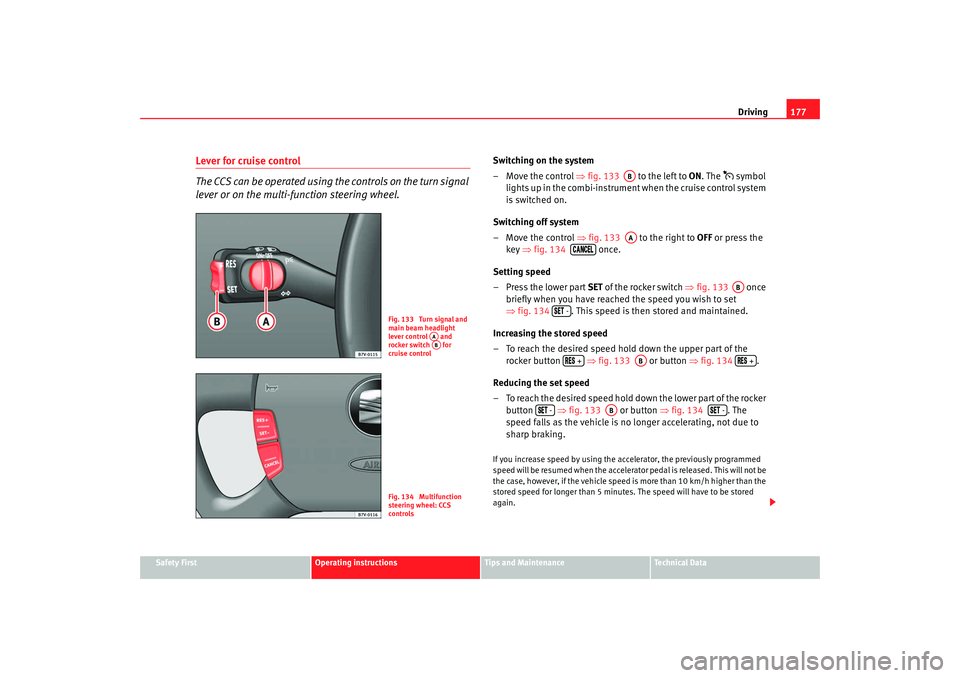
Lever for cruise control
The CCS can be operated using the controls on the turn signal
lever or on the multi-function steering wheel.
Switching on the system
– Move the control ⇒fig. 133 to the left to ON. The
symbol
lights up in the combi-instrument when the cruise control system
is switched on.
Switching off system
– Move the control ⇒fig. 133 to the right to OFF or press the
key ⇒fig. 134 once.
Setting speed
– Press the lower part SET of the rocker switch ⇒fig. 133 once
briefly when you have reached the speed you wish to set
⇒ fig. 134 . This speed is then stored and maintained.
Increasing the stored speed
– To reach the desired speed hold down the upper part of the rocker button ⇒fig. 133 or button ⇒fig. 134 .
Reducing the set speed
– To reach the desired speed hold down the lower part of the rocker button ⇒fig. 133
or button
⇒fig. 134
. The
speed falls as the vehicle is no longer accelerating, not due to
sharp braking.
If you increase speed by using the accelerator, the previously programmed
speed will be resumed when the accelerator pedal is released. This will not be
the case, however, if the vehicle speed is more than 10 km/h higher than the
stored speed for longer than 5 minutes. The speed will have to be stored
again.
Fig. 133 Turn signal and
main beam headlight
lever control and
rocker switch for
cruise control
AAAB
Fig. 134 Multifunction
steering wheel: CCS
controls
ABAA
AB
- +
AB
+
-
AB
-
alhambra_ingles_0708 Seite 177 Mittwoch, 10. September 2008 10:55 10
Page 181 of 295
Intelligent technology179
Safety First
Operating instructions
Tips and Maintenance
Te c h n i c a l D a t a
Tips and MaintenanceIntelligent technologyBrakesBrake servoThe brake servo supplements the pressure you exert on the brake pedal. It
works only when the engine is running .
If the brake servo does not operate, for example, when the vehicle is being
towed or due to a fault in the system, the brake pedal must be depressed
harder.
WARNING
The braking distance can also be affected by external factors.•
Never let the vehicle coast with the engine switched off. Failure to do so
could result in an accident. The braking distance is increased considerably
as the brake servo does not function.
•
If the brake servo is out of action, for example if the car is being towed,
you will have to press the brake pedal considerably harder than normal.
Brake pads wear display
If this light comes on, check the brake pads immediately.
At the same time, a text message or the necessary operations may appear on
the instrument panel.
WARNING
If the warning lamp lights up
or the corresponding message appears on
the instrument panel, immediately have the brake pads checked and
replaced, if necessary, at a specialised workshop.
Brake warning lamp
If the warning lamp comes on, this may be caused by the
following reasons:•
With the handbrake on the warning light comes on
on the instrument
panel. If you are travelling at over 6 km/h with the hand brake on, a text
message or the required operations may appear on the instrument panel. In
addition a warning signal is heard.
•
In the event of insufficient brake fluid the warning lamp lights up
on
the instrument panel. At the same time, a text message or the necessary oper-
ations may appear on the instrument panel. Stop the vehicle immediately
and check the level of the brake fluid ⇒page 221
•
In the event of a fault in the brake system the warning lamp lights up
on the instrument panel and three buzzes are emitted. At the same time, a
text message or the necessary operations may appear on the instrument
panel. Stop the vehicle and do not drive on. You should obtain professional
assistance. This warning lamp
can light up together with the anti-locking
brake system warning lamp
⇒ .
alhambra_ingles_0708 Seite 179 Mittwoch, 10. September 2008 10:55 10