maintenance Seat Alhambra 2008 Manual PDF
[x] Cancel search | Manufacturer: SEAT, Model Year: 2008, Model line: Alhambra, Model: Seat Alhambra 2008Pages: 295, PDF Size: 7.83 MB
Page 143 of 295
Seats and stowage141
Safety First
Operating instructions
Tips and Maintenance
Te c h n i c a l D a t a
•
Take care when using the cigarette lighter. Carelessness or negligence
when using the cigarette lighter can cause burns, risk of injury.
•
The cigarette lighter also works when the ignition is off and when the
ignition key is removed. To avoid the risk of fire, never leave children unsu-
pervised in the vehicle.
Sockets
Electrical equipment can be connected to any of the 12 volt
sockets.
Socket in the centre console
The 12 Volt socket in the stowage area or the 12 Volt socket of the cigarette
lighter
34) can be used for further electrical consumers with a power rating of
up to 120 Watt.
Socket, luggage compartment
34)
Electrical equipment can be connected to the 12-volt socket in the luggage
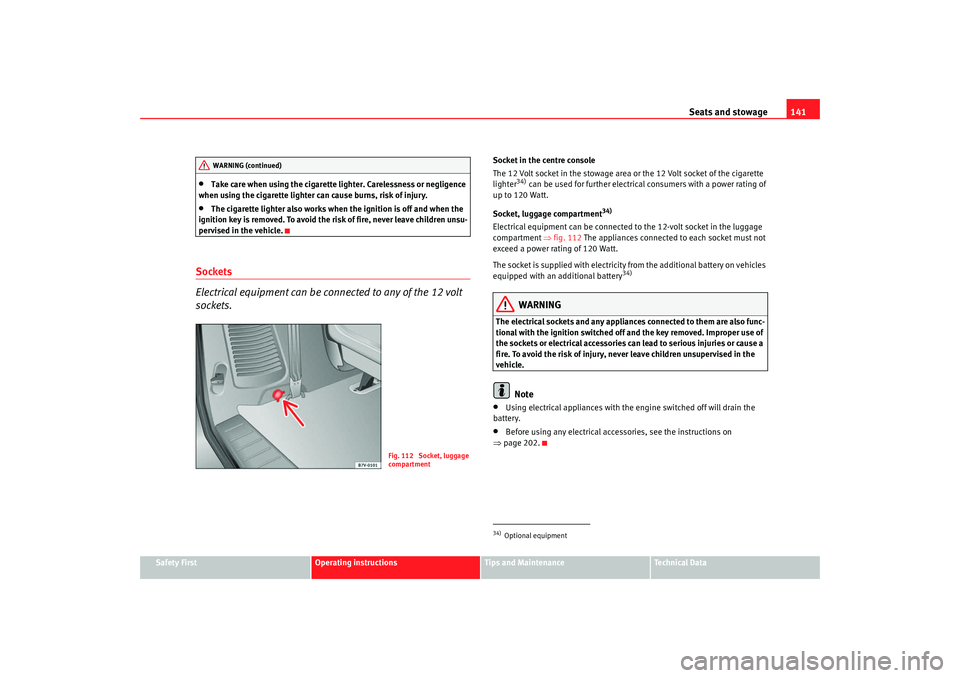
compartment ⇒fig. 112 The appliances connected to each socket must not
exceed a power rating of 120 Watt.
The socket is supplied with electricity from the additional battery on vehicles
equipped with an additional battery
34)
WARNING
The electrical sockets and any appliances connected to them are also func-
tional with the ignition switched off and the key removed. Improper use of
the sockets or electrical accessories can lead to serious injuries or cause a
fire. To avoid the risk of injury, never leave children unsupervised in the
vehicle.
Note
•
Using electrical appliances with the engine switched off will drain the
battery.
•
Before using any electrical accessories, see the instructions on
⇒ page 202.
WARNING (continued)
Fig. 112 Socket, luggage
compartment
34)Optional equipment
alhambra_ingles_0708 Seite 141 Mittwoch, 10. September 2008 10:55 10
Page 145 of 295
Seats and stowage143
Safety First
Operating instructions
Tips and Maintenance
Te c h n i c a l D a t a
Hazard warning triangles and first aid kitWarning triangleThe hazard warning triangle may be fitted in the bracket behind the right trim
of the luggage compartment.
Note
The warning triangle is not part of the vehicle's standard equipment.First-aid kitIn the bracket located behind the right hand trim in the luggage compartment
there is space for a standard first aid kit and the hazard warning triangle.
For reasons of space, in vehicles fitted with a removable tow bar
35) the
bracket only holds a smaller first aid kit and the hazard warning triangle.
Note
•
In some vehicles the first aid kit bracket is behind the left hand trim in the
luggage compartment.
•
The first aid kit is not issued as a standard feature with the vehicle.
•
The first aid kit must comply with legal requirements.
•
Observe the expiry date of the contents of the first aid kit. You should
purchase a new first-aid kit as soon as possible after the shelf-life date of the
first-aid kit has expired.
•
Before buying accessories and replacement parts, refer to the note
“Accessories, modifications and renewal of parts”.
Luggage compartmentLoading the luggage compartment
All luggage and other loose objects must be safely secured in
the luggage compartment.Please observe the following points to ensure the vehicle handles
well at all times:
– If necessary, remove the seats to increase the load area.
– Distribute the load as evenly as possible in the luggage compart- ment.
– Place and stow heavy objects directly on the floor of the vehicle. I f p ossi ble th ey sho uld b e p osi tion ed a b ove or i n fron t of th e rea r
axle.
– Drive particularly carefully if you are transporting heavy objects ⇒page 145.
– Use suitable straps to secure he avy objects to the fitted fastening
rings ⇒ page 144.
– If objects protrude over the end of the vehicle, you must draw the attention of other road users to this. Observe legal requirements
when doing so.When driving with the tailgate open, please observe the instructions on
⇒page 99.
35)Optional equipment
alhambra_ingles_0708 Seite 143 Mittwoch, 10. September 2008 10:55 10
Page 147 of 295
Seats and stowage145
Safety First
Operating instructions
Tips and Maintenance
Te c h n i c a l D a t a
During a collision or an accident, even small and light objects can build up so
much energy that they can cause very severe injuries. The amount of “kinetic
energy” depends on the speed of the vehicle and the weight of the object.
The most significant factor, however, is the speed of the vehicle.
Example: An object weighing 4.5 kg is lying unsecured in the vehicle. During
a frontal collision at a speed of 50 km/h, this object generates a force corre-
sponding to 20 times its weight. That means that the effective weight of the
object increases to about 90 kg. You can imagine the severity of the injuries
which might be sustained if this “projectile” strikes an occupant as it flies
through the passenger compartment. This increased risk of injury will be
further increased if a loose object is struck by an inflating airbag.
WARNING
If pieces of baggage or other objects are secured to the fastening rings with
inappropriate or damaged re
taining cords, injuries could result in the event
of braking manoeuvres or accidents.•
To prevent pieces of luggage or other objects from flying forward,
always use appropriate retaining cords which are secured to the fastening
rings.
•
Never secure a child seat on the fastening rings.
Loading heavy objects
Special care is required when loading heavy objects and
when driving a vehicle which contains heavy objects.Observe the following points to prevent damage and accidents:
– If necessary, remove the seats to increase the load area. –
Before loading the vehicle place a sturdy mat or similar cover
flush on floor of the vehicle.
– Where necessary, do not cover protruding parts of the vehicle floor.
– Protect the seat anchor points from damage.
– Avoid overloading small areas - spread the load.
– Use suitable straps to secure the objects to retaining rings.
– Drive particularly carefully and think ahead.
– If possible, avoid sudden braking and driving manoeuvres.
WARNING
For safety reasons, you should read and observe all information on loading
the vehicle ⇒ page 145.
Caution
•
If you have removed the seats from the passenger compartment, you
should place a large, robust covering over the seat rails to prevent damage.
•
Avoid overloading small areas - spread the load.
Safety notes on loading the vehicle
WARNING
Loose luggage and other objects in the luggage compartment can cause
serious injuries.
alhambra_ingles_0708 Seite 145 Mittwoch, 10. September 2008 10:55 10
Page 149 of 295
Seats and stowage147
Safety First
Operating instructions
Tips and Maintenance
Te c h n i c a l D a t a
Opening the luggage compartment cover
– After fitting the luggage compartment cover, pull the handle on
the cover back and hook in the cover on the side.
Removing the luggage compartment cover
– Press the unlock button (with the luggage compartment cover rolled up) ⇒page 146, fig. 114 in the direction of the arrow
and remove the cover from the right holder upwards.
– Remove the cover from the left holder in the direction of the arrow and remove from the vehicle.
Fitting the luggage compartment cover
– Push the luggage compartment cover to the stop in the direction of the arrow ⇒page 146, fig. 115 into the left-hand holder.
– Press the cover down into the right-hand holder until it engages in position.Light items of clothing or other objects on the luggage compartment cover
can restrict visibility through the rear window.
WARNING
•
Never leave hard, heavy or sharp objects on the shelf (unrolled) or in the
pockets of clothing on the luggage compartment cover. Animals must
never be allowed onto the luggage compartment cover. During a sudden
braking or driving manoeuvre or an accident, these objects and animals
endanger all vehicle occupants.Risk of injury.
Caution
The wires of the heating element in the rear window and the window aerial in
the rear side windows could be damaged if objects on the luggage compart-
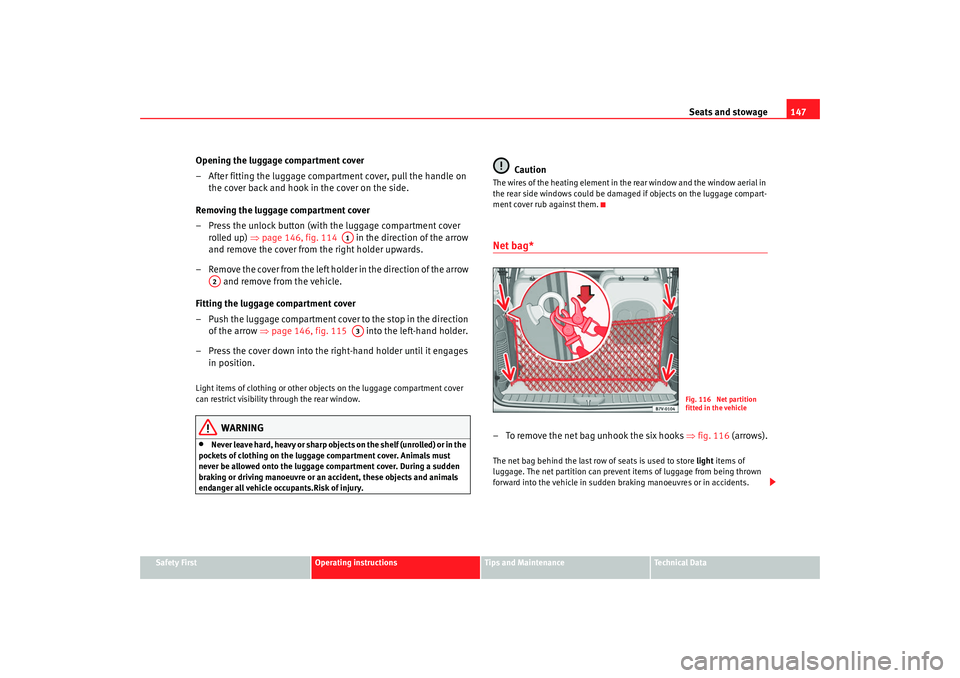
ment cover rub against them.Net bag*– To remove the net bag unhook the six hooks ⇒fig. 116 (arrows).The net bag behind the last row of seats is used to store light items of
luggage. The net partition can prevent items of luggage from being thrown
forward into the vehicle in sudden braking manoeuvres or in accidents.
A1
A2
A3
Fig. 116 Net partition
fitted in the vehicle
alhambra_ingles_0708 Seite 147 Mittwoch, 10. September 2008 10:55 10
Page 151 of 295
Seats and stowage149
Safety First
Operating instructions
Tips and Maintenance
Te c h n i c a l D a t a
•
Damage to the vehicle caused by incorrect installation of mounts or roof
carrier systems not approved by the factory are excluded from the vehicle
warranty.
Securing the load
Loads transported on the roof carrier must be securely
attached. The car's handling is affected when transporting
loads.The maximum permissible roof load for your vehicle is 75 kg. The load limit
applies to the combined weight of the carrier system and the load itself.
Distribute the load evenly. However, if you are using a roof carrier with a lower
weight rating, you will not be able to carry the maximum roof load. Do not
exceed the maximum weight limit for the roof carrier which is listed in the
fitting instructions.
WARNING
•
If damaged, fine or inadequate securing straps are used to fasten
objects carried on the roof, they could break in the event of sharp braking.
This could cause an accident and serious injury.
•
Always use appropriate securing straps to secure objects on the roof
carrier against sliding or flying off.,This could cause an accident. The load
must be correctly secured.
•
Always respect the maximum authorised weight for the roof, the
maximum authorised weight on the axles and the total maximum author-
ised weight of the vehicle. Otherwise there is danger of causing an acci-
dent.
•
The risk of an accident is increased by transporting heavy or bulky
loads on the roof, which affects the car's handling by shifting the centre of
gravity and increasing susceptibility to cross winds. Both circumstances increase the risk of accident. Therefore you must adapt your driving style
and speed to the prevailing conditions - avoid sudden braking or driving
manoeuvres when there is a load on the roof carrier.
Caution
Please take extra care not to let the tailgate or rear window strike the roof load
when open – there is a risk of damage to the vehicle.
For the sake of the environment
The roof carrier is often left on the roof for convenience even if it is not being
used. However, increased air resistance means that the vehicle uses more
fuel. For this reason you should always take off the roof carrier when it is not
in use.Cooling and heating box*Notes on usage
The cooling and heating box may only be installed in the posi-
tion of rear left seat in the third row.Power can be supplied by any of the 12 Volt sockets in the vehicle. It
consumes approximately 33 watts and has a capacity of approximately 32
litres.
The battery will discharge if the cooling and heating box is used for a long
period while the engine is switched off.
WARNING (continued)
alhambra_ingles_0708 Seite 149 Mittwoch, 10. September 2008 10:55 10
Page 153 of 295
Seats and stowage151
Safety First
Operating instructions
Tips and Maintenance
Te c h n i c a l D a t a
Switching on the heating function
– Insert the cable plug in the cooling and heating box so that the
red marking on the plug is pointing to the notch.
– Insert the connector cable plug into one of the vehicle's 12 volt sockets.
– Keep the lid of the cooling and heating box closed.
Switching the cooling and heating box off fully
– Disconnect the power supply to the 12 Volt socket.The internal temperature of the cooling and heating box is dependent on the
temperature in the vehicle. In cooling mode, the internal temperature can be
max. 20 degrees below the temperature in the vehicle. In heating mode it can
be max. 35 degrees above the temperature in the vehicle ⇒ in “Safety
notes on using the cooling and heating box” on page 151.
If you switch directly from cooling to heating (or vice versa) it will take a rela-
tively long time for the interior to reach the desired temperature.
Faults
If the cooling and heating box does not work, proceed as follows:•
Check whether there is power and whether the plug is securely in the
socket.
•
Make sure the power cable is not damaged.
•
Check the fuse for the power supply to the 12 Volt socket.
•
Run the engine to recharge the battery.
If these steps do not help, contact a qualified dealership.
Safety notes on using the cooling and heating box
WARNING
•
For reasons of safety, the cooling and heating box lid must always be
closed and latched when the vehicle is in motion. The cooling and heating
box must always be firmly secured in the correct floor anchorings.
•
If the temperature in the vehicle is too low, the temperature in the box
may fall below +2 degrees and the contents may freeze. Bottles and other
containers could burst. Risk of injury.
•
For reasons of safety, the cooling and heating box lid must not be used
as a table or shelf when the vehicle is in motion.
•
Always close the lid of the cooling and heating box before the vehicle
moves off. If the flap is open, it could drop down when the vehicle moves
off. Risk of injury.
alhambra_ingles_0708 Seite 151 Mittwoch, 10. September 2008 10:55 10
Page 155 of 295
Heating, Ventilation and Air conditioning153
Safety First
Operating instructions
Tips and Maintenance
Te c h n i c a l D a t a
−
ECON (cooling system off) or
− OFF (entire system off)
Outside temperature display
Display for windscreen defrosting – lights up when the windscreen
defrosting function is switched on
Display for air recirculation mode
Display for air flow
Display of the selected interior temperature front
Display of the blower setting rear
Display of the selected interior temperature rear
Button for the automatic mode
Button for air recirculation mode
Button for reducing the blower speed front
Button for raising the blower speed front
Button for directing the air flow to the chest
Button for directing the air flow to the footwell
Button for reducing the temperature front
Button for raising the temperature front
Button for reducing the blower speed rear
Button for raising the blower speed rear
Button for reducing the temperature rear
Button for raising the temperature rear
Button for switching the cooling system off
Switching between Celsius and Fahrenheit
Press and hold the button and press the button.
The selected temperature unit is then displayed.
WARNING
For road safety all windows must be clear of ice, snow, and condensation.
This is essential to ensure good visibility. Please familiarise yourself with
the correct operation of the heating and ventilation system, including the
demist/defrost functions for the windows.
Note
Please observe the general notes ⇒page 158.Automatic mode
In automatic mode air temperature, flow, and distribution are
automatically regulated so that a specified temperature is
attained as quickly as possible and then maintained.Switching on automatic mode
– Press the button .
– Select the desired temperature We recommend 22°C (72°F).A comfortable interior climate is quickly reached when a temperature of
+22°C (72°F) is set in automatic mode. It can be changed as necessary to suit
individual preferences or particular circumstances. It is possible to select
interior temperatures from +18°C (64°F) to +29°C (86°F). These are approxi-
mate temperatures and the actual temperature may be slightly higher or
lower depending on the outside conditions.
If a temperature below +18°C (17.78°C) is selected, the display switches to
LO The temperature is not controlled and in AUTO mode, the system runs at
maximum cooling output.
A4A5A6A7A8A9A10A11
AUTO
A12
A13
A14
A15
A16
A17
A18
A19
A20
A21
A22
A23
ECON
ECON
AUTO
AUTO
alhambra_ingles_0708 Seite 153 Mittwoch, 10. September 2008 10:55 10
Page 157 of 295
Heating, Ventilation and Air conditioning155
Safety First
Operating instructions
Tips and Maintenance
Te c h n i c a l D a t a
Te m p e r a t u r e
The selected temperature setting is shown on the display. It is possible to
select interior temperatures from +18°C (64°F) to +29°C (86°F). These are
approximate temperatures and the actual temperature may be slightly higher
or lower depending on the outside conditions.
If a temperature below +18°C (17.78°C) is selected, the display switches to
LO
The temperature is not controlled and in AUTO mode, the system runs at
maximum cooling output.
If a temperature above +29°C (86°F) is selected, the display switches to HI In
this setting the system runs at maximum heating output and the temperature
is not controlled.
Blower
The blower can be adjusted gradually using the controls y . Always
have the blower running at a low setting to ensure a constant flow of fresh air
into the vehicle. If the blower is set to 0, the Climatronic is switched off.
Air distribution
The air distribution is adjusted using the buttons and . It is also
possible to open and close some of the air outlets separately.
Switching off the cooling system
Pressing the button switches off the air cooling system to save fuel.
The temperature continues to be controlled, but the air cannot be cooled. The
set temperature can then only be reached if it is higher than the outside
temperature.
Switching the Climatronic on/off
Press button until OFF is shown on display . The Climatronic is switched
off. This function should be used in certain situations only (e.g. if the system
develops a fault).
The Climatronic is switched back on by pressing button .
WARNING
When the Climatronic is off open a window to ensure an adequate supply of
fresh air in the vehicle. Otherwise, when the Climatronic is switched off, no
fresh air enters the vehicle. Stale or contaminated air inside the vehicle
may cause drowsiness, increasing the risk of accident.Air recirculation mode
Air recirculation mode prevents fumes or unpleasant smells
from entering the vehicle.– Press the button ⇒page 154, fig. 119 to switch air recircula-
tion mode on or off. This is ON if the symbol is displayed
on the screen.Air recirculation mode prevents strong odours in the ambient air from
entering the vehicle interior, for example when passing through a tunnel or in
queuing traffic.
When the outside temperature is low, using air recirculation mode provides
more effective heating by heating air from the vehicle interior instead of cold
air from outside.
When the outside temperature is high, using air recirculation mode provides
more effective cooling by cooling air from the vehicle interior instead of warm
air from outside.
ECON
A13
A3
AUTO
A12
A6
alhambra_ingles_0708 Seite 155 Mittwoch, 10. September 2008 10:55 10
Page 159 of 295
Heating, Ventilation and Air conditioning157
Safety First
Operating instructions
Tips and Maintenance
Te c h n i c a l D a t a
The Climatronic can be fitted either with or without an additional cooling
system
38) for the passenger compartment.
Climatronic for the passenger compartment without additional cooling
system
The temperature setting for the rear can be max. 3°C higher than the temper-
ature in the passenger compartment. A lower temperature can not be set.
If the Climatronic detects that the passenger compartment has to be heated,
it activates the additional heat exchanger. The air outlets on the floor guide
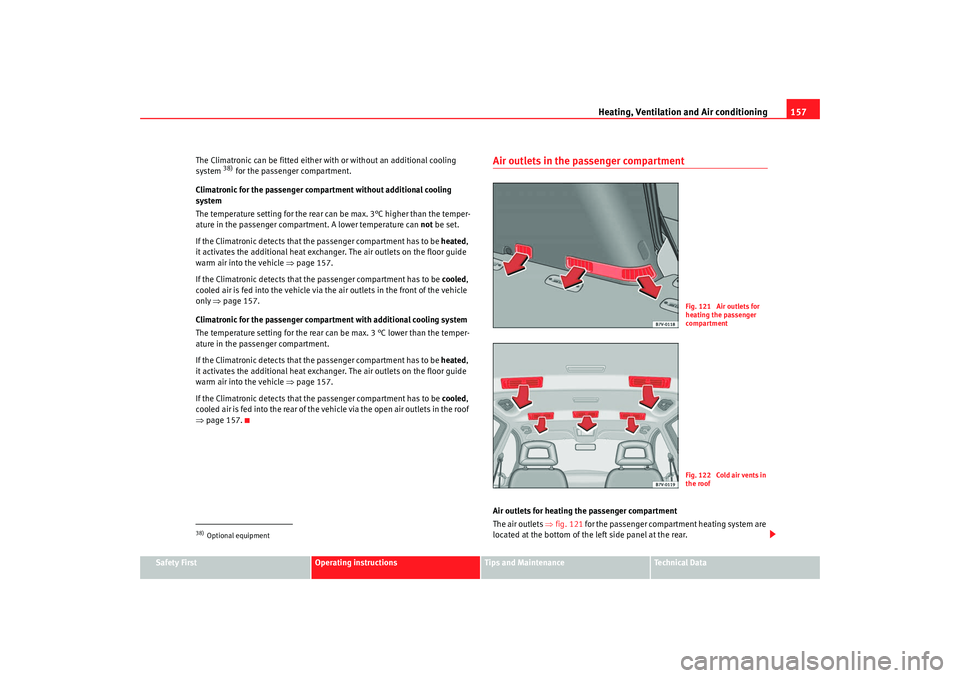
warm air into the vehicle ⇒ page 157.
If the Climatronic detects that the passenger compartment has to be cooled,
cooled air is fed into the vehicle via the air outlets in the front of the vehicle
only ⇒page 157.
Climatronic for the passenger compartment with additional cooling system
The temperature setting for the rear can be max. 3 °C lower than the temper-
ature in the passenger compartment.
If the Climatronic detects that the passenger compartment has to be heated,
it activates the additional heat exchanger. The air outlets on the floor guide
warm air into the vehicle ⇒ page 157.
If the Climatronic detects that the passenger compartment has to be cooled,
cooled air is fed into the rear of the vehicle via the open air outlets in the roof
⇒ page 157.
Air outlets in the passenger compartmentAir outlets for heating the passenger compartment
The air outlets ⇒ fig. 121 for the passenger compartment heating system are
located at the bottom of the left side panel at the rear.
38)Optional equipment
Fig. 121 Air outlets for
heating the passenger
compartmentFig. 122 Cold air vents in
the roof
alhambra_ingles_0708 Seite 157 Mittwoch, 10. September 2008 10:55 10
Page 161 of 295
Heating, Ventilation and Air conditioning159
Safety First
Operating instructions
Tips and Maintenance
Te c h n i c a l D a t a
•
Another fault in the vehicle. Have the air conditioning checked by a qual-
ified workshop.
WARNING
Please note that when the Climatronic is switched off, no fresh air will enter
the vehicle interior. For this reason you should ensure that sufficient fresh
air is able to enter the vehicle by opening a window or the sliding/tilting
sunroof
40) when the Climatronic is switched off.
Caution
•
If you suspect that the air conditioning is damaged, switch off the air
conditioning with button to prevent further damage and have it
checked by a qualified workshop.
•
Repairs to the air conditioning system require specialist knowledge and
special tools. Therefore, we recommend that you take the vehicle to a quali-
fied workshop should problems occur.Note
•
If the humidity and temperature outside the vehicle are high, condensa-
tion can drip off the evaporator in the cooling system and form a pool under-
neath the vehicle, this is completely normal and there is no need to suspect
a leak.
•
Keep the air intake slots in front of the windscreen free of snow, ice and
leaves to ensure heating and cooling is not impaired, and to prevent the
windows misting over.
•
The air conditioning system operates most effectively with the windows
and the sliding /tilting roof
40) closed. However, if the sun has heated up the
vehicle, the air inside can be cooled more quickly by opening the windows for
a short period.
•
Do not smoke while air recirculation mode is on, as smoke drawn into the
cooling system leaves a residue on the evaporator, producing a permanent
unpleasant odour.
ECON
alhambra_ingles_0708 Seite 159 Mittwoch, 10. September 2008 10:55 10