ECO mode Seat Alhambra 2009 User Guide
[x] Cancel search | Manufacturer: SEAT, Model Year: 2009, Model line: Alhambra, Model: Seat Alhambra 2009Pages: 285, PDF Size: 7.62 MB
Page 173 of 285
Driving171
Safety First
Operating instructions
Tips and Maintenance
Te c h n i c a l D a t a
Note
The two clutch system of the direct shift gearbox* has a system to protect
against excess strain, which may occur, for example, when the vehicle is held
on a hill with the clutch and the gearbox oil overheats. When the clutch is
overloaded, the vehicle begins to jerk and the position indicator of the
selector lever begins to flash. To avoid breakdowns, the clutch breaks the
power transmission between the engine and the gearbox, as a result of which
the vehicle loses impetus. If the clutch opens automatically due to over-
loading, depress the brake pedal and wait a few seconds before
continuing.Selector lever positions
The selector lever positions and gears are shown on the
display in the combi-instrument.
Selector lever positions
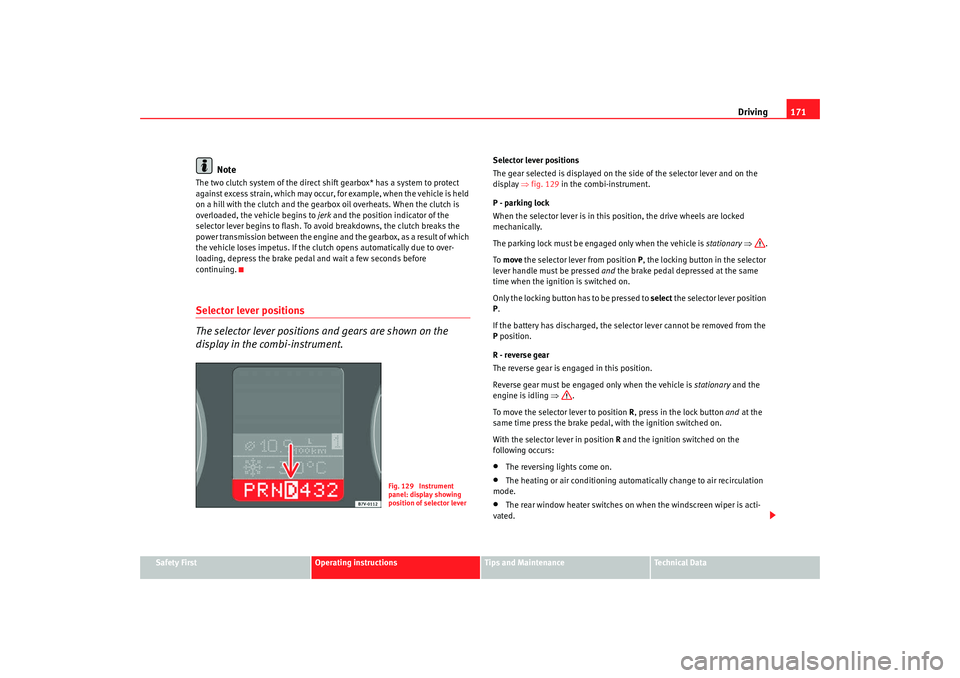
The gear selected is displayed on the side of the selector lever and on the
display ⇒fig. 129 in the combi-instrument.
P - parking lock
When the selector lever is in this position, the drive wheels are locked
mechanically.
The parking lock must be engaged only when the vehicle is stationary ⇒ .
To move the selector lever from position P, the locking button in the selector
lever handle must be pressed and the brake pedal depressed at the same
time when the ignition is switched on.
Only the locking button has to be pressed to select the selector lever position
P .
If the battery has discharged, the selector lever cannot be removed from the
P position.
R - reverse gear
The reverse gear is engaged in this position.
Reverse gear must be engaged only when the vehicle is stationary and the
engine is idling ⇒.
To move the selector lever to position R, press in the lock button and at the
same time press the brake pedal, with the ignition switched on.
With the selector lever in position R and the ignition switched on the
following occurs:•
The reversing lights come on.
•
The heating or air conditioning automatically change to air recirculation
mode.
•
The rear window heater switches on when the windscreen wiper is acti-
vated.
Fig. 129 Instrument
panel: display showing
position of selector lever
alhambra_aleman.book Seite 171 Montag, 23. M‰ rz 2009 1:12 13
Page 192 of 285
Driving and the environment
190Manual gearbox: Change from first to second gear as quickly as possible. We
recommend that, whenever possible, you change to a higher gear upon
reaching 2,000 rpms.
Automatic gearbox: Accelerate in moderation and avoid the “kick-down” (full
throttle) position.
Avoid driving at high speed
We advise you not to drive at the top speed permitted by the vehicle. Fuel
consumption, exhaust emissions and noise levels all increase very rapidly at
higher speeds. Driving at moderate speeds will help to save fuel.
Avoid idling
It is worthwhile switching off the engine when waiting in a traffic jam, at level
crossings or at traffic lights with a long red phase. The fuel saved after only
30 - 40 seconds is greater than the amount of fuel needed to restart the
engine.
The engine takes a very long time to warm up when it is running at idling
speed. Mechanical wear and pollutant emissions are also especially high
during this initial warm-up phase. It is therefore best to drive off immediately
after starting the engine. Avoid running the engine at high speed.
Periodic maintenance
Periodic maintenance work guarantees that, before beginning a journey, you
will not consume more than the required amount of fuel. A well-serviced
engine gives you the benefit of improved fuel efficiency as well as maximum
reliability and an enhanced resale value.
A badly serviced engine can consume up to 10% more fuel than necessary.
Avoid short journeys
To reduce the consumption and emission of polluting gases, the engine and
the exhaust filtration systems should reach the optimum service tempera-
ture . With the engine cold, fuel consumption is proportionally higher. The engine
does not warm up and fuel consumption does not regularise until having
driven some
four kilometres. This is the reason why we recommend avoiding
short trips wherever possible.
Maintain the correct tyre pressures
Bear in mind that keeping the tyres at the correct pressure saves fuel. If the
tyre pressures are just 1 bar too low, this can put the fuel consumption up by
as much as 5 %. Due to the greater rolling resistance, under-inflation also
increases tyre wear and impairs handling.
The tyre pressures should always be checked when the tyres are cold.
Do not use winter tyres all through the year: they will increase fuel consump-
tion by up to 10 %.
Avoid unnecessary weight
Every kilo of extra weight will put up the fuel consumption, so it is worth
checking the luggage compartment occasionally to make sure that no unnec-
essary loads are being transported.
A roof carrier is often left in place for the sake of convenience, even when it is
no longer needed. At a speed of 100-120 km/h your car will use about 12%
more fuel as a result of the extra wind resistance caused by the roof carrier
even when it is not in use.
Save electrical energy
The engine activates the alternator, which produces electricity. With the need
for electricity, fuel consumption is also increased. Because of this, always
turn off electrical equipment when you do not need them. Examples of equip-
ment that use a lot of electricity are: the fan at high speeds, the rear window
heating or the seat heaters*.
alhambra_aleman.book Seite 190 Montag, 23. M‰ rz 2009 1:12 13
Page 193 of 285
Driving and the environment191
Safety First
Operating instructions
Tips and Maintenance
Te c h n i c a l D a t a
Environmental friendlinessEnvironmental protection is a top priority in the design, choice of materials
and production of your new Seat.
Design measures for economical recycling•
Joints and connections designed for ease of dismantling
•
Modular construction to facilitate dismantling
•
Increased use of single-grade materials
•
Plastic parts and elastomers are labelled in accordance with ISO 1043,
ISO 11469 and ISO 1629
Choice of materials
•
Nearly all materials used can be recycled
•
Similar types of plastics grouped together for easy recycling
•
Recycled materials used in manufacture
•
Reduction of volatile compounds in plastics
•
CFC-free refrigerant in air conditioning
Compliance with prohibited materials laws : cadmium, asbestos, lead,
mercury, chrome VI.
Manufacturing methods
•
Use of recycled material for manufacturing plastic parts
•
Solvent-free cavity sealing
•
Solvent-free wax for protecting the vehicles in transit
•
Solvent-free adhesives
•
No CFCs used in production
•
Surplus materials used extensively for energy conversion and building
materials
•
Overall water consumption reduced
•
Heat recovery systems
•
Water-soluble paint
Driving abroadNotesFor driving abroad, the following must be taken into consideration:•
For vehicles fitted with a catalytic converter ensure that unleaded petrol is
available for the journey. See the chapter “Refuelling”. Automobile organisa-
tions will have information about service station networks selling unleaded
fuel.
•
In some countries it is possible that a vehicle model is sold under condi-
tions where some spare parts are not available or that the Authorised Service
Centre may only carry out limited repairs.
SEAT importers and distributors will gladly provide information about the
technical preparation of your vehicle in addition to necessary maintenance
and repair possibilities.
Adhesive strips for headlightsIf you have to drive a right-hand drive vehicle in a left-hand drive country, or
vice versa, the asymmetric dipped beam headlights will dazzle oncoming
traffic.
To prevent dazzling, you must apply stickers to certain parts of the headlight
lenses. Further information is available from your Authorised Service
Centre.
alhambra_aleman.book Seite 191 Montag, 23. M‰ rz 2009 1:12 13
Page 194 of 285

Driving and the environment
192Trailer towingWhat do you need to bear in mind when towing a trailer?The vehicle can, if suitably equipped, be used to tow a trailer or caravan.
If the car is supplied with a factory-fitted towing bracket it will already have
the necessary technical modifications and meet the statutory requirements
for towing a trailer. If you wish to retrofit a towing bracket ⇒page 206.
Connectors
Your vehicle is fitted with a 12-pin connector for the electrical connection
between the trailer and the vehicle.
If the trailer has a 7-pin plug, you will need to use an adapter cable. This is
available from SEAT Service.
Trailer weight / draw bar loading
Never exceed the maximum permitted trailer weights. If you do not load the
trailer up to the maximum permitted trailer weight, you can then climb corre-
spondingly steeper gradients.
The maximum trailer weights listed are only applicable for altitudes up to
1,000 m above sea level. With increasing altitude the engine power and
therefore the vehicle's climbing ability are impaired because of the reduced
air density. The maximum trailer weight has to be reduced accordingly. The
weight of the vehicle and trailer combination must be reduced by 10% for
every further 1,000 m (or part thereof). Where possible, operate the trailer
with the maximum permitted draw bar weight on the ball joint of the towing
bracket, but do not exceed the specified limit.
The figures for trailer weights and draw bar weights given on the data plate
of the towing bracket are for certification purposes only. The correct figures
for your specific model, which may be lower than these figures for the towing
bracket, are given in the registration documents and “Technical data”. Gross combination weight
The gross combination weight is the actual weight of the laden vehicle plus
the actual weight of the laden trailer. If the maximum permissible trailer
weight is to be utilized, the weight of the vehicle may have to be reduced.
Distributing the load
Distribute loads in the trailer so that heavy objects are as near to the axle as
possible. Loads carried in the trailer must be secured to prevent them
moving.
Tyre pressu re
Set tyre pressure to the maximum permitted pressure shown on the sticker on
the inside of the tank flap. Set the tyre pressure of the trailer tyres in accord-
ance with the trailer manufacturer's recommendations.
Exterior mirrors
Check whether you can see enough of the road behind the trailer with the
standard mirrors. If this is not the case you should have additional mirrors
fitted. Both exterior mirrors should be mounted on hinged extension
brackets. Adjust the mirrors to give sufficient vision to the rear.
Headlight adjustment
If towing a trailer the dipped light may dazzle other drivers. Use the headlight
range control to lower the cone of light. If you do not have headlight range
control, have the headlights adjusted by a qualified dealership.
WARNING
•
Never transport people in a trailer. This could result in fatal accidents.
•
To avoid dazzling other drivers, adjust the dipped beam according to
the load. If not, an accident may occur.
alhambra_aleman.book Seite 192 Montag, 23. M‰ rz 2009 1:12 13
Page 211 of 285
Checking and refilling levels209
Safety First
Operating instructions
Tips and Maintenance
Te c h n i c a l D a t a
Petrol typesThe correct petrol types are listed on a sticker inside the fuel
tank flap.Only unleaded petrol, corresponding to the standard DIN EN 228 , may be
used for vehicles with catalytic converters (EN = “European Norm”).
Fuel types are differentiated by the octane rating, e.g: 91, 95, 98 RON (RON
= “Regulation Octane Number, unit for determining the knock resistance of
petrol”). You may use petrol with a higher octane number than the one recom-
mended for your engine. However, this has no advantage in terms of fuel
consumption and engine power. If, in exceptional circumstances, the correct
octane rating is not available:•
For engines which require Premium unleaded petrol (95 RON) the
following is valid: Regular unleaded fuel with 91 RON can also be used. This
can, however, result in a slight loss of power under certain driving conditions.
•
For engines which require Premium unleaded petrol (98 RON) the
following is valid: Premium unleaded fuel with 95 RON can also be used. This
can, however, result in a slight loss of power under certain driving conditions.
– If premium unleaded petrol is not available, the engine can be run on
regular unleaded petrol with 91 RON as an “emergency measure”. In this
case only use moderate engine speeds and a light throttle. Avoid using full
throttle. Fill up with premium petrol as soon as possible.Caution
•
Petrol that follows EN 228 may be mixed with small quantities of ethanol.
However, the so-called “bioethanol fuels” available at commercial establish-
ments with reference E50 or E85, which contain a high percentage of ethanol,
may not be used, as they will damage the fuel system.
•
Even one tankfull of leaded fuel would permanently impair the efficiency
of the catalytic converter.
•
High engine speed and full throttle can damage the engine when using
petrol with an octane rating lower than the correct grade for the engine.For the sake of the environment
Just one full tank of leaded fuel would seriously impair the efficiency of the
catalytic converter.DieselDiesel*Diesel fuel must correspond to DIN EN 590 (EN = “European standard”). It
must have a cetane number (CN) of at least 51. The cetane number indicates
the ignition quality of the diesel fuel.
Notes on filling with fuel ⇒page 208.RME fuel*The biodiesel fuel must comply with the DIN EN 14.214 (FAME) Standard.•
Biodiesel is a methylester obtained from rapeseed oil.
•
DIN is a German abbreviation for “ Deutsches Institut für N ormung e.V.”,
the German standards institute.
•
EN means European Norm.
•
FAME is the English abbreviation “ Fatty Acid Methyl Ester”
Your Authorised Service Centre can also be consulted to know if the vehicle
has been prepared for biodiesel use.
alhambra_aleman.book Seite 209 Montag, 23. M‰ rz 2009 1:12 13
Page 232 of 285
Checking and refilling levels
230easier to choose the correct tyres. Radial tyres have the tyre designations
marked on the sidewall, for example:
195/65 R15 91T
This contains the following information:
195 Tyre width in mm
65 Height/width ratio in %
R Tyre construction: Radial
15 Rim diameter in inches
91 Load rating code
T Speed rating
The tyres could also have the following information:•
A direction of rotation symbol
•
“Reinforced” denotes heavy-duty tyres.
The manufacturing date is also indicated on the tyre sidewall (possibly only
on the inner side of the wheel).
“DOT... 1105...” means, for example, that the tyre was produced in the 11th
week of 2005.
We recommend that work on tyres and wheels is carried out by an Authorised
Service Centre. They are familiar with the procedure and have the necessary
special tools and spare parts as well as the proper facilities for disposing of
the old tyres.
Any Authorised Service Centre has full information on the technical require-
ments when installing or changing tyres, wheels or wheel trims.
WARNING
•
We recommend that you use only wheels and tyres which have been
approved by SEAT for your model. Failure to do so could impair vehicle
handling. Risk of accident.
•
Avoid running the vehicle on tyres that are more than six years old. If
you have no alternative, you should drive slowly and with extra care at all
times.
•
Never use old tyres or those with an unknown “history of use”.
•
If wheel trims are retrofitted, you must ensure that the flow of air to the
brakes is not restricted. This could cause them to overheat.
•
All four wheels must be fitted with radial tyres of the same type, size
(rolling circumference) and the same tread pattern.For the sake of the environment
Old tyres must be disposed of according to the laws in the country concerned.
Note
•
For technical reasons, it is not generally possible to use the wheels from
other vehicles. This can also apply to wheels of the same model. The use of
wheels or tyres which have not been approved by SEAT for use with your
model may invalidate the vehicle's type approval for use on public roads.
•
If the spare tyre is not the same as the tyres that are mounted on the
vehicle - for example with winter tyres - you should only use the spare tyre for
a short period of time and drive with extra care. Refit the normal road wheel
as soon as possible.
Wheel bolts
Wheel bolts must be tightened to the correct torque.The design of wheel bolts is matched to the rims. If different wheel rims are
fitted, the correct wheel bolts with the right length and correctly shaped bolt
WARNING (continued)
alhambra_aleman.book Seite 230 Montag, 23. M‰ rz 2009 1:12 13
Page 233 of 285
Checking and refilling levels231
Safety First
Operating instructions
Tips and Maintenance
Te c h n i c a l D a t a
heads must be used. This ensures that wheels are fitted securely and that the
brake system functions correctly.
In certain circumstances, you may not use wheel bolts from a different car -
even if it is the same model
⇒page 204.
WARNING
If the wheel bolts are not tightened correctly, the wheel could become
loose while driving. Risk of accident.•
The wheel bolts must be clean and turn easily. Never apply grease or oil
to them.
•
Use only wheel bolts which belong to the wheel.
•
If the prescribed torque of the wheel bolts is too low, they could loosen
whilst the vehicle is in motion. Risk of accident! If the tightening torque is
too high, the wheel bolts and threads could be damaged.Caution
The prescribed torque for wheel bolts for steel and alloy wheels is 120 Nm.Winter tyres
Winter tyres will improve the vehicles handling on snow and
ice.In winter conditions winter tyres will considerably improve the vehicles
handling. The design of summer tyres (width, rubber compound, tread
pattern) gives less grip on ice and snow.
Winter tyres must be inflated to a pressure 0.2 bar higher than the pressures
specified for summer tyres (see sticker on tank flap).
Winter tyres must be fitted on all four wheels. Information on permitted
winter tyre sizes can be found in the vehicle's regis-
tration documents. Use only radial winter tyres. All tyre sizes listed in the
vehicle documentation also apply to winter tyres.
Winter tyres lose their effectiveness when the tread is worn down to a depth
of 4 mm.
The speed rating code ⇒page 229, “New tyres and wheels” determines the
following speed limits : ⇒
Q max. 160 km/h
S max. 180 km/h
T max. 190 km/h
H max. 210 km/h
In some countries, vehicles which can exceed the speed rating of the fitted
tyre must have an appropriate sticker in the driver's field of view. These
stickers are available from your Authorised Service Centre. The legal require-
ments of each country must be followed.
Do not have winter tyres fitted for unnecessarily long periods. Vehicles with
summer tyres handle better when the roads are free of snow and ice.
If you have a flat tyre, please refer to the notes on the spare wheel
⇒ page 229, “New tyres and wheels”.
WARNING
The maximum speed for the winter tyres must not be exceeded. Otherwise,
this could lead to tyre damage and thus, an accident risk.
For the sake of the environment
Fit your summer tyres in good time. They are quieter, do not wear so quickly
and reduce fuel consumption.
alhambra_aleman.book Seite 231 Montag, 23. M‰ rz 2009 1:12 13
Page 236 of 285
If and when
234
Box spanner for wheel bolts
Jack. Before you return the jack to the tool box, you must fully wind in the
claw. The crank must then be folded tight against the side of the jack.
The removable towing bracket
44), the key for unlocking the sunroof in an
emergency
44) and the anti-theft wheel bolt adaptor
44) are stored next to the
vehicle tools.
Adapter for anti-theft wheel bolts
We recommend you carry the wheel bolt adapter
44) in the vehicle tool kit at
all times.
The code number of the anti-theft wheel bolt is stamped on the front of the
adapter. You will need this number to replace the adapter if lost. Make a note
the code number of the anti-theft wheel bolt and keep it in a safe place - but
not in your vehicle.
WARNING
•
Do not use the hexagonal socket in the screwdriver handle to tighten
the wheel bolts. It is not suitable for tightening the bolts to the necessary
torque. This may cause an accident.
•
The jack supplied by the factory is only designed for changing wheels
on this model. Never attempt to use it for lifting heavier vehicles or other
loads. Risk of injury.
•
Use the jack only on firm, level ground.
•
Never start the engine when you have raised the vehicle on the jack.
Risk of accident.
•
Never place your body (e.g. arm or leg) underneath the vehicle if it is
only supported by the jack Risk of injury.
•
If you have to work underneath the vehicle, you must use suitable
stands additionally to support the vehicle - Risk of accident!.
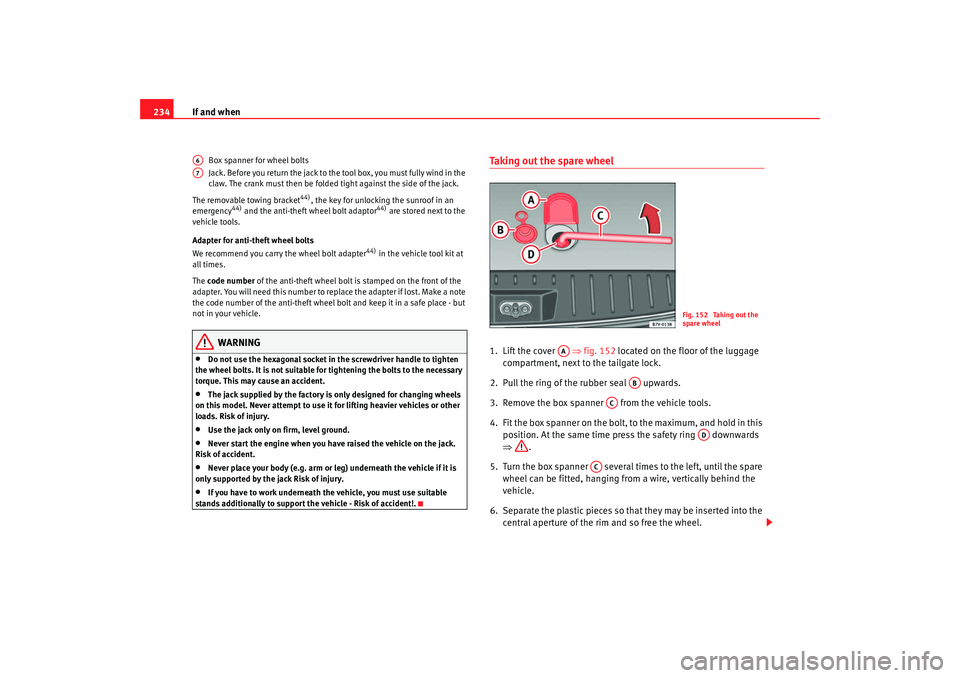
Taking out the spare wheel1. Lift the cover ⇒fig. 152 located on the floor of the luggage
compartment, next to the tailgate lock.
2. Pull the ring of the rubber seal upwards.
3. Remove the box spanner from the vehicle tools.
4. Fit the box spanner on the bolt, to the maximum, and hold in this position. At the same time press the safety ring downwards
⇒ .
5. Turn the box spanner several times to the left, until the spare wheel can be fitted, hanging from a wire, vertically behind the
vehicle.
6. Separate the plastic pieces so that they may be inserted into the central aperture of the rim and so free the wheel.
A6A7
Fig. 152 Taking out the
spare wheel
AA
AB
AC
AD
AC
alhambra_aleman.book Seite 234 Montag, 23. M‰ rz 2009 1:12 13
Page 262 of 285
General notes on the technical data
260WeightsKerb weight refers to the basic model with a fuel tank filled to 90% capacity
and without optional extras. The figure quoted includes 75 kg to allow for the
weight of the driver.
For special versions and optional equipment fittings or for the addition of
accessories, the weight of the vehicle will increase ⇒.
WARNING
•
Please note that the centre of gravity may shift when transporting
heavy objects; this may affect the vehicle's handling and lead to an acci-
dent. Always adjust your speed and driving style to suit road conditions
and requirements.
•
Never exceed the gross axle weight rating or the gross vehicle weight
rating. If the allowed axle load or the allowed total weight is exceeded, the
driving characteristics of the vehicle may change, leading to accidents,
injuries and damage to the vehicle.
To w i n g a t r a i l e rTra iler weig htsTrailer weigh ts
The trailer weights and drawbar loads approved are selected in intensive
trials according to precisely defined criteria. The approved trailer weights are
valid for vehicles in the EU for maximum speeds of 80 km/h (in certain
circumstances up to 100 km/h). The figures may be different in other coun-
tries. All data in the official vehicle documents take precedence over these
data ⇒ . Drawbar load
The
maximum permitted weight exerted by the trailer drawbar on the ball joint
of the towing bracket must not exceed 85 kg.
In the interest of road safety, we recommend that you always tow
approaching the maximum drawbar load. The response of the trailer on the
road will be poor if the drawbar load is too small.
If the maximum permissible drawbar load cannot be met (e.g. with small,
empty and light-weight single axle trailers or tandem axle trailers with an axle
base of less than 1 metre), at least 4% of the actual trailer weight is a legal
stipulation for a drawbar load.
WARNING
•
For safety reasons, you should not drive at speeds above 80 km/h when
towing a trailer. This also applies to countries where higher speeds are
permitted.
•
Never exceed the maximum trailer weights or the draw bar loading. If
the permissible axle load or the permissible total weight is exceeded, the
driving characteristics of the vehicle may change, leading to accidents,
injuries and damage to the vehicle.
WheelsTyre pressure, snow chains, wheel boltsTyre pressu res
The sticker with the tyre pressure values can be found on the inside of the
tank flap. The tyre pressure values given there are for cold tyres. The slightly
raised pressures of warm tyres must not be reduced ⇒.
alhambra_aleman.book Seite 260 Montag, 23. M‰ rz 2009 1:12 13