cooling Seat Alhambra 2009 User Guide
[x] Cancel search | Manufacturer: SEAT, Model Year: 2009, Model line: Alhambra, Model: Seat Alhambra 2009Pages: 285, PDF Size: 7.62 MB
Page 159 of 285
Heating, Ventilation and Air conditioning157
Safety First
Operating instructions
Tips and Maintenance
Te c h n i c a l D a t a
WARNING
Do not leave the air recirculation function on for long periods. In air recircu-
lation mode, no fresh air enters the vehicle interior. Also, if the cooling
system is switched off, the windows can quickly mist over. Stale or contam-
inated air inside the vehicle may cause drowsiness, increasing the risk of
accident.Climatronic for the passenger compartmentSetting the blower speed for the passenger compartment
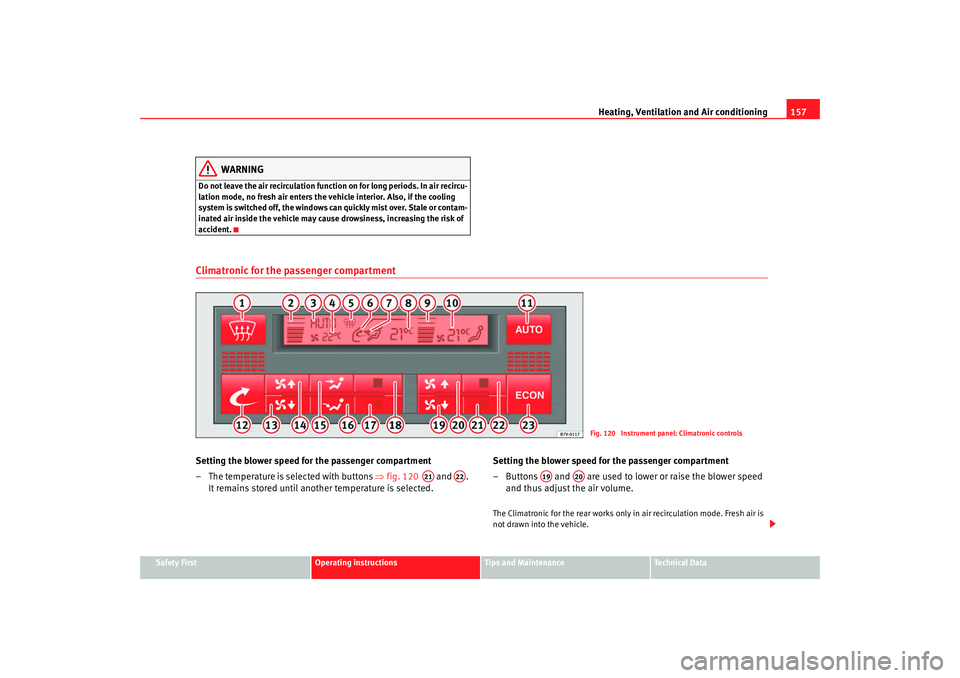
– The temperature is selected with buttons ⇒fig. 120 and .
It remains stored until another temperature is selected. Setting the blower speed for the passenger compartment
– Buttons and are used to lower or raise the blower speed
and thus adjust the air volume.
The Climatronic for the rear works only in air recirculation mode. Fresh air is
not drawn into the vehicle.
Fig. 120 Instrument panel: Climatronic controls
A21
A22
A19
A20
alhambra_aleman.book Seite 157 Montag, 23. M‰ rz 2009 1:12 13
Page 160 of 285
Heating, Ventilation and Air conditioning
158The Climatronic can be fitted either with or without an additional cooling
system
38) for the passenger compartment.
Climatronic for the passenger compartment without additional cooling
system
The temperature setting for the rear can be max. 3°C higher than the temper-
ature in the passenger compartment. A lower temperature can not be set.
If the Climatronic detects that the passenger compartment has to be heated,
it activates the additional heat exchanger. The air outlets on the floor guide
warm air into the vehicle ⇒page 158.
If the Climatronic detects that the passenger compartment has to be cooled,
cooled air is fed into the vehicle via the air outlets in the front of the vehicle
only ⇒page 158.
Climatronic for the passenger compartment with additional cooling system
The temperature setting for the rear can be max. 3°C lower than the tempera-
ture in the passenger compartment.
If the Climatronic detects that the passenger compartment has to be heated,
it activates the additional heat exchanger. The air outlets on the floor guide
warm air into the vehicle ⇒page 158.
If the Climatronic detects that the passenger compartment has to be cooled,
cooled air is fed into the rear of the vehicle via the open air outlets in the roof
⇒ page 158.
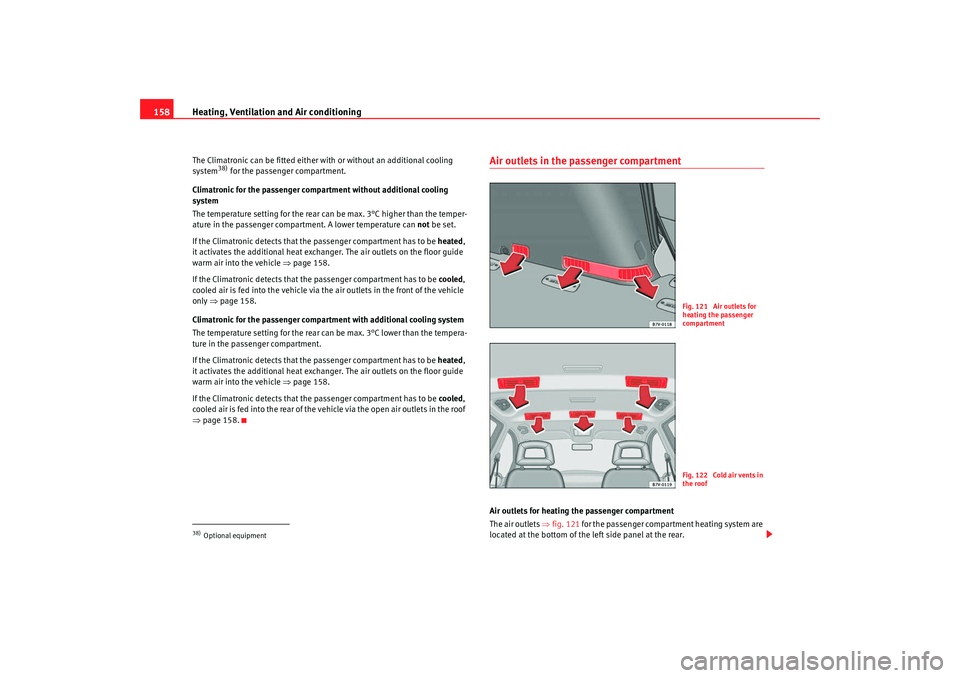
Air outlets in the passenger compartmentAir outlets for heating the passenger compartment
The air outlets ⇒ fig. 121 for the passenger compartment heating system are
located at the bottom of the left side panel at the rear.
38)Optional equipment
Fig. 121 Air outlets for
heating the passenger
compartmentFig. 122 Cold air vents in
the roof
alhambra_aleman.book Seite 158 Montag, 23. M‰ rz 2009 1:12 13
Page 161 of 285
Heating, Ventilation and Air conditioning159
Safety First
Operating instructions
Tips and Maintenance
Te c h n i c a l D a t a
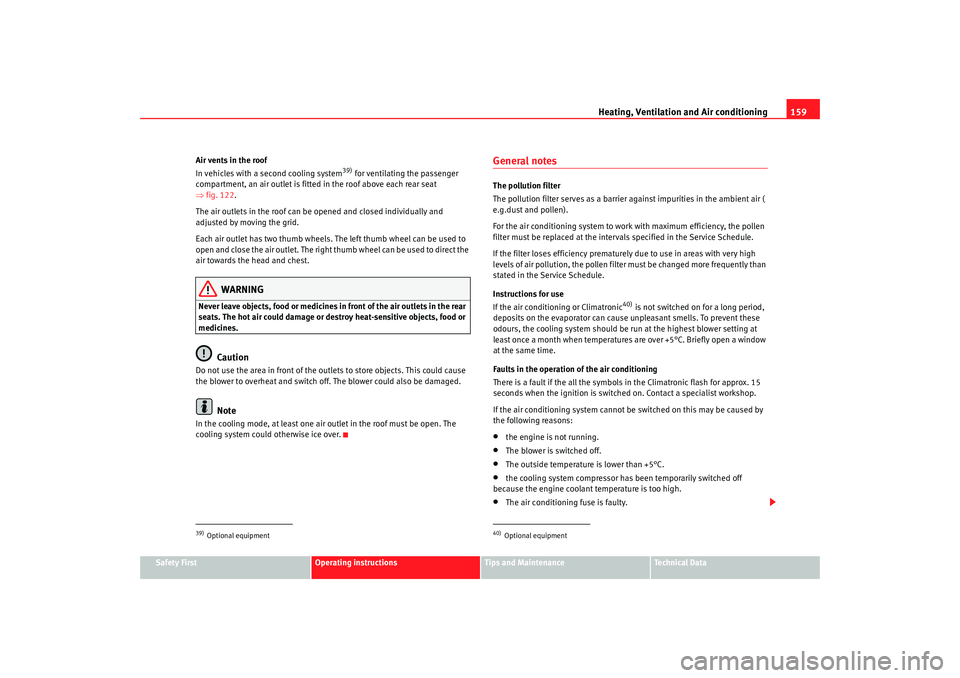
Air vents in the roof
In vehicles with a second cooling system
39) for ventilating the passenger
compartment, an air outlet is fitted in the roof above each rear seat
⇒ fig. 122 .
The air outlets in the roof can be opened and closed individually and
adjusted by moving the grid.
Each air outlet has two thumb wheels. The left thumb wheel can be used to
open and close the air outlet. The right thumb wheel can be used to direct the
air towards the head and chest.
WARNING
Never leave objects, food or medicines in front of the air outlets in the rear
seats. The hot air could damage or destroy heat-sensitive objects, food or
medicines.
Caution
Do not use the area in front of the outlets to store objects. This could cause
the blower to overheat and switch off. The blower could also be damaged.
Note
In the cooling mode, at least one air outlet in the roof must be open. The
cooling system could otherwise ice over.
General notesThe pollution filter
The pollution filter serves as a barrier against impurities in the ambient air (
e.g.dust and pollen).
For the air conditioning system to work with maximum efficiency, the pollen
filter must be replaced at the intervals specified in the Service Schedule.
If the filter loses efficiency prematurely due to use in areas with very high
levels of air pollution, the pollen filter must be changed more frequently than
stated in the Service Schedule.
Instructions for use
If the air conditioning or Climatronic
40) is not switched on for a long period,
deposits on the evaporator can cause unpleasant smells. To prevent these
odours, the cooling system should be run at the highest blower setting at
least once a month when temperatures are over +5°C. Briefly open a window
at the same time.
Faults in the operation of the air conditioning
There is a fault if the all the symbols in the Climatronic flash for approx. 15
seconds when the ignition is switched on. Contact a specialist workshop.
If the air conditioning system cannot be switched on this may be caused by
the following reasons:
•
the engine is not running.
•
The blower is switched off.
•
The outside temperature is lower than +5°C.
•
the cooling system compressor has been temporarily switched off
because the engine coolant temperature is too high.
•
The air conditioning fuse is faulty.
39)Optional equipment
40)Optional equipment
alhambra_aleman.book Seite 159 Montag, 23. M‰ rz 2009 1:12 13
Page 162 of 285
Heating, Ventilation and Air conditioning
160•
Another fault in the vehicle. Have the air conditioning checked by a qual-
ified workshop.
WARNING
Please note that when the Climatronic is switched off, no fresh air will enter
the vehicle interior. For this reason you should ensure that sufficient fresh
air is able to enter the vehicle by opening a window or the sliding/tilting
sunroof
40) when the Climatronic is switched off.
Caution
•
If you suspect that the air conditioning is damaged, switch off the air
conditioning with button to prevent further damage and have it
checked by a qualified workshop.
•
Repairs to the air conditioning system require specialist knowledge and
special tools. Therefore, we recommend that you take the vehicle to a quali-
fied workshop should problems occur.Note
•
If the humidity and temperature outside the vehicle are high, condensa-
tion can drip off the evaporator in the cooling system and form a pool under-
neath the vehicle, this is completely normal and there is no need to suspect
a leak.
•
Keep the air intake slots in front of the windscreen free of snow, ice and
leaves to ensure heating and cooling is not impaired, and to prevent the
windows misting over.
•
The air conditioning system operates most effectively with the windows
and the sliding /tilting roof
40) closed. However, if the sun has heated up the
vehicle, the air inside can be cooled more quickly by opening the windows for
a short period.
•
Do not smoke while air recirculation mode is on, as smoke drawn into the
cooling system leaves a residue on the evaporator, producing a permanent
unpleasant odour.
ECON
alhambra_aleman.book Seite 160 Montag, 23. M‰ rz 2009 1:12 13
Page 205 of 285
Cleaning and caring for your vehicle203
Safety First
Operating instructions
Tips and Maintenance
Te c h n i c a l D a t a
•
Check the condition of all seat belts at regular intervals. If you notice
that the belt webbing, fittings, retractor mechanism or buckle of any of the
belts is damaged, the belt must be replaced by a specialist workshop.
•
Do not attempt to repair a damaged seat belt yourself. The seat belts
must not be removed or modified in any way.Caution
After cleaning, allow seat belts to dry completely before rolling them up.
Otherwise the belt retractors could become damaged.Cleaning the cool/thermos box – Before using the insulated box for the first time, you should clean
it, using a household detergent.
– Always clean the inside of the insulated box when it is soiled.If you do not plan to use the insulated box for a long period, disconnect the
power supply and clean the inside and outside of the box. Place a folded
towel between the box and its lid. This prevents mould and damp stains
forming in the cooling and heating box.
WARNING (continued)
alhambra_aleman.book Seite 203 Montag, 23. M‰ rz 2009 1:12 13
Page 209 of 285
Accessories, parts replacement and modifications207
Safety First
Operating instructions
Tips and Maintenance
Te c h n i c a l D a t a
If a towing bracket is to be retro-fitted to the car, it must be done according to
the instructions of the towing bracket manufacturer.
The attachment points for the towing bracket ⇒
page 206, fig. 136 are
underneath the vehicle.
Always observe the minimum distance from the middle of the ball coupling to
the ground (350 to 420 mm). This also applies when the vehicle is fully laden,
including maximum drawbar load.
Fitting a towing bracket
•
Driving with a trailer implies additional work for the vehicle. Therefore,
before fitting a towing bracket, please contact an Authorised Service Centre
to check whether your cooling system needs modification.
•
Observe the legal requirements in your country (e.g. the fitting of a sepa-
rate pilot lamp).
•
Certain vehicle components, e.g. the rear bumper must be removed and
reinstalled. The towing bracket securing bolts have to be tightened using a
torque wrench, and a socket connected to the vehicle's electrical system. This
requires specialist knowledge and tools.
•
The figures in the illustration show the dimensions and attachment points
which must be observed if you are retrofitting a towing bracket.
WARNING
If a towing bracket is retrofitted, it should be done by a qualified dealer.•
If the towing bracket is incorrectly fitted, this could cause a safety risk.
•
For your own safety, please observe the instructions provided by the
manufacturer of the towing bracket.Caution
If the connector socket is not fitted correctly, this could cause damage to the
vehicle's electrical system.
AA
alhambra_aleman.book Seite 207 Montag, 23. M‰ rz 2009 1:12 13
Page 214 of 285
Checking and refilling levels
212•
Do not unscrew the cap on the expansion tank when the engine is hot.
If the coolant is hot, the cooling system will be pressurised!
•
Protect face, hands and arms by covering the cap with a large, thick
cloth to protect against escaping coolant and steam.
•
Always make sure you have not left any objects, such as cleaning cloths
and tools, in the engine compartment.
•
If you have to work underneath the vehicle, you must use suitable
stands additionally to support the vehicle, there is a risk of accident!. A
hydraulic jack is insufficient for securing the vehicle and there is a risk of
injury.
•
If any work has to be performed when the engine is started or with the
engine running, there is an additional, potentially fatal, safety risk from the
rotating parts, such as the drive belts, alternator, radiator fan, etc., and
from the high-voltage ignition system. You should also observe the
following points:
−Never touch the electrical wiring of the ignition system.
− Ensure that jewellery, loose clothing and long hair do not get
trapped in rotating engine parts. Danger of death. Before starting any
work remove jewellery, tie back and cover hair, and wear tight-fitting
clothes.
− Always think carefully about pressing the accelerator if a gear is
engaged in either an automatic or manual gearbox. The vehicle could
move, even if the handbrake is applied. Danger of death.
•
If work has to be carried out on the fuel system or on electrical compo-
nents, you must observe the following safety notes in addition to the above
warnings:
−Always disconnect the battery. The vehicle must be unlocked when
this is done, otherwise the alarm will be triggered.
− Do not smoke.
− Never work near naked flames. −
Always have a fire extinguisher on hand.
Caution
When changing or topping up service fluids, make absolutely certain that you
fill the fluids into the correct reservoirs. Failure to observe this point will result
in serious malfunctions and engine damage!
For the sake of the environment
Service fluids leaks are harmful to the environment. For this reason you
should make regular checks on the ground underneath your vehicle. If you
find spots of oil or other fluids, have your vehicle inspected in a qualified
workshop.
WARNING (continued)
WARNING (continued)
alhambra_aleman.book Seite 212 Montag, 23. M‰ rz 2009 1:12 13
Page 220 of 285
Checking and refilling levels
218•
Before opening the bonnet, read and observe the warnings
⇒ page 211, “Safety instructions on working in the engine compartment”.
•
Wait for the engine to cool down. Hot oil may cause burn injuries.
•
Wear eye protection to avoid injuries caused by splashes of oil.
•
When removing the oil drain plug with your fingers, keep your arm hori-
zontal to help prevent oil from running down your arm.
•
Wash your skin thoroughly if it comes into contact with engine oil.
•
Engine oil is poisonous! Used oil must be stored in a safe place out of
the reach of children until it is disposed of.Caution
No additives should be used with engine oil. This could result in engine
damage. Any damage caused by the use of such additives would not be
covered by the factory warranty.
For the sake of the environment
•
Because of the disposal problems, the necessary special tools and
specialist knowledge required, we recommend that you have the engine oil
and filter changed by an Authorised Service Centre.
•
Never pour oil down drains or into the ground.
•
Use a suitable container when draining the used oil. It has to be large
enough to hold all the engine oil
CoolantCoolant specifications
Coolant is a mixture of water and at least 40% coolant addi-
tive.The cooling system must be filled with a mixture of water and at least 40 % of
our coolant additive G 12+ or an additive with the specification TT-VW 774 F
(it is dyed purple). This mixture gives the necessary frost protection down to
-25°C and protects the alloy parts of the cooling system against corrosion. It
also prevents scaling and raises the boiling point of the coolant.
The concentration of coolant must always be at least 40% - even if frost
protection is not required.
If greater frost protection is required in very cold climates, the proportion of
the antifreeze additive G 12+ can be increased. However, the percentage of
coolant additives should not exceed 60%, as this would reduce the frost
protection. It would also reduce the cooling effect. A mixture with 60%
coolant additive will give frost protection to approx. -40°C.
WARNING
•
The coolant additive is toxic. There is a toxic risk. Always keep the
coolant additive in the original container which should be stored out of the
reach of children. The same applies to coolant which you have drained off.
•
The coolant additive G 12+ must be added in sufficient quantities to
provide anti-freeze protection at the coldest ambient temperatures that
can be expected. At extremely cold ambient temperatures, the coolant
could freeze, causing the vehicle to breakdown. As the heater would also
not work in this situation, there is a risk of suffering exposure!
WARNING (continued)
alhambra_aleman.book Seite 218 Montag, 23. M‰ rz 2009 1:12 13
Page 221 of 285
Checking and refilling levels219
Safety First
Operating instructions
Tips and Maintenance
Te c h n i c a l D a t a
Caution
•
Other additives may give considerably inferior corrosion protection. The
resulting corrosion in the cooling system can lead to a loss of coolant,
causing serious damage to the engine.
•
The coolant additive G 12+ (purple) can be mixed with the additive G 12
(red) or G 11. Never mix G12 (red colour) with G 11.
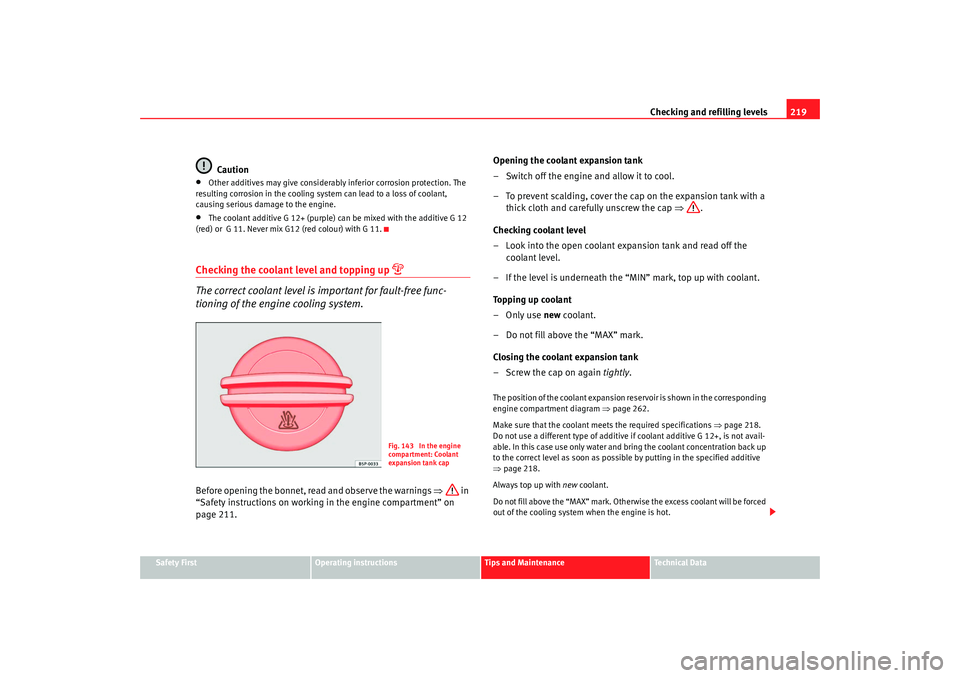
Checking the coolant level and topping up
The correct coolant level is important for fault-free func-
tioning of the engine cooling system.Before opening the bonnet, read and observe the warnings ⇒ in
“Safety instructions on working in the engine compartment” on
page 211. Opening the coolant expansion tank
– Switch off the engine and allow it to cool.
– To prevent scalding, cover the cap on the expansion tank with a
thick cloth and carefully unscrew the cap ⇒.
Checking coolant level
– Look into the open coolant expansion tank and read off the coolant level.
– If the level is underneath the “MIN” mark, top up with coolant.
To p p i n g u p c o o l a n t
–Only use new coolant.
– Do not fill above the “MAX” mark.
Closing the coolant expansion tank
– Screw the cap on again tightly.
The position of the coolant expansion reservoir is shown in the corresponding
engine compartment diagram ⇒page 262.
Make sure that the coolant meets the required specifications ⇒page 218.
Do not use a different type of additive if coolant additive G 12+, is not avail-
able. In this case use only water and bring the coolant concentration back up
to the correct level as soon as possible by putting in the specified additive
⇒ page 218.
Always top up with new coolant.
Do not fill above the “MAX” mark. Otherwise the excess coolant will be forced
out of the cooling system when the engine is hot.
Fig. 143 In the engine
compartment: Coolant
expansion tank cap
alhambra_aleman.book Seite 219 Montag, 23. M‰ rz 2009 1:12 13
Page 222 of 285
Checking and refilling levels
220The coolant additive G 12+ (dyed purple) may be mixed with G 12 (dyed red)
and also with G 11.
WARNING
Any work carried out in the engine compartment or on the engine must be
carried out cautiously.•
When working in the engine compartment, always observe the safety
warnings ⇒page 211
•
When the engine is warm or hot, the cooling system is pressurised! Do
not unscrew the cap on the expansion tank when the engine is hot. This is
a burn injury risk.Caution
•
When mixed with other additives the colour of G 12 will change to brown.
If this occurs you should have the coolant changed immediately. Failure to do
so will result in engine damage!
•
If a lot of coolant has been lost, wait for the engine to cool down before
putting in cold coolant. This avoids damaging the engine. Large coolant
losses are an indication of leaks in the cooling system. See a specialised
workshop immediately and have the cooling system checked. Otherwise,
there is a risk of engine damage.
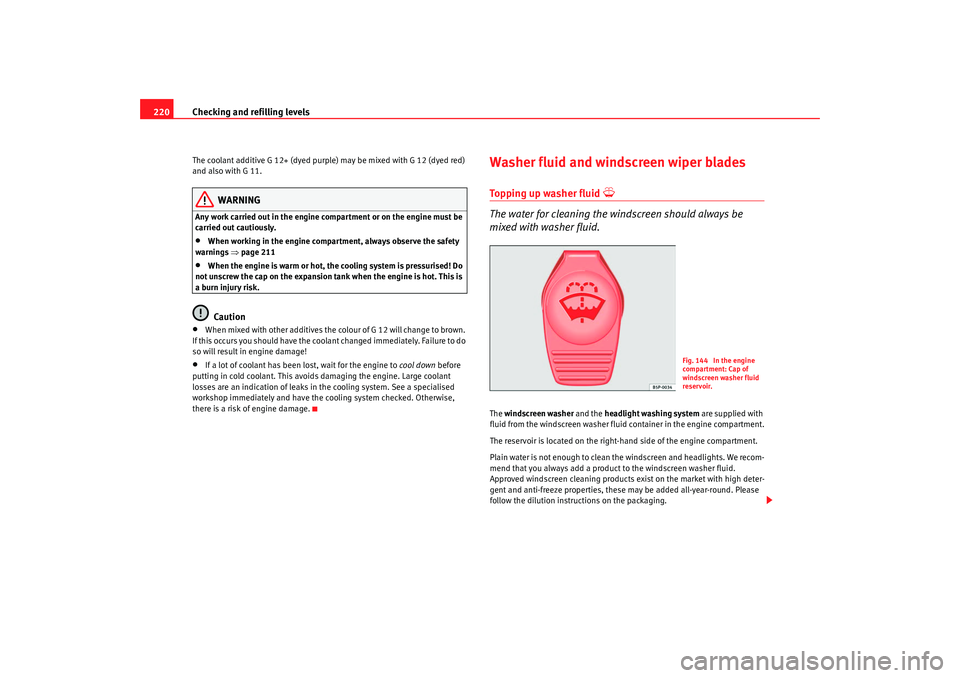
Washer fluid and windscreen wiper bladesTo p p i n g u p w a s h e r f l u i d
The water for cleaning the windscreen should always be
mixed with washer fluid.The windscreen washer and the headlight washing system are supplied with
fluid from the windscreen washer fluid container in the engine compartment.
The reservoir is located on the right-hand side of the engine compartment.
Plain water is not enough to clean the windscreen and headlights. We recom-
mend that you always add a product to the windscreen washer fluid.
Approved windscreen cleaning products exist on the market with high deter-
gent and anti-freeze properties, these may be added all-year-round. Please
follow the dilution instructions on the packaging.
Fig. 144 In the engine
compartment: Cap of
windscreen washer fluid
reservoir.
alhambra_aleman.book Seite 220 Montag, 23. M‰ rz 2009 1:12 13