stop start Seat Alhambra 2009 User Guide
[x] Cancel search | Manufacturer: SEAT, Model Year: 2009, Model line: Alhambra, Model: Seat Alhambra 2009Pages: 285, PDF Size: 7.62 MB
Page 171 of 285
Driving169
Safety First
Operating instructions
Tips and Maintenance
Te c h n i c a l D a t a
Note
A programme will, depending on the driving resistance, be selected automat-
ically that guarantees more pulling power, thus avoiding having to shift gear
constantly.Selector lever lock
The selector lever lock in position P or N prevents gears from
being engaged inadvertently, which would cause the vehicle
to move.The selector lever lock is released as follows:
– Switch on the ignition.
– Press and hold the brake pedal and press the selector lever lock
on the left of the selector lever at the same time ⇒page 168,
fig. 128 .The selector lever lock only works if the vehicle is stationary or driving at
speeds up to 5 km/h (approx. 3 mph). At higher speeds the selector lever
lock is disengaged automatically in the N position.
The selector lever lock is not engaged if the selector lever is moved quickly
through position N (e.g. when shifting from R to D) . Th is ma kes i t p ossibl e , fo r
instance, to “rock” the vehicle backwards and forwards if it is stuck in snow
or mud. The selector lever lock engages automatically if the brake pedal is not
depressed and the lever is in position N for more than about 1 second.
Driving a car with an automatic gearbox
The gearbox changes the forward gears up and down auto-
matically.Switching on
– Start the engine with the selector lever in position P or N . Further
information ⇒page 165.
Driving
– Press and hold the brake pedal.
– Press and hold the lock button (button on the knob of the selector lever) ⇒ page 168, fig. 128 , select gear position ( R, D or
S ).
– Release the lock button and wait for the gearbox to engage the gear (a slight movement can be felt).
– Release the brake and press the accelerator ⇒.
Stopping briefly
– Use the foot brake to prevent the car “creeping” forwards, e.g. at traffic lights. The selector lever does not need to be put into the
positions P or N for this.
– Do not press the accelerator.
Parking the vehicle
– Press and hold the brake pedal until the vehicle comes to a standstill ⇒.
– Apply the handbrake firmly.
alhambra_aleman.book Seite 169 Montag, 23. M‰ rz 2009 1:12 13
Page 177 of 285

Driving175
Safety First
Operating instructions
Tips and Maintenance
Te c h n i c a l D a t a
– Switch off the engine and remove the key from the ignition lock.
Turn the steering wheel slightly to engage the steering lock.
– Always take you car keys with you when you leave the vehicle ⇒ .Additional notes on parking the vehicle on gradients:
Turn the steering wheel so that the vehicle would roll against the kerb if it did
start to roll.•
If the vehicle is facing downhill , turn the front wheels so that they point
towards the kerb .
•
If the vehicle is facing uphill , turn the front wheels so that they point away
from the kerb .
WARNING
Take measures to reduce the risk of injury when you leave your vehicle
unattended.•
Never park where the hot exhaust system could ignite inflammable
materials, such as dry grass, low bushes, spilt fuel etc.
•
Never allow vehicle occupants to remain in the vehicle when it is
locked. They would be unable to open the vehicle from the inside, and
could become trapped in the vehicle in an emergency. In the event of an
emergency, locked doors will delay assistance to occupants.
•
Never leave children unsupervised in the vehicle. They could set the
vehicle in motion, for example, by releasing the handbrake or the gear
lever / selector lever.
•
Depending on weather conditions, it may become extremely hot or cold
inside the vehicle. This can be fatal.
Parking distance warning system*Description
The parking distance warning system is a parking aid which
draws your attention to obstacles in front or behind the
vehicle.The parking distance warning system assists the driver when parking. If the
rear of the vehicle is approaching an obstacle, an intermittent sound signal is
emitted. The shorter the distance, the shorter the intervals between tones. If
the vehicle is too close to the obstacle, the sound signal becomes constant.
The distance to an obstacle at the front is indicated via a high tone and via a
low tone at the rear. The shorter the distance, the shorter the intervals
between tones. If the vehicle is too close to the obstacle, the sound signal
becomes constant.
The obstacle may no longer be detected if the vehicle gets even closer to it!
The warning signal will stop when•
the vehicle moves away from the obstacle
•
the outer sensors measure a constant distance for approximately 3
seconds.
The signal will not be switched off once the vehicle has reached the perma-
nent tone area.
Registering the obstacle
•
Exterior front and rear sensors: from approx 80 cm
•
Front central sensors: from approx 120 cm
•
Rear central sensors: from approx 160 cm
alhambra_aleman.book Seite 175 Montag, 23. M‰ rz 2009 1:12 13
Page 186 of 285
Intelligent technology
184•
If the brake warning lamp
should light up together with the ABS
warning lamp
, stop the vehicle immediately and check the brake fluid
level in the reservoir ⇒page 223. If the fluid level has dropped below the
“MIN” mark you must not drive on. Risk of accident. You should obtain
professional assistance.
•
If the brake fluid level is correct, the fault in the brake system may have
been caused by a failure of the ABS control function. This could cause the
rear wheels to lock quickly when you brake. This could cause the tail of the
vehicle to skid sideways. Drive carefully to the nearest qualified workshop
and have the fault corrected.
Electronic differential lock (EDL)
The electronic differential lock helps prevent the loss of trac-
tion caused if one of the driven wheels starts spinning.The electronic differential lock (EDL) only works when the engine is running.
EDL helps the vehicle to start moving, accelerate and climb a gradient in slip-
pery conditions where this may otherwise be difficult or even impossible.
It uses the ABS sensors to monitor the speed of the driven wheels.
At speeds of up to approximately 80 km/h, it is able to balance out differ-
ences in the speed of the driven wheels of approximately 100 rpm caused by
a slippery road surface on one side of the vehicle. It does this by braking the
wheel which has lost traction and distributing more driving force to the other
driven wheel via the differential.
To prevent the disc brake of the braked wheel from overheating, the EDL cuts
out automatically if subjected to excessive loads. The car remains operational
and will behave in the same way as a car without EDL. For this reason, the
driver is not informed that the EDL has been switched off. The EDL will switch on again automatically when the brake has cooled down.
WARNING
Try to always adapt the speed of the vehicle to weather, road and traffic
conditions. Do not let the extra safety afforded by the system tempt you
into taking any risks when driving. Risk of accident.•
When accelerating on a slippery surface, for example on ice and snow,
press the accelerator carefully. Despite EDL, the driven wheels may other-
wise start to spin. This could impair the car's stability.
•
Always adapt your driving style to suit road conditions and the traffic
situation.WARNING
Modifications to the vehicle or work carried out incorrectly (e.g. to the
engine, the brake system, running gear or any components affecting the
wheels and tyres) could affect the efficiency of the ABS, EDL, ESP and TCS
and lessen their efficiency.Electronic stabilisation programme (ESP)
The electronic stabilisation programme helps to reduce the
danger of skidding.The electronic stabilisation programme (ESP) consists of ABS, EDL and TCS
and only works when the engine is running.
The ESP should generally be left switched on at all times. Only when the
necessary drive can not be obtained should the ESP be disconnected.
For example:•
when driving with snow chains,
WARNING (continued)
alhambra_aleman.book Seite 184 Montag, 23. M‰ rz 2009 1:12 13
Page 189 of 285
Driving and the environment187
Safety First
Operating instructions
Tips and Maintenance
Te c h n i c a l D a t a
Driving and the environmentRunning-inRunning in a new engine
The engine needs to be run-in over the first 1,500 km.Up to 1,000 kilometres
– Do not drive at speeds of more than 2/3 the maximum speed.
– Do not use full throttle.
– Avoid high engine revolutions.
– Do not tow a trailer.
From 1000 to 1500 km
– Speeds can be gradually increased to the maximum road speed
or maximum permissible engine speed (rpm).During its first few hours of running, the internal friction in the engine is
greater than later on when all the moving parts have bedded down.
For the sake of the environment
If the engine is run in gently, the life of the engine will be increased and its oil
consumption reduced.
Running in tyres and brake pads
New tyres should be run-in carefully for the first 500 km. New
brake pads should be run-in carefully for the first 200 km.During the first 200 km, you can compensate for the reduced braking effect
by applying more pressure to the brake pedal. If you need to make an emer-
gency stop, the braking distance will be longer with new brake pads than with
brake pads which have been run-in.
WARNING
•
New tyres do not give maximum grip to start with, and need running in.
This may cause an accident. Drive particularly carefully in the first 500 km.
•
New brake pads must be “run in” an d do not have the correct friction
properties during the first 200 km. However, you can compensate for the
slightly reduced braking effect by applying more pressure on the brake
pedal.
Braking effect and braking distance
The braking effect and braking distance are influenced by
driving situations and road conditions.The efficiency of the brakes depends directly on the brake pad wear. The rate
of wear of the brake pads depends to a great extent on the conditions under
which the vehicle is operated and the way the vehicle is driven. If you often
drive in town traffic, drive short distances or have a sporty driving style, we
recommend that you have the thickness of your brake pads checked by SEAT
Service more frequently than recommended in the service schedule.
alhambra_aleman.book Seite 187 Montag, 23. M‰ rz 2009 1:12 13
Page 196 of 285
Driving and the environment
194
NoteBy law, the ball coupling must be removed if a trailer is not being towed and
it obscures the number plate.•
When placing the towing bracket in the casing check that it is no longer
tensed and securely fastened.
Driving tips
Driving with a trailer always requires extra care.Weight distribution
The weight distribution of a loaded trailer with an unladen vehicle is very
unfavourable. However, if this cannot be avoided, drive extra slowly to allow
for the unbalanced weight distribution.
Speed
The stability of the car and trailer is reduced with increasing speed. For this
reason it is advisable not to drive at the maximum permissible top speed in
unfavourable road, weather or wind conditions. This applies especially when
driving downhill.
You should always reduce speed immediately if the trailer shows the slightest
sign of snaking . Never try to stop the “snaking” by increasing speed.
Always brake in good time. If the trailer has an overrun brake, apply the
brakes gently at first and then firmly. This will prevent the jerking that can be
caused by the trailer wheels locking. Select a low gear (in both manual and
automatic gearboxes) in good time before going down a steep hill. This
enables you to use the engine braking effect to slow down the vehicle. Overheating
At very high temperatures and during prolonged ascents, driving in a low gear
and high engine speed, always monitor the temperature indicator for the
coolant.
Electronic Stabilisation Program
Do not switch off the ESP when towing a trailer. The ESP makes it easier to
stabilise if the trailer starts to snake.
alhambra_aleman.book Seite 194 Montag, 23. M‰
rz 2009 1:12 13
Page 213 of 285
Checking and refilling levels211
Safety First
Operating instructions
Tips and Maintenance
Te c h n i c a l D a t a
The exhaust fumes produced are eliminated through an exhaust pipe below
the vehicle.
Note
•
For short journeys, very low outside temperatures and a percentage of
biodiesel fuel of over 50 % too much smoke may be produced.
•
Every time the engine is switched off, the fan continues to operate for a
short time in order to more quickly cool the heater. When refuelling it is not
necessary to wait until the fan stops operating.
Working in the engine compartmentSafety instructions on working in the engine compartment
Any work carried out in the engine compartment or on the
engine must be carried out cautiously.Before starting any work on the engine or in the engine compart-
ment:
1. Switch off the engine and remove the key from the ignition.
2. Apply the handbrake.
3. Move the gear stick to neutral or the selector lever to position P.
4. Wait for the engine to cool down.
5. Keep children away from the vehicle.
6. Raise the bonnet ⇒page 99.
You should not do any work in the engine compartment unless you know
exactly how to carry out the jobs and have the correct tools! Have the work
carried out by a qualified workshop if you are uncertain.
All service fluids and consumables, e.g. coolant, engine oil, spark plugs and
batteries, are being constantly developed. SEAT provides a constant flow of
information to the Authorised Service Centres concerning modifications. For
this reason we recommend that you have service fluids and consumables
replaced by an Authorised Service Centre. Please observe the relevant
instructions ⇒page 204. The engine compartment of any motor vehicle is a
hazardous area ⇒ .
WARNING
All work on the engine or in the engine compartment, e.g. checking and
refilling fluids, involves the danger of injury and scalding as well as the risk
of accident or fire.•
Never open the bonnet if you see steam, smoke or coolant escaping
from the engine compartment. Otherwise, there is a risk of sustaining
burns. Wait until no more steam or coolant is emitted, then allow the
engine to cool before carefully opening the bonnet.
•
Switch off the engine and remove the key from the ignition.
•
Apply the handbrake and move the gear stick to neutral or selector
lever to position P.
•
Keep children away from the vehicle.
•
Never touch hot engine parts. There is a risk of burns.
•
Never spill liquids on a hot engine or on a hot exhaust gas system. This
is a fire hazard.
•
Avoid causing short-circuits in the electrical system, particularly at the
points where the jump leads are attached ⇒page 250. The battery could
explode.
•
Never touch the radiator fan. It is temperature controlled and could
start automatically, even when the engine has been switched off and the
key removed from the ignition!
alhambra_aleman.book Seite 211 Montag, 23. M‰ rz 2009 1:12 13
Page 216 of 285
Checking and refilling levels
214Closing the bonnetClosing the bonnet
1. To close the bonnet, pull it down to overcome the gas strut pres-
sure.
2. Make sure that the bonnet catches onto its clasp. Do not press
down ⇒ .If the bonnet does not close properly, open it again and close it properly.
WARNING
If the bonnet is not closed properly, it could open while you are driving and
completely obscure your view of the road. Risk of accident.•
After closing the bonnet, always check that it is properly secured. The
bonnet must be flush with the surrounding body panels.
•
If you notice that the bonnet latch is not secured when the vehicle is
moving, stop the vehicle immediately and close the bonnet properly. Risk
of accident.
Engine oilEngine oil specifications
The engine oil used must conform with exact specifications.Specifications
The engine comes with a special, high quality, multi grade oil that can be
used in all seasons of the year except for those regions affected by extreme
cold.
As the use of good quality oil is necessary for the correct operation and long
service life of the engine, when it becomes necessary to replenish or change
the oil, always use an oil that complies to the VW standards.
If it is not possible to find oil conforming to the VW standards then oil
conforming to the ACEA or API standards with an appropriate viscosity at
atmospheric temperature should be used instead. The use of this type of oil
may have some repercussions on the performance of the engine for example,
long starting time, increased consumption and a higher emission level.
If a top up is required then different oils may be mixed as long as they all
conform to the VW standards.
The specifications (VW standards) set out in the following page should
appear on the container of the service oil; the container will display together
the different standards for petrol and diesel engines, the oil can be used for
both types of engines.
alhambra_aleman.book Seite 214 Montag, 23. M‰ rz 2009 1:12 13
Page 218 of 285
Checking and refilling levels
216
NoteBefore a long trip, we recommend finding an engine oil that conforms to the
corresponding VW specifications and keeping it in the vehicle. This way, the
correct engine oil will always be available for a top-up if needed.Checking the engine oil level
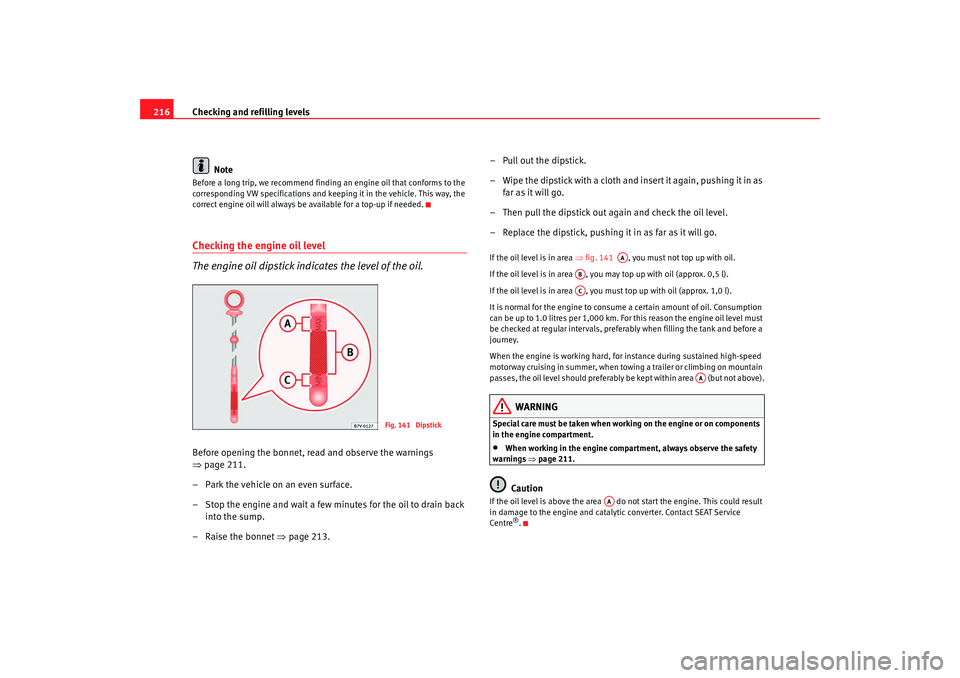
The engine oil dipstick indicates the level of the oil.Before opening the bonnet, read and observe the warnings
⇒page 211.
– Park the vehicle on an even surface.
– Stop the engine and wait a few minutes for the oil to drain back into the sump.
–Raise the bonnet ⇒ page 213. – Pull out the dipstick.
– Wipe the dipstick with a cloth and insert it again, pushing it in as
far as it will go.
– Then pull the dipstick out again and check the oil level.
– Replace the dipstick, pushing it in as far as it will go.
If the oil level is in area ⇒fig. 141 , you must not top up with oil.
If the oil level is in area , you may top up with oil (approx. 0,5 l).
If the oil level is in area , you must top up with oil (approx. 1,0 l).
It is normal for the engine to consume a certain amount of oil. Consumption
can be up to 1.0 litres per 1,000 km. For this reason the engine oil level must
be checked at regular intervals, preferably when filling the tank and before a
journey.
When the engine is working hard, for instance during sustained high-speed
motorway cruising in summer, when towing a trailer or climbing on mountain
passes, the oil level should preferably be kept within area (but not above).
WARNING
Special care must be taken when working on the engine or on components
in the engine compartment.•
When working in the engine compartment, always observe the safety
warnings ⇒page 211.Caution
If the oil level is above the area do not start the engine. This could result
in damage to the engine and catalytic converter. Contact SEAT Service
Centre
®.
Fig. 141 Dipstick
AA
ABAC
AA
AA
alhambra_aleman.book Seite 216 Montag, 23. M‰ rz 2009 1:12 13
Page 223 of 285
Checking and refilling levels221
Safety First
Operating instructions
Tips and Maintenance
Te c h n i c a l D a t a
WARNING
Any work carried out in the engine compartment or on the engine must be
carried out cautiously.•
When working in the engine compartment, always observe the safety
warnings ⇒page 211.Caution
•
Never put radiator anti-freeze or other additives into the windscreen
washer fluid.
•
Always use approved windscreen cleansing products diluted as per
instructions. If you use other washer fluids or soap solutions, the tiny holes
in the fan-shaped nozzles could become blocked.
Changing the front windscreen wiper blades
Damaged wiper blades should be replaced immediately.
Check the condition of the wiper blades regularly. Change them as
required.
Change the windscreen wiper blades
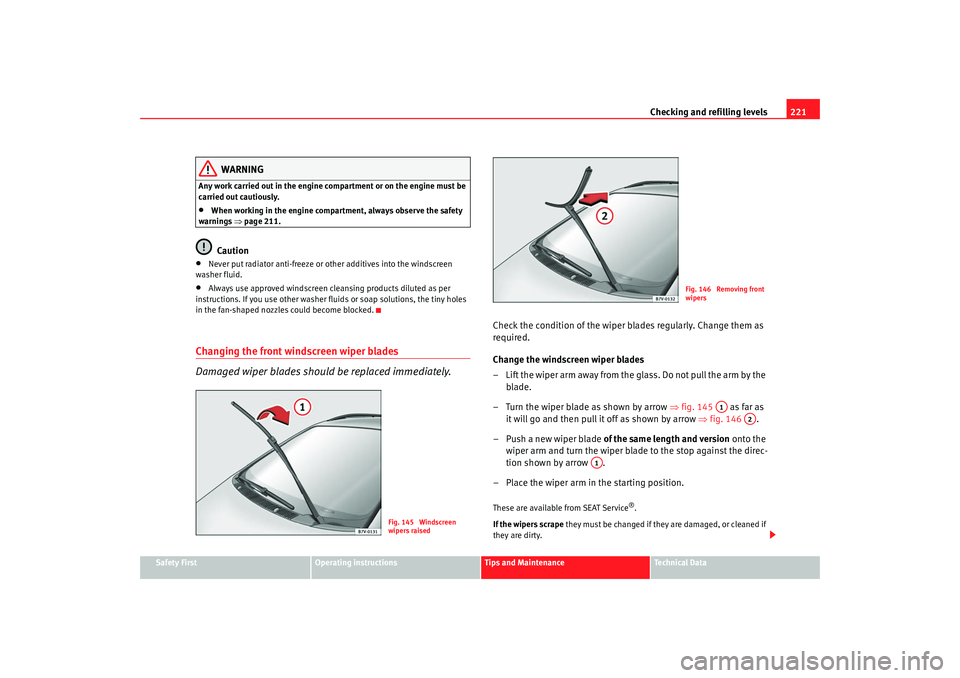
– Lift the wiper arm away from the glass. Do not pull the arm by the
blade.
– Turn the wiper blade as shown by arrow ⇒fig. 145 as far as
it will go and then pull it off as shown by arrow ⇒fig. 146 .
– Push a new wiper blade of the same length and version onto the
wiper arm and turn the wiper blade to the stop against the direc-
tion shown by arrow .
– Place the wiper arm in the starting position.These are available from SEAT Service
®.
If the wipers scrape they must be changed if they are damaged, or cleaned if
they are dirty.
Fig. 145 Windscreen
wipers raised
Fig. 146 Removing front
wipers
A1
A2
A1
alhambra_aleman.book Seite 221 Montag, 23. M‰ rz 2009 1:12 13
Page 240 of 285

If and when
238
WARNING
•
Do not allow the sealant to get onto your skin or into your eyes. Risk of
injury.
•
Keep children away from the sealant.
Changing a wheel Preparation
You must park the vehicle correctly before changing a tyre.– If you have a flat tyre or puncture, park the car as far away from the flow of traffic as possible on a flat surface.
– Switch off the engine. Switch on the hazard warning lights.
– Apply the handbrake firmly and engage a gear or put the selector in the P position.
– Chock the wheel opposite the wheel being changed with a stone or similar object.
– If you are towing a trailer, unhitch it from your vehicle.
– Remove the spare wheel and the vehicle tools from the luggage compartment.
– All passengers should leave the car. They should wait in a safe place (for instance behind the safety barrier).
WARNING
•
If you have a puncture, stop the car well away from moving traffic.
Switch on the hazard warning lights and set the emergency triangle in
position. Please observe legal requirements when doing so.
•
All passengers should leave the car.
•
Apply the handbrake firmly and engage a gear or put the gear selector
in the P position. Chock the wheel opposite the wheel being changed with
a stone or similar object.
•
If you are towing a trailer, unhitch it from your vehicle.
•
Only use jacks which have been approved for your vehicle by SEAT.
•
Never use other jacks, even if they have been approved for use on other
SEAT models. The jack could slip. Risk of injury.
•
Never start the engine when the vehicle is raised. This may cause an
accident.
•
Never place your body (e.g. arm or leg) underneath the vehicle if it is
only supported by the jack Risk of injury.
•
If you have to work underneath the vehicle, you must use suitable
stands additionally to support the vehicle - Risk of accident!.
alhambra_aleman.book Seite 238 Montag, 23. M‰ rz 2009 1:12 13