tow Seat Alhambra 2009 Workshop Manual
[x] Cancel search | Manufacturer: SEAT, Model Year: 2009, Model line: Alhambra, Model: Seat Alhambra 2009Pages: 285, PDF Size: 7.62 MB
Page 183 of 285
Intelligent technology181
Safety First
Operating instructions
Tips and Maintenance
Te c h n i c a l D a t a
Tips and MaintenanceIntelligent technologyBrakesBrake servoThe brake servo supplements the pressure you exert on the brake pedal. It
works only when the engine is running .
If the brake servo does not operate, for example, when the vehicle is being
towed or due to a fault in the system, the brake pedal must be depressed
harder.
WARNING
The braking distance can also be affected by external factors.•
Never let the vehicle coast with the engine switched off. Failure to do so
could result in an accident. The braking distance is increased considerably
as the brake servo does not function.
•
If the brake servo is out of action, for example if the car is being towed,
you will have to press the brake pedal considerably harder than normal.
Brake pads wear display
If this light comes on, check the brake pads immediately.
At the same time, a text message or the necessary operations may appear on
the instrument panel.
WARNING
If the warning lamp lights up
or the corresponding message appears on
the instrument panel, immediately have the brake pads checked and
replaced, if necessary, at a specialised workshop.
Brake warning lamp
If the warning lamp comes on, this may be caused by the
following reasons:•
With the handbrake on the warning light comes on
on the instrument
panel. If you are travelling at over 6 km/h with the hand brake on, a text
message or the required operations may appear on the instrument panel. In
addition a warning signal is heard.
•
In the event of insufficient brake fluid the warning lamp lights up
on
the instrument panel. At the same time, a text message or the necessary oper-
ations may appear on the instrument panel. Stop the vehicle immediately
and check the level of the brake fluid ⇒page 223.
•
In the event of a fault in the brake system the warning lamp lights up
on the instrument panel and three buzzes are emitted. At the same time, a
text message or the necessary operations may appear on the instrument
panel. Stop the vehicle and do not drive on. You should obtain professional
assistance. This warning lamp
can light up together with the anti-locking
brake system warning lamp
⇒ .
alhambra_aleman.book Seite 181 Montag, 23. M‰ rz 2009 1:12 13
Page 187 of 285
Intelligent technology185
Safety First
Operating instructions
Tips and Maintenance
Te c h n i c a l D a t a
•
when driving in deep snow or on loose surfaces,
•
when rocking the vehicle backwards and forwards to free it from mud, for
example.
You should press the button to switch the ESP back on when you no longer
need wheel spin.
When the ESP is deactivated, the TCS is switched off at the same time. This
means that this technology is not available for as long as the ESP remains
switched off.
How ESP works
ESP reduces the danger of skidding by braking the wheels individually. The
system uses the steering wheel angle and road speed to calculate the
changes of direction desired by the driver, and constantly compares them
with the actual behaviour of the car. If the desired course is not being main-
tained accurately (for instance if the car is beginning to skid) the ESP compen-
sates automatically by applying the brake at the appropriate wheel.
The forces acting on the braked wheel bring the car back to a stable condi-
tion. If the car is tending to oversteer (break away at the rear) the brake appli-
cation is concentrated on the outside front wheel; if the car is understeering
(tending to follow a wider radius in a bend), the brake is mainly applied to the
inside rear wheel.
How the Traction Control System (TCS) works
TCS reduces engine power to help prevent the driven wheels of front-wheel
drive vehicles losing traction during acceleration. The system works in the
entire speed range in conjunction with ABS. If a malfunction should occur in
the ABS, the TCS will also be out of action. TCS helps the car to start moving,
accelerate and climb a gradient in slippery conditions where this may other-
wise be difficult or even impossible.
When does the warning lamp light up or flash
?
•
The warning lamp
lights up when the ignition is switched on and
should go out again after a few seconds.
•
The warning lamp
will start flashing to indicate that the ESP and TCS
are counteracting an unstable driving condition.
•
It will light up continuously if there is a malfunction in the ESP.
•
It will light up continuously if the ESP is switched off.
•
It will also come on if a fault should occur in the ABS because the ESP
operates in conjunction with the ABS.
If the warning lamp
lights up and stays on after the engine is started, this
may mean that the control system has temporarily switched off the function.
In this case the ESP can be reactivated by switching the ignition off and then
on again. If the warning lamp goes out, this means the system is fully func-
tional
If the battery is disconnected, the warning lamp
lights after turning the
ignition on. This should turn off after a brief trip.
WARNING
Try to always adapt the speed of the vehicle to weather, road and traffic
conditions. Do not let the extra safety afforded by the system tempt you
into taking any risks when driving. Risk of accident.•
The ESP and TCS cannot defy the laws of motion. This should be kept in
mind, particularly on slippery and wet roads and when towing a trailer.
•
Always adapt your driving style to suit the condition of the roads and
the traffic situation.
•
The ESP cannot reduce the risk of accident if, for example, you are
driving with an unsuitable load or too close to the preceding vehicle.WARNING
•
Modifications to the vehicle or work carried out incorrectly (e.g. to the
engine, the brake system, running gear or any components affecting the
wheels and tyres) could affect the efficiency of the ABS, EDL, ESP and TCS
and lessen their efficiency.
alhambra_aleman.book Seite 185 Montag, 23. M‰ rz 2009 1:12 13
Page 189 of 285
Driving and the environment187
Safety First
Operating instructions
Tips and Maintenance
Te c h n i c a l D a t a
Driving and the environmentRunning-inRunning in a new engine
The engine needs to be run-in over the first 1,500 km.Up to 1,000 kilometres
– Do not drive at speeds of more than 2/3 the maximum speed.
– Do not use full throttle.
– Avoid high engine revolutions.
– Do not tow a trailer.
From 1000 to 1500 km
– Speeds can be gradually increased to the maximum road speed
or maximum permissible engine speed (rpm).During its first few hours of running, the internal friction in the engine is
greater than later on when all the moving parts have bedded down.
For the sake of the environment
If the engine is run in gently, the life of the engine will be increased and its oil
consumption reduced.
Running in tyres and brake pads
New tyres should be run-in carefully for the first 500 km. New
brake pads should be run-in carefully for the first 200 km.During the first 200 km, you can compensate for the reduced braking effect
by applying more pressure to the brake pedal. If you need to make an emer-
gency stop, the braking distance will be longer with new brake pads than with
brake pads which have been run-in.
WARNING
•
New tyres do not give maximum grip to start with, and need running in.
This may cause an accident. Drive particularly carefully in the first 500 km.
•
New brake pads must be “run in” an d do not have the correct friction
properties during the first 200 km. However, you can compensate for the
slightly reduced braking effect by applying more pressure on the brake
pedal.
Braking effect and braking distance
The braking effect and braking distance are influenced by
driving situations and road conditions.The efficiency of the brakes depends directly on the brake pad wear. The rate
of wear of the brake pads depends to a great extent on the conditions under
which the vehicle is operated and the way the vehicle is driven. If you often
drive in town traffic, drive short distances or have a sporty driving style, we
recommend that you have the thickness of your brake pads checked by SEAT
Service more frequently than recommended in the service schedule.
alhambra_aleman.book Seite 187 Montag, 23. M‰ rz 2009 1:12 13
Page 190 of 285
Driving and the environment
188If you drive with wet brakes, for example, after crossing areas of water, in
heavy rainfall or even after washing the car, the effect of the brakes is less-
ened as the brake discs are wet or even frozen (in winter): in this case, “dry”
the brakes by applying the brakes carefully several times
WARNING
Longer braking distances and faults in the brake system increase the risk
of accidents.•
New brake pads must be run in and do not have the correct friction
during the first 200 km. The slightly reduced braking effect can be compen-
sated for by increasing pressure on the brake pedal. This also applies when
new brake pads are fitted.
•
If brakes are wet or frozen, or if you are driving on roads which have
been gritted with salt, braking power may set in later than normal.
•
When driving downhill, the brakes work hard and get hot very quickly.
Before driving down a long steep gradient, it is advisable to reduce speed
and change to a lower gear (or move the selector lever to a lower gear if
your vehicle has automatic transmission). In this way you will make use of
the engine braking effect and relieve the load on the brakes.
•
Never let the brakes “rub” by only applying light pressure. Continuous
braking will cause the brakes to overheat and will increase the braking
distance. Apply and then release the brakes alternately.
•
Never let the vehicle coast with the engine switched off. The braking
distance is increased considerably as the brake servo does not work.
•
Very heavy use of the brakes may cause a vapour lock if the brake fluid
is left in the system for too long. This impairs the braking effect.
•
Non-standard or damaged front spoilers could restrict the airflow to the
brakes and cause them to overheat. Observe the notes ⇒page 204 before
buying accessories.
•
If a brake circuit fails, the braking distance will be increased consider-
ably. Contact a qualified workshop immediately and avoid unnecessary
journeys.
Exhaust gas emission control systemCatalytic converter*To conserve the useful life of the catalytic converter
– Always use unleaded petrol.
– Do not run the fuel tank dry.
– For engine oil changes, do not replenish with too much engine oil ⇒page 217, “Topping up engine oil ”.
– Never tow the vehicle to start it, use jump leads if necessary ⇒page 250.If you notice misfiring, uneven running or loss of power when the vehicle is
moving, reduce speed immediately and have the vehicle inspected at the
nearest qualified workshop. These symptoms are communicated by the
exhaust gas warning lamp ⇒page 72. If this happens, unburnt fuel can enter
the exhaust system and escape into the environment. The catalytic converter
can also be damaged by overheating.
WARNING
The catalytic converter reaches very high temperatures! Fire hazard!•
Never park where the catalytic converter could come into contact with
dry grass or inflammable materials under the vehicle.
•
Do not apply additional underseal or anti-corrosion coatings to the
exhaust pipes, catalytic converter or the heat shields on the exhaust
system, because the heat from the engine could ignite them.
alhambra_aleman.book Seite 188 Montag, 23. M‰ rz 2009 1:12 13
Page 194 of 285

Driving and the environment
192Trailer towingWhat do you need to bear in mind when towing a trailer?The vehicle can, if suitably equipped, be used to tow a trailer or caravan.
If the car is supplied with a factory-fitted towing bracket it will already have
the necessary technical modifications and meet the statutory requirements
for towing a trailer. If you wish to retrofit a towing bracket ⇒page 206.
Connectors
Your vehicle is fitted with a 12-pin connector for the electrical connection
between the trailer and the vehicle.
If the trailer has a 7-pin plug, you will need to use an adapter cable. This is
available from SEAT Service.
Trailer weight / draw bar loading
Never exceed the maximum permitted trailer weights. If you do not load the
trailer up to the maximum permitted trailer weight, you can then climb corre-
spondingly steeper gradients.
The maximum trailer weights listed are only applicable for altitudes up to
1,000 m above sea level. With increasing altitude the engine power and
therefore the vehicle's climbing ability are impaired because of the reduced
air density. The maximum trailer weight has to be reduced accordingly. The
weight of the vehicle and trailer combination must be reduced by 10% for
every further 1,000 m (or part thereof). Where possible, operate the trailer
with the maximum permitted draw bar weight on the ball joint of the towing
bracket, but do not exceed the specified limit.
The figures for trailer weights and draw bar weights given on the data plate
of the towing bracket are for certification purposes only. The correct figures
for your specific model, which may be lower than these figures for the towing
bracket, are given in the registration documents and “Technical data”. Gross combination weight
The gross combination weight is the actual weight of the laden vehicle plus
the actual weight of the laden trailer. If the maximum permissible trailer
weight is to be utilized, the weight of the vehicle may have to be reduced.
Distributing the load
Distribute loads in the trailer so that heavy objects are as near to the axle as
possible. Loads carried in the trailer must be secured to prevent them
moving.
Tyre pressu re
Set tyre pressure to the maximum permitted pressure shown on the sticker on
the inside of the tank flap. Set the tyre pressure of the trailer tyres in accord-
ance with the trailer manufacturer's recommendations.
Exterior mirrors
Check whether you can see enough of the road behind the trailer with the
standard mirrors. If this is not the case you should have additional mirrors
fitted. Both exterior mirrors should be mounted on hinged extension
brackets. Adjust the mirrors to give sufficient vision to the rear.
Headlight adjustment
If towing a trailer the dipped light may dazzle other drivers. Use the headlight
range control to lower the cone of light. If you do not have headlight range
control, have the headlights adjusted by a qualified dealership.
WARNING
•
Never transport people in a trailer. This could result in fatal accidents.
•
To avoid dazzling other drivers, adjust the dipped beam according to
the load. If not, an accident may occur.
alhambra_aleman.book Seite 192 Montag, 23. M‰ rz 2009 1:12 13
Page 195 of 285
Driving and the environment193
Safety First
Operating instructions
Tips and Maintenance
Te c h n i c a l D a t a
Note
•
Towing a trailer places additional demands on the vehicle. We recom-
mend additional services between the normal inspection intervals if the
vehicle is used frequently for towing a trailer.
•
Find out whether special regulations apply to towing a trailer in your
country.
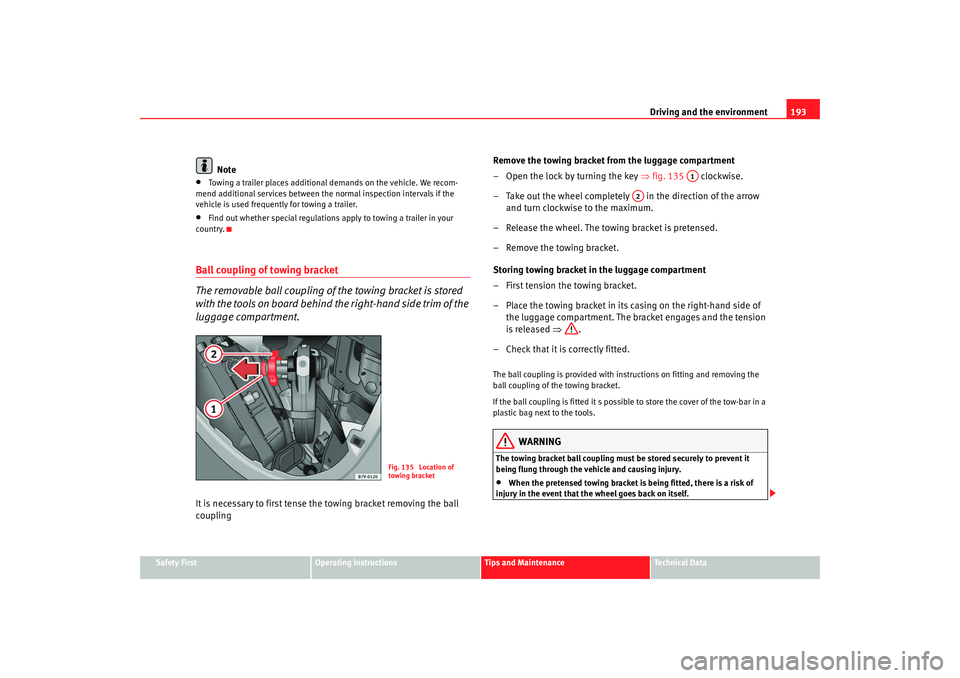
Ball coupling of towing bracket
The removable ball coupling of the towing bracket is stored
with the tools on board behind the right-hand side trim of the
luggage compartment.It is necessary to first tense the towing bracket removing the ball
coupling Remove the towing bracket from the luggage compartment
– Open the lock by turning the key
⇒fig. 135 clockwise.
– Take out the wheel completely in the direction of the arrow and turn clockwise to the maximum.
– Release the wheel. The towing bracket is pretensed.
– Remove the towing bracket.
Storing towing bracket in the luggage compartment
– First tension the towing bracket.
– Place the towing bracket in its casing on the right-hand side of the luggage compartment. The bracket engages and the tension
is released ⇒ .
– Check that it is correctly fitted.
The ball coupling is provided with instructions on fitting and removing the
ball coupling of the towing bracket.
If the ball coupling is fitted it s possible to store the cover of the tow-bar in a
plastic bag next to the tools.
WARNING
The towing bracket ball coupling must be stored securely to prevent it
being flung through the vehicle and causing injury.•
When the pretensed towing bracket is being fitted, there is a risk of
injury in the event that the wheel goes back on itself.
Fig. 135 Location of
towing bracket
A1
A2
alhambra_aleman.book Seite 193 Montag, 23. M‰ rz 2009 1:12 13
Page 196 of 285
Driving and the environment
194
NoteBy law, the ball coupling must be removed if a trailer is not being towed and
it obscures the number plate.•
When placing the towing bracket in the casing check that it is no longer
tensed and securely fastened.
Driving tips
Driving with a trailer always requires extra care.Weight distribution
The weight distribution of a loaded trailer with an unladen vehicle is very
unfavourable. However, if this cannot be avoided, drive extra slowly to allow
for the unbalanced weight distribution.
Speed
The stability of the car and trailer is reduced with increasing speed. For this
reason it is advisable not to drive at the maximum permissible top speed in
unfavourable road, weather or wind conditions. This applies especially when
driving downhill.
You should always reduce speed immediately if the trailer shows the slightest
sign of snaking . Never try to stop the “snaking” by increasing speed.
Always brake in good time. If the trailer has an overrun brake, apply the
brakes gently at first and then firmly. This will prevent the jerking that can be
caused by the trailer wheels locking. Select a low gear (in both manual and
automatic gearboxes) in good time before going down a steep hill. This
enables you to use the engine braking effect to slow down the vehicle. Overheating
At very high temperatures and during prolonged ascents, driving in a low gear
and high engine speed, always monitor the temperature indicator for the
coolant.
Electronic Stabilisation Program
Do not switch off the ESP when towing a trailer. The ESP makes it easier to
stabilise if the trailer starts to snake.
alhambra_aleman.book Seite 194 Montag, 23. M‰
rz 2009 1:12 13
Page 205 of 285
Cleaning and caring for your vehicle203
Safety First
Operating instructions
Tips and Maintenance
Te c h n i c a l D a t a
•
Check the condition of all seat belts at regular intervals. If you notice
that the belt webbing, fittings, retractor mechanism or buckle of any of the
belts is damaged, the belt must be replaced by a specialist workshop.
•
Do not attempt to repair a damaged seat belt yourself. The seat belts
must not be removed or modified in any way.Caution
After cleaning, allow seat belts to dry completely before rolling them up.
Otherwise the belt retractors could become damaged.Cleaning the cool/thermos box – Before using the insulated box for the first time, you should clean
it, using a household detergent.
– Always clean the inside of the insulated box when it is soiled.If you do not plan to use the insulated box for a long period, disconnect the
power supply and clean the inside and outside of the box. Place a folded
towel between the box and its lid. This prevents mould and damp stains
forming in the cooling and heating box.
WARNING (continued)
alhambra_aleman.book Seite 203 Montag, 23. M‰ rz 2009 1:12 13
Page 208 of 285
Accessories, parts replacement and modifications
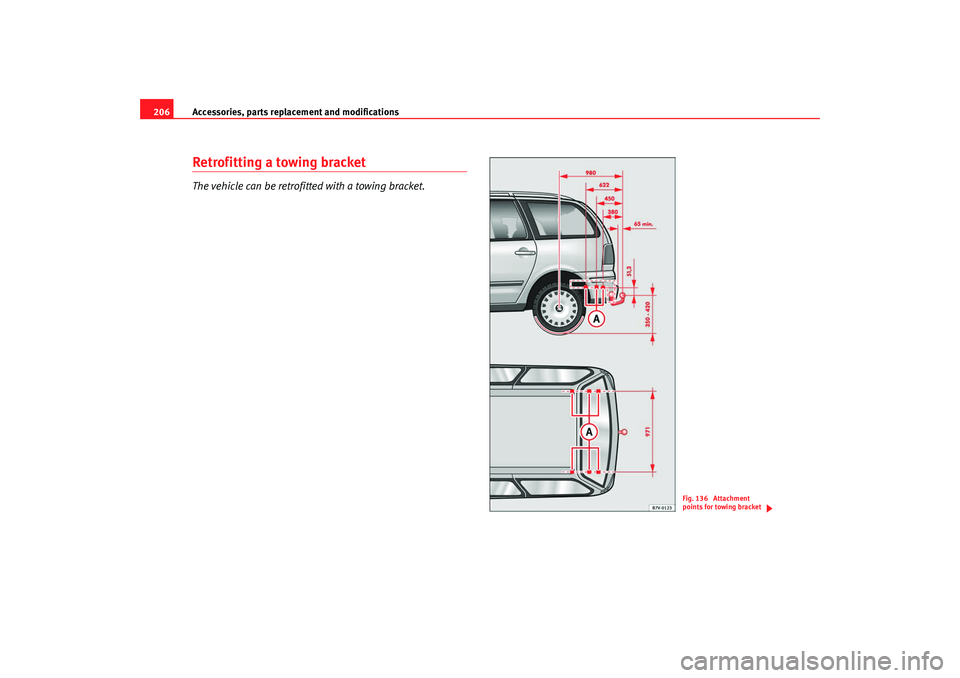
206Retrofitting a towing bracketThe vehicle can be retrofitted with a towing bracket.
Fig. 136 Attachment
points for towing bracket
alhambra_aleman.book Seite 206 Montag, 23. M‰ rz 2009 1:12 13
Page 209 of 285
Accessories, parts replacement and modifications207
Safety First
Operating instructions
Tips and Maintenance
Te c h n i c a l D a t a
If a towing bracket is to be retro-fitted to the car, it must be done according to
the instructions of the towing bracket manufacturer.
The attachment points for the towing bracket ⇒
page 206, fig. 136 are
underneath the vehicle.
Always observe the minimum distance from the middle of the ball coupling to
the ground (350 to 420 mm). This also applies when the vehicle is fully laden,
including maximum drawbar load.
Fitting a towing bracket
•
Driving with a trailer implies additional work for the vehicle. Therefore,
before fitting a towing bracket, please contact an Authorised Service Centre
to check whether your cooling system needs modification.
•
Observe the legal requirements in your country (e.g. the fitting of a sepa-
rate pilot lamp).
•
Certain vehicle components, e.g. the rear bumper must be removed and
reinstalled. The towing bracket securing bolts have to be tightened using a
torque wrench, and a socket connected to the vehicle's electrical system. This
requires specialist knowledge and tools.
•
The figures in the illustration show the dimensions and attachment points
which must be observed if you are retrofitting a towing bracket.
WARNING
If a towing bracket is retrofitted, it should be done by a qualified dealer.•
If the towing bracket is incorrectly fitted, this could cause a safety risk.
•
For your own safety, please observe the instructions provided by the
manufacturer of the towing bracket.Caution
If the connector socket is not fitted correctly, this could cause damage to the
vehicle's electrical system.
AA
alhambra_aleman.book Seite 207 Montag, 23. M‰ rz 2009 1:12 13