air conditioning Seat Alhambra 2009 Owner's Manual
[x] Cancel search | Manufacturer: SEAT, Model Year: 2009, Model line: Alhambra, Model: Seat Alhambra 2009Pages: 285, PDF Size: 7.62 MB
Page 5 of 285
Contents3
ContentsThe structure of this manual
. . . . .
Content
. . . . . . . . . . . . . . . . . . . . . . . . . . . . . . . .
Safety First
. . . . . . . . . . . . . . . . . . . . . . . . . . .
Safe Driving
. . . . . . . . . . . . . . . . . . . . . . . . . . . . . .
Brief introduction . . . . . . . . . . . . . . . . . . . . . . . .
Proper sitting position for occupants . . . . . . . . .
Pedal area . . . . . . . . . . . . . . . . . . . . . . . . . . . . . .
Stowing luggage . . . . . . . . . . . . . . . . . . . . . . . . .
Seat belts
. . . . . . . . . . . . . . . . . . . . . . . . . . . . . . . .
Introduction . . . . . . . . . . . . . . . . . . . . . . . . . . . . .
Why wear seat belts? . . . . . . . . . . . . . . . . . . . . . .
Seat belts . . . . . . . . . . . . . . . . . . . . . . . . . . . . . . .
Belt tension devices . . . . . . . . . . . . . . . . . . . . . .
Airbag system
. . . . . . . . . . . . . . . . . . . . . . . . . . . .
Brief introduction . . . . . . . . . . . . . . . . . . . . . . . .
Front airbags . . . . . . . . . . . . . . . . . . . . . . . . . . . .
Side airbags . . . . . . . . . . . . . . . . . . . . . . . . . . . . .
Curtain airbags . . . . . . . . . . . . . . . . . . . . . . . . . .
Deactivating airbags* . . . . . . . . . . . . . . . . . . . . .
Child safety
. . . . . . . . . . . . . . . . . . . . . . . . . . . . . .
Brief introduction . . . . . . . . . . . . . . . . . . . . . . . .
Child seats . . . . . . . . . . . . . . . . . . . . . . . . . . . . . .
Installation of child seats in vehicle seats . . . . .
Integrated child seat . . . . . . . . . . . . . . . . . . . . . .
Operating instructions
. . . . . . . . . . . .
Overview
. . . . . . . . . . . . . . . . . . . . . . . . . . . . . . . . .
Overview of the instrument panel . . . . . . . . . . .
Instruments . . . . . . . . . . . . . . . . . . . . . . . . . . . . .
Display in the instrument panel . . . . . . . . . . . . .
Warning lamps . . . . . . . . . . . . . . . . . . . . . . . . . . .
On board computer with multifunction display .
Steering wheel controls . . . . . . . . . . . . . . . . . . .
Telephone* . . . . . . . . . . . . . . . . . . . . . . . . . . . . .
Unlocking and locking
. . . . . . . . . . . . . . . . . . . .
Keys . . . . . . . . . . . . . . . . . . . . . . . . . . . . . . . . . . .
Central locking . . . . . . . . . . . . . . . . . . . . . . . . . . .
Key with remote control . . . . . . . . . . . . . . . . . . .
Anti-theft alarm system . . . . . . . . . . . . . . . . . . . .
Tailgate . . . . . . . . . . . . . . . . . . . . . . . . . . . . . . . . .
Windows . . . . . . . . . . . . . . . . . . . . . . . . . . . . . . .
Sliding/tilting sun roof . . . . . . . . . . . . . . . . . . . .
Lights and visibility
. . . . . . . . . . . . . . . . . . . . . . .
Lights . . . . . . . . . . . . . . . . . . . . . . . . . . . . . . . . . .
Visibility . . . . . . . . . . . . . . . . . . . . . . . . . . . . . . . .
Windscreen washers . . . . . . . . . . . . . . . . . . . . . .
Mirrors . . . . . . . . . . . . . . . . . . . . . . . . . . . . . . . . .
Seats and stowage
. . . . . . . . . . . . . . . . . . . . . . .
The importance of correct seat adjustment . . . .
Head restraints . . . . . . . . . . . . . . . . . . . . . . . . . .
Front seats . . . . . . . . . . . . . . . . . . . . . . . . . . . . . .
Rear seats . . . . . . . . . . . . . . . . . . . . . . . . . . . . . .
Stowage compartments . . . . . . . . . . . . . . . . . . .
Ashtrays, cigarette lighter and electrical sockets
AUX-IN Input . . . . . . . . . . . . . . . . . . . . . . . . . . . . .
Hazard warning triangles and first aid kit . . . . .
Luggage compartment . . . . . . . . . . . . . . . . . . . . Roof carrier . . . . . . . . . . . . . . . . . . . . . . . . . . . . . .
Cooling and heating box* . . . . . . . . . . . . . . . . . .
Heating, Ventilation and Air conditioning
. .
Climatronic . . . . . . . . . . . . . . . . . . . . . . . . . . . . . .
Driving
. . . . . . . . . . . . . . . . . . . . . . . . . . . . . . . . . . .
Address . . . . . . . . . . . . . . . . . . . . . . . . . . . . . . . .
Safety . . . . . . . . . . . . . . . . . . . . . . . . . . . . . . . . . .
Ignition lock . . . . . . . . . . . . . . . . . . . . . . . . . . . . .
Starting and stopping the engine . . . . . . . . . . .
Manual gearbox . . . . . . . . . . . . . . . . . . . . . . . . . .
Automatic gearbox . . . . . . . . . . . . . . . . . . . . . . .
Handbrake . . . . . . . . . . . . . . . . . . . . . . . . . . . . . .
Parking distance warning system* . . . . . . . . . . .
Cruise control system (CCS) . . . . . . . . . . . . . . . .
Tips and Maintenance
. . . . . . . . . . . . .
Intelligent technology
. . . . . . . . . . . . . . . . . . . . .
Brakes . . . . . . . . . . . . . . . . . . . . . . . . . . . . . . . . .
Driving and the environment
. . . . . . . . . . . . . .
Running-in . . . . . . . . . . . . . . . . . . . . . . . . . . . . . .
Exhaust gas emission control system . . . . . . . .
Economical and environmentally friendly driving
Driving abroad . . . . . . . . . . . . . . . . . . . . . . . . . . .
Trailer towing . . . . . . . . . . . . . . . . . . . . . . . . . . . .
Cleaning and caring for your vehicle
. . . . . . .
General notes . . . . . . . . . . . . . . . . . . . . . . . . . . .
Care of the vehicle exterior . . . . . . . . . . . . . . . . .
Care of the vehicle interior . . . . . . . . . . . . . . . . .
5
6
7
7
7
10
15
16
18
18
20
23
31
33
33
37
40
42
44
46
46
48
51
54 63
63
63
64
69
72
81
86
87
88
88
89
95
97
99
102
105
109
109
115
117
119
122
122
123
125
127
134
140
143
144
144 149
150
153
153
161
161
162
163
165
167
168
174
175
177
181
181
181
187
187
188
189
191
192
195
195
196
201
alhambra_aleman.book Seite 3 Montag, 23. M‰
rz 2009 1:12 13
Page 8 of 285
Content
6ContentThis manual is structured to give you the information you need as quickly and
clearly as possible. The contents of this Manual are grouped into relatively
short sections making up chapters (e.g. “Air conditioning”). The entire
manual is divided into five large parts which are:1. Safety FirstInformation on the vehicle equipment relating to passive safety such as seat
belts, airbags, seats, etc.2. Controls and equipmentInformation about the distribution of controls in the driver position of the
vehicle, about the seat adjustment possibilities, how to create a suitable
climate in the passenger compartment, etc.3. Tips and MaintenanceAdvice relating to driving, care and maintenance of your vehicle and certain
problems which you may solve yourself.4. Technical DataFigures, data, dimensions and measurements (for example fuel consump-
tion) of your vehicle.5. Alphabetic indexAt the end of this manual there is a detailed alphabetical index, this will help
you to rapidly find the information you require.
alhambra_aleman.book Seite 6 Montag, 23. M‰ rz 2009 1:12 13
Page 118 of 285
Lights and visibility
116Rear window heating
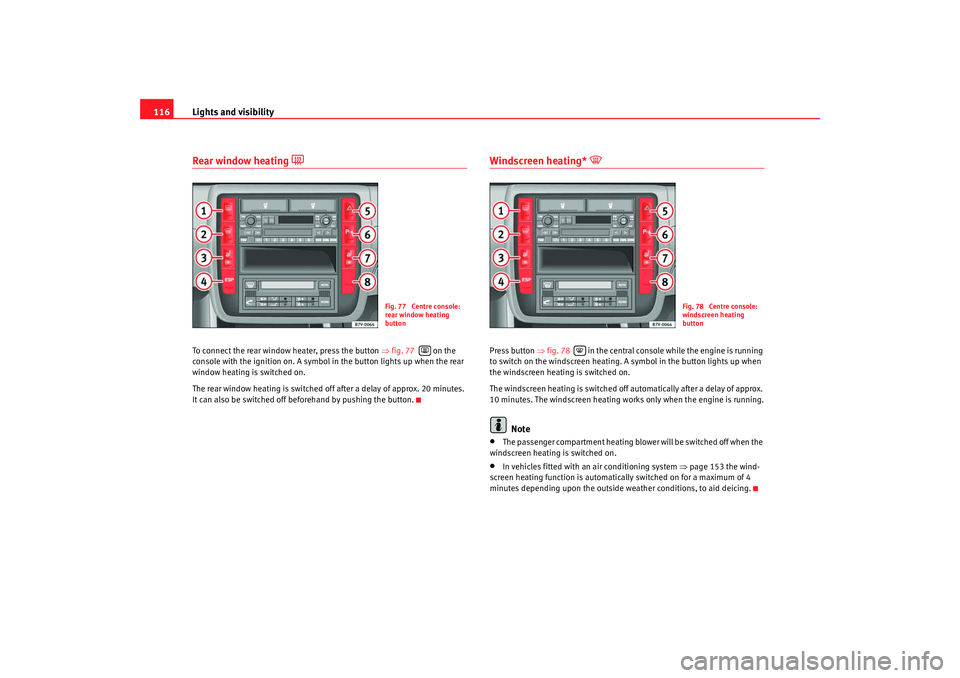
To connect the rear window heater, press the button ⇒fig. 77 on the
console with the ignition on. A symbol in the button lights up when the rear
window heating is switched on.
The rear window heating is switched off after a delay of approx. 20 minutes.
It can also be switched off beforehand by pushing the button.
Windscreen heating*
Press button ⇒fig. 78 in the central console while the engine is running
to switch on the windscreen heating. A symbol in the button lights up when
the windscreen heating is switched on.
The windscreen heating is switched off automatically after a delay of approx.
10 minutes. The windscreen heating works only when the engine is running.
Note
•
The passenger compartment heating blower will be switched off when the
windscreen heating is switched on.
•
In vehicles fitted with an air conditioning system ⇒page 153 the wind-
screen heating function is automatically switched on for a maximum of 4
minutes depending upon the outside weather conditions, to aid deicing.
Fig. 77 Centre console:
rear window heating
button
Fig. 78 Centre console:
windscreen heating
button
alhambra_aleman.book Seite 116 Montag, 23. M‰ rz 2009 1:12 13
Page 155 of 285
Heating, Ventilation and Air conditioning153
Safety First
Operating instructions
Tips and Maintenance
Te c h n i c a l D a t a
Heating, Ventilation and Air conditioningClimatronicControls
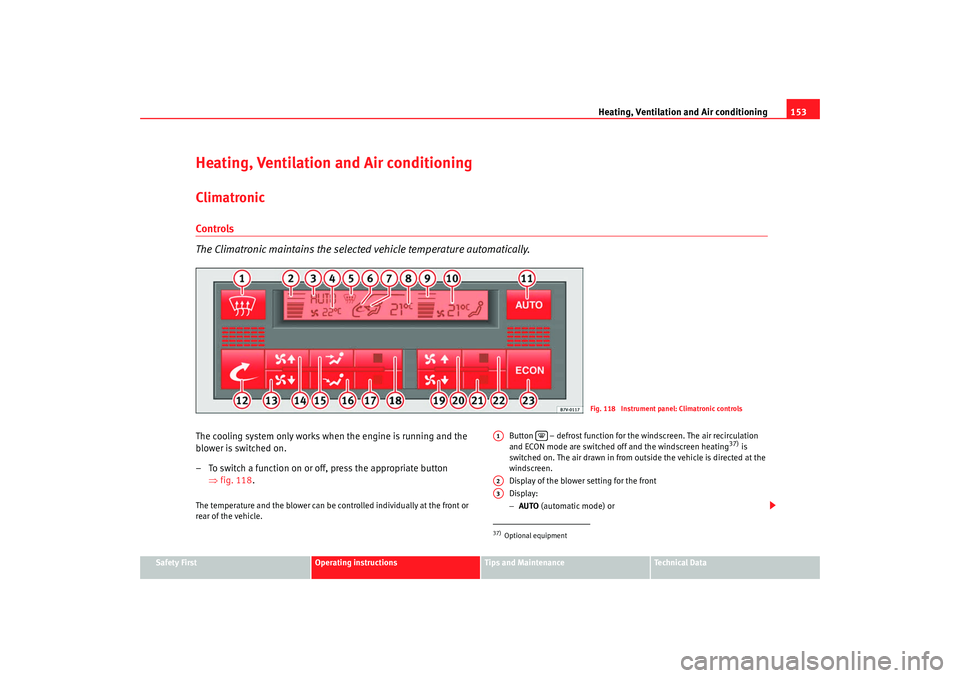
The Climatronic maintains the selected vehicle temperature automatically.The cooling system only works when the engine is running and the
blower is switched on.
– To switch a function on or off, press the appropriate button
⇒fig. 118 .The temperature and the blower can be controlled individually at the front or
rear of the vehicle. Button – defrost function for the windscreen. The air recirculation
and ECON mode are switched off and the windscreen heating
37) is
switched on. The air drawn in from outside the vehicle is directed at the
windscreen.
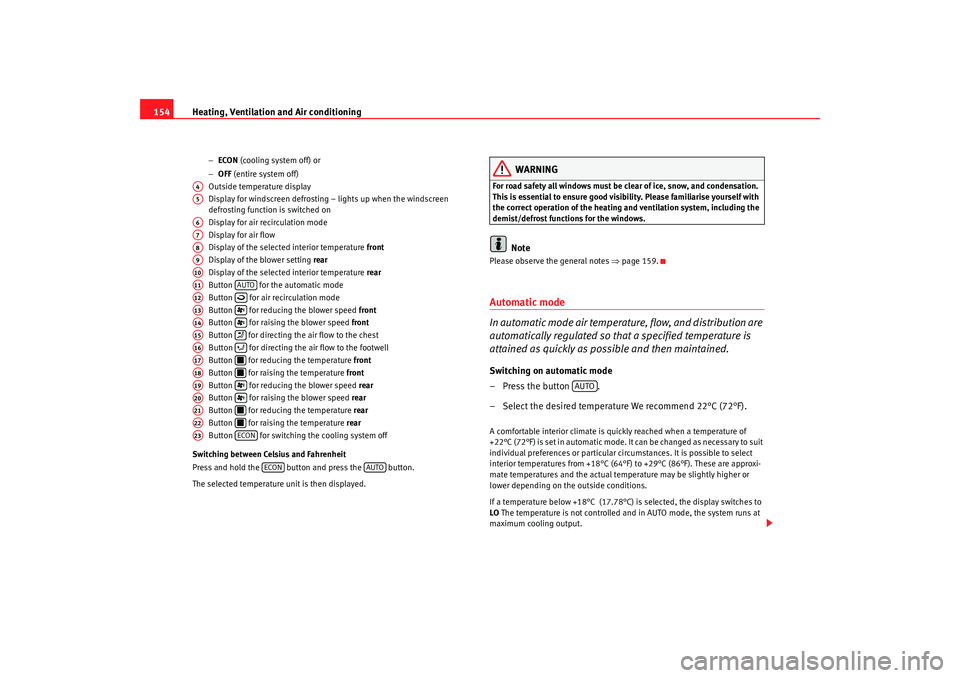
Display of the blower setting for the front
Display:
− AUTO (automatic mode) or
Fig. 118 Instrument panel: Climatronic controls
37)Optional equipmentA1
A2A3
alhambra_aleman.book Seite 153 Montag, 23. M‰ rz 2009 1:12 13
Page 156 of 285
Heating, Ventilation and Air conditioning
154
− ECON (cooling system off) or
− OFF (entire system off)
Outside temperature display
Display for windscreen defrosting – lights up when the windscreen
defrosting function is switched on
Display for air recirculation mode
Display for air flow
Display of the selected interior temperature front
Display of the blower setting rear
Display of the selected interior temperature rear
Button for the automatic mode
Button for air recirculation mode
Button for reducing the blower speed front
Button for raising the blower speed front
Button for directing the air flow to the chest
Button for directing the air flow to the footwell
Button for reducing the temperature front
Button for raising the temperature front
Button for reducing the blower speed rear
Button for raising the blower speed rear
Button for reducing the temperature rear
Button for raising the temperature rear
Button for switching the cooling system off
Switching between Celsius and Fahrenheit
Press and hold the button and press the button.
The selected temperature unit is then displayed.
WARNING
For road safety all windows must be clear of ice, snow, and condensation.
This is essential to ensure good visibility. Please familiarise yourself with
the correct operation of the heating and ventilation system, including the
demist/defrost functions for the windows.
Note
Please observe the general notes ⇒page 159.Automatic mode
In automatic mode air temperature, flow, and distribution are
automatically regulated so that a specified temperature is
attained as quickly as possible and then maintained.Switching on automatic mode
– Press the button .
– Select the desired temperature We recommend 22°C (72°F).A comfortable interior climate is quickly reached when a temperature of
+22°C (72°F) is set in automatic mode. It can be changed as necessary to suit
individual preferences or particular circumstances. It is possible to select
interior temperatures from +18°C (64°F) to +29°C (86°F). These are approxi-
mate temperatures and the actual temperature may be slightly higher or
lower depending on the outside conditions.
If a temperature below +18°C (17.78°C) is selected, the display switches to
LO The temperature is not controlled and in AUTO mode, the system runs at
maximum cooling output.
A4A5A6A7A8A9A10A11
AUTO
A12
A13
A14
A15
A16
A17
A18
A19
A20
A21
A22
A23
ECON
ECON
AUTO
AUTO
alhambra_aleman.book Seite 154 Montag, 23. M‰ rz 2009 1:12 13
Page 157 of 285
Heating, Ventilation and Air conditioning155
Safety First
Operating instructions
Tips and Maintenance
Te c h n i c a l D a t a
If a temperature above +29°C (86°F) is selected, the display switches to
HI In
this setting the system runs at maximum heating output and the temperature
is not controlled.
Climatronic maintains a constant temperature level fully automatically. This is
done by automatically adjusting the temperature of the air supplied to the
interior, the blower setting, and the air distribution. The system also allows
for the effect of strong sunlight, so there is no need for manual adjustment.
Therefore, automatic mode provides the best comfort for the vehicle occu-
pants in virtually all conditions throughout the year. Automatic mode is switched off whenever an adjustment is made using the
buttons for air distribution or blower. The temperature continues to be regu-
lated.
Note
In the automatic mode, at least one outlet in the instrument panel must be
open. The cooling system could otherwise ice over.
Manual mode
In manual mode you can adjust the air temp
erature, flow, and distribution yourself.Switching on manual mode
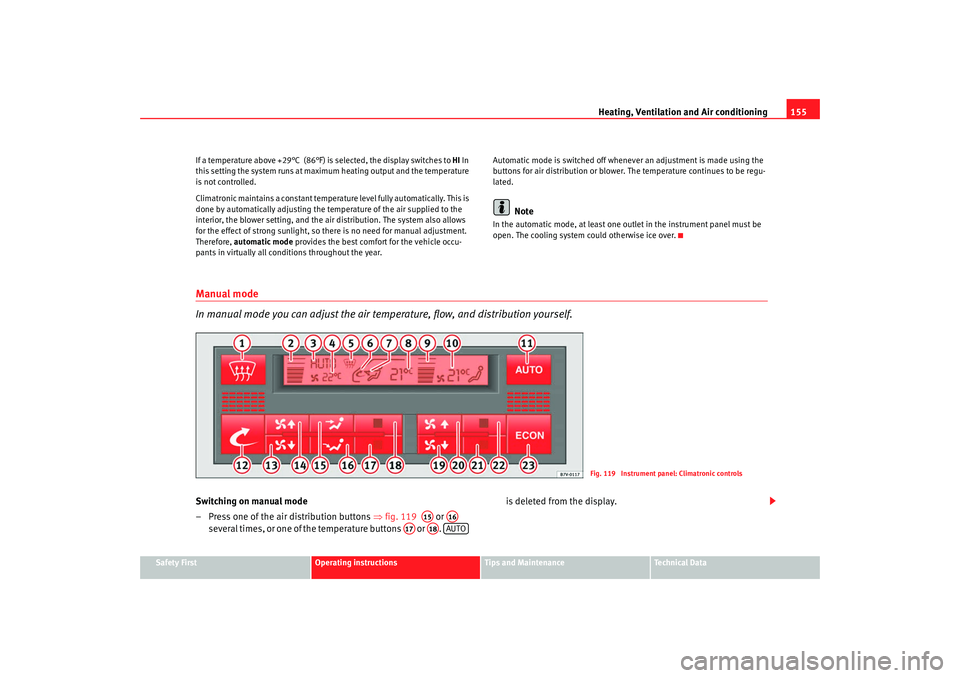
– Press one of the air distribution buttons ⇒fig. 119 or
several times, or one of the temperature buttons or . is deleted from the display.
Fig. 119 Instrument panel: Climatronic controls
A15
A16
A17
A18
AUTO
alhambra_aleman.book Seite 155 Montag, 23. M‰
rz 2009 1:12 13
Page 158 of 285
Heating, Ventilation and Air conditioning
156Te m p e r a t u r e
The selected temperature setting is shown on the display. It is possible to
select interior temperatures from +18°C (64°F) to +29°C (86°F). These are
approximate temperatures and the actual temperature may be slightly higher
or lower depending on the outside conditions.
If a temperature below +18°C (17.78°C) is selected, the display switches to
LO The temperature is not controlled and in AUTO mode, the system runs at
maximum cooling output.
If a temperature above +29°C (86°F) is selected, the display switches to HI In
this setting the system runs at maximum heating output and the temperature
is not controlled.
Blower
The blower can be adjusted gradually using the controls y . Always
have the blower running at a low setting to ensure a constant flow of fresh air
into the vehicle. If the blower is set to 0, the Climatronic is switched off.
Air distribution
The air distribution is adjusted using the buttons and . It is also
possible to open and close some of the air outlets separately.
Switching off the cooling system
Pressing the button switches off the air cooling system to save fuel.
The temperature continues to be controlled, but the air cannot be cooled. The
set temperature can then only be reached if it is higher than the outside
temperature.
Switching the Climatronic on/off
Press button until OFF is shown on display . The Climatronic is switched
off. This function should be used in certain situations only (e.g. if the system
develops a fault).
The Climatronic is switched back on by pressing button .
WARNING
When the Climatronic is off open a window to ensure an adequate supply of
fresh air in the vehicle. Otherwise, when the Climatronic is switched off, no
fresh air enters the vehicle. Stale or contaminated air inside the vehicle
may cause drowsiness, increasing the risk of accident.Air recirculation mode
Air recirculation mode prevents fumes or unpleasant smells
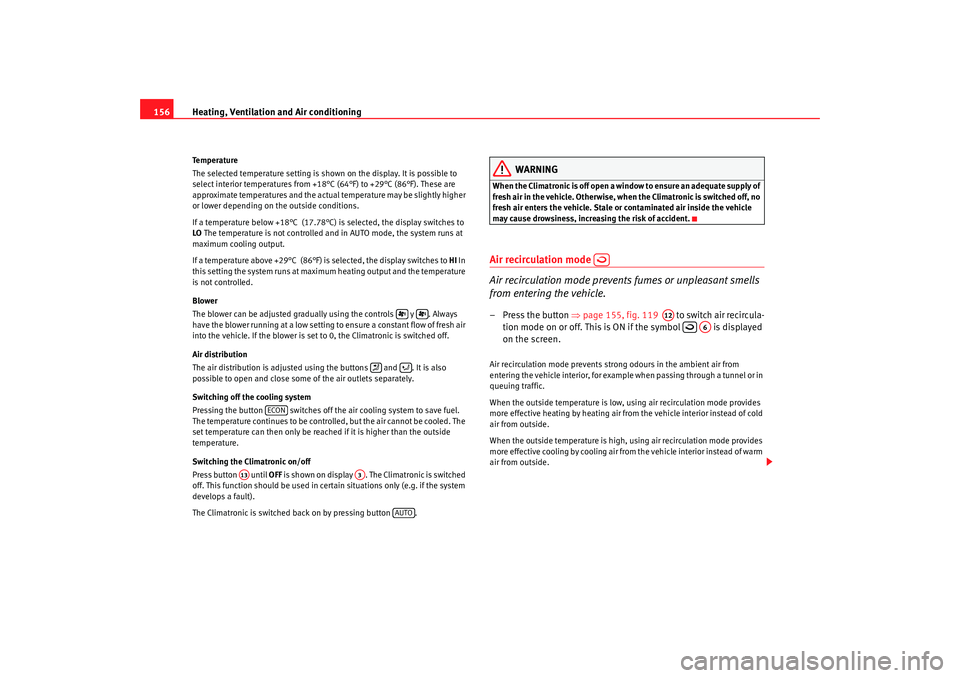
from entering the vehicle.– Press the button ⇒page 155, fig. 119 to switch air recircula-
tion mode on or off. This is ON if the symbol is displayed
on the screen.Air recirculation mode prevents strong odours in the ambient air from
entering the vehicle interior, for example when passing through a tunnel or in
queuing traffic.
When the outside temperature is low, using air recirculation mode provides
more effective heating by heating air from the vehicle interior instead of cold
air from outside.
When the outside temperature is high, using air recirculation mode provides
more effective cooling by cooling air from the vehicle interior instead of warm
air from outside.
ECON
A13
A3
AUTO
A12
A6
alhambra_aleman.book Seite 156 Montag, 23. M‰ rz 2009 1:12 13
Page 159 of 285
Heating, Ventilation and Air conditioning157
Safety First
Operating instructions
Tips and Maintenance
Te c h n i c a l D a t a
WARNING
Do not leave the air recirculation function on for long periods. In air recircu-
lation mode, no fresh air enters the vehicle interior. Also, if the cooling
system is switched off, the windows can quickly mist over. Stale or contam-
inated air inside the vehicle may cause drowsiness, increasing the risk of
accident.Climatronic for the passenger compartmentSetting the blower speed for the passenger compartment
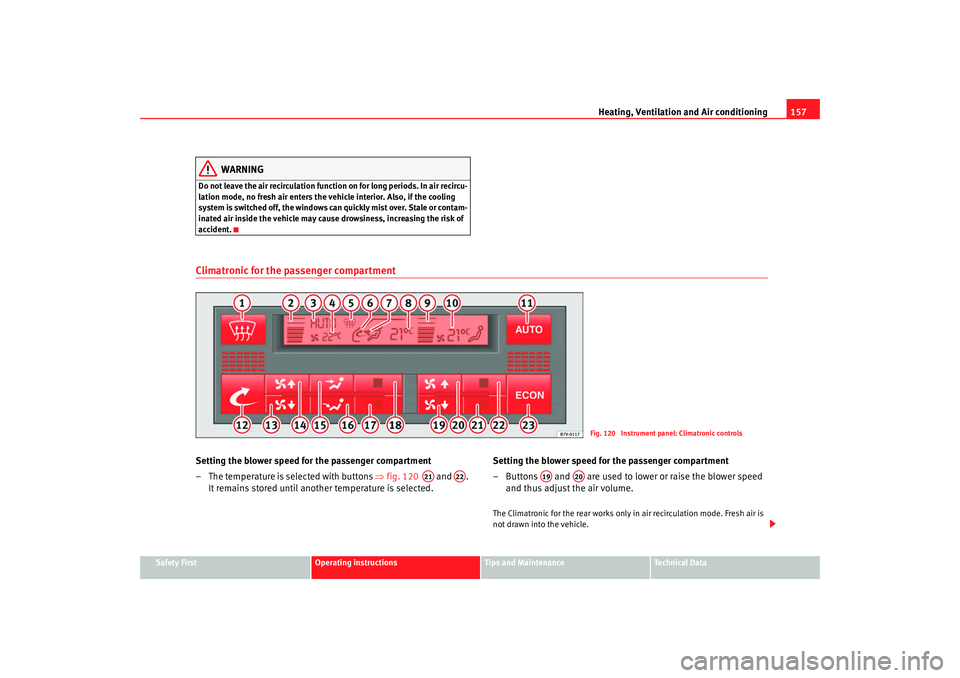
– The temperature is selected with buttons ⇒fig. 120 and .
It remains stored until another temperature is selected. Setting the blower speed for the passenger compartment
– Buttons and are used to lower or raise the blower speed
and thus adjust the air volume.
The Climatronic for the rear works only in air recirculation mode. Fresh air is
not drawn into the vehicle.
Fig. 120 Instrument panel: Climatronic controls
A21
A22
A19
A20
alhambra_aleman.book Seite 157 Montag, 23. M‰ rz 2009 1:12 13
Page 160 of 285
Heating, Ventilation and Air conditioning
158The Climatronic can be fitted either with or without an additional cooling
system
38) for the passenger compartment.
Climatronic for the passenger compartment without additional cooling
system
The temperature setting for the rear can be max. 3°C higher than the temper-
ature in the passenger compartment. A lower temperature can not be set.
If the Climatronic detects that the passenger compartment has to be heated,
it activates the additional heat exchanger. The air outlets on the floor guide
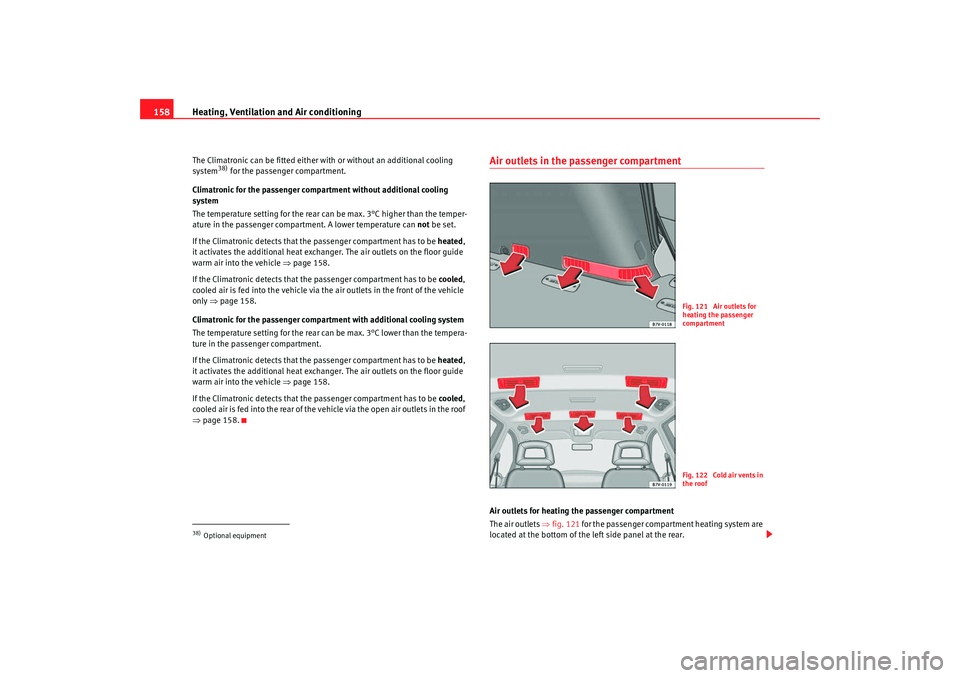
warm air into the vehicle ⇒page 158.
If the Climatronic detects that the passenger compartment has to be cooled,
cooled air is fed into the vehicle via the air outlets in the front of the vehicle
only ⇒page 158.
Climatronic for the passenger compartment with additional cooling system
The temperature setting for the rear can be max. 3°C lower than the tempera-
ture in the passenger compartment.
If the Climatronic detects that the passenger compartment has to be heated,
it activates the additional heat exchanger. The air outlets on the floor guide
warm air into the vehicle ⇒page 158.
If the Climatronic detects that the passenger compartment has to be cooled,
cooled air is fed into the rear of the vehicle via the open air outlets in the roof
⇒ page 158.
Air outlets in the passenger compartmentAir outlets for heating the passenger compartment
The air outlets ⇒ fig. 121 for the passenger compartment heating system are
located at the bottom of the left side panel at the rear.
38)Optional equipment
Fig. 121 Air outlets for
heating the passenger
compartmentFig. 122 Cold air vents in
the roof
alhambra_aleman.book Seite 158 Montag, 23. M‰ rz 2009 1:12 13
Page 161 of 285
Heating, Ventilation and Air conditioning159
Safety First
Operating instructions
Tips and Maintenance
Te c h n i c a l D a t a
Air vents in the roof
In vehicles with a second cooling system
39) for ventilating the passenger
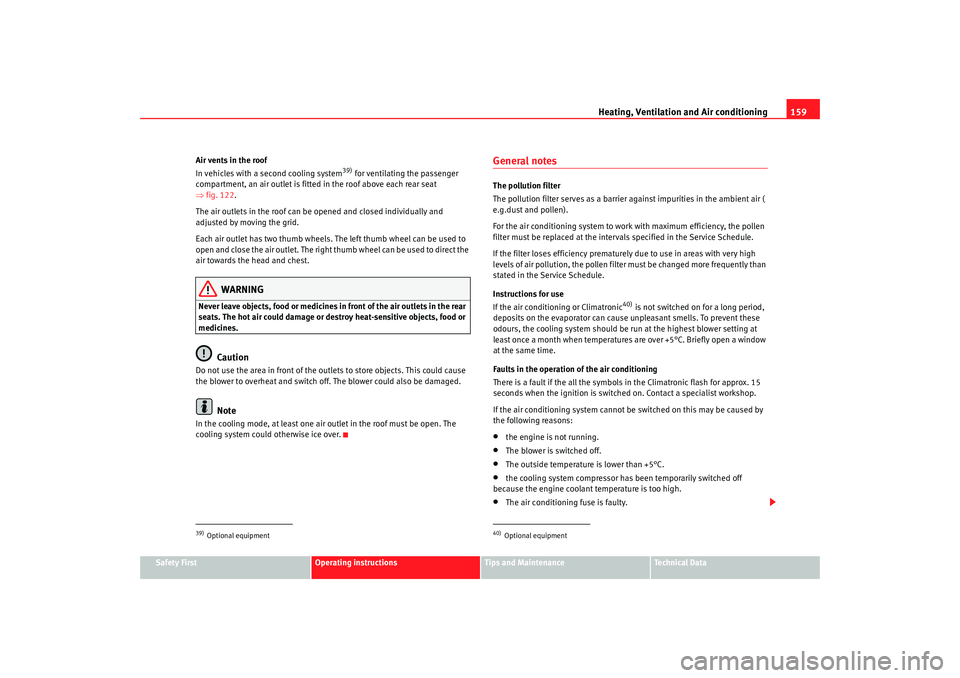
compartment, an air outlet is fitted in the roof above each rear seat
⇒ fig. 122 .
The air outlets in the roof can be opened and closed individually and
adjusted by moving the grid.
Each air outlet has two thumb wheels. The left thumb wheel can be used to
open and close the air outlet. The right thumb wheel can be used to direct the
air towards the head and chest.
WARNING
Never leave objects, food or medicines in front of the air outlets in the rear
seats. The hot air could damage or destroy heat-sensitive objects, food or
medicines.
Caution
Do not use the area in front of the outlets to store objects. This could cause
the blower to overheat and switch off. The blower could also be damaged.
Note
In the cooling mode, at least one air outlet in the roof must be open. The
cooling system could otherwise ice over.
General notesThe pollution filter
The pollution filter serves as a barrier against impurities in the ambient air (
e.g.dust and pollen).
For the air conditioning system to work with maximum efficiency, the pollen
filter must be replaced at the intervals specified in the Service Schedule.
If the filter loses efficiency prematurely due to use in areas with very high
levels of air pollution, the pollen filter must be changed more frequently than
stated in the Service Schedule.
Instructions for use
If the air conditioning or Climatronic
40) is not switched on for a long period,
deposits on the evaporator can cause unpleasant smells. To prevent these
odours, the cooling system should be run at the highest blower setting at
least once a month when temperatures are over +5°C. Briefly open a window
at the same time.
Faults in the operation of the air conditioning
There is a fault if the all the symbols in the Climatronic flash for approx. 15
seconds when the ignition is switched on. Contact a specialist workshop.
If the air conditioning system cannot be switched on this may be caused by
the following reasons:
•
the engine is not running.
•
The blower is switched off.
•
The outside temperature is lower than +5°C.
•
the cooling system compressor has been temporarily switched off
because the engine coolant temperature is too high.
•
The air conditioning fuse is faulty.
39)Optional equipment
40)Optional equipment
alhambra_aleman.book Seite 159 Montag, 23. M‰ rz 2009 1:12 13