maintenance Seat Alhambra 2010 User Guide
[x] Cancel search | Manufacturer: SEAT, Model Year: 2010, Model line: Alhambra, Model: Seat Alhambra 2010Pages: 413, PDF Size: 3.86 MB
Page 220 of 413
Driving219
Safety FirstOperating instructionsPractical tipsTe c h n i c a l D a t a
Brake fluid
In the course of time, the brake fluid absorbs water from the ambient air. If
there is too much water contained in the brake fluid, the brake system could
be damaged. In addition, the boiling point of the brake fluid is significantly
lowered. When the brake fluid contains too much water and the brakes are
subject to considerable forces, bubbles of water vapour can form in the
system. These bubbles of water vapour can significantly reduce braking
power, notably increasing braking distance, and could even result in the total
failure of the brake system. Ensuring that the brake system is always func-
tioning correctly is essential for your own safety and the safety of other road
users Ÿ.
Brake fluid specifications
SEAT have developed a special brake fluid optimised for the brake systems of
their vehicles. To ensure the optimum working of the brake system, SEAT
recommends the use of brake fluid in accordance with the VW 501 14
standard. If this brake fluid is not available or another brake fluid is used for
different reasons, use a brake fluid that complies with the United States standard FMVSS 116 DOT 4 or the German standard DIN ISO 4925 CLASS 4
Ÿ.
Brake fluids conforming to the standard VW 501 14, fulfil the American
requirements of the FMVSS 116 DOT 4 standard and the German DIN ISO
4925 CLASS 4 standard. However, fluids that comply with the American
FMVSS 116 DOT 4 standard or the German DIN ISO 4925 CLASS 4 standard do
not necessarily comply with the VW 501 14 standard. Always check the infor-
mation on the brake fluid container and ensure that you are using suitable
brake fluid.
A suitable brake fluid can be obtained from Authorised Service Centres.
Brake fluid level
The level of the brake fluid should always be between the MIN and MAX
marks, or above the MIN mark Ÿ.
It is not always possible to check the level of the brake fluid, as in some
models the engine components make it difficult to see the brake fluid reser-
voir. If you cannot read the exact brake fluid level, consult a specialist.
The brake fluid level drops slightly when the vehicle is being used due to wear
of the brake pads and the automatic readjustment of the brake.
Changing the brake fluid
The brake fluid should be changed in accordance with the instructions given
in the Maintenance Programme. Have the brake fluid changed by a qualified
workshop. SEAT recommends visiting a qualified workshop. This means that
only brake fluid complying with the required specifications will be used.
WARNING
If the brake fluid level is low or unsuitable/old brake fluid is used, the brake
system may fail or braking power will be reduced.
xCheck the brake system and the brake fluid level regularly!
xThe brake fluid should be changed regularly in accordance with the
instructions given in the Maintenance Programme.
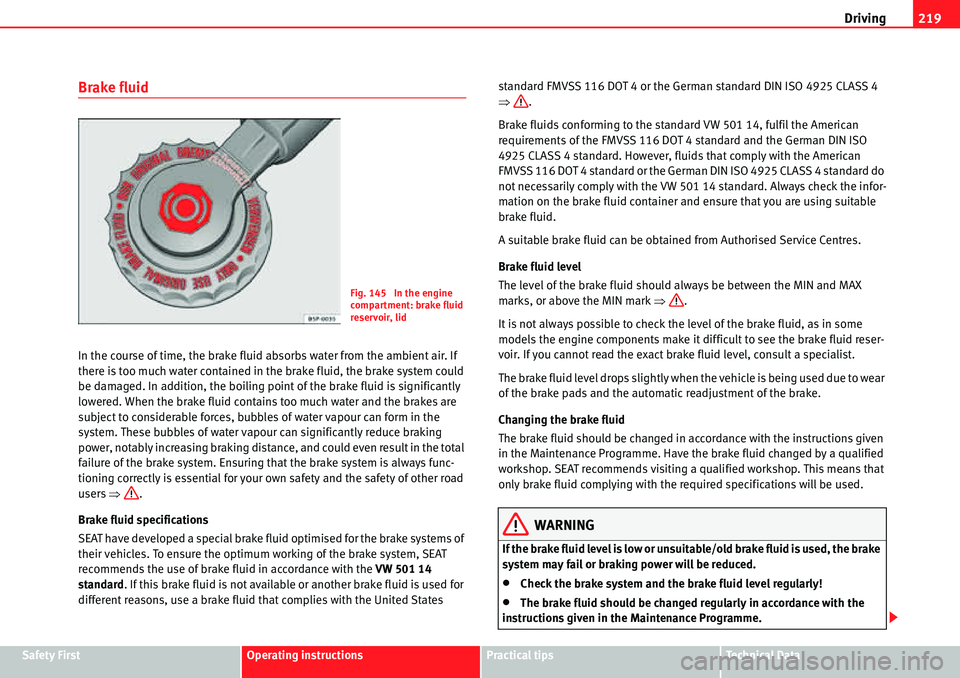
Fig. 145 In the engine
compartment: brake fluid
reservoir, lid
Page 268 of 413
Trailer towing267
Safety FirstOperating instructionsPractical tipsTe c h n i c a l D a t a 247 mm (10 inches)
596 mm (23 inches)
1,097 mm (43 inches)
1,102 mm (43 inches)
WARNING
Erroneous or unsuitable connection of electric cables may cause anomalies
in the vehicle electronics that could result in an accident with serious
consequences.
xNever connect the trailer's electric system to the electrical connections
of the rear lights or any other unsuitable power sources. Only use suitable
connectors to connect a trailer.
xVisit a specialist workshop if you wish to retrofit a tow hitch to the
vehicle.
WARNING
If the tow hitch is badly fitted or unsuitable, the trailer may separate from
the vehicle while driving. This could result in serious accident.
Note
Use only tow hitches approved by SEAT for the vehicle.
Maximum gross trailer weight
The instructions in the official vehicle documents take precedence. All the
technical data provided in this documentation is applicable to the basic
model. The vehicle data label in the Maintenance Programme or the vehicle
documents show which engine is installed in your vehicle.The figures may be different depending on if additional equipment is fitted,
for different models and for special vehicles.
WARNING
Exceeding the maximum trailer weight indicated could cause a serious
accident.
xNever exceed the indicated trailer weight.
Caution
Exceeding the maximum trailer weight indicated could cause damage to the
vehicle.
xNever exceed the indicated trailer weight.
Gross combined vehicle weight rating
The instructions in the official vehicle documents take precedence. All the
technical data provided in this documentation is applicable to the basic
model. The vehicle data label in the Maintenance Programme or the vehicle
documents show which engine is installed in your vehicle.
The figures may be different depending on if additional equipment is fitted,
for different models and for special vehicles.
The maximum combined weights listed are only applicable for altitudes up to
1,000 m above sea level. The weight of the car and trailer must be reduced by
about 10% for every further 1000 m (or part thereof).
WARNING
Exceeding the maximum weight indicated could cause a serious accident.
xNever exceed the gross combined weight rating.
AE
AF
AG
AH
Page 270 of 413
Vehicle maintenance and cleaning269
Safety FirstOperating instructionsPractical tipsTe c h n i c a l D a t a
Vehicle maintenance and cleaning
Care and cleaning the vehicle exterior
Introduction
Regular maintenance and washing help to maintain the value of the vehicle.
This may also be one of the requirements for acknowledging warranty claims
in the event of bodywork corrosion or paint defects.
Products suitable for the care of your vehicle are available at any Technical
Service.
Additional information and warnings:
xCare and cleaning of the vehicle interior Ÿpage 278
xWorking in the engine compartment Ÿpage 304
xAccessories, parts replacement, repairs and modifications Ÿpage 285
WARNING
Car care products may be toxic and hazardous. If car care products are not
suitable or are used inappropriately, this could result in accident, serious
injury, burns or intoxication.
xCar care products must always be stored in the original container which
should be kept closed.
xObserve information provided by the manufacturer.
xTo prevent confusion, never store car care products in empty food cans,
bottles or other containers.
xKeep all care products out of reach of children.
xHarmful vapours may be produced when using car care products. There-
fore, care products should only be used in well-ventilated spaces or in the
open air.
xNever use fuel, turpentine, engine oil, acetone or any other volatile
liquid to wash, clean or care for the vehicle. These are toxic and highly
flammable.
WARNING
Inappropriate care and cleaning of vehicle components may effect the
vehicle safety equipment, increasing the risk of severe injury.
xVehicle components should only be cleaned and maintained in accord-
ance with the manufacturer's instructions.
xOnly use approved or recommended care products.
Caution
Cleaning products which contain solvents will damage the material.
For the sake of the environment
Only wash the vehicle in areas allocated for this purpose, to prevent dirty
water which may be contaminated by oil, grease or fuel, from entering the
drains. In some districts, washing vehicles outside wash bays is prohibited.
For the sake of the environment
Where possible, always use products which respect the environment.
WARNING (continued)
Page 271 of 413
Vehicle maintenance and cleaning 270
For the sake of the environment
The remains of car care products should not be disposed of with ordinary
household waste. Observe information provided by the manufacturer.
Washing the vehicle
The longer substances such as insects, bird droppings, resinous tree sap,
road dirt, industrial deposits, tar, soot or road salt and other aggressive mate-
rials remain on the vehicle, the more damage they do to the paintwork. High
temperatures (for instance due to strong sunlight) further intensify the corro-
sive effect. The vehicle undercarriage should also be thoroughly washed at
regular intervals.
Automatic car washes
Always observe the instructions provided at the automatic car wash. The
standard precautionary measures prior to entering the car wash should be
taken to avoid damage to the vehicle (close all windows, fold in exterior
mirrors). If the vehicle is fitted with additional components (spoiler, roof-rack,
aerial...), check with the car wash supervisor whether these can enter the car
wash Ÿ.
The vehicle paintwork is so durable that the car can normally be washed
without problems in an automatic car washing tunnel. However, wear and
damage to the paintwork will depend on the type of car wash used. SEAT
recommends the use of car washed without brushes.
To remove traces of wax on windows and to prevent wiper blades from
scratching, please observe the following Ÿpage 272, “Cleaning windows
and exterior mirrors”.
Washing the car by hand
When washing the car by hand, use plenty of water to soften the dirt first, and
rinse off as well as possible.Then clean the vehicle with a soft sponge, glove or brush using only slight
pressure. Start at the roof and work downwards. Special car shampoo should
only be used for very persistent dirt.
Rinse the sponge or glove thoroughly and often.
Wheels, sills and similar should be cleaned last. Use a second sponge for
this.WARNING
Sharp components on the vehicle may cause injury.
xProtect arms and hands from sharp edges when cleaning the vehicle
undercarriage or the interior of the wheel hubs.
WARNING
After the vehicle has been washed, the braking effect will be reduced (and
the braking distance increased) due to moisture (and ice in winter) on the
brakes.
xDry the brakes and remove ice by braking carefully. Ensure that you are
not endangering other road-users or breaking traffic regulations in the
process.
Caution
xThe temperature of the water must not exceed +60 °C (+140 °F).
xTo avoid damage to the paintwork, do not wash the vehicle in full sun.
xDo not use rough sponges or similar which could damage the surface to
clean away the traces of insects.
xNever wipe the headlights with a dry cloth or sponge, always moisten
first. It is best to use soapy water.
Page 272 of 413
Vehicle maintenance and cleaning271
Safety FirstOperating instructionsPractical tipsTe c h n i c a l D a t a
xWashing the vehicle in low temperatures: When washing the vehicle with
a hose, do not direct water into the lock cylinders or the gaps around the
doors, tailgate, or sunroof. Locks and seals could freeze!
Caution
To prevent damage to the vehicle, please observe the following before
entering an automatic car wash:
xCompare the distance between the vehicle wheels and the distance
between the guide-rails of the car wash to prevent damage to the wheels and
tyres!
xSwitch off the rain sensor and the Auto Hold function before entering a car
wash.
xCompare the height and width of your vehicle with the available height
and width when entering and driving through the car wash.
xFold in exterior mirrors Electrically retractable exterior mirrors must NOT
be folded in or out by hand. Always use the electrical power control.
xTo avoid damaging the bonnet paintwork, rest the wipers on the wind-
screen after drying them. Do not let them fall!
xLock the tailgate to prevent it from opening unexpectedly while inside the
car wash.
Washing the vehicle with high pressure cleaning equipment
When cleaning the vehicle with a high-pressure cleaner, always follow the
operating instructions for the equipment. Pay special attention to the
required pressure of the jet and the distance between the jet and the vehicle
Ÿ.
Keep a suitable distance from soft materials, such as rubber hoses or insu-
lating material, and from the parking distance warning system sensors. The parking distance sensors are fitted in the rear bumpers and, where appli-
cable, in the front bumpers Ÿ.
Do not use a nozzle that sprays the water out in a direct stream or one that
has a rotating jet for forcing off dirt Ÿ.
WARNING
The incorrect use of high pressure cleaning equipment could result in
permanent damage, visible or invisible, to the tyres or other materials. This
could result in serious accident.
xEnsure there is a suitable distance between the nozzle and the tyres.
xNever wash tyres with a concentrated jet or so-called “dirt blasters”.
Even at large spraying distances and short cleaning times, you may
damage the tyres.
WARNING
After the vehicle has been washed, the braking effect will be reduced (and
the braking distance increased) due to moisture (and ice in winter) on the
brakes.
xDry the brakes and remove ice by braking carefully. Ensure that you are
not endangering other road-users or breaking traffic regulations in the
process.
Caution
xThe temperature of the water must not be above +60 °C (+140 °F).
xTo avoid damage to the paintwork, do not wash the vehicle in full sun.
xThe sensors on the bumpers should be kept clean and free of ice at all
times to ensure the parking distance warning system and the parking aid
system operate correctly. When cleaning with pressure hoses and steam
cleaners, the sensors should be sprayed only briefly. A distance of 10 cm
between the sensors and the steam / hose nozzle must be observed.
Page 273 of 413
Vehicle maintenance and cleaning 272
xDo not use a high pressure cleaner to remove ice or snow from windows
xWashing the vehicle in low temperatures: When washing the vehicle with
a hose, do not direct water into the lock cylinders or the gaps around the
doors, tailgate, or sunroof. Locks and seals could freeze!
Cleaning windows and exterior mirrors
Cleaning windows and exterior mirrors
Spray windows and exterior windows with a standard window cleaner
containing alcohol.
Dry the windows with a clean chamois leather or a lint-free cloth. The chamois
leathers used on painted surfaces are not suitable for cleaning windows
because they are soiled with wax deposits which could smear the windows.
Use window cleaner or a silicone remover to clean rubber, oil, grease and sili-
cone deposits off Ÿ.
Removing wax deposits
Automatic car washes and certain car care products may leave wax deposits
on the windows. These deposits can only be removed with a special product
or cleaning cloths. Wax deposits on the windscreen could cause the wiper
blades to judder. SEAT recommends you wipe the wax deposits off the wind-
screen with a soft cloth each time after you have washed the vehicle.
A window cleaning detergent which helps to dissolve the wax may be added
to the windscreen washer fluid to prevent the wiper blades from scratching
the windscreen. Please ensure the you add the cleaning product in the correct
proportions. Products for removing grease do not eliminate the wax deposits
Ÿ.
Special cleaning products or window cloths are available at any Technical
Service. To remove wax deposits, SEAT recommends the following products:
xFor the hottest time of the year: the window cleaner for summer use G 052
184 A1 . Proportion 1:100 (1 part detergent, 100 parts water) in the wind-
screen washer bottle.
xAll year round: the window cleaner G 052 164 A2; Proportion 1:2 in wind-
screen washer bottle (1 part concentrate, 2 parts water) in winter, up to
-18 °C (-0.4 °F), or 1:4, during the rest of the year.
xWindow cloths G 052 522 A1 for all windows and exterior mirrors.
Removing snow
Use a small brush to remove snow from the windows and exterior mirrors.
Removing ice
If possible, use a de-icing spray to remove ice. If you use an ice scraper, push
it in one direction only without swinging it. If you pull the scraper backwards,
the dirt may scratch the window.
WARNING
Dirty or misted windows reduce visibility in all directions and increase the
risk of accident and serious injury.
xDo not drive unless you have good visibility through all windows!
xRemove ice and snow from the windows and demist inside and out.
Caution
xNever mix our cleaning products with other products not recommended
by SEAT in the windscreen washer bottle. This could lead to flocculation and
may block the windscreen washer jets.
xDo not use hot or warm water to remove ice or snow from the windows and
exterior mirrors. The glass could crack!
xThe heating element for the rear window is located on the inner side of the
window. Do not stick adhesive labels over the heating elements and never
clean the inside of the rear window with corrosive or acid products or other
similar chemical cleaning products.
Page 274 of 413
Vehicle maintenance and cleaning273
Safety FirstOperating instructionsPractical tipsTe c h n i c a l D a t a
xAerials on the inside of windows may be damaged if knocked or if cleaned
with corrosive or acid cleaning products. Do not stick adhesive labels over the
heating elements and never clean the inside of the rear window with corro-
sive or acid products or other similar chemical cleaning products.
Cleaning and changing windscreen wiper blades
The windscreen wiper blades are supplied as standard with a layer of
graphite. This layer is responsible for ensuring that the wipe is silent. If the
graphite layer is damaged, the noise of the water as it is wiped across the
windscreen will be louder.
Check the condition of the wiper blades regularly. If the wipers scrape across
the glass they should be changed if they are damaged, or cleaned if they are
dirty Ÿ.
Damaged wiper blades should be replaced immediately. Blades are available
from qualified workshops.
Lifting and unfolding the wiper arms
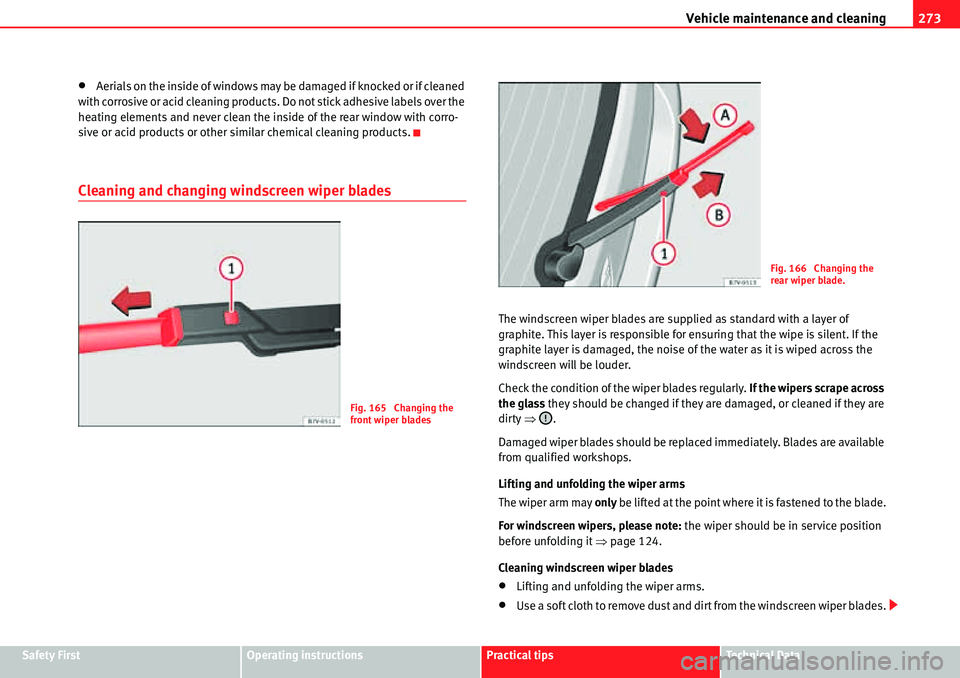
The wiper arm may only be lifted at the point where it is fastened to the blade.
For windscreen wipers, please note: the wiper should be in service position
before unfolding it Ÿpage 124.
Cleaning windscreen wiper blades
xLifting and unfolding the wiper arms.
xUse a soft cloth to remove dust and dirt from the windscreen wiper blades.
Fig. 165 Changing the
front wiper blades
Fig. 166 Changing the
rear wiper blade.
Page 275 of 413

Vehicle maintenance and cleaning 274
xIf the blades are very dirty, a sponge or damp cloth may be used Ÿ.
Changing the front wiper blades
xLifting and unfolding the wiper arms.
xHold down the release button Ÿpage 273, fig. 165 while gently
pulling the blade in the direction of the arrow.
xFit a new wiper blade of the same length and design on to the wiper arm
and hook it into place.
xRest the wiper arms back onto the windscreen.
Changing the rear wiper blade
xLift and unfold the wiper arm.
xPull the wiper blade out of its mounting on the wiper arm Ÿpage 273,
fig. 166 (arrow ).
xHold down the release button Ÿpage 273, fig. 166 while gently
pulling the blade in the direction of the arrow . This may require some
strength.
xInsert a new blade of the same length and type in the wiper arm in the
opposite direction to the arrow Ÿpage 273, fig. 166 and hook into
place. This feature is operational when the knob is in position (arrow ).
xReplace the wiper arm on the rear window.
WARNING
Worn or dirty wiper blades reduce visibility and increase the risk of acci-
dent and serious injury.
xAlways replace damaged or worn blades or blades which do not clean
the windscreen correctly.
Caution
xDamaged or dirty windscreen wipers could scratch the glass.
xIf products containing solvents, rough sponges or sharp objects are used
to clean the blades, the graphite layer will be damaged.
xNever use fuel, nail varnish remover, paint thinner or similar products to
clean the windows.
Caring for and polishing the vehicle paintwork
Waxing
Regular waxing protects the paintwork. It is time to apply a good coat of wax
when water no longer forms droplets and rolls off the clean paintwork.
Even if a wax solution is used regularly in the automatic car wash, SEAT
recommends protecting the paint with a hard wax coating at least twice a
year.
Polishing
Polishing is only necessary if the paint has lost its shine, and the gloss cannot
be brought back by applying wax.
If the polish does not contain wax, a wax product should be applied after
polishing.
Caution
xTo prevent damage, car polish or hard wax should not be used on compo-
nents painted in matt paint, plastic components and the glass headlamp and
tail light covers.
xDo not polish the paintwork if it is dirty, apply polish in dusty or sandy
zones.
A1
AA
A1AB
ABAA
Page 276 of 413
Vehicle maintenance and cleaning275
Safety FirstOperating instructionsPractical tipsTe c h n i c a l D a t a
Cleaning chrome parts
Clean chrome parts with a damp cloth. SEAT recommends the use of a chrome
care product to clean stains and dirt from chrome surfaces. Use a soft dry
cloth to polish chrome parts.
Caution
To prevent scratching chrome surfaces:
xDo not use abrasive products.
xDo not clean or polish chrome parts in a sandy or dusty environment.
xDo not polish dirty surfaces.
Caring for and cleaning anodized surfaces
It is not easy to detect the difference between aluminium and an anodized
surface, for example, a radiator grille. However, anodized surfaces must not
be treated in the same way as aluminium surfaces. Never use rough sponges
or cloths to wipe away insect remains.
xUse a clean, damp, lint-free cloth to clean anodized surfaces.
xIf there is a lot of dirt, use a special cleaning product which does not
contain solvents.
Caution
To prevent damage to the anodized surfaces:
xDo not use products containing solvents.
xDo not use polish or hard wax.
xDo not use abrasive products.
xDo not polish anodized surfaces in sandy or dusty environments.
xDo not polish dirty surfaces.
Cleaning wheels
Cleaning steel wheels
Use an industrial cleaner to remove brake dust. Therefore, clean wheels regu-
larly with a separate sponge.
Any damage to the paint on steel wheels should be touched up before the
metal starts to rust.
Caring for and cleaning alloy wheels
Remove road salt and brake dust by washing the wheels approximately once
a fortnight. Use an acid free detergent to clean the wheel rims. SEAT recom-
mends treating the wheels thoroughly with a wax compound about once
every three months.
It is important to remove road salt and brake dust by washing the wheels at
regular intervals, otherwise the finish will be impaired.
Always use an acid-free detergent for alloy wheel rims. Car polish or other
abrasive agents should not be used.
If the protective coating on the paint has been damaged (for example, hit by
a stone), it should be repaired immediately.
Caring for rubber seals
The rubber seals on doors, windows, etc., remain flexible, provide a better
seal and last longer if they are regularly treated with a product specifically
designed for use on rubber.
Page 277 of 413
Vehicle maintenance and cleaning 276
Before applying the product, use a soft cloth to remove dust and dirt from the
rubber seals.
De-icing the door lock cylinder
To de-ice the lock cylinders, SEAT recommend the use of genuine SEAT spray
with lubricating and anti-corrosive properties.
Caution
The use of products containing degreasing agents to de-ice the locks may
rust the lock cylinder.
Protection of vehicle undercarriage
The vehicle underbody is coated to protect it from chemical and mechanical
damage. The protective coat on the undercarriage may wear through use
while driving. Therefore, SEAT recommends that the protective coating on the
undercarriage and on the running gear should be regularly checked, and
repaired if necessary.
WARNING
Additional underseal or anti-corrosion products could catch fire due to the
high temperatures reached by the exhaust gas system and other engine
components.
xDo not apply additional underseal or anti-corrosion products to the
exhaust pipes, catalytic converters, heat shields or other parts of the
vehicle which reach high temperatures.
Cleaning the engine compartment
The engine compartment of any motor vehicle is a potentially hazardous area
Ÿpage 304.
The engine compartment should only be cleaned by qualified personnel. If it
is not correctly cleaned, the anti-corrosion coating and consequently elec-
trical components may be damaged. Moreover, water may filter directly into
the vehicle interior through the water chamber Ÿ.
If the engine compartment is very dirty, always take the vehicle to a qualified
workshop for professional cleaning. SEAT recommends visiting a qualified
workshop.
Water box
The water box is in the engine compartment, between the windscreen and the
engine, and beneath a perforated cover. Air is taken in through the water box
from outside to the vehicle interior via the heating and air conditioning
system.
Leaves and other loose objects should be regularly cleaned away from the
water box either by hand or with a vacuum.
WARNING
When working on the engine or in the engine compartment, there is a risk
of injury, burns, accident or fire.
xBefore starting work, please ensure you are familiar with the required
procedure and the safety precautions Ÿpage 304.
xSEAT recommends you have this work performed by a qualified dealer-
ship.
Caution
If water is manually poured into the water box (for example, using a high pres-
sure cleaning appliance), this could cause significant damage to the vehicle.