warning Seat Alhambra 2011 Owner's Manual
[x] Cancel search | Manufacturer: SEAT, Model Year: 2011, Model line: Alhambra, Model: Seat Alhambra 2011Pages: 385, PDF Size: 7.92 MB
Page 195 of 385
193
Driving WARNING
Brake fluid is poisonous.
● To reduce the risk of poisoning, do not keep brake fluid in drinks bot-
tle s/c
ontainers or similar. Other people could drink from these recipients
even if the contents are clearly marked.
● Always keep brake fluid in the original container; keep it correctly
seal
ed and out of reach of children. CAUTION
Brake fluid could damage the paintwork. Wipe off any brake fluid from the
paintw ork
immediately. For the sake of the environment
Brake fluid is an environmental pollutant. Collect any spilt service fluids and
allo w a pr
ofessional to dispose of them. Safety First Operating instructions Practical tips Technical Data
Page 196 of 385
194
Driving
Start assist systems
Introduction Additional information and warnings:
●
SEAT information system ⇒ pag e 62
● Br
aking, stopping and parking ⇒ page 183
● V
ehicle battery ⇒ page 288
● Wheel
s and tyres ⇒ page 293
● A
ccessories, parts replacement, repairs and modifications ⇒ page 257
● Jump s
tarting ⇒ page 337 WARNING
The intelligent technology in the start assist systems cannot change the
la w
s of physics. The improved comfort provided by start assist systems
should not prompt you to take risks.
● Unintentional movements of the vehicle could cause serious injury.
● The start assist systems are not a replacement for driver awareness.
● Always try to adapt the speed of the vehicle and your style of driving
to the condition of
the ground or the road and to weather and traffic con-
ditions.
● The start assist system cannot keep the vehicle stationary in all con-
ditions on a gr
adient or cause it to brake on steep downhill gradients,
e.g. if the road is slippery or icy. Auto Hold function*
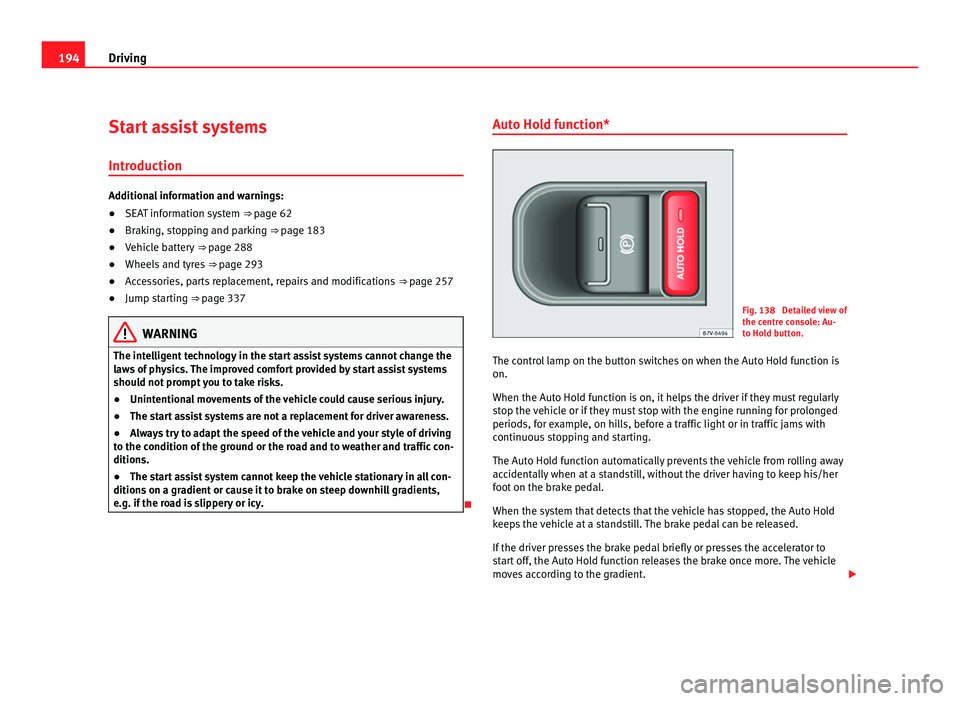
Fig. 138 Detailed view of
the centr
e c
onsole: Au-
to Hold button.
The control lamp on the button switches on when the Auto Hold function is
on.
When the Auto Hol
d function is on, it helps the driver if they must regularly
stop the vehicle or if they must stop with the engine running for prolonged
periods, for example, on hills, before a traffic light or in traffic jams with
continuous stopping and starting.
The Auto Hold function automatically prevents the vehicle from rolling away
accidentally when at a standstill, without the driver having to keep his/her
foot on the brake pedal.
When the system that detects that the vehicle has stopped, the Auto Hold
keeps the vehicle at a standstill. The brake pedal can be released.
If the driver presses the brake pedal briefly or presses the accelerator to
start off, the Auto Hold function releases the brake once more. The vehicle
moves according to the gradient.
Page 197 of 385
195
Driving
If any of the conditions necessary for the Auto Hold function change while
the v ehic
le stopped, the system is turned off as is the indicator on the but-
ton ⇒ fig. 138. The electronic parking brake engages where necessary to
park the vehicle safely ⇒ .
Condition s
for keeping the vehicle at a standstill with Auto Hold:
● The driver's door must be closed.
● The driver's seat belt must be buckled.
● The engine must be running.
● The ASR (TCS) system must be switched on ⇒ page 183.
Sw
itching Auto Hold on and off manually
Press the AUTO HOLD button ⇒ . The control lamp on the button switches
off when the Aut o Ho
ld function is switched off.
Permanent Auto Hold connection
The Auto Hold function must be switched on every time the engine is star-
ted. However, to switch the Auto Hold function on permanently, the mark
must be switched on in the Settings menu, “Autohold” submenu
⇒ page 62.
Auto Hold works automatically under the following conditions: All points must be fulfilled simultaneously ⇒ :
manual gearbox Automatic gearbox
1. If the vehicle is
stop
ped using the brake pedal on a flat or slope.2. The engine must be running smoothly.
3. On a slope, the 1st gear is engag-
ed uphil
l
or the reverse gear is en-
gaged for a downhill. The clutch
must be held down. A gear for driving is selected from
R, D or S.
Upon accelerating and pressing in
the clut
c
h simultaneously, the
brake releases gradually. Upon accelerating, the brake re-
le
a
ses gradually. Auto Hold turns off automatically under the following conditions:
manual gearbox Automatic gearbox
1. If one of the conditions mentioned in table on page 195 changes.
2. If the engine is not running regularly or if there is a malfunction.
3. When changing to idle speed. If the selector lever is placed in
neutral
(N
). 4. If the engine is turned off or stalls. If the engine is switched off.
5. If the driver accelerates while
pre
s
sing the clutch in. If the vehicle is accelerated.
6. When one of the wheels has mini-
mal
c
ontact with the ground (for
example, on uneven ground). WARNING
The Auto Hold technology is limited by the laws of physics. The improved
comf or
t provided by Auto Hold should never prompt you to take risks.
● Never leave the vehicle running and with the Auto Hold function
switc
hed on.
● Auto Hold cannot always stop the vehicle uphill and downhill (for ex-
ample, if
the ground is slippery or frozen). CAUTION
Before entering an automatic car wash, alwa
ys switch the Auto Hold func-
tion off, as it could be damaged when the electronic parking brake automat-
ically engages. Safety First Operating instructions Practical tips Technical Data
Page 199 of 385
197
Driving
● If the driver unbuckles his/her seat belt.
● If the driv
er's door is opened.
● If the bonnet is opened.
● In vehicles with a manual gearbox: If a gear has been selected.
Switc
hing Start-Stop mode on and off manually
● Press the button on the centre console ⇒
fig. 139.
● The b
utton will light up when the Start-Stop function is switched off.
The engine wi
ll start immediately if the vehicle is in Stop mode when it is
switched off manually. WARNING
The brake servo and the power steering do not work when the engine is
swit c
hed off.
● Never allow the vehicle to move when the engine is switched off. CAUTION
Using the Start-Stop function for a long period at very high outdoor temper-
atur e
s could damage the vehicle's battery. Note
In some cases, you may have to restart the vehicle using the key. Observe
the corr e
sponding message on the instrument panel display. Safety First Operating instructions Practical tips Technical Data
Page 200 of 385
198
Driving
Parking sensor system*
Introduction The parking sensor system assists the driver when parking. When the vehi-
cl
e ap
proaches an obstacle, forwards or backwards, an intermittent sound
will be heard, higher or lower depending on the distance. The shorter the
distance, the shorter the intervals between tones. If the vehicle is too close
to the obstacle, the sound signal becomes constant.
If you continue to approach an obstacle when the sound is continuous, this
means the system can no longer measure the distance.
The sensor system on the bumpers transmit and receive ultrasound. Using
the ultrasound signal (transmission, reflection from the obstacle and recep-
tion), this system continuously calculates the distance between the bumper
and the obstacle.
Additional information and warnings:
● Park Assist system ⇒ page 202
● A
ccessories, parts replacement, repairs and modifications ⇒ page 257WARNING
The parking sensor system and the optical parking system cannot re-
pl ac
e driver awareness.
● The sensors have blind spots in which obstacles and people are not
regi
stered.
● Always observe the area around the vehicle, as the sensors do not al-
way
s detect small children, animals or objects. WARNING (Continued)
● The s urface of certain objects and some clothing do not reflect the ul-
tr a
sound signals from the parking distance system. The system cannot
detect or incorrectly detects these objects and people wearing these
types of clothes.
● External sound sources can affect the parking distance aid signals. In
this c
ase, under certain circumstances, people and objects will not be de-
tected. CAUTION
● The sensors may not always be able to detect objects such as trailer
dr a
w bars, thin rails, fences, posts, trees and open boots, etc. This could re-
sult in damage to your car.
● Although the parking sensor system detects and warns of the presence
of an ob
stacle, the obstacle could disappear from the angle of measure-
ment of the sensors if it is too high or low and the system would no longer
indicate it. Therefore, it will not warn you of these objects. Ignoring the
warnings of the parking sensor system could cause considerable damage to
the vehicle.
● The bumper sensors may become damaged or misaligned, for example,
when parkin
g.
● To ensure that the system works properly, the bumper sensors must be
kept c
lean, free of ice and snow and uncovered.
● When cleaning the sensors with high-pressure or steam cleaning equip-
ment, spra
y the sensors briefly at a distance of no less than 10 cm (4 in-
ches). Note
Acoustic sources may lead to erroneous warnings on the parking sensor
sys t
em, e.g. rough tarmac, cobbles or the noise of other vehicles.
Page 201 of 385
199
Driving
Parking sensor system* Fig. 140 Detailed view of
the centr
e c
onsole: but-
ton for switching the
parking sensor system
on and off. Fig. 141 Parking sensor
sys
t
em sensors on the
front bumper.
The parking sensor system assists the driver when parking. If the vehicle is
appro
aching an obstacle, an intermittent sound signal is emitted. The short-
er the distance, the shorter the intervals between tones. If the vehicle is too
close to the obstacle, the sound signal becomes constant. Switching the parking sensor system on and off
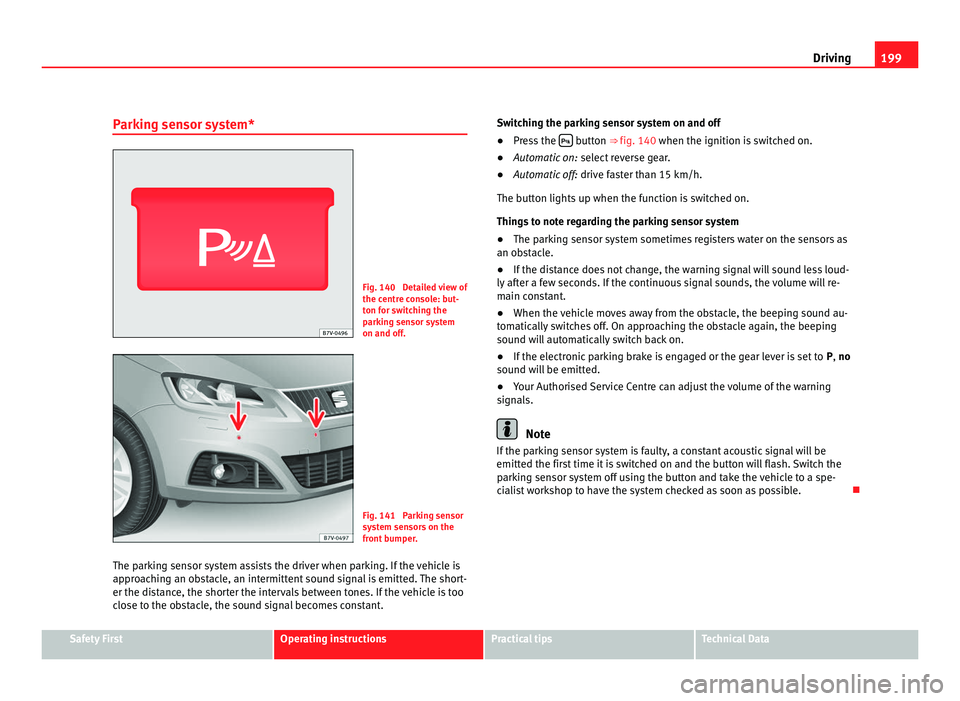
●
Press the button ⇒
fig. 140 when the ignition i
s switched on.
● Automatic on: select r
everse gear.
● Automatic off: drive fa
ster than 15 km/h.
The button lights up when the function is switched on.
Things to note regarding the parking sensor system
● The parking sensor system sometimes registers water on the sensors as
an obs
tacle.
● If the distance does not change, the warning signal will sound less loud-
ly aft
er a few seconds. If the continuous signal sounds, the volume will re-
main constant.
● When the vehicle moves away from the obstacle, the beeping sound au-
tomatic
ally switches off. On approaching the obstacle again, the beeping
sound will automatically switch back on.
● If the electronic parking brake is engaged or the gear lever is set to P, no
sound wi
ll be emitted.
● Your Authorised Service Centre can adjust the volume of the warning
signal
s. Note
If the parking sensor system is faulty, a constant acoustic signal will be
emitted the fir s
t time it is switched on and the button will flash. Switch the
parking sensor system off using the button and take the vehicle to a spe-
cialist workshop to have the system checked as soon as possible. Safety First Operating instructions Practical tips Technical Data
Page 203 of 385
201
Driving Distance from the vehicle to the
ob
s
tacle Acoustic sig-
nal Displayed in colour on
the sc r
een: colour of the
segment if an obstacle is recognised in front: approx. 31 – 120 cm
behind: ap
pr
ox. 31 – 160 cm beeping
sound Yellow
approx. 0 – 30 cm
in fr
ont or be-
hind a) permanent
sound Red
a)
The permanent sound starts at a somewhat greater distance on vehicles with a factory-fit-
ted t o
wing bracket.
With towing bracket
A specific image is displayed on the screen of vehicles with a factory-fitted
towing bracket and an electrically connected trailer. In this case, the distan-
ces behind the vehicle are not indicated.
Switching the parking sensor system sound on and off
If the button on the radio or navigation system screen may mute the
sound of OP
S warnings. To switch the warnings back on, press the button
again briefly.
When the OPS is switched off and back on again, muting is cancelled. Error
messages cannot be switched off. WARNING
Do not be distracted from the traffic when looking at the screen.
Safety First Operating instructions Practical tips Technical Data
Page 204 of 385
202
Driving
Park Assist system*
Introduction The Park Assist system helps the driver to find a suitable place to park, to
inser
t
the vehicle into parallel and perpendicular parking places and to
leave parallel parking places.
The Park Assist system is limited to the system abilities and requires that
the driver is especially attentive ⇒ .
The park in
g sensor system is a component of the Park Assist system that
helps to park the vehicle.
For vehicles with the optical parking system, the radio navigation systems
screen displays the detected zones in front of and behind the vehicle, indi-
cating - within the limits of the system - the position of obstacles compared
to the vehicle.
The park assist system cannot be switched on if the factory-fitted towing
bracket is electrically connected to a trailer.
Additional information and warnings:
● Braking, stopping and parking ⇒ page 183
● P
arking sensor system ⇒ page 198
● C
aring for and cleaning the vehicle exterior ⇒ page 242
● A
ccessories, parts replacement, repairs and modifications ⇒ page 257 WARNING
Despite the assistance provided by the park assist system, do not run
any ri
sks when parking. The system is not a replacement for driver
awareness.
● Unintentional movements of the vehicle could cause serious injury.
● Adjust your speed and driving style to visibility, road, traffic and
weather c
onditions.
● The surface of certain objects and items of clothing and external
sound sourc
es may have a negative affect on the park assist signals or on
the system sensors or may not reflect its signals.
● The sensors have blind spots in which obstacles and people are not
regi
stered.
● Always observe the area around the vehicle, as the sensors do not al-
way
s detect small children, animals or objects. CAUTION
● The park assist system aims exclusively at other parked vehicles, with-
out t
aking curbs or other circumstances into account. Make sure you do not
damage the tyres and wheel rims when parking. Where necessary, stop ma-
noeuvring to avoid damaging the vehicle.
● The sensors may not always be able to detect objects such as trailer
draw b
ars, thin rails, fences, posts and trees, etc. This could result in dam-
age to your car.
● Although the parking sensor system detects and warns of the presence
of an ob
stacle, the obstacle could disappear from the angle of measure-
ment of the sensors if it is too high or low and the system would no longer
indicate it. Therefore, it will not warn you of these objects. Ignoring the
warnings of the parking sensor system could cause considerable damage to
the vehicle. This is also valid when using the park assist (e.g. to park be-
hind a truck or motorcycle). Therefore, always keep a close watch on the
area in front of and behind the vehicle while parking, and intervene prompt-
ly if necessary.
Page 206 of 385
204
Driving
Parking
● Parking parallel to the road: Drive next to the gap at a speed of no more
than 40 km/h and at a distance of between 0.5 m and 2 m.
● Parking perpendicular to the road: Drive next
to the gap at a speed of no
more than 20 km/h and at a distance of between 0.5 m and 2 m.
● The best parking results will be achieved if you position the vehicle as
paral
lel as possible to the line of parked cars or the kerb.
● When a suitable parking place is displayed on the instrument panel,
stop and sel
ect reverse gear.
● Follow the instructions given on the instrument panel display
● Then, release the steering wheel when the warning signal sounds ⇒ :
The sys t
em will move the steering wheel! Observe the surrounding area.
● Observe the surrounding area and accelerate carefully at a maximum of
up to 7 km/h.
● The park
assist system is only r
esponsible for moving the steering wheel
during the manoeuvre. The driver applies the accelerator, the clutch, the
gears and the brake.
● Follow the instructions given by the park assist system until the ma-
noeuvre i
s completed.
● The park assist system steers the vehicle forwards and backwards until
it is
in a straight position in the parking space.
● The manoeuvre is complete when the corresponding indication is given
on the instrument
panel display.
Stopping the parking manoeuvre
The park assist system stops the manoeuvre in the event of one of the fol-
lowing:
● Press button .
● Driving faster than 7 km/h.
● The driver moves the steering wheel.
● The parking manoeuvre has not been completed after six minutes since
the park a
ssist system was activated. ●
A sliding door is opened. To restart the manoeuvre, close the sliding
door and pre
ss the button again.
● There is a system malfunction (system temporarily unavailable).
● The ASR (TCS) system is switched off or the ASR (TCS) or ESC (ESP) is
work in
g. WARNING
The steering wheel turns quickly by itself when parking using the park
as s
ist system. Placing your hand between the steering wheel spokes
could lead to injuries. Note
● The park assist system has its limitations. For example, it is not possible
t o p
ark on tight bends using the park assist system.
● Even if the park assist system recognises that there is not enough space
for park
ing the vehicle, the display screen on the instrument panel will still
display this place. In this case, the parking manoeuvre should not be re-
quested.
● Changing gears between forward and reverse gears before indicated
(that i
s, before the signal from the parking sensor system) the parking re-
sults may not be ideal.
● For parallel parking (parallel to the road), a sound will tell the driver
when they mus
t change from forward gears to reverse; the signal from the
parking sensor system does not indicate changes of direction.
● The park assist can also be activated afterwards, if you pass close to a
paral
lel parking space at a maximum of 40 km an hour or close to be per-
pendicular parking space at about 20 km an hour then press the button .
● The progress bar on the screen of the instrument panel shows a display
of the r el
ative distance to be covered.
● When the Park Assist system is turning the steering wheel of the stop-
ped vehic
le the symbol is also displayed. Press on the brake pedal so
that the steering can turn with the vehicle at a standstill and thus reduce
the number of manoeuvres.
Page 207 of 385
205
Driving
● A suitable parking space length is at least 1.1 m greater than the length
of the
vehicle.
● If the results of the park assist system are not as good after changing
the wheels, the sys
tem must memorise the perimeter of the new wheels.
This process is performed automatically while the vehicle is in motion. To
help this process, turn slowly (at less than 20 km/h), e.g. in an empty car
park.
Leaving a parking space using the Park Assist system Driving off
●
Switch on the engine.
● Press button . When the function is enabled, the button
⇒ fig. 144
wi l
l light up.
● Apply the turn signal indicator for the side on which you want to leave
the parkin
g space.
● Select reverse gear.
● Follow the instructions given by the park assist system.
● When the next indication appears, release the steering wheel ⇒ in
Park in
g using the park assist system on page 204: The system will move the
steering wheel! Observe the surrounding area.
● Observe the surrounding area and accelerate carefully at a maximum of
up to 7 km/h.
● The park
assist system is only r
esponsible for moving the steering wheel
during the manoeuvre. The driver applies the accelerator, the clutch, the
gears and the brake.
● When it is possible to leave the parking space, the Park Assist system
wil
l stop. Take control of the steering and when traffic conditions permit,
leave the parking space. Automatic stoppage of the manoeuvre
The park a
ssist system stops the manoeuvre in the event of one of the fol-
lowing:
● Driving faster than 7 km/h.
● The driver moves the steering wheel.
● A sliding door is opened. To restart the manoeuvre, close the sliding
door and pres
s the button again.
● There is a system malfunction (system temporarily unavailable).
● The ASR (TCS) system is switched off or the ASR (TCS) or ESC (ESP) is
work in
g. WARNING
The steering wheel turns quickly automatically when leaving a parking
sp ac
e using the park assist system. Placing your hand between the steer-
ing wheel spokes could lead to injuries.
Park Assist brake operation The Park Assist system helps the driver by braking automatically. Automatic
brak
in
g does not relieve the driver of responsibility for controlling the accel-
erator, brake and clutch ⇒ .
Brak in
g to avoid damage at excess speed
It is possible that the system operates the brakes to reduce excess speed.
The parking manoeuvre can then continue. The brakes will intervene during
each parking process.
Braking to minimise damage
When approaching an obstacle, the vehicle may brake automatically. In cer-
tain circumstances (for example, storm, detection of ultrasounds, vehicle Safety First Operating instructions Practical tips Technical Data