engine oil Seat Alhambra 2011 User Guide
[x] Cancel search | Manufacturer: SEAT, Model Year: 2011, Model line: Alhambra, Model: Seat Alhambra 2011Pages: 385, PDF Size: 7.92 MB
Page 230 of 385
228
Driving and the environment
Avoid carrying unnecessary loads
The lighter the v
ehicle, the more economical and ecological the driving
style. For example, an additional weight of 100 kg will increase fuel con-
sumption up to 0.3 l/100 km.
Remove any unnecessary objects or loads from the vehicle.
Remove optional equipment and unnecessary accessories
The more aerodynamic the vehicle, the lower the fuel consumption. Option-
al equipment and accessories (such as roof racks or bike carriers) reduce
the aerodynamic benefits of the vehicle.
Therefore, we recommend you remove all optional and unnecessary equip-
ment and racks, especially if you intend to drive at high speeds.
Engine management and exhaust gas
purification sy
stem
Introduction Additional information and warnings:
●
Changing gear ⇒ p ag
e 174
● Refuelling ⇒ pag
e 264
● Fuel ⇒ page 267
● En
gine oil ⇒ pag
e 279
● Vehicle battery ⇒ pag
e 288
● Information stored in the control units ⇒ pag
e 257
● Tow-starting and towing away ⇒ pag
e 340 WARNING
The components of the exhaust system reach very high temperatures.
This c
ould cause a fire.
● Always park your vehicle so that no part of the exhaust system can
come in cont
act with flammable materials (such as dried grass).
● Do not apply additional underseal or anti-corrosion coatings to the
exhau
st pipes, catalytic converter, heat shields or the diesel particulate
filter.
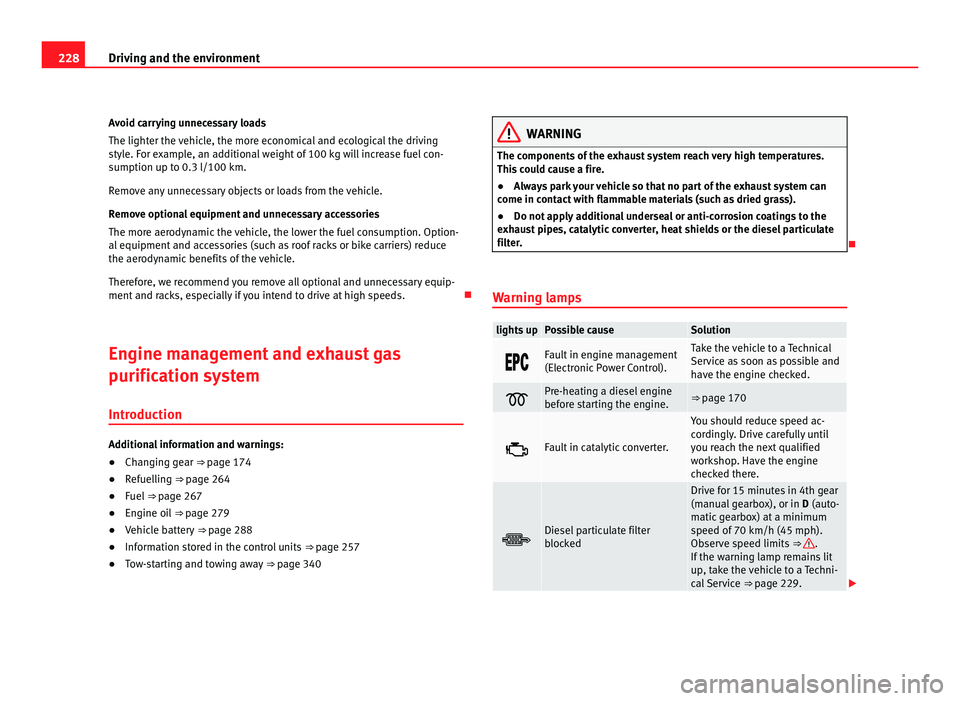
Warning lamps lights up Possible cause Solution
Fault in engine management
(Electr
onic
Power Control). Take the vehicle to a Technical
Serv
ic
e as soon as possible and
have the engine checked. Pre-heating a diesel engine
befor
e s
tarting the engine. ⇒ page 170
Fault in catalytic converter. You should reduce speed ac-
cor
din
gly. Drive carefully until
you reach the next qualified
workshop. Have the engine
checked there. Diesel particulate filter
bloc
k
ed Drive for 15 minutes in 4th gear
(manual
g
earbox), or in D (auto-
matic gearbox) at a minimum
speed of 70 km/h (45 mph).
Observe speed limits ⇒ .
If the w arnin
g lamp remains lit
up, take the vehicle to a Techni-
cal Service ⇒ page 229.
Page 231 of 385
229
Driving and the environment flashes Possible cause Solution
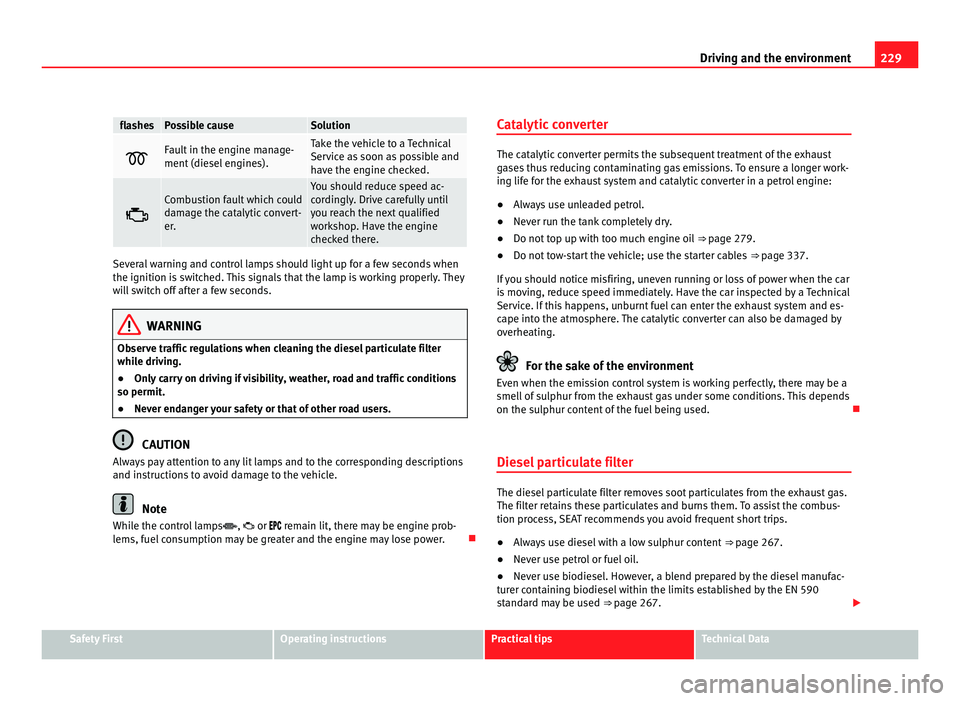
Fault in the engine manage-
ment (die
sel
engines). Take the vehicle to a Technical
Serv
ic
e as soon as possible and
have the engine checked. Combustion fault which could
dam
ag
e the catalytic convert-
er. You should reduce speed ac-
cor
din
gly. Drive carefully until
you reach the next qualified
workshop. Have the engine
checked there. Several warning and control lamps should light up for a few seconds when
the ignition is
sw
itched. This signals that the lamp is working properly. They
will switch off after a few seconds. WARNING
Observe traffic regulations when cleaning the diesel particulate filter
whil e driv
ing.
● Only carry on driving if visibility, weather, road and traffic conditions
so permit.
● Never end
anger your safety or that of other road users. CAUTION
Always pay attention to any lit lamps and to the corresponding descriptions
and ins truction
s to avoid damage to the vehicle. Note
While the control lamps , or r
emain lit, there may be engine prob-
lems, fuel consumption may be greater and the engine may lose power. Catalytic converter The catalytic converter permits the subsequent treatment of the exhaust
ga
se
s thus reducing contaminating gas emissions. To ensure a longer work-
ing life for the exhaust system and catalytic converter in a petrol engine:
● Always use unleaded petrol.
● Never run the tank completely dry.
● Do not top up with too much engine oil ⇒ page 279.
● Do not
tow-start the vehicle; use the starter cables ⇒ page 337.
If
you should notice misfiring, uneven running or loss of power when the car
is moving, reduce speed immediately. Have the car inspected by a Technical
Service. If this happens, unburnt fuel can enter the exhaust system and es-
cape into the atmosphere. The catalytic converter can also be damaged by
overheating. For the sake of the environment
Even when the emission control system is working perfectly, there may be a
smell of
sulphur from the exhaust gas under some conditions. This depends
on the sulphur content of the fuel being used.
Diesel particulate filter The diesel particulate filter removes soot particulates from the exhaust gas.
The filt
er r
etains these particulates and burns them. To assist the combus-
tion process, SEAT recommends you avoid frequent short trips.
● Always use diesel with a low sulphur content ⇒ page 267.
● Nev
er use petrol or fuel oil.
● Never use biodiesel. However, a blend prepared by the diesel manufac-
turer c
ontaining biodiesel within the limits established by the EN 590
standard may be used ⇒ page 267. Safety First Operating instructions Practical tips Technical Data
Page 232 of 385
230
Driving and the environment
●Never run the tank completely dry.
● Do not t
op up with too much engine oil ⇒ page 279.
● Do not
tow-start the vehicle; use the starter cables ⇒ page 337.
In or
der to reduce blocking of the diesel particulate filter, some vehicles
with an automatic gearbox may increase the engine speed slightly to auto-
matically start cleaning the diesel particulate filter. The warning lamp will
not light up in this case .For the sake of the environment
Even when the emission control system is working perfectly, there may be a
smell of
sulphur from the exhaust gas under some conditions. This depends
on the sulphur content of the fuel being used.
Page 244 of 385
242
Vehicle maintenance and cleaning
Vehicle maintenance and cleaning
Care and cleaning the vehicle exterior
Introduction Regular maintenance and washing help to maint
ain the value of the vehicle.
This may also be one of the requirements for acknowledging warranty
claims in the event of bodywork corrosion or paint defects.
Products suitable for the care of your vehicle are available at any Technical
Service.
Additional information and warnings:
● Care and cleaning of the vehicle interior ⇒ page 249
● W
orking in the engine compartment ⇒ page 275
● A
ccessories, parts replacement, repairs and modifications ⇒ page 257WARNING
Car care products may be toxic and hazardous. If car care products are
not s uit
able or are used inappropriately, this could result in accident, se-
rious injury, burns or intoxication.
● Car care products must always be stored in the original container
which shoul
d be kept closed.
● Observe information provided by the manufacturer.
● To prevent confusion, never store car care products in empty food
cans, bottl
es or other containers.
● Keep all care products out of reach of children. WARNING (Continued)
● Harmf ul vapours may be produced when using car care products.
Ther ef
ore, care products should only be used in well-ventilated spaces or
in the open air.
● Never use fuel, turpentine, engine oil, acetone or any other volatile
liquid to w
ash, clean or care for the vehicle. These are toxic and highly
flammable. WARNING
Inappropriate care and cleaning of vehicle components may effect the ve-
hicl e s
afety equipment, increasing the risk of severe injury.
● Vehicle components should only be cleaned and maintained in ac-
cord
ance with the manufacturer's instructions.
● Only use approved or recommended care products. CAUTION
Cleaning products which contain solvents will damage the material. For the sake of the environment
● Only wash the vehicle in areas allocated for this purpose, to prevent
dir ty
water which may be contaminated by oil, grease or fuel, from entering
the drains. In some districts, washing vehicles outside wash bays is prohibi-
ted.
● Where possible, always use products which respect the environment.
● The remains of car care products should not be disposed of with ordina-
ry hou
sehold waste. Observe information provided by the manufacturer.
Page 251 of 385
249
Vehicle maintenance and cleaning WARNING
Additional underseal or anti-corrosion products could catch fire due to
the high temper at
ures reached by the exhaust gas system and other en-
gine components.
● Do not apply additional underseal or anti-corrosion products to the
exhau
st pipes, catalytic converters, heat shields or other parts of the ve-
hicle which reach high temperatures.
Cleaning the engine compartment The engine compartment of any motor vehicle is a potentially hazardous
are
a
⇒ page 275.
The engine compartment should only be cleaned by qualified personnel. If
it is not correctly cleaned, the anti-corrosion coating and consequently elec-
trical components may be damaged. Moreover, water may filter directly into
the vehicle interior through the water chamber ⇒ .
If the en gine c
ompartment is very dirty, always take the vehicle to a Techni-
cal Service for professional cleaning. SEAT recommends visiting a Technical
Service.
Water box
The water box is in the engine compartment, between the windscreen and
the engine, and beneath a perforated cover. Air is taken in through the wa-
ter box from outside to the vehicle interior via the heating and air condition-
ing system.
Leaves and other loose objects should be regularly cleaned away from the
water box either by hand or with a vacuum. WARNING
When working on the engine or in the engine compartment, there is a
risk of
injury, burns, accident or fire.
● Before starting work, please ensure you are familiar with the required
procedur
e and the safety precautions ⇒ page 275.
● SEAT recommends you have this work performed by a qualified deal-
ership. CAUTION
If water is manually poured into the water box (for example, using a high
pre s
sure cleaning appliance), this could cause significant damage to the ve-
hicle. For the sake of the environment
Only wash the engine compartment in areas allocated for this purpose, to
prev ent
dirty water which may be contaminated by oil, grease or fuel, from
entering the drains. In some districts, the engine compartment may not be
washed outside the wash bays provided for this purpose.
Caring for and cleaning the vehicle interior Introduction The dye from many items of modern clothing (e.g. dark jeans) is not always
solid enough.
Se
at upholstery (material and leather), especially when light-
coloured, may visibly discolour if the dye comes out of clothing (even when
used correctly). This is not an upholstery defect but indicates that the dye in
the item of clothing is not solid enough. Safety First Operating instructions Practical tips Technical Data
Page 252 of 385
250
Vehicle maintenance and cleaning
Additional information and warnings:
● Caring for and cleaning the vehicle exterior ⇒ page 242
● A
ccessories, parts replacement, repairs and modifications ⇒ page 257WARNING
Car care products may be toxic and hazardous. If car care products are
not s uit
able or are used inappropriately, this could result in accident, se-
rious injury, burns or intoxication.
● Car care products must always be stored in the original container
which shoul
d be kept closed.
● Observe information provided by the manufacturer.
● To prevent confusion, never store car care products in empty food
cans, bottl
es or other containers.
● Keep all care products out of reach of children.
● Harmful vapours may be produced when using car care products.
Therefor
e, care products should only be used in well-ventilated spaces or
in the open air.
● Never use fuel, turpentine, engine oil, acetone or any other volatile
liquid to w
ash, clean or care for the vehicle. These are toxic and highly
flammable. WARNING
Inappropriate care and cleaning of vehicle components may effect the ve-
hicl e s
afety equipment, increasing the risk of severe injury.
● Vehicle components should only be cleaned and maintained in ac-
cord
ance with the manufacturer's instructions.
● Only use approved or recommended care products. CAUTION
● Cleaning products which contain solvents will damage the material.
● To av
oid damage, stubborn stains should be removed by a specialist
cle
aning company. Note
Suitable car care products are available from your Technical Service.
Treating your upholstery Check list
For inf
orm
ation on how to treat and care for the vehicle upholstery, please
bear the following in mind ⇒ :
● Before entering the vehicle, fasten all Velcro fastenings which could
come int o c
ontact with upholstery and coverings. If the Velcro fastenings on
upholstery and material covers are not securely fastened, this could dam-
age them.
● To prevent damage, do not allow the upholstery or covers to come into
contact
with sharp or decorative objects. Decorative objects such as zips,
rivets and rhinestones on clothing and belts.
● Dust and grit in the pores and seams should be removed regularly to
prevent
them scratching and damaging the surface.
● Always check that the dyes used in clothing are fast to prevent them
from st
aining the upholstery. This is particularly true for clear-coloured up-
holstery.
Page 260 of 385
258
Accessories, parts replacement and modifications
Fluids and consumables All vehicle fluids and consumables
, such a s notched belts, tyres, coolant
fluids, engine oils, spark plugs and batteries are continually being devel-
oped. Therefore all fluids and consumables should be changed at a Techni-
cal Service. Qualified workshops are permanently informed of any modifica-
tions. WARNING
The incorrect use or handling of fluids or consumables may result in acci-
dent, serious injur
y, burns or intoxication.
● Therefore, fluids must always be stored closed in their original con-
tainer.
● Nev
er store fluids in empty food containers or bottles as other people
may
accidentally drink the fluid.
● Keep all fluids and consumables out of reach of children.
● Read and observe the information and warnings given on the fluid
container
s.
● Only work in the open air or in well-ventilated zones, when using
products
which give off harmful vapours.
● Never use fuel, turpentine, engine oil, acetone or any other volatile
liquid in the maint
enance of the vehicle. These are toxic and highly flam-
mable. They could lead to fire or explosions! CAUTION
● Only use appropriate fluids. Never mix the fluids. Failure to observe this
point w
ill result in serious malfunctions and engine damage!
● Accessories and other components mounted in front of the air inlet re-
duce the coo
ling effect of the coolant. If the engine is running under great
strain in high outside temperatures, it could overheat. For the sake of the environment
Leaking fluids could pollute the environment. Collect any spilt fluids in suit-
abl e c
ontainers and dispose of in accordance with legislation and with re-
spect for the environment.
Repairs and technical changes When performing repairs and technical modifications, SEAT's directives
mus
t
be observed! ⇒ Unauthorised modifications to the electronic components or software in the
vehic
l
e may cause malfunctions. Due to the way the electronic components
are linked together in networks, other indirect systems may be affected by
the faults. This may significantly affect the vehicle's performance, increase
component wear and could mean that the vehicle registration documents
are no longer valid.
Your Technical Service cannot be held liable for any damage caused by tech-
nical modifications or repairs performed incorrectly.
The Technical Service does not accept liability for damage resulting from
technical modifications or repairs performed incorrectly; neither is the SEAT
warranty valid in these cases.
SEAT recommends you have any technical modifications or repairs per-
formed at a SEAT authorised service and that you use genuine SEAT spare
parts ®
.
Vehicles with special accessories and equipment
The manufacturers of additional equipment guarantee that the equipment
complies with applicable laws and regulations with respect to the environ-
ment, in particular Directives 2000/53/CE and 2003/11/CE. The first direc-
tive governs the disposal of end-of-life vehicles while the second refers to
the restrictions on the marketing and use of certain dangerous substances
and preparations.
Page 265 of 385
263
Accessories, parts replacement and modifications
The vehicle should not be lifted using lifting platforms with lift pads con-
tainin g fluid.
When r
aising a vehicle using a platform or jack, a series of precautionary
measures are required. Never raise the vehicle with a lifting platform or jack
unless you have received training in how to do so and know how to lift the
vehicle safely.
Notes on raising the vehicle with a jack ⇒ page 309. WARNING
The improper use of the lifting platform or the jack when raising the vehi-
cl e m
ay result in accidents or serious injury.
● Before raising the vehicle, please observe the manufacturer's instruc-
tions f
or the platform or jack, and the legal requirements, where applica-
ble.
● There should not be anyone inside the vehicle when it is being raised
or once it i
s in the air.
● Only use the jacking points indicated in the figures ⇒ fig. 160
and
⇒ fig. 161 when raising the vehicle. If the vehicle is not lifted at the indi-
cated points, it may fall from the platform while the engine or gearbox is
being dismounted, for example.
● The jacking points should be centrally aligned and firmly positioned
on the platf
orm support plates.
● Never start the engine when the vehicle is raised! The vehicle may fall
from the pl
atform due to the engine vibrations.
● If it is necessary to work underneath the vehicle while it is raised, you
should c
heck that the supporting stands have an adequate load capacity.
● Never climb onto the lifting platform.
● Always make sure that the weight of the vehicle does not exceed the
lifting p
latform load capacity. CAUTION
● Never raise the vehicle at the engine oil sump, the gearbox or the rear or
fr ont
axles.
● Always use an intermediat
e rubber support to prevent damage to the
vehicle underbody. Check that the arms of the lifting platform are able to
move with obstruction.
● The arms should not come into contact with the side running boards or
other parts
of the vehicle. Safety First Operating instructions Practical tips Technical Data
Page 267 of 385
265
Checking and refilling levels WARNING (Continued)
– If you are using a metal fuel canister, the nozzle must always touch
the c ani
s
ter while it is being filled to avoid static electricity.
– Follow the legal requirements for the use, storage and transport of
spar
e fuel canisters.
– Insure that the fuel container complies with manufacturing stand-
ards, f
or example, ANSI or ASTM F852-86. CAUTION
● Always remove any fuel spilled on the vehicle paintwork immediately to
av oid d
amage to the wheel housing, the tyre and vehicle paintwork.
● Refuelling a petrol engine with diesel or a diesel engine with petrol can
cause seriou
s engine and fuel system damage; the resulting malfunctions
are not covered by the SEAT warranty. If you refuel with the wrong type of
fuel, never start the engine. This applies to even the smallest amount of the
wrong fuel. You should obtain professional assistance. With the engine run-
ning, the composition of the wrong fuel could significantly damage the fuel
system and the engine itself.
● In vehicles with a diesel engine, under no cir
cumstances should you re-
fuel or drive with petrol, kerosene, heating oil or any other type of different
fuel. Other types of fuels could cause serious damage to the engine and to
the fuel supply system and the resulting problems are not covered by the
SEAT warranty. For the sake of the environment
Fuels can contaminate the environment. Collect any spilt service fluids and
allo w a pr
ofessional to dispose of them. Note
There is no emergency mechanism for the manual release of the tank flap. If
nece s
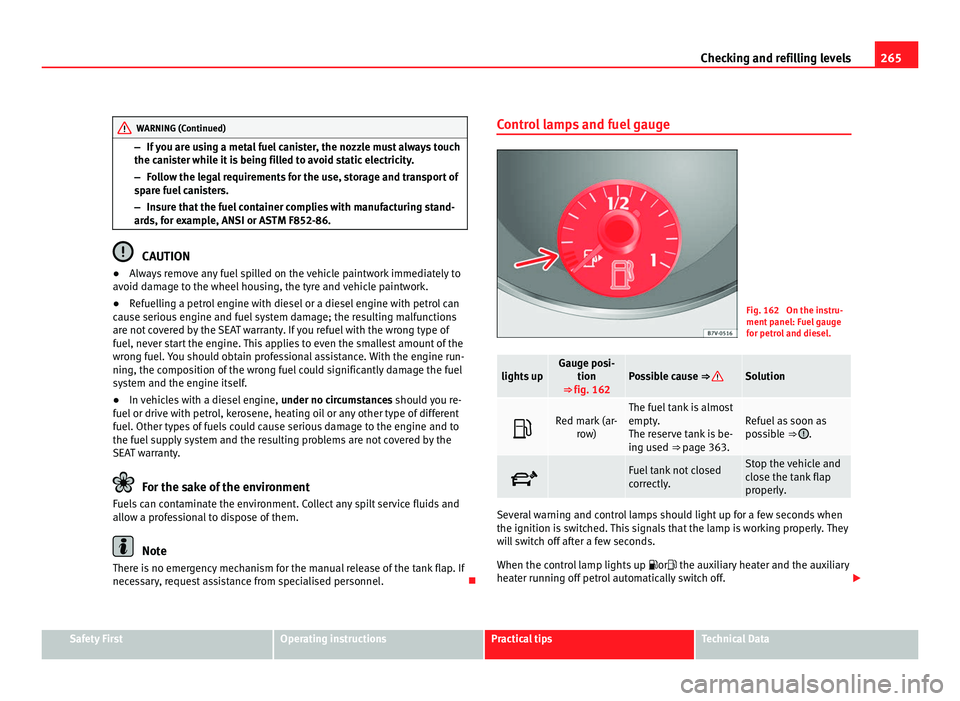
sary, request assistance from specialised personnel. Control lamps and fuel gauge
Fig. 162 On the instru-
ment p
anel: F
uel gauge
for petrol and diesel. lights up Gauge posi-
tion
⇒ fig. 162 Possible cause ⇒ Solution
Red mark (ar-
row) The fuel tank is almost
empty.
The r
e
serve tank is be-
ing used ⇒ page 363. Refuel as soon as
pos
s
ible ⇒ .
Fuel tank not closed
corr
ectly
. Stop the vehicle and
clo
se the t
ank flap
properly. Several warning and control lamps should light up for a few seconds when
the ignition is
sw
itched. This signals that the lamp is working properly. They
will switch off after a few seconds.
When the control lamp lights up or the auxiliary heater and the auxiliary
heater running off petrol automatically switch off. Safety First Operating instructions Practical tips Technical Data
Page 269 of 385
267
Checking and refilling levels
Closing the tank cap
● Screw on the tank cap clockwise until it you hear it click into position.
● Press the tank flap until you hear it click into place. The tank flap must
be flush w ith the body
contour. WARNING
Do not continue refilling once the fuel nozzle has switched itself off. The
fuel t
ank may be filled too much. As a result, fuel may spurt out and spill.
This could lead to a fire, explosion and severe injuries. CAUTION
● Always remove any fuel spilled on the vehicle paintwork immediately to
av oid d
amage to the wheel housing, the tyre and vehicle paintwork. For the sake of the environment
Spilt fuel can contaminate the environment.
Refilling precautions Information on bulb replacement
⇒ pag
e 326.
Checklist
Never work on the engine or in the engine compartment if you are not famil-
iar with the operations to be carried out, the applicable safety standards
and especially if you do not have the instruments, liquids and tools neces-
sary ⇒ page 275, Working in the engine compartment! Have the work car-
ried out by a Technical Service if you are uncertain. Check the following reg-
ularly, preferably when you refuel:
● Windscreen washer fluid level ⇒ pag
e 105
● Engine oil level ⇒ pag
e 279 ●
Engine coolant level ⇒ p
age 283
● Brake fluid level ⇒ pag
e 183
● Tyre pressure ⇒ pag
e 293
● Vehicle lighting required to guarantee road safety:
Indicator
s
Side lights, dipped headlights and full beam headlights
Rear lights
Brake lights
Rear fog light ⇒ page 97 WARNING
Not following the checklist prepared for your own safety could lead to ac-
cident s
and severe injuries.
● Always follow the check list and perform the necessary operations.
Fuel Introduction You will find a factory-fitted sticker containing information on the type of
fuel
f
or your vehicle on the inside of the fuel tank flap.
Additional information and warnings:
● ⇒ Bookl et Maintenance Programme
● R
efuelling ⇒ pag e 264
● En
gine and exhaust system management ⇒ page 228
–
–
–
–
–
Safety First Operating instructions Practical tips Technical Data