headlight Seat Alhambra 2011 User Guide
[x] Cancel search | Manufacturer: SEAT, Model Year: 2011, Model line: Alhambra, Model: Seat Alhambra 2011Pages: 385, PDF Size: 7.92 MB
Page 111 of 385
109
Lights and visibility
● Damaged blades: A film of water on the damaged blades may lengthen
the activ ation time, r
educe the washing intervals or result in a fast and con-
tinuous wipe.
● Insects: insects on the sensor may trigger the windscreen wipers.
● Salt on roads: in winter, salt spread in the roads may cause an extra
long wipe when the w
indscreen is almost dry.
● Dirt: dry dust, wax, coating on glass (Lotus effect) or traces of detergent
(car wa
sh) may reduce the effectiveness of the rain sensor or make it react
more slowly, later or not at all.
● Cracked windscreen: the impact of a stone will trigger a single wipe cy-
cle w
ith the rain sensor on. Next the rain sensor detects the reduction in the
sensitive surface area and adapts accordingly. The behaviour of the sensor
will vary with the size of the damage caused by the stone. WARNING
The rain sensor may not detect enough rain to switch on the wipers.
● If necessary, switch on the wipers manually when water on the wind-
sc r
een obstructs visibility. Note
● Clean the sensitive surface of the rain sensor regularly and check the
b l
ades for damage ⇒ fig. 70 (arrow).
● To remove wax and coatings, we recommend a window cleaner contain-
ing alcoho
l. Checking and topping up the windscreen washer bottle
with wat
er Fig. 71 In the engine
comp
ar
tment: wind-
screen washer bottle top.
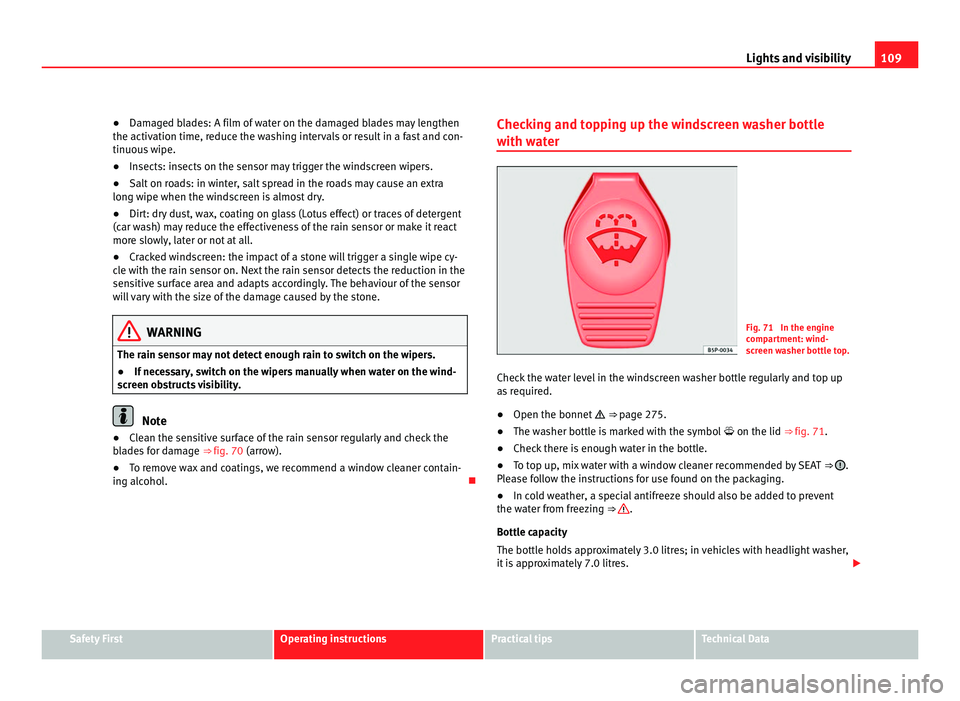
Check the water level in the windscreen washer bottle regularly and top up
as r
equired.
● Open the bonnet ⇒ pag
e 275.
● The washer bottle is marked with the symbol on the lid ⇒ fig. 71.
● Check there is enough water in the bottle.
● To top up, mix water with a window cleaner recommended by SEAT ⇒ .
Ple a
se follow the instructions for use found on the packaging.
● In cold weather, a special antifreeze should also be added to prevent
the water fr
om freezing ⇒ .
Bottle c ap
acity
The bottle holds approximately 3.0 litres; in vehicles with headlight washer,
it is approximately 7.0 litres. Safety First Operating instructions Practical tips Technical Data
Page 239 of 385
237
Trailer towing
For the sake of road safety, SEAT recommends using the maximum allowed
dra wb
ar load. The handling of the combined vehicle and trailer will be poor
if the drawbar load is too low.
The drawbar load increases the weight on the rear axle, reducing the vehicle
carrying capacity.
Gross combination weight
This figure refers to the combined weight of the loaded vehicle and loaded
trailer.
Loading the trailer
The combined vehicle and trailer must be balanced. Use the maximum
drawbar load authorised and do not overload the front or the rear of the
trailer:
● Distribute loads in the trailer so that heavy objects are as near to the
axle a
s possible or even above it.
● Correctly secure the trailer load.
Tyr
e pressure
Inflate the trailer tyres according to the manufacturer's instructions.
Inflate the towing vehicles tyres to the maximum ⇒ page 293.WARNING
Exceeding the maximum authorised axle load, drawbar load or the gross
comb in
ation weight of the towing vehicle and trailer could cause a seri-
ous accident with severe consequences.
● Never exceed the specifications.
● With the actual load on the front and rear axles, the maximum axle
load shou
ld never be exceeded. The weight on the front and rear should
never exceed the gross vehicle weight. WARNING
If the load moves, the stability and safety of the vehicle and trailer com-
bin ation w
ill be seriously affected and this could result in a serious acci-
dent.
● Always correctly load the trailer.
● Always secure loads correctly with suitable and undamaged attach-
ment rope or s
traps.
Driving with a trailer Adjusting the headlights
When to
w
ing a trailer, the front of the vehicle may rise and so the dipped
beam headlights may blind other drivers. Use the headlight range control to
lower the cone of light. If you do not have headlight range control, have the
headlights adjusted by a qualified dealership. Vehicles with high-intensity
discharge lamps adapt automatically and do not require adjustment.
Details of driving with a trailer
● If the trailer has an overru
n brake, apply the brakes gently at first and
then, firmly. This will prevent the jerking that can be caused by the trailer
wheels locking.
● As of the combined vehicle and trailer mass, braking distances will be
great
er.
● Select a low gear before driving down a steep hill to use the engine
brakin
g effect to slow down the vehicle. Otherwise, the braking system
could overheat and fail. Safety First Operating instructions Practical tips Technical Data
Page 245 of 385
243
Vehicle maintenance and cleaning
Washing the vehicle The longer substances such as insects, bird droppings, resinous tree sap,
ro
a
d dirt, industrial deposits, tar, soot or road salt and other aggressive ma-
terials remain on the vehicle, the more damage they do to the paintwork.
High temperatures (for instance due to strong sunlight) further intensify the
corrosive effect. The vehicle undercarriage should also be thoroughly wash-
ed at regular intervals.
Automatic car washes
Always observe the instructions provided at the automatic car wash. The
standard precautionary measures prior to entering the car wash should be
taken to avoid damage to the vehicle (close all windows, fold in exterior mir-
rors). If the vehicle is fitted with additional components (spoiler, roof-rack,
aerial...), check with the car wash supervisor whether these can enter the
car wash ⇒ .
The v ehic
le paintwork is so durable that the car can normally be washed
without problems in an automatic car washing tunnel. However, wear and
damage to the paintwork will depend on the type of car wash used. SEAT
recommends the use of car washed without brushes.
To remove traces of wax on windows and to prevent wiper blades from
scratching, please observe the following ⇒ page 245, Cleaning windows
and exterior mirrors.
Washing the car by hand
When washing the car by hand, use plenty of water to soften the dirt first,
and rinse off as well as possible.
Then clean the vehicle with a soft sponge, glove or brush using only slight
pressure. Start at the roof and work downwards. Special car shampoo
should only be used for very persistent dirt.
Rinse the sponge or glove thoroughly and often.
Wheels, sills and similar should be cleaned last. Use a second sponge for
this. WARNING
Sharp components on the vehicle may cause injury.
● Protect arms and hands from sharp edges when cleaning the vehicle
under c
arriage or the interior of the wheel hubs. WARNING
After the vehicle has been washed, the braking effect will be reduced
(and the brakin
g distance increased) due to moisture (and ice in winter)
on the brakes.
● Dry the brakes and remove ice by braking carefully. Ensure that you
are not end
angering other road-users or breaking traffic regulations in
the process. CAUTION
● The temperature of the water must not exceed +60°C (+140°F).
● To av
oid damage to the paintwork, do not wash the vehicle in full sun.
● Do not use rough sponges or similar which could damage the surface to
cle
an away the traces of insects.
● Never wipe the headlights with a dry cloth or sponge, always moisten
first
. It is best to use soapy water.
● Washing the vehicle in low temperatures: When washing the vehicle
with a hose, do not
direct water into the lock cylinders or the gaps around
the doors, tailgate, or sunroof. Locks and seals could freeze! CAUTION
To prevent damage to the vehicle, please observe the following before en-
terin g
an automatic car wash :
● Compare the distance between the vehicle wheels and the distance be-
tween the guide-rai
ls of the car wash to prevent damage to the wheels and
tyres! Safety First Operating instructions Practical tips Technical Data
Page 269 of 385
267
Checking and refilling levels
Closing the tank cap
● Screw on the tank cap clockwise until it you hear it click into position.
● Press the tank flap until you hear it click into place. The tank flap must
be flush w ith the body
contour. WARNING
Do not continue refilling once the fuel nozzle has switched itself off. The
fuel t
ank may be filled too much. As a result, fuel may spurt out and spill.
This could lead to a fire, explosion and severe injuries. CAUTION
● Always remove any fuel spilled on the vehicle paintwork immediately to
av oid d
amage to the wheel housing, the tyre and vehicle paintwork. For the sake of the environment
Spilt fuel can contaminate the environment.
Refilling precautions Information on bulb replacement
⇒ pag
e 326.
Checklist
Never work on the engine or in the engine compartment if you are not famil-
iar with the operations to be carried out, the applicable safety standards
and especially if you do not have the instruments, liquids and tools neces-
sary ⇒ page 275, Working in the engine compartment! Have the work car-
ried out by a Technical Service if you are uncertain. Check the following reg-
ularly, preferably when you refuel:
● Windscreen washer fluid level ⇒ pag
e 105
● Engine oil level ⇒ pag
e 279 ●
Engine coolant level ⇒ p
age 283
● Brake fluid level ⇒ pag
e 183
● Tyre pressure ⇒ pag
e 293
● Vehicle lighting required to guarantee road safety:
Indicator
s
Side lights, dipped headlights and full beam headlights
Rear lights
Brake lights
Rear fog light ⇒ page 97 WARNING
Not following the checklist prepared for your own safety could lead to ac-
cident s
and severe injuries.
● Always follow the check list and perform the necessary operations.
Fuel Introduction You will find a factory-fitted sticker containing information on the type of
fuel
f
or your vehicle on the inside of the fuel tank flap.
Additional information and warnings:
● ⇒ Bookl et Maintenance Programme
● R
efuelling ⇒ pag e 264
● En
gine and exhaust system management ⇒ page 228
–
–
–
–
–
Safety First Operating instructions Practical tips Technical Data
Page 329 of 385
327
If and when
Several warning and control lamps should light up for a few seconds when
the ignition is sw
itched. This signals that the lamp is working properly. They
will switch off after a few seconds.
Checking the bulbs of a trailer
For vehicles with the factory fitted trailer system, certain trailer lights are al-
so controlled if the socket is correctly connected.
A fault on a trailer turn indicator is indicated on the instrument panel by the
indicator blinking twice as fast ( or ) ⇒ page 95.
● General fault of all indicators on one side.
● Fault in one tail light (on some models, also the registration light).
● Fault in two brake lights. WARNING
If the warning lamps and messages are ignored, the vehicle may stall in
traffic, or m a
y cause accidents and severe injuries.
● Never ignore the warning lamps or text messages.
● Stop the vehicle safely as soon as possible. CAUTION
Failure to heed the warning lamps and text messages when they appear
ma y
result in faults in the vehicle. Note
A fault in the LED on the tail lights will not be indicated. However, if the fault
affects al
l the LEDs then this will be indicated by the indicator . Information for replacing bulbs Checklist
To r
ep
lace a bulb, carry out the following operations always in the order giv-
en ⇒ :
Park the
vehicle a safe distance from traffic and on suitable ground.
Connect the electronic parking brake ⇒ page 183.
Turn the light switch to position 0 ⇒ page 95.
Move the gear lever into the neutral position ⇒ page 95.
Automatic gearbox: Move selector lever to position P ⇒ page 174.
Stop the engine and remove the key from the ignition ⇒ page 170.
Manual gearbox: Select a gear ⇒ page 174.
Wait until all of the passenger compartment lights are turned off
⇒ page 95.
Allow the corresponding bulb to cool. Visually inspect fuses to see if any are blown ⇒ page 322.
Replace the bulb according to the instructions ⇒ . Bulbs should only
be rep l
aced by new identical models. Bulb information is displayed on
the bulb socket or on the bulb itself.
In general, never touch the bulb glass directly. The heat of the bulb
would cause the fingerprint to evaporate and condense on the reflector.
This will impair the brightness of the headlight.
Check if the new bulb is working. If the bulb is not working, it may not
have been correctly fitted, it could be damaged or the connector may
not be correctly connected.
Every time a bulb for the headlights is replaced, visit a specialised
workshop to check the headlights.
1.
2.
3.
4.
5.
6.
7.
8.
9.
10.
11.
12.
13.
14.
Safety First Operating instructions Practical tips Technical Data
Page 330 of 385
328
If and when WARNING
Failure to follow the checklist prepared for your own safety could lead to
acc ident
s and severe injuries.
● Always complete the operations given in the checklist and observe
the genera
l rules of safety. CAUTION
Always remove and fit headlights carefully to avoid damage to the paint-
work and other
vehicle parts.
To replace halogen headlight bulbs Fig. 203 In the engine
comp
ar
tment: Left-hand
side headlight lining. A dipped beam headlights,
B daytime lights and
C main beam headlights
and side light
s. Fig. 204 Left headlight
There is no need to remove the headlight to replace bulbs.
Comp l
ete operations only in the sequence given: fig. 203,
fig. 204 A B C
Indicators (small lamp
holder) Dipped beam head-
lights Daylight driving lights Main beam headlights Side lights
1. Always take the checklist into account and take the necessary actions
⇒ pag
e 327.2. Open the bonnet
⇒ page 275.
Page 331 of 385
329
If and when fig. 203,
fig. 204 A B C
Indicators (small lamp
holder) Dipped beam head-
lights Daylight driving lights Main beam headlights Side lights
3. Remove the rubber cover on the rear of the headlight.
4. Rotate the lamp holder
1 to the left all the way
and pu l
l it out back-
wards with the bulb. Rotate the lamp holder to the left all the way and
pul
l it out backwards with the bulb. Press the wire clip down-
war d
s and pull the lamp
holder 2 out with the
bu l
b. Pull the lamp holder
3 out backwards with the
bul
b. 5. Depending on the model, the bulb is removed directly from the lamp holder or it may need to be rotated and then removed.
6. Replace the faulty bulb by a new identical bulb.
7. Place the bulb holder in the headlight and rotate to the right all the way. Place the lamp holder in
the hea
dlight
and pull the
wire clip upwards until it
clicks into place. Place the lamp holder in
the hea dlight
and insert
completely. 8. Insert the rubber cover.
Note
The images show the left hand headlight from behind. The structure of the
right h and s
ide headlight is symmetric. Safety First Operating instructions Practical tips Technical Data
Page 332 of 385
330
If and when
To replace the xenon headlights bulb Fig. 205 In the engine
comp
ar
tment: Turn signal
cover. Fig. 206 Turn signal in-
dicat
or l
amp holder 1 and turning light
2 .
There is no need to remove the headlight to replace bulbs.
Comp l
ete operations only in the sequence given: Turn signal indicators
1 Turning lights
2 1. Always take the checklist into account and take the necessary ac-
tions ⇒
page 327. 2. Open the bonnet
⇒ page 275. 3. Rotate the cover ⇒
fig. 205 in the dir
ection of the arrow and remove
it. 4. Rotate the lamp holder
1 ⇒ fig. 206 to the left all the way
and p
u
ll it out backwards with
the bulb. Press the wire clip downwards
and pu
l
l the lamp holder 2 ⇒ fig. 206 out w
ith the b
ulb. 5. Depending on the model, the bulb is removed directly from the
lamp ho l
der or it may need to be rotated and then removed. 6. Replace the faulty bulb by a new identical bulb.
7. Place the bulb holder in the
hea
dlight
and rotate to the right
all the way. Place the lamp holder in the
hea
dlight
and pull the wire clip
upwards until it clicks into place. 8. Rotate the cover ⇒
fig. 205 in the op
posite direction to the arrow as
far as it will go. Always seek the help of a specialist when changing the Xenon dipped beam
and fu
l
l beam headlamps ⇒ in Introduction on page 326.
Note
The illustrations show the left hand headlight. The structure of the right
hand s ide he
adlight is symmetric.
Page 333 of 385
331
If and when
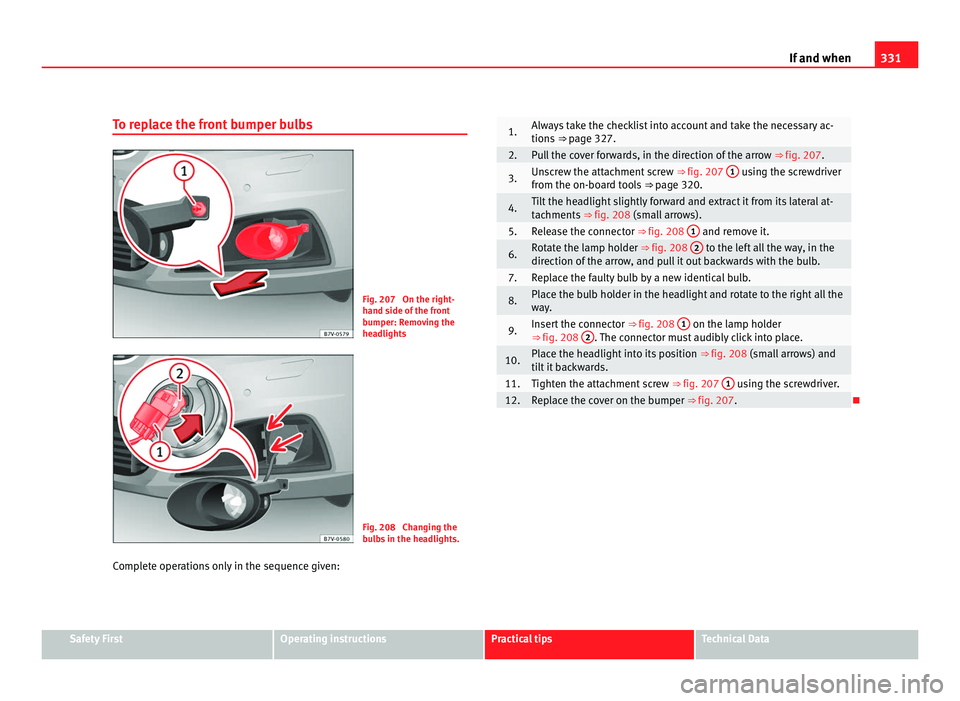
To replace the front bumper bulbs Fig. 207 On the right-
hand s
ide of
the front
bumper: Removing the
headlights Fig. 208 Changing the
bu
l
bs in the headlights.
Complete operations only in the sequence given: 1. Always take the checklist into account and take the necessary ac-
tions
⇒
page 327. 2. Pull the cover forwards, in the direction of the arrow
⇒ fig. 207. 3. Unscrew the attachment screw
⇒ fig. 207 1 using the screwdriver
from the on-bo ar
d tools ⇒ page 320. 4. Tilt the headlight slightly forward and extract it from its lateral at-
tac
hments
⇒ fig. 208 (small arrows). 5. Release the connector ⇒ fig. 208
1 and remove it.
6. Rotate the lamp holder ⇒ fig. 208
2 to the left all the way, in the
direction of the arr
ow, and pull it out backwards with the bulb. 7. Replace the faulty bulb by a new identical bulb.
8. Place the bulb holder in the headlight and rotate to the right all the
wa
y
. 9. Insert the connector
⇒ fig. 208 1 on the lamp holder
⇒ fig. 208 2 . The connector must audibly click into place.
10. Place the headlight into its position
⇒ fig. 208 (small
arrows) and
tilt it backwards. 11. Tighten the attachment screw
⇒ fig. 207 1 using the screwdriver.
12. Replace the cover on the bumper ⇒ fig. 207.
Safety First Operating instructions Practical tips Technical Data
Page 341 of 385
339
If and when
The vehicles should not touch. Otherwise, current may be allowed to flow
when the pos itiv
e poles are connected.
Connect the clamps so they have good metal-to-metal contact with the ter-
minals.
If the engine fails to start straight-away, switch off the starter after about 10
seconds and try again after about a minute.
Complete operations only in the sequence given.
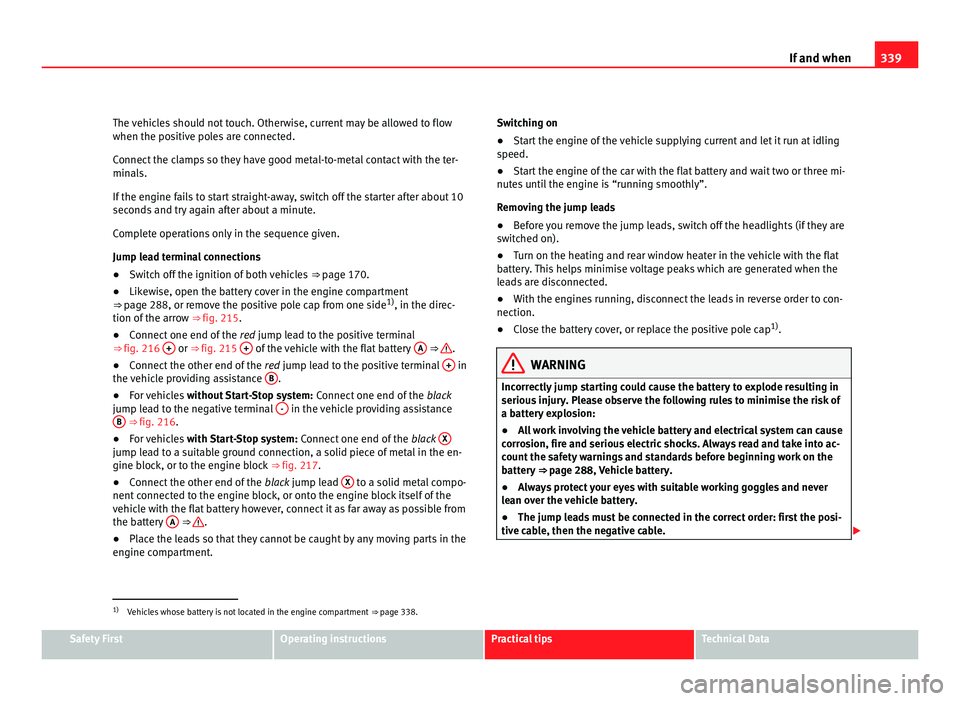
Jump lead terminal connections
● Switch off the ignition of both vehicles ⇒ page 170.
● Lik
ewise, open the battery cover in the engine compartment
⇒ pag
e 288, or remove the positive pole cap from one side 1)
, in the direc-
tion of the arrow ⇒ fig. 215.
● Connect one end of the red
jump lead to the positive terminal
⇒ fig. 216 + or ⇒
fig. 215 + of the vehicle with the flat battery
A ⇒ .
● Connect the other end of the red
jump lead to the positive terminal + in
the v ehic
le providing assistance B .
● For vehicles without
Start-Stop system: Connect one end of the black
jump lead to the negative terminal - in the vehicle providing assistance
B ⇒ fig. 216.
● For vehicles with St
art-Stop system: Connect one end of the black X jump lead to a suitable ground connection, a solid piece of metal in the en-
gine bloc
k, or t
o the engine block ⇒ fig. 217.
● Connect the other end of the black
jump lead X to a solid metal compo-
nent c onnect
ed to the engine block, or onto the engine block itself of the
vehicle with the flat battery however, connect it as far away as possible from
the battery A ⇒ .
● Place the leads so that they cannot be caught by any moving parts in the
engine c omp
artment. Switching on
●
Start the engine of the vehicle supplying current and let it run at idling
speed.
● Star
t the engine of the car with the flat battery and wait two or three mi-
nutes
until the engine is “running smoothly”.
Removing the jump leads
● Before you remove the jump leads, switch off the headlights (if they are
switc
hed on).
● Turn on the heating and rear window heater in the vehicle with the flat
batter
y. This helps minimise voltage peaks which are generated when the
leads are disconnected.
● With the engines running, disconnect the leads in reverse order to con-
nection.
● Close the battery cover, or replace the positive pole cap 1)
. WARNING
Incorrectly jump starting could cause the battery to explode resulting in
serious injur
y. Please observe the following rules to minimise the risk of
a battery explosion:
● All work involving the vehicle battery and electrical system can cause
corro
sion, fire and serious electric shocks. Always read and take into ac-
count the safety warnings and standards before beginning work on the
battery ⇒ page 288, Vehicle battery.
● Always protect your eyes with suitable working goggles and never
lean o
ver the vehicle battery.
● The jump leads must be connected in the correct order: first the posi-
tive cab
le, then the negative cable. 1)
Vehicles whose battery is not located in the engine compartment ⇒ page 338. Safety First Operating instructions Practical tips Technical Data