warning Seat Alhambra 2011 Owner's Manual
[x] Cancel search | Manufacturer: SEAT, Model Year: 2011, Model line: Alhambra, Model: Seat Alhambra 2011Pages: 385, PDF Size: 7.92 MB
Page 264 of 385
262
Accessories, parts replacement and modifications
electromagnetic radiation transmitted and the risk to human health. It will
also impr o
ve the quality of the connection.
If the phone is used inside the vehicle without the hands-free system, it will
not be securely fastened and will not be connected to the exterior aerial of
the vehicle telephone. Nor will the telephone charge if it is not on the sup-
port. In addition, some calls may break off and the quality of the connection
will be affected.
Mobile phones should only be used inside the vehicle if they are connected
to a hands-free system with an exterior aerial. WARNING
If the mobile phone is not securely fastened in position, it could be sent
flyin g ar
ound the vehicle in the event of sharp braking, sudden manoeu-
vres or accident, causing injury.
● While driving, mobile phones must be securely fastened in position,
outside the r
adius of action of the airbags, or safely stowed away. WARNING
When using a mobile phone without a connection to an exterior aerial,
the max imum permitt
ed levels of electromagnetic radiation may be ex-
ceeded. This is also the case if the aerial has not been correctly installed.
● A minimum of 20 centimetres should be kept between mobile phone
aerial
s and artificial pacemakers, as mobile telephones may affect the
working of pacemakers.
● Do not carry a mobile phone in your breast pocket directly over the
pacem
aker when the phone is switched on.
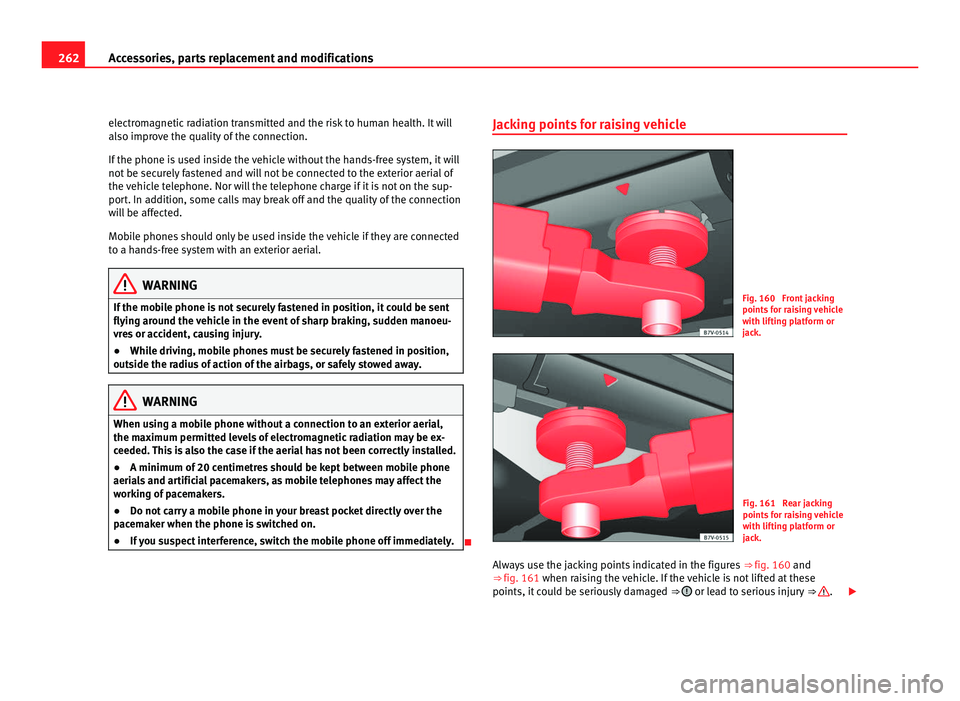
● If you suspect interference, switch the mobile phone off immediately. Jacking points for raising vehicle
Fig. 160 Front jacking
points
f
or raising vehicle
with lifting platform or
jack. Fig. 161 Rear jacking
points
f
or raising vehicle
with lifting platform or
jack.
Always use the jacking points indicated in the figures ⇒ fig. 160 and
⇒ fig. 161 when rais
ing the vehicle. If the vehicle is not lifted at these
points, it could be seriously damaged ⇒ or lead to serious injury
⇒ .
Page 265 of 385
263
Accessories, parts replacement and modifications
The vehicle should not be lifted using lifting platforms with lift pads con-
tainin g fluid.
When r
aising a vehicle using a platform or jack, a series of precautionary
measures are required. Never raise the vehicle with a lifting platform or jack
unless you have received training in how to do so and know how to lift the
vehicle safely.
Notes on raising the vehicle with a jack ⇒ page 309. WARNING
The improper use of the lifting platform or the jack when raising the vehi-
cl e m
ay result in accidents or serious injury.
● Before raising the vehicle, please observe the manufacturer's instruc-
tions f
or the platform or jack, and the legal requirements, where applica-
ble.
● There should not be anyone inside the vehicle when it is being raised
or once it i
s in the air.
● Only use the jacking points indicated in the figures ⇒ fig. 160
and
⇒ fig. 161 when raising the vehicle. If the vehicle is not lifted at the indi-
cated points, it may fall from the platform while the engine or gearbox is
being dismounted, for example.
● The jacking points should be centrally aligned and firmly positioned
on the platf
orm support plates.
● Never start the engine when the vehicle is raised! The vehicle may fall
from the pl
atform due to the engine vibrations.
● If it is necessary to work underneath the vehicle while it is raised, you
should c
heck that the supporting stands have an adequate load capacity.
● Never climb onto the lifting platform.
● Always make sure that the weight of the vehicle does not exceed the
lifting p
latform load capacity. CAUTION
● Never raise the vehicle at the engine oil sump, the gearbox or the rear or
fr ont
axles.
● Always use an intermediat
e rubber support to prevent damage to the
vehicle underbody. Check that the arms of the lifting platform are able to
move with obstruction.
● The arms should not come into contact with the side running boards or
other parts
of the vehicle. Safety First Operating instructions Practical tips Technical Data
Page 266 of 385
264
Checking and refilling levels
Checking and refilling levels
Filling the tank
Introduction The fuel tank flap is on the rear right of the vehicle.
Addition
a
l information and warnings:
● Fuel ⇒ page 267
● Selectiv
e Catalytic Reduction (AdBlue) ⇒ page 271
● W
orking in the engine compartment ⇒ page 275WARNING
Refuelling or handling fuel carelessly can cause an explosion or fire re-
su ltin
g in serious burns and injuries.
● Always make sure that you correctly close the fuel cap to avoid evap-
oration and fuel
spillage.
● Fuels are highly explosive and inflammable substances that can
cause seriou
s burns and injuries.
● Fuel could leak out or be spilt if the engine is not switched off or if the
fill
er fuel nozzle is not fully inserted into the tank filler neck when refuel-
ling. This could lead to a fire, explosion and severe injuries.
● When refuelling, turn off the engine, the auxiliary heating
(⇒ page 163) and t
urn off the ignition for safety reasons.
● Always turn off mobile telephones, radio apparatus and other radio
wave emittin
g equipment before refuelling. Electromagnetic waves could
cause sparks and lead to a fire. WARNING (Continued)
● Nev er enter the vehicle while refuelling. If it is absolutely necessary
t o ent
er the vehicle, close the door and touch a metal surface before
touching the filler nozzle again. This will prevent the generation of static
electricity. Sparks could cause a fire when refuelling.
● Never handle fuel close to open flames, sparks or objects with slow
combu
stion (e.g. cigarettes).
● Avoid static electricity and electro-magnetic radiation when refuel-
ling.
● Ob
serve the safety regulations of the service station.
● Never spill fuel on the vehicle or in the luggage compartment. WARNING
For safety reasons, SEAT does not recommend carrying a spare fuel canis-
ter in the v
ehicle. Fuel could be spilled and catch fire, above all in case of
an accident and this applies to a full container as well as empty contain-
ers. This could lead to explosions, fires and injuries.
● Observe the following if you exceptionally have to carry fuel in a can-
ist
er:
– Never place a fuel container to fill it inside the vehicle or on the ve-
hicle, f
or example, in the luggage compartment or on the tailgate.
Filling in these circumstances could create an electrostatic charge
and spark that could ignite fuel fumes.
– Always place the canister on the ground to fill it.
– Insert the fuel nozzle into the mouth of the canister as far as possi-
ble.
Page 267 of 385
265
Checking and refilling levels WARNING (Continued)
– If you are using a metal fuel canister, the nozzle must always touch
the c ani
s
ter while it is being filled to avoid static electricity.
– Follow the legal requirements for the use, storage and transport of
spar
e fuel canisters.
– Insure that the fuel container complies with manufacturing stand-
ards, f
or example, ANSI or ASTM F852-86. CAUTION
● Always remove any fuel spilled on the vehicle paintwork immediately to
av oid d
amage to the wheel housing, the tyre and vehicle paintwork.
● Refuelling a petrol engine with diesel or a diesel engine with petrol can
cause seriou
s engine and fuel system damage; the resulting malfunctions
are not covered by the SEAT warranty. If you refuel with the wrong type of
fuel, never start the engine. This applies to even the smallest amount of the
wrong fuel. You should obtain professional assistance. With the engine run-
ning, the composition of the wrong fuel could significantly damage the fuel
system and the engine itself.
● In vehicles with a diesel engine, under no cir
cumstances should you re-
fuel or drive with petrol, kerosene, heating oil or any other type of different
fuel. Other types of fuels could cause serious damage to the engine and to
the fuel supply system and the resulting problems are not covered by the
SEAT warranty. For the sake of the environment
Fuels can contaminate the environment. Collect any spilt service fluids and
allo w a pr
ofessional to dispose of them. Note
There is no emergency mechanism for the manual release of the tank flap. If
nece s
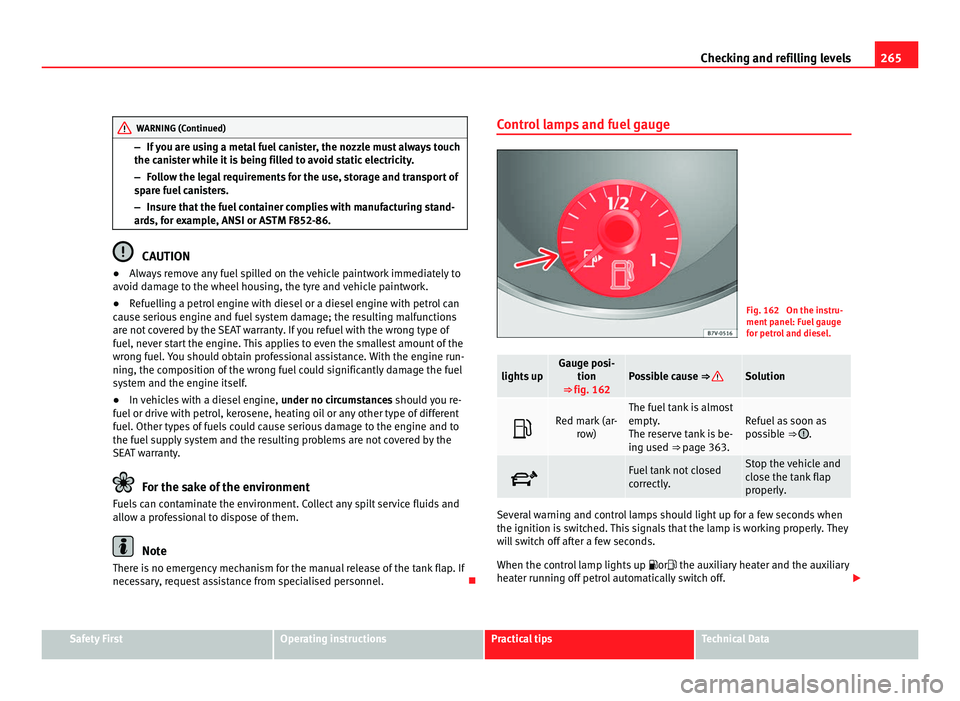
sary, request assistance from specialised personnel. Control lamps and fuel gauge
Fig. 162 On the instru-
ment p
anel: F
uel gauge
for petrol and diesel. lights up Gauge posi-
tion
⇒ fig. 162 Possible cause ⇒ Solution
Red mark (ar-
row) The fuel tank is almost
empty.
The r
e
serve tank is be-
ing used ⇒ page 363. Refuel as soon as
pos
s
ible ⇒ .
Fuel tank not closed
corr
ectly
. Stop the vehicle and
clo
se the t
ank flap
properly. Several warning and control lamps should light up for a few seconds when
the ignition is
sw
itched. This signals that the lamp is working properly. They
will switch off after a few seconds.
When the control lamp lights up or the auxiliary heater and the auxiliary
heater running off petrol automatically switch off. Safety First Operating instructions Practical tips Technical Data
Page 268 of 385
266
Checking and refilling levels WARNING
Driving with insufficient fuel reserve could result in the vehicle breaking
down in tr affic
and a serious accident.
● If the fuel level is too low then the fuel supply to the engine can be-
come irre
gular especially on slopes.
● If the engine “is choked” or stalls due to lack of or irregularity of the
fuel s
upply, the power steering as well as all of the driver assistance sys-
tems including braking assistance will stop working.
● Always refuel when there is only one quarter of the fuel tank left to
avoid runnin
g out of fuel. CAUTION
● Always pay attention to any lit lamps and to the corresponding descrip-
tion s
and instructions to avoid damage to the vehicle.
● Never run the tank completely dry. An irregular fuel supply may lead to
ignition faults
and unburnt fuel could enter the exhaust system. This could
damage the catalytic converter filter or the diesel particulate filter! Note
The arrow next to the fuel pump symbol on the instrument panel ⇒ fig. 162
indic
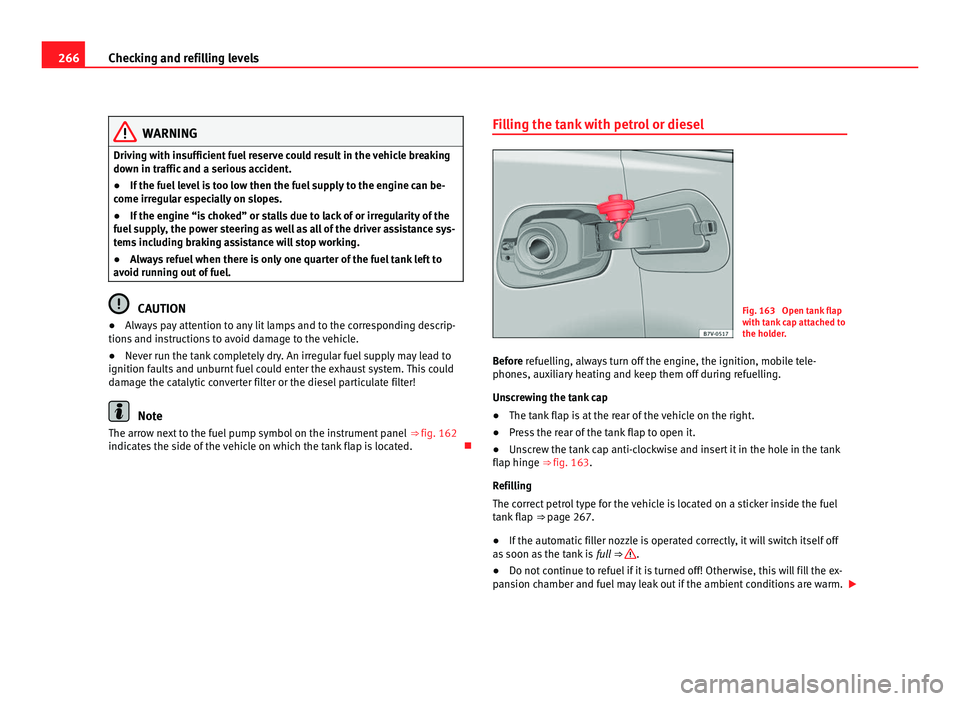
ates the side of the vehicle on which the tank flap is located. Filling the tank with petrol or diesel Fig. 163 Open tank flap
with t
ank
cap attached to
the holder.
Before refuelling, always turn off the engine, the ignition, mobile tele- phones, aux
iliary heating and keep them off during refuelling.
Unscrewing the tank cap
● The tank flap is at the rear of the vehicle on the right.
● Press the rear of the tank flap to open it.
● Unscrew the tank cap anti-clockwise and insert it in the hole in the tank
flap hing
e ⇒ fig. 163.
Refilling
The correct petrol type for the vehicle is located on a sticker inside the fuel
tank flap ⇒ page 267.
● If the automatic filler nozzle is operated correctly, it will switch itself off
as soon a
s the tank is full ⇒ .
● Do not continue to refuel if it is turned off! Otherwise, this will fill the ex-
pan s
ion chamber and fuel may leak out if the ambient conditions are warm.
Page 269 of 385
267
Checking and refilling levels
Closing the tank cap
● Screw on the tank cap clockwise until it you hear it click into position.
● Press the tank flap until you hear it click into place. The tank flap must
be flush w ith the body
contour. WARNING
Do not continue refilling once the fuel nozzle has switched itself off. The
fuel t
ank may be filled too much. As a result, fuel may spurt out and spill.
This could lead to a fire, explosion and severe injuries. CAUTION
● Always remove any fuel spilled on the vehicle paintwork immediately to
av oid d
amage to the wheel housing, the tyre and vehicle paintwork. For the sake of the environment
Spilt fuel can contaminate the environment.
Refilling precautions Information on bulb replacement
⇒ pag
e 326.
Checklist
Never work on the engine or in the engine compartment if you are not famil-
iar with the operations to be carried out, the applicable safety standards
and especially if you do not have the instruments, liquids and tools neces-
sary ⇒ page 275, Working in the engine compartment! Have the work car-
ried out by a Technical Service if you are uncertain. Check the following reg-
ularly, preferably when you refuel:
● Windscreen washer fluid level ⇒ pag
e 105
● Engine oil level ⇒ pag
e 279 ●
Engine coolant level ⇒ p
age 283
● Brake fluid level ⇒ pag
e 183
● Tyre pressure ⇒ pag
e 293
● Vehicle lighting required to guarantee road safety:
Indicator
s
Side lights, dipped headlights and full beam headlights
Rear lights
Brake lights
Rear fog light ⇒ page 97 WARNING
Not following the checklist prepared for your own safety could lead to ac-
cident s
and severe injuries.
● Always follow the check list and perform the necessary operations.
Fuel Introduction You will find a factory-fitted sticker containing information on the type of
fuel
f
or your vehicle on the inside of the fuel tank flap.
Additional information and warnings:
● ⇒ Bookl et Maintenance Programme
● R
efuelling ⇒ pag e 264
● En
gine and exhaust system management ⇒ page 228
–
–
–
–
–
Safety First Operating instructions Practical tips Technical Data
Page 270 of 385
268
Checking and refilling levels WARNING
Refuelling or handling fuel carelessly can cause an explosion or fire re-
su ltin
g in serious burns and injuries.
● Fuel is a highly explosive, easily flammable substance.
● Observe current safety instructions and local regulations concerning
the handling of
fuel.
Types of fuel The type of fuel to use when refilling will depend on the vehicle's engine.
You w
i
ll find a factory-fitted sticker containing information on the type of
fuel for your vehicle on the inside of the fuel tank flap.
SEAT recommends the use of sulphur-free or low sulphur fuel to reduce con-
sumption and prevent engine damage. Possible types of
fuel Alternative names Further information
91
a)
RON Normal petrol, normal unlea-
ded petro
l ⇒ page 26895
a)
RON Premium unleaded petrol (95
RON)
98
a)
RON Premium unleaded petrol (98
RON)
Diesel ⇒ page 269
a)
RON = Regulation Octane Number Petrol Petrol types
Vehic
l
es with petrol engines must refuel using unleaded petrol according to
European norm EN 228 ⇒ .
Petr o
l types are categorised according to their octane number (e.g. 91, 95,
98 or 99 RON (RON = “Research Octane Number”). You may use petrol with
a high octane number than the one recommended for your engine. Howev-
er, this has no advantage in terms of fuel consumption and engine power.
SEAT recommends refuelling with a low sulphur content or sulphur-free pet-
rol to reduce petrol consumption for petrol engines.
Petrol additives
The quality of the fuel influences running behaviour, performance and serv-
ice life of the engine. For this reason, you should use good quality petrol
containing a mixture of additives. These additives will help to prevent corro-
sion, keep the fuel system clean and prevent deposits from building up in
the engine.
If good quality petrol with additives is not available or engine problems
arise, the necessary additives must be added when refuelling.
Not all petrol additives have been shown to be effective. The use of unsuita-
ble petrol additives could damage the engine. These additives are available
from qualified workshops, who will inform you of their application. CAUTION
● Only use fuel with an octane rating that is in line with the norm EN 228,
other w
ise significant damage could be caused to the engine and fuel sys-
tem. Furthermore, it could lead to a loss of performance with the conse-
quent engine fault.
● The use of unsuitable petrol additives could damage the engine.
Page 271 of 385
269
Checking and refilling levels
● If, in exceptional circumstances, petrol with a lower octane rating to that
r ec
ommended is used, only use moderate engine speeds and a light throt-
tle. Avoid using full throttle and overloading the engine. Otherwise you may
damage the engine. Fill up with fuel of a suitable octane rating as soon as
possible.
● Do not refuel if the filler indicates that the fuel contains metal. LRP (lead
repl
acement petrol) fuels also contain high concentrations of metal addi-
tives. This could damage the engine!
● Just one full tank of leaded fuel would seriously impair the efficiency of
the catalytic
converter and could damage it.
Diesel Diesel fuel
Diesel
f
uel must correspond to European standard EN 590 (In Germany,
EN 590 or DIN 51628).
The use of diesel fuel with a high sulphur percentage requires shorter serv-
ice intervals ⇒ Booklet Maintenance Programme ⇒ . Your qualified work-
shop wi l
l be able to tell you which countries have diesel with a high sulphur
content.
Do not mix fuel additives (thinners, or similar additives) with diesel fuel.
Winter-grade diesel
When using “summer-grade diesel fuel”, difficulties may be experienced at
temperatures below 0°C (+32°F) because the fuel thickens due to wax sepa-
ration. For this reason, “winter-grade diesel fuel” is available in Germany,
for example, during the cold months. It can be used at temperatures as low
as -20°C (-4°F).
In countries with different climatic conditions, other types of diesel fuel are
available that are suitable to local temperatures. SEAT qualified workshops
and filling stations in the country concerned will inform you on the type of
diesel fuels available. A cold diesel engine makes more noise during winter temperatures than
summer temper
atures. Furthermore, the exhaust fumes may turn slightly
bluish while the engine is heating. The quantity of exhaust gases will de-
pend on the outside temperature.
Filter pre-heater
Vehicles with a diesel engine are fitted with a fuel filter pre-heater. This en-
sures that the fuel system remains operational to approx. -24°C (-11.2°F),
provided you use winter-grade diesel which is safe to -15°C (+5°F).
However, if the fuel has waxed to such an extent that the engine will not
start at temperatures of under -24°C (-11.2°F), simply place the vehicle in a
warm garage or workshop for a while to heat up.
Auxiliary heater
Vehicles with a diesel engine may be fitted with an auxiliary heater. The
heater runs off the fuel from the fuel tank. On doing so, smells and steam
may be noticed outside the vehicle for a short period. This is normal and it
is not an indication of a fault in the vehicle.
Whenever there is little fuel in the tank (reserve), the auxiliary heater auto-
matically switches off. WARNING
Never use start boosters. An aerosol start booster could explode or cause
a sud den ri
se in engine speed leading to engine damage and serious in-
jury. Safety First Operating instructions Practical tips Technical Data
Page 273 of 385
271
Checking and refilling levels
Selective Catalytic Reduction* (AdBlue)
Introduction The AdBlue fill level must be checked when the vehicle is being serviced
⇒ Bookl
et
Maintenance Programme.
Additional information and warnings:
● Luggage compartment ⇒ p
age 125
● Fuel ⇒ page 267
● Wheels
and tyres ⇒ pag
e 293
● Accessories, parts replacement, repairs and modifications ⇒ page 257WARNING
If the AdBlue fill level is too low, the vehicle may not restart after switch-
ing the ignition off .
The emergency start or jump start will not be possi-
ble either!
● Top up with AdBlue at the latest 1000 km or 600 miles before it runs
out.
● Do not a
llow the AdBlue to run too low. WARNING
AdBlue is an irritant, corrosive liquid that can cause injuries if it touches
the skin, ey e
s or respiratory organs.
● If AdBlue get in contact with eyes and skin, rinse for at least 15 mi-
nutes
with plenty of water and seek medical help.
● If the AdBlue is swallowed, wash the mouth with plenty of water for at
lea
st 15 minutes. Do not try to provoke vomiting unless recommended by
a Doctor. Seek medical advice immediately. CAUTION
AdBlue damages surfaces such as painted vehicle parts, plastic, items of
clothin g and c
arpets. Spilt AdBlue should be removed as quickly as possi-
ble using a damp cloth and plenty of cold water.
● If the AdBlue has crystallised, remove with warm water and a sponge.
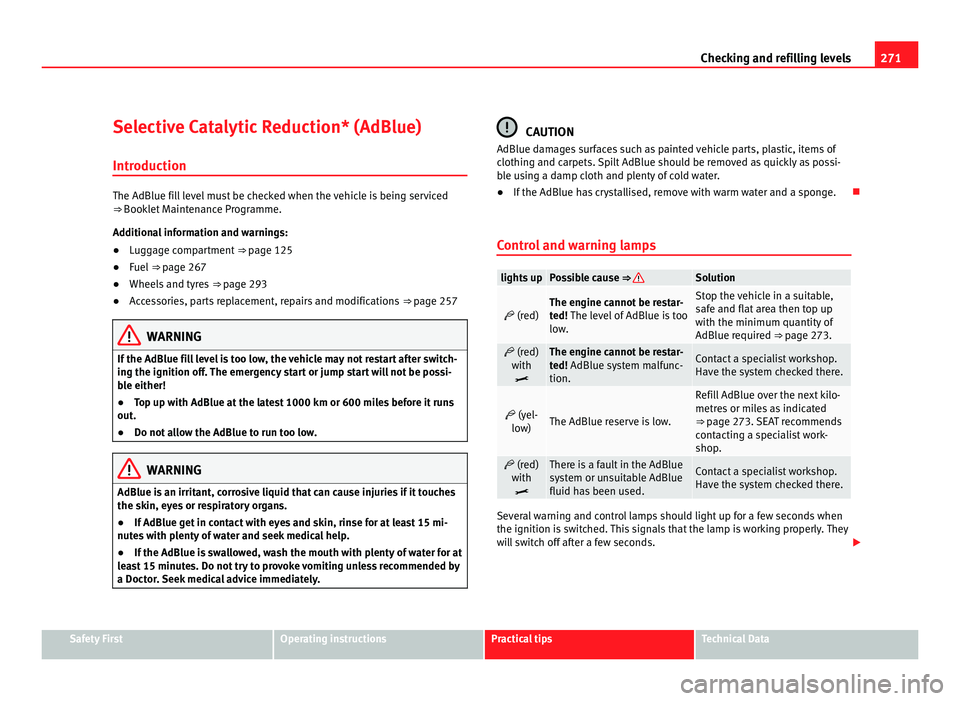
Control and warning lamps lights up Possible cause ⇒ Solution
(red) The engine cannot be restar-
ted!
The l
evel of AdBlue is too
low. Stop the vehicle in a suitable,
saf
e and fl
at area then top up
with the minimum quantity of
AdBlue required ⇒ page 273. (red)
with
The engine cannot be restar-
ted!
AdBlue sy
stem malfunc-
tion. Contact a specialist workshop.
Have the sy
s
tem checked there.
(yel-
lo w) The AdBlue reserve is low. Refill AdBlue over the next kilo-
metre
s
or miles as indicated
⇒ page 273. SEAT recommends
contacting a specialist work-
shop. (red)
with
There is a fault in the AdBlue
sys
t
em or unsuitable AdBlue
fluid has been used. Contact a specialist workshop.
Have the sy
s
tem checked there. Several warning and control lamps should light up for a few seconds when
the ignition is
sw
itched. This signals that the lamp is working properly. They
will switch off after a few seconds. Safety First Operating instructions Practical tips Technical Data
Page 274 of 385
272
Checking and refilling levels WARNING
If the warning lamps and messages are ignored, the vehicle may stall in
traffic, or m a
y cause accidents and severe injuries.
● Never ignore the warning lamps or text messages.
● Stop the vehicle safely as soon as possible. CAUTION
Failure to heed the warning lamps and text messages when they appear
ma y
result in faults in the vehicle.
Information on AdBlue In vehicles with Selective Catalytic Reduction, a special urea solution (AdBl-
ue) is
inj
ected into the exhaust gas system in front of the catalytic converter
to reduce nitrogen oxide emissions.
The consumption of AdBlue depends on individual driving style, the tem-
perature at which the system operates and the outside temperature where
the vehicle is driven. AdBlue is kept in an independent tank in the vehicle and should be refilled
at an offici
al supplier. The AdBlue tank holds about 17 litres.
A message will be displayed on the instrument panel around 2400 km be-
fore the next service to indicate that AdBlue must be refilled ⇒ page 273. If
you ignore this message and do not refill, you will be unable to start the en-
gine afterwards ⇒ page 271.
SEAT recommends contacting a specialist workshop. If you are unable to
visit a qualified specialist workshop, you should temporarily refill with a
minimum of 10.0 litres of AdBlue. Only refill using AdBlue expressly ap-
proved by SEAT.
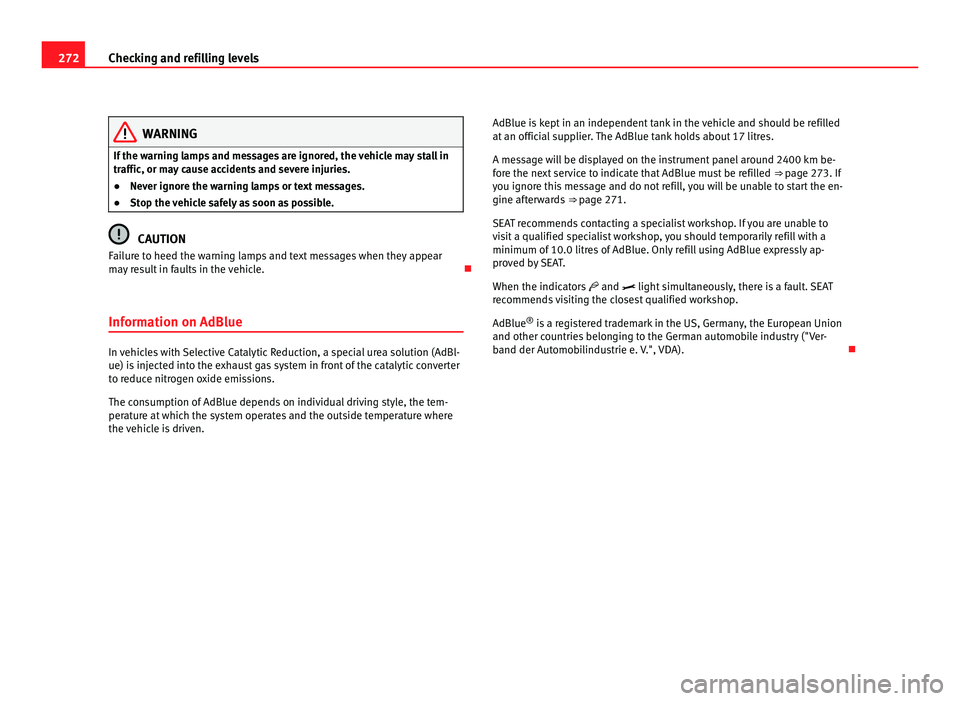
When the indicators and light simultaneously, there is a fault. SEAT
recommends visiting the closest qualified workshop.
AdBlue ®
is a registered trademark in the US, Germany, the European Union
and other countries belonging to the German automobile industry ("Ver-
band der Automobilindustrie e. V.", VDA).