warning light Seat Alhambra 2011 Owner's Guide
[x] Cancel search | Manufacturer: SEAT, Model Year: 2011, Model line: Alhambra, Model: Seat Alhambra 2011Pages: 385, PDF Size: 7.92 MB
Page 103 of 385
101
Lights and visibility
For those vehicles in which it is not possible to adjust the headlights from
the menu, adhe s
ive strips are used to cover certain parts of the headlamp
cover or the headlights may be adjusted at a specialised workshop. For fur-
ther information, please refer to a specialised workshop. SEAT recommends
visiting a Technical Service. Note
Use of the Touris
t light option and the adhesives on the headlights is only
allowed if they are to be used for a short period of time. To modify the direc-
tion of the headlights permanently, please take the vehicle to a specialised
workshop. SEAT recommends visiting a Technical Service.
“Coming home” and “Leaving home” function (guidance
lights)C omin
g HomeThe “Coming home” function should be switched on manually. However the
“Le
av
ing home” function is automatically controlled by a photo sensor. “Coming Home” Necessary operations
To switch sys-
tem on: – Switch off the ignition.
– Briefly fl
a
sh the headlights for approximately one sec-
ond ⇒ page 96.
The “Coming home” lighting comes on when the driver's
door is opened. The delay in switching off the headlights
is counted from when the last door or tailgate is closed. The system
swit
c
hes off: – Automatically at the end of the delay period.
– Autom
atic
ally, if 30 seconds after coming on, a vehicle
door or tailgate remains open.
– If the light switch is turned to position .
– If the ignition is switched on. “Leaving home” Necessary operations
To switch sys-
tem on: – Unlock the vehicle when the light switch is in position
and the phot
o sensor detects darkness. The system
swit
c
hes off: – Automatically, at the end of the delay period.
– When the
v
ehicle is locked.
– When the light switch is turned to position .
– When the ignition is switched on. Lighting around the exterior mirrors
The lighting ar
ou
nd the exterior mirrors illuminates the door area on enter-
ing and leaving the vehicles. It comes on when the vehicle is unlocked,
when the vehicle door is opened and when the “Coming home” or “Leaving
home” function is switched on. If the equipment includes the light sensor,
the lighting around the exterior mirrors only comes when it is dark. Note
● The time tak en f
or the headlights to go off can be changed in the Lights
& Visibility menu and the function can be switched on or off ⇒ page 62.
● When the “Coming home” function is on, if the vehicle door is opened
there is
no audible warning signal to advise that the light is still on. Safety First Operating instructions Practical tips Technical Data
Page 104 of 385
102
Lights and visibility
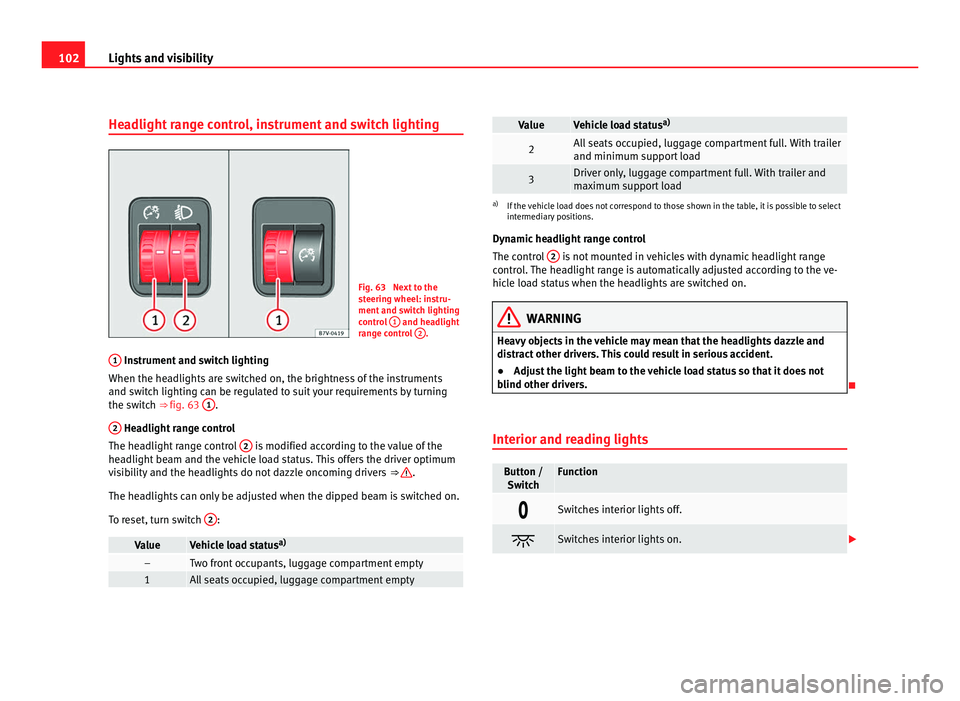
Headlight range control, instrument and switch lighting Fig. 63 Next to the
st
eerin
g wheel: instru-
ment and switch lighting
control 1 and headlight
ran g
e control 2 .
1 Instrument and switch lighting
When the hea dlights
are switched on, the brightness of the instruments
and switch lighting can be regulated to suit your requirements by turning
the switch ⇒ fig. 63 1 .
2 Headlight range control
The hea dlight
range control 2 is modified according to the value of the
hea dlight
beam and the vehicle load status. This offers the driver optimum
visibility and the headlights do not dazzle oncoming drivers ⇒ .
The hea dlights
can only be adjusted when the dipped beam is switched on.
To reset, turn switch 2 :
Value Vehicle load status
a) – Two front occupants, luggage compartment empty
1 All seats occupied, luggage compartment empty Value Vehicle load status
a) 2 All seats occupied, luggage compartment full. With trailer
and minimum sup
por
t load 3 Driver only, luggage compartment full. With trailer and
max
imum s
upport load a)
If the vehicle load does not correspond to those shown in the table, it is possible to select
intermedi ar
y positions.
Dynamic headlight range control
The control 2 is not mounted in vehicles with dynamic headlight range
contr o
l. The headlight range is automatically adjusted according to the ve-
hicle load status when the headlights are switched on. WARNING
Heavy objects in the vehicle may mean that the headlights dazzle and
dis tr
act other drivers. This could result in serious accident.
● Adjust the light beam to the vehicle load status so that it does not
blind other driver
s.
Interior and reading lights Button /
Swit c
h Function
Switches interior lights off.
Switches interior lights on.
Page 105 of 385
103
Lights and visibility Button /
Swit c
h Function
Switches door contact control on (central position).
The interior lights
c
ome on automatically when the vehicle is
unlocked, a door is opened or the key is removed from the ig-
nition.
The lights go off a few seconds after all the doors are closed,
the vehicle is locked or the ignition is switched on. Turning the reading light on and off
Storage and luggage compartment lighting
When the glov
e bo
x and the tailgate are opened and closed, a light auto-
matically switches on or off.
Background lighting
The background lighting in the front covering of the ceiling lights up the
controls on the central console from above when the side or dipped lights
are on.
In addition, the lever on the door moulding can also be illuminated. Note
The reading lights go out when the vehicle is locked, or a few minutes after
the key i
s removed from the ignition. This prevents the battery from dis-
charging. Sun blind
Introduction WARNING
Sun visors and sun blinds may reduce visibility when open.
● Always roll or fold sun blinds and visors away when not in use.
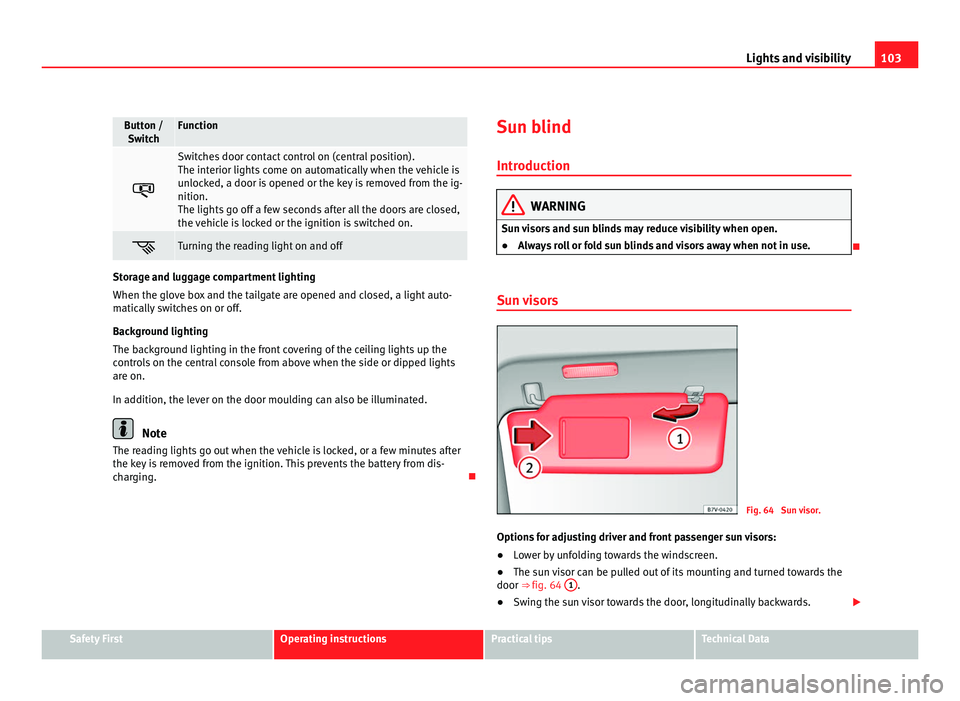
Sun visors Fig. 64 Sun visor.
Options for adjusting driver and front passenger sun visors:
● Lower by unfolding towards the windscreen.
● The sun visor can be pulled out of its mounting and turned towards the
door ⇒ fig. 64 1 .
● Swing the sun visor towards the door, longitudinally backwards. Safety First Operating instructions Practical tips Technical Data
Page 107 of 385
105
Lights and visibility
Windscreen wiper and washer
Introduction Additional information and warnings:
●
Recirculation of air conditioning air ⇒ p age 155
● Working in the engine compartment ⇒ page 275
● C
aring for and cleaning the vehicle exterior ⇒ page 242WARNING
Water from the windscreen washer water bottle may freeze on the wind-
sc r
een if it does not contain enough anti-freeze, reducing forward visibili-
ty.
● In winter, ensure the windscreen washer contains enough anti-freeze.
● In cold conditions, you should not use the wash / wipe system unless
you hav
e warmed the windscreen with the ventilation system. The anti-
freeze could freeze on the windscreen and reduce visibility. WARNING
Worn or dirty wiper blades reduce visibility and increase the risk of acci-
dent and seriou s
injury.
● Always replace damaged or worn blades or blades which do not clean
the winds
creen correctly. CAUTION
In icy conditions, always check that the wiper blades are not frozen to the
gla s
s before using the wipers for the first time. In cold weather, it may help
to leave the vehicle parked with the wipers in service position ⇒ page 107. Control lamp lights up Possible cause Solution
Windscreen wiper fluid level
too lo
w Top up the windscreen wiper
bottle a
s
soon as possible
⇒ page 109. Several warning and control lamps should light up for a few seconds when
the ignition is
sw
itched. This signals that the lamp is working properly. They
will switch off after a few seconds. CAUTION
Failure to heed the warning lamps and text messages when they appear
ma y
result in faults in the vehicle. Safety First Operating instructions Practical tips Technical Data
Page 111 of 385
109
Lights and visibility
● Damaged blades: A film of water on the damaged blades may lengthen
the activ ation time, r
educe the washing intervals or result in a fast and con-
tinuous wipe.
● Insects: insects on the sensor may trigger the windscreen wipers.
● Salt on roads: in winter, salt spread in the roads may cause an extra
long wipe when the w
indscreen is almost dry.
● Dirt: dry dust, wax, coating on glass (Lotus effect) or traces of detergent
(car wa
sh) may reduce the effectiveness of the rain sensor or make it react
more slowly, later or not at all.
● Cracked windscreen: the impact of a stone will trigger a single wipe cy-
cle w
ith the rain sensor on. Next the rain sensor detects the reduction in the
sensitive surface area and adapts accordingly. The behaviour of the sensor
will vary with the size of the damage caused by the stone. WARNING
The rain sensor may not detect enough rain to switch on the wipers.
● If necessary, switch on the wipers manually when water on the wind-
sc r
een obstructs visibility. Note
● Clean the sensitive surface of the rain sensor regularly and check the
b l
ades for damage ⇒ fig. 70 (arrow).
● To remove wax and coatings, we recommend a window cleaner contain-
ing alcoho
l. Checking and topping up the windscreen washer bottle
with wat
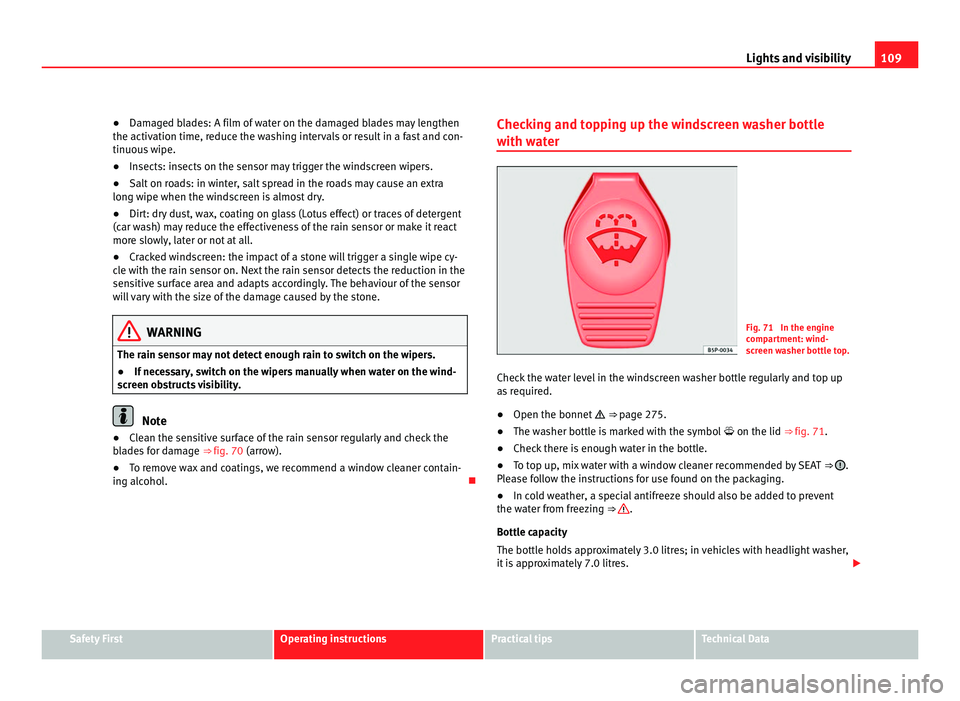
er Fig. 71 In the engine
comp
ar
tment: wind-
screen washer bottle top.
Check the water level in the windscreen washer bottle regularly and top up
as r
equired.
● Open the bonnet ⇒ pag
e 275.
● The washer bottle is marked with the symbol on the lid ⇒ fig. 71.
● Check there is enough water in the bottle.
● To top up, mix water with a window cleaner recommended by SEAT ⇒ .
Ple a
se follow the instructions for use found on the packaging.
● In cold weather, a special antifreeze should also be added to prevent
the water fr
om freezing ⇒ .
Bottle c ap
acity
The bottle holds approximately 3.0 litres; in vehicles with headlight washer,
it is approximately 7.0 litres. Safety First Operating instructions Practical tips Technical Data
Page 112 of 385
110
Lights and visibility WARNING
Never mix an unsuitable antifreeze or other similar products with the
wind s
creen washer water. A greasy layer may be formed on the wind-
screen which will impair visibility.
● Use clean water with a window cleaner recommended by SEAT.
● If necessary, add a suitable antifreeze to the water bottle. CAUTION
● Do not mix cleaning products recommended by SEAT with other prod-
ucts. Thi
s could lead to flocculation and may block the windscreen washer
jets.
● When topping up service fluids, make absolutely certain that you fill the
fluids int
o the correct reservoirs. Failure to observe this point will result in
serious malfunctions and engine damage!
Rear vision mirror
Intr oduction Additional information and warnings:
●
Personal convenience settings in the SEAT information system
⇒ pag
e 62
● Se
at memory ⇒ page 117
● Ch
anging gear ⇒ page 174
● Br
aking, stopping and parking ⇒ page 183 WARNING
The automatic anti-dazzle rear vision mirror contains an electrolytic fluid
which m a
y leak if the mirror is broken. This fluid can cause irritation to
the skin, eyes and respiratory organs.
● The electrolytic fluid may cause irritation to the skin, eyes and respi-
rator
y organs, particularly in individuals suffering from asthma or other
illnesses. Make sure that adequate quantities of fresh air enter and leave
the vehicle if it is not possible to open all the doors and windows.
● If the electrolytic fluid comes into contact with eyes or skin, wash the
area f
or at least 15 minutes with plenty of water, and seek medical ad-
vice.
● If the electrolytic fluid comes into contact with shoes or clothing,
wash the ar
ea for at least 15 minutes with plenty of water. Wash shoes
and clothing before wearing them again.
● If the electrolytic fluid is swallowed, wash the mouth with plenty of
water f
or at least 15 minutes. Do not try to provoke vomiting unless rec-
ommended by a Doctor. Seek medical advice immediately. CAUTION
If an automatic anti-dazzle rear vision mirror is broken, the electrolytic fluid
ma y
leak out. This fluid attacks plastic surfaces. Therefore, it should be
cleaned as fast as possible with a damp sponge or similar.
Page 113 of 385
111
Lights and visibility
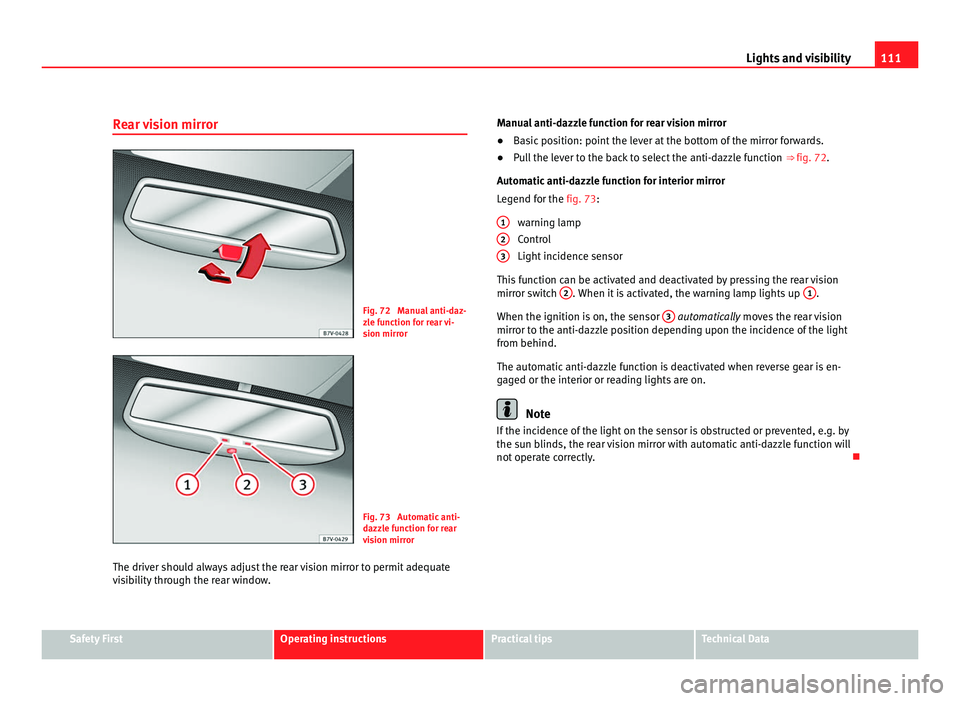
Rear vision mirror Fig. 72 Manual anti-daz-
zl
e f
unction for rear vi-
sion mirror Fig. 73 Automatic anti-
dazz
l
e function for rear
vision mirror
The driver should always adjust the rear vision mirror to permit adequate
vis
ibility through the rear window. Manual anti-dazzle function for rear vision mirror
●
Basic position: point the lever at the bottom of the mirror forwards.
● Pull the lever to the back to select the anti-dazzle function ⇒ fig. 72.
Automatic
anti-dazzle function for interior mirror
Legend for the fig. 73:
warning lamp
Control
Light incidence sensor
This function can be activated and deactivated by pressing the rear vision
mirror switch 2 . When it is activated, the warning lamp lights up
1 .
When the ignition is on, the sen
sor 3 automatically moves the rear vision
mirr or t
o the anti-dazzle position depending upon the incidence of the light
from behind.
The automatic anti-dazzle function is deactivated when reverse gear is en-
gaged or the interior or reading lights are on. Note
If the incidence of the light on the sensor is obstructed or prevented, e.g. by
the su n b
linds, the rear vision mirror with automatic anti-dazzle function will
not operate correctly.
1 2
3
Safety First Operating instructions Practical tips Technical Data
Page 115 of 385
113
Lights and visibility WARNING
Fold and unfold the exterior mirror, taking care to avoid injuries.
● Only fold or unfold the exterior mirror when there is no-one in the way
of the mirr or
.
● When moving the mirror, take care not to trap fingers between the
mirror and the mirror br
acket. WARNING
Failure to correctly estimate the distance of the vehicle behind could lead
to serious
accident.
● Rear-view convex or aspheric mirrors increase the field of vision, how-
ever ob
jects appear smaller and further away in the mirrors.
● The use of these mirrors to estimate the distance to the next vehicle
when chan
ging lane is imprecise and could result in serious accident.
● If possible, use the rear vision mirror to estimate distances to vehi-
cle
s behind you or in other circumstances.
● Make sure that the rear visibility is adequate. CAUTION
● Before entering a car wash, always ensure that the exterior mirrors are
c orr
ectly folded in.
● Electrically-folding exterior mirrors should not be folded and unfolded
mechanic
ally as this may damage the electrical operation. For the sake of the environment
The exterior mirror heating should be switched off when it is no longer nee-
ded. Otherw i
se, it is an unnecessary fuel waste. Note
● The exterior mirror heating initially heats up with a high power, after two
minut e
s the heat will depend upon the ambient temperature.
● In the event of faults, the electric exterior mirrors can be adjusted man-
ually b
y pressing the edge of the mirror surface. Safety First Operating instructions Practical tips Technical Data
Page 119 of 385
117
Seats and storage compartments
Seat functions Introduction Additional information and warnings
●
Adjust the seat position ⇒ page 10
● Se
at belts ⇒ page 21
● Airb
ag system ⇒ page 31
● Chi
ld seats (accessories) ⇒ page 39
● Int
egrated child seats ⇒ page 46
● Ext
erior mirrors ⇒ page 110
● L
uggage compartment ⇒ page 125 WARNING
Inappropriate use of the seat functions can cause severe injuries.
● Assume the proper sitting position before your trip and remain in it
throughout .
This also applies to the other occupants.
● Only adjust the seat position memory when the vehicle is stationary.
● Only switch the lumbar massage function on and off when the vehicle
is s
tationary.
● Keep hands, fingers, feet and other limbs away from the seat operat-
ing and adju
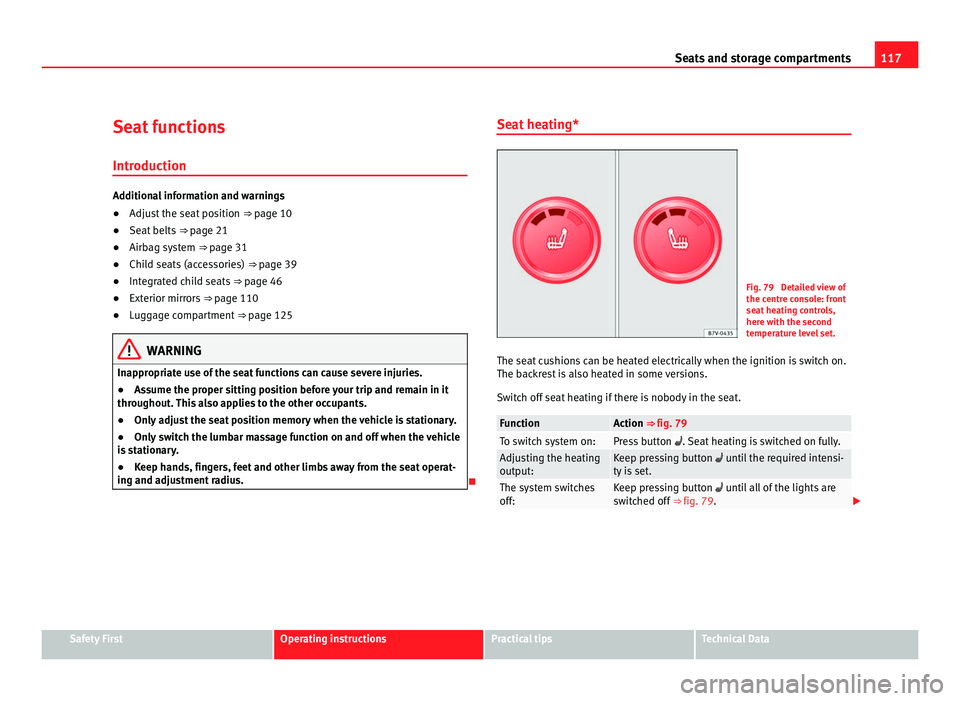
stment radius. Seat heating* Fig. 79 Detailed view of
the centr
e c
onsole: front
seat heating controls,
here with the second
temperature level set.
The seat cushions can be heated electrically when the ignition is switch on.
The back
rest is also heated in some versions.
Switch off seat heating if there is nobody in the seat. Function Action ⇒ fig. 79
To switch system on: Press button
. Seat
heating is switched on fully. Adjusting the heating
output: Keep pressing button unti
l
the required intensi-
ty is set. The system switches
off: Keep pressing button unti
l
all of the lights are
switched off ⇒ fig. 79. Safety First Operating instructions Practical tips Technical Data
Page 124 of 385
122
Seats and storage compartments
The front passenger's frontal airbag must be disconnected ⇒ page 31 if ob-
jects are being transported on the folded front passenger's seat.
Folding the backrest of the front passenger's seat
● Remove any objects from the front passenger's seat cushion ⇒ .
● Adjust the front passenger's seat to its lowest position ⇒ page 10.
● P
ush the head restraint down as far as it will go ⇒ page 10.
● Un
lock the backrest of the front passenger's seat in the direction of the
arrow
⇒ fig. 82 1 .
● Fold the backrest of the front passenger's seat forwards in the direction
of the arr o
w 2 until it is horizontal.
● The backrest of the front passenger's seat must engage safely in its fol-
ded pos ition.
Lif
ting the backrest of the front passenger seat
● Check that there are no objects or parts of the body in the hinge area.
● Lift the backrest of the front passenger's seat by first unlocking it again
⇒ fig. 83.
● Lift the backrest of the front passenger seat until it is upright. The back-
res
t must be engaged.
● The upright backrest of the front passenger's seat must safely engage. WARNING
Folding and lifting the backrest of the front passenger's seat uncontrolla-
bly or w
ithout paying attention may lead to severe injuries.
● Only fold and lift the backrest of the front passenger's seat when the
vehicl
e is stationary.
● While the backrest of the front passenger's seat is folded, the frontal
airbag mus
t remain disconnected and the PASSENGER AIRBAG OFF light
on. WARNING (Continued)
● Keep your hands, fingers, feet and other body parts out of the hinges
and the se at
locking mechanism when folding and unfolding.
● Mats or other objects can be caught in the hinges of the backrest of
the front p
assenger's seat. This could prevent the backrest from locking
safely when positioned upright.
● The upright backrest of the front passenger's seat must engage. If the
back
rest of the front passenger's seat is not locked, it may suddenly
move and cause severe injuries. WARNING
Seat anchors and hinges exposed when the backrest of the front pas-
seng er's
seat is folded may lead to severe injuries in the event of an acci-
dent or sudden braking.
● Never carry people or children on the front passenger's seat when the
back
rest is folded.
● When the backrest of the front passenger's seat is folded, only the
outer seat
behind the driver on the second row of seats may be occupied.
This also applies to children sitting in a child seat.